Thursday, August 31, 2006

Essay 1003


Nelly sells Pimp Juice, Tab sells an energy drink for the ladies. Makes perfect sense.

----------------------------------------------------------

For the past few weeks, MultiCultClassics has been paging through general market magazines in search of advertising featuring Black characters. The list included Elle, Vogue, Cosmopolitan, People, Us, Reader’s Digest, TV Guide, Redbook, Woman’s Day, Parents, Esquire, GQ, Vanity Fair, Time, Newsweek, Business Week, Forbes and many more.

Excluded were layouts with Black sports figures, celebrities and super models. Additionally, ads depicting group photos including token Black figures were nixed. The goal was to determine the true diversity of the general market adscape.

After poring over scores of publications — and literally thousands of pages of ads and editorial — barely a dozen messages were uncovered.

This week, MultiCultClassics presents the rare findings.

Essay 1002


MultiCultClassics Monologue Update…

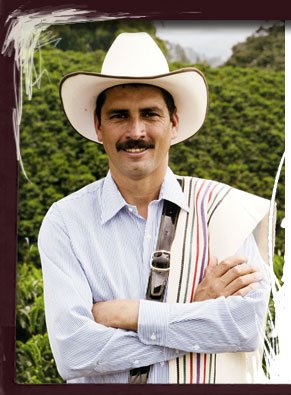
• Campbell’s Soup, Home Depot and Coca-Cola joined GM in declining to advertise during the upcoming “Survivor” season. However, the advertisers insist the decision is not based on the new format segregating competitors according to race. Hey, maybe CBS should consider segregating advertisers according to race. Stage a face-off between Juan Valdez, Aunt Jemima, Michelin Man and Benihana’s Rocky.

Essay 1001


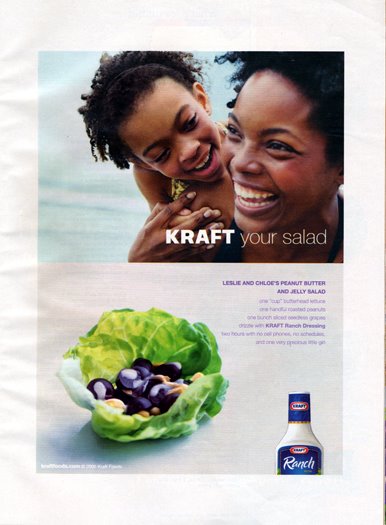
It’s always odd to see Kraft hawk healthy food in one ad, then turn around and hype Macaroni & Cheese in another. They’re the sleeeeaziest.

----------------------------------------------------------

For the past few weeks, MultiCultClassics has been paging through general market magazines in search of advertising featuring Black characters. The list included Elle, Vogue, Cosmopolitan, People, Us, Reader’s Digest, TV Guide, Redbook, Woman’s Day, Parents, Esquire, GQ, Vanity Fair, Time, Newsweek, Business Week, Forbes and many more.

Excluded were layouts with Black sports figures, celebrities and super models. Additionally, ads depicting group photos including token Black figures were nixed. The goal was to determine the true diversity of the general market adscape.

After poring over scores of publications — and literally thousands of pages of ads and editorial — barely a dozen messages were uncovered.

This week, MultiCultClassics presents the rare findings.

Essay 1000


A highly addictive MultiCultClassics Monologue…

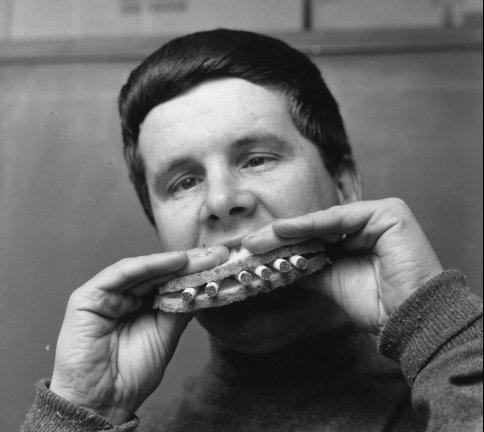
• Nicotine levels in cigarettes rose an average of about 10 percent between 1998 and 2004. Brands targeting youth and minorities saw the biggest increases. “The reports are stunning,” said the president of the Campaign for Tobacco-Free Kids. “What’s critical is the consistency of the increase, which leads to the conclusion that it has to have been conscious and deliberate. … The only way the companies were able to secretly increase nicotine levels without anyone knowing about it is because no federal agency regulates tobacco products.” They’re probably all too busy smoking.

• Britain now reports a new border problem of its own. However, it involves citizens emigrating at record numbers. Over 350,000 people leave the country annually, up nearly 50 percent from a decade ago. They’re probably coming to America, lured by the increased nicotine in cigarettes.

• General Motors has voted itself off the roster of sponsors for “Survivor.” However, the decision was not related to the show’s plan to segregate contestants based on race. The automaker is probably just uncomfortable being associated with the word “survivor,” given their continued inability to compete in the global marketplace.

• The University of Illinois’ Chief Illiniwek is heading into his final season, after which he’ll no longer serve as an official school mascot. It’s all in response to the NCAA’s rulings against symbols deemed “hostile” and “abusive.” Perhaps the Chief is now available to compete in the upcoming “Survivor” program.

Wednesday, August 30, 2006

Essay 999


If the woman in this ad were really smart, she’d march away from most of the sponsors’ products pronto.

----------------------------------------------------------

For the past few weeks, MultiCultClassics has been paging through general market magazines in search of advertising featuring Black characters. The list included Elle, Vogue, Cosmopolitan, People, Us, Reader’s Digest, TV Guide, Redbook, Woman’s Day, Parents, Esquire, GQ, Vanity Fair, Time, Newsweek, Business Week, Forbes and many more.

Excluded were layouts with Black sports figures, celebrities and super models. Additionally, ads depicting group photos including token Black figures were nixed. The goal was to determine the true diversity of the general market adscape.

After poring over scores of publications — and literally thousands of pages of ads and editorial — barely a dozen messages were uncovered.

This week, MultiCultClassics presents the rare findings.

Essay 998


For anyone curious, here’s a partial list of the publications perused in the search for Blacks in general market advertising:

AARP, Business Week, Child, Consumer Reports, Cosmopolitan, Details, The Economist, Elle, ESPN, Esquire, Fast Company, Forbes, Fortune, Glamour, Good Housekeeping, GQ, Harper’s Bazaar, House & Garden, InStyle, Ladies’ Home Journal, Maxim, Men’s Fitness, Money, New York, The New Yorker, Newsweek, Parents, People, Reader’s Digest, Redbook, Self, Seventeen, Smart Money, Sports Illustrated, Teen People, Time, Town & Country, U.S. News & World Report, Vanity Fair, Vogue, Woman’s Day and Wired.

Essay 997


Grandpa and shorty appear to be the only minorities in the stadium. Plus, they have to climb 52 steps to the nosebleed section.

----------------------------------------------------------

For the past few weeks, MultiCultClassics has been paging through general market magazines in search of advertising featuring Black characters. The list included Elle, Vogue, Cosmopolitan, People, Us, Reader’s Digest, TV Guide, Redbook, Woman’s Day, Parents, Esquire, GQ, Vanity Fair, Time, Newsweek, Business Week, Forbes and many more.

Excluded were layouts with Black sports figures, celebrities and super models. Additionally, ads depicting group photos including token Black figures were nixed. The goal was to determine the true diversity of the general market adscape.

After poring over scores of publications — and literally thousands of pages of ads and editorial — barely a dozen messages were uncovered.

This week, MultiCultClassics presents the rare findings.

Essay 996


Secret shows stylish, contemporary Black women — but still manages to let one sistah diss a Black man. Unless the secret is the boyfriend is not Black. Now that might make the advertiser sweat.

----------------------------------------------------------

For the past few weeks, MultiCultClassics has been paging through general market magazines in search of advertising featuring Black characters. The list included Elle, Vogue, Cosmopolitan, People, Us, Reader’s Digest, TV Guide, Redbook, Woman’s Day, Parents, Esquire, GQ, Vanity Fair, Time, Newsweek, Business Week, Forbes and many more.

Excluded were layouts with Black sports figures, celebrities and super models. Additionally, ads depicting group photos including token Black figures were nixed. The goal was to determine the true diversity of the general market adscape.

After poring over scores of publications — and literally thousands of pages of ads and editorial — barely a dozen messages were uncovered.

This week, MultiCultClassics presents the rare findings.

Essay 995


From Advertising Age’s Letters To The Editor…

-----------------------------------------------------------

Garfield Indian comment insensitive and offensive

RE: Bob Garfield’s “This time, Vegas tourism gets the credit it deserves” (AA, Aug. 21). “Vegas is overbuilt at the moment and facing stiff competition from the Indian tribes our forebears somehow forgot to slaughter.”

Deplorable at any time, but in this day and age, and from an authority on PR and media? If this is acceptable editorial, then close the doors now because: 1) The thinking world has left you behind and you are no longer relevant; 2) you are doing more harm than good by writing; 3) your staff is likely on drugs so powerful that they forgot what their jobs were, the responsibility to society they hold as journalists and how to write with an ounce of creative juice or wordsmithing talent!

Absolutely deplorable! I hope you get sued or something.

Fraser Rennie
Owner
York Durham Sign
Sutton West, Ontario, Canada

Essay 994


This Graco advertisement was probably created by simpletons.

----------------------------------------------------------

For the past few weeks, MultiCultClassics has been paging through general market magazines in search of advertising featuring Black characters. The list included Elle, Vogue, Cosmopolitan, People, Us, Reader’s Digest, TV Guide, Redbook, Woman’s Day, Parents, Esquire, GQ, Vanity Fair, Time, Newsweek, Business Week, Forbes and many more.

Excluded were layouts with Black sports figures, celebrities and super models. Additionally, ads depicting group photos including token Black figures were nixed. The goal was to determine the true diversity of the general market adscape.

After poring over scores of publications — and literally thousands of pages of ads and editorial — barely a dozen messages were uncovered.

This week, MultiCultClassics presents the rare findings.

Essay 993


Midweek madness in a MultiCultClassics Monologue…

• RadioShack fired 400 employees via email on Tuesday. The message included, “The work force reduction notification is currently in progress. Unfortunately your position is one that has been eliminated.” You’ve got questions, we’ve got answers — which will be sent electronically.

• The Rev. Calvin O. Butts III led a protest outside CBS headquarters in New York to complain about the decision to segregate contestants by race in the upcoming season of “Survivor.” Butts remarked, “I thought the writers and producers and executives of CBS are more intelligent and more creative than to have to pander to the worst in human nature.” The man clearly has not watched CBS sitcom “Three and a Half Men.”

• Andrew Young and Wal-Mart are facing a $7.5 million lawsuit for derogatory remarks Young made a few weeks ago (see Essay 951). A Korean grocery group in California filed the lawsuit, charging Young and the mega-retailer with libel. Young probably thought, “Hmmmm. $7.5 million will buy a week’s worth of groceries from a typical Korean convenience store.”

• The Wall Street Journal reported on a survey showing many Hurricane Katrina survivors have suffered a heavy psychological toll. According to the story, “Signs of distress ranged from frequent nightmares and irritability to debilitating anxiety and phobias.” Meanwhile, members of the Bush administration continue to sleep like babies.

Tuesday, August 29, 2006

Essay 992


In Splendaville, Black people wear strange outfits.

----------------------------------------------------------

For the past few weeks, MultiCultClassics has been paging through general market magazines in search of advertising featuring Black characters. The list included Elle, Vogue, Cosmopolitan, People, Us, Reader’s Digest, TV Guide, Redbook, Woman’s Day, Parents, Esquire, GQ, Vanity Fair, Time, Newsweek, Business Week, Forbes and many more.

Excluded were layouts with Black sports figures, celebrities and super models. Additionally, ads depicting group photos including token Black figures were nixed. The goal was to determine the true diversity of the general market adscape.

After poring over scores of publications — and literally thousands of pages of ads and editorial — barely a dozen messages were uncovered.

This week, MultiCultClassics presents the rare findings.

Essay 991


Rappers rule in a MultiCultClassics Monologue…

• Foxy Brown pleaded guilty to beating manicurists, receiving a sentence that includes three years probation and attendance at anger-management courses. However, minutes after the sentence, the rap diva tried to change her plea. “After conferring with my attorney, I’m not pleading guilty!” hollered Brown. “I’m innocent in this case! You were rushing me!” The judge refused Brown’s protests. Gee, Foxy can’t get to those anger-management courses too soon.

• Eminem teamed with Nike to create limited-edition kicks that will be auctioned for charity. Eight sets of the special shoes will go on the auction block. Bidding will start at 50 Cent.

Essay 990


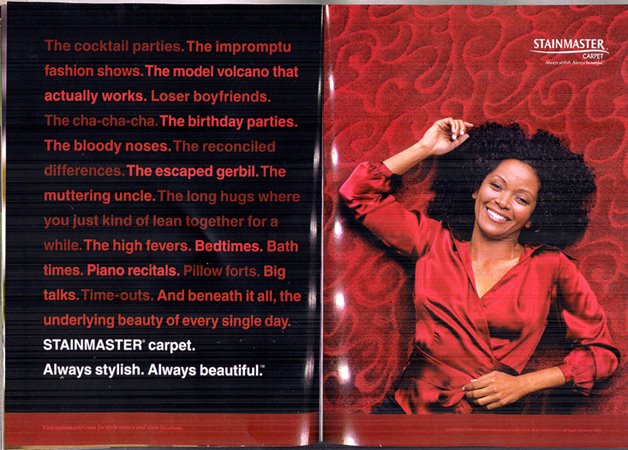
Um, why does having “Loser boyfriends” necessitate owning a Stainmaster carpet?

----------------------------------------------------------

For the past few weeks, MultiCultClassics has been paging through general market magazines in search of advertising featuring Black characters. The list included Elle, Vogue, Cosmopolitan, People, Us, Reader’s Digest, TV Guide, Redbook, Woman’s Day, Parents, Esquire, GQ, Vanity Fair, Time, Newsweek, Business Week, Forbes and many more.

Excluded were layouts with Black sports figures, celebrities and super models. Additionally, ads depicting group photos including token Black figures were nixed. The goal was to determine the true diversity of the general market adscape.

After poring over scores of publications — and literally thousands of pages of ads and editorial — barely a dozen messages were uncovered.

This week, MultiCultClassics presents the rare findings.

Essay 989


Cosby and me: Why we don’t see eye-to-eye

By Michael Eric Dyson, the author of “Is Bill Cosby Right?” and a professor of humanities at the University of Pennsylvania

For more than a year, I’ve been embroiled in a public debate with Bill Cosby about poor blacks. Cosby has been harshly critical of the poor, blaming them for their plight and arguing that personal responsibility is the key to their success. Cosby has dismissed both social forces and the legacy of racism in berating the poor for their many failures--bad parenting, bad language and bad behavior.

I have acknowledged that personal responsibility is an important element in all people’s flourishing. I have also argued that it is naive and irresponsible to ignore the negative impact of low wages, poor health care, persistent prejudice and conservative public policies on the lives of the black poor.

Recently, civil rights leader (and my dear friend) Rev. Jesse Jackson and columnist Clarence Page have entered the fray. I’m afraid they’ve both missed the point of my criticism of Cosby’s beliefs.

In an open letter, Jackson contends that my “attacks on Dr. Bill Cosby are too harsh,” and that it is “one thing to disagree with his views, but quite another to personally denigrate him to make one’s point.” Instead of saying how this is the case, Jackson defends Cosby by chronicling his generosity to Jackson’s organizations. Jackson also points to Cosby’s pioneering role in defeating racial stereotypes as a reason to admire him.

True, but that has little to do with the legitimacy of my criticism of Cosby’s stern rebuke to the poor. In the absence of any supporting evidence, it might appear that Jackson is arguing that the very act of my disagreeing with Cosby is to denigrate him. But that would mean that kowtowing to the rich and mighty had replaced the role of social criticism and, presumably, strong black leadership: to speak truth to power and defend the vulnerable.

Jackson is justly famous for doing both. Renowned scholar John Hope Franklin reminded him of it recently in a public forum. When Jackson asked Franklin about Cosby’s comments about poor black folk, Franklin said that too many influential blacks have been “co-opted by white people” and have “betrayed their own race.” Franklin urged Jackson to keep up his fight for the voiceless.

In a profile of Jackson by Don Terry in the Tribune Sunday magazine last year, Jackson said that while he agreed with much that Cosby had to say, he thought the comedian’s words were too harsh and lacked context. I agree with Jackson’s assessment, one that I think he should have repeated in his open letter to me. Jackson calls for a balanced approach to our problems: Black folk must exercise personal responsibility as we fight “institutional inequality and injustice.” I agree. But Cosby’s stark insistence on personal responsibility while slighting institutional impediments is a gross distortion of the situation of the black poor.

Jackson knows better. He has criticized others for holding such out-of-kilter views. He must summon the courage to confront Cosby.

Clarence Page’s arguments about my take on Cosby are rooted in celebrity worship more than persuasive reasoning. Page appears to have reneged on his journalistic duty to maintain at least the semblance of fairness, even for a columnist, when he gushes over a call from Cosby that includes saying hello to Page’s son, “scoring some rare cool points for me in the process.” Page’s “heart pounded” as he wondered what Cosby wanted with him.

Cosby wanted to complain about the media and me, especially my insistence that behavioral modification, while intrinsically appealing, would not clear the path to social prosperity for the poor. Page also took issue with me, saying that my argument is “wrong, dangerously wrong in the disrespect it pays to the value of good behavior,” and that many blacks could attest that it “beats drugs, crime, abuse, child neglect and other forms of destructive behavior.”

My beef, however, is not with behavior; it is with those who exaggerate its influence to sting the poor for their troubles while overlooking the unjust arrangements that reinforce their poverty, something that good behavior doesn’t have the power to remove. If it did, poor black folk who behaved well in slavery would have been freed.

Page insists that I “must be delighted” by all the controversy, since “overreaction helps book sales.” It helps stand-up gigs even more so, especially since they are largely subscribed by the same white audience Cosby refuses to publicly scorn or alienate.

Unlike his colorblind comedy, Cosby’s harsh criticisms of the poor are curiously segregated. That ought to leave Jackson and Page, champions of integration, more than a little dismayed. Unless, of course, Cosby gets another pass.

Monday, August 28, 2006

Essay 988


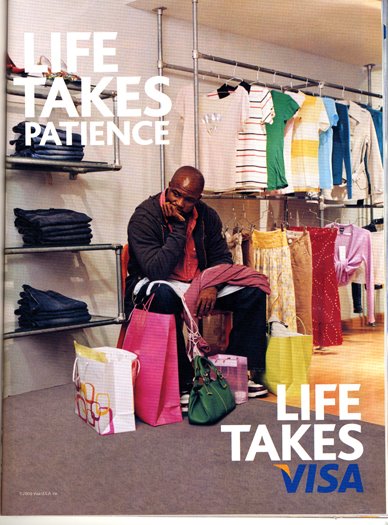
The guy in this Visa layout is probably waiting for his next advertising gig. Don’t hold your breath, man.

----------------------------------------------------------

For the past few weeks, MultiCultClassics has been paging through general market magazines in search of advertising featuring Black characters. The list included Elle, Vogue, Cosmopolitan, People, Us, Reader’s Digest, TV Guide, Redbook, Woman’s Day, Parents, Esquire, GQ, Vanity Fair, Time, Newsweek, Business Week, Forbes and many more.

Excluded were layouts with Black sports figures, celebrities and super models. Additionally, ads depicting group photos including token Black figures were nixed. The goal was to determine the true diversity of the general market adscape.

After poring over scores of publications — and literally thousands of pages of ads and editorial — barely a dozen messages were uncovered.

This week, MultiCultClassics presents the rare findings.

Essay 987


Political maneuvering in a MultiCultClassics Monologue…

• New Orleans Mayor Ray Nagin (pictured above) apologized for his comments regarding the World Trade Center site. “I wish I would have basically said that it was an undeveloped site, which it is,” said Nagin. Instead, when Nagin was originally pressed about the slow progress of rebuilding efforts in New Orleans, he remarked, “You guys in New York can’t get a hole in the ground fixed, and it’s five years later. So let’s be fair.” Nagin continues to have a problem with the hole in his head — his mouth, that is.

• The Christian Science Monitor reported that Black candidates for major political offices hit a record high in 2006. There are a whopping six men running for senator and governor positions — and three are Republicans. However, the story proclaimed, “Ultimately, all six of the African-Americans running for Senate and state house could end up losing.” Hey, let’s not call the elections before any votes have been cast. Click on the essay title above to read the full details.

Essay 986


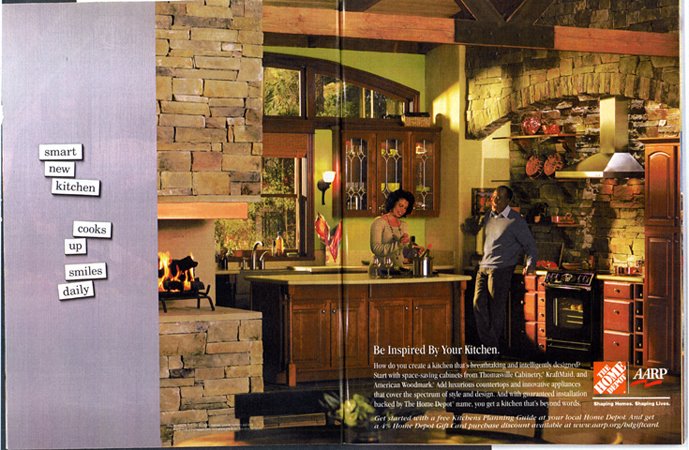
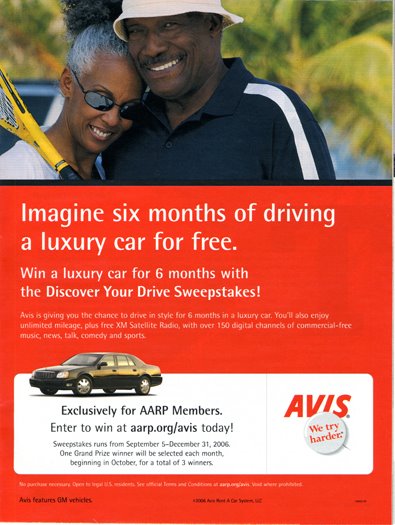
AARP must have a large number of Black members, because its magazine contained an unprecedented two ads with Black characters. Maybe they should change their name to African American Retired Persons.

----------------------------------------------------------

For the past few weeks, MultiCultClassics has been paging through general market magazines in search of advertising featuring Black characters. The list included Elle, Vogue, Cosmopolitan, People, Us, Reader’s Digest, TV Guide, Redbook, Woman’s Day, Parents, Esquire, GQ, Vanity Fair, Time, Newsweek, Business Week, Forbes and many more.

Excluded were layouts with Black sports figures, celebrities and super models. Additionally, ads depicting group photos including token Black figures were nixed. The goal was to determine the true diversity of the general market adscape.

After poring over scores of publications — and literally thousands of pages of ads and editorial — barely a dozen messages were uncovered.

This week, MultiCultClassics presents the rare findings.

Essay 985


From The Chicago Sun-Times...

--------------------------------------

Tough job awaits new Urban League chief

BY LAURA WASHINGTON

If there is a civil rights group as moribund as the Chicago Urban League, I haven’t seen it. Serendipitously, there will soon be a fresh breeze blowing through the league’s headquarters at 45th Street and Michigan Avenue.

On Oct. 1, Cheryle Jackson will take charge as the president and CEO. When I heard the 45-member Urban League board had chosen Jackson, I was more than pleasantly surprised. I was stunned -- that a board that has presided over this fading institution mustered the chutzpa to make such a nontraditional choice.

Jackson, 41, is the first black woman to head the league. The Chicago native comes from a three-year stint as deputy chief of staff and communications director for Gov. Blagojevich. Her portfolio also includes tours as a public relations executive for National Public Radio and top jobs in government and public affairs at Amtrak.

She also brings precious few, if any ties to the stodgy, risk-averse boardroom jockeys who have dominated the organization for decades.

At 90, the Chicago Urban League has betrayed its storied history. The agency has grown passive and lethargic. Many observers have predicted Jackson will bring a new approach to civil rights activism. I would settle for some leadership. The problem is not so much that the agency is out-of-date, it’s out of steam.

Jackson will replace James Compton, who ran the agency for 34 years. When Compton took over, Mayor Richard J. Daley was still in his reign and the Sears Tower was under construction. Compton can claim many accomplishments: He has built an institution with a $6 million-plus budget. Its focus on job enhancement, education and research has drawn generous support from the Chicago establishment.

Yet I say it’s nearly dead -- why? The list is long, but here’s one number to ponder: 500. That’s how many paying members the league claims, in a city with more than a million black residents. The league has a profile bordering on invisibility (Ralph Ellison could relate). Whenever there is a crisis or controversy in the black community, the league's voice has been muted at best. Black Chicago, in fact, black America, is awash in a boatload of problems. We don’t need any of the league’s repetitive studies to tell us what they are, and have been for decades: racism, single-woman-headed households, no jobs, too many black men in jail.

Jackson praises the league’s legacy and pledges to “build on the successes of Jim Compton.” Yet she acknowledges the challenges. While not ready to lay out her full agenda, she did share a few budding ideas. Noting that the Urban League has historically focused on job training and placement for the inner-city jobless, she is looking to focus on economic development and job creation. “We train people for jobs, but where are the jobs? How do you attract commerce?”

Jackson mentioned the “exciting” cultural and economic resurrection of neighborhoods like Bronzeville, then recalls a recent drive through Englewood, where she saw “a deep and abiding lack of economic infrastructure” and “blighted corner after blighted corner after blighted corner.”

So what’s next? She is looking at ways to attract commerce, real estate and business development, and capital investment. Her keywords: re-invention and innovation.

So what should a civil rights organization look like today? “Maybe it should look like a venture capital fund,” Jackson ponders. “Maybe it should look like Wall Street.”

Education and advocacy are also priorities, she says, along with building membership. Jackson says she’ll deploy her communications savvy to raise the league’s profile and “engage” its constituents. “We’re going to be out there on the streets,” she assures.

That’s a tough one. The marching days for civil rights organizations are misty memories. Much of the league’s budget comes from the largess of corporate and government sources. Business and government honchos, however, aren’t keen on controversy and critiques, especially when they’re paying the bills. Jackson will have to ramp up the membership to give her backup when it’s time to take on a hot topic or sacred cow.

Black folks can’t afford to work in a vacuum. The league must devise programming that builds alliances with other urban constituencies like Latinos, gays and lesbians and women to tackle complex concerns like immigration, gay marriage, AIDS and the repugnant exploitation of women that’s so popular with the hip-hop crowd.

Watch out. There’s a new Jackson on the scene.

Sunday, August 27, 2006

Essay 984


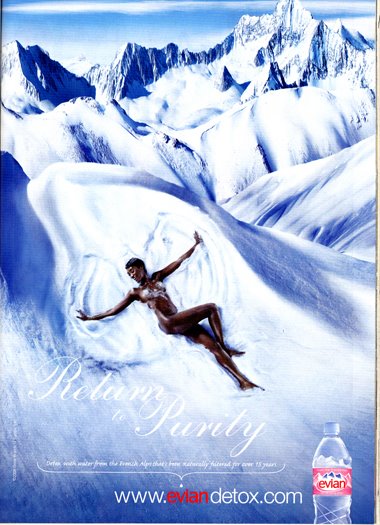
The fools responsible for this Evian ad should be sent to drug and alcohol detox treatment.

----------------------------------------------------------

For the past few weeks, MultiCultClassics has been paging through general market magazines in search of advertising featuring Black characters. The list included Elle, Vogue, Cosmopolitan, People, Us, Reader’s Digest, TV Guide, Redbook, Woman’s Day, Parents, Esquire, GQ, Vanity Fair, Time, Newsweek, Business Week, Forbes and many more.

Excluded were layouts with Black sports figures, celebrities and super models. Additionally, ads depicting group photos including token Black figures were nixed. The goal was to determine the true diversity of the general market adscape.

After poring over scores of publications — and literally thousands of pages of ads and editorial — barely a dozen messages were uncovered.

This week, MultiCultClassics presents the rare findings.

Essay 983


Belting out the news with a MultiCultClassics Monologue…

• The New York Post reported that Foxy Brown was acting crazy before allegedly lifting two expensive belts from a trendy boutique (see Essay 978). The rap diva apparently threatened a family friend just before heading to the store, screaming at the friend for no apparent reason. “She just flipped,” said the family friend. “She was just shouting — and then she threatened to attack me.” Yeah, desperately seeking accessories can drive folks over the edge.

• Lil’ Kim may find herself in a catfight, as a Jamaican reggae singer is suing the rap star for allegedly stealing lyrics. A song from Lil’ Kim’s 2005 album, The Naked Truth, sounds extremely similar to a reggae tune released in 1997. What’s more, Lil’ Kim even admitted being a great fan of the female reggae artist, actually recording with her in 1999. Yeah, sounds like the recently released rapper is in a lil’ more trouble.

• California Governor Arnold Schwarzenegger has settled a libel suit with a British TV personality who claims the actor-politician groped her in 2000 and defamed her in 2003. “The parties are content to put this matter behind them and are pleased that this legal dispute has now been settled,” said Schwarzenegger’s lawyers. Yeah, Schwarzenegger probably sent her off with a friendly pat on the ass.

• The Chicago Urban League has a new chief — Cheryle Jackson. Founded in 1916, the organization is dedicated to fighting discrimination in education and employment. Boasting a membership exceeding 1,100, the Chicago Urban League offers programs in youth mentoring, financial counseling, job training and placement, affordable housing, health services and more. Jackson plans to focus on reaching the younger generations while moving the organization forward. She said, “I would like to take the traditional tools of civil rights and merge them with the tools used on Wall Street and Madison Avenue.” Um, somebody better tell her about the discrimination tools used on Madison Avenue.

Essay 982


For the past few weeks, MultiCultClassics has been paging through general market magazines in search of advertising featuring Black characters. The list included Elle, Vogue, Cosmopolitan, People, Us, Reader’s Digest, TV Guide, Redbook, Woman’s Day, Parents, Esquire, GQ, Vanity Fair, Time, Newsweek, Business Week, Forbes and many more.

Excluded were layouts with Black sports figures, celebrities and super models. Additionally, ads depicting group photos including token Black figures were nixed. The goal was to determine the true diversity of the general market adscape.

After poring over scores of publications — and literally thousands of pages of ads and editorial — barely a dozen messages were uncovered.

This week, MultiCultClassics presents the rare findings.

-----------------------------------------------

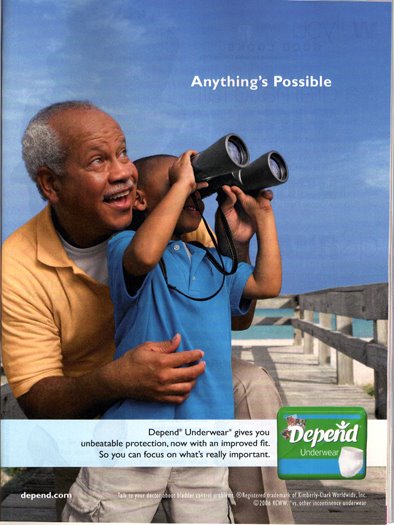
Depend shows anything’s possible by letting Blacks hawk adult diapers. Sheeee-it.

Essay 981


From The New York Post…

-----------------------------------------

CLA$$ SELECTION AT IVY HALLS

INJUSTICE LEAGUE REVEALED

By WILLIAM GEORGIADES

The country’s most elite colleges turn away deserving students to admit the less talented offspring of alumni and of wealthy and powerful parents, according to an explosive new book.

“One of the last taboos among America’s aristocracy is talking — or writing — about pulling strings in college admissions,” writes Pulitzer Prize-winning Wall Street Journal reporter Daniel Golden in “The Price of Admission: How America’s Ruling Class Buys Its Way into Elite Colleges — And Who Gets Left Outside the Gates.”

In what Golden calls “affirmative action for rich white people,” colleges like Brown, Princeton and Harvard ignore poor SAT scores and other factors in favor of alumni connections, celebrity parents and generous donors.

An advance copy of the book, being published by Crown and due in bookstores Sept. 5, cites the following examples:

- Christopher Ovitz, son of Michael Ovitz, “had a mediocre academic record and a middle-school suspension for swinging a baseball bat at a female classmate.” Brown University admitted him as “a special student.” He didn’t last a year.

- The now-disgraced New Jersey real-estate developer Charlie Kushner pledged $2.5 million to Harvard in 1998. A year later, his son Jared, who recently bought The New York Observer, was admitted to Harvard despite having test scores “well below Ivy League standards.” Then “Kushner gave $3 million to endow an undergraduate deanship at NYU in July 2001; his daughter, Dara, enrolled that fall.” In 2003, Jared went on to NYU Law.

- Model Lauren Bush, niece of President Bush, applied to Princeton in February 2002, a month after its application deadline had passed. She was granted a “special dispensation” despite “SAT scores considerably below the typical Princeton student.”

- David Zucconi, a Brown administrator, “helped guide Jane Fonda’s daughter, Vanessa Vadim, through the admission process.” Later, the actress “gave $750,000 anonymously for minority scholarships.”

Golden details how “university presidents generally have a right-hand man, from Joel Fleishman at Duke to the late David Zucconi at Brown, whose role is to gratify key donors and alumni, including facilitating the admission of their children.”

How unfair is it?

The sons of Senate Majority Leader Bill Frist and former Vice President Al Gore, “both middling students who preferred partying to homework,” according to Golden, were admitted to Princeton and Harvard, respectively, “where their fathers had gone before them.”

Elite offspring who do get in say there’s a reason for the uneven selection system.

Frances Cashin, who followed her dad, Richard, an investment manager and big-time donor, into Harvard, told the author that “any college has to be careful about the students it lets in from a social perspective … It’s important to Harvard to have people who know what it means to work hard, make good friends, and go out at night. A lot more alumni children are well-rounded kids, probably because they come from more stable families.”

But so many spaces at elite universities are reserved for well-connected students, lamented a Notre Dame official quoted by the author, that “the poor schmuck who has to get in on his own has to walk on water.”

Saturday, August 26, 2006

Essay 980


Blacks must keep their eyes on the truth

By Stanley Crouch

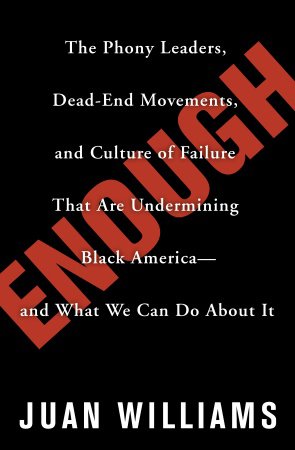
We live in a peculiarly twisting and turning time in which the responsibility of defining our troubles becomes ever more befuddling. Now Juan Williams, because of his new book, “Enough,” is getting the treatment.

Williams, so goes the critics’ tales, is a man who went blind in the long storm of racial trouble and has converted to that lunatic, black middle class, which rejects its lower-class brothers and can do nothing but “blame the victim.”

How did Williams become excluded from the squad of acceptable black commentators after debating the right-wing gang on Fox News, writing a biography of Thurgood Marshall and another book examining the role of faith in Afro-American progress, and working on the impressive PBS documentary of the civil rights movement, “Eyes on the Prize”?

Williams would be just fine if he had denounced Bill Cosby instead of championing the comedian’s opinions and basing “Enough” on substantial research that corroborates Cosby’s attacks on the self-destructive behavior in the black lower class.

“What happens,” says Williams, “is that you become some sort of a leper if you don’t lockstep your opinions in line with white liberals. They run the programming of CBS, NBC and ABC, and they don’t want you to rock the boat of received opinion. I have done my homework and I have seen these problems grow to epidemic proportions. But I have to say that these white liberals have bought the line of the do-nothing black leadership on the one hand, and have been convinced that the high dropout rate, the violence and the misogyny you hear in one rap recording after another are just natural to black culture and not an aberration.”

Williams means that what he calls a “culture of failure” is a historical aberration. Once upon a time in America, black people from the top to the bottom realized the importance of education in supplying some of the most reliable tools with which to combat the limitations imposed by racism. Though 500 black men just graduated from Morehouse College, there is now a 50% dropout rate among black high school students in America. Though Dorothy Height and the Council of Negro Women warned against irresponsible sexual behavior many years ago, 70% of black American children are born out of wedlock.

Racists might look at the gloomy numbers and say that they were right all along: Black men and women are not ready for civilization. But we have learned so much about the gene pool over the past 50 years that we can now dismiss such stupidity and realize that what we are seeing has less to do with genetic doom than with learned behavior, or learned misbehavior. It is still, however, an inarguable form of doom.

I strongly recommend “Enough” as a very welcome turning away from explaining everything in terms of white America’s unlimited power and unlimited disregard. Had black Americans ever truly believed that, there never would have been a Thurgood Marshall or a Rev. Martin Luther King Jr. and all of those who came before them. In our moment, Bill Cosby opened the door for new discussion. For the good of all, Juan Williams is helping to hold that door open. If you enter, you will risk nothing but your received opinions.

Essay 979


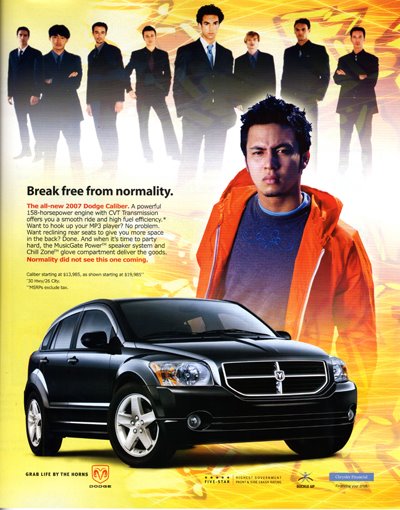
This Asian American-targeted ad is abnormally awful.

Essay 978


Not-so-funny business in a MultiCultClassics Monologue…

• Forbes magazine sparked outrage by publishing an editorial titled, “Don’t Marry a Career Woman” — compelling men to avoid such unions or face disaster. The writer referenced studies that showed career women are more likely to cheat on their spouses and get divorced. “If they do have kids, they’re more likely to be unhappy about it. … The more successful she is, the more likely she is to grow dissatisfied with you,” wrote the editor. “The piece was intended to be part academic and part humorous,” said editor-in-chief Steve Forbes. “Instead, it profoundly offended hardworking career women everywhere. We deeply regret having done so.” Bet Forbes caught heat from his wife and five daughters.

• Foxy Brown is being accused of stealing two $400 belts from a boutique in Greenwich Village. The rap diva allegedly threw a fit upon learning the shop had not finished tailoring some lingerie, ultimately grabbing the belts and storming out. “Honestly, I never thought she would do anything like that,” said the boutique owner. “I was shocked. Who does she think she is?” Seems like the boutique owner got off easy, as Foxy has been known to become physically violent over bad manicures.

• Elton John wants to produce a hip-hop album. “I want to work with Pharrell, Timbaland, Snoop, Kanye, Eminem and just see what happens,” said John. “It may be a disaster, it could be fantastic, but you don’t know until you try. … I want to bring my songs and melodies to hip-hop beats.” Maybe he could belt out some music with Foxy Brown.

Friday, August 25, 2006

Essay 977


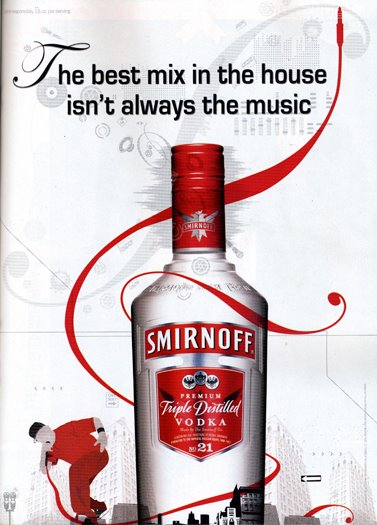
Yo, this is definitely not the best ad in the house.

Essay 976


Maybe the headline should have read, “Fits like a glove.”

Essay 975


Dealing with change in a MultiCultClassics Monologue…

• The Hitler’s Cross restaurant in Mumbai, India, will change its name after protests. For history buffs, while Nazis adopted the swastika as their own, it originated as an ancient Hindu symbol of good luck and is still present throughout India. “Once [people] told me how upset they were with the name, I decided to change it,” said the restaurant owner. “I don’t want to do business by hurting people.” Alternative names probably include Kaddafi’s Kitchen and bin Laden’s Bistro.

• A Louisiana school bus driver has been suspended after ordering Black kids to sit at the back of the vehicle. “All nine [Black] children were assigned to two seats in the back of the bus and the older ones had to hold the smaller ones in their laps,” said one parent. Back to school means back to segregation.

• Following Dell’s record-breaking battery recall, Apple instructed customers to return 1.8 million laptop batteries. Wonder how this might change the debates between the Mac and PC characters in those annoying commercials.

Thursday, August 24, 2006

Essay 974


Basketball is to Black advertising what soccer is to Hispanic advertising.

Essay 973


From DiversityInc.com…

-----------------------------------------------------

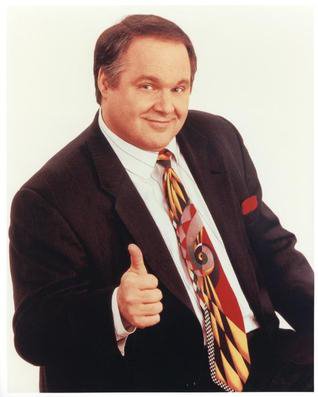
Rush Limbaugh Steps In It Again With ‘Survivor’ Comments

Controversial talk-show host Rush Limbaugh predicts a Latino will win the upcoming 13th season of “Survivor” because blacks are not good swimmers and Latinos “will do things other people won’t do.” 

Yesterday after CBS announced that it would break down the tribes on the hit reality show “Survivor” by race (Asians, Latinos, blacks and whites), Limbaugh went on a racially insensitive tirade. He suggested on his nationally syndicated radio program, that the competition in “Survivor” will not “be fair if there’s a lot of water events.” In support of this assertion, he cited a March 2 HealthDay article reporting that “young blacks—especially males—are much more likely to drown in pools than whites.”

The HealthDay article he based his argument on, however, did not address the swimming abilities of blacks in general. HealthDay, according to Media Matters, reported that “[r]esearchers don’t know why black kids are at higher risk of drowning,” that “[m]ost of the black [drowning] victims … drowned in public pools,” and that the “study didn’t examine whether the victims had taken swimming lessons or whether the pools were supervised by lifeguards.” Additionally, the article noted that according to the study, “people from poorer families were more likely to drown … regardless of race,” and that one author of the study suggested “[f]uture research” will be done to “examine whether swimming instruction reduces the risk of drowning.”

Limbaugh said that there “are many characteristics … that you would think would give [the African-American tribe] the lead and the heads up in terms of skill and athleticism and so forth.” But as far as an early prediction on a winner, he is counting on the Latino tribe to win unless they “start fighting for supremacy amongst themselves.” He went on to say that Latinos have “probably shown the most survival tactics,” and that they “have shown a remarkable ability to cross borders.”

Limbaugh, not wanting to leave anyone out of his offensive speech, said “the Asian-American tribe”—whom he called “the brainiacs of the bunch”—probably will “outsmart everybody” but would not be the winners. He went on to say that “the Native Americans were excluded, because they were at one with the land and they would probably have an unfair advantage.”

In response to a black caller, Limbaugh said that “the white tribe would be the best swimmers” based on the performance of white athletes at the Olympics. After apparently disconnecting or cutting the volume level of the caller, according to Media Matters for America, Limbaugh said: “[Y]ou’re saying I’m being racist because I’m saying blacks can’t swim … I mentioned the swimming comment only because it’s not going to be fair if there is a lot of water competition in this. It just isn’t. It is not a racial or racist comment at all.”

Essay 972


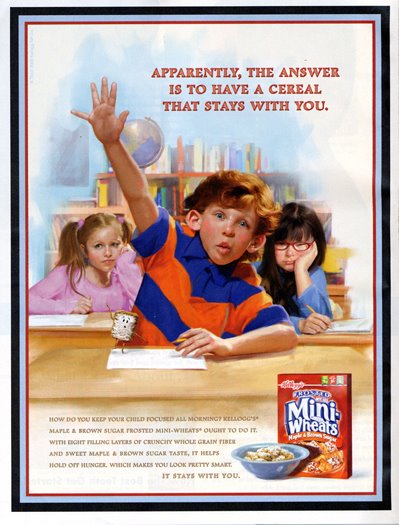
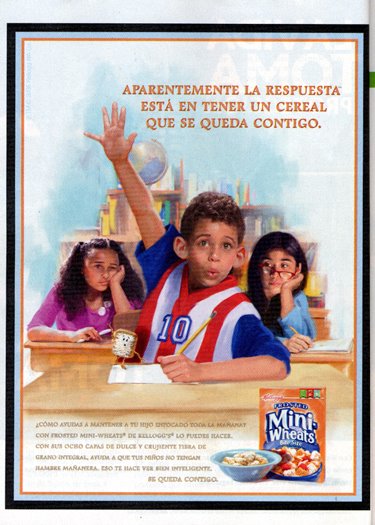
Now this is messed up. Mini-Wheats illustrates big-eared geeks for two separate markets. And the Hispanic kid even gets a soccer jersey for added relevance. Damn.

Essay 971


Here’s the Hispanic-targeted version of the ad concept presented in Essay 942. There’s probably a Native American-targeted version featuring a father and son building a toy teepee.

Essay 970


Hunting for news with a MultiCultClassics Monologue…

• SWAT teams may increase their presence along the U.S.-Mexico border. The special units have been dealing with drug dealers and human traffickers since the 1980s, staging “soft” ambushes against a sometimes heavily-armed target. “We will go in hard, often with a flash-bang grenade to maintain the element of surprise,” said one SWAT member. “Even if they have weapons, it can turn a lethal situation into a non-lethal situation. … We are paid to hunt people and we think we are smarter than they are.” The hunters who are not smarter comprise The Minuteman Project.

• A new survey showed nearly 20 percent of female cadets at The Citadel claimed being sexually assaulted since signing up at the military college. Plus, nearly 4 percent of male cadets reported instances of sexual assault. Is this part of the ultimate training for serving in the armed forces?

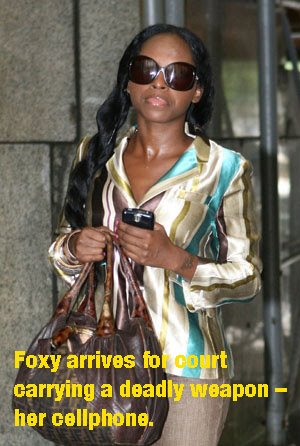
• Foxy Brown was a no-show for her latest court appearance. She probably didn’t receive the phone call to appear because she was using her cell phone to beat manicurists (see Essay 806).

• Wendy’s completed its switch to using new cooking oil to reduce the levels of trans fat in menu offerings. The fast feeder becomes the first major chain to make such a change. Mickey D’s continues to drag its McFeet on the issue, opting to change COOs instead.

Essay 969


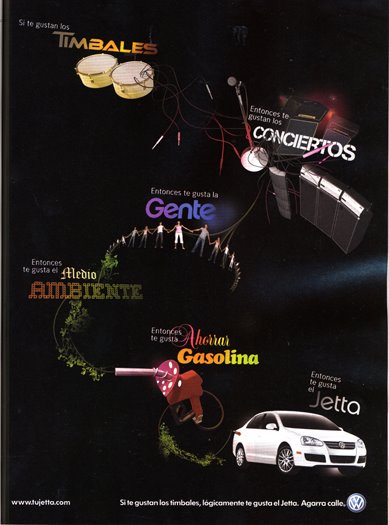
The Volkswagen Jetta “Safe Happens” television campaign presents car crashes. In this Hispanic-targeted print ad, the typography is a total wreck.

Essay 968


From The New York Times…

----------------------------------------

‘Survivor’ to Divide Teams Along Racial Lines

By BILL CARTER

For the first time since it went on the air in 2000, the hit CBS reality television program “Survivor” will divide its teams — or tribes, as they are known on the show — along racial lines.

For the first half of the series this fall, four teams of five members will be made up of blacks, Asian-Americans, Hispanics and whites. They will compete in weekly challenges against each other, and the losing group will have to vote out a member of its own team.

Mark Burnett, the series producer, said in a telephone interview yesterday that the decision to organize the teams by race was made in group discussions with CBS executives and was in no way intended to promote racial divisiveness.

“In America today,” Mr. Burnett said, “I really don’t believe there are many people who hate each other because of their race. But even though people may work together, they do tend in their private lives to divide along social and ethnic lines.”

Mr. Burnett noted that in many cities, members of ethnic groups tended to cluster in neighborhoods. “In New York you will find areas like Little Afghanistan,” he said. “Maybe in the year 3010, when we’re all coffee-colored, it really will make no difference. But right now, it is what it is.”

Mr. Burnett said that “Survivor” and other shows had often been criticized for a lack of ethnic diversity. “We’re always hearing about how we only have two token blacks on the show,” he said. And the predominance of whites has been reflected in the show’s applicants, with more than 80 percent of them white, he said.

For the new contest, Mr. Burnett said, the show reached out to social and church groups to bring in more applicants of different backgrounds. He said the results had been gratifying. “We got so many good people we expanded the number of contestants to 20 instead of the usual 16,” he said.

Both CBS and Mr. Burnett acknowledged that the new format could be criticized. “I know it’s going to be controversial,” he said. “I’m not an idiot.”

In a statement, CBS said it “fully recognizes the controversial nature” of the format change. But it expressed confidence in the program’s ability to handle the situation sensitively.

The change leaves CBS open to charges that it was done to increase the ratings for “Survivor,” which, while still a hit, has had a diminished audience in recent years. In addition, in the new television season, CBS is facing a serious new challenge on Thursdays, the “Survivor” broadcast night. ABC has moved its strongest drama, “Grey’s Anatomy,” to Thursday nights at 9 to oppose CBS’s top show, “CSI.” ABC has also placed its most promising new series, “Ugly Betty,” on Thursday at 8 to compete with “Survivor.”

But Mr. Burnett said he was not making the change as a ratings strategy. “We have hardly been hurting in the ratings,” he said, noting that “Survivor” still attracted about 17 million viewers a week last season.

Instead, he called the move “an interesting social experiment.”

“I don’t think it would be valid in the regular modern world,” Mr. Burnett said. “But this is suddenly a very different playing field. People here are playing for a million dollars. They’re going to want to know if you’re going to vote them out. Or if they’re hungry, they’ll want to know if you know how to catch a fish. They’re not going to care if you’re green or Martian.”

Wednesday, August 23, 2006

Essay 967


“I don’t want to be younger. I just want to look it.”

Hey, Christie, your teen-chasing hubby isn’t buying that notion.

Essay 966


You don’t have to be fluent in Spanish to understand this ad sucks.

Essay 965


International affairs and foreign concepts in a MultiCultClassics Monologue…

• A new restaurant in Mumbai, India, has sparked outrage with its name — The Hitler’s Cross. The décor features portraits of the former German leader, along with swastikas and Nazi colors. “We wanted to be different. This is one name that will stay in people’s minds,” said owner Punit Shablok. “We are not promoting Hitler. But we want to tell people we are different in the way he was different.” The restaurant manager added, “This place is not about wars or crimes, but where people come to relax and enjoy a meal.” Entrees are probably baked in Auschwitz ovens.

• A Sudanese writer claiming to have been Osama bin Laden’s captive mistress has penned a memoir that reveals the terrorist leader has a crush on Whitney Houston. The writer said bin Laden joked about knocking off Bobby Brown and inviting Houston into his harem. “He mentioned her constantly, how beautiful she is, what a nice smile, how truly Islamic she is, but just brainwashed by American culture and her husband,” said the memoirist. Um, Whitney’s “brainwashing” can be attributed to foreign substances versus American culture.

Tuesday, August 22, 2006

Essay 964


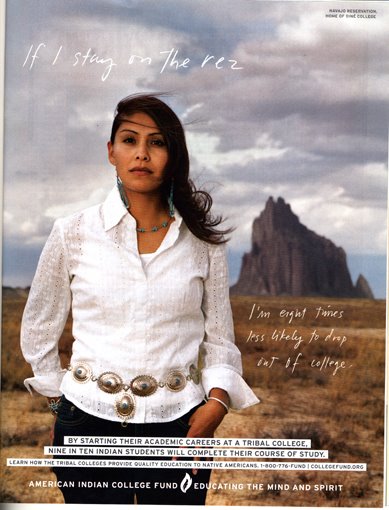
Most folks are familiar with the United Negro College Fund. But you probably haven’t heard of the American Indian College Fund. Why does it seem like Native Americans remain on the bottom of the minority totem pole?

Click on the essay title above to learn more.

Essay 963


Busta Bits in a MultiCultClassics Monologue…

• More details have been published regarding Busta Rhymes’ latest confrontation with a Bronx man (see Essay 953). The alleged beating victim claimed he accidentally spat on the rapper’s ride on August 12. “Homie, did you just spit on my car?” said the rapper as he approached the man. “I said, ‘Sorry, I didn't mean to,’” claimed the spitter. “I said, ‘We’re big fans of yours.’” At that point, Rhymes and his posse kicked the man’s ass, dealing out a concussion, abrasions and lacerations (scarred victim pictured above). No word if the man is still a big fan.

• Meanwhile, Busta Rhymes remains silent regarding the shooting that left an aide dead last February 5 (see Essay 407). “No one has come forward as an eyewitness,” said a deputy police commissioner. “Some have acknowledged being there but didn’t see anything.” Rhymes didn’t say anything when pressed by cops last Sunday. “I got a lawyer,” he allegedly told detectives. “I’ve got nothing to say about that. I already told you that.” It’s safe to say the cops are not big fans.

Essay 962


Qwest doesn’t mince words when directing messages to Native Americans. It’s surprising the telecommunications company didn’t simply go with, “Attention, Poor Injuns.”

Essay 961


Here’s something that appeared in the latest issue of Adweek. The MultiCultClassics response immediately follows…

-------------------------------------------

Blacks, Hispanics Believe In Brands They Know

NEW YORK A new survey suggests that both African Americans and Hispanics have strong trust in brands. The Yankelovich Monitor Multicultural Marketing Study, released last week, found that both groups are increasingly reconnecting to their respective roots, which has implications for marketers who want to maintain their brand message in front of these consumers. The study shows that both groups are reconnecting to their cultures more than ever before, with 67 percent of African Americans and 71 percent of Hispanics acknowledging, “My roots and heritage are more important to me today than they were just five years ago.” The good news for marketers is that 58 percent of Hispanics and 55 percent of African Americans said, “It is risky to buy a brand you are not familiar with.” Only 42 percent of African Americans and 40 percent of Hispanics said they would “buy private label and generic brands” if their families unexpectedly found themselves with less money.

-------------------------------------------

Blurbs like this can be dangerous because they lack details and specificity. Click on the essay title above to view a more in-depth report at Hadji Williams’ blog.

Sadly, most advertisers will interpret the findings in the following ways:

• Since Blacks and Hispanics have stronger trust in brands, advertisers may feel more comfortable applying less of their marketing budgets against the audiences. Who needs an expensive multimedia campaign when you can capture a segment by sponsoring a gospel choir and/or salsa music celebration?

• Both groups are reconnecting with their cultures more than ever before, which means ads should prominently feature kente cloth and piñatas more than ever before.

It would be interesting to see how the Yankelovich study has actually influenced or inspired great advertising for Blacks and Hispanics. Based on the multicultural work in the marketplace, there appears to be little evidence that the study — which has been updated regularly for many years — helps generate progress.

Essay 960


According to the IRS, everyone has it all. Recruitment ads offer identical benefits to different audiences. Native Americans are targeted in a pretty subtle style. Guess the assumption is that folks will recognize the depicted woman is a Native American. But just to be on the safe side, she’s wearing a turquoise pendant.

Essay 959


Immigrant activist holed up in church is no Rosa Parks

BY MARY MITCHELL, SUN-TIMES COLUMNIST

Elvira Arellano is definitely no Rosa Parks.

I even doubt that Arellano has any idea who Parks really was.

Because if she did, she wouldn’t have hid inside the Adalberto United Methodist Church instead of reporting to immigration authorities for deportation. But with her son in tow, Arellano and her supporters could have marched into the immigration office and showed America exactly what the present immigration laws really mean:

That a single mother can be separated from her child; that husbands can be snatched from their wives; that working-class families can be torn apart simply because America has waited far too long to craft a fair and reasonable immigration policy.

Maybe then more of us would respect her stance.

But a week ago, Arellano, who is being described as an immigration activist, fled to the West Side church seeking sanctuary. The church is pastored by longtime social activist Rev. Walter “Slim” Coleman. She has vowed to stay put, and Coleman has promised to let her stay put.

“I’m strong, I’ve learned from Rosa Parks – I’m not going to the back of the bus. The law is wrong,” Arellano told reporters last week.

Despite the rhetoric, the 31-year-old Arellano doesn’t seem to know much about black Americans' struggle for civil rights.

Didn’t break the law

Parks didn’t refuse to go to the back of the bus. She refused to give up her seat to a white man who couldn’t find a seat in the so-called “white section.” As onerous as the Jim Crow laws were, Parks didn’t break them. That’s why she could calmly go to the police station and sit in jail until her husband came to bail her out.

Because Parks wasn’t a lawbreaker, the local NAACP decided to use her as a test case to challenge the Jim Crow laws. Her righteous cause drew widespread support and launched the civil rights movement in earnest.

Arellano obviously doesn’t know anything about this important piece of history. If she did, she would care more about the circumstances of all illegal immigrants and not just her own.

As they say in the streets, Arellano is pimping the system. She is using Rosa Parks’ name to buy herself more time, and that disgusts me.

Arellano is not a victim of an unjust system. She crossed into the U.S. from Mexico in 1997, obtained a fake ID and was caught at the border and returned home. Three days later, she sneaked back into the country and made her way to Washington state, where she managed to get a driver’s license. She met her son’s father and gave birth to her son in 1998. Two years later, Arellano moved to Chicago and again managed to get a fake ID -- a Social Security card -- and landed a job as a cleaning lady at O’Hare Airport. Three years after that, she was caught and pleaded guilty to working under a false Social Security number.

Her chutzpah makes her a folk hero to some, but her blatant exploitation of Parks’ legacy undermines the fragile coalition between some blacks and Hispanics that has formed around the immigration issue.

Some of us -- particularly those who came to the urban areas during the Great Migration -- admire the courage it takes for someone to leave everything behind to strike out in search of a better life. But none should forget that blacks paid their dues.

Our ancestors didn’t come here looking for work. They were dragged here against their will to work someone else’s fields. They were the unpaid cotton, berry and peach pickers. They were the unpaid gardeners, construction laborers, nannies and domestics. If they stole an identity, it was to escape the cruel lash of the slavemaster. Their children weren’t born American citizens, they were born chattel.

But instead of thanking blacks for paving the way, other groups have walked across black backs without so much as a “thank you for your sacrifices.”

Should have returned to Mexico

The benefits that so many other groups -- women included -- now enjoy were purchased with black blood, sweat and tears.

As for Arellano, she’s extremely fortunate. Black people were lynched in the past for defying any ol’ white man, let alone one with authority.

Still, I understand why she garnered empathy from U.S. Rep. Luis Gutierrez and U.S. Sen. Dick Durbin. America’s immigration system is such a mess, both men stepped in in 2003 and secured a one-year extension from deportation on Arellano’s behalf. They secured another one-year extension in 2004 and again in 2005.

During that grace period, Arellano should have returned to Mexico and gone to the back of the line. But she chose instead to butt those who play by the rules.

Obviously fearing a publicity nightmare, immigration authorities say they will not storm the church to deport Arellano. Instead, they will wait her out. Although a wise decision, it nonetheless sends a dangerous message.

Hopefully, while Arellano is languishing she will brush up on black history.
Monday, August 21, 2006

Essay 958


It’s extremely rare when an ad has the ability to offend all audiences. Kudos to FDS.

Essay 957


The CIA takes some interesting approaches when speaking to diverse audiences via recruitment ads.

For Native Americans, the headline reads, “A career that takes you full circle.” Looks like the man is handing over North America.

Asians are told, “Our mission depends on different views. Because nothing in the world is the same.” What in the world does that mean?

The Hispanic-targeted headline proclaims, “Work for the most important and respected employer of all. Your nation.” Never realized the CIA had such an ego.

Essay 956


Special K introduces a new flavor — fruit & yogurt & blue jeans. Yum!

Essay 955


For better or worse with a MultiCultClassics Monologue…

• Teens in Utah rallied in defense of polygamy. “Because of our beliefs, many of our people have been incarcerated and had their basic human rights stripped of them, namely life, liberty and the pursuit of happiness,” said one 19-year-old. “I didn’t come here today to ask for your permission to live my beliefs. I shouldn’t have to.” Hey, you’ve got to fight for your right to party with multiple spouses.

• The Boston Globe reported that Black teens have highly negative views on marriage. “I’m not looking forward to marriage,” said one 17-year-old, “and I don’t think we [people in general] should be married because I see how other marriages ended up in my family and on television. It’s always a disaster.” Hey, have these kids considered polygamy?

• The U.S. Census reported that Whites are now the minority Phoenix, Tucson and Denver. A demographer with the Brookings Institution predicts Whites will also fall below the 50 percent line in Charlotte, Las Vegas and Arlington, Texas, within the next two years. Across the board, Hispanic immigration influenced the shifts. “One thing that has changed is the overt demonstration of racism,” said an executive of the Tucson service organization Chicanos por la Causa Inc. “The element itself is very small but can be intimidating.” Or business as usual for The Minuteman Project.

Sunday, August 20, 2006

Essay 954


Wal-Mart takes credit for community renewal in this Hispanic-targeted message. Hey, maybe Andrew Young was right after all (see Essays 944 and 951).

Essay 953


Cross reactions in a MultiCultClassics Monologue…

• The Los Angeles Times reported on the increasing difficulty of crossing the U.S.-Mexico border for older and less-fit migrants. “If you hire the right [smuggler] and are willing to accept the higher degree of physical risk, you can get through,” said a UC San Diego professor who conducted a study on immigration. “But the older people are less tolerant of the kind of risks that young men are willing to take.” Click on the essay title above to read the full story.

• Busta Rhymes was busted for roughing up a man who accidentally spat on the rapper’s ride. Rhymes may also face additional charges because cops found a machete in his vehicle. Guess the spitter should feel lucky he only got beat up versus carved up.

• A group of angry lesbians beat and stabbed a man in the West Village area of New York City. According to the man’s side of the story, the attack was sparked after he made a pass at one of the women, infuriating her girlfriend. An argument ensued, leading to another woman spitting on the man, who spat back. The man was then pummeled with belts, slapped, kicked and stabbed. “It was a bias attack by 20 gay women,” said the man. The women deny his accusations. No word yet from Busta Rhymes on this melee.

Essay 952


Mickey D’s continues its hype for the new Snack Wrap (see Essay 939) with consecutive pages in hip hop magazines.

The first page demonstrates “How to Make a Hot W(rap).” It’s enough to make Vanilla Ice look credible.

The next page presents hot new sensation Snack Wraps and hot new artist Hot2Def. The art direction is not hot or new. The copy sucks 2.

The final page features another “Looks like somebody missed snack time” execution. Looks like somebody missed art school.

Essay 951


Andrew Young’s melting pot boils over

By Clarence Page

WASHINGTON -- After making what he admits were “demagogic” remarks about Jewish, Asian and Arab business owners, Andrew Young has done the right thing. The former civil rights leader, Atlanta mayor and UN ambassador found himself guilty and sentenced himself to resign as head of a Wal-Mart advocacy group.

Wal-Mart Stores Inc. said it did not ask for Young to step down, but it did not stand in his way when he did. After all, what does it profit an international mega-corporation to hire a liberal feel-good front man if he makes people feel bad?

Young, 74, stuck his wingtips in his mouth during an interview that appeared in Thursday’s Los Angeles Sentinel, the West Coast’s oldest and largest black-owned weekly, when he was asked whether Wal-Mart squeezed small stores out of black neighborhoods.

“Well, I think they should; they (big stores) ran the mom-and-pop stores out of my neighborhood,” he told the Sentinel. “But you see those are the people (owners of mom-and-pop stores) who have been overcharging us--selling us stale bread, and bad meat and wilted vegetables. And they sold out and moved to Florida. I think they’ve ripped off our communities enough. First it was Jews, then it was Koreans and now it’s Arabs, very few black people own these stores.”

I don’t expect anyone to be nominating Young for an NAACP Image Award this year, although he might be a contender for the Mel Gibson Sensitivity Prize.

Unlike Gibson’s infamous drunken slurs against Jews, Young was apparently sober and trying to say something that anyone familiar with urban commerce knows to be quite true. He dug his grave with the way he said it.

There’s nothing new about the “black tax” that residents of economically abandoned urban neighborhoods have had to pay for goods and services in recent decades. It is part of the economic dynamic of old urban neighborhoods that waves of immigrants, including black immigrants from the South, have operated mom-and-pop stores, become successful, and eventually move on to better neighborhoods.

These “middle-man minorities,” as economist Thomas Sowell labeled them more than a decade ago, are a worldwide phenomenon reflecting how some ethnic cultures are more entrepreneurial than others because of culture and peculiar historical circumstances. They may be Cuban merchants in Latin America, ethnic Chinese in the Philippines or East Indians in East Africa.

This helps to explain, for example, why a survey of black-owned New York businesses in the 1980s found that more than half were owned by immigrants from Africa or the Caribbean, even though immigrants comprised only a tenth of New York’s black population overall.

In cities like Chicago, Detroit and New York, for example, many black neighborhoods saw black, Jewish or Italian merchants move their stores in the wake of riots in the 1960s, only to be replaced by Arab merchants displaced by the 1967 Six-Day War, and later, Korean merchants.

But like Wal-Mart, these middleman minority merchants provide commerce in communities that have little or none and they stir resentment from the very communities they serve.

Long-simmering resentments toward mostly Asian merchants in South Central Los Angeles boiled over into mainstream news during that city's 1992 riots. TV cameras caught armed Korean merchants guarding their stores against mostly black and Hispanic looters.

Young could hardly have picked a worse place to reopen old resentments than Los Angeles, a city that has been trying ever since 1992 to cool its heavily immigrant stir-fry of blacks, whites, Hispanics and Asians. Yet, he also provides what educators call a “teachable moment.”

Instead of getting mad at Young or at immigrant merchants, we should take a lesson from neighborhoods that are bringing businesses back, including a new wave of locally owned mom-and-pop stores and franchises. Through public-private partnerships, neighborhood-based community development corporations in many cities are pooling resources to help lure major chain stores to serve as anchors for the development of smaller businesses.

The real problem Young uncovered is not ethnic but economic and educational. Better schools provide the tools that enable people to take care of themselves and their families, ride out economic hard times and help their children move on to better lives.

And, in our market-driven society, economics determine the market conditions that create the engines of upward mobility that enable low-paid workers to move up to higher-paying jobs. Those who get left behind while others, including immigrant merchant families, get ahead are left more isolated and resentful than ever. Capitalism obviously works. Our challenge is to make it work for every American.

Essay 950


From The Associated Press…

---------------------------------------------

Recruiters molest, rape potential enlistees

BY MARTHA MENDOZA

More than 100 young women who expressed interest in joining the military in the past year were preyed upon sexually by their recruiters. Women were raped on recruiting office couches, assaulted in government cars and groped en route to entrance exams.

A six-month Associated Press investigation found that more than 80 military recruiters were disciplined last year for sexual misconduct with potential enlistees. The cases occurred across all branches of the military and in all regions of the country.

“This should never be allowed to happen,” said one 18-year-old victim. “The recruiter had all the power. He had the uniform. He had my future. I trusted him.”

1 in 200 recruiters disciplined

At least 35 Army recruiters, 18 Marine Corps recruiters, 18 Navy recruiters and 12 Air Force recruiters were disciplined for sexual misconduct or other inappropriate behavior with potential enlistees in 2005, according to records obtained by the AP under dozens of Freedom of Information Act requests. That’s significantly more than the handful of cases disclosed in the past decade.

The AP also found:

•The Army, which accounts for almost half of the military, has had 722 recruiters accused of rape and sexual misconduct since 1996.

•Across all services, one out of 200 frontline recruiters -- the ones who deal directly with young people -- was disciplined for sexual misconduct last year.

•Some cases of improper behavior involved romantic relationships, and sometimes those relationships were initiated by the women.

•Most recruiters found guilty of sexual misconduct are disciplined administratively, facing a reduction in rank or forfeiture of pay; military and civilian prosecutions are rare.

•The increase in sexual misconduct incidents is consistent with overall recruiter wrongdoing, which has increased from just over 400 cases in 2004 to 630 cases in 2005, according to a General Accounting Office report released this week.

Defense Department spokeswoman Lt. Col. Ellen Krenke said the Pentagon, which has committed more than $1.5 billion to recruiting efforts this year, doesn’t track sexual misconduct cases among recruiters and had no comment on the AP’s findings. She referred the question to the military branches.

In the Army, 53 recruiters were charged with misconduct last year. Recruiting spokesman S. Douglas Smith said the Army has put much energy into training its staff to avoid these problems.

“To have 53 allegations in a year, while it is 53 more than we would want, is not indicative of the entire command of 8,000 recruiters,” he said.

Recurring pattern

For this story, victims were interviewed in their homes and perpetrators in jail; and the AP scoured police and court accounts of assaults and in one case portions of a victim’s journal.

A pattern emerged. The sexual misconduct almost always takes place in recruiting stations, recruiters’ apartments or government vehicles. The victims are typically between 16 and 18 years old, and they usually are thinking about enlisting. They usually meet the recruiters at their high schools, but sometimes at malls or recruiting offices.

“We had been drinking, yes. And we went to the recruiting station at about midnight,” begins one girl’s story.

Tall and slim, her long hair sweeping down her back, this 18-year-old from Ukiah, Calif., hides her face in her hands as she describes the night when Marine Corps recruiter Sgt. Brian Fukushima climbed into her sleeping bag on the floor of the station and took off her pants. Two other recruiters were having sex with two of her friends in the same room.

Fukushima was convicted of misconduct in a military court after other young women reported similar assaults. He left the service with a less-than-honorable discharge last fall.

In Indiana, where National Guard recruiter Sgt. Eric Vetesy has been charged with 31 counts of rape, sexual battery, official misconduct and corrupt business influence, military officials have instituted a new “No One Alone” policy to prevent further incidents.

Apparently the first of its kind in the country, the male Army National Guard recruiters in Indiana cannot be alone in offices, cars, or anywhere else with a female enlistee. If they are, they risk immediate disciplinary action. Recruiters also face discipline if they hear of another recruiter’s misconduct and don't report it.

The result?

“We’ve had a lot fewer problems,” said Lt. Col. Ivan Denton, commander of the Indiana Guard’s recruiting battalion. “It’s almost like we’re changing the culture in our recruiting.”

Saturday, August 19, 2006

Essay 949


Working for justice and overtime with a MultiCultClassics Monologue…

• In Chicago, an illegal immigrant and her son (pictured above) have taken refuge in a church to avoid deportation. The woman stated that if she is forcibly removed from the church, she “will know that God wants me to be an example of the hatred and hypocrisy of the current policy of this government.” The director of the Illinois Minuteman Project said, “She’s spewing all this anti-American stuff. … The thing that scares me the most is her defiance, it really does.” Or maybe the Minutemen are frightened by the prospect of having to enter a church.

• An investigation by Apple discovered laborers at a Chinese iPod factory were working too many hours. However, the investigators “found no evidence whatsoever of the use of child labor or any form of forced labor.” But it’s still unlikely that any of the Chinese workers can afford an iPod.

• Built Ford tough? More like tough luck, as the automaker announced the temporary halt of production at 10 plants between now and the end of the year. “We know this decision will have a dramatic impact on our employees, as well as our suppliers,” said Chairman and Chief Executive Bill Ford. “This is, however, the right call for our customers, our dealers and our long-term future.” What makes Ford think there’s a long-term future?

• A former judge in Oklahoma was convicted of obscene acts made while he was on the bench. Between 2001 and 2003, the judge apparently exposed himself and used a penis pump under his robe during trials. He’s now being sent to prison for 4 years, where he’ll no longer need the sex devices.

Essay 948


Depicting the range of Black skin tones is an interesting notion (albeit not new). But packing folks shoulder to shoulder seems awkward. The three-fingered hand is weird too.

Essay 947


Face it: Profiling makes sense
Race should be factor in detaining travelers

By Jonah Goldberg, editor at large of National Review Online

The Wall Street Journal reported this week that the Transportation Security Administration is testing sophisticated machines that use elaborate algorithms to determine whether air travelers have “hostile intent.” The machines measure your sweat output, pulse rate and other signs while asking questions such as: “Are you planning to immigrate illegally?” “Are you smuggling drugs?” “Do these stupid questions make you feel like committing a terrorist act?”

OK, I made the last one up, and I shouldn’t make fun because supposedly the Israelis have figured out how to make this stuff work. The thinking behind this program rests on the assumption that searching for every kind of potential weapon or explosive is too reactive. Find the bad motives, and the rest will follow.

If it works, great. But one of the frustrating reasons the U.S. government feels compelled to spend all of this time and energy coming up with computerized lie detectors is that civil libertarians can’t trust airport security personnel to do the same thing. Why? Because it's possible for humans to be racist.

The TSA’s more established security system, Screening Passengers by Observation Technique, or SPOT, relies on human intelligence instead of the artificial kind. Teams are trained to scrutinize passengers for more than 30 questionable behaviors, according to the Journal: “They look for obvious things like someone wearing a heavy coat on a hot day, but also for subtle signs like vocal timbre, gestures and tiny facial movements that indicate someone is trying to disguise an emotion.”

This apparently is unacceptable for civil libertarians.

“Our concern is that giving TSA screeners this kind of responsibility and discretion can result in their making decisions not based on solid criteria but on impermissible characteristics such as race,” the American Civil Liberties Union's Gregory T. Nojeim told the Journal.

In other words, while our enemies are coming up with ingenious ways to murder Americans, we’re coming up with ingenious ways to search for our enemies in the nicest manner possible. No amount of training, it seems, can immunize against the real threat to America: the possibility that somewhere, at some time, a TSA cop might pull an Arab or South Asian out of a line at an airport unfairly and talk to them for five minutes.

Note: We’re not talking about training security personnel to racially profile passengers. Quite the opposite. The ACLU’s problem is with training officers not to racially profile if that training nonetheless gives them enough autonomy so that it’s theoretically possible to take race into account.

What is so infuriating about this is that the ACLU favors policies that discriminate against all sorts of people--old people, women, children and others who, under random searches and other idiotic numerical formulas, are pulled aside for no reason at all.

All of this is happening against a backdrop of a war on terror in which roughly 99 percent of jihadi terrorists are of either Middle Eastern or South Asian descent and 100 percent of them are Muslim.

Critics of racial profiling say that it wouldn’t have stopped Richard Reid (the shoe bomber) or Timothy McVeigh (the Oklahoma City bomber). This is a red herring. Nobody ever proposed that race should be the only factor, or even the most important factor. But why can’t it be one of those 30-plus factors? The Brits who foiled this most recent plot were allowed to take race into account. Was that too high a price to pay for thwarting mass murder?

The terrorists we’re looking for are overwhelmingly young male Muslims from places such as Pakistan and Saudi Arabia. Why is it morally superior to inconvenience old Mormon women of Swedish descent--for no reason at all--as much as young men from Pakistan?

Two alleged members of the British liquid explosives plot were young men of British descent who converted to Islam, and one was a woman with a child. Only a fool would advocate a system that, as a rule, deliberately excludes such people from scrutiny. But isn’t it equally foolish to spend vast sums on machines designed to interpret the facial twitches and sweat glands of millions of passengers out of an irrational phobia of racial profiling?

Ron Suskind's new book, “The One Percent Doctrine,” explores Vice President Dick Cheney’s view that if there’s a 1 percent chance terrorists might detonate a nuclear bomb in an American city, the government must act as if there’s a 100 percent chance. Despite the guffawing this elicited from administration critics, it strikes me as eminently sensible. (If there were a 1 percent chance the snake in your back yard would kill your child, wouldn’t 1 percent equal 100 percent for you too?) The ACLU’s self-indulgent position, meanwhile, seems to be that if there’s a 1 percent chance a cop will be a racist, we must act as if it’s a 100 percent chance. And that means humans can’t ever be trusted.

Friday, August 18, 2006

Essay 946


Shopping for shoes? Um, girlfriend needs to shop for a hairstylist.

Essay 945


The New York Times wrote:

“More than a decade after the city created a special institute to prepare black and Hispanic students for the mind-bendingly difficult test that determines who gets into New York’s three most elite specialized high schools, the percentage of such students has not only failed to rise, it has declined.”

Click on the essay title above to read the full story.

Essay 944


It’s not shopping. It’s bad Photoshopping.

Essay 943


Blowing smoke and talking trash in a MultiCultClassics Monologue…

• A federal judge declared that Big Tobacco has been lying to the public for years about the negative effects of smoking. The ruling proclaimed, “Over the course of more than 50 years, defendants lied, misrepresented and deceived the American public, including smokers and the young people they avidly sought as ‘replacement smokers,’ about the devastating health effects of smoking and environmental tobacco smoke (secondhand smoke).” The judge ordered cigarette makers to publish “corrective statements” online and in newspapers about the true hazards of smoking. Plus, the companies were ordered to stop labeling products with words like low tar, light or mild, as these terms imply a cigarette may be safer. Talk about extending the Truth campaign.

• Civil rights icon and former U.N. Ambassador Andrew Young is quitting his leadership role in a Wal-Mart advocacy group after making racial remarks about Jews, Asians and Arabs. While going off on a rant about mom-and-pop stores, Young said, “But you see those are the people who have been overcharging us — selling us stale bread, and bad meat and wilted vegetables. And they sold out and moved to Florida. I think they’ve ripped off our communities enough. First it was Jews, then it was Koreans and now it’s Arabs, very few Black people own these stores.” Young later explained, “I guess I was sort of being confronted and challenged for supporting the big monster Wal-Mart, as they call it. … I was attempting to say that these large shops have been good for my community, and in this meeting I said it too quick. And instead of giving a long explanation, it was a racist shorthand, which was wrong.” Next time, just talk about Wal-Mart’s low prices.

Thursday, August 17, 2006

Essay 942


Never realized Blacks and Asian Americans had so much in common. Two insurance companies see fit to produce nearly identical ads to target the segments. Wonder if they demonstrate similar equality when redlining minority neighborhoods. Just kidding.


Essay 941


Adopting new attitudes with a MultiCultClassics Monologue…

• The New York Times published a story on the increase of transracial adoptions in the United States. “It is a significant increase,” said a sociologist at American University. “It is getting easier, bureaucratically and socially. With so many people going overseas, people are also increasingly saying, Wait a minute, there are children here who need to be adopted, too.” Click on the essay title above to read it all.

• Immigrant workers from Peru, Bolivia and the Dominican Republic filed a lawsuit against a prominent hotelier in New Orleans, claiming they were exploited and lied to regarding pay. Decatur Hotels LLC allegedly promised high wages and steady jobs, but delivered low loot and lousy hours. One worker claimed his last paycheck was for $18, which is essentially the price for a Snickers bar from the hotel minibar.

• In Evansville, Indiana, the police force are trying to figure out why officers mistakenly arrested a white woman on a warrant for a Black man. “We’re looking at how things were done,” said a police official. “This is an accident, and all we want to do is make sure we figure out how it happened so it doesn’t again.” Next time, do a better job of racial profiling.

Wednesday, August 16, 2006

Essay 940


It’s kind of funny that similar concepts would be used to recruit folks for custodial and clandestine services. Guess the job requirements are pretty much identical.

Essay 939


If the creative team had just practiced harder on their advertising skills, this wouldn’t have been so shitty.

Essay 938


Lowering our standards with a MultiCultClassics Monologue…

• To meet recruitment goals, the U.S. Army is relaxing its standards and accepting low-scoring candidates. “It is more difficult to be a soldier,” argued a military behavioral scientist and director of the Center for Research on Military Organization at the University of Maryland. “Smarter people do it better, particularly in combat where they are better able to respond with common sense to situations that their training didn’t prepare them for.” Looks like Uncle Sam wants Gomer Pyle and Frank Burns.

• Rapper Lil’ Wayne was caught with a lotta drugs, leading to a lil’ trouble with local law enforcement in Atlanta.

• Virginia Senator George Allen is taking heat for referring to a man of Indian descent with the word “Macaca.” The term literally means a genus of monkey. The senator’s aides defended the politician, explaining it was a twist on “Mohawk,” which was playing off the Indian man’s hairstyle. Sounds like a bunch of caca.

• A city councilwoman in Ecorse, Michigan, allegedly hit and choked the mayor during a heated council meeting. The official, who is Black, insisted the mayor used a racial slur during an argument. The mayor’s lawyer denied the accusations and said, “This lady is in need of some serious anger management classes.” Just keep her away from Senator George Allen.

Tuesday, August 15, 2006

Essay 937


Here’s another look at Sodexho (see Essay 919). The top ad targets Blacks and the lower ad targets Hispanics. The company is committed to diversity, but apparently not for its advertising concepts.

Essay 936


OK, so Mudd is tapping into the volunteer spirit of Generation Y. But the copy and visuals don’t seem to jibe. Can’t picture Jerell of New Orleans hauling sandbags in her fly new outfit.

Essay 935


‘Defender’ Newspaper Leaves Past Behind, Brings in a Profit

Focus on Contemporary Issues Rejuvenates Storied African-American Daily

By Jeremy Mullman

NEW YORK (AdAge.com) -- The Chicago Defender is making money for the first time since 1983.

The 101-year-old African-American daily newspaper made a modest $117,000 last year on the heels of a $950,000 loss the year before. Roland Martin, the paper’s editor and general manager, said he credits better operating efficiency and some profitable event sponsorships for the long-struggling paper’s improved business fortunes.

But readers and advertisers say even more important has been Mr. Martin’s ability to jolt the paper out of a crippling fixation with its storied past. It’s now striving for relevance among younger readers by eschewing its half-hearted attempt at comprehensive coverage and embracing its ethnic niche with gossipy and controversial stories designed to get its audience talking.

“He’s got them thinking contemporary instead of just obsessing on their past,” said Hermene Hartman, publisher of African-American titles N’Digo and Savoy, who also leads the Alliance of Business Leaders and Entrepreneurs, an association of black business figures. “People are beginning to pay attention to it again.”

Glory days gone
Granted, the Defender remains a shadow of its glory days, when it boasted a circulation of 250,000 and -- thanks to a distribution network of porters on Pullman Railroad cars -- helped fuel the black migration to the North from the South. It later became a prominent voice in the civil-rights movement of the 1960s.

But the paper’s influence and quality began diminishing shortly thereafter. After the death of longtime proprietor John Sengstacke in 1997, the paper spent six years in receivership. By the time Mr. Martin was hired in 2004, its circulation had fallen to around 15,000. And its standing had dropped even further. “Instead of a reputation, the Defender had a history … that barely anyone remembers,” the influential local media column of the weekly Chicago Reader observed at the time.

To remedy that, Mr. Martin quickly shook up the Defender. He added Associated Press wire stories to spare his thin staff the burden of attempting to offer comprehensive coverage and instead asked reporters to focus on stories more narrowly cast toward the paper’s African-American audience. Recent articles have chronicled the impact on African-Americans of a controversial local ordinance forcing big-box retailers to pay $10 an hour and a child-support battle involving Chicago Bears star Brian Urlacher.

Website and podcasts
Mr. Martin broke with the past visually, dumping the paper’s historic script nameplate for a more contemporary look as part of a larger redesign. He also launched the paper’s first website and recently began podcasting.

The Defender also has invested more heavily in event marketing, which has raised its profile and revenue. Its “Million Pound Challenge,” which challenged Chicagoans to lose a million pounds in an effort to combat obesity, has drawn more than $400,000 in advertising revenue since being launched in July.

But while those moves have improved the paper’s image and finances, they’ve done little to grow an audience that remains a fraction of its former size, and its once-broad readership is confined to a narrow stretch of Chicago’s South Side. (Mr. Martin estimates a circulation audit under way will put paid daily circulation between 14,000 and 16,000.) In order to combat that, he’s eyeing an expansion to the city’s southern suburbs and West Side, which both have large, and largely untapped, black populations.

Becoming relevant
“We’ve been relevant to only a very small group of people for a long time,” he said. “That needs to change.”

Advertisers said they saw the paper’s relevance beginning to expand. “They’ve gone from having a very old worldview to trying to connect with young people, and it appears to be working,” said Linda Jefferson, director-media services at Burrell Communications, who places ads for national clients such as McDonald’s Corp. in the Defender. “You can’t really see it in terms of [return on investment] yet, but there really seems to be a new level of strength there.”

And, with that, profitability, for the first time in 23 years.

“In the black is a beautiful thing,” said Ms. Hartman, the rival publisher. “Black is beautiful.”

-----------------------------------------

How they did it
• Stopped trying to compete with larger dailies by adding wire copy and using small staff only on stories of interest to the paper’s niche audience
• Redesigned to appeal to younger readers
• Launched the Defender’s first website and podcasts
• Used promotions such as the “Million Pound Challenge” to raise the paper’s profile and revenue
• Now eyeing expansion from South Side to other African-American neighborhoods on the West Side and in the south suburbs

A man who knows the niche
Roland Martin tapped broad experience in black media to turn around the Chicago Defender.

• Editor and general manager, Chicago Defender
• Host, "The Roland S. Martin Show" on WVON-AM, Chicago
• Founding editor, BlackAmericaWeb.com
• Columnist, Creators Syndicate
• Former managing editor, Houston Defender and Dallas Weekly

Essay 934


When compared to the competitors’ messages, Zingy ads really are dfrnt. And probably another indicator of the decline of civilized society.

Essay 933


Hot news in a MultiCultClassics Monologue…

• Hey, dude, you got a flaming Dell. The computer company is recalling 4.1 million laptop batteries after determining there was a risk of overheating and catching fire. The Energizer Bunny vehemently denied any involvement.

• Census figures showed minority populations have grown in every state except West Virginia. “This is just an extraordinary explosion of diversity all across the United States,” said a demographer at the Brookings Institution, a Washington think tank. “It’s diversity and immigration going hand in hand.” The exception of West Virginia may be attributed to the state’s struggling economy. Although Minuteman Project Founder Jim Gilchrist might proclaim, “Mission Accomplished.”

• The minority population at PepsiCo received a major lift as Indra Nooyi (pictured below) was named to become CEO in October. Nooyi will be the first female CEO — plus the first female CEO of color — in the company’s history. Additionally, Nooyi becomes the second female of color currently heading a Fortune 100 company, joining Avon’s Andrea Jung. Wonder if Coca-Cola will respond in typical fashion by copying Pepsi’s innovations.

Essay 932


From The Associated Press…

------------------------------------------

Once a mystery, 9/11 rescuer unmasks self amid publicity for new film

(Encouraged by his aunt, Jason Thomas, shown here in the rubble of the World Trade Center in September 2001, unmasked his identity as the Marine who saved two Port Authority officers.)

NEW YORK (AP) — For years, authorities wondered about the identity of a U.S. Marine who appeared at the World Trade Center on Sept. 11, 2001, helped find a pair of police officers buried in the rubble, then vanished.

Even the producers of the new film chronicling the rescue, World Trade Center, couldn’t locate the mystery serviceman, who had given his name only as Sgt. Thomas.

The puzzle was finally solved when one Jason Thomas, of Columbus, Ohio, saw a TV commercial for the new movie a few weeks ago as he relaxed on his couch.

His eyes widened as he saw two Marines with flashlights, hunting for survivors atop the smoldering ruins.

“That’s us. That’s me!” thought Thomas, who lived in Long Island during the attacks and now works as an officer in Ohio’s Supreme Court.

Thomas, 32, hesitantly re-emerged last week to recount the role he played in the rescue of Port Authority police officers Will Jimeno and Sgt. John McLoughlin, who were entombed beneath 20 feet of debris when the twin towers collapsed.

Back in New York to speak of his experience and visit family, Thomas provided the AP with photographs of himself at ground zero. As further proof of his identity, the movie’s producer, Michael Shamberg, said Thomas and Jimeno have spoken by phone and shared details only the two of them would know.

Thomas, who had been out of the Marine Corps about a year, was dropping his daughter off at his mother’s Long Island home when she told him planes had struck the towers.

He retrieved his Marine uniform from his truck, sped to Manhattan and had just parked his car when one of the towers collapsed. Thomas ran toward the center of the ash cloud.

“Someone needed help. It didn’t matter who,” he said. “I didn’t even have a plan. But I have all this training as a Marine, and all I could think was, ‘My city is in need.’”

Thomas bumped into another ex-Marine, Staff Sgt. David Karnes, and the pair decided to search for survivors.

Carrying little more than flashlights and an infantryman’s shovel, they climbed the mountain of debris, skirting dangerous crevasses and shards of red-hot metal, calling out “Is anyone down there? United States Marines!”

It was dark before they heard a response. The two crawled into a deep pit to find McLoughlin and Jimeno, injured but alive.

Jimeno would spend 13 hours in the pit before he was pulled free. Thomas stayed long enough to see him come up, but left due to exhaustion before McLoughlin, who remained pinned for another nine hours, was retrieved.

Thomas said he returned to ground zero every day for another 2½ weeks to pitch in, then walked away and tried to forget.

“I didn’t want to relive what took place that day,” he said.

Shamberg said he apologized to Thomas for an inaccuracy in the film: Thomas is black, but the actor cast to portray him, William Mapother, is white. Filmmakers realized the mistake only after production had begun, Shamberg said.

Thomas laughed and gently chided the filmmakers, then politely declined to discuss it further. “I don’t want to shed any negativity on what they were trying to show,” he said.

As for his story, Thomas said he is gradually becoming more comfortable telling it.

“It's been like therapy,” he said.

Essay 931


Somebody needs to fine-tune their conceptual skills.

Essay 930


Black leaders at last declare war on AIDS and its ally, homophobia

BY MARY MITCHELL, SUN-TIMES COLUMNIST

The face of AIDS is black. That acknowledgment from black leaders at the 16th International AIDS Conference in Toronto has been a long time coming. While emphasis has been placed on the pandemic in Africa, HIV/AIDS has violently ravaged rural and urban black America. On Monday, national black leaders joined Julian Bond, the longtime chairman of the NAACP, and stepped up to declare an all-out war on AIDS in the black community.

A war on stigma.

A war on homophobia.

A war on ignorance and irresponsibility.

“The majority of new HIV infections here are black, the majority of people who die from AIDS here are black and the people most at risk of contracting this virus in the United States are black,” Bond wrote in a Monday opinion piece for the Washington Post. “AIDS is now in our house. It’s now our problem, and we must come up with solutions.”

The statistics are shocking.

•Nearly 50 percent of black gay and bisexual men in some of America’s cities are estimated to be infected with HIV.

•Black women account for nearly 70 percent of the newly infected cases.

•Black youth represent nearly 56 percent of the new AIDS cases.

•Of the 1 million people who are living with HIV/AIDS, nearly half of them are black, according to the latest statistics from the U.S. Centers for Disease Control and Prevention.

“AIDS in America today is black,” said Phill Wilson, executive director of the Black AIDS Institute and the driving force behind what’s being called a “national call to action and declaration of commitment to end the AIDS epidemic in Black America.”

The commitment was personally signed by a lineup of national black leaders that came to the conference. Included were Rep. Maxine Waters (D-Calif.); Permessa Seele, founder of the Balm in Gilead, a network of African-American churches that has been at the forefront of the disparity of health care issue; George Curry of the National Newspapers Publishers Association, and Cheryl Cooper of the National Council of Negro Women.

“We call on leaders to lead,” Wilson said at a Toronto press conference. “The AIDS story in America is mostly one of a failure to lead.”

Neither the Rev. Jesse Jackson nor Al Sharpton attended the conference, but they sent letters of support. The National Urban League dispatched a representative.

Still, the pledge was historic for two reasons: It signaled a willingness on the part of black organizations to move AIDS to the top of their agendas, and it put these organizations on the spot.

In order to accomplish the threefold goal of reducing HIV rates in black America over the next five years; to increase the percentage of African Americans who get tested and know their HIV status, and to increase access to appropriate care and treatment, black leaders will have to tackle the thorny issue of homophobia in the black community.

In a media roundtable discussion put together by Black AIDS Institute before the convention kicked off, several black men who are living with the virus challenged black journalists to begin the conversation on this subject.

“What is it that the African-American community believes about homosexuality and why?” one speaker asked. “We are having a debate about same-sex marriage -- and in my view same-sex marriage isn’t in the top 10 of our agenda. Same-sex marriage is no threat to anyone else.”

‘We’ve got to care’

Ironically, traditional marriage may now pose the biggest threat to African-American women. Actor and filmmaker Bill Duke gave roundtable participants a first look at his documentary, “Faces,” a film about the devastation of AIDS.

He was compelled to tackle the subject after his goddaughter disclosed that she was HIV-positive. She had been married 12 years. After her diagnosis, her husband admitted he had been sleeping with a man 10 of those years.

This year’s conference marked the first time the Black AIDS Institute has played a prominent role in conference programming. The group coordinated several of the sessions geared toward African-American policy makers. A standout among them was a performance by stage and TV actress Sheryl Lee Ralph.

Ralph performed two characters from her new one-woman show, “Sometimes I Cry.”

“I try to use my talent to make us know we’ve got to care. I want my daughter to have all of the information, all of the education possible about HIV/AIDS.

“In the future, I do not want to send my child into this war of life.”

We are now at the point where stigma doesn’t matter.

Monday, August 14, 2006

Essay 929


“The bigger we get, the bigger our dreams get.” Um, we don’t get it.

Essay 928


“The person who has nothing for which he is willing to fight is a miserable creature and has no chance of being free unless made so and kept so by the exertions of better men than himself,” said Minuteman Britt Craig.

Other musings while patrolling the border include:

“A society that cannot enforce its most basic rules is not a society at all.”

“I’m not saying we are at war. But in the course of human history, wars have always started because of one tribe pushing into the traditional boundaries of another.”

The New York Times spotlights Craig and his role in the Minuteman Project. Click on the essay title above to read it all.

Essay 927


Tyson® chicken, beef and pork power students at Historically Black Colleges and Universities? Let’s replace the drumline with a drumstickline.

Sunday, August 13, 2006

Essay 926


Courting Rappers in a MultiCultClassics Monologue…

• Jay-Z is being sued for copying someone’s work — specifically, the designs of his interior decorator. The interior decorator plotted the look for the Hip Hop mogul’s 40/40 Club in Manhattan, only to learn that Jay-Z plans to recreate the space for a second venue in Atlantic City. So the interior decorator filed a lawsuit for $600,000. Based on 40/40 Club’s alleged reputation for nonpayment and bounced checks, the chances of seeing the $600k are about 50/50.

• Ja Rule is dealing with lawsuits after a concert in South Korea went south. The rapper was a no-show after claiming the promoters failed to pay him. As it turned out, a member of his entourage didn’t forward the cash provided by the promoters. Now the promoters are suing Ja Rule for about $500,000, while Ja Rule is suing his associate for about $125,000. At this point, it looks like a judge will ultimately declare Ja Rulings.

Essay 925


Despite the big-budget production values and celebrity talent, can’t help but think that Instant Def is wack. Click on the essay title above and check it out.

Essay 924


Here’s a story originally published August 7, 2006…

------------------------------------------------

Philadelphia pulls ads for HIV testing featuring young black men in crosshairs

By Marie McCullough, Philadelphia Inquirer

While Philadelphia’s mayor and police commissioner have been campaigning against surging gun violence, the city’s department of public health has been fighting another scourge with both barrels.

In public service ads urging HIV testing, young African-American men are shown in the crosshairs of a gun with the tagline “Have You Been Hit?”

The $236,000 campaign — aimed at gay, bisexual and “down-low” men — ended abruptly Monday, a few days after the Black Gay Men’s Leadership Council went public with concerns it has been raising since December.

“Putting the face of a Black man in the crosshairs of a gun paints a damaging message about violence and Black men. … Given the violence perpetrated against gay men, it is not far-fetched to see how this campaign fosters violence,” Lee Carson, chair of the year-old leadership council, wrote last month to interim Health Commissioner Carmen Paris.

Monday, Paris stressed that she “inherited” the campaign and only recently saw the ads. But she added, “The right thing to do, of course, is not to promote any message that could be perceived as promoting violence.”

The campaign launched in late May with ads on city buses, television, postcards and a Web site,www.dontguess.org.

On Friday, the Web site featured ads and video clips of men in gunsights. Monday, they were gone.

Whether this was a result of planning or embarrassment is unclear. The kick-off press release said the campaign’s developers would “promote the need for testing throughout the year,” but Paris said the campaign was scheduled to end Aug. 3 — last Thursday.

That came as a surprise to UPN 57, one of the TV stations that has been running the ads. “There is no indication of a kill date on any material given to me,” said Shelley Hoffmann, UPN’s public affairs coordinator.

Even David Acosta, the city’s coordinator of AIDS prevention programs, said he was told only Monday that the campaign he was overseeing had been “pulled as of August 3.”

Philadelphia’s seemingly intractable crisis of gun violence has gotten so bad — particularly in poor, predominantly minority neighborhoods — that Mayor John Street and regional leaders including Cardinal Justin Rigali held an unprecedented summit meeting at City Hall late last month. As of midnight Sunday, 238 people had been fatally shot, compared to 215 at the same time last year.

But HIV/AIDS hits the same neighborhoods. Originally the plague of young, middle-class, gay men, HIV/AIDS now predominantly afflicts the marginalized poor, especially African-Americans. Blacks account for more HIV and AIDS diagnoses and deaths than any other racial or ethnic group in Philadelphia and nationally.

The “Have You Been Hit” campaign illustrates the challenges of finding a catchy yet careful way of motivating them to find out if they have a potentially deadly sexually transmitted disease.

Zigzag Net Inc., the Philadelphia-based marketing company that developed the campaign, spent months setting up two focus groups to evaluate the most effective themes.

“We are aware of objections to the campaign,” said Zigzag project manager Aaron McLean. “However, we acted under the explicit direction of the city health department. The response in the focus groups was very positive.”

But while McLean said each group had “10 or 12” men who represented the types that resist testing, a letter from Gay Leadership Council member Kevin Trimell Jones to a city AIDS official suggests otherwise.

Jones, an AIDS researcher at the University of Pennsylvania, complained last December that the first focus group had only eight men and most didn’t fit Zigzag’s own recruitment criteria. Most had been tested for HIV recently and at least one worked with a local AIDS service organization.

Mark McLaurin, founder of the New York State Black Gay Network, said that to be effective, AIDS prevention campaigns must address underlying problems such as homophobia and substance abuse — and stop fear-mongering.

“I can’t imagine the vetting process was well-grounded in this targeted community,” he said of Philadelphia’s ads. “Above and beyond the obvious issues of scapegoating and demonizing HIV positive people, for a campaign to simulate gun violence in a city that has been ravaged by gun violence, I’m almost speechless.”

Saturday, August 12, 2006

Essay 923


It’s always interesting to see folks reveal their biased beliefs and cultural cluelessness, especially in an online format where there is added openness in expressing opinions.

Blogger Copyranter ranted on the ad depicted here, inspiring a thread of unique responses. Click on the essay title above to join the fun.

Essay 922


Truth, Justice and the American Way in a MultiCultClassics Monologue…

• News sources reported “La Bamba” star Lou Diamond Philips was busted for physically assaulting his girlfriend. Not sure what’s worse — the actor’s alleged offense or still being recognized as “‘La Bamba’ star.”

• The family of slain rapper Notorious B.I.G. lost their bid for an expanded civil suit against the LAPD. A judge’s ruling essentially put the case against the city back to where it started four years ago. Justice delayed is justice denied — or just another day in sunny Los Angeles.

• USA Today reported that groups are actively seeking females to become candidates for political office. The number of female state legislators has remained stuck at 22 percent for the past decade. “We really need to get enough women in all of these positions, from county board to the Legislature on up, to have a permanent pipeline to power in this country,” said the president and founder of the White House Project, a non-partisan group focused on expanding women’s leadership. “They’re not running for the power of the office, but to get something done.” Now there’s a novel approach to politics.

Essay 921


MultiCultClassics presents Mo’ Diversity Ads…

Praying for diversity? Thank the Lawd for Manpower!

Essay 920


From The Washington Post…

---------------------------------------------------------------

A Spa Day That Was Anything but Relaxing
Reinstated Suit Alleges Racial Bias in Va.

By Jerry Markon, Washington Post Staff Writer

Seandria Denny wanted to do something special for Mother’s Day. So she treated her mom to a full package at the Elizabeth Arden Red Door Salon and Spa in Vienna -- manicure, massage, hairstyling, the works.

During her mother’s visit to the upscale spa in 2002, Denny showed up and tried to add a hair coloring. It was then, she said, that a receptionist uttered the words that turned a day of pampering into a protracted legal battle.

“We have a problem,” the receptionist and then the manager allegedly told Denny. “We don’t do black people’s hair.”

Outraged, Denny told the salon to send her mother home. She said the salon tried to style Jean Denny’s hair anyway but did a shoddy job. “Her hair looked like her finger was in a socket,” she said. “They just blew-dry it out and sent her out the door.”

Denny and her mother sued Elizabeth Arden for racial discrimination in U.S. District Court in Alexandria. A federal judge dismissed the case. But the U.S. Court of Appeals for the 4th Circuit reinstated the suit this week and sent it back to Alexandria for trial, ruling that “there can be no doubt that plaintiffs have presented not only strong but direct evidence of the salon's intent to discriminate.”

“It is hard to imagine plainer evidence of purposeful discrimination than when services are denied expressly because the purchaser is African-American,” Judge J. Harvie Wilkinson III wrote for a three-judge panel. “It is, of course, entirely possible that the trier of fact may ultimately see this matter Elizabeth Arden’s way. The record before us, however, at least draws into serious question the neutral and non-racial explanations for whatever happened here.”

In court papers, Elizabeth Arden accused the Dennys of trying to make a “federal case” out of what was merely the salon’s inability to schedule the coloring that day. A lawyer for the company, Stephanie Quincy, said it “unequivocally denies that we have discriminated based on race.” She said the 4th Circuit ruling “does not indicate that there was discrimination. It merely says plaintiffs have alleged discrimination, not that they have proven a case.”

What, if anything, the receptionist told Seandria Denny that day remains in dispute. Elizabeth Arden denies the statement was made.

Carla Cooley, who was the general manager for Elizabeth Arden salons in 2002, said in court papers that some of her stylists had little experience doing black women’s hair.

“We didn’t have a lot of African American guests requesting hair services at Elizabeth Arden,” Cooley said in a 2004 deposition. “I’m going to be honest with you on that. It didn’t come up very often. Most of our African American guests really have a salon they go to and they love, and they wouldn’t even think of trying somewhere else.” Cooley’s statements are not a part of the salon’s defense, and the salon maintains that scheduling is the sole reason Denny’s request was not accommodated.

Seandria Denny, 31, of Vienna chose Elizabeth Arden because “I wanted to give my mother a full day of pampering. She’s old, she has raised nine kids and she still works hard.”

Denny paid $295 for a “Miracle Morning” package that included a facial and lunch. Her mother redeemed the gift on May 26, 2002. Denny said she decided to surprise her mother and add the coloring to make her mother’s black hair “a little lighter.”

Denny said the manager tried to explain to her that “doing black people’s hair requires a technician who is trained for it.”

“I said, ‘What do you mean, you don’t do black people’s hair?’ The salon was full of people, and it was very embarrassing,” Denny said. “I guess they think that doing a black person’s hair is different from a Caucasian person’s hair, but there is no difference. Every woman uses a curling iron.”

NeCole Cumberlander, vice president of the Professional Beauty Association, a trade group, said blacks tend to have drier hair texture. In decades past, she said, “it probably was true that you needed specific types of tools in order to do textured hair or African American hair.”

That is no longer true, she said. “The tools are pretty universal now, and any product line will have a line that is designed for a drier texture of hair,” said Cumberlander, who owns a salon and cosmetology school in Cleveland. “There should have been at least one person on staff who could have done this woman’s hair, especially at a salon of that caliber.”

Shaken by the confrontation, Denny and her mother filed suit in May 2004. U.S. District Judge Claude M. Hilton dismissed the suit in January 2005, ruling that the Dennys had not provided sufficient evidence of discrimination and that “the fact that Plaintiff was displeased with her hair style certainly cannot be said to be regarded as atrocious.”

The 4th Circuit upheld Hilton on several grounds but reinstated the suit under a law that forbids racial discrimination in the making and enforcing of contracts. Judge Paul V. Niemeyer sided with Wilkinson. Judge Robert B. King dissented on parts of the decision but agreed to send the case back to Alexandria for trial.

Staff writer Tom Jackman contributed to this report

Friday, August 11, 2006

Essay 919


MultiCultClassics presents Mo’ Diversity Ads…

She could be… She could be… She could be… in need of a new ‘do.

Essay 918


Studying hard with a MultiCultClassics Monologue…

• A new study published in the journal Obesity says more babies are overweight. According to the findings, the percentage of fat babies less than 6 months old jumped from 10.4 percent in 1980 to 17 percent in 2001. However, critics dispute the conclusions and argue there is no distinct definition of overweight for kids under 2 years old. One clue: your newborn opts for a Super-Size portion over a Happy Meal.

• The Pew Hispanic Center produced a new study claiming that the high level of immigration has not adversely affected job opportunities for American workers. Of course, critics are disputing these latest findings. Then again, perhaps any potential negative effects to American workers have been offset by increased job opportunities with Border Patrol efforts.

Thursday, August 10, 2006

Essay 917


MultiCultClassics presents Mo’ Diversity Ads…

It’s pretty sad when a restaurant message is just plain nauseating.

Essay 916


Study shows it’s not all about race

By Stanley Crouch

Our culture is so debased by the startling renditions of black Americans — portrayed as predominantly pornographic, misogynistic and with buffoon garishness — that it is hard to understand how a new version of “the brown doll, the white doll” tells us anything important at all.

The doll test was used by the NAACP to make its case as Brown vs. Board of Education was argued before the Supreme Court in 1954. The fate of segregation hung in the balance. Would it legally continue or would it not?

The doll test proved a dramatic high point. When shown both a brown doll and a white one, the majority of black kids preferred the white doll to the black doll, picking the black doll as looking “bad”; more than half identified themselves with the “bad” doll. The children said the white one was “pretty” and “good.” Prof. Kenneth Clark, a psychologist employed by the City College of New York, provided what was explosive testimony.

When asked to explain the results of the test, Clark testified, “The conclusion which I was forced to reach was that these children in Clarendon County [S.C.], like other human beings who are subjected to an obviously inferior status in the society in which they live, have been definitely harmed in the development of their personalities; that the signs of instability in their personalities are clear, and I think that every psychologist would accept and interpret these signs as such.”

As Gordon Beggs wrote in the American University Law Review in 1995, “NAACP counsel Thurgood Marshall, arguing on behalf of plaintiff schoolchildren, asserted the broadest inference that could be drawn from results of these tests: they proved actual harm done by segregated schools. Thus, minority schools violated the Fourteenth Amendment because they could not satisfy the separate but equal standard announced by the Court in Plessy vs. Ferguson.”

The rest was surely history because that Supreme Court ruling in 1954 provided the legislation, or the decision, that would bring official and casual segregation to an end.

Now, after all of these years, 16-year-old Kiri Davis has made a short film sponsored by HBO called “A Girl Like Me.”

Davis asks black children in New York the same question asked of kids in South Carolina 50 years ago. The results were the same! Fifteen of the 21 kids in the study said the white doll was good and pretty, the brown one bad. This evidence is sure to produce a second wave of concern, but I am not so sure it is right to be concerned because I do not believe, nor have I ever seen evidence, that white people actually believe that they have superior looks.

When I taught large numbers of white students at the Claremont Colleges from 1968 to 1975, I was surprised to find white women and white men as insecure as anyone else about their looks, which is proven by the multibillion-dollar business in cosmetics and cosmetic surgery. And whites are not alone. The American Society of Plastic Surgeons says that the number of cosmetic surgery procedures on black Americans, Asians and Hispanics in this country jumped 65% last year. And, according to an analysis published in the Psychological Bulletin last month, white and nonwhite women are about equally unhappy with their looks. Ah, equality!

What I find most interesting and provocative about “A Girl Like Me” is that young black women feel that they suffer from stereotypes about being “loud, obnoxious and less than intelligent.” When one steps away from the news, “The Oprah Winfrey Show” and any of the true-crime documentaries (which always feature a wide array of minorities in law enforcement), it is easy to see how those stereotypes are not only held in place but continually projected. Black entertainers, like those spewed from the world of hip hop, are maintaining a strong lead when it comes to proving that minstrelsy is an equal-opportunity endeavor.

Essay 915


MultiCultClassics presents Mo’ Diversity Ads…

At Weyerhaeuser, a Black employee’s achievements include “Co-hosted Martin Luther King, Jr. celebration.” Um, is there symbolic meaning behind putting the man in a box?

Essay 914


Driven to drink with a MultiCultClassics Monologue…

• Jay-Z is using his worldwide tour to tell youth about the lack of safe drinking water in poor nations. During a press conference at U.N. headquarters, the rap mogul said, “As I started looking around and looking at ways I can become helpful, it started with water. Something as simple as water.” No word if Jay-Z intends to persuade people to replace Cristal with Evian (see Essays 747 and 773).

• Lynda Lovejoy of Crownpoint, New Mexico, has become the first female candidate for the presidency of the Navajo Nation. It’s a great achievement for Lovejoy. But it’s sad to realize most people are less familiar with the Navajo Nation than with Rhythm Nation.

Essay 913


MultiCultClassics presents Mo’ Diversity Ads…

Are you Metavante? Sounds like an ailment requiring treatment with Metamucil.

Wednesday, August 09, 2006

Essay 912


Additional thoughts regarding the scientific review referenced in Essay 909:

When you consider the probability that sugary soft drinks greatly contribute to America’s obesity problem, and you consider the Fanta Girls pictured above, it’s no wonder the typical citizens resemble the picture below.

Essay 911


The new Website — JudgeOJ.com — has officially launched (see Essay 897).

Here’s the opening of the Mission Statement:

“This website has been created to show the general public a side of O.J. Simpson that he has carefully tried to conceal for years. Once the glare of the media lights died down during the day, once the scrutinizing eyes of America were no longer looking at him, another personality of O.J.’s emerged. O.J.’s true character came out when the sun went down. When he was away from the fans, the fanatics, critics and naysayers, O.J. let loose and the camera was there to capture the intimate and revealing nature of O.J.’s media savvy Jekyll & Hyde persona.”

While the creators insist the project is designed to present the real O.J., allowing visitors to make their own judgments, things appear to be skewed anti-O.J.

Visitors are invited to judge O.J.’s innocence. Right now, the tabulation records over 75 percent guilty votes, over 16 percent not guilty votes and nearly 9 percent undecided.

Click on the essay title above and judge for yourself.

Essay 910


Winners and losers in a MultiCultClassics Monologue…

• Hank Johnson (pictured above) beat Rep. Cynthia McKinney in the Democratic Primary runoff (see Essay 889). And he didn’t even have to resort to violence or pummeling with a cell phone.

• The U.S. Army nixed plans to build a military theme park (see Essay 906). According to news sources, “local officials worried that a park would make a mockery of the Army experience.” Sadly, many members of the Army have made a mockery of the Army experience.

• A new scientific review showed sugary soft drinks have greatly contributed to America’s obesity problem. Folks can gain as much as 15 pounds per year by slugging down one can of soda every day. Maybe the Fantanas should look more like the Dove girls.


Essay 909


MultiCultClassics presents Mo’ Diversity Ads…

Diversity is important at Henkel. Apparently, art direction is not.

Essay 908


Cosby’s call for understanding

By Clarence Page

WASHINGTON -- Here’s a scoop for you, America: Bill Cosby has a hard time getting his message out.

“The media love to choose what they want to use,” he said. “I can’t go door-to-door to tell everyone what I really mean.”

But William H. Cosby Jr., PhD, did manage to get ahold of your humble scribe on my cellphone during my vacation, scoring some rare cool points for me in the process by saying hi to my teenage son.

Cosby is like my 100-year-old grandmother; you never know what to expect. My heart pounded. Was he calling to praise? To complain? To sue?

As it turned out, he was calling to complain, but not about me. He appreciated my recent column about the national debate he ignited with his now-famous speech on the 50th anniversary of the 1954 Brown vs. Board of Education school desegregation decision.

No, Cosby was calling out of frustration, he said, over failure of other media to report what he has been trying to say. The Washington Post, which first reported the uproar over his 2004 speech, and other media have focused too much, in his view, on his sarcastic language. Too little attention has been given to the problems about which he was speaking: crime, violence, school dropouts, out-of-wedlock births and other self-inflicted plagues among black youths who were left behind by civil rights reforms.

“Our children are trying to tell us something [with their self-destructive behavior] and we’re not listening,” he said.

I listened. He talked. I took notes. The last straw for Cosby appears to have been Michael Eric Dyson, a University of Pennsylvania humanities professor and a Cosby critic. In a July 21 op-ed essay in the Post, Dyson lashed out at what he calls Cosby’s “blame-the-poor tour” for ignoring major political and economic forces that continue to reinforce black poverty--such as low wages, outsourcing, urban disinvestment, unemployment and substandard schools.

“None of these can be overcome by the good behavior of poor blacks,” Dyson declared.

But, of course, that statement is wrong, dangerously wrong in the disrespect it pays to the value of good behavior. As generations of successful black families can attest, good behavior won't solve all problems, but it beats drugs, crime, abuse, child neglect and other forms of destructive behavior.

Cosby offered two stellar examples, Jachin Leatherman and Wayne Nesbit, who defied the usual young black male stereotypes by graduating at the top of their class from Ballou Senior High School, which has one of Washington’s worst crime, poverty and dropout rates. Having survived distractions that included the shooting death of one of Nesbit’s football teammates, the two athletes are headed for College of the Holy Cross this fall.

At a July forum in Washington on the state of black men in America, featuring Cosby, Harvard psychiatrist Alvin Poussaint and other experts, Leatherman and Nesbit were asked how they did it. They praised their fathers and their athletic coaches for “staying on top” of them.

(The forum, sponsored by the Post, Harvard University and the Kaiser Family Foundation, can be seen at Kaiser’s Web site, www.kff.org),

“There’s the answer right there,” Cosby said. “Why won’t the media cover that?”

Alas, in newsroom terms, the lads are a heartwarming but play-it-inside-the-news-pages human-interest story. As one cynical mentor told me years ago, “News is what happens when things are not going the way they’re supposed to.” Want more attention for your honor students? Let them hold up a liquor store.

Some people think Cosby, who has given millions for scholarships and black colleges, has come down too harshly on black parents who shun personal responsibility, blame police for incarcerations and let their children exalt sports and improper dialect over books and proper English.

I suggested in an earlier column that Cosby might not have been harsh enough. For all of the burdens that we African-Americans have to bear from a legacy of historical and institutional racism, we also need to call each other to account for the damage we do to ourselves.

For starters, we could use a lot more fathers like those of the Ballou scholars. Unfortunately, good dads and good moms don’t grow on trees, as my own dad used to say about money. If we, as a society, do not do all that we can to help families in crisis and encourage parental responsibility, we will reap the ugly dividends later in our streets.

That’s Cosby’s message. At least he has what some critics call his “bullying pulpit” to help get his message out--and he’s not afraid to use it.

Tuesday, August 08, 2006

Essay 907


Came across this birthday card, produced by a leading greeting card company (The interior message reads, “See… there are scarier things than turning another year older.”).

How come greeting card companies can get away with stuff like this, but if ad agency creatives tried to use similar images, it would never get past the legal department?

Essay 906


Revealing nonsense in a MultiCultClassics Monologue…

• Janet Jackson exposes herself in the latest issue of Vibe magazine (pictured above). “I came to realize that younger men had less of a problem with who I am than older men,” said Jackson. “With the younger guys, there was less ego. Things were less competitive. They weren’t threatened by who made more and who made less.” Careful, girl — look at the trouble brother Michael had with younger males.

• Michael Jackson believes his former business pals are scheming to force him into bankruptcy. The star’s manager and spokeswoman said the alleged effort “could be one of the biggest conspiracies in entertainment history.” Right alongside Jacko’s child molestation acquittals.

• The real estate mogul and owner of the L.A. Clippers has been accused of housing bias — allegedly favoring Korean tenants over Blacks — according to a lawsuit filed by the U.S. District Court in Los Angeles. The man obviously doesn’t show similar bias when signing players for the Clippers.

• The U.S. Army may approve the development of an entertainment, hotel and conference center beside Fort Belvoir in Fairfax County, effectively creating a military theme park. Can’t wait to see the Abu Ghraib Funhouse.

Essay 905


MultiCultClassics presents Mo’ Diversity Ads…

Bingham McCutchen believes in diversity. However, they show a preference for minority women capable of punching through steel poles.

Essay 904


From The Associated Press…

-----------------------------------------

Bias at big law firms fuels exodus of minority women

By Audrey McAvoy

HONOLULU -- An American Indian attorney is asked where she keeps her tomahawk. White male partners look past a black lawyer, assuming she is clerical staff. An Asian attorney is called a “dragon lady” when she asserts herself.

A study by the American Bar Association that says those real-life experiences, along with more subtle forms of discrimination, are prompting growing numbers of minority women to abandon the nation's biggest law firms.

“We’re not even talking about trying to get up through a glass ceiling; we’re trying to stay above ground,” said Paulette Brown, co-chairwoman of the group that produced the study, released Friday at the bar association’s annual convention.

The report, “Visible Invisibility: Women of Color in Law Firms,” was conducted by the bar association with the help of the National Opinion Research Center at the University of Chicago. Questionnaires were sent to about 1,300 attorneys of both sexes, with 920 responding.

Law firms exclude minority women from golf outings, after-hours drinks and other networking events, the study says. Partners neglect the women of color they are supposed to help mentor.

In some cases, partners and senior lawyers disregard minority women less because of outright bigotry than because they have less in common with them and thus do not connect well with them, the study found.

Firms routinely hand minority women inferior assignments--such as reviewing documents or writing briefs--that provide little opportunity to meet clients, the study says.

That means women of color are not able to cultivate business relationships and develop the “billable hours” that are the basis of career advancement within a firm.

Among the findings:

- Forty-four percent of women of color said they were denied desirable assignments, versus 2 percent of white men.

- Forty-three percent said they had limited access to client development opportunities, versus 3 percent of white men.

- Nearly two-thirds said they were excluded from informal and formal networking opportunities, versus 4 percent of white men.

Such discrimination largely goes unchecked at law firms, forcing women to quit to avoid it, Brown said.

The study cited 2005 data from the National Association of Law Placement showing 81 percent of minority female associates quit within five years of being hired. That figure was up from 75 percent in the late 1990s.

Michael Greco, the bar association president, said managing partners at law firms--mostly white men--need to dedicate themselves to reform.

“This is intolerable,” Greco told reporters. “It stings the conscience of our profession.”

Essay 903


100 years ago, the Bronx Zoo sparked controversy with a new addition to the Monkey House — a Congolese pygmy named Ota Benga. The man was exhibited in the afternoons, frolicking with an orangutan. The crowds adored him, until Black clergymen protested. Read all about it from The New York Times by clicking the essay title above.

Essay 902


The Christian Science Monitor takes a closer look at the Teens & Music study referenced in Essay 900 (taking a subtle swipe at Hip Hop)…

----------------------------------------------

Misogyny — set to music — may alter teen behavior

By Amanda Paulson, Staff writer of The Christian Science Monitor

CHICAGO — When it comes to the sexuality of music, the battle between the old and young has raged for decades.

Blues was once “the devil’s music.” The Rolling Stones had to sing a sterilized “Let’s Spend Some Time Together” to get radio play.

But, as always, the previous generations’ complaints over musical tastefulness might now appear almost quaint. A new study poses serious questions about more recent music that isn’t just sexual, but also degrading and misogynistic.

According to a study published Monday by the RAND Corporation, a nonpartisan research group, teenagers who spent more time listening to music with lyrics that objectify women or praise men for their voracious sexual appetites were more likely to become sexually active earlier in their youth. Previous studies have linked sex at a young age with higher risks of pregnancy and sexually transmitted diseases.

It’s the latest, and among the most rigorous, studies in a growing body of research that suggests media have a significant impact on young people’s behavior — a claim that ignites controversy when coupled with calls for censorship or restrictions.

When it comes to counteracting a harmful message, communicating with teenagers about appropriate behavior, experts say, can be more useful than stopping the music.

“Kids are exposed to these sorts of messages not just in music but in culture in general,” says Steven Martino, a RAND psychologist and lead researcher on the study. “It’s better to have them be critical thinkers than have them just be sheltered teens.”

Still, Dr. Martino says, the study left little doubt in his mind that the music’s message has an effect.

He and other researchers surveyed 1,461 adolescents in 2001 about their sexual experiences and related factors. The researchers followed up with similar questions in 2002 and 2004.

Throughout the study, participants reported how often they were listening to 16 artists chosen by the study’s authors based on their popularity. In every case — across racial and gender lines, and after accounting for factors like a heightened interest in sex or more permissive parents — increased exposure to sexually degrading lyrics (though not merely sexual ones) led to increased sexual activity.

Parents and psychologists have long worried about the harm not only of music, but also of TV, movies, and video games. After the Columbine High School massacre in 1999, a few groups decried the violence depicted by rock singer Marilyn Manson’s lyrics. Some went so far as to blame the singer for the attacks. More recently, the governor of Illinois tried unsuccessfully to ban sales of violent video games to minors.

Free-speech proponents have reacted angrily to suggestions of censorship, sometimes citing the fact that all individuals process information differently and can normally distinguish between what they're watching or listening to and their own behavior.

But more sophisticated studies, like the one published by RAND, are starting to tease out which aspects of media affect kids, and in what ways.

“This uses a more precise methodology than previous studies have, particularly around the issue of content,” says Michael Rich, director of the Center on Media and Child Health at Harvard University. “We as a society have lulled ourselves into thinking that if it’s entertainment it doesn't affect us. There’s this artificial dichotomy we've drawn between education and entertainment — education is at school, and then kids turn their brains off when they go home and listen to misogynistic lyrics.”

Still, Dr. Rich and others agree that censorship — whether at home or on a social level — is a losing game. Rather than ban music, they say, parents should be aware of what their kids are listening to and willing to have conversations that put it in context.

“You can listen with them, and then say ‘What do you think of that line?’” says James Steyer, the founder of Common Sense Media, which conducts media ratings and reviews. “It may be a little embarrassing, but it’s a great way to have a conversation with kids about smart sexuality.”

Mr. Steyer is quick to say that media shouldn’t be punished — it’s very possible, he says, to appreciate the beat and rhythm of a song and reject the lyrics’ message. But he thinks it’s naive to assume music has no effect. “More and more, it’s going to be important to look at media through the lens of public health,” he says.

Still, such studies are notoriously difficult to conduct and are often inconclusive — merely finding an association, for instance, doesn’t necessarily mean that one activity leads to another. Even Martino acknowledges there are still variables his team might not have accounted for. While it’s impossible to prove that lyrics were responsible for his study's observations, Martino says he hopes that by tracking the adolescents over time — as well as by accounting for other factors such as an expressed desire to have sex at an earlier age — the study has demonstrated a strong causal connection.

Determining which lyrics were degrading and which were merely sexual constituted another challenge. Two separate researchers made that subjective decision and generally agreed. They looked for lyrics that either objectified women, viewed men as insatiable studs, or treated sex as an inconsequential game.

“These kids are teenagers, and … it would be wrong to say we shouldn’t expose these kids to sex,” says Martino. “But it’s another thing to expose these kids very consistently to the message that women are sexual objects.”

Monday, August 07, 2006

Essay 901


Not sure what the hell’s going on with this ad appearing in Hispanic publications. It’s bad enough that the whole family’s decked out in sombreros. But using a Glad bag as a poor man’s piñata is pretty sad.

Essay 900


A studious MultiCultClassics Monologue…

• A new study showed teens listening to lots of sexy music are about twice as likely to have intercourse within two years. Which probably explains how R. Kelly and Michael Jackson lure the youngsters.

• Another new study showed teens watching lots of wrestling on television are more prone to violent behavior. And if they’re listening to sexy music while watching wrestling, call 911.

• The New York Times published a story on National Guard troops working the border. The debates continue on the true effectiveness of the initiatives. “I don’t see that we are having an impact,” said one soldier. “But every time the Border Patrol comes up, they tell us movement of people has almost completely stopped through here.” An official at the Center for Strategic and International Studies in Washington following the efforts said, “There is no question in my mind they are providing added value. … But in the grand scheme of border security it is not clear this deployment is going to dramatically enhance the nation’s border security.” Providing added value but not dramatically enhancing? Sounds like the typical advertising agency account person hype.

• The Washington Post published a story on the abysmal lack of Black lobbyists. According to the story, “Lobbyists suggest a few reasons [for the lack of Blacks]. One is that Blacks are underrepresented in Congress, especially in the Senate, and the result is that relatively few African Americans get the experience they need to become professional lobbyists. Another explanation is that because Black lobbyists have been so rare for so long, the network of predominantly white people who do the hiring for lobby groups doesn’t routinely reach out to Blacks.” Read all the typical excuses by clicking on the essay title above.

Essay 899


Here’s a rebuttal of sorts to a story featured in Essay 872…

----------------------------------------------

Black artists flourish on stages here

BY HEDY WEISS, Theater Critic

The impressive list of nominations for the 2005-2006 Black Theater Alliance Awards (BTAA) refutes a recent story in Time Out Chicago magazine that theater here is overwhelmingly white.

In fact, a more accurate assessment is that black actors, directors and playwrights have been flourishing here, doing superb work in both African-American-oriented theaters and beyond, and in classics and new plays in a wide array of styles.

Chicago Shakespeare Theatre’s recent production of “Henry IV, Parts 1 and 2” (which just returned from England), Writers’ Theatre’s production of “The Duchess of Malfi,” Steppenwolf’s “The Unmentionables,” Court Theatre’s “Fences,” Pegasus Players’ “Two Trains Running” and Next Theatre’s “Fabulation” were exceptional showcases for black artists, as were the Goodman Theatre’s “Crumbs From the Table of Joy” and “The Dreams of Sarah Breedlove,” and Next Theatre’s staging of “Fabulation.” Chicago Dramatists’ mounting of Lydia R. Diamond’s “Voyeurs de Venus” highlighted a talented playwright, and Charles Smith’s “Denmark,” Victory Gardens’ inaugural production at its new Biograph home this fall, is devoted to an aspect of black history as related by a skilled black playwright.

The Congo Square Theatre company is thriving at its Chernin Center location and its annual “Black Nativity” production at the Goodman. Jackie Taylor’s Black Ensemble Theater has sealed the deal on its new home. And the Hip-Hop Theatre Festival at the Museum of Contemporary Art Theatre showcased yet another facet of black theatrical influence.

The BTAA Award winners will be announced Oct. 2 at the Hyatt Regency McCormick Place Hotel, 2233 S. Martin Luther King. The awards spotlight local black artists in a more focused way than the Jeff Awards and suggest the depth of talent on Chicago stages.

Tickets to the dinner and ceremony are $65; $55 for groups of five or more. Phone: (773) 624-5729.

THE NOMINEES

Here is a look at the nominees in the principal categories. For a complete list go to: www.btaawards.org.

PRODUCTION, PLAY: “Louie and Ophelia” (eta Creative Arts Foundation); “Salt in a Wound” (eta); “Stickfly” (Congo Square Theatre Company).

PRODUCTION, MUSICAL: “Don’t Make Me Over: A Tribute to Dionne Warwick” (Black Ensemble Theater); “Home, The Musical” (eta); “Nina Simone: The High Priestess Speaks” (Black Ensemble).

ENSEMBLE: “Blaxploitation, The Mix” (MPAACT); “Fences” (Court Theatre); “Two Trains Running” (Pegasus Players).

PLAYWRIGHT: Lydia R. Diamond, “Voyeurs de Venus” (Chicago Dramatists); Kevin Douglas, Inda Craig Galvan and Carla Stillwell, “Blaxploitation, The Remix”; Ebony Joy, “Nina Simone: The High Priestess Speaks”; Melissa Maxwell, “Salt in a Wound”; Regina Taylor, “The Dreams of Sarah Breedlove” (Goodman Theatre).

DIRECTION, PLAY: Delia Gray, “Stage Directions” (Chicago Theater Company); Ron OJ Parson, “Fences”; Jonathan Wilson, “Two Trains Running.”

DIRECTION, MUSICAL: Ilesa Duncan, “tick, tick...BOOM!” (Pegasus Players); Sheldon Epps, “Purlie” (Goodman Theatre); Ebony Joy and Jackie Taylor, “Nina Simone: The High Priestess Speaks.”

Essay 898


MultiCultClassics presents Mo’ Diversity Ads…

This ad is totally unbelievable. No, it’s not because an advertiser most people have never heard of boasts being among the top 50 companies for diversity. It’s for the photo of a kid raiding his refrigerator completely devoid of junk food.

Sunday, August 06, 2006

Essay 897


Another Sunday Edition of a MultiCultClassics Monologue…

• President Bush proclaimed that successful immigration reform must include four points: 1) A temporary worker program; 2) More ways for employers to verify whether workers are in the country legally; 3) A path to citizenship for illegal immigrants already working in the country; 4) Tools to help immigrants learn English and otherwise assimilate. The president also said, “By passing comprehensive immigration reform, we will uphold our laws, meet the needs of our economy and keep America what she has always been — an open door to the future, a blessed and promised land, one nation under God.” Um, isn’t the problem that immigrants are already viewing America as a promised land with an open door?

• American Airlines apparently doesn’t think the customer is always right. The airline is suing a man for repeatedly calling its CEO to complain. One day the irate customer allegedly placed 200 phone calls in 30 minutes. The guy deserves a job as an airline reservations operator.

• Video clips of O.J. Simpson will soon be appearing on JudgeOJ.com — a free Web site designed to show the many sides of the man acquitted of murdering his ex-wife Nicole Simpson and friend Ronald Goldman. “It’s important to see the raw footage rather than edited or ‘bleeped out’ versions that might leak out to TV shows,” said the producer behind the project. “That’s the only way Americans will ever be able to see the real O.J. — and judge for themselves whether he’s guilty or not.” Didn’t realize Americans still had to vote on the matter.

Essay 896


MultiCultClassics presents Mo’ Diversity Ads…

Not sure about this ad from Mattel. It almost looks like they’re promoting multicultural child labor.

Essay 895


Stanley Crouch on Mel Gibson…

-------------------------------------

Mel’s mea culpa a sorry excuse

Mel Gibson has gotten himself into trouble for saying that Jews are responsible for all the wars in the world.

As expected, Gibson apologized and said that he has trouble with alcohol, which he allegedly had a snoot full of when he was stopped by the cops in California for drunken driving. In response, there are people climbing the walls and being interviewed about his statement and what he should do to make up for what is said to be more the fault of demon rum than an anti-Semitic demon in the soul of the Australian actor.

Some say that he has brought his career to a rubber-burning halt, and that he will just have to take the $350 million in profit from “The Passion of the Christ” and shove it up someplace where the sun doesn’t shine. Those who say this claim that the media are totally controlled by Jews and what they want goes and what they don’t want just disappears.

Those supposedly in the know were absolutely sure that Gibson had cooked his goose with an anti-Semitic film about the crucifixion, “The Passion of the Christ.” It was destined to flop. It went on to become a blockbuster hit.

Perhaps Jews actually didn’t have the control of media that those in the know were sure that they had, or perhaps Hollywood had already created so many precedents for terribly convincing brutality and sadism that sadism with a solemnly brutal Christian message was a shoo-in.

My point is a simple one, which is that no amount of Jewish novelists, mass media entertainers, radio, television and film executives, public school and college teachers, broadcasters, investigative journalists and whatever else have changed the fundamental religious identity of the United States. What the worst Jews have done is whatever the worst of any other ethnic group have done — stolen, murdered, kidnapped and bilked. The essence of anti-Semitic bigotry is the same as any other bigotry in that the souls of the minority among Jews who are criminals are seen as emblematic and an explanation of behavior.

In the mind of the anti-Semite, those bad things were determined by the fact that the perpetrator is a Jew. Next case.

But what some of the most thoroughly influential Jews have done is open up our conversations about ethnic and religious identity, which makes us wonder what the Gibson flap tells us about ourselves as Americans.

I do not believe that Gibson, whether he is an anti-Semite or not, is connected to or speaks for any group violently opposed to Jews running or owning anything. That is not even close to a problem. Another Third Reich is not just around the corner.

Under the influence of drink Gibson probably just let slip what far too many Americans let slip when they think there are no Jews within hearing distance. In short, they express a social superstition much more accepted than we would like to admit. And superstition has always been, and always will be, the problem. I sincerely doubt apologies will change that.

Saturday, August 05, 2006

Essay 894


Both of these ads appeared in the same July publication — during one of the worst nationwide heat waves in history. Guess it was Christmas in July.

Essay 893


Drumming diversity with a MultiCultClassics Monologue…

• Historically Black colleges and universities have started recruiting Hispanics, hiring Hispanic recruiters and even offering special scholarships. “Considering Latinos and African-Americans share a lot of history together that they don’t realize, I think it’s a good idea,” said one Hispanic student. Should make for spirited drumlines.

• New Census figures showed suburbs are becoming more diverse. “Suburbs and especially fast-growing outer suburbs are not just attracting whites anymore,” said a demographer at the Brookings Institution. “All minority groups are coming. They’re a magnet for Blacks as well as Hispanics and Asians.” No word yet on any changes at historically white colleges and universities.

• A grand jury is set to investigate an ugly incident that allegedly occurred in the aftermath of Hurricane Katrina, when armed cops created a blockade on a New Orleans bridge to stop victims from crossing over. Officials claimed there were no supplies and services on the other side to help folks. Somebody better double-check those Census figures hyping new diversity.

Essay 892


The U.S. Army has struggled to recruit soldiers. Looks like they have trouble recruiting decent creatives for their advertising account too.

Essay 891


From The Washington Post…

-----------------------------------------

Debating Race in Cyberspace
D.C. E-Mail Lists Allow Spirited Discussions at a Safe Distance

By Henri E. Cauvin
Washington Post Staff Writer

It didn’t take long for the e-mail lists to light up.

Andy Solberg, a well-liked police commander, had been reassigned after saying that black people were an unusual sight in Georgetown.

Faster than anyone could call an old-fashioned, down-at-the-elementary-school community meeting, e-mail lists in Cleveland Park, Chevy Chase and elsewhere were abuzz.

First came a flurry of testimonials for the embattled acting commander of the 2nd Police District, defending him and sometimes sticking up for his comments. And then came the angry replies, from people appalled by what seemed to be open support among their neighbors for racial profiling as a police policy.

Suddenly people more accustomed to going online to compare contractor references and complain about missed recycling pickups found themselves engulfed in a forum about race and crime in a city long defined by both.

“So, yes, black people do live in Georgetown, but their numbers are very few. It is not racist to state this fact,” a man wrote on the Cleveland Park e-mail list. “To be suspicious at the sight of a couple of young black men hanging out along the quiet residential streets of Georgetown after 2 o’clock in the morning is not racial profiling, it is common sense.”

The next day came a reply: “No, it is racial profiling. If you think they are suspicious primarily because they are black, that is the definition of racial profiling. We can’t have people suggesting that citizens should call 911 whenever they see a black man in their neighborhood.”

And so it went for days, a raw, impromptu debate almost unimaginable anywhere but online -- fueled by the immediacy of Internet communication and stimulated by the sense of security that comes with composing your thoughts in the solitude of your home.

Often people are reluctant to talk openly and deeply about race, especially among strangers. But in the furor that erupted after Solberg’s comments, people expressed themselves with a candor that to some was open and refreshing and to others was abrasive and ignorant.

Solberg had made his remarks at a community meeting July 10, a day after a white man from Britain was slain in Georgetown. Four black people were charged in the killing. Urging anxious residents to report suspicious activity to police, Solberg said, “This is not a racial thing to say that black people are unusual in Georgetown. This is a fact of life.” The next day, Police Chief Charles H. Ramsey reassigned him, saying his comments at the meeting were unacceptable.

Upper Northwest, where in just a few months Solberg had established himself as a fast-acting commander, was soon up in arms, demanding his reinstatement. After Solberg made a public apology, Ramsey reinstated him -- but by then, the public debate was on.

“He is not a racist. He was doing his job. He may not have been politically correct but he was direct,” one woman wrote on the Cleveland Park list a couple of days after Solberg’s reassignment. “… Sometimes, you know something is not right, but how do you tell the police without sounding racist?”

A couple of days later, a woman offered her take. “Sure people should remain vigilant and report suspicious activity, but stating that black people are unusual in Georgetown is racist. Tell that to all the black people who come to Georgetown to shop or eat out, or all of the students who attend Ellington, Georgetown U, GW, etc.”

This was not the first time that a big issue such as race or class had surfaced on a neighborhood e-mail list in the District. But the breadth and energy of the debate were a sign of how important the lists have become as more and more people turn to them, often to talk to the people just down the street.

“I think it was really healthy,” said Peggy Robin, who moderates the 4,300-member Cleveland Park list with her husband, Bill Adler. “I think it got a lot of dialogue going that otherwise never would have happened.”

E-mail lists are changing the way neighbors communicate. In many respects, it’s for the better. But not always, say some people, and few subjects are as fraught with possibilities -- and perils -- as race.

Which is why Don Squires of Shepherd Park thought “long and hard” before diving into the debate.

“Those kind of subjects do not do well on Listservs,” said Squires, who knows Solberg from Shepherd Elementary, the Northwest Washington school their children have attended. “I think those subjects are best discussed face to face, in person, so people can explain fully what they mean and things are not misinterpreted. Listservs are prone to people overreacting and people dashing off quick e-mails without thinking.”

In the Chevy Chase neighborhood, the always busy list of more than 1,700 members was even busier than usual with discussions about the commander.

“I have received several offline messages from people who tell me I just don’t get it,” one woman wrote. “I find it interesting that the writers, none of whom I know personally, all assume I am Caucasian and/or have never suffered discrimination. I don’t want to reopen that discussion but only want to point out that many of us tend to make snap judgments about a person based on a few words with no context.”

Reggie Sanders wrote back: “Perhaps the reason you don’t get it is because you may not have to. You are so concerned about Officer Solberg’s reputation and future job prospects you gloss over the fact that his words, as a sworn public servant, could lead to a larger issue affecting many lives.”

Sanders, a public relations consultant who recently moved from Chevy Chase to Manor Park, said he was stunned at how unconcerned some of his old neighbors were about the substance of Solberg’s comments.

“A lot of these people have grown up and gone on with most of their lives and never had any interaction with people who didn’t look like them,” he said in an interview.

So he spoke up, not so much to scold but to enlighten others who might not have been stopped at gunpoint by police, as he once was, he said.

“The Listserv gave us a place to talk about this. I didn’t get into the race-baiting and the name-calling and the smart-aleck remarks. What I was trying to say was I want to keep the dialogue going,” he said.

And that is the goal, said the founder and moderator of the Chevy Chase list, Mary Rowse. “People are given an opportunity to weigh in on any subject, and people weigh in thoughtfully,” she said.

At an Advisory Neighborhood Commission meeting or at Starbucks, that wouldn’t necessarily happen, she said. People would be cut off, by the clock or by another person. On the e-mail list, people actually have time to think about what someone said and about what they are going to say in reply, and what they say reaches far more people than it ever would during an ordinary neighborhood meeting or a stop at the coffeehouse.

But civility is not always easy to maintain, particularly when a contentious, complicated topic such as race surfaces, as it did here.

“People felt like it gave them free rein to say and do things that they might not otherwise publicly say,” Michele Pollak of Chevy Chase said in an interview.

Pollak, a former civil rights lawyer who is white, wrote of black colleagues and friends who had endured particular scrutiny from police simply because they were black. “I was offended by the thought that in a city that is majority African American that anyone should say there’s any place that an African American should not be,” she said.

And the sort of candor she saw on the list was telling, she said. “I think race is a hard thing to talk about, but I found it interesting that people found it not so hard to talk about it, when it came to racial profiling, because they viewed it as a sensible thing.”

Deborah Tannen, an author and Georgetown University linguist, said the Internet “clearly makes people freer with hostile invective. … There’s the anonymity, there’s the speed. You can dash it off and hit that send button.”

The positive side, she said, is that “everyone gets their say.”

But it can make for a confusing confluence of private and public, she said. “It feels private. It’s your home, it’s your computer screen, it’s almost like you're writing in a journal. But if you were standing with 500 people facing you, you would have the sense that you’re in a public forum, which is what you are in.”

And as democratic and diverse as the e-mail exchanges can be, they are not perfect.

“Listservs are helpful and allow people to express their views,” Cathy Pollin of Chevy Chase said as she read the newspaper at Starbucks, “but it’s not the same thing as having to sit across from another person and listen to other ideas. Real communication isn’t just about what you say. It’s about how you look, how you move. And I think we’re losing that.”

Friday, August 04, 2006

Essay 890


Looks like the Black mom in this ad needs a Helping Hand — with her ‘do.

Essay 889


Old Moves, Cold Moves and Bold Moves in a MultiCultClassics Monologue…

• Rep. Cynthia McKinney is fighting again, this time for her career. She’s facing a runoff election against Democrat Hank Johnson (both candidates pictured above), whose political slogan reads, “Vote Hank, Replace Cynthia.” Johnson recently received support from three county sheriffs and the statewide Fraternal Order of Police, no doubt a semi-result of McKinney’s infamous scuffle with a Capitol Hill cop (see Essay 516). “I was never charged with anything, and so it’s not an issue,” said McKinney. Gee, that almost sounds like OJ Simpson’s line.

• AOL plans to cut 5,000 employees — which amounts to about 25 percent of its global workforce. Wonder if terminated employees will be alerted via high-speed emails.

• Ford Motor Company is recalling 1.2 million vehicles. This is one of the biggest vehicle recalls in history, officially making it an unintended Bold Move.

• Toyota posted a 39 percent profit increase for its fiscal first quarter, surpassing Ford and inching closer to leader GM. It’s interesting to note that Ford’s slogan is Bold Moves, while Toyota’s slogan is Moving Forward. Hey, at least one of them is moving in the right direction.

• The grandson of Malcolm X was busted for punching his fist through the window of a Yonkers doughnut shop. America Runs On Dunkin’ — by any means necessary.

Thursday, August 03, 2006

Essay 888


Free headline concept for GOLDTEETHUSA: Grillz Gone Wild.

Essay 887


Now premiering in a MultiCultClassics Monologue…

• The New York Times spotlighted Spike Lee and his latest work focused on New Orleans. “When the Levees Broke: A Requiem in Four Acts” is a four-hour documentary slated to run on HBO this month. When asked what Hurricane Katrina and his film reflected, Lee answered, “Politics. Ethics. Morals. … This is about what this country is really going to be.” Click on the essay title above to read the full story.

• Now DJ Star’s mother is getting nasty, filing an $11 million lawsuit against radio station Hot 97 for allowing a DJ to diss her on the air (see Essay 884). During the verbal volleying between DJ Star and his rivals at Hot 97, a female DJ said, “Your white mom was nothing but a prostitute that your dad turned out,” and “got knocked up by the blackest, blackest, blackest nigger.” There’s a “Yo Mama” joke in all of this somewhere.

• The Milwaukee Brewers had introduced a new mascot, Chorizo the sausage (pictured below), for its Sausage Race promotion. But after his inaugural sprint, the character was shelved. Major League Baseball apparently has strict rules regarding new mascots, including rigorous approvals that Chorizo did not yet pass. Somebody better check his immigration status too.

Wednesday, August 02, 2006

Essay 886


It’s EZ 2 C: Royal Blunts needs an art director, copywriter and package designer. Wardrobe stylist too.

Essay 885


One more comment regarding Bob Garfield’s critique of Oreos advertising (Essays 830, 823 and 820)…

>It didn’t even enter my mind that this would be a racist ad. A stupid ad, yes, but not racist. So there should be NO blacks in Oreo advertisements because fools in the eighth grade choose to make a negative association? What about Aunt Jemima or KFC? Bob, I respect your opinion and generally agree with you. But to condemn this ad because you make the connection between Oreo and childish racist comments comes across as... somewhat racist. Maybe if you had allowed an actual black individual [to] review this ad in collaboration with you, it would hold water. But, because you’ve applied ugliness to this ad that isn’t overtly there, it says more about the reviewer than the Oreo spot.
— New York City, NY


Special Bonus! Here’s a story that appeared last month in response to the Oreo Controversy. The most outrageous item in the piece: Referring to Bob Garfield as the Roger Ebert of the ad trade. The second-most outrageous item: Garfield’s asinine commentary.

Idol judge’s oreo ad called out of tune
Commercial exploits racial stereotypes: critics

By Misty Harris, CanWest News Service

American Idol’s Randy Jackson is at the centre of an Oreo cookie controversy incited by a TV ad some say exploits racial stereotypes.

The commercial, which promotes an Oreo-sponsored talent contest, features Mr. Jackson being hounded by wannabe pop stars who sing, rap and holler “Oreo!” at the black Idol judge.

Oreo is a widely recognized epithet describing an African-American who has shunned black culture to curry favour with the white majority. The term was inspired by the cookie’s appearance: black on the outside, white on the inside.

Critics of the campaign include leading academic and advertising figures who charge that Nabisco and the Idol judge are reckless in highlighting the connection between a commercial product and a racial slur.

“It just amazes me that Randy Jackson and Nabisco would put themselves in this position,” says Advertising Age columnist Bob Garfield, the Roger Ebert of the ad trade.

“Now if Randy had played with the racial subtext in some way, that would have been a different matter. That would have been pretty hilarious, actually, flipping the bird at his jackass critics. But in the ad, it’s as if he and everybody else were completely unaware of the double entendre.”

Advertising critic Steve Hall acknowledged the cookie controversy on Thursday on his blog AdRants.

“Of course there’s nothing wrong with Randy Jackson hosting the contest but ... to see fellow African-Americans appear to be calling Jackson an ‘Oreo’ in the ad is either a perpetuation of the stereotype or a brilliant twist on the stereotype that gleefully casts aside political correctness and goes for daring humour,” Mr. Hall writes.

A spokeswoman for Kraft, Nabisco’s parent company, said she is not aware of any discussion by the company's marketing team about the double meaning of Oreo, or of the word being interpreted negatively in the context of the ad.

“Oreo’s program is all about music,” said Laurie Guzzinati. “Randy’s involvement is all about the musical aspect and the celebration of the [brand’s] jingle.”

Tricia Rose, a professor of Africana studies at Brown University, believes this line of reasoning is a way of evading responsibility.

“By claiming to be colour blind when racial discrimination is widespread, you actually reinforce the pervasive and misunderstood reality of racial discrimination and work to maintain it,” said Ms. Rose, who believes Mr. Jackson entered the partnership knowing “full well what the pun is about.”

She contends the Oreo commercial hides behind the assumption that to mention race is to be racist.

“There’s a presumption that we’re past certain types of racism and that you can use these terms now in a tongue-in-cheek way,” she said. “[So] it’s very hard to fight this sort of thing because you look too serious, you look old-fashioned, like you’re overreacting to a harmless joke.”

Previous examples of marketers using what Ms. Rose calls the “old language of racism” in a seemingly ironic way include the recent Adidas Y1 Huf -- a sneaker that drew sharp criticism for its depiction of a yellow-faced youth with bowl-cut hair, a pig nose and buck teeth.

Essay 884


Cartoonish behavior in a MultiCultClassics Monologue…

• Comedy Central placed the ad pictured above in Tuesday’s edition of Daily Variety. However, it was completely coincidental, with no ties to the recent Mel Gibson fiasco (see Essay 882). Or maybe it’s part of the covert Jewish conspiracy in Hollywood.

• Michael Jackson has split with his latest lawyers, and both sides have different stories. Jacko claims he fired them, while the lawyers insist they were never able to contact the star. At this point, Jackson is going through attorneys as quickly as noses.

• DJ Star has hooked up with lawyers, filing a $5 million lawsuit against a New York City councilman who led the charge to fire the radio station personality (see Essay 868). The DJ insists his new mission in life is to deal with “everyone who has interfered [with] and undermined my business and career.” Talk about an ambitious goal.

• The U.S. Army has been raising its enlistment age limit over the past year, jumping from 35 to 42. Hey, it won’t be long before the military recalls Colonel Sherman Potter.

Essay 883


Hey, any ad making reference to George and Weezie deserves kudos. Then again, did the Jeffersons drive a Mercedes?

Tuesday, August 01, 2006

Essay 882


Justice is blind, deaf and dumb in a MultiCultClassics Monologue…

• Six Los Angeles homicide detectives are spearheading a special task force to investigate the 1997 murder of Notorious B.I.G. The group hopes to uncover new evidence to help fight the lawsuit filed by the rapper’s family. Although they’ll probably find new evidence to hide from officials.

• Mel Gibson checked into a treatment center and continued his apologies stemming from the infamous DUI arrest. “I’m not just asking for forgiveness [for making anti-Semitic remarks],” said Gibson. “I would like to take it one step further, and meet with leaders in the Jewish community, with whom I can have a one-on-one discussion to discern the appropriate path for healing. … There is no excuse, nor should there be any tolerance, for anyone who thinks or expresses any kind of anti-Semitic remark. … But please know from my heart that I am not an anti-Semite. I am not a bigot. Hatred of any kind goes against my faith.” Hey, here’s the perfect product for Gibson to endorse…

Essay 881


Hip Hop artists have teamed up with PETAWorld to spread the word about animal rights. Celebrity supporters include Russell Simmons, Pharrell, Common, Masta Killa and more. No word on when Beyoncé may join the fold (see Essay 706). Click on the essay title above to check it out.

Essay 880


From The New York Times…

------------------------------------------

An Image Popular in Films Raises Some Eyebrows in Ads

By JEREMY W. PETERS

At 200 pounds plus — most of that pure attitude — she is hard to miss.

Her onscreen presence takes on many variations, but she is easily recognizable by a few defining traits. Other than her size, she is almost always black. She typically finds herself in an exchange that is either confrontational or embarrassing. And her best line is often little more than a sassy “Mmmm hmmm.”

This caricature, playing on stereotypes of heavy black women as boisterous and sometimes aggressive, has been showing up for some time in stand-up comedy routines and in movies like “Big Momma’s House” and “Diary of a Mad Black Woman.”

Often, the pieces are produced by directors and writers who are black themselves.

With black creators giving more acceptability to the image, it is now starting to appear more often in television commercials as well. Most recently some variation of this character has appeared in commercials for Dairy Queen, Universal Studios and Captain Morgan rum.

But despite the popularity of such characters among blacks, the use of the image of big black women as the target of so many jokes is troublesome to some marketers and media scholars.

“It is perpetuating a stereotype that black females are strong, aggressive, controlling people,” said Tommy E. Whittler, a marketing professor at DePaul University. “I don’t think you want to do that.”

To be sure, sassy overweight black women appear to represent only a small fraction of the African-American actresses who appear in commercials. Marketers have made strides in recent years toward making advertisements with a more diverse cast of characters.

Blacks regularly appear in commercials selling products as diverse as toothpaste, credit cards and erectile dysfunction medication. Indeed, according to several academic studies, over the last 15 years the number of blacks appearing in commercials has been roughly proportional to their share of the American population, about 14 percent.

“Over the years it’s evolved,” said Fay Ferguson, co-chief executive of Burrell Communications, an advertising agency that specializes in marketing toward black consumers. “We’ve come a long way in how we see black women in advertising.”

Stereotypical portrayals of blacks in commercials have drawn criticism from civil rights groups for decades. Some of the earliest and most iconic examples of blacks in advertising — Rastus the Cream of Wheat chef, Aunt Jemima, Uncle Ben — showed blacks in subservient roles that recalled the days of slavery.

Those images have been toned down over the years (Aunt Jemima’s red bandanna, for example, was replaced with pearl earrings and a lace collar in 1989) and are no longer as overtly stereotypical as they once were. And now there are many examples of blacks presented in middle-class settings and engaged in mainstream activities.

To some, the freer use of overweight black women in comic situations suggests a welcome change that reflects a broader acceptability of blacks in the media. But others find the recurring use of the image a return to a disturbing past.

And some say these images may serve to exacerbate misunderstanding between whites and blacks.

“Not only are we being given images of who we are supposed to be, but others are also formulating their images of us based on that,” said Marilyn Kern Foxworth, an author and marketing expert who studies how blacks are portrayed in advertising. “People have already determined who we are and how we’re going to react in certain situations.”

The heavy black female makes one of her latest appearances in a commercial for the Dairy Queen Blizzard. In the spot, a man boarding an airplane sets his ice cream shake down so he can load his bag into an overhead compartment. As he reaches up, another passenger on the plane starts eating the Blizzard. Seeing this, the first man lets go of his bag so he can reclaim his Blizzard and inadvertently drops his luggage on another passenger’s head.

That unlucky passenger happens to be an overweight black woman who lets out an irritated gasp that reminds all the passengers around her who not to mess with.

Rick Cusato, executive vice president for Grey Worldwide, the firm that wrote the campaign for Dairy Queen, said the script was not written with a black actress in mind.

“We basically cast the funniest person,” he said. “We didn’t specifically cast for a black woman. We said, ‘Wow, she’s really funny.’ And she happened to be black.”

Another new Dairy Queen commercial features a similar character — played by the same actress — working as an airport security screener. When a man tries to walk through a metal detector eating a Dairy Queen burger, her eyes dart disapprovingly downward at him. Then she barks, “Uh, uh. Get on!” directing him to walk through again.

Michael Keller, Dairy Queen’s chief brand officer, said the company considered actors of all sizes and races before making a decision. “We looked at male body builders, really big tall women. We looked at just about everybody we could,” he said. “She projected an image that was everything we wanted it to be. This is just a strong woman being herself.” He added that the company had not received any complaints about the ads being racially insensitive. But to some these images are troubling.

“It’s not an accident that she’s African-American and heavy,” said Howard Buford, founder and chief executive of Prime Access, an advertising agency that creates commercials marketed toward minority audiences. “There’s certainly a long heritage of large African-American women who are kind of sassy and feisty and humorously angry. There’s a sense that this whole value system is O.K. again.”

Large black actresses have had recurring roles in commercials over the years, and often are cast in roles where their aggressiveness is a defining trait. The heavy black spokeswoman for Pine Sol was one of the first to embrace the role. Her aggression was aimed at household dirt, however, not people. In a recent commercial for Captain Morgan rum, a large black woman berates her man for playing dominoes and making her late.

In one recent Twix commercial, a full-figured black woman asks her boyfriend if her pants make her rear end look big. As the camera focuses on her plump backside (exaggerated by the camera for effect), the man stuffs his face with a Twix bar and mumbles an indecipherable answer.

Pleased with his response, the woman walks away. She is not shown being aggressive or loud, but the commercial leaves the impression that if the man had given the wrong answer, she might have erupted.

A series of Universal Studios commercials star a heavy black woman who is accompanying her children on a Jurassic Park ride. Frightened by the ride, she roars and buries the heads of her two young children in her bosom.

Black advertising executives have noticed the stereotype.

“There’s an image out there of black women being boisterous, overbearing, controlling and extremely aggressive in their behavior,” said Carol H. Williams, who runs her own advertising firm in Oakland, Calif., that specializes in marketing toward blacks. “I really don’t know why that stereotype is laughed at.”

Some have trouble with the new commercial images in part because they are being created by white writers.

“There are images of African-Americans created for white people by white people and there are images of African-Americans created for African-Americans,” Mr. Buford said. “And there’s a big difference.”

The lack of diversity on Madison Avenue has been a long-standing issue. In fact, the New York City Commission on Human Rights is investigating the hiring practices of advertising agencies in the city and is looking at how they have approached employing blacks.

Jannette L. Dates, dean of the communications school at Howard University, said that while whites and blacks could watch the same portrayal of a large black woman on television and laugh, they are laughing for different reasons.

Some whites, Ms. Dates said, may laugh thinking, “Wow, she’s so ridiculous. My people aren’t like that.” She added: “They wouldn’t consciously feel that way. But there is something going on subconsciously because that’s what advertising is all about. They’re trying to tap into some feeling, some emotion, some psychological hang-up.”

Blacks, meanwhile, might laugh because they can identify with the character, Ms. Dates said. “It’s for both the people who want to snicker and say, ‘See, that’s how they are.’ And for people to say, ‘There’s one of us.’”

Orlando Patterson, a sociology professor at Harvard, amplified that point. “To the black audience, this may be, ‘You do your thing, sister,’” Professor Patterson said. “The white audience is laughing with her. Then they go back to reality, and they laugh at her.”

But Liz Gumbinner, a creative director at David and Goliath, the agency that developed the Universal campaign, said the broad appeal of the commercials was proof they were not insensitively playing on racial stereotypes.

Noting that a black woman in a recent David and Goliath focus group spoke up about how much she liked the Universal ads, Ms. Gumbinner said: “I wonder if sometimes when you have somebody that is less conventional, they become the most memorable. We use a lot of bald men, and it’s not like we have it out for bald men.”

Ms. Gumbinner and Mr. Cusato of Grey Advertising, however, said no black writers were involved in either of their campaigns.

As is typically the case with racial stereotypes, who is laughing and why is complex and potentially inflammatory. Black actors and comedians have profited handsomely from creating bumptious female characters on TV and in movies, raising the issue of whether they, too, are perpetuating the stereotypes that many find offensive.

Tyler Perry, the filmmaker and actor, created a series of plays and movies, including the huge hit “Diary of a Mad Black Woman,” in which the main character Mable (Madea) Simmons is a no-nonsense overweight matriarch. Mo’Nique, a full-figured comedian, has built a routine on being outlandish, brash and, at times, downright crude.

Mr. Buford, of Prime Access, said part of what makes the comedy of Mr. Perry and Mo’Nique acceptable is that it is written from a personal experience common to many blacks.

“Authenticity makes a lot of difference,” he said. “It’s authenticity born of having lived that life versus having been cast in that role.”