Wednesday, February 28, 2007

Essay 1782


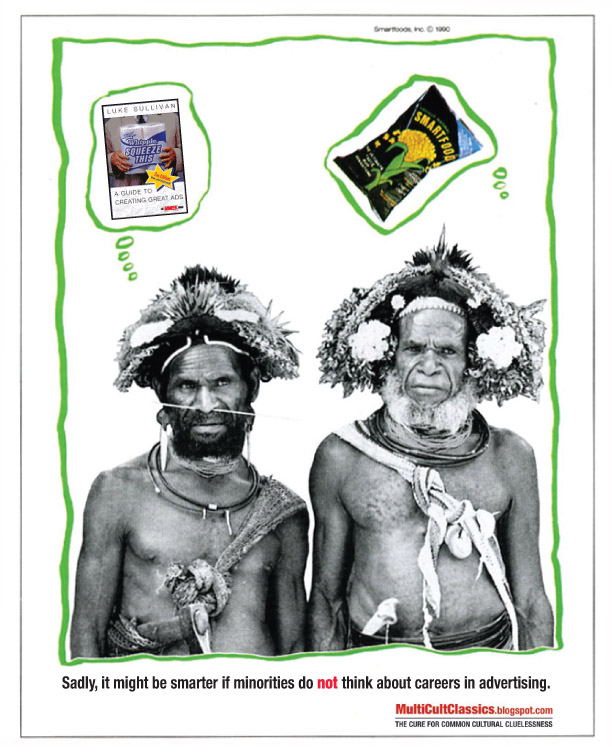
The American Advertising Federation closes out Black History Month with this full-page ad running in USA Today. Hyping the Most Promising Minority Students Class of 2007, the AAF seeks to persuade recruiters to hire the graduates.

There’s a lot to question about this effort.

First, is USA Today really the best vehicle to reach the intended audience? Hell, the ad didn’t even appear in the Money-Business section.

People in the know realize better tactics would include direct word-of-mouth and professional networking. In the Life section of a national newspaper, the message will probably generate more head scratches than job connections.

The ad also features some (hopefully) unintentional copy quirks:

Collect the whole set! (Sadly, there are only about 50 figures available nationwide.)

Be the first on your block. (An admission that, especially if you’re on Madison Avenue, you’ll be the first to hire a minority?)

They’re the best in their class… If you’re a recruiter, you won’t find a better place to shop. (Potentially hurting the many minorities who weren’t lucky enough to be selected to join the MPMS program.)

Overall, not sure it’s right to position minority students as products to be purchased.

This execution, while a well-intentioned endeavor, is trying too hard. It’s another example of adpeople hoping to win an award via cleverness versus creating a solution that will be relevant, meaningful and effective.

[Thanks to makethelogobigger and copyranter for spotting the piece.]

Essay 1781


Royal silliness in a MultiCultClassics Monologue…

• Prince Charles became a royal pain in the ass for Mickey D’s when he declared the fast feeder should be banned. While visiting the Imperial College London Diabetes Center in Abu Dhabi to hype a public health campaign, he said, “Have you got anywhere with McDonald’s? Have you tried getting it banned? That’s the key.” A McDonald’s spokesman responded, “This appears to be an off-the-cuff remark, in our opinion. … It does not reflect our menu or where we are as a business.” The spokesman then probably snickered, “Besides, have you seen the guy’s wife — that says a lot about his tastes.” No word yet from the King at Burger King.

• Eddie Murphy may have stormed out of the Academy Awards show, but P. Diddy allegedly showed greater emotion. The artist allegedly punched some dude in the face at an after-party. According to the punchee, Diddy was hitting on the man’s girlfriend. When the guy stepped in, Diddy hit on him with a punch to the jaw. The man claims to have been severely injured — which means he’ll be putting on an Oscar-worthy performance for financial damages.

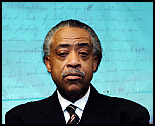
• The biracial daughter of the late Sen. Strom Thurmond believes Rev. Al Sharpton overreacted upon learning his ancestors were slaves owned by Strom’s relatives. The woman said, “In spite of the fact [Thurmond] was a segregationist, he did many wonderful things for Black people. … I’m not sure that Rev. Sharpton is aware of all the things he did.” Hey, maybe Sharpton’s eligible for inheritance loot.

• New studies by California researchers counter the beliefs that immigrants increase crime and job competition. The figures showed immigrants are jailed far less than native-born folks; plus, immigrants actually help to boost citizens’ wages. “The big message is that there is no big loss from immigration,” said one researcher. “There are gains, and these are enjoyed by a much bigger share of the population than is commonly believed.” Another researcher remarked, “There are grossly distorted perceptions between what people think about immigrants and the reality. … The old bromide that education is the way to reduce prejudice comes into play here.”

Essay 1780

Essay 1779


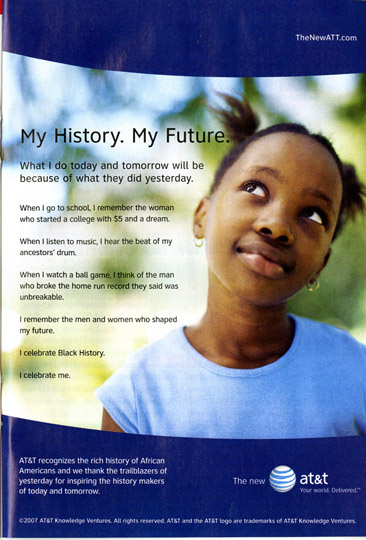
BHM2007: This ad seems to communicate that Black History Month is for Blacks only.

Tuesday, February 27, 2007

Essay 1778


Looks like Procter & Gamble is feeling generous during Black History Month. The following comes from the Associated Press…

-------------------------------------

P&G increases spending on ads targeted to black consumers

CINCINNATI (AP) — Procter & Gamble Co. is building on its decades-long tradition of targeting products and advertising to black consumers, hoping to tap into their growing spending power.

The consumer products giant spends at least six times more on ads in magazines and broadcasts aimed at a black audience compared with five years ago, and is expanding its roster of black celebrities who pitch moisturizers and razors.

Industry watchers say the company has been a model for advertising that features black faces and black families without stereotypes.

“Without question, P&G has to be seen as one of the companies that other companies pattern their behavior after,” said Ken Smikle, president of Target Market News, a Chicago firm that tracks trends in advertising for black consumers.

Cincinnati-based P&G featured a young Bill Cosby in a 1969 ad for Crest toothpaste and in the 1970s created a separate unit to develop marketing for an ethnic audience.

“It was the (population) numbers, combined with the cultural differences, that made it such an opportunity, and frankly such a necessity,” said Buddy Tucker, former head of the unit who left the company last year.

“I am proud to say that when we received some racist backlash from a small number of consumers over the 800 (phone) lines (for customer complaints), management stood behind us and remained committed to reaching out to ethnic consumers.”

Today, black spending power is approaching $800 billion yearly, according to the University of Georgia’s Selig Center for Economic Growth. P&G sees that as a promising source for its goal to increase overall sales by 5 percent.

The company recently hired Tiger Woods for an upcoming campaign to promote Gillette razors, adding to celebrities such as actresses Angela Bassett for Olay lotions and Queen Latifah for Cover Girl makeup.

The company also tweaks the ad message, and products themselves, based on research into black customers’ preferences.

It added flavors to Crest Whitening Expressions toothpaste and scents to Gain detergent because research showed blacks and Hispanics want more scents and flavors. It touts the ability of Olay Definity cream to smooth skin tones for black women, while it’s marketed as an anti-aging cream for white women.

“It’s imperative that I see African-American faces in those spots, but it needs to be more than that,” said Sallie Elliott of North College Hill in suburban Cincinnati, a promoter for a leadership program honoring local black youth. “If it gets talked about in the beauty shop, then it’s on target.”

Essay 1777


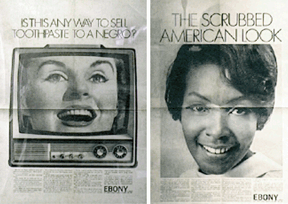
BHM RETRO EXTRA: Two classic Ebony print ads.

Essay 1776


What Can Brown Do For A MultiCultClassics Monologue…

• Foxy Brown charges she was dragged off the toilet by a Florida beauty shop owner and picked on by police in her latest legal drama (see Essay 1720). “I was exposed from the waist down on the toilet. … I had to get dressed in front of a total stranger,” said Brown. “The only crime I’m guilty of is being a young black woman.” Um, Foxy is on probation for past offenses.

• Bobby Brown was ordered to stay in jail until he coughs up $19,000 in delinquent child support and court fees. “Although this agreement was put in place when he was Bobby Brown the star, this agreement is being enforced when he is not always able to find work,” said Brown’s lawyer, seeking to explain why the star has been unable to meet his financial obligations. “He hasn’t made an album in quite some years.” It’s tough being Bobby Brown.

• The New York City Council, seeking to draft a measure to discourage the use of the N-word, wound up using the slur about 50 times in the session. “If I had been the chair, I would have asked them not to use the word,” said the measure’s chief sponsor. “I was not pleased.” Before this is all over, Michael Richards may run for councilman.

• The New York Times reported that the demand for English tutoring far outweighs the supply. In large cities like New York, folks can wait for months — and even years — to get into government-backed classes. Maybe they should attend New York City Council sessions for practice. Click on the essay title above to read the NY Times story.

Essay 1775


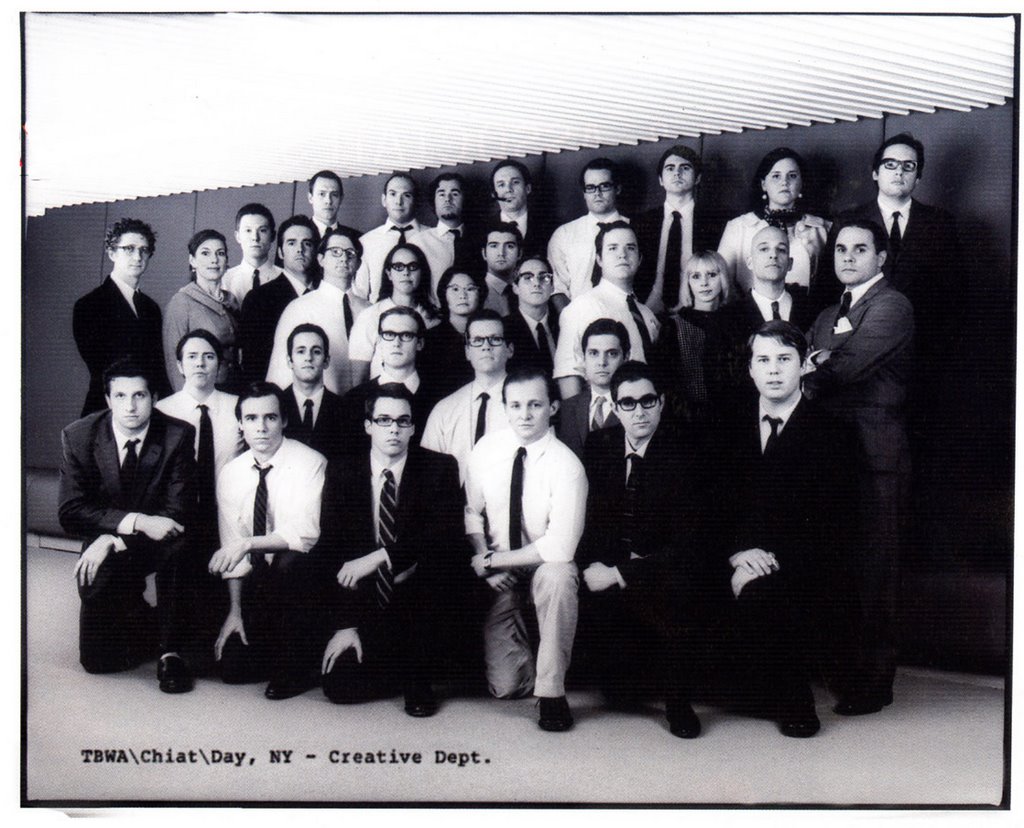
The creative department of TBWA\Chiat\Day, NY staged a retro group portrait for the February issue of Creativity magazine — and wound up revealing a lack of diversity reminiscent of the Golden Age of Advertising.

Essay 1774


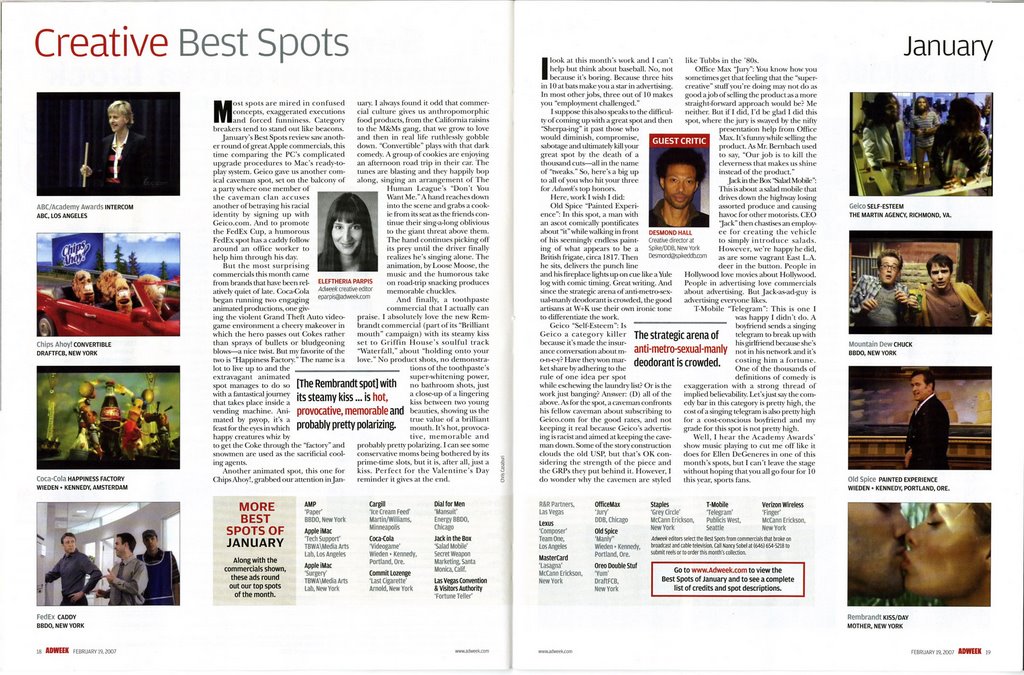
Not sure if it’s related to Black History Month, but Adweek invited Spike/DDB creative director Desmond Hall to serve as Best Spots guest critic.

Essay 1773

Essay 1772


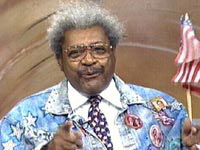
BHM RETRO EXTRA: The King of Beers has been hyping the Great Kings of Africa since the mid 1970s. Maybe Bud could contemporize things by integrating Don King.

[Click on the essay title above for a Black advertising history lesson.]

Essay 1771


Phat news in a MultiCultClassics Monologue…

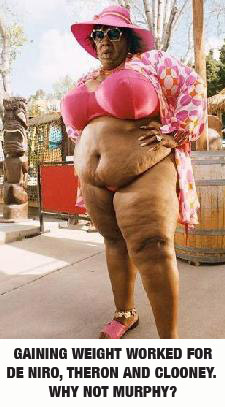
• A miffed Eddie Murphy allegedly exited Sunday’s Oscar show shortly after Alan Arkin was named Best Supporting Actor. Maybe Murphy hoped to catch an early evening showing of Norbit.

• A new dog store targeting female pet owners opened in Seattle and is igniting controversy with its name: High Maintenance Bitch. The store’s founder wants to reclaim the word’s original meaning — a female dog. She said, “Our store is a dog store, but the concept and philosophy is directed specifically toward women.” Actually, High Maintenance Bitch sounds like Alan Arkin’s new nickname for Eddie Murphy.

Monday, February 26, 2007

Essay 1770


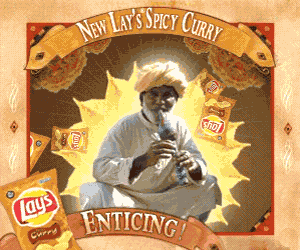
Not sure this is the best way to promote new Lay’s Spicy Curry chips.

Essay 1769


Essay 1768

Essay 1767


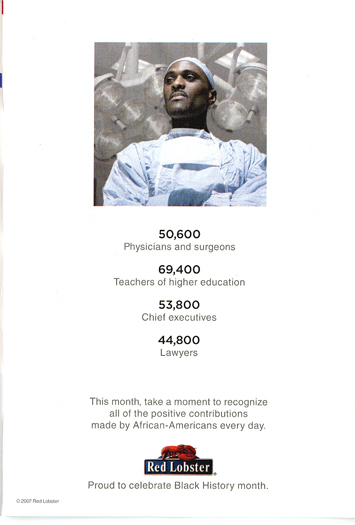
BHM2007: Here’s another Red Lobster BHM message. This one takes a much more positive perspective. Wonder if the figures are still impressive when viewed as percentages.

Sunday, February 25, 2007

Essay 1766


In good hands with a MultiCultClassics Monologue…

• A Texas Federal Court approved a nationwide class action settlement between Allstate Insurance and its minority customers. A lawsuit filed in 2001 charged the insurer discriminated against Blacks and Hispanics, charging them higher premiums based on the company’s credit scoring. “This is a great day for Allstate’s minority customers,” said lead attorney Christa Collins. “This is a groundbreaking settlement, because Allstate has agreed to change the way it uses credit information to price insurance. We believe this change significantly benefits Allstate’s minority customers. … The bottom line is many of Allstate’s minority customers stand to save significant dollars in their premium payments as a result of the credit scoring changes.” Wonder if Allstate used its twisted credit scoring to determine how much to pay spokesman Dennis Haysbert.

• The Virginia General Assembly unanimously voted to express “profound regret” for the state’s role in slavery — as well as “the exploitation of Native Americans.” The measure states government-sanctioned slavery “ranks as the most horrendous of all depredations of human rights and violations of our founding ideals in our nation’s history, and the abolition of slavery was followed by systematic discrimination, enforced segregation, and other insidious institutions and practices toward Americans of African descent that were rooted in racism, racial bias, and racial misunderstanding.” Delegate Frank D. Hargrove is probably hoping Blacks will now get over it already.

• A Virginia Beach Catholic high school principal is ordering sensitivity training for students who chanted “We love Jesus!” during a basketball game. The Catholic school was competing against a school with Jewish students. The principal said, “It was obviously in reference to the Jewish population of [rival] Norfolk Academy; that’s the only way you can take that. … It is important that we work harder at having students leaving here who are tolerant and understand how serious these kinds of things are.” What would Jesus chant?

• Indiana’s DePauw University is facing charges of bias in reference to sororities. Last November, the sisters of Delta Zeta interviewed members about their commitment to recruitment and ultimately ejected 23 members. But every member of the ejected group was overweight; plus, the group included the only Black, Korean and Vietnamese members. The members permitted to stay were all slender and conventionally pretty. “Virtually everyone who didn’t fit a certain sorority member archetype was told to leave,” said one member who opted to leave on her own. Perhaps the banned women can start a Dove Real Beauty sorority.

• The FDNY announced a significant increase in minority applicants, jumping from 3,730 in 2002 to 8,297 this year. “All the hard work we put into this [multimillion-dollar recruitment] campaign has paid off,” said Fire Commissioner Nicholas Scoppetta. “We hope once we begin hiring from this list next year, we’ll have the most diverse group of candidates joining the world’s greatest fire department.” There’s still a long way to go, as the FDNY is currently 91 percent White.

• The Rev. Al Sharpton learned and announced that his ancestors were slaves owned by relatives of the late South Carolina Sen. Strom Thurmond. “I have always wondered what was the background of my family,” said Sharpton. “But nothing — nothing — could prepare me for this.” Thurmond’s gotta be rolling in his grave as well.

Essay 1765


BHM RETRO EXTRA: Seems like the military is always eager to recognize the achievements of minorities — for recruiting purposes.

Essay 1764


From The Chicago Sun-Times…

-----------------------------------------

A movie record that leaves you reeling

BY MONROE ANDERSON

Odds are that when this weekend’s 79th Annual Academy Awards show fades to black, Jennifer Hudson will be hugging an Oscar. The Chicago South Sider’s meteoric rise from an “American Idol” wannabe to a “Dreamgirl” to a Golden Globe Award winner is the stuff of “A Star is Born” script. And Hudson won’t be the only African American going home with the gold. Chances are the names of Forest Whitaker and Eddie Murphy will be spoken after “and the winner is” gets read. Let’s celebrate the moment, but not forget the past.

From “The Birth of a Nation” to “Gone With the Wind” to “The Color Purple,” Hollywood movies have played a leading role in the stereotyping of African Americans for audiences at home and abroad. So, on Oscar weekend, I thought it might be useful to compose of a list of Tinseltown’s Top Ten Racist Movies. I called my friend, Sergio Mims, for some professional advice. Sergio knows movies. He co-founded the Black Harvest Film Festival. He taught film at the School of the Art Institute and Columbia College. He hosts a radio program about movies and he reviews movies for print.

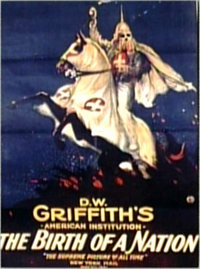
Right off the bat, we both agree on America’s first feature film, “The Birth of a Nation.” The 1915 silent movie started out as “The Clansman” but went through a name change when it traveled to movie theaters above the Mason-Dixon line. Set during Reconstruction, white men in blackface play Negro characters who take over Southern state legislatures. Once in power, they are portrayed as mainly interested in shooting craps, eating chicken, boozing and landing white women. The first law they want to pass is for “equal rights, equal marriage.” Just in a nick of time, the noble, heroic Ku Klux Klan comes to the rescue after a white woman is almost raped by Gus, the renegade Negro. After a quick lynching, the KKK valiantly resubjugates the blacks and restores the good white citizens to their rightful place. “If you compare it with today’s box office,” Sergio said, “it’s one of the most successful movies in American cinema.”

It was also one of the most influential. By romanticizing America’s homegrown terrorist organization, “The Birth of a Nation” ignited a second surge of lynchings. Thousands of African Americans, Mexican Americans and Jews were publicly tortured and murdered to the maddening cheers of Southern white mobs, sometimes during a family outing. D.W. Griffith’s film worked so well as a propaganda vehicle for white supremacy that it’s used to this day as a recruitment tool for the Klan. It also set the standard for stereotyping blacks for generations to follow.

One down and nine to go. But before I could add “Gone With the Wind,” with its scene featuring Butterfly McQueen’s character Prissy proclaiming, “I don’t know nuthin’ about birthin’ no baby,” Sergio argued that my Top Ten plan was both too ambitious and too limited.

Like “The Birth of a Nation,” “GWTW” also glorifies the KKK, but like scores of other Hollywood productions, it deserves to be vilified as part of the sum. And in “The Color Purple,” Danny Glover’s character, Albert, is no renegade Negro, but he’s cut from the same violent, sex-crazed cloth as “The Birth of a Nation’s” Gus. And none of “Purple’s” nine other major male characters would be likely candidates for Man of the Year.

“It’s the collective, constant stream of images in one movie after the other,” Sergio said. Those images portray black men as lazy, lying, head-scratching, raping, violent coons and buffoons. Black women are mammies, maids and whores. And Tarzan is the king of the jungle. In the 1940 movie, “The Ghost Breakers,” Willie Best plays the eye-bulging, knee-knocking butt of Bob Hope’s corny jokes. That same year, in the “Santa Fe Trail,” John Brown was the villain because he tried to free the slaves. “In one scene, a fire breaks out in a barn and the slaves are terrified,” Sergio said. “‘If this is freedom, I want no part of it,’ one slave says. He wants to go back home to the master’s plantation and rock til Kingdom come.”

So when Jennifer Hudson accepts her statuette, I will remember: We’ve come a long way, but we’ve still got a long way to go.

Essay 1763


From The Chicago Sun-Times…

-----------------------------

New Urban League focus is aimed in right direction

The decision by the Chicago Urban League’s new president and CEO, Cheryle Jackson, to get out of the social service business may ruffle a few feathers. But it is a giant -- and necessary -- step toward returning the nation’s oldest civil rights organization to its original mission: equipping African Americans with the tools needed to succeed in today’s America.

Dubbed “projectNEXT,” the successful execution of the plan would put the league at the forefront of the urban economic development movement.

During that first wave of migration and for decades afterward, African Americans knew they could depend on the Chicago Urban League to help them find jobs, as well as to develop the social networks that would lead them to better housing and better schools.

Today, in neighborhoods on the South and West sides -- still the hardest hit by under- and unemployment -- the need is different, but just as great.

Nearly 60 years after the dawning of the civil rights movement, many African-American workers in Chicago are still shut out of trade unions that provide the lucrative jobs needed to improve their communities.

And while mom-and-pop stores serve these areas, too often those stores are not owned by African Americans, nor do they provide the employment opportunities critical to boosting another generation of black workers.

That’s why plans recently unveiled by Jackson to refocus the Chicago Urban League by concentrating on economic development are as exciting as any urban redevelopment plans we’ve heard.

Those plans include tackling the exclusion of African Americans in trade unions, partnering with the Chicago Manufacturing Renaissance Council to help African Americans land high-paying jobs in the manufacturing industry, and using the City Colleges of Chicago to train unemployed workers in the trades.

The group’s goals are to raise black employment and income levels, to expand the number of black-owned businesses and to promote real estate development.

To meet those goals, the Chicago Urban League will create a small-business incubation center and will work with the Kellogg School of Management to help owners of African-American businesses help themselves.

BP America has pledged $6.2 million over three years for the initiative, and the Illinois Finance Authority has committed $1 million to help create an entrepreneurship center.

Jackson’s vision for the Chicago Urban League is grand -- but focused enough to lead this organization into the next frontier of the civil rights movement.

Saturday, February 24, 2007

Essay 1762


[From Target Market News. It’s somewhat odd for Burrell Communications Group to present a study on Black History Month advertising, as the company is responsible for much of the corny and contrived BHM messaging that appears every February.]

--------------------------------

Burrell study sheds light on consumers’ attitudes toward Black History Month

Burrell Communications Group, a leading multicultural marketing communications agency released findings from a recent Black History Month study that reveals current perceptions, connections and the impact of Black History Month within the African-American community. The study was conducted in response to the limited market research available about the February observance, and it benchmarks African-American consumer attitudes across generational age segments.

“It was important to understand how African-American consumers view the importance of Black History Month and the opportunity it presents to connect with these consumers on a deeper, more profound level during the month long observance and beyond,” explains Burrell Communications Co-CEO McGhee Williams-Osse. Research concluded that acknowledging and celebrating Black History Month is vital to both younger and older generations.

At least 79% of each group agreed that it was very important for future generations to understand the historical struggles of African-Americans. Additionally, the majority of African-American’s interest in Black History Month have either remained the same or increased over decades, specifically, within the 18-24 age groups.

Most importantly, the study reveals new insights into the younger African-American consumer market. Considering that much of the Black History Month marketing centers on the legacy, story and the historical struggles of African-Americans, there is an emotional disconnect with younger age demographics. Although the message of honoring and acknowledging the past remains significant to younger audiences, it does not resound as strongly as with their parents’ and grandparents’ generations.

Younger generations have a different perspective on their challenges as compared with those experienced during The Civil Rights Movement. In dealing with racism and oppression, they believe issues are now more covert and subtle. As a result, they have a stronger focus on financial empowerment, battling crime and educational advancement. They want Black History Month to represent and highlight the accomplishments of modern day African-Americans and current issues facing this new generation.

Up to 63% of respondents agree that companies’ participation in Black History Month enhances their image, 65% are more likely to buy products from companies that salute African-American achievements, and up to 57% would recommend the company’s services or products to someone they know, a good source of not traditional or word of mouth promotion.

Consumers are also looking for companies to sponsor more events and activities celebrating Black History Month. In addition to the extending of Black History recognitions beyond February, respondents are also looking for a year-round commitment to showcasing African-American achievement.

Burrell campaigns such as McDonald’s 365Black and Verizon’s History in The Making featuring New Age spoken word poet J. Ivey reflects the responsiveness to current consumer perspectives. In a saturation of Black History messaging, McDonald’s advertising was the most recalled by study participants.

“For decades Burrell has advocated that Black History is a major part of U.S. history and that its observance should not be just compacted into one month. The study validates our stance and provides a better perspective on how African Americans of all ages would like to see their history celebrated,” explains Williams-Osse.

The study underscores that Black History Month initiatives are an effective way for brands to connect and build loyalty with African-American consumers.

Essay 1761


From The New York Times…

---------------------------

In Bid to Ban Racial Slur, Blacks Are on Both Sides

By ANAHAD O’CONNOR

Days after Michael Richards’s racist tirade at a Los Angeles comedy club, Leroy G. Comrie Jr., a New York City councilman, seethed as he listened to some black teenagers on a Queens street spewing out the same word Mr. Richards had been using.

“They were saying ‘nigga’ or ‘niggas’ every other word,” said Mr. Comrie, who is black. “I could tell they didn’t get it. They don’t realize how their self-image is debilitated when they use this awful word in public.”

So Mr. Comrie sponsored a resolution for a moratorium on the use of the n-word in New York City, prompting a spate of similar proposals in half a dozen local governments across four states in recent weeks. The New York City Council is scheduled to discuss Mr. Comrie’s proposal tomorrow and vote on it on Wednesday; the City Council in Paterson, N.J., and the Westchester County Legislature both unanimously approved such bans recently.

(Mr. Richards, who played Kramer on “Seinfeld,” has been invited to the New York City hearings; a Richards spokesman said that he would respectfully decline to attend.)

The measures, which describe the forbidden word as an “ignorant and derogatory” insult toward blacks, try to sidestep First Amendment questions by calling for “symbolic” bans only, meaning they do not have the force of law. Because they are largely aimed at blacks who use the word among themselves, the proposals have revived a debate over whether minority groups can co-opt epithets and make them empowering.

“There is a swelling population of black youth that use this word as if it is a term of endearment,” said Andrea C. McElroy, a black councilwoman who sponsored a ban on the racial epithet in Irvington, N.J., that was passed this month (pictured above, left). “And I think it is basically incumbent upon us to remind them of the story of what that word meant to so many of our ancestors. This is something we probably should have done years ago.”

[Click on the essay title above to read the full story.]

Essay 1760


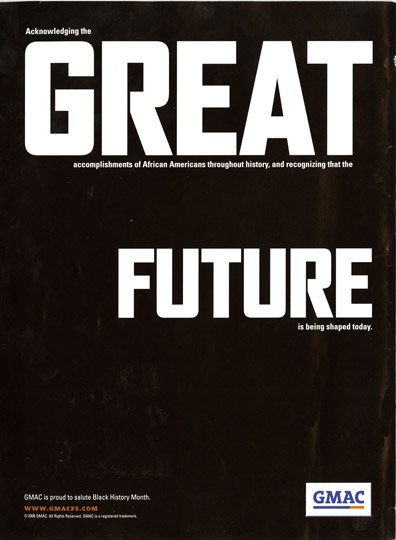
BHM2007: The art director and copywriter responsible for this message do not have a GREAT FUTURE in advertising.

Essay 1759


Ratting out the news in a MultiCultClassics Monologue…

• Forget trans fats — the problem is rats. TV cameras showed rodents scurrying around in a KFC and Taco Bell in Manhattan’s Greenwich Village (pictured above), putting parent company Yum Brands in a bad position. “Nothing is more important to us than the health and safety of our customers. This is completely unacceptable and is an absolute violation of our high standards,” said Yum Brands in a statement. KFC recently asked Pope Benedict XVI to lend his personal seal of approval for its fish sandwiches during the Lenten season. Guess they should also ask him to pray for protection from pestilence.

• Wendy’s will close the restaurant that launched the business in 1969. The historic location has failed to generate suitable profits. “This is a very difficult decision, but the truth is we kept it open for sentimental reasons much longer than we should have,” said a company spokesman. Hey, Yum Brands keeps rat-infested restaurants open, so there’s nothing wrong with doing likewise for sentimental motivations.

• Another promotional campaign has exploded in Boston. This time, the culprit is Dr. Pepper. The soft drink manufacturer created a contest for consumers to seek a coin valued at $1 million that may have been buried in the Granary Burying Ground — the final resting place of John Hancock, Paul Revere, Samuel Adams and others. When crowds showed up at the location, city officials closed down the area, fearing contestants would damage stuff in search of the prize. “It absolutely is disrespectful,” said Boston Parks Commissioner Toni Pollak. “It’s an affront to the people who are buried there, our nation’s ancestors.” A Dr. Pepper spokesman said, “We agree with the Park Department’s decision to lock the gates. We wouldn’t do anything to desecrate this cemetery.” It might have been better — and more clever — to create a promotional tie-in between Dr. Pepper and Dr. Kervorkian.

Essay 1758


From The Chicago Sun-Times…

------------------------------

Oscars reflect greater cultural diversity in movies today

BY LUIS I. REYES AND ED RAMPELL

Jamestown’s 400th anniversary is also a multicultural milestone year for movie minorities. Reflecting our increasingly internationalized society and world, the current bumper crop of films made and released in America is arguably the most culturally diverse in motion picture history. Today’s silver screen features Latinos, blacks, Native Americans, Asians, Arabs and Polynesians shattering celluloid stereotypes.

Civil rights icon Jesse Jackson, who long struggled to integrate the film/TV industry, is “delighted” by this development. Edward James Olmos, a 1988 best actor Oscar nominee for “Stand and Deliver,” declares: “It’s the most prolific time we’ve ever had as Latinos in Hollywood.”

Many of these films earn accolades. This year, the Directors Guild nominated Olmos for directing HBO’s “Walkout,” about L.A.’s 1968 Chicano protests -- which inspired 2006 student strikes against immigration policies. “All of the Oscar-nominated pictures put together give lots of hope to diversity in general, and world cinema in particular,” Olmos said.

In this record-setting year, Latinos received 16 nominations in categories including best picture, directing, acting, cinematography, screenwriting and music. There were nominations for Spanish-born Penelope Cruz for “Volver” and her fellow Mexicans Adriana Barraza (best supporting actress for “Babel”) and directors Alejandro Gonzalez Innaritu, Guillermo del Toro and Alfonso Cuaron.

Innaritu is nominated for directing best picture nominee “Babel.” In best foreign film contender “Pan’s Labyrinth,” the terrors of Franco’s fascist Spain become a child’s fantasy, earning del Toro a screenwriting nomination. Cuaron is co-nominated for editing and screenwriting Oscars for “Children of Men.”

Blacks’ screen image is also rising; Oscar may make history during Black History Month. Will Smith is up for “The Pursuit of Happyness,” which reveals U.S. poverty while challenging caricatures of African Americans as absentee fathers. Jamie Foxx stars in “Dreamgirls,” nominated for eight Academy Awards, including best supporting acting for Eddie Murphy and Jennifer Hudson.

African-born Djimon Hounsou is likewise nominated for best supporting Oscar for the Sierra Leone-set “Blood Diamond.” Best actor Oscar contender Forest Whitaker plays Ugandan dictator Idi Amin in “The Last King of Scotland.”

Other ethnic groups are likewise ascendant. Once-faceless World War II Asian enemies have human faces in “Letters from Iwo Jima” via actors Ken Watanabe and Kazunari Ninomiya. The anti-war film is Oscar-nominated, as are director Clint Eastwood and its screenwriters. As a troubled deaf teenager, Japanese actress Rinko Kikuchi vies for best supporting actress for “Babel.”

Although overlooked, 2006 was a banner year for the Western Hemisphere’s indigenous people. Four films took the Americas’ natives beyond the cowboys and Indians paradigm. Mel Gibson’s “Apocalypto” and Darren Aronofsky’s “The Fountain” depict ancient Mayans. In Eastwood’s “Flags of Our Fathers,” aboriginal actor Adam Beach depicts real-life World War II Marine Ira Hayes.

What accounts for today’s movie minority cornucopia? Films mirror globalization and demographic shifts, such as the emergence of Hispanics as America's largest nonwhite group. The Colts’ Tony Dungy became the first African-American head coach to win a Super Bowl, while blacks wield greater congressional power than at any time since Reconstruction.

Hollywood depictions of nationalities certainly remain imperfect. But one can only ponder what natives such as Pocahontas, Africans here before the Mayflower and groups who came later would make of cinema's brave new multicultural world. From 1607 to 2007, Jamestown’s settlers and indigenous people, plus other ethnic ancestors who've composed the melting pot now called America, have come a long way, baby.

Luis I. Reyes and Ed Rampell co-authored Made In Paradise, Hollywood’s Films of Hawaii and the South Seas and Pearl Harbor In the Movies.

Essay 1757


BHM RETRO EXTRA: Big Tastin’ Biscuits, but no Big Idea.

Essay 1756


From The Chicago Sun-Times…

------------------------------

Black history is a shared legacy of tragedy and triumph

BY JEREMY I. LEVITT

As Black History Month comes to a close, ask yourself if you celebrated it. Isn't Black History Month really “White History Month,” too?

While the aim of Black History Month is to acquire and share knowledge about the innumerable contributions of black civilizations and peoples from ancient history to the present, doing so is virtually impossible without also examining the role of other nations and peoples in the making of black history. From the great civilizations of Egypt, Kush and Nubia to the trans-Atlantic slave trade, slavery, emancipation, segregation and integration, Caucasians, Latinos, Indians, Arabs, Asians and so forth have played a critical role in the history of persons of African descent, as both oppressors and liberators.

In the United States, white Americans have shaped the course of black history and the lives of African Americans more than any other group. In fact, the creation of Black History Month was a reaction to the widely held belief among white Americans in the early 20th century that blacks made no significant or viable contribution to human civilization -- let alone America.

The formal celebration of black history in the United States began in 1926 as “Negro History Week.” Carter G. Woodson, the grandfather of modern black history, selected the second week in February for Negro History Week because it marked the birthdays of two of the most influential figures in American politics: Frederick Douglass and Abraham Lincoln.

Other significant events that took place in February make it an ideal time to celebrate black history, including the birth of W.E.B. DuBois, the famed intellectual, civil rights and pan-Africanist leader and co-founder of the NAACP (Feb. 23, 1868); the passage in Congress of the 15th Amendment giving blacks the right to vote (Feb. 3, 1870); the taking of the oath of office of the first black U.S. senator, Hiram R. Revels, a Republican from Mississippi (Feb. 25, 1870); founding of the NAACP (Feb. 12, 1909); the historical civil rights lunch counter sit-in at the segregated Woolworth's store in Greensboro, N.C. (Feb. 1, 1960), and the murder of Malcolm X (Feb. 21, 1965). I might add that it is also the month that Tony Dungy, coach of the Indianapolis Colts, became the first African American to win a Super Bowl and Barack Obama the first mulatto to declare his candidacy for the American presidency.

Black History Month is not a monthlong affirmative holiday for African Americans, but rather a time for all Americans to learn about and celebrate the rich culture, heritage and achievements of blacks from Chicago to Cairo and Los Angeles to Lagos. It’s a time to remember the sacrifices of the unknown millions of enslaved blacks who were murdered in the Middle Passage and millions more whose blood and labor in bondage provided the economic impetus for America to become the most powerful country in the world. It’s a time to honor the legacy of those unnamed blacks who served as the backbone of the black power and civil rights movements. The black struggle for freedom in America has come at a very high cost to African-Americans -- yet all Americans have enormously benefitted from black liberation. What would America be without the innumerable sacrifices and contributions of African Americans?

All Americans should study black history. For better or for worse, white Americans and other nonblacks have been and are makers of black history. From the white supremacist Democrats and white Republican abolitionists of the 19th century to the white citizens’ councils and non-black civil rights activists of the 20th century, black history is incontestably white, Latino, Arab and Asian history, too. In fact, black history is world history!

No one group owns, controls or is entitled to celebrate Black History Month more than any other. It is the product of a shared legacy of tragedy and triumph that all Americansave a civic responsibility and duty to learn about, reflect upon, debate and share. We should never allow political correctness, guilt or perceived racial ownership interfere with our quest for knowledge and cross-cultural exchange, because to know black history is to know your history.

Jeremy Levitt is a professor of international law at Florida International University and distinguished research scholar at Northern Illinois University College of Law.

Friday, February 23, 2007

Essay 1755


From nationwide news sources…

-----------------------------------

Oscars Spark Renewed Questions of Race

By Bob Tourtellotte

LOS ANGELES — Is racial bias still keeping black artists from being recognized when Hollywood hands out its annual Academy Awards?

On the one hand, the musical “Dreamgirls,” which features an ensemble of black actors in the story of an African-American singing group, failed to earn an expected best film Oscar nomination this year, and some Hollywood watchers wondered if racism played a role.

But on the other, black actors received a record five of the 20 nominations in acting categories for 2006. And three — Forest Whitaker, Eddie Murphy and Jennifer Hudson — are favored to win when the Oscars are handed out on February 25.

If they do not, the question of racism among the nearly 6,000 Academy Award voters almost certainly will be raised again. The Academy of Motion Picture Arts and Sciences has been notoriously stingy to black artists at Oscar time, with blacks having won only 10 acting Oscars since the first awards in 1929, excluding honorary awards.

No black person has ever been named best director.

Race bias will affect Oscar politics as long as it plays a role in U.S. culture, Oscar watchers said. “Race will go away from the Academy when race goes away from America,” said David Poland of MovieCityNews.com.

Poland is one of many observers who said he did not believe race played a part in “Dreamgirls” failing to land in the best film category despite gaining eight nominations overall, more than any other movie.

Since the January 23 nominations, several theories have outweighed racial bias when it came to the “Dreamgirls” snub, according to Oscar pundits, film historians and critics.

Musicals are a hard sell to Oscar voters, they noted. “Dreamgirls” was also touted early on as the best-film frontrunner, and Academy Award voters did not want to be told which film was best before casting votes, some said.

SIMPLE MAY BE BEST

But the simplest explanation is the movie was not among 2006’s five best. “Having seen all the other films … they are better films, pure and simple,” said Gil Robertson, syndicated columnist and president of the African American Film Critics Association.

The five best picture nominees are: road comedy “Little Miss Sunshine,” crime thriller “The Departed,” cultural drama “Babel,” Japanese war saga “Letters from Iwo Jima,” and “The Queen,” about Britain’s royal family in a period of crisis.

Hattie McDaniel was the first black to win an acting Oscar — for supporting actress in 1939’s “Gone with the Wind.” The second was not until Sidney Poitier received the best actor nod for 1963’s “Lilies of the Field,” and the third took almost another two decades — Louis Gossett Jr.’s supporting actor nod for 1982’s “An Officer and a Gentleman.”

Just a handful of supporting actor and actress nods followed, until 2002, when Hollywood thought that the Academy had put the race issue behind it. That year, Denzel Washington won best actor for “Training Day” and Halle Berry was named best actress for “Monster’s Ball.”

It was the first time black Americans won the top two acting awards in the same year. Three years after Washington’s and Berry’s dual wins, Jamie Foxx scored a best actor victory for his role as soul singer Ray Charles in 2004’s “Ray,” and last year the drama “Crash,” which explores race in America, was named best film.

“I think the color barrier is coming down, but it takes a generation or two to die off. It’s a slow process,” said Robert Osborne, Oscar historian and author of a series of books subtitled “The Official History of the Academy Awards.”

What many Hollywood watchers are wondering now is whether younger voters will cast enough votes for Whitaker as the brutal dictator Idi Amin in “The Last King of Scotland,” and Murphy and Hudson playing soulful singers in “Dreamgirls.”

Essay 1754


Posing as news with a MultiCultClassics Monologue…

• A 10-year-old boy in Pennsylvania filed a lawsuit because he was prohibited from dressing up as Jesus for his school’s Halloween activities. The school claimed the costume violated a policy against promoting religion, but the kid argues costumes for witches and devils were allowed. What would Jesus do? He’d probably deny having any involvement with this kid.

• Busta Rhymes was busted again, this time for driving without a license. The rapper, claiming he thought the arresting officers were robbers posing as cops, allegedly told them, “You hide behind the shield. This is bullshit.” You’d think at this point, Rhymes could tell the real cops from the fakes.

Essay 1753


From The New York Daily News…

----------------------------------------

How easily he forgets racism

By Juan Gonzalez

Wesley Chan, a freshman at New York University, did his part to further the new college fad of defending America from yet another “invasion.”

With fellow members of NYU’s Republican club, Chan, who hails from New Jersey, joined yesterday in a bizarre exercise called Find the Illegal Immigrant.

“My parents came to this country from China the legal way: They waited their turn in line,” Chan said, offering a patriot’s pose to the throng of reporters and cameramen camped near Washington Square Park.

Chan stood out as one of the few nonwhites among a few dozen young Republicans who had turned out for what was more of a public relations stunt than a game.

Across the street, a far larger crowd of several hundred angry NYU students found nothing to laugh at.

“It’s degrading and racist,” said Dalia Yedidia, a freshman from San Francisco. “These people are trivializing a serious problem. They’re showing pictures of Mexicans and their children running across the border, so it’s clear who they’re trying to target.”

Chan roundly rejected such charges.

“We have a serious immigration problem we’re trying to highlight,” he said. “A lot of crimes are being committed by illegal immigrants.”

“What about the Chinese Exclusion Act?” he was asked. “That was the law here once.”

The glib words stopped. The smart, young Republican started groping for answers.

His sudden discomfort showed once again how little most of us know about this nation’s history of immigration battles.

Who legally gets to enter this country? Under what conditions can they become citizens? These questions have provoked repeated political battles among each new generation of Americans.

And no story is more buried, none more shameful, none more important to understand than how our nation treated the Chinese — a group so often referred to these days as a model minority.

As early as 1850, when there were only 600 Chinese in California, that state began to adopt discriminatory laws aimed at taxing the newcomers more than other foreigners in order to drive them from the gold fields.

As the Chinese population grew, white labor leaders and politicians began to target them as a new immigrant menace.

On Sept. 29, 1854, in the powerful New York Tribune, Horace Greeley, the paper’s legendary publisher and staunch abolitionist, called the new Chinese “uncivilized, unclean and filthy beyond all conception.” The men, Greeley wrote, “were lustful and sensual,” while every Chinese female was a “prostitute of the basest order.”

Two months after Greeley’s article, the California Supreme Court overturned the conviction of George Hall, a white man who had murdered a Chinese miner named Ling Sing.

The higher court ruled that the testimony of three Chinese witnesses to the murder was not admissible because Chinese, like blacks and Native Americans, could not testify against a white person.

In the court’s opinion, Chief Justice Hugh Murray called the Chinese “a race of people whom nature has marked as inferior, and who are incapable of progress or intellectual development beyond a certain point … between whom and ourselves nature has placed an impassable difference.”

There followed decades of nationwide anti-immigrant hysteria aimed at the Chinese, with Congress finally bowing to the pressure and passing the Chinese Exclusion Act of 1882.

It was the beginning of America’s use of immigration policies to promote racial prejudice.

For the next 60 years, until the outbreak of World War II, virtually all Chinese were banned from entering the United States.

“I don’t support the racist part,” young Chan said after a long pause. “But our leaders were trying to protect our economy at the time.”

Whatever that means.

With the rest of his young Republican friends, young patriot Chan then went off to “Find an Illegal Immigrant” in Washington Square Park.

Essay 1752

Essay 1751


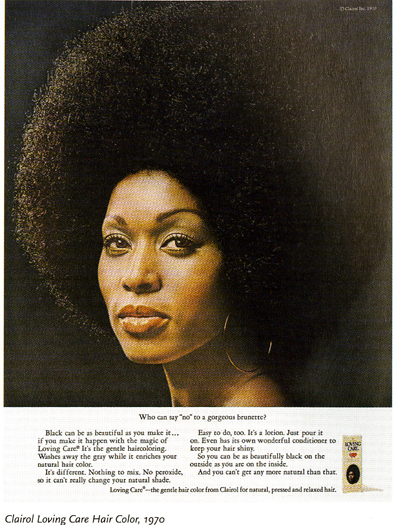
BHM RETRO EXTRA: Miss Clairol colored colored folks too.

Essay 1750


Equal Play in a MultiCultClassics Monologue…

• This year, Wimbledon will award equal prize awards to the men and women competitors for the first time. “I just feel that in the modern world with the modern thoughts, we all understand that everyone’s equal,” said Venus Williams. “So if someone else doesn’t choose to live in the modern world and do the right thing, then thank God that the majority of people in the All England Club do.” Does this mean NBC will pay the same amount of loot to John McEnroe and Mary Carillo? You cannot be serious!

• Republican students at NYU drew criticism for playing a game dubbed “Catch the Illegal Immigrant.” The game calls for participants to hunt down a student wearing a name tag labeled “illegal immigrant.” A protesting student remarked, “The idea of hunting down an illegal immigrant in a game was disgusting. … If they want to have an honest conversation about a very difficult topic, let’s do it. Instead, they decided to host what many of us felt was an insensitive and offensive event.” Wait until the students learn about the “South Of The Border Party” held at Santa Clara University.

• A North Carolina high school teacher sparked controversy after allegedly permitting an anti-Muslim group to address a ninth-grade class and distribute questionable literature, including a pamphlet titled “Do Not Marry A Muslim Man.” Imagine the parties this moron might chaperone.

Thursday, February 22, 2007

Essay 1749


BHM2007: Toyota publishes The Forward Thinker for Black History Month. Please wrap some fish in this one.

Essay 1748


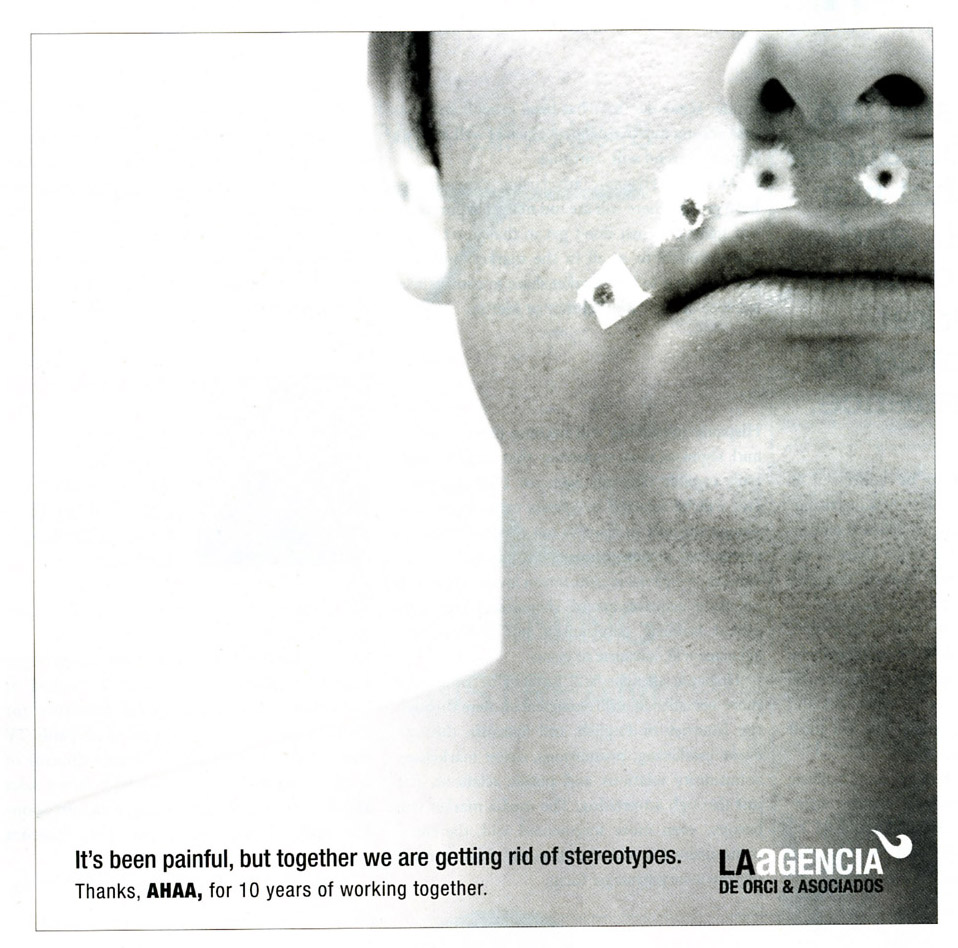
Advertising Age presents a special section commemorating the 10-year anniversary of the Association of Hispanic Advertising Agencies. The contents include reports, interviews and creative work. Plus, there’s the obligatory collection of congratulatory ads — but no fornicating lions ala the DraftFCB Cannes fiasco. Grab a copy of the latest issue or click on the essay title above to view it online.

Essay 1747


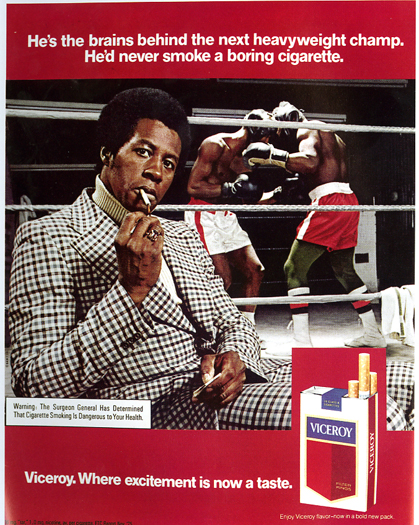
BHM RETRO EXTRA: He’d never smoke a boring cigarette. But he’s got no problem wearing a plaid suit.

Essay 1746


Uncommonly sorry news in a MultiCultClassics Monologue…

• Rapper Common is scheduled to perform at Duke University in April. Problem is, he dissed the school’s lacrosse team during a concert at Emory University last year. “F— them damn n—s from Duke lacrosse,” Common allegedly freestyled. “I really believe in my heart that those boys in Duke lacrosse did it — that they raped a black princess.” Duke officials don’t plan to cancel the upcoming concert, as a contract is already signed. A Duke spokeswoman said, “We’re not actively seeking an apology. It’s free speech. But we would like a statement from [Common’s management] just so we know they recognize that to us it is a very grave situation.” The Duke lacrosse team is probably just hoping for free tickets.

• Producers for “Dreamgirls” apologized to Motown legend Barry Gordy via a full-page ad in Variety. The ad from Paramount and DreamWorks read, “‘Dreamgirls’ is a work of fiction. It is also an homage to Motown. We used many wonderful accomplishments that belong to the rich Motown history. For any confusion that has resulted from our fictional work, we apologize to Mr. Gordy and all of the incredible people who were a part of that great legacy. It is vital that the public understand that the real Motown story has yet to be told.” Gordy released a statement that read, “For the past 50 years, I have been protecting the integrity, the love and the talent that is and has become Motown’s legacy. … I applaud DreamWorks and Paramount Pictures for doing their part, to clearly differentiate the fictional movie ‘Dreamgirls’ from the real Motown.” No word yet from the Duke lacrosse team.

Essay 1745

Essay 1744


BHM2007: Isn’t it time to take the Month out of Black History Month? Um, isn’t it time to take the patronizing messages out of Black History Month?

Essay 1743


Random, semi-coherent thoughts regarding the Advertising Age story presented in Essay 1741 and the responding letters in Essay 1742…

Gee, Wallace S. Snyder seems a tad oversensitive. A closer read of the Advertising Age article shows a pretty fair analysis of the situation. Snyder’s been in the business long enough to understand how headlines and copy work to draw attention. Chill out, dawg.

All minority internship programs deserve respect and appreciation just for trying. At the same time, an honest inspection of the efforts seems reasonable — and even imperative.

If the AAF initiative is truly successful, Snyder should have stepped forward to display the amazing results when things got really hot during Advertising Week 2006. Or perhaps the survey revealed bugs that have always existed in the 10-year-old MPMS program.

The 4A’s runs its Multicultural Advertising Internship Program (MAIP). Senior Vice President Don Richards — who leads of the organization’s Agency Diversity Programs — once bragged, “We have the premier diversity internship program in the industry.” Um, didn’t realize it was a competition.

Yet while both of these esteemed groups claim to cultivate and operate so successfully, there’s still a ridiculous dearth of diversity on Madison Avenue. Whassup wit dat?

Could it be that minority internship programs — while vital and invaluable — only address a small, segregated piece of the puzzle?

You can recruit the able bodies, but if there’s an inadequate and invisible support system, well, MPMS and MAIP spell MESS.

Maybe it’s not the minority students who lack the qualifications and potential to make things happen — rather, it’s the majority adpeople. The culturally clueless are probably incapable of professionally mentoring and creating inclusive environments. However, for true integration to occur, these folks must evolve and progress too. It’s unreasonable, unmanageable and unfair to expect MPMS and MAIP alumni to shoulder all the responsibilities. Remember, there aren’t enough of them to begin with. Just ask the New York City Commission on Human Rights.

It’s time to supplement minority training programs with majority training programs.

Wednesday, February 21, 2007

Essay 1742


Letters From The Latest Issue Of Advertising Age…

Accentuate positive in minority issue

The headline in the Feb. 12, 2007 edition of Advertising Age, “Nearly One-Third of AAF Minority Candidates Vacate Ad Industry,” is a deliberate distortion of the research upon which the story is based. As noted in the article, 69.3% of Most Promising Minority Students are employed in advertising, marketing and communications. How many industries can prove those numbers?

Not only have we come a tremendous way since starting the program in 1997, but the American Advertising Federation will continue to refine and improve the workplace environment for minorities through new business practices relating to mentoring, integrating and promoting talent. We will do so despite Advertising Age’s reporting.

Wallace S. Snyder
President-CEO
American Advertising Federation
New York

As a proud alumna of the AAF Most Promising Minority Students program, I was saddened that the focus was on the one-third who left and not the two-thirds who stayed. The success rate of the AAF MPMS program is unparalleled. As the premier industry trade publication and a valued supporter of the AAF MPMS program, I would think you would support the incredible success of the program and not join the tired choir that continue to champion the negative point of view of diversity in advertising.

Tiffany R. Warren
VP-director of multicultural programs and community outreach
Arnold
New York

One group left out of the diversity fray

RE: “NYC Shops Scramble to Hit Diversity Targets” (AA, Jan. 15). There is a minority within the diversity pool that seems to be left out of almost every mention of the subject: service-disabled-veteran-owned businesses. Attending the 4A’s/AAF diversity fair in New York in November, I was able to identify a grand total of two of us out of 400-plus attendees. All federal government contracts require 3% participation by service-disabled-veteran-owned businesses. Yet, every attempt by this service-disabled-veteran-owned business with HUB (historically underused business) Zone certification to partner with the holding-company agencies with large government contracts has been met with a slamming door.

With the number of service-disabled veterans joining the work force after serving our country in the “global war on terror,” there needs to be a big wake-up call for integration of this federally designated minority into the advertising business.

David Esrati
Chief creative officer
The Next Wave
Dayton, Ohio

Essay 1741


From the February 12 issue of Advertising Age (followed by online responses)…

-------------------------------------

Nearly One-Third of AAF Minority Candidates Vacate Ad Industry
Lack of Mentors Biggest Stumbling Block; Being Pigeonholed Also an Issue

By Brooke Capps

NEW YORK (AdAge.com) -- One month after the New York City Commission on Human Rights released its minority-hiring goals for agencies, 50 of the most talented minority students in advertising came to New York for lunch -- and were virtually devoured by 40 recruiters there to meet them.

The perception about or the reality of low starting salaries, along with difficulty breaking into the business, may be part of the reason MPMS alumni have left the ad business.

MPMS program
The American Advertising Federation has for a decade run its Most Promising Minority Student program to help connect candidates with ad agencies, media agencies and marketers. But finding them and keeping them aren’t the same thing, as evident by the group’s first career-path survey.

Nearly one-third of MPMS program’s alumni have since left the business. Advertising professors Alice Kendrick and Jami Fullerton, who conducted the survey and analyzed the results, speculate that perception about or the reality of low starting salaries, along with difficulty breaking into the business, may be part of the cause. Another issue that emerged as a stumbling block for almost all the participants was the lack of mentors.

The upside is that three-quarters of survey participants said they would be willing to serve as mentors themselves. “They know how important it is and what it meant to them,” said Ms. Fullerton, a professor at Oklahoma State University.

Other concerns
Another concern among minority candidates was that they would be “forever relegated to working on minority accounts,” said Ms. Kendrick, a professor at Temerlin Advertising Institute of Southern Methodist University in Dallas.

Several respondents remarked that it was a double-edged sword: They felt pigeonholed and found it difficult to work on minority business with people who didn’t understand the culture.

-------------------------------------

Take this in the larger perspective – I’m an industry veteran who has seen minority and “non-minority” people leave this business at an alarming clip. It’s not about ethnicity – it’s about (many) other things. — NY, NY

Great point on looking at the 66% vs. anything else. By comparison, AD AGE would look at other educational institutions and the % of dropouts and success for example. Number for number.....it is the same percentage at any learning institution or field anywhere. EX. dropout rates for Hispanics in just US High School is 35%. Freshman graduation rates at major colleges can also be found to be the same percentage. — Brandon, FL

The facts mentioned in this article do not surprise me at all. Matter of fact, I am one of the one-third who left the Advertising industry because of lack of recognition and promotion due to not having a mentor. When I started at my first agency, the environment was extremely challenging to find someone who would take me under his or her arms to show me how to handle clients and how to make an account profitable, which leads to recognition and promotions. These ideal mentors either do not necessarily have time to mentor people or are lousy mentors themselves. I resorted to learning the business through the school of hard-knocks and quit after 6 years. Being an African American, I would advise minority students who are looking to get into Advertising to find a small but talented agency with good people to learn the business of Advertising. Advertising is a tough and competitive business that can deter hopes of making it big in the business. However, I would like to see or hear more insights from the other two-third who are doing well and how they managed to survive. — San Francisco, CA

As a proud alumnus of the AAF Most Promising Minority Students programs I was saddened that the focus was on the 1/3 that left and not the 2/3 who stayed. The success rate of the AAF MPMS program is unparalleled. As the premier industry trade publication I would think you would support the obvious success of the program and not join the tired choir of voices who champion the negative POV of diversity in advertising. — New York, NY

Essay 1740


Critters Gone Wild in a MultiCultClassics Monologue…

• The University of Illinois’ Chief Illiniwek mascot will perform for the final time today. However, the school is still wondering what to do with the trademarked logo (pictured above). The NCAA mandates prohibit associating the imagery with athletic programs, but there are no rules against having the school own the trademark. Look for the Chief and his logo to start showing up at student parties.

• A judge ordered O.J. Simpson to turn over income from past TV projects, movies and commercials to Ron Goldman’s family in order to pay off the wrongful death lawsuit conviction. However, the judge rejected the family’s attempt to also collect future earnings. So O.J.’s free to pursue new gigs — like serving as the University of Illinois’ new mascot.

• Busta Rhymes was offered a plea deal to stay out of jail for allegedly beating up two people. The deal would call for three years’ probation, six months of anger management therapy and three weeks of community service. The rapper and his lawyer, who both vehemently deny the charges, are considering the offer. The deal should include protection for the anger management therapist.

• Checkers Drive-In Restaurants is taking heat for a promotion persuading customers to dress their cats in a special take-out bag. The “Rapcat” bags are designed to look like the jersey and gold chain worn by a hip-hop puppet featured in commercials (pictured below). “We have no ill will toward Checkers or Rapcat as a character,” said an animal services spokeswoman. “Our message is that it is not a good idea to try to stuff a cat in a bag. It’s a matter of common sense.” Checkers’ senior vice president of marketing responded by saying, “When our Rapcat commercials began airing last fall, they were an overnight success. … We received dozens of letters from our guests requesting Rapcat merchandise. Our new Rapcat website, cups and carry out bags are all in response to Rapcat’s popularity and are intended only as a creative extension of our television campaign.” This VP cat sounds like a moron.

[Click on the essay title above to view a Rapcat commercial.]

Essay 1739

Essay 1738


From USA Today…

---------------------------------

Racism: What do we tell the kids?

By Bruce Kluger

Those of us who grew up in the civil rights era saw things that sound like cruel fiction when retold to our children. Yet these lessons are vital, for the progress we see today is only possible because of the pain we felt yesterday. And this generation may just deliver us from the evil past.

Forty-five years ago this spring, my brothers and I (ages 5, 6, 7 and 9) went to a Saturday afternoon showing of Pinocchio at the Uptown Theater in suburban Baltimore. Our mom had errands to run, so she sent us with our babysitter, Elizabeth.

Outside the theater, we noticed that Elizabeth was engaged in a hushed conversation with the woman in the box office. Apparently, she was having trouble buying our tickets. “But I’m the babysitter,” Elizabeth said coolly. “I have to stay with them.”

After a bit more whispering, we were admitted to the theater and seated as a group in the glassed-in balcony. My brothers and I had never sat up high before, and we were delighted by it all. What we didn’t know was that we had no choice. Elizabeth was black and not permitted in the lower seats.

When I tell my daughters (Audrey, 8, and Bridgette, 11) this story, they look at me wide-eyed, as if I’m concocting some wild fiction. To them, skin color has always been a non-issue, as inconsequential in their personal relationships as hair color, eye color or even the color of a blouse.

Audrey’s first “boyfriend” in pre-school was a handsome little man named Mekahel, a black child with an infectious smile and boundless energy. The only time Audrey and Mekahel ever discussed color was over crayons.

Bridgette’s godfather Guy, meanwhile, also is black, a trait she finds far less interesting than his computer wizardry or the fact that he was the first person she ever “danced” with — at a wedding, when she was just 4 weeks old.

‘The past as the past’

To my daughters and their friends, the days of America’s apartheid are sepia-tinted, blurry, a giant chapter of our national story that, once shouted from pulpits in Birmingham and Memphis, has now been compacted for easy listening. Sure, they’re taught about Martin Luther King and Rosa Parks maybe once a year in school; and perhaps they’ll casually glimpse some boring documentary their parents are watching in the den.

But kids of any generation tend to see the past as the past — and, besides, a new episode of American Idol is on tonight.

So as we celebrate Black History Month, I wonder: What kind of responsibility do we parents have in educating our children about the sad legacy of racism that has run through our nation’s life like a persistent electrical current? Do we bequeath that shame to our kids out of a sense of obligation, charging them with the task of carrying the long, hard fight of our troubled heritage into a new era? Or do we quietly give thanks for their blissful naivet — their lucky late-century birth — and hope that the deeper sense of fairness that is already evident in their new generation may take root in America’s future? Do we leave well enough alone?

To be sure, our country is experiencing a transformation that would have been unimaginable half a century ago.

Our last two secretaries of State have been African-American (likewise, both 2007 Super Bowl head coaches); our most talked-about presidential candidate is black; people of color populate executive suites and statehouses across the country in increasing numbers. And the only conversation about race that seems to interest Major League Baseball anymore is the one about the pennant.

Yet just because America’s more notorious racial injustices are thankfully behind us — the segregated lunch counters, the unconscionable lynchings, the ignominious Jim Crow laws — thick capillaries of discrimination continue to pulse beneath our national skin. These lingering vestiges of that old-time racism are, in many ways, just as insidious as those we thought we’d thrown off with the great civil rights acts of the ‘60s, if only because they are more cleverly cloaked from view.

Today’s stains of racism

Blacks continue to be shut out of polling places because of dubious technicalities. Families of color continue to carry a disproportionate share of our country’s worst afflictions — from poverty and unemployment to teen pregnancy — at national rates that have consistently remained two to three times that of whites for the past 20 years. Minority youth continue to be isolated, not embraced, by our education system, despite the efforts of No Child Left Behind. And in November, another unarmed black man was killed in a hail of police bullets, just a subway ride from where my daughters go to school. It was a flashback to the bad old days.

This, to me, is what Black History Month is really about — a time to step back and measure our growth as a nation against the work that remains to be done. Certainly, I appreciate honoring noteworthy figures who somehow never made it into my childhood classroom texts (black scientist Charles Henry Turner; 1867-1923; the first to prove that insects can hear). But our children also need to know that America’s complicated relationship with race is an unfinished story, and it will one day be up to them to write its ending. That’s why, as a parent, I’d rather spend this month — not to mention the 11 around it — making sure that my kids understand that black history is their history, too.

Just like their dad at that movie theater nearly 50 years ago, Bridgette and Audrey live in a country that still struggles to do the right thing. But unlike their father, they were born in a time of progress, a time of hope. We haven’t yet reached Martin Luther King’s mountaintop in America. But I have to believe that our children may one day take us there.

Bruce Kluger, a member of USA TODAY’s board of contributors, is also a contributing editor for Parenting magazine and writes for National Public Radio.

Essay 1737


BHM2007: Verizon presents poet J. Ivy for Black History Month. Target trumps Verizon with Dr. Maya Angelou.

Essay 1736


From The Chicago Sun-Times…

------------------------------

Object of a proposition: English as a national language

BY ED FEULNER

In the mid-1950s, French educator Jacques Barzun said, “Whoever wants to know the heart and mind of America had better learn baseball.” He correctly recognized the sport as a cultural touchstone that united us.

Half a century later, finding a tie that binds us as a nation is a little tougher. So let’s go back to basics. How about the English language?

This probably seems like common sense. After all, English is already universal. It’s not only spoken by an overwhelming number of Americans, it’s also understood by hundreds of millions worldwide. It’s the language of aviation, and thus international commerce, as well as the default language of the Internet. Everyone, from stock traders in New York to software designers in Mumbai, uses English to conduct business.

But instead of using the power of our native tongue to unite the country, our official policy has been to balkanize the United States.

Executive Order 13166, issued by Bill Clinton in the summer before he left office, mandates that any group that receives any federal funding must provide its services in any foreign language that may be spoken by someone likely to receive those services. So instead of having one official language, in practice we have dozens.

Predictably, this leads to problems. As David Leahy, the election supervisor for Miami-Dade County, told PBS in 2001, “We print every ballot in Spanish, English and some ballots in Creole.” So much for the idea that an election should promote national unity. No wonder we sometimes have problems figuring out who won.

Enough. It’s time for a new approach, one that unites all Americans instead of dividing them -- and one that stops putting the children of immigrants at an economic disadvantage. English should be our official language. This can, and in fact must, start in our schools. And we’ve already taken an important step.

Under President Bush’s leadership, we’ve made significant progress toward helping all American students become fluent in English. Previously, the federal bilingual education program had promoted non-English instruction; in fact, three-fourths of the program's funding for public schools was reserved to teach students in their native languages. Instructors weren’t even required to know English.

That’s changed. Now, the goal for non-English speakers is to make them, well, English speakers. Their teachers have to know English, and schools must chart student progress. Schools are required to inform parents when their child is placed in an English-learning course and to disclose the course’s methods, its requirements, and alternative ways their child can learn English.

Still, lawmakers should go further, ensuring that federal funding for English-language learners is used exclusively for courses that move students toward English fluency as quickly as possible, not on bilingual-education programs that indefinitely postpone their ability to function independently in their new homeland. Students in bilingual classes learn English more slowly than students in regular classrooms do. Every student learning English as a second language should do so in an immersion program. That'll help them learn English more quickly, so they can make the move to a standard classroom.

Immersion works. Just ask California voters, who opted out of bilingual education in 1998 in favor of immersion. Since then, according to the Lexington Institute, the state has seen major gains in students’ English fluency, with the best progress charted in the districts that are taking steps to emphasize early English fluency.

One of the federal government’s primary jobs is to unify Americans. Besides being our native tongue, English is the language of commerce worldwide. Every student should be able to speak it fluently. That’s the only way to ensure that every child can make progress toward the American dream.

Ed Feulner is president of the Heritage Foundation.

Tuesday, February 20, 2007

Essay 1735

Essay 1734


BHM RETRO EXTRA: Wilt Chamberlain claimed he had sex with over 20,000 women. Wonder how many of the encounters took place in his VW Rabbit.

Monday, February 19, 2007

Essay 1733


BHM2007: Wellpoint takes a Medicare ad and tags it with a Black History Month salute. Now that’s ill.

Essay 1732


From Adweek.com…

------------------------------

Q&A: Alex López Negrete

By NANCY AYALA/Marketing y Medios

Houston-based López Negrete Communications had a momentous start to 2007. Despite weeks of delays, the incumbent for the Wal-Mart Stores Hispanic account kept the $50 million business. “It’s the first time there’s been a review [in 11 years],” Alex López Negrete, president and CEO, said. “Keep in mind that a client like this gets agency kits 24/7.” Needless to say, he added, “we’re very happy to see how it ended up.” With a client roster that includes Bank of America, Visa, Domino’s and new clients ConAgra Foods and Novartis, he has reason to be so.

Q: With so much attention on the general-market Wal-Mart account, it seemed Hispanic was getting overlooked. Was that the case?

A: If I had anything to say, I couldn’t say it. But I really had nothing to say. [Wal-Mart] was nothing but professional in the process. You’ve got the biggest retailer in mankind’s history having an agency review. That can’t be easy. I’m glad they took their time, and they made decisions they feel good about. I never felt shortchanged by anybody in the process, by [search consultancy] SRI, by Julie [Roehm, Wal-Mart’s fired svp of communications], by anybody.

After the review, what are you focusing on?

The focus is transition and integration to make sure we’re all up to speed and that we deliver to the [Hispanic] customer. Not only did we compete for this large piece of business, but we had a lot of work to do. We had a roll-back campaign, we had the Latin Grammys, we had the big RBD initiative. We had holiday. (He gives a relieved laugh.) It was as busy a year as we’ve ever had for Wal-Mart.

How did you go about connecting Wal-Mart to hot pop band and Univision TV stars RBD?

Hispanic agencies, historically, have been better at doing branded entertainment, integrated marketing and all this kind of stuff that is so buzzy right now in the general market. You look at the RBD concert that we had here in Houston, that we filmed and then we broadcast on Univision—that was not an event that we decided to sponsor—we created that event: Wal-Mart, López Negrete, Anderson Merchandisers and [record label] EMI Televisa. We sat at a table and said, “Wow, how do we do this?” In the Hispanic space, we’re ahead of the curve. I don’t think we’ve been given credit. I think that that’s what 2007 will bring more of, not just for retail, but category after category.

Are all your clients angling to go this route?

I wouldn’t doubt it. The thing is about all clients, or at least all of my clients, we’re all interested in things that we can own and build around as opposed to just sponsoring. All clients want more ROI, and they want to be associated with properties that are memorable and meaningful to the audience, whether it’s Hispanics or Smurfs. Take a look at who’s committed. [For] Wal-Mart, we built a whole initiative around the World Cup. Why Wal-Mart? Well, what are you going to watch it on? HDTV, which I got for sale real cheap [at Wal-Mart]. Where are you going to buy your jerseys? Wal-Mart. Where are you going to buy the snacks, the beer and the chips and the salsa for your World Cup viewing party? Wal-Mart. [We] built these great merchandising opportunities around the World Cup that are very unique.

How much does marketing play a part?

At the end of the day, I would rather you call me a Hispanic marketing agency than a Hispanic advertising agency because the responsibility this agency has is to connect its clients with Hispanic consumers. That’s my job. Along the way, do you produce ads? Yeah. Do you do promotions? Yes. Do you do interactive? Yes. But again, Wal-Mart, Visa, ConAgra, Novartis, any of my clients are not going to gauge me and do my review on, “Wow, you did cool ads.” We are in the era of ROI. My job is to demonstrate ROI.

Bank of America seems to be aggressively expanding nationwide.

That’s been a labor of love. When we came on the roster with them, they were spending a million bucks. Wal-Mart was spending a million and a half bucks 12 years ago. Part of our responsibility as an agency is to grow those accounts so that the Hispanic consumer can partake of them. It’s an interesting thing. I really see this higher calling for what we Hispanic agencies do that fuels [our] work. This business isn’t easy by any stretch. And so you have to have a reason to get up in the morning beyond just doing cool spots. … The nice thing about Bank of America for us is that it’s moved beyond the broadcast realm and the print realm. We’re handling a lot of direct response and a lot of direct marketing for them. The stuff you see in Spanish at a bank of America branch, that’s our work.
I feel like I should switch banks since I’m constantly being wooed with both English and Spanish fliers at home.

That’s right. That’s the idea. With Visa, right now we just completed the new campaign for them. You’re going to start seeing this on the air next week. We shot it in Argentina and Uruguay.

Will we see some new work soon for ConAgra?

One of the first brands that we’re working on is [for ConAgra’s] Act II popcorn. We’re beyond storyboard phase there. We’re testing the work now. It’s a great category, it’s a great client. They’re a very marketing-focused client. We’re very full-steam ahead on that one. Same thing with Chili’s. We’re at storyboard stage with them right now.

What stage are you at with Novartis?

Anybody who has a pharmaceutical client will tell you that it’s a highly regulated [business] that doesn’t move that quickly. It’s very big and you can’t really talk about certain treatments that are coming out. For us, it’s been a great learning experience. We’re learning about disease areas that they’re investing in. We’re not doing commercials right now. It’s more about getting integrated. I think this year will be a year of learning and putting their initiatives on the road, if you will.

Novartis selected your agency in December. Are you still looking for new business in ‘07?

Our commitment and our focus is always to deliver above and beyond to the clients that have given you the opportunity to add their name to your roster. It’s not a contest of who ends up with more new businesses. Are we looking for new business? There are some categories that we would very much like to pursue. We want clients that last with us. You take a look again at the number of years that we’ve had with Bank of America. We’re going into our 15th year. Visa brought us on at the end of ‘98, so we’re going on nine years with them. Wal-Mart again, we’re going onto our 12th year. You want those relationships to last because we invest a great deal in them, just like clients invest a great deal in you.

It sounds like you are just as committed to building a dependable staff that will stay with you at your Houston headquarters.

The creative I’m most proud of is careers and helping build people’s lives. When Javier [Gonzalez-Herba, vp/creative director] joined my agency, he was straight out of the University of St. Thomas and hadn’t had a job a day in his life. He’s been with me 21 years, and now he’s one of the preeminent directors in the space. Again, it’s about building careers. Jaime Belden started with me as a production artist, who is now creative director for my direct-marketing unit. He’s been with me for 12 years. When you see people grow within your organization, and have three kids, a house and cars, we made that possible together. That’s the cool creative. That’s what I’m in this thing for. Frederico [Traeger] joins our team under Javier’s leadership. To me, that’s a really great moment in my career. Federico and I went to high school together [in Mexico City]. He was creative chief at Bromley, at Bravo. Here’s a guy who is a very unique human being with a hell of a pedigree, and he chose us. We invited him to come in, and he said, “Yeah, this is a place I want to be.” Luis Gonzalez, one of my other creative directors, he was with me nine years and then he went off to general-market land for four or five years, and then he came back to us. So he’s been with me a collective of 11 years now. It’s really unique, I tell you. You look at Simon El Hage Lisha, who is my director of marketing services and business development, he’s going on eight years with me. Adalis Arroyo, who is my group account director on Wal-Mart, she’s with me now 12 or 13 years.

It’s great to be able to speak in decades [about clients and staff].

You know what’s cool about that? This is our 22nd year, but we’re still young. The energy is still there, and we still feel like the new kids on the block. We still feel like the underdog. I love that idea. You should never lose your underdog status, whether it’s real or not. It makes you appreciate your wins.

Essay 1731


A Presidents’ Day MultiCultClassics Monologue…

• A gay couple were married in New Jersey (pictured above), becoming the first people to take advantage of the state’s new same-sex equal-rights law. “It’s a tremendous step forward, but we want more,” said the head of the gay-rights group Garden State Equality. “It is progress but it’s not the final goal.” Perhaps they could do a promotional tie-in with Snickers.

• Nicole Richie was charged with her second DUI, which means she could be facing jail time. Good luck finding a prison uniform that will fit her.

Essay 1730

Essay 1729


BHM RETRO EXTRA: You haven’t come a long way, baby. Plus, studies show menthol cigarettes are the most potent and lethal of all. Any coincidence these smokes are so heavily advertised to Blacks?


Essay 1728


From The New York Daily News…

------------------------------

Amazing grace always defeats hatred

By Stanley Crouch

Friday is the 200th anniversary of the day that the efforts of England’s abolitionists paid off and the British Parliament cast the vote that brought an end to the slave trade. This was one of the greatest moments in Western history and had absolutely no parallels in Africa, the Middle East or Asia. Is this because — as the owners of slaves and the defenders of slavery would have us believe — that the pale-skinned people of Europe were superior to those with darker hues or eyes that appeared to be slanted? Hardly.

The fact of the matter is that two things essentially cooked slavery’s goose. One was Christianity, because of its conception that there were no chosen people and that all had equal access to God. The other was the idea of universal humanism, the grandest conception to arrive in the 18th century. Universal humanism meant that there is a universal connection between human beings that transcends time, religion or place. To think that is a natural and very simple deduction is to be pathetically ignorant of the tribalistic thinking that has dominated the vision of our species and underlies all wars that are not fought over land masses.

Together, those two ideas were central to the thinking that led to the abolition of slavery without bloodshed in Europe and through an extremely bloody Civil War in the United States. In both cases and both places, things went beyond.

The campaign in England was led by William Wilberforce, and two events are taking place that acknowledge this momentous moment in world history. One of them is a very fine film called “Amazing Grace,” which opens this Friday to celebrate the anniversary of the campaign led by Wilberforce — a campaign which not only rocked the system of bondage but built its coffin and laid it to rest. The other is a superb history of the British campaign against slavery, which has the same name and was written by Eric Metaxas.

It is of absolute importance that we also see that the abolition of the slave trade helped to purify universal humanism, which was not initially conceived to include those from outside of Europe or outside of Christianity.

Great thinkers of the 18th-century Enlightenment such as Voltaire and John Locke went on the record making what seem now to be absurdly racist statements.

But the racist thoughts of even great thinkers were overmatched by the Christian will, the great determination and the resilient shrewdness Wilberforce brought to the long march that brought slavery down piece by piece.

Petitions, boycotts and brilliant strategy won the day.

“Amazing Grace,” whether seen or read, will prove to you how great a human effort abolition demanded and may convince you that it is time to stop allowing those in the South to pretend that the issue was any other than being able to legally own other human beings and treat them like lower animals capable of speech.

Sunday, February 18, 2007

Essay 1727


BHM2007: The Museum Of Science And Industry in Chicago presents a special program titled, “Black Creativity 2007: Designs For Life.” The event includes showcasing contemporary Black industrial designers, workshops, symposiums, performances and more. Click on the essay title above for additional details.

Essay 1726


It’s like asking you to choose between new leather or suede kicks. Because it’s like asking you to eat a shoe.

Essay 1725


Beating the news with a MultiCultClassics Monologue…

• School officials at Santa Clara University are investigating a January off-campus party whose “South Of The Border” theme featured students mocking Hispanics. Partygoers dressed up as janitors, gardeners, gang members and pregnant teens. Damn, Santa Clara University students are clearly ignorant — they should realize a party like that must be held much later in the year during Hispanic Heritage Month.

• Cingular revised a commercial that made reference to an old minstrel song. The spot features a dude coming up with nicknames for his father-in-law named Jim, who ultimately offers “Jimmy Crack Corn” — from the tune titled “Blue Tail Fly,” a song about a slave mourning his master’s death. Consumer complaints prompted the cell phone company to edit out the remark. Talk about dropped lines.

• The Florida beauty shop owner who faced a spitting, hair-glue hurling Foxy Brown hopes to get an extreme monetary makeover (see Essay 1720). “I hired a lawyer. I hope to pay off my mortgage with whatever I get. … She definitely has to pay for what she did — one way or another,” said the owner of Queen Beauty Supply in Pembroke Pines. Talk about trying to turn Brown to green.

• A man accused of attacking Holocaust scholar Elie Wiesel was nabbed by cops in New Jersey (see Essay 1689). Officials charged him with attempted kidnapping, false imprisonment, elder abuse, stalking, battery and the commission of a hate crime. Looks like a guy who allegedly believes the Holocaust was a hoax will now be facing real imprisonment.

• A settlement was reached over conflicts involving the estate of civil rights icon Rosa Parks, negating the need for a trial between relatives and the institute bearing Parks’ name. So the Parks family doesn’t have to worry about sitting in the back of a courtroom.

Essay 1724


From The Los Angeles Times…

--------------------------------------------

Kramer vs. Kramer without Kramer
Michael Richards’ accusers get their day in mock court as the comedian is ‘tried’ for his n-word outburst at an L.A. comedy club.

By Rong-Gong Lin II, Times Staff Writer

There was no bailiff, no court reporter, no public and no charges lodged at the start of the trial.

There was even no defendant in person — but no matter. The mock trial would go on, its centerpiece a videotape replay of the accused, actor Michael Richards, repeating the “n-word” over and over in an onstage tirade at a Hollywood comedy stage three months ago.

The goal: to try Richards before an audience of invited media, relying on testimony from the four African Americans who were the targets of Richards’ outburst, a UCLA psychologist and a Chicago-based expert on the history of the n-word. Presiding over the trial was a three-member panel headed by former California Supreme Court Justice Armand Arabian, who rendered a nonbinding verdict on the comedian who portrayed Kramer on the hit TV series “Seinfeld.”

Attorney Gloria Allred, who organized Saturday’s event, held at Loyola Law School, and picked the judges, acknowledged it was unusual.

“If we went ahead with a regular lawsuit, it could have taken several years before it got to court,” Allred said of the four African Americans. “Now is when they are hurting. Now is when the public needs to hear a trial.”

Saturday’s event was scheduled after attorneys for Richards and the four audience members were unable to agree on how to proceed with a meeting or mediation. The four have not filed a civil case.

Allred invited Richards and his lawyers to attend the event; they declined, saying any meeting between the two sides should be private.

So the trial went on, and a verdict was rendered — to no one’s surprise — against Richards. The panel recommended the actor pay each of the four plaintiffs $50,000 for intentional infliction of emotional distress, double what Allred had sought.

“What a shock!” said Richards’ attorney, Douglas Mirell, feigning surprise. He called it a “Soviet-style show trial … that has utterly no legitimacy.”

But Mirell said Richards still wants to apologize to the four.

Jamie Masada, the owner of the Laugh Factory, where Richards went on his tirade after allegedly being heckled, said Saturday’s event appeared to be opportunistic. “They’re trying to make a Hollywood stage show out of it,” Masada said.

Masada said that other audience members — African Americans, whites and Latinos — were in the audience, and some were crying as they left the Laugh Factory the night of Richards’ performance.

Compensation should also go to the people who were crying and walking out, Masada said.

Richards should make a donation to charities, such as those in South-Central L.A., that help homeless children, or that teach children about race relations, to show that he’s serious about his apology, Masada said.

But the four African Americans represented by Allred said they felt they were specifically targeted in Richards’ outburst, which began after one of them, Kyle Doss, told Richards that his friend didn’t think he was funny.

Doss, 26, whose voice can be heard on the video reacting to Richards’ outburst, said he hoped Saturday’s verdict would send a message that Richards’ actions “should have some kind of consequence.”

“No one deserves anything like that,” Doss said. “You don’t deserve to be thoroughly embarrassed because you’re different.”

Essay 1723


BHM RETRO EXTRA: Here’s some Old School copy — “For a change of taste, let us whip some cheese on it. Have mercy!!”

Essay 1722


From The Chicago Tribune…

----------------------------------------

Is one month long enough?
Black history=U.S. history

By Tracy Mack, a copy editor on the Tribune’s Metro desk

It’s time to end Black History Month.

For that matter, it’s time to say goodbye to Hispanic Heritage Month, Asian Pacific American Heritage Month and American Indian Heritage Month as well.

For those who question why a black woman would express such sentiments, rest assured it is not because I lack pride in my heritage. It is because I am proud to be a black American.

It has been said before, but it bears repeating: Black history is American history. The same could be said for all of this country’s ethnic groups. These histories have intertwined to make America unique, and they deserve equal respect.

To reduce these groups’ contributions to just one month of stories about “trailblazers” is ludicrous. As grateful as I am to Martin Luther King Jr., Malcolm X and Harriet Tubman, their stories have become obligatory sagas of Black History Month.

Unlike many of the blacks in recent years who have called for an end to Black History Month, I am not a mouthpiece for conservative Republicans. And although actor Morgan Freeman has been quoted as saying that he, too, believes the month should end, I disagree with his suggestion that racism will end if we stop talking about race. Race colors everything in America.

Black Americans’ history can be traced to the exploration of the continent.

In 1492, a black navigator named Alonzo di Pietro piloted one of Christopher Columbus’ ships on his first voyage to the Americas, according to one of my favorite books, “Great Negroes Past and Present.”

In 1513, 30 blacks were with Vasco Nunez de Balboa when he discovered the Pacific Ocean. A black pioneer named Estavanico, under the direction of the Spanish government, explored what is now Arizona and New Mexico.

The first blacks brought to Colonial Virginia were indentured servants who worked for their freedom, as were many of their poor white European counterparts.

In fact, a black man named Anthony Johnson, brought to Virginia in 1621 as a servant and slave, worked his way to freedom and by 1650 owned indentured servants/slaves himself, according to that state’s census.

It is difficult to tackle these stories and more in one month.

Knowledge lacking

Most depressing is that the majority of American students are woefully deficient in the knowledge of their history, education assessment exams have shown.

In 2002, only 57 percent of 4th graders knew that differences over slavery in the North and South were one of the primary causes of the Civil War, according to the National Assessment of Educational Progress.

If the goal is for Americans to have a lasting understanding of blacks’ contributions to this great country, then neither Black History Month nor the current school curriculum seems to be working.

It’s time for a change.

I don’t pretend to know the complexities of setting school curricula. But I do know that black history has to be part of a larger, more thorough approach to history. If left on its own, black history might not seem important to some, and therefore, students might not enroll in the program.

For example, the racially integrated Oakton Elementary School in Evanston is experimenting with an African-centered learning program. African themes, topics and examples are incorporated into these classes throughout the day. Children sing the black national anthem, read books about African or African-American children, and shop for items at a make-believe Nigerian market when learning math concepts, among other things.

Although the program was open to all pupils in the district, only parents of African-American pupils opted in. Another problem is that the program is housed in a separate wing at the school. Critics fear that racial separatism might spill outside the classroom. Proponents say the enrolled youths are eager to learn, are more attentive and express pride in their heritage, but it appears only black pupils are reaping the benefits.

‘No Ethnic Group Left Behind’?

I advocate a more inclusive approach. Although many decry the federal No Child Left Behind act, which sets high learning standards and accountability in schools, I believe it lays a foundation for our thoughts about history. Perhaps there should be a federal “No Ethnic Group Left Behind” act, which sets higher standards for U.S. history education.

One option would be to require that students take an American history course as well as an ethnic-group history course (each group with its own course), every year from K through 12.

At first I thought my idea to end Black History Month was unique. Carter G. Woodson had the wrong idea when he started Negro History Week in 1926, I thought. But I discovered that Woodson never intended for the week, which was renamed and turned into a monthlong celebration in 1976, to be a permanent fixture.

He thought black history should be included in American history and that a month is not enough time to learn one group’s significant contributions.

“Woodson spoke of the day when Negro History Week would be unnecessary, but on this point he is often misrepresented,” said Daryl Scott, chairman of the history department at Howard University and a spokesman for the Washington-based Association for the Study of African American Life and History, a group Woodson founded in 1915.

“The end of Negro History Week did not imply the end of the study about black folks as a people,” Scott said. Woodson “talked about a move from Negro History Week to Negro History Year. By this he meant that a week was too short to encompass all that was needed to know about black history. He felt black history should be an everyday part of American life.”

Mr. Woodson, I agree with you. That day has come.

Saturday, February 17, 2007

Essay 1721


BHM2007: How come the author of “The Pursuit of Happyness” looks so damned unhappy? Plus, the statement that “wealth is the least important component of happiness” seems odd coming from Wal-Mart.

Essay 1720


Talking and trashing in a MultiCultClassics Monologue…

• The mayor of North Miami (pictured above, left) has invited NBA gay-basher Tim Hardaway to spend the day with him. “We’re just trying to show him that there are living, breathing people that just happen to be gay,” said North Miami Mayor Kevin Burns, who is gay. “I don’t expect [Hardaway] to be waving a peace flag anytime soon, even after this. … But maybe he’ll be less likely to say something bad about people if he knows them and understands a little more.” Hardaway will probably open by saying, “Hello Gayor Burns — I mean, Mayor Burns.”

• Foxy Brown’s anger-management studies apparently failed, as the rapper was busted for assaulting a Florida beauty shop owner. Brown allegedly threw hair glue and spat at the owner. “This is news to me,” said the rapper’s lawyer. “She’s doing very well with probation, and she’s doing very well with her anger-management classes.” Um, somebody needs to show him Foxy’s report card.

• Eminem’s ex-wife is ripping the rapper, even dissing his sexual abilities. “I vomit in my mouth whenever I’m around him,” said the ex-wife. Rappers spit rhymes; their ex-wives spit, oh, never mind.

Essay 1719


BHM RETRO EXTRA: Sean Combs bragged he was breaking new ground with the ads for Unforgivable. But this Funky dude predates Diddy by over 30 years.

Essay 1718


From The Chicago Tribune…

-----------------------------------

Illiniwek’s last dance

It took almost 20 years and some strong-arm encouragement from the National Collegiate Athletic Association, but the University of Illinois has finally agreed to stop “honoring” Native Americans with a prancing caricature in a feathered headdress and blue-and-orange war paint.

Chief Illiniwek, the university mascot since 1926, will dance his last dance at Wednesday’s men's basketball game.

It’s long past time for this issue--and Illiniwek--to go away. Over the years, the debate has occupied the time and energy of students, university administrators and trustees, alumni, the Illinois General Assembly, the U.S. Senate and at least two governors. All of them have more important things to worry about, such as studying for finals or running the country. The squabble over the chief is a distraction and a poor reflection on the state’s flagship academic institution.

There were some noble arguments on both sides, especially in the beginning.

The chief’s defenders said he was a symbol of strength, valor and dignity. They wanted to preserve a revered tradition honoring the state’s rich Indian heritage. Those who wanted Illiniwek gone said his antics--designed to fire up the fans at halftime--were not respectful of Native American religions and customs.

In the end the struggle was more about whether the forces of political correctness would compel a beloved institution to retire in shame. How else to explain the self-righteous but disingenuous insistence on “honoring” Native Americans when many Native Americans themselves objected? The argument that no offense should be taken because none was intended is a little like saying the aggrieved parties can’t take a joke.

Across the country, the same controversy has played out more than 2,000 times since the 1970s. Elementary schools, high schools, colleges and even pro sports teams have changed their names or made other concessions to correct offensive stereotypes.

The University of Illinois needed an extra nudge from the NCAA, which since 2005 has prohibited the school from hosting postseason athletic events because of its “hostile and abusive” mascot.

Experience elsewhere suggests otherwise, but there are still worries that the university’s multibillion-dollar fundraising campaign will suffer as angry alumni seek to punish trustees for capitulating to the NCAA. That would be a poor way to show support for the school--or for Native Americans.

Essay 1717


[Revised layout for previously presented concept.]

Friday, February 16, 2007

Essay 1716


BHM2007: In the company of greatness… longing to be in the company of a decent art director and copywriter.

Essay 1715


Bigot plans for the weekend with a MultiCultClassics Monologue…

• Michael Richards will not be meeting this weekend with the four Black men he targeted in the infamous comedy club tirade. A planned powwow will happen without the ex-Kramer because lawyers could not agree on the nature and purpose of the event. The men’s lawyer sought to gather a jury of a retired judge and two lawyers, but opposing counsel complained that he wasn’t given enough details regarding the potential participants’ identities. “I don’t even know who they’re planning to use as the retired judge, and we certainly haven’t had any agreement about it,” said Richards’ counsel. “That’s obviously a part of mediation. Both sides have to be comfortable with who the mediator is.” Richards is probably pushing for Jerry Seinfeld and Jason Alexander.

• Ex-NBA star Tim Hardaway is under fire for his rant that featured, “I hate gay people.” Activist groups and others have been quick to denounce Hardaway, and the league has banned him from appearing at the upcoming All-Star Weekend. “As an African American, I know all too well the negative thoughts and feelings hatred and bigotry cause,” said Hardaway. “I regret and apologize for the statements that I made that have certainly caused the same kinds of feelings and reactions. … I especially apologize to my fans, friends and family in Miami and Chicago. I am committed to examining my feelings and will recognize, appreciate and respect the differences among people in our society. … I regret any embarrassment I have caused the league on the eve of one of their greatest annual events.” Maybe Hardaway can organize a special All-Star Weekend featuring Michael Richards, Mel Gibson, Rosie O’Donnell and Isaiah Washington.

• The Hershey Company, creator of chocolate stuff, plans to cut about 1,500 people from its workforce and move some operations to Mexico. Names for the downsizing event include “The Hershey’s Kiss-Off.”

• Volkswagen becomes the latest advertiser to pull a commercial after public outrage. The automaker also presented a potential suicide, except this one involved an actual person who decides not to jump off a ledge after learning about great savings from Volkswagen. Damn, these advertisers can’t even be original with their rejected ideas.

• The Ohio couple that forced their foster kids to sleep in cages will spend two years in cages themselves, as a judge sentenced them to prison terms. During the sentencing session, the couple continued to argue the cages protected the kids from hurting themselves. The woman claimed one child once tried to jump from a second-story window. “Would you prefer that we let them jump? Either way, we’d be here. The difference is they’re still alive,” said the foster mom. No word yet from the American Foundation for Suicide Prevention.

• The University of Illinois has decided to end the reign of its Chief Illiniwek mascot next week, ultimately bowing to pressure from Native American groups and the NCAA. Of course, not everyone is happy to see him go. One person who portrayed the mascot in the 1990s said, “It is a dishonorable ending to 80 years of an honorable tradition. … The tradition and the origins and the efforts that we have made over the years have only been done in respect of the history of Illinois and the history of the Illinois tribe. To see that linkage and that appreciation go by the wayside … without an opportunity to find common ground is disappointing.” Let’s hope the Chief doesn’t try to jump off a bridge.

Essay 1714


From The Chicago Sun-Times…

-------------------------------------

Lack history month?
African-American celebration going commercial

BY ERIN TEXEIRA

Black History Month: Come February, the now-familiar observance seems to inspire ever more -- and ever more random -- celebrations.

Multinational corporations mount billboard campaigns, while community centers hold fashion shows and tourist spots highlight their connection to black history.
But does saturation equal success?

While the concept of Black History Month has been widely embraced in pop culture, it means some of the nation’s most bitter history also is getting watered down into cliches or irrelevance. Some events have no historical tie-in at all – they’re merely topics of interest to African Americans. And, perhaps unsurprisingly, black history is used as a kind of commercial brand.

“It has become very mainstream,” said Sheri Parks, a professor of American Studies at the University of Maryland. “I do think it’s been diluted. Some of this seems like an excuse to put things on sale.”

Black History Cheerleading
At Drexel University in Philadelphia, events range from panel discussions about affirmative action and self-segregation on campus to a black art sale and a Down-Home Soul Food Dinner.

In Maryland’s Prince George’s County, there’s a Black History Cheerleading Show.
A new-age center in Oakland, Calif., offered Mindful Drumming for Opening Minds and Healing Hearts.

Black History Month “does caricature itself at times,” said Linda Symcox, author of Whose History?: The Struggle for National Standards in American Classrooms. Though she believes the month is a good thing overall, she said some events cross the line.

“If I were an African American, I would be offended by having the month of February be some kind of palliative,” she said.

Proof that corporate America has discovered Black History Month came Feb. 4, when the Super Bowl for the first time featured two African-American coaches.

Super Bowl ads
Frito Lay had a commercial showing black families bonding over a football game with an announcer’s voice saying, “We’ve got more than a game here. We’ve got history.”

Parks felt there were too many ads highlighting black history. “With the first one, I smiled,” she said. “By the third one, I wasn’t smiling anymore. I wondered if they were exploiting [black history] and why.”

But, she added, commercialism is inevitable in American culture. “It’s unrealistic in this culture to say that Black History Month should be noncommercial. This is how we do it.”

Essay 1713

Essay 1712


BHM RETRO EXTRA: Would an order from Flagg Bros. be considered funk mail?

Essay 1711


From The New York Daily News…

------------------------------------------

Poverty is a poor excuse for violence

By Stanley Crouch

Before the victories of the civil rights movement, the murders of black people during the most intense redneck reigns throughout the South were committed by those once called “poor white trash.” These were the people who became homicidally enraged at the idea of a black man acting as if he was a free person.

What is now so appalling is that while the street gangs that presently terrorize black communities across the nation do so with astonishing levels of murder and mayhem, they are so often defined by supposedly empathetic liberals as victims of race and class.

No such glib hogwash was spewed when the murderers were white and the resultant corpses were black. No one ever explained that the lower-class rednecks who were presenting themselves under peaked sheets while burning crosses, setting homes afire, bombing homes, offices and churches or murdering and mutilating their black victims, did so because they were feeling inferior to the white upper class of the South.

When the killers were white, the issues were justice and injustice, not social status or income. If there were actual justice, as we often heard during those violent Southern years of the civil rights movement, the killers would be punished for their crimes and black people would be able to walk the streets with the safety that should be the right of every citizen of this country.

But when the street gangs emerged with unprecedented fury 30 years ago in Los Angeles, we began to see something quite unusual. The opinions of those who had been so ice cold when it came to Southern racists either became quiet or looked for ways of explaining away the corpse after corpse after corpse left perforated by shotgun blasts and automatic weapons. Some were gang bangers, some were innocent bystanders, some were children caught in the crossfire.

In my travels to many cities during the past 30 years, I have noticed a distinct difference between the perception of these knuckleheads by those within striking distance of their anarchist wrath and those who live far from the mean streets on which so much violence takes place. Those oppressed by crime do not have the kind of inordinate sympathy for these killers that the bleeding hearts do. They want them controlled, incarcerated or removed from the world.

Is that because lower-class black people do not understand the nuances of racism and cannot comprehend the overwhelming power of the self-hatred that drives these young men who only want comradeship and the feeling of importance? Even if they must get that feeling of importance by terrorizing their communities?

But that is not the problem. Lower-class black people may not know statistics, but they do know that the overwhelming majority of black people who are not economically fortunate do not murder, rape and brutalize other people.

The monsters among us are always a decided minority, even within a minority, somewhere just above 1%. That is the hardest and most enduring fact, but the one that those who put all blame at the feet of “the system” never want to hear. They prefer to think of black people and Hispanics as wind-up toys who can make no decisions of their own.

That is part of the burden and the tragedy of our time.

Thursday, February 15, 2007

Essay 1710


BHM2007: The American Advertising Federation placed an advertisement in Advertising Age to show off its minority student program, while also permitting Pepsi to present a Black History Month message. Guess the only way to get minorities into the trade publications is to run an advertisement. Or publish reports about subpoenas.

Essay 1709


Nissan says the Black Experience is everywhere. Apparently, so is the Black Advertising Cliché.

Essay 1708


BHM2007: It’s not too late to pick up your Black History trading cards. Created by Luanga Nuwame (pictured above), the cards are designed to ignite new interest in historical events and figures. Nuwame said, “In my research from August to November 2005, I met with young Black kids and youths who felt 50 Cent’s lyrics meant more than Dr. King’s ‘I Have a Dream’ speech. I met older Black adults who knew little about ancient African legendary figures and both children and adults of other ethnicities that couldn’t be bothered picking up a book on Black heritage. If these cards can’t get people excited and inquisitive about Black history, I don’t know what will.” Click on the essay title above to learn more.

Essay 1707

Essay 1706


BHM2007: Mickey D’s celebrates its timeless tradition of producing ads with dancing and singing Black folks.

Wednesday, February 14, 2007

Essay 1705


From the Associated Press…

------------------------------------------------

Army Post Opens Its Own Nightclub

By RUSS BYNUM

FORT STEWART, Ga. — On weekends, Army Pfc. Keith Smith used to drive 45 miles to Savannah to find a nightclub with hip-hop music, single women and a bar open well past midnight.

The 24-year-old soldier would often have too much fun to make it back to the barracks. “There’s been times I went to Savannah and had to sleep in the car because I didn’t want to get a DUI,” the New Yorker said.

But now he can do his drinking, dancing and lookin’ for love just blocks from his Fort Stewart billet, without even leaving the Army post.

Deciding too many soldiers were dying behind the wheel after partying out of town, Fort Stewart commanders spent $300,000 turning a defunct sports bar on the Army post into Rocky’s, a bar and nightclub that aims to mimic the after-hours party scene of Savannah’s hippest spots.

Knowing booze and dance tunes wouldn’t be enough, commanders also eased security restrictions at the post’s front gate to encourage civilians — namely women, who get free admission between 10 p.m. and midnight Fridays and Saturdays — to party at Rocky’s, which opened in November.

“We never want to glamorize alcohol, but we’ve got to be realistic about this,” said Col. Todd Buchs, garrison commander. “If we know they’re going to drink, let’s provide a safe place for them to drink so we know they’re going to be alive the next morning.”

[Click on the essay title above to read the full story.]

Essay 1704


Taking credit with a MultiCultClassics Monologue…

• A major bank plans to offer credit cards exclusively to illegal immigrants. “We are willing to grant credit to someone with little or no credit history,” said one bank spokesperson. Another remarked, “These people are coming here for quality of life, and they deserve somebody to give them a chance to achieve that quality of life.” But a spokesman for the Federation for American Immigration Reform said, “They are clearly crossing the line; they are actually aiding and abetting people who broke the law.” Ironically, the name of the financial institution is Bank of America.

• The Detroit News was a tad low in its estimate on job cuts at DaimlerChrysler (see Essay 1700). Turns out the automaker plans to eliminate over 13,000 jobs. Bet there will be a lot of depressed factory robots on the assembly line.

Essay 1703

Essay 1702


BHM RETRO EXTRA: This could explain how OJ managed to flee so quickly from the murder scene.

Tuesday, February 13, 2007

Essay 1701


Newspaper reports about advertising-related issues are usually idiotic. This piece from the New York Post is no exception. Check it out. A brief MultiCultClassics commentary immediately follows…

-------------------------------

OFFENSIVE FOULS CALLED OVER SUPER BOWL SPOTS

By HOLLY M. SANDERS

REJECTED: Snickers’ mechanics ad drew fire from gay rights groups.

This year’s Super Bowl ads managed to offend fast-food workers, gays and the depressed and suicidal.

General Motors’ spot depicting a sad robot that dreams of jumping off a bridge was the latest ad to come under fire, this time from a suicide-prevention group that deemed it insensitive. Thousands of Detroit autoworkers who have been laid off from their jobs weren’t amused, either.

Other ads that hit a hot button included a Snickers’ commercial in which two male mechanics end up locking lips and freaking out — angering gay and lesbian advocates — and a Nationwide insurance ad starring Kevin Federline as a fry cook that burned a restaurant trade group.

Ad execs said it’s tough to anticipate what will be a hit or a miss, and the chances of pleasing all 90 million people who tune in to watch the big game is next to impossible.

“Any time you do something that reaches that large an audience, you’re going to ruffle some feathers,” said Ari Merkin, founding partner and creative director at New York agency Toy. “It’s hard to predict what will and what won’t rub people the wrong way.”

Marketing experts said while some ads are truly offensive, others seem outright benign. “There are organizations out there looking for attention in the same way these advertisers are,” Merkin said.

-------------------------------

First, it’s incorrect, insensitive and downright ignorant to write, “This year’s Super Bowl ads managed to offend fast-food workers, gays and the depressed and suicidal.” The American Foundation for Suicide Prevention — as well as countless people who lost friends and family to suicide — expressed unhappiness over the GM spot. To refer to them as “the depressed and suicidal” is just plain dumb.

Another gem: “Ad execs said it’s tough to anticipate what will be a hit or a miss, and the chances of pleasing all 90 million people who tune in to watch the big game is next to impossible.” Gee, let’s admit that adpeople have no idea whether their big ideas are breakthrough or bullshit. And the goal has never been to please all 90 million people. But it sure isn’t necessary to offend a large number of them.

Ari Merkin continues the stupidity by remarking, “Any time you do something that reaches that large an audience, you’re going to ruffle some feathers. … It’s hard to predict what will and what won’t rub people the wrong way.” Why is it a given that feathers will be ruffled? Has anyone heard public outcry over the work from Coca-Cola, Blockbuster or Emerald Nuts with Robert Goulet? Mr. Merkin, it really is hard to predict what will and what won’t rub people the wrong way — when you’re completely clueless about the sensibilities of anyone not sharing your personal culture and perspective.

Merkin solidifies his silliness by opining, “There are organizations out there looking for attention in the same way these advertisers are.” Right, the American Foundation for Suicide Prevention is desperately seeking to place itself in the spotlight. What an arrogant and asinine viewpoint.

Old school adpeople like to proclaim, “A good idea is a good idea.” The same equation applies to a bad idea.

The New York Post needs to focus its journalistic skills on topics where they may actually have expertise — like the tawdry affairs of Isiah Thomas and the New York Knicks.

Essay 1700


A mean-spirited MultiCultClassics Monologue…

• Nashville Mayor Bill Purcell vetoed the proposal to make English the official city language (see Essay 1682). “This ordinance does not reflect who we are in Nashville,” said Purcell, calling the measure unconstitutional, unnecessary and mean-spirited. “If this ordinance becomes law, Nashville will become a less safe, less friendly and less successful city.” Plus, unconstitutional, unnecessary and mean-spirited.

• Fred Goldman and family are now chasing after O.J. Simpson’s acting-related residuals. Simpson apparently still receives loot for movies like “The Towering Inferno” and “Naked Gun,” and the Goldmans hope the money can be diverted to pay off the $40 million wrongful-death lawsuit tab. Yeah, residuals for those flicks ought to cover a sizable chunk of the lawsuit award.

• According to the Detroit News, DaimlerChrysler plans to cut about 1,000 salaried positions — roughly 7 percent of its white-collar workforce. Yeah, that ought to cover a sizable chunk of the automaker’s shrinking profits.

Essay 1699

Essay 1698


BHM2007: American Airlines presents its Ultimate Family Reunion promotion for Black History Month. Wonder what would happen if a non-Black family won the contest.

Monday, February 12, 2007

Essay 1697


From The New York Post…

-----------------------

DEF JAMMIES
VIDEO GAME SLIPS INTO COOL CLOTHES

By SUZANNE KAPNER

A new video game due out next month lets players pretend to be rap stars and dress like them, too.

The latest fashions from Phat Farm, Adidas, Rocawear and other brands will get top billing in “Def Jam: Icon,” a game jointly produced by Def Jam Interactive and Electronic Arts, in which players try to get their foot in the door of the music business.

Players can model characters after themselves, or after real rap stars such as Method Man, Jim Jones and T.I. They acquire points depending on how tight they become with virtual mogul Curtis Carver. The more successful they are, the more money they have to buy clothes.

Players can try on Sean John jeans or Adidas T-shirts in virtual stores before purchasing the items (in the game, not the real world).

In an attempt to make the game as authentic as possible, the virtual products are modeled on real-life merchandise that will be sold in stores this fall. Even pricing is similar; $78 for a Sean John hoodie, for instance. The game even incorporates something called “cloth physics,” which means the virtual clothing will ripple and move when a character walks.

“We wanted to create as authentic an experience as possible,” said Lauren Wirtzer, the vice president of Marketing for Def Jam Enterprises.

While not entirely new, brands are increasingly popping up in video games, either through product placements, or in the case of Def Jam: Icon, licensing deals that allow the use of product images.

The next generation Xbox from Microsoft and PlayStation 3 from Sony are taking the concept a step further by allowing players to plug into the Internet and make actual purchases.

In the case of Def Jam: Icon sometimes the rap stars who are featured in the game dictated what brands they would wear. The rapper T.I., for instance, insisted that his virtual self wear a specific style of Michael Jordan sneakers with a red sole.

Essay 1696

Essay 1695


From USA Today…

---------------------

Big piece of civil rights history is falling apart

By Jerry Mitchell The (Jackson, Miss.) Clarion-Ledger

MONEY, Miss. — Years of neglect and the battering winds of Hurricane Katrina have all but destroyed the country store where the crime that galvanized the civil rights movement began.

The events at Bryant's Grocery and Meat Market in August 1955 led to the murder of a black teenager named Emmett Till. “Like the Liberty Bell, it’s the symbol of the movement,” Democratic state Sen. David Jordan says. “That ought not to be lost.”

Leflore County Tax Assessor Leroy Ware says the store isn’t worth a penny on the county’s books — but that didn't stop the crumbling store’s owners from initially asking local officials last year for $40 million. They later reduced their asking price to $4 million.

Local officials balked and countered with a $50,000 offer. Talks broke off, and the store has continued to rot, despite being included on the Mississippi Heritage Trust’s list of the state’s “10 Most Endangered Historic Places.”

Harold Ray Tribble, whose family owns the property, says he plans to start working in March with local, state and national officials to return the property to its original condition. “We want to restore it,” Tribble says. “It’s a part of history, and it’s about to fall down.”

Till, 14, a Chicago teen visiting his cousins in Mississippi, walked into the general store on Aug. 24, 1955. Some people said he asked for candy. Some said he asked the proprietor, 21-year-old Carolyn Bryant, for a date.

She testified that Till grabbed her and called her “baby,” but Till’s cousins said he never touched her or said anything inappropriate. As Till exited the store, he whistled at her, the cousins say.

Several nights later, Bryant’s then-husband, Roy, and his half-brother, J.W. Milam, kidnapped Till and beat him repeatedly before shooting him. They tossed him into the Tallahatchie River.

After their arrests, the pair admitted abducting Till but denied killing him.

At trial in September 1955, defense lawyers claimed civil rights leaders had planted the body in the river. Jurors acquitted Bryant and Milam, who later admitted their guilt in Look magazine.

Tribble says his family wants to preserve history and has artifacts from the old store. “We’ve got all the signs, the cash registers, the shelves,” he says.

If the store were returned to its original condition, it could be a tourist attraction. Last year, dozens of student groups from across the nation came to the area to visit civil rights sites, including the store, Jordan says.

In neighboring Tallahatchie County, the Emmett Till Memorial Commission is creating a civil rights trail for visitors that would include markers to recognize such places as the courthouse where Till’s killers were tried and the spot in the Tallahatchie River where his body was found.

A recent Justice Department probe into Till’s slaying also renewed interest in the case. Last year, the FBI recommended local prosecutors take a closer look at Carolyn Bryant. Roy Bryant died in 1994 and J.W. Milam in 1980.

A Leflore County grand jury will take up the case in March.

Essay 1694


BHM RETRO EXTRA: Floats like a butterfly. Stings like a bee. Kills roaches without poison.

Sunday, February 11, 2007

Essay 1693


In the advertising industry, pre-Super Bowl hype centered on consumer-generated content. Now the hoopla has shifted to consumer-generated discontent.

At least two spots drew public outrage, mobilizing advertisers into damage-control mode.

A Snickers commercial and website — focused on a couple of men accidentally kissing — were denounced as anti-gay, and the candy maker ultimately pulled the messaging.

General Motors sought to communicate its commitment to quality, but instead managed to upset tons of folks and the American Foundation for Suicide Prevention. GM has pledged to revise the spot starring a depressed auto factory robot.

Add the ill-fated Cartoon Network guerilla marketing campaign for Aqua Teen Hunger Force that ignited a disaster in Boston, and you’ve got a trifecta of nationwide rejection.

And we’re barely into the second month of 2007.

The new media landscape fuels the furor, as citizens can more quickly and easily voice disdain and organize picket lines. No need to wait for Ralph Nader or Jesse Jackson to launch a revolution. Blogs and websites like YouTube turn the Average Joe into cyber versions of Siskel & Ebert.

Lots of adpeople whine that the PC police are out of control. But this is the stereotypical gripe whenever Madison Avenue has birthed an insensitive, clueless piece of shit.

The Super Bowl commercial still recognized as the all-time gold standard is Apple’s 1984. Can’t recall any complaints over that classic.

Maybe it’s time to stop attacking the offended and consider the offenders.

Let’s face it — the advertising industry has lost touch with today’s consumer. Indeed, the business has not even demonstrated an ability to navigate and prosper with new media.

One can’t help but wonder if Madison Avenue’s dearth of diversity is contributing to the problems.

The lineup of Super Bowl offerings certainly showed a sameness and lameness; that is, much of the work presented a White male perspective. Sprint’s Connectile Dysfunction, Chevy’s Car Wash Dudes and the endless beer spots reflected the tired trend. Sure, one might argue a football audience is primarily male. Then again, women are a growing NFL fan segment. Additionally, Blacks have always accounted for a big share of the eyeballs. And of course, the grand sporting event attracts a broad and international viewership.

So why does the advertising look like it was hatched by young to middle-aged Caucasian guys?

Um, because the majority of it was.

Ideas from a monotone and exclusive group tend to ignore the sensibilities and sensitivities of the new consumer landscape. It’s important to note that the word “ignore” is related to the word “ignorant” too.

The 2007 Super Bowl was historic and breakthrough, as two Black head coaches led the opposing teams. Diversity dominated on the field, in the stands and throughout the global spectators.

Can Madison Avenue elevate its game to match?

Essay 1692


BHM2007: Delta soars to new heights of tackiness by taking its diversity recruitment advertisement and adding a Black History Month mention.

Essay 1691


From The Associated Press…

-------------------------------------

Panel says that black America is adrift

By Dionne Walker, Associated Press

HAMPTON, Va. -- Beneath an oak tree on the campus of what is now Hampton University, historians say, Virginia blacks heard a reading of the Emancipation Proclamation and began to dream of a better life.

On Saturday, more than 8,000 people returned to the historically black university to chart how far they have come. They gathered for the “State of the Black Union,” an annual traveling town hall that is considered a barometer for black America’s ills.

This year’s conference coincides with the 400th anniversary of the nation’s first permanent English settlement, Jamestown. Africans arriving in Virginia in the years following that milestone in American history faced enslavement and entrenched racism.

Today’s black Americans grapple with political apathy, limited business strength and a lack of motivation, a panel of black leaders said Saturday.

“We need a big idea that unifies us all,” said Rep. Keith Ellison (D-Minn.), the nation’s first Muslim congressman. Ellison was on the panel that included Rev. Al Sharpton and former Virginia Gov. L. Douglas Wilder, the nation’s first elected black governor, currently mayor of Richmond.

They spoke of a black America adrift. Black males are more common in prisons than on college campuses, they said. Black children, meanwhile, are increasingly born into single-parent homes. “A lot of us have lost the dignity that our community has shown from Jamestown to now,” Sharpton said.

Others pointed to a lack of personal responsibility among blacks who, they said, were too busy waiting for leadership to make change.

“I didn’t have to wait for people to tell me it was my time to run for governor--it was my time,” Wilder said, encouraging other blacks to take similar initiative. “We can’t stop here.”

During the discussion, U.S. Sen. Barack Obama (D-Ill.) announced his bid for the Democratic presidential nomination. The announcement drew mixed reactions from the panelists, with some questioning why Obama has drawn such strong support from whites. Others said it was irrelevant to the conference’s goals.

“Quite frankly it’s too early to talk about a presidential campaign,” Wilder said. “What we should be doing is talking about what we do in our own home.”

Essay 1690


BHM RETRO EXTRA: America, we must reduce our dependence on oil.

Saturday, February 10, 2007

Essay 1689


Taking heat with a MultiCultClassics Monologue…

• Turner Broadcasting officials allegedly pressured Cartoon Network GM Jim Samples to resign in response to the Aqua Teen Hunger Force guerilla marketing campaign that blew up in Boston. Samples stated, “I deeply regret the negative publicity and expense caused to our company … I feel compelled to step down, effective immediately, in recognition of the gravity of the situation that occurred under my watch.” From now on, Cartoon Network’s guerilla tactics will only involve Magilla and Mister Peebles.

• GM has agreed to re-edit its Super Bowl commercial starring a suicidal auto factory robot after complaints from the American Foundation for Suicide Prevention. The automaker will probably revise the spot to end with two robots kissing over a Snickers bar.

• MTV is poised to terminate about 500 employees next week. The leaders of parent company Viacom have apparently lost patience with the struggling performance of the iconic brand. Time to pimp my MTV.

• Nobel Peace laureate and Holocaust scholar Elie Wiesel was dragged from a hotel elevator and assaulted by a man that investigators believe may be a Holocaust denier. The attacker fled when Wiesel began to scream. Ironically, Wiesel was in San Francisco attending a peace conference.

• Harvard University is poised to name its first woman president. Drew Gilpin Faust, dean of the Radcliffe Institute for Advanced Study and a leading historian on the American South, may be officially appointed president as soon as this weekend. Faust (pictured below) follows a parade of 27 White men who have led the university since 1636. You’ve come a long way, baby.

Essay 1688


BHM RETRO EXTRA: Advertisers have offered Blacks whiter teeth and whiter skin.

Essay 1687


From The Miami Herald…

-----------------------------------

Reform, civil rights compared
The administration expects Congress to pass comprehensive immigration reform, a measure that a top immigration official called historic.

BY ALFONSO CHARDY AND NIALA BOODHOO

President Bush’s temporary worker proposal has a better chance of passing in Congress this year, and if it does, it will be as significant a milestone in U.S. history as the civil rights movement, the head of the immigration and citizenship agency said Friday.

“Immigration, as we all know, is the hot-button domestic issue of the day,” Emilio Gonzalez, director of U.S. Citizenship and Immigration Services, told the Greater Miami Chamber of Commerce. “And I’ll go one step further and I’ll tell you that immigration reform is probably as important as the civil rights movement was back in the ‘60s.”

Gonzalez’s remarks marked the first time a senior-level federal immigration official has cast the effort to legalize millions of undocumented immigrants as an historic endeavor. Gonzalez’s statements also amounted to the strongest indication yet that the administration expects Congress will pass a measure to legalize many of the nation’s estimated 12 million undocumented immigrants.

Gonzalez said he had met Thursday afternoon with President Bush, and “I can tell you that he’s as committed to comprehensive reform as he’s always been.”

Efforts to rewrite immigration law failed last year when the House and Senate passed radically different bills that never were reconciled.

Gonzalez, a Cuban American who arrived in the United States when he was 4 years old after his parents fled the communist island, would lead the effort to process work permits for the millions of undocumented immigrants who would be allowed to apply for status if Congress approves a legalization bill.

APPLICATION FEE HIKE

USCIS considers applications for asylum, citizenship, green cards and work permits. Gonzalez recently announced a proposal for hefty application filing fee increases in a bid, he says, to improve and modernize service and speed up document delivery.

Members of Congress have criticized the proposed fee hikes and the chairwoman of the House Subcommittee on Immigration and Citizenship has asked Gonzalez to appear before her Wednesday to defend the increase.

“I’m entirely opposed to the doubling of citizenship fees,” said Rep. Zoe Lofgren, D-California. Sen. Ted Kennedy, D-Mass., has suggested that Congress should pony up some of the money.

Homeland Security Secretary Michael Chertoff said Friday that the fee increase has been factored into the agency's budget already and that blocking it “would be a big problem for this Congress. Either we would have to go back to the days of backlog, or we would have to decide to hire fewer border patrols or have less technology,” he said before the House Homeland Security Committee.

Many businesses may not be prepared for the impending changes comprehensive reform will bring. Very few have participated in the government’s voluntary Web-based program, called Basic Pilot, to verify workers’ status.

COMPANIES UNPREPARED

Most proposals for immigration reform call for new laws that would mandate, for example, that companies participate in some sort of federal employment verification program. The only requirement employers currently have is to fill out an I-9 form.

Miami-based corporate immigration lawyer Jorge Lopez thinks few South Florida employers are prepared for the new laws.

“It’s not because they don’t want to participate,” said Lopez, a partner with Jackson Lewis who participated in an afternoon discussion with Wal-Mart’s in-house immigration lawyer. “The bottom line is, they’re not sure what it’s all about.”

In answers to questions after his speech, Gonzalez said he believed that prospects for passage of immigration reform in Congress were “much better this year than last year” because the administration is working with Democrats and Republicans in Congress on a compromise that he did not outline.

After the session, Gonzalez explained why he compared immigration reform to the civil rights movement.

“The changes would be almost as dramatic,” he told The Miami Herald. “We are talking about how we treat 12 million people that are here, that are in the shadows … This is a comprehensive reform that if enacted is going to change the complexity of America, change what America looks like. It’s going to say a lot about us.”

Miami Herald staff writer Lesley Clark contributed to this report from Washington.

Friday, February 09, 2007

Essay 1686


Shirt happens in a MultiCultClassics Monologue…

• Wal-Mart continues to take heat for selling t-shirts with Nazi symbols (depicted above). The mega-retailer agreed to remove the items from stores months ago, but they’ve struggled to get it done. “Everyone agreed that these shirts have to go, including Wal-Mart; it’s just that they didn’t do anything about it,” said Rep. Jan Schakowsky (D-IL). “Either at the time they really weren’t serious, or their capacity to do that is limited, which makes one wonder about recalls of potentially dangerous products.” Wal-Mart replied, “We’re working as quickly as we can to get them off [store shelves] … We expect to reach 100 percent completion of this task in a few days.” So much for thinking Wal-Mart operated with Nazi-like efficiency.

• 50 Cent won’t pay a cent for canceling a concert. A concert promoter sought to sue Fiddy for damages after the rapper failed to show for a show, but a judge ruled against it. Fiddy had “promptly refunded” a $50,000 deposit after the cancellation. So if the promoter hoped to get rich, he’ll die tryin’ at this point.

• Rapper Jadakiss was indicted for gun and drug charges stemming from an October arrest in Yonkers, New York. Police allegedly found a gun after stopping the artist’s car and detecting marijuana. “I have yet to see or hear of any evidence connecting my client to possessing this weapon,” said the rapper’s lawyer. Gee, isn’t it just a given?

• Immigration has inspired recruitment efforts for the Ku Klux Klan. “They use this immigration issue to bring in others who feel like America is under siege,” said the Anti-Defamation League’s national civil rights director. “It’s easy for hate to spread.” An email from a KKK leader stated, “Everyday that our government allows this Illegal Mexican Invasion to continue, our membership numbers continue to grow in the KKK.” Wow, the KKK is starting to get more diverse in directing their hate.

Essay 1685

Essay 1684


From The New York Daily News…

---------------------------------------

Black history now: demagoguery vs. decency

By Stanley Crouch

As we step into Black History Month, there is much the nation can learn about the complexities that face the black community by scrutinizing things that are happening in New York — some tragic, some noble, some naive and some the very definition of irresponsible.

First, there’s the killing of Sean Bell in what appears to have been a Keystone Kops episode, in which 50 shots were fired on three unarmed black men. In the middle of all the anger and sorrow, Nicole Paultre, the woman Bell was to marry the day he was killed, carried herself with a dignity that so surprised Larry King that he asked her on his TV show why she didn’t express the kind of theatrical anger that has become a cliché since the days of Black Power.

King had the wrong guest on his show. He should have brought on Charles Barron, a former Black Panther and a rabble-rouser of the most irresponsible stripe. Following the Bell killing, Barron spoke at a Brooklyn rally and proved himself an incendiary at best when he made an apparent attempt to incite violence against the police, saying, “We need to let the system know that they have to fear us.”

Barron also deeply troubles black cops, whom he refers to as “house Negroes,” or faithful slaves. Interestingly, Barron has made no similarly aggressive commentary about what community people should do to pimps, drug dealers, serial rapists and the sellers of illegal firearms. Without our cops, they would wreak much more havoc on the black community than they already do.

Then, just last week, Ronell Wilson, a young black man, was sentenced to death for the murder of two black undercover detectives in 2003. Men such as the murdered cops, of course, are of no interest to the Charles Barrons, the loons among us ever ready to make empty threats and spew endlessly divisive commentary. They remain intellectual blights on the black community.

Finally, in the interest of Black History Month and partially in response to the infamous tirade by supposed comedian Michael Richards, Council member Leroy Comrie has submitted a resolution to the New York City Council that calls for a “symbolic moratorium on the use of the N-word in New York City.” Good luck.

Michael Richards is not the problem. The actual problem is the continual use of the word by black comedians and rappers, ever since Richard Pryor made it a basic part of his routine. Even the fact that Pryor himself came to think he had made a mistake could not stop the word’s use from spreading, across racial lines, among young people. Congressman Charles Rangel has expressed the intention of drafting a similar resolution for Washington senators and congressmen to decide on.

These are the sorts of messes we can easily see these days, but it is important that we recognize what Sean Bell’s intended wife represents. It is she who reflects the heart of the civil rights movement. She wants nothing less than justice and holds no malice toward the NYPD as a whole. She is too noble and mature to allow the worst blunders of a few to indelibly stain the majority. Having police officers in her family, she is too sensible to traffic in brutal stereotypes.

Charles Barron and all those like him need to follow her example. Don’t back down, but rise above petty hysteria. That would give real meaning to Black History Month.

Essay 1683


BHM RETRO EXTRA: This ad might hold the record for most “Get Down” references.

Thursday, February 08, 2007

Essay 1682


More badvertising in a MultiCultClassics Monologue…

• Another Super Bowl spot is taking heat from activist groups. The GM spot depicting a fired auto factory robot has caught the attention of the American Foundation for Suicide Prevention because the robot is shown jumping off a bridge. “We wouldn’t see this ad around cancer or heart disease,” says the group’s executive director. “Why’s it OK to make fun of mental illness or depression?” Better not show this guy the heart attack spot from King Pharmaceuticals.


• Mike Tyson checked himself into a treatment center to address “various addictions.” He’s also awaiting trial for felony drug possession charges — to which he has pleaded not guilty. You’d think the treatment center visit might impact the credibility of his legal defense.

• The Nashville City Council voted to make English the city’s official language. Since when did folks in Tennessee start speaking English?

Essay 1681


BHM2007: The Marines salute Black History Month. Literally.

Essay 1680

Wednesday, February 07, 2007

Essay 1679


From AdAge.com…

--------------------------------

Locked in a Cultural Battle of the Ages

Generation Gap: Age Issues Are Often More About a Power Struggle

By Mya Frazier

COLUMBUS, Ohio (AdAge.com) – “Who’s Bernbach?”

Bruce Kelley was taken aback at that response from a young colleague who’d just plopped the Martin Agency vice chairman firmly into the generation gap.

Mr. Kelley, feeling that a campaign idea from the young creative was misguided, had just quoted Bill Bernbach, one of the fathers of modern advertising. The quote was vintage Bernbach: “If you have a man stand on his head, you’ll get people to look. But you won’t sell anything unless you’re selling a product to keep things from falling from a man’s pockets.”

The young agency executive’s idea, on the other hand, “was creative and fun; it just had nothing to do with selling the client’s product,” recalled Mr. Kelley, 57, who also holds the titles of partner and director-account services at the Richmond, Va., agency. The response was particularly stinging, considering that Mr. Kelley, in his 30-year agency career, did a stint at Doyle Dane Bernbach during the 1970s.

As generations collide
It’s not just the Bernbach quote falling on deaf ears as generations collide in the workplace.

A New York magazine sales executive joked about his experience at a family-owned publisher where the boss, who was retired for all practical purposes, visited a few times a week. “For security, the office had a numerical key pad for entry, but either because the old man didn’t like technology or was forgetful, the code was, shall we say, a consecutive sequence starting with 1 and ending in 4.”

Sometimes the generation gap underlines a power struggle. A New York copywriter lamented about a boss who used his age as a mark of superiority and excuse not to read e-mail. “It was as though he was above all this newfangled e-mail,” the copywriter said. The boss “preferred face-to-face meetings, which was catastrophic when accounts were pushed beyond deadline because it was impossible to reach him for sign-offs on ads. It was also looked down upon that we didn’t know instrumental rock bands of the ‘60s.”

Executives such as Mr. Kelley, a father of three teenagers, are the first to admit shortcomings on emerging pop-culture trends, especially music. He admitted with a laugh that he can’t remember a list of current bands.

Beyond Bernbach and bands
But beyond Bernbach and bands, the differences spill over into such areas as dress codes. A 34-year-old Midwestern magazine sales rep recalled a boomer manager who required all women on staff to wear nylons with skirts, even in the summer. “She actually didn’t think it was professional to wear sandals without them,” she said.

So if baby boomers find themselves marginalized as dinosaurs, they shouldn’t blame younger colleagues for the label.

“You have to position yourself to not say dated things,” said Lynne Lancaster, a consultant on generational issues and co-author of “When Generations Collide.” “You have to be a real media junkie and accept that in an agency … you have to dabble around in new media, visit social-networking sites, blog.”

Indeed, many are. “The boomers I work with are very hip; they all had iPods before me and are very up with what is going on,” said Christie Hadley, 26, assistant account manager at Northlich, in Cincinnati.

For Nancy Kramer, who is known to refer to her 30-and-under employees as “my kids,” the vast age gap is rarely an issue. But the 51-year-old Ms. Kramer -- who is CEO of Resource Interactive, a Columbus, Ohio, shop where nearly half of the 150 employees are under the age of 30 -- admitted her young employees fail to grasp what the business world was like when she started 25 years ago.

Life before ‘1984’
“They don’t understand what the ‘1984’ commercial was for Apple, they don’t understand business life before e-mail or what it was it like before there was FedEx,” she said.

Then there’s the example of 42-year-old David Swaebe, corporate-communications director at Wenham, Mass.-based Mullen. Around Thanksgiving he was interviewing a 20-something job candidate and mentioned the story of Arlo Guthrie’s “Alice’s Restaurant.” He explained how the saga that commented on the 1960s’ counterculture movement took place in nearby Stockbridge, Mass., around the holiday.

“The job candidate looked at me with the blankest of stares,” Mr. Swaebe said. “She had no idea what I was talking about. It was a classic I’m-getting-old moment.”

But Katie Yontz, 25, project coordinator at Resource Interactive, puts a positive spin on the differences. The coordinator celebrated her last birthday on the same day her agency turned 25. “That was a really poignant moment for me,” she said. “These are the same people who were starting a business the day I was being born. … They have so much experience and insight.”

Experience vs. the hotshots
There’s the very serious and often confusing problem for agency managers facing the dilemma of whether to keep the experienced 55-year-old on the longtime drug account or to hand over a hard-won new technology account to the new hotshot creative with almost no experience.

It shouldn’t be such a dilemma, argued Patty Bloomfield, 50, VP-account director at Northlich, who spent 20 years at Leo Burnett Co. before joining the Cincinnati-based agency.

“We are all, hopefully, in the business where people and consumers come first,” she said. “That makes the experiences of even those of us who are a little bit older still relevant.”

Age bias has led some agencies to disregard a key target market.

“There is still a love affair with the 18-to-34 group in this business because of the conventional wisdom that people make brand choices when they are young, so don’t target people when they are older,” Ms. Bloomfield added.

Northlich’s BoomBiz practice has documented this problem and reminds marketers of the competitive advantage to buck the youth trend. “There are 78 million boomers in the U.S, but only 10% of ads are directed at them,” she said.

“This is a young person’s business,” said Debbie Strobel, managing partner of Advertising Recruitment Specialists, who added it’s rare she gets a call from an agency asking for her to hunt for a baby boomer. “I don’t care what anyone says, agencies want the young, hot talents.”

(Brooke capps, Ken Wheaton contributed to this report.)

Essay 1678


Clean never smelled so good. Or felt so good.

This ad is not so good.

Essay 1677


Paw & Order in a MultiCultClassics Monologue…

• Two Los Angeles Fire Department captains charge they are victims of reverse discrimination in the infamous dog food case (see Essay 1451), and they’re going to trial with a lawsuit. The incident involved an alleged firehouse prank, where firefighters served spaghetti laced with dog food to a Black team member. The two captains were punished for the event, but insist they were unaware of the dog food in the spaghetti. Now a court will decide if they should not have been sent to the doghouse.

• Wal-Mart is facing a class-action lawsuit that charges up to 1.5 million female employees experienced discrimination in pay and promotions, and the ultimate result could be billions of dollars in damages. Perhaps the mega-retailer should set up special in-store departments to deal with all the lawsuits.

• A new study shows kids who don’t get enough sleep are more likely to be overweight. A researcher said, “It’s also quite possible that when (children are) really fatigued, they are less likely to go outside and play or engage in a sport, and they may be more likely to slouch in front of the television.” Or maybe they’re visiting the 24-hour Taco Bell for the Fourth Meal.

Essay 1676

Essay 1675


From The Associated Press…

-------------------------------------

Immigrant Protests Energize KKK, Neo-Nazis

By ERIN TEXEIRA

NEW YORK (Feb. 6) - Huge street protests made millions of immigrants more visible and powerful last year, but they also seem to have revived a hateful counter force: white supremacists

Groups linked to the Ku Klux Klan, skinheads and neo-Nazis grew significantly more active, holding more rallies, distributing leaflets and increasing their presence on the Internet — much of it focused on stirring anti-immigrant sentiment, a new report released by the Anti-Defamation League says.

“Extremist groups are good at seizing on whatever the hot button is of the day and twisting the message to get new members,” Deborah M. Lauter, ADL Civil Rights director, said Monday. “This one seems to be taking hold with more of mainstream America than we’d like to see.”

Old Klan chapters have been revived and new ones started throughout the South, historically the heart of the group, and in other places such as Michigan, Iowa and New Jersey, says the report, which was scheduled for official release Tuesday.

Last May in Alabama, an anti-immigration rally included slogans such as, “Let’s get rid of the Mexicans!” according to the document, titled “Ku Klux Klan Rebounds.”

“The Klan is increasingly cooperating with other extremist groups and Neo-Nazi groups,” Lauter said. “That’s a new phenomenon.”

Between 2000 and 2005, hate groups mushroomed 33 percent and Klan chapters by 63 percent, according to Mark Potok, director of the Southern Poverty Law Center, which tracks hate crimes.

Precise data are difficult to pin down, but Potok’s group counts as many as 150 Klan chapters with up to 8,000 members nationwide. More than 800 hate groups exist around the country, Southern Poverty research shows.

In the late 1990s, memberships in such groups was crumbling as they lost leaders and struggled to organize, said Brian Levin, director of the Center for the Study of Hate and Extremism at California State University, San Bernardino. Many hit bottom around 2000.

“Whenever you think the Klan is down and out, they find another way to reinvent themselves,” he said of the recent resurgence.

Historically, the Klan’s focus had been to terrorize African-Americans — through race riots, lynchings and other killings — but it reached peak membership at more than 4 million in the 1920s by focusing on immigration.

Newcomers from Ireland and Germany were portrayed as Catholic usurpers invading the United States, taking jobs from native-born Americans and undermining national fabric, Levin said.

Said Potok: “It’s remarkable to look back at the nativist sentiments toward Catholics — it’s very similar to what we're seeing with Mexicans now.”

Today, many white supremacists blame immigrants, particularly Hispanics, for crime, struggling schools or unemployment, for instance. With many Americans already divided on how to revamp laws and practices to address the nation’s swelling immigrant communities, immigration “is an issue that works for hate groups,” Potok said.

Many Latinos are feeling the effects firsthand. Last September, a Kentucky family originally from El Salvador found a wooden cross burning on their front lawn just weeks after they moved in. Earlier last year, a Latino teenager in Houston was brutally beaten and sodomized while one attacker screamed “White Power!” The victim barely survived, and one attacker was sentenced to life in prison.

“I’ve been doing (Hispanic advocacy work) for a long, long time and the atmosphere has never been as poisonous as it has been in the last few years,” said Lisa Navarrete, a vice president at the National Council of La Raza. “The level of vitriol is new.”

Increasingly, fear permeates many Hispanic communities as individuals and businesses are targeted. Last year, La Raza held a workshop at its annual convention titled “Keeping Our Institutions Safe.”

“It was very well attended, unfortunately,” Navarrete said.

Essay 1674


BHM RETRO EXTRA: Bet the Boys Club would run for their lives from O.J. now.

Tuesday, February 06, 2007

Essay 1673


Admen behaving badly in a MultiCultClassics Monologue…

• Snickers became the first major advertiser in 2007 to offend via cultural cluelessness — and the candy company did it during the Super Bowl to boot. Eat your hearts out, Justin Timberlake and Janet Jackson. It started with a spot depicting two men who accidentally kiss while sharing a Snickers bar, then prove their manliness by pulling out their own chest hair (click on the essay title above to view it). Brilliant. The Snickers website later offered three alternative endings for the commercial, allowing visitors to vote for their favorite. However, gay and human rights groups pressured Snickers officials to end the madness. “That Snickers, Mars and the NFL would promote and endorse this kind of prejudice is simply inexcusable,” said GLAAD President Neil Giuliano. “We know that humor is highly subjective and understand that some people may have found the ad offensive. Clearly that was not our intent,” said parent company Masterfoods in a statement. “As with all of our Snickers advertising, our goal was to capture the attention of our core Snickers consumer.” Guess the core Snickers consumer is a homophobic jackass. All the work has been pulled from the website, and the spot will no longer air. Kudos to advertising agency TBWA/Chiat/Day New York for producing the mess. The New York City Human Rights Commission should check into the shop’s record on hiring gays and lesbians. Or have the Queer Eye team visit Lee Clow — he could use a makeover.

Essay 1672


Cooking up trouble in a MultiCultClassics Monologue…

• First Maytag recalled millions of dishwashers. Now Hasbro has recalled about 1 million Easy Bake Ovens. Little bakers are at risk of being burned when hands and fingers get caught in the oven’s opening. Hey, are kids still able to land Creepy Crawlers kits?


• Michigan is joining the debate over trans fats in restaurants. “Protecting the public health is a basic function of government agencies,” said the executive director of the non-profit Center for Science in the Public Interest. “When the federal government moves too slowly, states and cities will sometimes fill the void. That’s what’s happening with trans fats.” Has anyone checked for trans fats in Easy Bake Oven desserts?

Essay 1671


From The Chicago Sun-Times…

-----------------------------------------

‘History’ came in late from sidelines

BY LEWIS LAZARE, Sun-Times Columnist

Eight days ago, it was just an idea in Phil Gant’s head. On Sunday, “This Is History” was a full-blown 30-second Super Bowl commercial. We’re talking about a commercial that actually ran during the Super Bowl, not the pregame.

Gant had been a creative director at Element 79 for all of a week when he went to chief creative officer Dennis Ryan’s office Jan. 29 to tell him about a concept for a commercial celebrating a historic moment in Super Bowl annals: the first time African Americans would be head coaches of teams in the big game.

Gant, who had been chief creative officer at BBDO/Chicago, wanted to do a commercial showing groups of people in different settings watching the game. As the commercial progressed, we would see that all the people were African Americans. A message would appear on screen asking “Who's winning?,” followed by the answer “We all are,” before a final reminder to “Enjoy the game.”

Ryan was immediately taken with the concept. Within an hour, Ryan had sold the spot to Element 79 client Frito-Lay. That left Gant just days -- about four, give or take -- to get the spot made and approved by Frito-Lay, CBS and the NFL.

Ryan tapped another Element 79 talent, creative director Scott Smith, to direct the commercial. On Jan. 30, Gant and Scott looked at 150 local actors and cast 40 for the commercial. On Wednesday they scouted and selected several sites on Chicago’s South Side where they would film. On Thursday a film crew shot the commercial.

Footage was delivered to the Whitehouse edit facility as quickly as it was shot, while CBS Super Bowl commentators Jim Nantz and Phil Simms in Miami kindly agreed to record simulated football game voiceover copy that would seem to be emanating from television sets in the commercial, and Joel Corelitz at Underscore Music quickly whipped up an original piece of music.

By midnight Thursday, Gant and Smith had a rough cut of “This Is History.” By midday Friday, several cuts later, Frito-Lay had signed off on the finished commercial. By Saturday morning, CBS and the NFL had given their approval as well.

All that remained was to decide where in the big game the spot would run. Smith first heard word it might air during the most prestigious first break after kickoff, but that wound up not being the case. “This Is History” in fact, aired near the end of the first half.

And the commercial turned out to be a welcome moment of quiet dignity in what was mostly a parade of spots going for laughs.

[Click on the essay title above to view the spot.]

Essay 1670


BHM2007: Well Fargo rolls out the annual depiction of Black inventions. Somebody ought to get credit for inventing this advertising concept.

Essay 1669

Monday, February 05, 2007

Essay 1668


Pardon the obsessive musings, but here are additional random thoughts inspired by the Coca-Cola Black History Month spot that debuted during the Super Bowl (see Essays 1665 and 1661):

• It’s not surprising that two of Adfreak’s critics — Marian Salzman and Tim Arnold — praised the spot, as both have demonstrated cultural cluelessness in the past year. To be clear, the spot is not awful. But it is contrived and expected from a Black History Month perspective. Visit this blog during February and you’ll see a few BHM ads with identical concepts (or review the BHM ads presented in February 2006). As noted in Essay 1665, copy from the commercial almost completely matches a BHM ad from IBM.

• It’s likely that the commercial’s creators opted against literally identifying people (i.e., hint at individuals via their accomplishments versus calling out Jackie Robinson, Rosa Parks, Dr. Martin Luther King Jr., etc.) in order to avoid paying rights management fees.

• On a side note, couldn’t Adfreak have invited at least one minority representative to participate in its esteemed panel of industry leaders? It might have demonstrated an attempt to recognize and right the historical exclusivity in our business.

• On another side note, were any Super Bowl spots hatched by minority advertising agencies? This year, ordinary consumers had a better shot at generating Super Bowl spots than minorities. Tony Dungy and Lovie Smith made history on the field. Perhaps the ad industry will do likewise someday.

• It would be interesting to learn which Coke advertising agency produced the commercial. Perhaps it was even created by one of the advertiser’s minority shops. Regardless, the spot reveals lots of the continued inequities on Madison Avenue. For example, Coke’s Super Bowl lineup presented super-high-budget productions. Except for the minority commercial, which featured bottles and titles. Plus, it’s a safe bet that Coke’s minority shops have submitted and executed similar ideas for the client over the years.

In the end, the commercial symbolizes the Coke side of life… in the ad industry.

Essay 1667


From the latest issue of Newsweek…

---------------------------------

Colorblind at Last?

This year, a record five black actors received Oscar nominations. That’s amazing progress—maybe.

By Sean Smith and Allison Samuels

Black Hollywood has been keeping a secret. For decades, African-Americans had been so consistently overlooked by the Academy Awards that a private group began sponsoring the “Black Oscars.” Every year, on the night before the actual Oscars, members of the community—including James Earl Jones, Whitney Houston, Samuel L. Jackson and Will Smith—gather at a Beverly Hills hotel to honor their own. “Everyone has on their tuxes, and you see all these people you want to work with who are cheering you on,” says Malcolm D. Lee, director of “Undercover Brother” and cousin of Spike Lee. “It’s a great feeling, and intimate—nice.”

But on March 24, 2002, Halle Berry crossed the stage at the Kodak Theatre to become the first African-American woman to win an Oscar for best actress. (She also set the record for most tears shed during an acceptance speech.) Minutes later, Denzel Washington took the best-actor award, the first black man to do so in 38 years. It was, by any measure, historic. Since 2002, 11 black actors have earned Oscar nominations. Jamie Foxx and Morgan Freeman have both won, and at least one black actor has been nominated every year. This year a record-breaking five—Forest Whitaker, Jennifer Hudson, Eddie Murphy, Will Smith and Djimon Hounsou—will be walking the red carpet on Feb. 25. “I certainly always hoped I’d see this day,” says Sidney Poitier, the first African-American man to win best actor. “I would have thought it would have occurred sooner.”

Yet breaking the color barrier hasn’t exactly been met with unmitigated joy in black Hollywood. The decades of exclusion have left a scar of skepticism. “I’m pleased all this is happening, but I hope and pray it’s not just a phase,” says Louis Gossett Jr., who won the 1982 best-supporting-actor Oscar for “An Officer and a Gentleman”—and never got another role of that stature. History is peppered with bursts of high-profile work for black actors that blazed out just as fast. Angela Bassett couldn’t find work for a year after being nominated for “What’s Love Got to Do With It.” In the early ‘70s, Diana Ross, Cicely Tyson and Diahann Carroll all earned best-actress nominations—and then no African-American woman was nominated in that category again for more than a decade. Even Washington questions the long-term impact of his own win. After Foxx won the 2004 best-actor Oscar, Washington told NEWSWEEK, “Who knows what it means for the future? I think we have to take it for just what it is—African-Americans winning awards. Beyond that, we have to wait and see.”

What’s most startling is that the 2002 Oscars have left a bitter aftertaste because of the kinds of roles that scored Washington and Berry their statues. He played a corrupt cop in “Training Day”; she starred as a woman who falls in love with a racist in “Monster’s Ball.” A segment within black Hollywood believes that white Academy voters reward black actors for roles that reinforce stereotypes—the angry black man, the noble slave, the sexualized black woman—rather than challenge them. “There’s a sense that in order to be embraced by the white community, you probably did something that violates your integrity within the black community,” says actress Kerry Washington, who stars opposite Whitaker in “The Last King of Scotland.” For black actors, succeeding in Hollywood comes at a price. “The playing field is not even, but I don’t know that it’s as evil as everyone likes to think it is,” says Antoine Fuqua, who directed “Training Day.” “People make films about what they experience, about what they know, and the film business was created by people that weren’t African-American.”

It would be unfair to leave the impression that African-Americans don’t value the recognition and their increasing power within the industry. The success of Will Smith’s “The Pursuit of Happyness”—a serious drama that has grossed more than $200 million worldwide and earned him his second Oscar nomination—is a milestone. “That movie is a story about determination and the American Dream,” Lee says. “And it has nothing to do with being black.” No one doubts that there’s more, and better, work available now for actors of color than at any time in American history. In addition to the five black actors nominated this year, there’s a Japanese actress and a Mexican actress, plus one Latino director. That’s not altruism—it’s business. The majority of theatrical revenue on studio films now comes from foreign box office, not domestic. And young audiences—the movie industry’s bread and butter—care much less about race than their parents do. “We read trend reports that high-school and junior-high kids are much more comfortable in a multiracial world,” says Stacey Snider, CEO of DreamWorks, which released “Dreamgirls.” “That has to have an impact, not just on music and fashion, but on movies as well.”

But rewriting history isn’t easy. Actresses still haven’t benefited much from Berry’s win—no black woman has been nominated for best actress since she won. “We still don’t have a female African-American superstar,” says black-film historian Donald Bogle. “There’s not even a female equivalent for Samuel L. Jackson or Morgan Freeman.” The next generation of men, however, has flourished. Five men have gotten lead Oscar nods since 2002. “Ten years ago Denzel was the only black actor who could get a lead in a quality movie,” says John Singleton, who directed the landmark film “Boyz n the Hood.” “Now, actors like Terrence Howard can get an Oscar nod with their first starring role.” That change, Singleton says, will not be undone. “There’s no going back to the back of the bus.” He may be right. Perhaps the biggest indicator that the world has changed is that the Black Oscars have been canceled. After being a necessity for more than 25 years, they have succeeded by becoming redundant. “We only had the event to acknowledge those who weren’t being acknowledged,” says a member of the (secretive) Friends of the Black Oscars board. That’s no longer the case. “This year, the Black Oscars will be at the Kodak.”

Essay 1666


From The New York Times…

-------------------------------------------

The Racial Politics of Speaking Well

By LYNETTE CLEMETSON

SENATOR JOSEPH R. BIDEN’S characterization of his fellow Democratic presidential contender Senator Barack Obama as “the first mainstream African-American who is articulate and bright and clean and a nice-looking guy” was so painfully clumsy that it nearly warranted pity.

There are not enough column inches on this page to parse interpretations of each of Mr. Biden’s chosen adjectives. But among his string of loaded words, one is so pervasive — and is generally used and viewed so differently by blacks and whites — that it calls out for a national chat, perhaps a national therapy session.

It is amazing that this still requires clarification, but here it is. Black people get a little testy when white people call them “articulate.”

Though it was little noted, on Wednesday President Bush on the Fox News Channel also described Mr. Obama as “articulate.” On any given day, in any number of settings, it is likely to be one of the first things white people warmly remark about Oprah Winfrey; Richard Parsons, chief executive of Time Warner; Secretary of State Condoleezza Rice; Deval Patrick, the newly elected governor of Massachusetts; or a recently promoted black colleague at work.

A series of conversations about the word with a number of black public figures last week elicited the kind of frustrated responses often uttered between blacks, but seldom shared with whites.

“You hear it and you just think, ‘Damn, this again?’” said Michael Eric Dyson, a professor of humanities at the University of Pennsylvania.

Anna Perez, the former communications counselor for Ms. Rice when she was national security adviser, said, “You just stand and wonder, ‘When will this foolishness end?’”

Said Reginald Hudlin, president of entertainment for Black Entertainment Television: “It makes me weary, literally tired, like, ‘Do I really want to spend my time right now educating this person?’”

So what is the problem with the word? Whites do not normally object when it is used to describe them. And it is not as if articulate black people do not wish to be thought of as that. The characterization is most often meant as a form of praise.

“Look, what I was attempting to be, but not very artfully, is complimentary,” Mr. Biden explained to Jon Stewart on Wednesday on “The Daily Show.” “This is an incredible guy. This is a phenomenon.”

What faint praise, indeed. Being articulate must surely be a baseline requirement for a former president of The Harvard Law Review. After all, Webster’s definitions of the word include “able to speak” and “expressing oneself easily and clearly.” It would be more incredible, more of a phenomenon, to borrow two more of the senator’s puzzling words, if Mr. Obama were inarticulate.

That is the core of the issue. When whites use the word in reference to blacks, it often carries a subtext of amazement, even bewilderment. It is similar to praising a female executive or politician by calling her “tough” or “a rational decision-maker.”
“When people say it, what they are really saying is that someone is articulate … for a black person,” Ms. Perez said.

Such a subtext is inherently offensive because it suggests that the recipient of the “compliment” is notably different from other black people.

“Historically, it was meant to signal the exceptional Negro,” Mr. Dyson said. “The implication is that most black people do not have the capacity to engage in articulate speech, when white people are automatically assumed to be articulate.”

And such distinctions discount as inarticulate historically black patterns of speech. “Al Sharpton is incredibly articulate,” said Tricia Rose, professor of Africana Studies at Brown University. “But because he speaks with a cadence and style that is firmly rooted in black rhetorical tradition you will rarely hear white people refer to him as articulate.”

While many white people do not automatically recognize how, and how often, the word is applied, many black people can recall with clarity the numerous times it has stopped them in their tracks.

[Click on the essay title above to read the full story.]

Essay 1665


BHM2007: Here’s some more commentary regarding the Coca-Cola Black History spot that ran on the Super Bowl (see Essay 1661 and click on the essay title above to view the commercial)…

At Adfreak’s special Super Bowl review, self-proclaimed futurist guru Marian Salzman posted the following: “Maybe it’s just me with so many African-American players on the field, but it was genuinely refreshing to see Coke celebrate Black History Month with such grace and ease. I wonder how the public will recall the spot, but I know I learned something from it.”

Um, it’s revealing to see someone state “I know I learned something from it.” After all, the spot referenced Tuskegee Airmen, Rosa Parks, Jackie Robinson and Dr. Martin Luther King Jr. These are hardly figures someone like Salzman should need schooling on.

Then again, it was somewhat breakthrough for the exposition to be presented to a general market (and international) audience. Yet anyone familiar with Black History Month advertising probably recognized the spot as being painfully contrived and expected.

The only potentially obscure reference in the spot is the first one: “North Pole, 1909. A black man is on top of the world.”

The reference is to Matthew A. Henson, pictured above and below. When Robert E. Peary allegedly discovered the North Pole in 1909, Henson was the person standing beside him.

But as seen in the BHM IBM ad below, Coke is hardly the first advertiser to honor the man. What’s more, they ripped off IBM’s headline.

Essay 1664


Monday Morning MultiCultClassics Monologue…

• The New York Times reported on Dr. Mathieu Eugene (pictured above, right) and his goal to become the first Haitian-born member of the New York City Council. “Has the time come?” asked Dr. Eugene. “Yes, I believe the time has come. We Haitians have been participating in the political system for some time, and we have helped others get into elective office. Many people believe that it’s our turn. And they look at this as a historic and important moment.” Click on the essay title above to read the full story.

• A new study showed getting kids to watch less TV does not translate to increased exercise routines. However, the researchers found that prolonged TV viewing does expose children to unhealthy dietary choices — plus, kids tend to eat more while watching. Whoever invents a combination refrigerator-microwave-TV is gonna make a fortune.

• The Rev. Al Sharpton wants to sue New York City over increased racial profiling by the NYPD. Law enforcement officials revealed that of the 508,540 people stopped by cops in 2006, 52 percent were Black and 29 percent were Hispanic. “It’s an outrage. It’s enough. No matter how productive you are, to be cast as a suspect rather than a citizen is intolerable in this country,” declared Sharpton. “One will have to explain how [nearly] 55 percent of the people stopped are Black when we’re not nearly 50 percent of the population.” Do we really need a formal explanation?

Essay 1663

Essay 1662


BHM RETRO EXTRA: Hired help hypes Hires.

Sunday, February 04, 2007

Essay 1661


Quick Hits From The Super Bowl In A MultiCultClassics Monologue…

• Congratulations to Indianapolis Colts Head Coach Tony Dungy, who becomes the first Black man to lead his team to a Super Bowl victory. Chicago Bears Head Coach Lovie Smith gains the distinction of being the first Black man to lead his team to a Super Bowl defeat — but Smith had the crummier quarterback.

• Budweiser Select presented Jay-Z versus Don Shula playing an animated football game. This one deserves a flag for roughing the viewer. Please, let’s not review the spot.

• Coca-Cola presented a corny commercial with the typical Black History timeline alongside the Coke bottle evolving over the years. The soft drink leader forgot at least one significant moment — 2000: Coca-Cola settles racial discrimination lawsuit for $192 million. (Click on the essay title above to view the spot.)

Essay 1660


Updated lack of progress reported in a MultiCultClassics Monologue…

• The New York Daily News reported the latest regarding Busta Rhymes’ slain bodyguard. Nearly a year ago, Israel Ramirez was shot during a music video production. Although numerous people were present, including Rhymes, no one is talking to police. “[Rhymes is] not talking,” said a police source. “He doesn’t want to lose money by getting the reputation for talking to cops, so a killer remains free.” The victim’s sister said, “We’re still very much grieving, but we’re not holding Busta Rhymes responsible. … We’re hoping that somebody will eventually come forward and say something to the police to help bring this lowlife to justice.” Rappers like to rhyme about murder, but talking is another story.

• The Los Angeles Times reported the latest regarding the wrongful-death lawsuit filed by the family of slain rapper Biggie Smalls against the city of Los Angeles. The family charges a rogue LAPD detective helped organize the murder. The lawyer representing the family said, “There are documents that we have looked at in the LAPD file that support our theory. The documents indicate that [LAPD detective] David Mack killed Christopher Wallace.” If it’s tough getting rappers to talk with cops about murders, imagine trying to persuade cops to talk with cops.

Essay 1659

Essay 1658


From The Los Angeles Times…

-----------------------------------

Activists hailed for improving neighborhoods
The L.A. advisory group Empowerment Congress honors seven residents and organizations. One woman worked to end a glut of liquor stores.

By Robert J. Lopez, Times Staff Writer

Elizabeth McClellan remembers walking past the liquor stores that dotted her South Los Angeles neighborhood, where addicts smoked crack cocaine and drank alcoholic beverages wrapped in brown paper bags.

She and her neighbors began organizing with the help of a then-newly formed advisory group called the Empowerment Congress. Eventually, they were able to reduce the number of area liquor stores and crimes.

On Saturday night, 15 years after McClellan began working with the congress, she and six other activists and organizations were honored at a dinner at USC celebrating the group and the people who helped turn a lofty experiment in micro-governance into the prototype for L.A.’s neighborhood councils.

Among those recognized were a Cal State L.A. educator who began a certificate program to train gang-intervention workers and a Jefferson Park couple who rallied residents against dozens of sex offenders living in a halfway house near an elementary school and church.

“It’s very, very exciting and deeply encouraging that these people and others continue to commit themselves to making the space they occupy better,” said state Sen. Mark Ridley-Thomas (D-Los Angeles).

He started the Empowerment Congress in 1992, when he was a Los Angeles councilman representing parts of South Los Angeles. The group, formed after the rioting over the Rodney G. King police beating verdict, was seen as a way to spark activism by electing people to local councils and hosting workshops on such topics as community organizing and leadership training.

The group has spread to parts of Ridley-Thomas’ Senate district in Hancock Park and Culver City and seeks nonprofit status, said Chairwoman Kara Carlisle, vice president of the city Human Relations Commission.

The congress has no formal authority, but it has become a potent organizing tool for activists such as McClellan, who worked with other members to stop the proliferation of liquor stores around her neighborhood at 91st and San Pedro streets.

Many of the stores had been damaged or burned down during the riots and were seeking to reopen. McClellan, 73, said residents were able to get the attention of city officials and stop owners who had allowed their businesses to become crime magnets from reopening. “We awakened City Hall to the fact that they had a responsibility over land-use authority,” she said. “Prior to that, everybody closed their eyes.”

Another activist honored Saturday, Bill Martinez, began working with Ridley-Thomas’ council office in the early 1990s after becoming the director of a city-sponsored gang-intervention program. Six years ago, Martinez helped start a 15-week course at Cal State L.A. that has trained more than 350 gang-intervention workers. The workers, many of them former gang members, learn to teach gang leaders conflict-resolution skills.

The workers are also taught about community organizing based on the model developed by the Empowerment Congress, Martinez said. “These guys can take that to the neighborhoods they’re working with and do the same thing,” he said.

Two other honorees, Michael and Dollinda Sampson, became involved with the congress five years ago when they discovered that an adjacent property was a halfway house where 31 registered sex offenders lived.

The men often peered over a waist-high fence into his yard, frightening his then-12-year-old daughter, Sampson said. The house, near Arlington Avenue and Exposition Boulevard, was about three blocks from a church and elementary school. “We had kids going back and forth to school,” Sampson said. “It was not a comfortable feeling.”

He said he and his wife met with congress members, who helped residents hold meetings and stage a protest march and sit-in at the house, where they met with the owner. He ultimately moved the men out, but recently started a sober-living residence for half a dozen drug offenders, Sampson said. “We’re still fighting,” he said.

Other honorees were Lark Galloway-Gilliam, who has worked to provide healthcare for low-income families, and the Korean American Coalition and City Watch, which have organized neighborhoods across L.A.

Essay 1657


BHM2007: Here’s a rather sobering message from Red Lobster. Maybe it would have been better to celebrate Black History Month with Blackened Salmon.

Essay 1656


From The Washington Post…

--------------------------------------

Athletes Black and Blind

By Michelle Singletary

Are black athletes wasting their considerable wealth?

Sportswriter William C. Rhoden thinks so.

Considering that February is Black History Month, I thought it was a perfect time to discuss whether black athletes are failing to use their money and influence to significantly tackle the social ills -- such as poverty and unemployment -- that are still plaguing the black community.

Rhoden adds a powerful voice to this debate. It’s why I’ve chosen his book “Forty Million Dollar Slaves: The Rise, Fall, and Redemption of the Black Athlete” (Crown, $23.95) for the February Color of Money Book Club.

Rhoden’s book raises provocative questions about wealth and responsibility. If wealthy black athletes donate money to charity, are they obligated to donate their personal time as well? If they donate their time, are they obligated to become spokesmen for a political or social cause as well? How much is enough? And who decides? Such questions are particularly important to ask of those among us who have been blessed with considerable economic resources.

Rhoden, who is African American, has been a sportswriter for the New York Times since 1983. He’s written the “Sports of the Times” column for more than a decade. He’s been up close and personal with the best-paid black athletes in this country. In his new book, Rhoden gives a much needed slap-down to wealthy, spoiled and socially unconscious African American professional sports figures.

Rhoden acknowledges that calling millionaire athletes slaves would stir up controversy. Even so, he says he uses that term because these players’ professional lives are controlled by white team owners.

“To the general public, athletes have achieved the Promised Land,” he writes. “The inference never far from the surface is that they should be grateful -- more grateful than their white peers -- for the money they make.”

Rhoden’s point is timely, considering all the media attention on the fact that for the first time two black men are head coaches in the Super Bowl. However, what I find fascinating about this book is that Rhoden doesn’t just criticize white sports-team owners. He spends far more time criticizing black athletes for not being more vocal about social issues important to the community.

Perhaps it’s not fair to swipe at them without a full analysis of all their personal charitable contributions, but I was nodding in agreement at Rhoden’s assessment of the modern black athlete.

We shouldn’t strive to be like Mike, according to Rhoden. Because what exactly has Michael Jordan stood up for off the basketball court?

Well, little more than making money and hawking products, Rhoden argues. Jordan has again and again chosen commercialism over important community and political advocacy, he says.

Jordan takes a great many hard shots from Rhoden, who says today’s black athletes like Jordan “have abdicated their responsibility to the community with an apathy that borders on treason.”

“When the face of black sports is Kobe Bryant or Mike Tyson or even a raging capitalist like Bob Johnson, it’s clear that the sense of a larger mission has collapsed,” he writes. “More than politicians or clergy, contemporary black athletes have unfettered access to young minds, even when at times they seem to have lost their own. They exercise phenomenal influence on styles and tastes, but their reach could potentially extend so much wider, and deeper.”

For example, Rhoden feels black athletes did not do enough in 2005 when Hurricane Katrina destroyed thousands of homes and displaced thousands of families, many of them black. While some athletes did donate their time and money, Rhoden notes that no one really stepped up to “galvanize the collective power of African-American professional athletes to create a more far-reaching initiative,” he says.

Where was the teamwork many of these athletes display in their sports? Rhoden asked.

But as his book title suggests, these players can redeem themselves. Rhoden proposes creating a national organization of professional black athletes to use their wealth and influence to improve the economic condition of many black folks who can’t afford to even go to their games.

I agree with Rhoden: To whom much is given, much is required.

Saturday, February 03, 2007

Essay 1655


Feet in mouths in a MultiCultClassics Monologue…

• CBS News published a story about senators’ growing fear over becoming the next George Allen. Allen’s political career was hurt after he was caught on tape mocking a rival’s volunteer staffer as a “macaca” — a slur to folks of Indian descent. “You hear it every day,” said a California media consultant. The paranoia “is more than sitting in the back of their minds. It is very much in the forefront.” People have even coined the term “George Allen-ed” to describe being revealed and exposed in such a way. “You can’t ignore the fact that every word you say is being recorded,” said one politician. “It is hard to make jokes, and a large part of my routine, my view of life, carries humor with it.” Not sure what the real problem is. Perhaps these guys could simply refrain from being bigoted morons. Click on the essay title above to read the full sob story.

• Despite Del. Frank D. Hargrove being “George Allen-ed” when he declared Blacks should “get over it” regarding slavery (see Essay 1590), the Virginia House of Delegates approved a measure expressing “profound regret” for the state’s role in the slave trade. “The General Assembly hereby expresses its profound regret for the Commonwealth’s role in sanctioning the immoral institution of human slavery, in the historic wrongs visited upon native peoples, and in all other forms of discrimination and injustice that have been rooted in racial and cultural bias and misunderstanding,” the resolution reads. Wonder if Hargrove will get over his gaffe.

• Maytag’s recall of 2.3 million dishwashers (see Essay 1650) resulted in flooded phone lines. “We have had high call volume and there have been some delays and some of those continue today, but I can tell you that the system is up and running,” said a company spokeswoman. “We expect to have that reconciled shortly.” Is the Maytag repairman qualified to fix phone systems?

• President Bush declared the child obesity problem is costly for the nation and stressful for families. “One way for this nation to cope with the issue of obesity is to get people outside — whether it be through sports or hiking or conservation,” suggested the president. Hey, maybe the fat kids should be shipped off to fight the war in Iraq.

Essay 1654


BHM RETRO EXTRA: Black History Month wouldn’t be complete without a salute to Rastus, Aunt Jemima and Uncle Ben.


Essay 1653


From The Chicago Tribune…

--------------------------------

There’s more to race than meets the eye

By Dawn Turner Trice

One of my best friends is a white man named Ken. He’s married to an African-American woman named Denise. They’ve been married for 16 years and have two beautiful children, a son, 14, and a daughter, 9.

These children, despite having parents who are of different races, look absolutely white. I tease Ken about this because it’s been my experience that the offspring from interracial unions are endowed with a hint of color.

Even if the skin is rather fair, the hair may have an extra kink; the nose an extra curve; the lips more than a little pout. It’s a beautiful thing. But looking at Ken and Denise’s children, the mother (her medium brown latte-ish complexion and African-ish facial features) is barely visible.

The children, for now, identify themselves as biracial. But society will look at them and check the “white” box.

In recent months I’ve received lots of e-mail from readers who complain about Sen. Barack Obama (D-Ill.) calling himself African-American when he is the offspring of a white mom from Kansas and a black dad from Kenya.

One testy reader wrote to me: I read Barack Obama’s autobiography and this is what I got from it. His mother was white, carried him for 9 months, supported him financially and emotionally … and is basically responsible for everything he turned into. His father left right after Barack was born, went back to Africa and was absent emotionally and financially from Barack’s life. Now Barack Obama is being called African-American? Well, isn’t that special? It’s such a slap in the face to his mother.--M.D., Chicago.

If I may, here’s why I believe Obama identifies as an African-American: It comes down to the way he looks, and he looks like a black man. I can’t imagine he’s ever denied being biracial.

It’s just, unfortunately, we as Americans tend not to be a society so given to nuance that upon meeting someone we wait to find out a person's racial lineage.

What we tend to do is assign race based on what we see. Even though DNA tests can reveal racial complexities far beyond what the eye can discern, we still think we know a boatload about a person (enough to make us feel safe or unsafe, comfortable or uncomfortable) based on how much melanin is in his or her skin.

That’s why if Obama were standing on a corner in Chicago, or any other town or hamlet, trying to hail a cab, he’d be seen as a black man, not as a Harvard Law School grad, husband, father, senator or son of a white mother.

I understand why Obama’s decision to call himself a black man is upsetting to some people, mostly non-black people. He’s a credit to the white race, and some white people simply want to claim him.

It reminds me of how wounded some blacks felt when Tiger Woods described his racial background as “Cablinasian,” for his Caucasian, black, American-Indian and Asian ancestry. Folks were even ticked off because within his word, the black part took a back seat to the Caucasian part.

But if the golfer were walking down a street at dusk in a white neighborhood and the police were called, he, too, would be described as a black man--albeit one with funny spiked shoes.

Racial identity can be such a silly albatross. Oddly, no matter how Obama defines himself, some blacks still won’t see him as being a candidate who’s black enough. The litmus test for being black enough simply eludes me. (What white candidate has been black enough?) Some non-black people might say he’s exceptional because he’s not all-black. OK, they won’t say it, but they sure as heck will think it.

My friends Ken and Denise say they knew that when they fell in love and married, their children would have some uniquely tough decisions to make regarding race. Of course, they couldn’t have predicted that his little white genes would overwhelm her little black ones and the children would look far more like him than her.

Still, when it comes time for their children to check one of those race boxes, they want their kids to define themselves--even though a lot of people (of many different races) will want desperately to do it for them.

Essay 1652


From The New York Times…

--------------------------------------

Push to Resolve Fading Killings of Rights Era

By SHAILA DEWAN

ATLANTA — For every infamous killing that tore at the South in the 1950s and ‘60s, there were many more that were barely noted, much less investigated.

Virtually all such cases gained momentum only when the victims of the past found voices in the present, like those that helped arrest a 71-year-old man last month in connection with the Klan killings of two black teenagers in Mississippi in 1964. Rather than police officials, it has often been journalists and filmmakers who have combed through documents and tracked down witnesses, fueling some 15 years of successful prosecutions.

Only now, with time running out because potential witnesses and suspects are dying off, have law enforcement officials begun to take a systematic approach to unsolved civil rights crimes. The Federal Bureau of Investigation recently canvassed its field offices for the first time, compiling a list of 51 victims in 39 cases, most of which were never investigated by the bureau.

The list was prompted not by the string of convictions, but by a letter about the lynching of two black couples at the Moore’s Ford Bridge, east of Atlanta, in 1946, said Chip Burrus, the assistant director of the F.B.I.’s criminal investigative division.

“When I read the letter, I said, ‘I’ve never heard of Moore’s Ford. What is this about?’” Mr. Burrus said. “There’ve got to be more of these things.”

That a single letter prodded the F.B.I. to action illustrates how slender are the time-brittled fibers that knit together the outcome in these fading crimes.

[Click on the essay title above to read the full story.]

Friday, February 02, 2007

Essay 1651


BHM2007: Good grief! Where’s Franklin?

Essay 1650


Calling out and recalling in a MultiCultClassics Monologue…

• Somebody call the Maytag repairman out of retirement. The company just recalled 2.3 million dishwashers.

• Somebody call to see if hell just froze over. Consumer Reports magazine says Mickey D’s coffee is better than Starbucks’ offerings. However, the review essentially stated the fast feeder’s Premium Roast “was decent and moderately strong. Although it lacked the subtle top notes needed to make it rise and shine, it had no flaws.” Now that’s a strong recommendation.

• A Queens Councilman proposed an official ban on the N-word. “It’s my hope this resolution will spark a dialogue in all communities and begin to move our society, especially in our entertainment culture, toward a place where the N-word is simply unacceptable to be used in any context,” said Councilman Leroy Comrie. A counterpoint rebuttal will be delivered by Michael “Kramer” Richards.

• A leading pastor from Atlanta proposed that Black churches officially denounce gangsta rap. “The church ought to say, ‘If you can’t do more positive rap, shut up and get the hell out,’” said the Rev. Michael A. Battle at the third annual Pastors and Laity Conference in Los Angeles. Now awaiting a rapper to battle Battle.

Essay 1649

Thursday, February 01, 2007

Essay 1648


From The New York Daily News (another take on the study presented in Essay 1646)…

------------------------------------------------

Racism is alive and well, black youth say in national survey

BY ADAM NICHOLS, DAILY NEWS STAFF WRITER

Many young blacks believe they are treated as third-class citizens in the U.S., ignored by a government that considers them the lowest of the low, researchers said yesterday.

The most comprehensive survey of black youth for years has found a community that sees itself as ravaged by poverty, crime and poor education - and kept down by leaders who represent only white America.

The University of Chicago survey found 48% thought even new immigrants are treated with more respect than blacks are.

Their sense of marginalization is so strong that the overwhelming majority believes the government sidelined the struggle against AIDS because it affected more blacks that whites.

“The most disheartening thing about this is that these are young people who have this feeling of isolation and secondary status,” said Cathy Cohen, who led the research.

“What shocked me was the matter-of-fact way that young people, in what's supposed to be the post-civil rights period, just expect that the government will not respond to their needs,” she said.

The nationwide survey questioned 1,590 blacks, whites and Hispanics between 15 and 25.

The findings included:

Most young black people believe racial discrimination stands in the way of success.

They think they get an inferior education to whites, they live in greater poverty, are more likely to be involved in crime and face police discrimination.

They believe the government is run by big interest groups and powerful people who care only about serving themselves and people like them.

Most put faith in their own communities uniting to deal with their own problems.

Only 11% believe they’ll see an end to racism in their lifetime.

Many believe their own role models put down their communities. Though most said they listened to rap music regularly, they considered it violent, sexist and degrading.

“I don’t think anything new is being said here,” Sonya Jonson, a hairdresser from the Bronx, said yesterday.

“Why is anybody surprised we feel alienated? Do they remember what happened in New Orleans?”

Essay 1647

Essay 1646


From The Chicago Sun-Times…

-----------------------------

Youths to rappers: Clean it up
Can raunchy music make ‘Hip Hop is Dead’ a reality?

BY ANDREW HERRMANN, Staff Reporter

They look, and they listen. But they don’t always love what they see and hear.

A University of Chicago survey shows 58 percent of black youths listen to rap daily, and nearly half watch music videos at least several days a week.

But most also say they think the videos contain too much sex and violence. Two-thirds of young black women say rap music videos portray African-American females “in bad and offensive ways.”

About 57 percent of young black men agree.

“At one point, we asked, ‘Why don’t you just stop listening to it?’ And they said, ‘Well, there’s not much else. This is what’s been given to us,’” said Cathy J. Cohen, a U. of C. political science professor who was the principal investigator for the Black Youth Project.

Too much sex, violence
The rap question was part of a wide-ranging survey of almost 1,600 young people of all races, ages 15 through 25. About 600 of those queried were black.

Additionally, about 40 young African Americans were interviewed in-depth in five Midwestern cities, including Chicago and Gary.

About 72 percent of black youths said there is too much sex in videos, and 68 percent said they think there is too much violence.

A sidewalk sampling Wednesday outside of Jones Academic Magnet High School, 606 S. State, found that some African-American teens have mixed feelings about rap -- yes, it can be vulgar, but, hey, it’s got a good beat, and you can dance to it.

“I say, OK, it’s disrespectful, but it’s good music,” said Janese Evans, 17, of Englewood. “It’s about the beat. I ignore the lyrics. I don’t let them dictate how I feel.”

Keyanna Taylor, 17, of the South Side, said, “Every time you watch a video, every time you listen to a CD, they’re always talking about something sexual or somebody’s going to kill somebody or hurt somebody. You get used to it after a while. That’s just how the song goes.”

“A lot of it is pointless, disrespectful. I used to watch videos all the time, but people started wearing less and less clothing, and more videos [made] women just look like nothing,” said Deandria Kelley, 17, of Ashburn.

Spencer Slaton, 14, of Chatham, considers rap to be poetry, though some of it is harsh, he said. But “just because 50 Cent says I should do something doesn’t mean I’m going to do it. I don’t take it to heart.”

‘Addicted to the images’
Parents have long worried about the music their kids listen to, noted Mark Anthony Neal, an associate professor of African-American studies at Duke University who specializes in pop culture. But young people today are “bombarded in ways we weren’t” through videos and iPods and the Internet, he said.

When it comes to consuming media, “the same way we watch the train wrecks on “American Idol” or Donald Trump, the kids are addicted to the images in music videos,” Neal said.

This spring, U. of C. researchers will begin analyzing the content of the top rap songs over the past 10 years.

Cohen said the survey may indicate that “a coalition across generations” is building to force the rap music industry to clean itself up.

Essay 1645


Another year, another collection of Black History Month ads.

A few advertisers opted to rerun last year’s BHM messages.

Ford takes credit for helping to create the Black middle class.

Nationwide Insurance presents family portraits, while Budweiser pours out its Great Kings and Queens of Africa portrait collection.

IBM reprints a concept that was also reworked for Hispanic Heritage Month.

Funny thing is, the new ads don’t seem any fresher than the reruns. Stay tuned.

Essay 1644


From The New York Daily News…

--------------------------------------------

Badillo is taking naysayers to school

By Stanley Crouch

Herman Badillo is a hero for our time.

Badillo, born in Puerto Rico and raised in the Bronx, has impeccable credentials — he’s been a congressman, a borough president, a deputy mayor of New York and chairman of the board of the City University of New York. He has not only been around the block, he has been in the neighborhoods and has thought long and hard about the various obstacles to those minorities presently given to accepting low levels of performance as “normal” or “cultural.” He knows enough about human beings to recognize that once their value system includes and celebrates high academic achievement, most of the problems disappear.

One of the things that has held minorities back is that many have lost sight of the value of the high standards that provide success in this country.

The result was that too many people have begun to see actual shortcomings as “cultural” styles that have to be defended against racism. Not being able to read, for instance, or not being able to speak English are not “cultural choices”; they are examples of an impermanent condition that can be cured by instruction.

Badillo, in his new book, “One Nation, One Standard,” shows he is well aware of the fact that minority students from the Middle East and Asia don’t rebel against high standards of academic performance; they go about mastering them, which is the only explanation when it is obvious that the same level of performance is seen in black and Latino students who do the same thing.

At one point, there was even a discussion in America of “black English,” as though it was a cultural choice and not a lack of mastering the language.

Arguments about cultural relativity did not serve black and Latino students well, nor did so many special programs that did not live up to the ultimate job, which is educating children so well that they can make career choices rather than have to settle for what little their skills can do for them in the workplace.

The liberals who secretly did not believe that black and Latino students were capable of rising to the challenge chose to remove as many challenges as possible in the interest of “fairness,” while the world of work moved along as it always had, not hiring them. It was never recognized that being trapped in the world of the poor because one is barely educated is a lot harder on the individual than putting in long hours of study when necessary.

Badillo recognizes the problems and rightly believes that Latinos and the nation at large will benefit from the imposition of high standards and the removal of the lower standards that express more condescension than any kind of actual regard for student potential.

In a period when public education is so slippery with snake oil, it is inspiring to read the words of someone who is not afraid to stand up to a self-serving and incompetent vision that sabotages black and Latino students.

Badillo knows that an inferior education is the equivalent of offering a pat on the back with hands that have razor blades between the fingers.

The little cuts are disguised by the backslapping but, in the long run, the wounds will result in one career corpse after another. Herman Badillo is trying to shed a light on the situation. He is a hero for our time.