Monday, March 26, 2007

Essay 1905


Soft news in a MultiCultClassics Monologue…

• Soft drinks lead to soft bodies, according to researchers at Yale University. A study showed soft drinkers don’t appear to compensate for their consumption of sugary liquids by reducing calories in other areas of their diets. A scientist connected to the research said, “There is compelling evidence that soft drinks have negative effects, and so actions such as stopping their sale in schools and scaling back marketing to children are justified.” Sprite will probably change its “Sublymonal” campaign to actual subliminal messages.

• Now folks are worried that the scenario involving rapper Tony Yayo beating up a kid for wearing a Czar Entertainment t-shirt may lead to more violence (see Essay 1901). As it turns out, the kid is the son of Czar Entertainment chief Jimmy Rosemond. One source said Rosemond, a former gang member, is plenty pissed off. “If he wanted Yayo dead, he’d be dead already,” said the source. Hey, that line would make for a great t-shirt design.

• Snoop Dogg has been denied a visa by British authorities. The rapper had planned a European concert tour with P. Diddy. A spokesperson for Mr. Dogg said, “Snoop and his team are mystified at the decision and are hoping that the British government will reconsider this decision.” Mystified? Gee, wonder if it had anything to do with the melee staged by Snoop and his posse in London’s Heathrow Airport back in 2006 (see Essay 558).

Essay 1904

Essay 1903


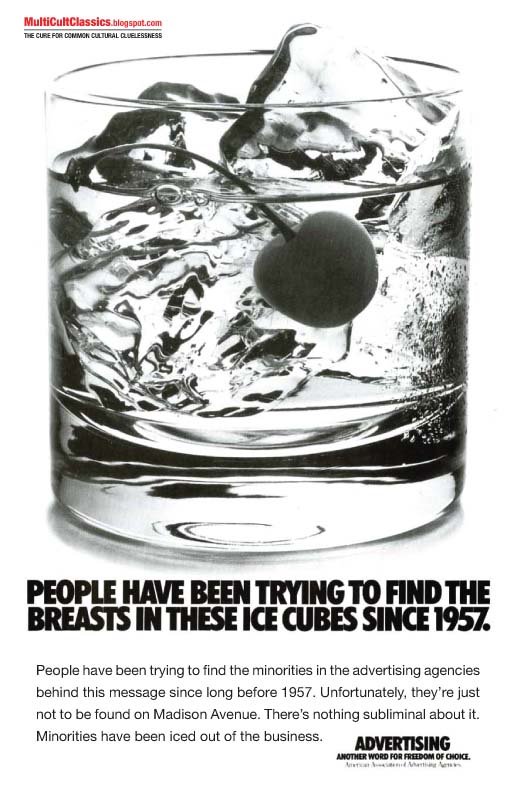
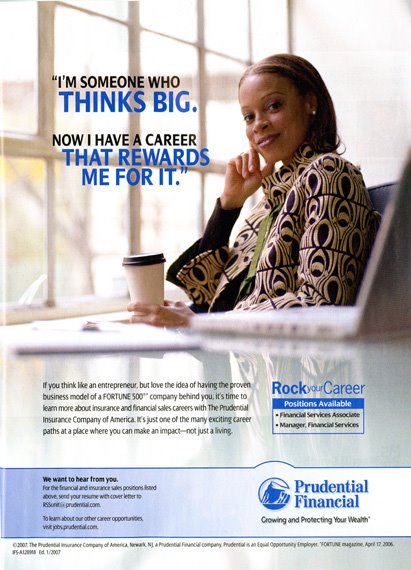
Not in love with this ad.

Sunday, March 25, 2007

Essay 1902


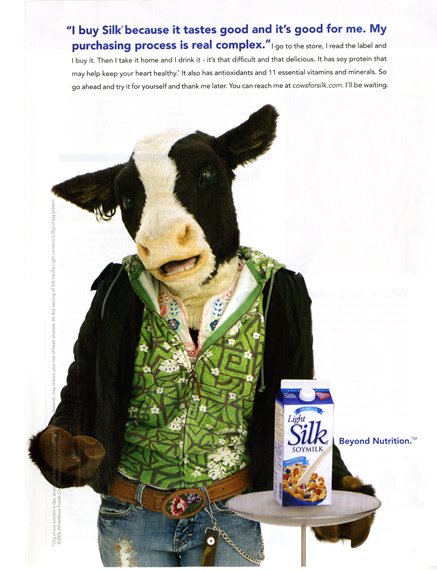
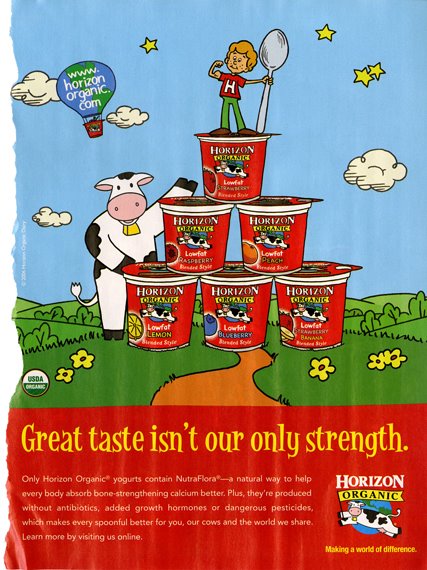
Holy cow! What’s with all the cattle ads lately?


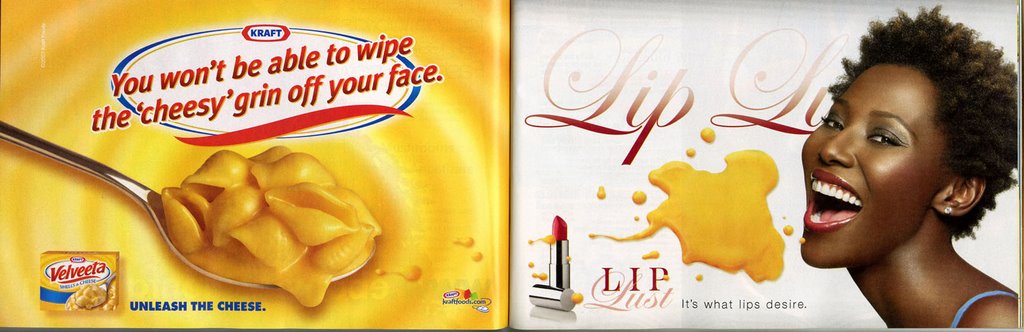
Damn! Even the direct marketers are joining the herd.

Essay 1901


The changing times in a MultiCultClassics Monologue…

• The city of Largo in Florida sparked controversy by firing its longtime city manager after he revealed plans to undergo a sex change. The City Commission voted on the action after a six-hour hearing where supporters insisted the city manager would do the job just as well after becoming a woman. A few commissioners argued they chose to fire the man not because of his sex-change decision, but because he violated their trust and caused public disruption. Seems they missed an opportunity to reduce the city’s budget, as Largo probably would have paid the city manager less money as a woman.

• Rapper Tony Yayo was busted for beating up a teen wearing the “wrong” t-shirt. The 14-year-old was sporting a shirt for Czar Entertainment, a rival music company, when the rapper assaulted him. Yayo allegedly displayed a gun, threw the kid against a wall, demanded to know why he was wearing the shirt and slapped him around. The kid’s mom later hollered in a statement, “It’s a shame that 50 Cent & Tony Yayo could feel comfortable slapping and physically attacking an innocent 14-year-old minor that they market and promote their records to. … This is a cowardly act on my son who has done nothing to warrant the verbal and physical abuse he received … This should be looked as a step away from child molestation.” In that case, Yayo better call R. Kelly for legal advice.

Essay 1900


Does anyone else view this ad as sleazy versus cheesy?

Essay 1899


From The Chicago Sun-Times…

-------------------------------------

Ethnic identity isn’t black and white

BY MONROE ANDERSON

For the past two decades, Barack Obama has been a faithful member of the congregation at Chicago’s Trinity United Church of Christ. Trinity is no run-of-the-mill black church. It’s social activism and political awareness on pure, natural holy water. Trinity’s progressive pastor, the Rev. Jeremiah Wright, preaches the black theology of liberation. And he practices what he preaches. Back when apartheid was the law of the land in South Africa, when Nelson Mandela was a political prisoner and when American corporations, institutions and the U.S. government all gave their blessings to those evil doings, the dashiki-wearing minister planted a “Free South Africa” sign on the church’s lawn. Obama’s spiritual mentor has routinely been on the right side of morality, championing liberal causes from gay rights to opposition of the war in Iraq.

Shortly after Sen. Obama launched his run for the presidency last month, Erik Rush, a right-wing Christian blogger who happens to be African American, discovered what had been hiding in plain sight: The motto for Trinity United is “Unashamedly Black and Unapologetically Christian.”

Trinity’s motto, as well as its mission to eradicate what W.E.B. DuBois called “the problem of the color line” and “the strange meaning of being black here,” so incensed Rush that he wrote a blistering blog about it. It was unnerving for him to learn that the South Side church had adopted a “Black Value System” and that its 8,000 black members are committed to the “Black Community,” the “Black Family” and “the Black Work Ethic.” In his blog, Rush ignores -- or is just ignorant about -- the nearly 200-year-long tradition of the black church’s struggle to free and elevate its people while slyly substituting the words white for black and then disingenuously concluding that “like the Nation of Islam, a white separatist church or the Branch Davidians, Trinity United more resembles a cult than a church.”

No doubt that concept came as news to the thousands of well-heeled, professional and middle-class black Chicagoans who are members of the church. And no doubt media mogul Oprah Winfrey and rap star Common, who have both attended Trinity, were surprised to discover they were cultists. But quicker than you could say “holy fit,” the cable conservatives were clucking and complaining to the high heavens. Tucker Carlson, MSNBC’s very own Fox News-type right-wing host, opined that, “This stuff sounds separatist to me.”

Sean Hannity, the conservative half of Fox News’ lightweight talk show, “Hannity and Colmes,” sounded as if this country was going to hypocritical hell. If a white presidential candidate’s church had a similar statement and “you substitute the word white for black, there would be an outrage in this country,” Hannity preached. “There would be cries of racism in this country.”

True and Catch-22. If a white church plainly and proudly pronounced its whiteness, Hannity, Carlson and company would be right. But if it was the Holy Trinity Polish Church on Chicago’s North Side, proclaiming its Polishness, who’d care? This is how African Americans find ourselves in a trick bag. We’re defined racially even when we’re acting like any other of this nation’s ethnic groups. Issues knee-jerkily become black and white when in reality they may be African American and Irish American. Or Serbian American and African American. Remove black and substitute another American ethnic group so that Trinity’s Concept No. 6 reads: “Adherence to the Mexican Work Ethic.” Does that still sound separatist? Or racist? Of course not. But, if you’re insincerely espousing color blindness, while holding the race card up your sleeve, you know you can easily trump African-American ethnic pride every time.

Obama’s political advisers know this as well. That’s why, at the last minute, Obama disinvited Wright to speak last month when he officially announced his presidential candidacy. Wright says that Obama now realizes that his political handlers gave him bad advice and that all is well between him and the senator.

I say this is just one more sad example of how ethnic identity gets color-coded for African Americans. And I believe it’s just one more sign that there are those who would place Obama in political purgatory -- painting him not good enough to be black and not right enough to be white.

Essay 1898


From The New York Times…

-------------------------------------

Will Diners Still Swallow This?

By ANDREW MARTIN

CARROLLTON, Tex.

RICHARD SNEAD came up through the restaurant industry when bigger was better.

He earned his managerial stripes in the fast-food industry as Burger King, McDonald’s and Wendy’s waged war over who could offer bigger burgers, more fries and larger cups of soda. Few questioned the strategy, not even after casual dining restaurants embarked on their own supersizing battle in the 1990s.

Now Mr. Snead is breaking ranks. As chief executive of Carlson Restaurants Worldwide he has chopped portion sizes at T.G.I. Friday’s, Carlson’s chain known for calorie-rich items like deep-fried potato skins stuffed with Cheddar cheese, bacon and sour cream. In a closely watched experiment, Friday’s will see whether diners will order what it calls “Right Size” portions that, on average, are about two-thirds the size of the usual serving.

“I firmly believe that the consumer is demanding a change,” said Mr. Snead, who is 55 and has a runner’s trim build. Many consumers are tired of huge portions, especially on weeknights or at lunch when they do not want to indulge, he says. The time has come, he says, to think smaller. But, he added, “I’ll be honest with you, it’s scary.”

Mr. Snead has good reason to be concerned.

The strategy of serving consumers smaller servings has a lamentably unprofitable history. Many restaurateurs remember far too well what happened to the Ruby Tuesday chain in 2004 after it trimmed some portions and started printing nutritional information on the menu of calorie-packed burgers, steaks and ribs. Consumers complained about the changes, and after about five months, Ruby Tuesday plumped the portions and provided nutritional information only when asked.

“Even if they don’t eat everything on the plate,” said Richard Johnson, Ruby Tuesday’s senior vice president, “they like that it’s a generous portion.”

While the success of Friday’s smaller portions is far from certain, its heavily marketed Right Size campaign is among the boldest efforts yet to address problems in the restaurant industry that many had considered insolvable: How do you sell the idea of giving people less food? More important, how do you make money at it?

[Click on the essay title above to consume the full story.]

Saturday, March 24, 2007

Essay 1897


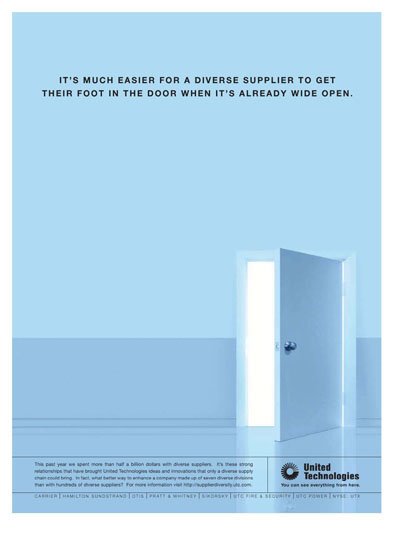
Technically, the door does not look like it’s wide open.

Essay 1896


Flying solo in a MultiCultClassics Monologue…

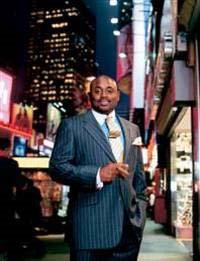
• 23-year-old Barrington Irving (pictured in plane above) is out to become the youngest person and first Black pilot to fly around the world solo. Irving built his own plane from over $300,000 worth of donated parts. Before takeoff, Irving proclaimed, “I want this completed before the year is over so kids can see that someone who started off with nothing set a goal and completed it.” Wonder which advertiser will be the first to tap Irving.

• Mel Gibson got into an argument with a college professor at California State University, Northridge, during a campus screening of “Apocalypto.” The professor was allegedly questioning the historical accuracy of the movie before Gibson told her, “Fuck off.” The woman, who was escorted out of the building, is now demanding an apology, “not only to me but to the Central American program at CSUN, to the university and most importantly to the Mayan people and Mayan community.” Looks like Gibson is out to become the first Hollywood superstar whose career goes down in flames around the world.

Essay 1895


From BusinessWeek.com…

----------------------------------

“A McKinsey Of Pop Culture?”
Steve Stoute is making hot sellers out of cold brands by turning execs on to “the tanning of America”

Several months into his new job as vice-president of U.S. marketing and advertising for General Motors, Mike Jackson came to the conclusion that the automaker was just not cool enough. Young, urban trendsetters on the East and West Coasts were not paying attention to GM’s cars. The message being sent to consumers, Jackson says, was all wrong. “We worried far too much about the sheet metal, color, etc.,” he explains. “What we really needed to worry about was connecting emotionally with our consumers.” So Jackson picked up the phone last spring and called Steve Stoute.

More executives overseeing brands that have gone stale are turning to the 36-year-old consultant and former music executive for help. Stoute’s agency, Translation Consultation & Brand Imaging, offers to imbue brands with a combination of hip-hop ethos and practicality to help reposition products, from Chevy Impalas to Crest Whitestrips to Reese’s peanut butter cups. The end result is for brands to resonate with a younger, more trendy audience. Other successful entrepreneurs have emerged from the hip-hop scene, such as Russell Simmons and Sean “P. Diddy” Combs, to help put urban fashion and lifestyle into the mainstream.

But Stoute is more closely aligned with a new guard of innovation consultants providing strategies that go beyond tricked-out sneakers and jeans. His message: Companies have not embraced the changes in the culture to be able to talk to a new generation of consumers. “So many executives,” says Stoute, “are lost in the confines of their own building.” Besides GM, Stoute has successfully taken his mantra to clients that include McDonald’s, Procter & Gamble, Hershey, Microsoft, and Estée Lauder.

Now Stoute seems to be gaining respect on Madison Avenue. Interpublic Group of Companies Inc., the $6.2 billion-a-year global advertising conglomerate, is in talks with Stoute to buy a majority stake in Translation, say sources close to those talks. If the deal is closed, IPG would get schooled on Stoute’s approach to brands and access to celebrities, while Translation would gain entrée to IPG's large client base and deeper pockets.

As an African American with strong relationships to hip-hop artists (music icon Jay-Z is a good friend and business partner), Stoute knows how easy it is to pigeonhole Translation as a black ad agency. He immodestly characterizes his firm as “a McKinsey of pop culture.” By that he means that Translation is called upon by companies facing strategic challenges. “These are companies who know they have to take advantage of global trends, but at the same time are afraid of jeopardizing core businesses,” says Stoute. “We show them how to walk that thin line. It often comes down to showing them the language and tonality needed to reach consumers.”

But Stoute also says he’s helping executives understand a phenomenon that he refers to as the “tanning of America.” It’s a generation of black, Latino, and white consumers who have the same “mental complexion,” he says, based on “shared experiences and values.” Rap and hip-hop, starting in the late 1980s when white suburban kids began snapping up music by mostly inner-city artists, provided the first glimpse into this shift. “Rap was a litmus test for where the culture was headed,” he says.

[Click on the essay title above to read the full story.]

Essay 1894


Whassup, circa 1962.

Essay 1893


From The New York Times…

---------------------------

After 5 Days of Mopping and Scrubbing, What Else Would a Model Wear?

By ANTHONY RAMIREZ

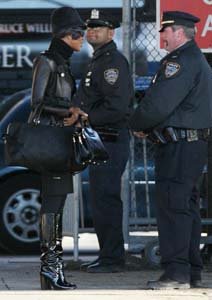
First there was a cry, then a murmur, and finally a swoon. Naomi Campbell, the millionaire fashion model, emerged yesterday from a grimy Department of Sanitation garage in a floor-length evening gown, marking the end of her court-ordered community service.

She waved with her right hand, pulled up the shimmering silver gown with her left, smiled for the cameras and then ducked into her Rolls-Royce limousine, a silver Phantom costing at least $340,000. She did not say a word.

The garage’s long driveway made for an effective catwalk. “Is that her?” cried a photographer, squinting at a distant, undulating figure. In unison, other photographers on stepladders swung telephoto lenses into position and began to murmur as she walked closer and into focus.

When the whites of Ms. Campbell’s eyes were in view, what could only be described as a collective swoon emerged from the dozens of reporters and paparazzi. A reporter with a British accent said out loud, “Smashing!” A photographer, not British, screamed: “Oh, what a shot! I love this!”

While paint peeled from an overpass directly overhead on South Street in Lower Manhattan, reporters quickly compared notes after Ms. Campbell left. Who designed the dress? What shade of silver was it? Was that a belt or a cummerbund? No one knew. It fell to Albert Durrell, deputy chief of the Sanitation Department, dressed in a drab-green military-style uniform, to answer reporters’ questions about Ms. Campbell’s public penance.

In January, Ms. Campbell, 36, pleaded guilty to a misdemeanor and admitted that she had thrown a cellphone at her maid, Ana Scolavino, striking her on the head. Ms. Campbell was ordered to pay Ms. Scolavino’s medical expenses, $363, attend a two-day anger management seminar and perform five days of community service.

As in the previous four days, Mr. Durrell told reporters, Ms. Campbell wore a dust mask, gloves and a vest, the usual garb provided by the department to those performing court-ordered sentences. She also wore her own stretch pants and work boots.

Ms. Campbell “completed her service successfully,” Mr. Durrell said. “From what I understand, she was pleasant the entire time.”

From 9 a.m. to 4 p.m., she swept, mopped and wiped at the garage, which has garbage and recycling facilities. She received no preferential treatment, Mr. Durrell said. Ms. Campbell ate pizza from Grimaldi’s in Brooklyn, like the others in her work crew.

Yes, Mr. Durrell acknowledged, Ms. Campbell did clean toilets. No, he said, she did not have to be taught how to use a mop or broom.

Ms. Campbell “was on her hands and knees at some point cleaning the walls and floors on the second floor,” he said.

But unlike Boy George, the singer who performed a similar sentence of community service last August, Ms. Campbell completed her sentence indoors. Mr. Durrell said it was a condition of her sentence. Why? “You’ll have to ask the judge,” Mr. Durrell said.

Mr. Durrell did report trouble inside. Someone took a digital photograph of Ms. Campbell as she scrubbed, presumably for sale to the press, but officials noticed and demanded the deletion of the image. The person was not punished, Mr. Durrell said.

Asked what he thought of Ms. Campbell’s attire at the end of her stay, Mr. Durrell replied, with a shrug, “You know, it was a gown.”

Essay 1892


Introducing The Diversity Cheer.

Friday, March 23, 2007

Essay 1891


Listen up with a MultiCultClassics Monologue…

• A pair of New Jersey radio personalities known as “The Jersey Guys” sparked controversy with an on-air segment featuring anti-immigration sentiments. “Operation Rat a Rat/La Cucha Gotcha” is a listener-participation bit that encourages people to turn in suspects to immigration authorities. Hispanic leaders are not too happy. “Scapegoating and stereotyping Latinos does nothing but give bigoted individuals a platform to make ethnic slurs and racist comments,” said Assemblyman Wilfredo Caraballo of Newark. The radio hosts disagree. “If you’re here illegally, you are breaking the law — no better, no worse than the guy who robs the liquor store or the guy who waits to case your house out and robs you of your belongings,” said one announcer. “You are a criminal.” Is it possible to deport The Jersey Guys?

• The cop who carried Naomi Campbell’s bag on Tuesday (see Essay 1879) has apparently been reassigned to Brooklyn. At least he wasn’t shipped off to New Jersey.

• A judge issued an arrest warrant for Foxy Brown after the rapper was a no-show in court. Foxy’s latest troubles come from allegedly fighting with a Florida beauty shop owner. The Jersey Guys will probably introduce a segment that encourages listeners to turn in fugitive rappers.

Essay 1890

Essay 1889


The creative team behind this ad didn’t think big.

Essay 1888


From The Chicago Tribune…

---------------------------------------

Flag protesters missing a point

By Steven Lubet
professor of law at Northwestern University

What is the proper way to hang a Confederate flag? According to artist John Sims, it’s from a noose. Not everyone agrees, of course, especially in the South. So it is unsurprising that protests quickly followed when the Mary Brogan Museum of Art and Science, in Tallahassee, Fla., displayed Sims’ installation of a Confederate flag suspended from 13-foot gallows. According to Robert Hurst, commander of the Tallahassee camp of the Sons of Confederate Veterans, it is offensive to show disrespect for the Confederate flag, which should be treated as a revered symbol of Southern heritage.

More than 140 years after the Civil War, defenders of the Confederate flag continue to fight a rear-guard action, proudly waving the standard while claiming that it stands for nothing more than pride in their ancestry and nostalgia for a vanished way of life. Denying that the flag has any association with slavery or segregation, they often seek its return to public prominence, notwithstanding the protests of civil rights organizations. For example, the Sons of Confederate Veterans boasts a “Flags Across Florida” project, seeking to “put Confederate flags on Florida’s major roads.”

But is it true that you can separate the Confederate flag from the institution of slavery? Is it possible to long for the antebellum South--and its vanished dream of independence--without recalling that nearly 4 million men and women were held in bondage?

Certainly not.

Any candid historical appraisal of the Confederacy has to recognize that it was motivated by slavery, built on slavery and deeply committed to slavery. Attempts to deny that relationship are naive at best and dishonest at worst. Here are some indisputable facts.

On Dec. 24, 1860, South Carolina became the first state to declare its secession from the Union. Its Declaration of Causes included 18 references to the sanctity of slavery, repeatedly justifying secession as necessary to protect the “right to hold property in slaves.” Indeed, the declaration gives only one reason for secession: The Northern states “have denounced as sinful the institution of slavery. … They have encouraged and assisted thousands of our slaves to leave their homes.” They have elected a president “whose opinions and purposes are hostile to slavery.”

Other state secession decrees were to the same effect. Alabama proclaimed its intention to unite with the “slaveholding states of the South.” Texas condemned the Lincoln administration as “a weapon with which to strike down the interests and property of the people of Texas and her sister slaveholding states.” Virginia bemoaned “the oppression of the Southern slaveholding states.”

The Confederate Constitution itself was explicit about the heart of its enterprise. Its “Bill of Rights” stated that no law “denying or impairing the right of property in Negro slaves shall be passed.”

It is true, of course, that the great majority of Confederate soldiers were not slaveholders. Most of the enlisted men fought for their homes, families and comrades-in-arms rather than for the abstract principles of a distant government. But there is still no escaping the fact that defense of the Confederacy meant the perpetuation of slavery for millions of African-Americans. It is impossible to separate the war from the cause.

So if you are tempted to think there might be something benign, or even admirable, about the Confederate flag, just remember that we pledge allegiance not only to the flag of the United States of America, but also “to the republic for which it stands.” In the case of the Confederacy, the republic undeniably stood for slavery, which is something that John Sims’ provocative artwork will not allow us to forget.

[Steven Lubet is a professor of law at Northwestern University.]

Essay 1887


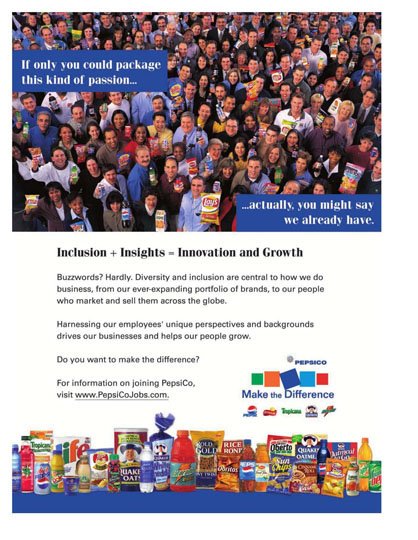
PepsiCo + Diversity = Obesity.

Thursday, March 22, 2007

Essay 1886


Criminal clothing and suits in a MultiCultClassics Monologue…

• Naomi Campbell spent her third day of community service cleaning lockers and scrubbing toilets. Now some critics are questioning the supermodel’s intention to auction off her work clothes for charity. The plans may violate state laws prohibiting felons from generating profits for their crimes. “Clearly this is income generated from the commission of a crime,” said a New York criminal-defense lawyer. “While it may not have violated the letter of ‘Son of Sam [laws against criminal profiteering],’ it certainly violated the spirit of it.” Look for legislators to introduce the Naomi Amendment.

• A couple in New York is suing a Park Avenue fertility clinic for screwing up the sperm used during in-vitro conception. The couple — the husband is White and the wife is Hispanic — accidentally received sperm from a Black man. They filed an emotional distress suit with numerous charges: they fear the natural father may claim rights to the child; they question whether additional screw-ups may mean they have other natural children or half-children out there; the child will be unaware of her full medical history; and they believe the child “may be subjected to physical and emotional illness as a result of not being the same race as her parents and siblings.” The kid’s had a rough childhood and she’s not even 3 years old.