

Friday, March 30, 2007

Essay 1924

Three cheese references in the headline are bad enough — but why’s the girl dancing in a cheese puddle?
Essay 1923

Damn, if the 4As can’t even retain its Diversity Guru, how can the organization hope to reform the industry? Check out this story from Target Market News…
-------------------------------
Don Richards joins JobPlex as executive vice president and diversity leader
JobPlex has announced the addition of Don Richards, Executive Vice President and Diversity Practice Leader to the Chicago, IL office. Don has thirty-five years experience in the advertising agency industry, working both in Account Management and in Diversity Management.
Prior to joining JobPlex, Don spent two years as Senior Vice President, Agency Diversity Programs at the American Association of Advertising Agencies (AAAA), where he worked closely with member advertising agencies on both workforce and supplier diversity initiatives. He also spent two years at the Screen Actors Guild as Associate National Director of Diversity.
Previously, during his twenty-one year tenure at Leo Burnett USA in Chicago, he worked his way up through the Account Management Department to become Vice President, Account Supervisor. Don was the company’s first African-American Vice President. He continued on as Senior Vice President, Director of Resource Development, developing and implementing strategies to identify, hire and retain minority professionals as well as developing strategies to increase the agency’s utilization of minority suppliers.
Additional advertising agency experience includes six years as Senior Vice President, Management Supervisor and member of the Board of Directors at Marschalk Advertising in New York City, supervising a number of client businesses including brands from the Coca-Cola Company, Heublein, Inc. and Stroh’s and six years at DDB Needham in Chicago as Senior Vice President, Management Representative on several Anheuser-Busch brands.
Don earned both his Bachelor and Master of Arts degrees at the University of Chicago.
Thursday, March 29, 2007
Essay 1922

“Mi blog es tu blog: Notas y netas de este planeta” is the title of a terrific blog by Laura Martinez. A bilingual journalist and editor, Martinez originally served as the founder and editor in chief of Marketing y Medios, the premier trade magazine on the Hispanic market from the publishers of Adweek. Media conglomerate VNU made the asinine decision to drop Marketing y Medios in 2006. But Martinez continues to bring fresh, spirited and insightful perspectives via her blog. Click on the essay title above to check it out — and visit often for enlightenment and entertainment.
Essay 1921

Breakthroughs In Motherhood. Unfortunately, no breakthroughs in art direction or copywriting.
Essay 1920

Oxymorons and regular morons in a MultiCultClassics Monologue…
• A new Kaiser Family Foundation study showed kids between the ages of 8 to 12 are hit with about 21 TV advertisements for food every day. Also, half of the ads on children’s programs hawk food items. “The vast majority of the foods that kids see advertised on television today are for products that nutritionists would tell us they need to be eating less of, not more of,” said a vice president at the Kaiser Family Foundation. Some advertisers protested the findings. “If you look across our portfolio in our marketing, less than 1 percent of our total marketing dollars are toward children’s marketing,” said the vice president for health and wellness at PepsiCo. “If you look at us companywide, that’s not a huge effort that we spend toward marketing to children. We focus more of our ads on adults.” Not sure about the credibility of anyone with the oxymoron title of vice president for health and wellness at PepsiCo.
• Mark April 17 as the day that the rights to O.J. Simpson’s “If I Did It” book will be auctioned off. Auction proceeds and subsequent profits will go to the Goldman family. If the Goldmans want to really cash in, they’ll turn the event into a realty TV show. The working title could be: “If I Bid It.”
• Delta Zeta, the sorority charged with dumping unattractive and unpopular members, is now suing DePauw University for the school’s decision to cut the organization from campus (see Essay 1834). The ladies allege the university broke promises and contracts, defamed them and interfered with their business. What a bunch of high-maintenance divas.
Essay 1919

From The Associated Press…
----------------------------------
Black Aviators to Be Honored by Congress
By DARLENE SUPERVILLE
WASHINGTON — Six decades after completing their World War II mission and coming home to a country that discriminated against them because they were black, the Tuskegee Airmen are getting high honors from Congress.
That gratitude will be expressed Thursday when the legendary black aviators will receive a Congressional Gold Medal during a ceremony in the Capitol Rotunda. The award is the most prestigious Congress can offer.
“It’s never too late for your country to say that you’ve done a great job for us,” Ret. Col. Elmer D. Jones, 89, of Arlington, Va., said in an interview. Jones was a maintenance officer during the war.
President Bush, members of Congress and other dignitaries are expected to join some 300 airmen, widows and relatives.
Ret. Lt. Col. Walter L. McCreary, who was shot from the sky during a mission in October 1994 and held prisoner for nine months in Germany, said it hurt that the group had not been honored for its accomplishments.
“We took it in stride. It’s a recognition long overdue,” said McCreary, also 89, of Burke, Va.
The Tuskegee Airmen were recruited into an Army Air Corps program that trained blacks to fly and maintain combat aircraft. President Roosevelt had overruled his top generals and ordered that such a program be created.
But even after they were admitted, many commanders continued to believe the Tuskegee Airmen didn’t have the smarts, courage and patriotism to do what was being asked of them.
Nearly 1,000 fighter pilots trained as a segregated unit at a Tuskegee, Ala., air base. Not allowed to practice or fight with their white counterparts, the Tuskegee Airmen distinguished themselves from the rest by painting the tails of their airplanes red, which led to them becoming known as the “Red Tails.”
Hundreds saw combat throughout Europe, the Mediterranean and North Africa, escorting bomber aircraft on missions and protecting them from the enemy. Dozens died in the fighting; others were held prisoners of war.
It long had been thought that the Tuskegee Airmen had amassed a perfect record of losing no bombers to the enemy during World War II. But new research has cast doubt on that theory.
Two historians recently said Air Force records and other documents show that at least a few bombers escorted by the Tuskegee pilots were downed by enemy planes. A former World War II bomber pilot said last year that his plane was shot down while escorted by the unit.
Congress has awarded gold medals to more than 300 individuals and groups since giving the first one to George Washington in 1776. Originally, they went only to military leaders, but Congress broadened the scope to include authors, entertainers, notables in science and medicine, athletes, humanitarians, public servants and foreign officials.
Other black recipients include singer Marian Anderson, athletes Joe Louis, Jesse Owens and Jackie Robinson, civil rights activists Roy Wilkins, Martin Luther King Jr. and Coretta Scott King, the Little Rock Nine, Rosa Parks and Dorothy Height, and statesmen Nelson Mandela of South Africa and former Secretary of State Colin Powell.
The actual medal for the airmen, made possible through legislation by Sen. Carl Levin, D-Mich., and Rep. Charles Rangel, D-N.Y., will go to the Smithsonian Institution for display. Individual airmen will receive bronze replicas.


Wednesday, March 28, 2007
Essay 1916

Luis Clemens is a freelance writer whose work often focuses on Hispanic marketing and media. His stuff has appeared in numerous news sources, including Marketing y Medios and Multichannel.com. After a long absence, Clemens has restarted his blog, Clemenseando: A Hack’s Observations on Hispanic Marketing and Media. Click on the essay title above to check it out.

Essay 1914

Unlocking the restraints in a MultiCultClassics Monologue…
• Walt Disney Company is debating unlocking its 1946 film “Song of the South.” The movie has never been released on video in the U.S., as critics contend it features racist stereotypes of Southern plantation Blacks. But Disney President and CEO Bob Iger said folks are reconsidering releasing the picture. “The question of ‘Song of the South’ comes up periodically, in fact it was raised at last year’s annual meeting,” said Iger. “And since that time, we’ve decided to take a look at it again because we’ve had numerous requests about bringing it out. Our concern was that a film that was made so many decades ago being brought out today perhaps could be either misinterpreted or that it would be somewhat challenging in terms of providing the appropriate context.” Ain’t nobodys gonna fuss ‘bout it no mo, boss.
• The King unlocked the cages at Burger King. The company announced it will only deal with suppliers who do not keep animals caged or crated. Ironically, the typical BK employee continues to feel like they’re working in a cage.

Essay 1912

Is it appropriate to label something as “borrowed interest” if the end result is not interesting?
Essay 1911

From The New York Daily News…
--------------------------------------
Hil’s awkward closeup
YouTube ad touched a chord because, unlike Obama, she’s cursed to be cold on camera
By Stanley Crouch
We appear to be entering a vastly new and significantly dangerous world of Internet politics. We are all aware of the old cliché of never believing anything you read, but that suspicion must now be extended to high-tech media communication.
Last week, Paul de Vellis was found to be the creator of an unofficial Web advertisement for Barack Obama that, parodying Apple Computer’s famous “1984” ad, depicted Hillary Clinton as a kind of totalitarian monster in the mold of George Orwell’s “Big Brother.” Almost 2 million people saw the spot, which ended by asking viewers to visit BarackObama.com.
The culprit proudly confessed his act of electronic mischief to Arianna Huffington and posted a note on her blog. His point, he said, was that politics was changing and that the average citizen will have a bigger influence on things in the future.
Given the uncountable number of loons who can operate personal computers, that fact creates an inarguable contemporary truth: Like everything else, this can be as bad as good. DeVellis, the citizen-consultant, reminded us of something that focus-group-tested TV commercials never could: For some unexplainable reason, the electronic mass media invariably serve up Clinton as an ice queen but project and perhaps enhance Obama’s warmth.
Hollywood’s liberal and limousine brigade understands this — just as it noticed the fact that Bill Clinton removed the redneck stigma of a Southern accent and made it no more than a regional sound.
Anyone who has had the revealing experience of first seeing a speech of Sen. Clinton’s in person and then watching it on the evening news or C-SPAN knows this much: The junior senator from New York has a problem as great as the shadow of her husband. That problem is not her hairdo or whether she will get an eye job. It is monumental: Television cameras seem to hate her and rob her of what is, in person, considerable charisma.
In other words, everyone knows Clinton has trouble connecting through mass media. But it took a crafty commercial on YouTube to write that problem in capital letters.
That said, for all the power of imagery, there is one very great danger in charisma — one that is enhanced by electronic media. It is this: We all need to pay much, much closer attention to details and the ideas behind the screen to make sure that we are not caught holding the bag for someone we, when informed, would love much less than the camera does. In the search for “authenticity” — no more than a fast-food cliché this election cycle — we must not fall prey to yet another form of slickness.
If we are careful, we can learn how to live with this latest development in our culture, just as we learned how to live with all of those things that entered our lives before this moment. The world will be changed quite surely — but we need not be taken in by the superficial.
Tuesday, March 27, 2007
Essay 1910

From the Letters To The Editor section in the latest issue of Advertising Age…
---------------------------------
We set the trends, but we’re underrepresented
RE: “Being Black on Mad Ave.: Tales From Young and Old” (AA, March 19).
This is always a great topic in the midst of America’s denial of racism. I am an advertising creative (black American) and let me tell you, yes, it is tough getting in and even tougher rising to the top. But is it different in any other industry? The answer is probably not.
I feel we are not grooming the next wave of kids properly or doing enough to pique their interest about the ad game until it’s too late—Erika Emeruwa, for instance, didn’t get hip to the game until college.
The most puzzling part of advertising and its exclusion of black people on the agency side—both creative and account (although there are more account people)—is that the trendsetters are black. So to be hip and cool and able to talk to the targeted millennials you’d think there’d be an influx of hip, in-the-know, cool black kids into shops, right? Wrong as calling dreadlocks braids.
Instead I’ve had middle-aged white dudes who don’t get out much tell me I’m not black enough. It’s such a good-ol’-boys club that I’m glad the dinosaurs are dying.
Here’s to letting the ideas flow on the basis of great creative and brilliant strategy and people with kick-ass hair.
The revolution will not be televised; it will be publicized.
Pardé Bridgett
Flow
Santa Monica, Calif.
Essay 1909
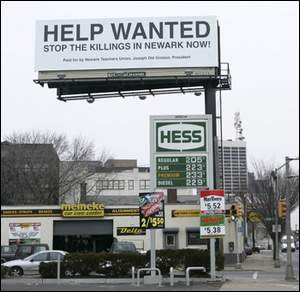
Sign of the times in a MultiCultClassics Monologue…
• The city’s teachers union in Newark, New Jersey has sparked controversy with a billboard campaign urging citizens to “Stop the killings” (pictured above). The mayor and local businesses want the signs taken down, arguing that the messages hurt business. Newark has a high homicide rate, and the campaign is intended to bring attention to the issue. “I think we have a serious problem,” said the president of the Newark Teachers Union. “It’s about people dying.” In other words, if you try to take down the signs, you might get killed.
• Citigroup is planning to kill about 15,000 jobs, according to the Wall Street Journal. However, Citigroup officials won’t confirm anything. The company’s chairman and chief executive said, “We are going to announce the results of our strategic structural review on or before our earnings announcement on April 16.” Which means 15,000 may have to amend the employment status on their tax forms.
• Eminem and his ex-wife have agreed to stop publicly dissing each other. During a court hearing on Monday, the two decided their verbal feuding could be harmful to their 11-year-old daughter. Look for the ex-Mrs. Mathers to erect billboards soon.


Monday, March 26, 2007
Essay 1906

Here’s an article from Adweek.com. A brief MultiCultClassics response immediately follows…
----------------------------------
Diversity Rewrites Prime-time Script
By A.J. Frutkin/Mediaweek
NEW YORK Music snobs may be miffed that 17-year-old Sanjaya Malakar has stayed afloat on Fox’s American Idol. But his continued presence on the program underscores a profound truth about that show and other non-scripted programs this season.
From Idol to CBS’ Survivor to The CW’s America’s Next Top Model, reality offers viewers a level of onscreen diversity that remains unmatched on the scripted side.
Of course, casting scripted and nonscripted shows is vastly different.
Scripted series demand talent from actors, whereas nonscripted programs often hinge more on personality from cast members. And when acting talent is removed from the casting mix, “you have the entire U.S. population to choose from,” said Peter Golden, evp of talent and casting at CBS. White, black or otherwise, Golden said finding the right actor for the right role is a much more challenging process. “You’re looking for people with the skill to deliver certain characters, and very often with the strength to carry an entire series on their backs,” he said.
If a scripted show doesn’t call for diversity, it can be challenging to change the creator’s vision. Nonscripted shows, on the other hand, purposely throw strangers together. They virtually require variety. In the happiest of results, it’s effortless. That is the case of America’s Next Top Model, where The CW doesn’t even have to recruit ethnic contestants.
“Because our audience is so diverse, when we put out a casting call, the people who show up reflect that diversity,” said Jennifer Bresnan, svp of alternative programming at The CW. “And when you have a diverse group of people show up to a casting session, there’s no way you can’t cast a diverse group of girls.”
Not all shows are so lucky. CBS took enormous heat earlier this season for splitting the cast of Survivor: Cook Islands into four ethnic groups: African Americans, Asians, Caucasians and Latinos. But finding contestants to fill each of those teams forced the network’s casting department to aggressively recruit within those ethnic communities.
Whether “grabbing people off the street,” as Golden said, or advertising on ethnic Web sites, CBS helped establish recruitment policies that likely will be used to funnel diverse casts into other reality programs.
And advertisers are looking for those casts. “If you’re marketing to everybody, you want to reach everybody,” said Shari Anne Brill, vp, director of programming at Carat. “The more the cast of a TV show reflects what America looks like, the better the opportunity to draw all types of diverse audiences.”
----------------------------------
Adweek almost completely ignores the advertising industry’s diversity issues, yet presents a story on the topic as it pertains to reality TV programs. If Donald Trump were rating the publication’s diversity reporting, he’d probably proclaim, “Adweek, you’re fired.”
Check out this bizarre excerpt: “Scripted series demand talent from actors, whereas nonscripted programs often hinge more on personality from cast members. And when acting talent is removed from the casting mix, ‘you have the entire U.S. population to choose from…’”
What’s the implication — that minorities don’t have the talent to compete in scripted series?
Here’s another gem: “‘If you’re marketing to everybody, you want to reach everybody,’ said Shari Anne Brill, vp, director of programming at Carat. ‘The more the cast of a TV show reflects what America looks like, the better the opportunity to draw all types of diverse audiences.’”
Gee, wonder if anyone will apply that theory to Madison Avenue — that is, the more the staff of an advertising agency reflects what America looks like, the better the opportunity to draw all types of diverse audiences.
Subscribe to:
Posts (Atom)
