Showing posts with label johnson publishing. Show all posts

Thursday, July 07, 2016

13249: Fade To Blacks.

The New York Times reported on how Black-owned media is in a death spiral. Which runs parallel with the near-death state of Black-owned advertising agencies. Which coincides with the dearth of Blacks in the advertising and media fields.

Pillars of Black Media, Once Vibrant, Now Fighting for Survival

By Sydney Ember and Nicholas Fandos

For the black community in Chicago and elsewhere, Johnson Publishing Company represented a certain kind of hope.

The company’s magazines, most notably Ebony and Jet, gained prominence during the struggle for civil rights — Jet published graphic photos of the murdered black teenager Emmett Till that helped intensify the movement — and made it their mission to chronicle African-American life.

At a time when much of the media was ignoring black people, or showing them primarily in the context of poverty or crime, Ebony and Jet celebrated their success, featuring stars like Muhammad Ali and Aretha Franklin on their covers. When Barack Obama was elected president in 2008, the first print publication he granted an interview to was Ebony.

So when Johnson Publishing, which is based in Chicago, announced a little more than two weeks ago that it had sold Ebony and Jet to a private equity firm in Texas, there was a sense of loss.

“It was a very heartbreaking day,” said Melody Spann-Cooper, the chairwoman of Midway Broadcasting Corporation, which owns a Chicago radio station, WVON, aimed at a black audience. “Ebony gave to African-Americans what Life didn’t.”

Ms. Spann-Cooper’s reaction underscored a deeper concern: As racial issues have once again become a prominent topic in the national conversation, the influence of black-owned media companies on black culture is diminishing.

“Ebony used to be the only thing black folks had and read,” Ms. Spann-Cooper said. “As we became more integrated into society, we had other options.”

To that end, Time Inc. now owns the magazine Essence and Viacom owns Black Entertainment Television. The Oprah Winfrey Network, a partnership between Ms. Winfrey and Discovery Communications, has been around since 2011. The Undefeated, ESPN’s site covering the intersection of race and sports, debuted in May. The emergence of Black Twitter has also given African-Americans a powerful voice on social media.

Johnson Publishing stressed that the Clear View Group, the private equity firm that bought Jet and Ebony, was an African-American-led company and positioned the sale more as a partnership. “We are very, very committed to Ebony,” said Michael Gibson, the chairman of Clear View.

Traditional media companies have struggled for years to adapt to a digital world, but the pressure on black-owned media has been even more acute. Many are smaller and lack the financial resources to compete in an increasingly consolidated media landscape. Advertisers have turned away from black-oriented media, owners say, under the belief that they can now reach minorities in other ways.

Since well before the Civil War, publications and, more recently, radio and television stations owned and operated by African-Americans have provided an important counterweight to mass market media, simultaneously celebrating and shaping black culture — from politics and government to fashion and music.

Johnson Publishing was started in 1942 with a modest $500 loan, and eventually turned into a media empire big enough that in 1982, its founder, John H. Johnson, became the first black person to make Forbes magazine’s list of the 400 wealthiest Americans. When the radio station WVON ran a program in 2007 for Black History Month called the “28 Blacks Who Changed America,” Mr. Johnson, who died in 2005, was No. 7 on the list, behind luminaries like Martin Luther King Jr., Rosa Parks and Thurgood Marshall.

“If we don’t own our press, we don’t have a platform to speak,” said Leonard Burnett Jr., whose company, the Uptown Ventures Group, owns Uptown Magazine, a lifestyle publication aimed at affluent African-Americans.

Several owners also pointed to another benefit: Their companies hired more minorities. Ms. Spann-Cooper of the Midway Broadcasting Corporation said 90 percent of her employees were African-American. “When we are African-American-owned, the work force looks like us,” she said.

But as financial resources dwindle, black-owned media companies are struggling to maintain their presence. Jet, for instance, became a web-only publication in 2014.

“It’s tougher and tougher for African-American companies,” said DesirĂ©e Rogers, the chief executive of Johnson Publishing, “to have the capital to compete in a landscape that’s increasingly crowded, increasingly changing.”

Mr. Burnett, who also owns Hype Hair, a magazine for African-American women, said his company was “marginally profitable.” But he said supporting his print business had been challenging largely because advertisers, particularly luxury brands, would rather connect with African-American consumers “by speaking broadly.”

“I think at times there’s a feeling that they do not want to directly speak to that audience because there’s a fear of bringing down their brand perception,” he said.

Earl G. Graves Jr., the president and chief executive of the business-focused magazine Black Enterprise, said his company was “not as strong as it was,” but preferred that it remain independent. Like many magazines, it has cut its publication schedule and focused more on its events business as a potential revenue source.

The picture is bleak in radio and television as well. In 2013, there were 166 black-owned radio stations and 68 black-owned radio companies, compared with 250 stations and 146 companies in 1995, according to the National Association of Black Owned Broadcasters.

Only 12 commercial television stations in the country are black-owned, and they tend to serve very small markets. The future of Howard University Television, the country’s only black-owned public television station, is also in question, as the university’s participation in Federal Communications Commission spectrum auction has raised the possibility that it could end up selling its place on the airwaves or stop broadcasting entirely.

“Black ownership is dying,” said Armstrong Williams, whose Howard Stirk Holdings owns seven of the black-owned commercial television stations. “Newspaper ownership, radio ownership — but it’s probably hit TV the hardest.”

In the late 1970s, the F.C.C. put into place a minority ownership policy that used credits and deferrals on capital gains taxes to help make minority businesses more competitive in the bidding process and promote the sale of existing stations to minorities.

The policy, while not without critics, was largely considered a success among advocates of minority ownership. But in 1995, after a Supreme Court ruling that established new standards for race-based government policies, the F.C.C. began to disassemble the program. A year later, Congress ended the tax-deferral policy that had helped drive sales to minorities. It also did away with most restrictions on the number of radio stations a single company could own.

The resulting wave of consolidation in the broadcast industry has made it more difficult for black entrepreneurs to enter the industry, said Alfred C. Liggins III, the president and chief executive of Radio One, which while publicly traded is the country’s largest black-controlled multimedia company.

“That means that the likelihood that minority owners are going to own a TV station in New York or Los Angeles gets lower and lower,” said Mr. Liggins, whose mother founded the company with a single radio station in 1980.

For Johnson Publishing, which also owns the Fashion Fair cosmetics line, pressures on the business proved too difficult to overcome. In the last several years, it sold its historic building on Michigan Avenue in Chicago, brought on JPMorgan Chase as a minority investor and reduced its staff.

“We did not feel that we had adequate capital and resources,” said Cheryl Mayberry McKissack, who was chief operating officer of Johnson Publishing and is now chief executive of Ebony Media Operations.

Yet as stories like Johnson Publishing’s have become more common across the industry, those who see their companies as following in its footsteps say the notion of black ownership continues to resonate.

Mr. Williams, who referred to Ebony as “a staple” of his upbringing, said that young African-Americans regularly expressed awe that he, a black man, really owned television stations.

“It does change the dynamic,” he said, “of what they believe they can become.”

Monday, June 20, 2016

13228: Johnson Publishing Quits Publishing.

From The Chicago Tribune…

Johnson Publishing sells Ebony, Jet magazines to Texas firm

Johnson Publishing sells magazines that have chronicled African-American life since 1945

By Robert Channick • Contact Reporter

After a 71-year run in Chicago, Johnson Publishing is getting out of publishing.

The company said Tuesday it has sold Ebony, its iconic African-American lifestyle magazine, and the now digital-only Jet magazine to Clear View Group, an Austin, Texas-based private equity firm, for an undisclosed amount.

Johnson Publishing will retain its Fashion Fair Cosmetics business and its historic Ebony photo archives, which remains up for sale. The deal, which closed in May, also included the assumption of debt.

A family-owned business throughout its history, Ebony has documented the African-American experience since it first hit newsstands in 1945. It has shaped culture ever since, coming into its own as it reported from the front lines of the civil rights movement during the 1960s in powerful photos and prose.

In recent years, though, Johnson Publishing has seen declining media revenues as it struggled to evolve from print to digital platforms.

Linda Johnson Rice, chairman of Johnson Publishing and daughter of founder John Johnson, will serve as chairman emeritus on the board of the new company.

“This is the next chapter in retaining the legacy that my father, John H. Johnson, built to ensure the celebration of African-Americans,” she said in a statement Tuesday.

The new publishing entity, Ebony Media Operations, will maintain the magazine’s Chicago headquarters and its New York editorial office, as well as much of the current staff, according to Michael Gibson, co-founder and chairman of African-American-owned Clear View Group.

It is the first investment in the publishing business for Clear View.

“We made this purchase because this is an iconic brand — it’s the most-recognized brand in the African-American community,” said Gibson, 59. “We just think this is a great opportunity for us.”

Cheryl McKissack, who has served as chief operating officer since 2013, will assume the role of CEO of the new publishing entity under Clear View, operating out of the magazine’s Chicago office. Kierna Mayo is stepping down as editor-in-chief of Ebony to pursue other opportunities, Gibson said.

Chicago-based Kyra Kyles, who has headed up digital content for Ebony and Jet since last June, will add the role of editor-in-chief of Ebony, Gibson said.

“When we make an investment, that’s what we look for — a strong team that can actually run the company,” Gibson said. “We’re not managers or experts by any stretch of imagination in the media business. What we bring to the table is very strong networking and the ability to raise financing and the ability to establish a vision for the company.”

Desiree Rogers, the former social secretary for President Barack Obama who has been steering Johnson Publishing since 2010, will remain CEO, focusing on the cosmetics business, which represents about half of the company’s total revenue.

“The overall strategy of separating these two distinct businesses — media and cosmetics — will ensure that both iconic brands are positioned for future investment and growth,” Rogers said in a statement.

Under Rogers, Johnson Publishing made a number of moves in an effort to shore up finances. Those included taking on a minority partner in 2011, and taking the money-losing weekly digest Jet out of print circulation in 2014.

In January 2015, Johnson Publishing put its entire photo archive up for sale, hoping to raise $40 million. The historic collection spans seven decades of African-American history, chronicling everyone from Martin Luther King Jr. to Sammy Davis Jr.

The collection is still for sale, Rogers said Tuesday.

While the publishing industry continues to face headwinds — year-over-year magazine revenue is down 9 percent through April, according to Standard Media Index — Gibson said Ebony will remain in print for the foreseeable future. At the same time, he recognizes the need to ramp up digital growth.

“There’s a lot of good reasons to keep the print,” Gibson said. “That will always be our anchor. We want to grow the digital platform more consistently with both Ebony and Jet.”

Gibson also sees opportunity in leveraging and expanding Ebony’s events business. But in the end, the greatest asset he acquired was the legacy of a brand, one which he hopes will be influential for years to come.

“It’s a dream come true,” Gibson said. “Growing up, we had Ebony and Jet in our household all along. You knew you made it when you made it to the cover of Ebony or Jet. It is just exciting — I pinch myself every morning.”

Monday, June 15, 2015

12712: Enter Ebony Editors.

From Advertising Age…

New Editor at Ebony Magazine Aims to Revive Maverick Spirit

Kierna Mayo Tackles Celebrity, Race Relations

By Lynne Marek

Johnson Publishing named Kierna Mayo as editor-in-chief of its monthly magazine Ebony and Kyra Kyles as its new head of digital editorial, promoting two employees to fill a gap left after exits since 2014.

Chicago-based Johnson Publishing has been trying to steady itself amid financial challenges and editorial exits.

Former Ebony Editor Mitzi Miller, who also was editor of the company’s weekly Jet magazine, exited abruptly in February months after her predecessor, Amy DuBois Barnett, left in 2014. The private company has been navigating efforts to boost profits, including the end of print production for Jet magazine and the proposed sale of its historic photo archive.

Ms. Mayo, 45, will work out of the company’s New York office. She was hired at the magazine in 2011 as its editorial director and has been leading the magazine since Ms. Miller’s departure. The publication has produced three issues under her leadership, including covers that featured hip-hop artist Kendrick Lamar, talk show host Wendy Williams and, for its current issue, singer Beyonce Knowles’ mother, Tina Knowles Lawson.

Ms. Mayo, who was a co-creator and founding editor-in-chief of Honey magazine, says she aims to revive a “maverick spirit” at Ebony that the magazine had in the 20th century, using a probing and provocative approach that tackles topics from celebrities to race relations. She also has written for Essence, Vibe and Marie Claire magazines, among other publications, the company said in a statement.

Ms. Kyles, 39, joined Johnson Publishing in 2011 also as a senior editor for Jet and most recently was the editorial director of that publication. In the past, she had produced a pop culture column called the “Kyles Files,” which had a weekly broadcast segment on Chicago-based WGN-TV.

Johnson Publishing CEO Desiree Rogers, who leads the company along with Chairman Linda Johnson Rice, said the two editors will work closely together on content for all the company’s channels.

“Both women have strong print as well as digital backgrounds,” Ms. Johnson said in an interview. “We want them to always be thinking across platforms.”

Lynne Marek is a reporter at Crain’s Chicago Business, where this story first appeared.

Wednesday, November 27, 2013

11602: Black Business R.I.P.

From Crain’s Chicago Business…

‘Black business’ is dead — and that’s a good thing

By Aaron Freeman

Black business empires, as we’ve mostly known them, have been the products of racism.

Johnson Publishing flourished because white magazines didn’t attend to the interests of colored people. If you wanted to read about great boxer Joe Louis, singer Nat “King” Cole or ogle a fine brown beauty of the week, you’d best be reading Ebony and Jet.

White taxis didn’t make pickups in Negro neighborhoods, so robust networks of jitney cabs provided transport and employment to a generation of Chicago coloreds.

Then came the civil rights movement and its damn integration that wrecked segregation businesses. Chicago and the rest of the U.S. got way more black folk-friendly. Our shopping options were no longer limited to the South and West sides. We could not only shop at F.W. Woolworth’s, we could eat at its lunch counter — yes, it was still boring Caucasian chow, but post-segregation, we could legally eat it!

We didn’t have to buy our hair products from Johnson Products — we could get them from Revlon. We could read about colored celebrities in Time and Newsweek. The famed “talented tenth” of the Negro community was not stuck on the impoverished West Side. They didn’t have to stay in the ghetto — and, surprise, surprise, they didn’t. They took their smarts, drive and culture out of the old neighborhoods, downtown and to the North Shore.

We now know Martin Luther King Jr.’s dream fell short. Black and white boys and girls were playing together as sisters and brothers by the end of the decade he spoke those words in. His dream didn’t include the empowerment of women or gays or people with disabilities or Hispanics or Asians, for that matter. He couldn’t have imagined that the governor of Alabama, George Wallace, the poster child for segregation, would find Jesus and become so strong an advocate of integration that he got 80 percent of the black vote when he ran for re-election as governor a few years later. In King’s wildest dreams, there was no Barack Obama. In 1963, American Negros were awash in optimism when James Meredith became the first Negro to graduate from the University of Mississippi. We all knew education was the ticket to freedom and success.

The ticket is still being vigorously punched. As rough as some of the numbers look for modern black men, every decade, the number and percentage of black men who earn a college degree increase. In 1990 the proportion of black males over age 25 who had completed college was 11.1 percent. By 2000 it was 13.2 percent and by 2010 15.8 percent. If trends continue, we’ll be at 20 percent by 2020.

What if we are all James Meredith now? Ours is a world of massive open online courses. In the 21st century, a black parent need not merely dream of getting her child a Harvard University education. She can get one herself online free and tutor the kid herself to an even better one!

In 2013 there are more than 50,000 black business owners in the city of Chicago. Their annual household income is more than $75,000. They have above-average rates of education, homeownership and car ownership. They lead communities, influence opinions and hire people. Any one of them or their kids could be the next Steve Jobs or Bill Gates or Elon Musk (who is, by the way, an African).

Maybe the lack of celebrated, segregation-based black business empires masks a roiling cauldron of ebony entrepreneurs. Maybe those brothers and sisters are right now building the networks that will support the next explosion of black enterprise fueled by the current gains in black education.

Maybe, to quote from “Purlie,” by playwright and actor Ossie Davis, “the world ain’t comin’ to an end, my friend. The world is comin’ to a start.” Perhaps we fret now because we are all James Meredith and MLK. Maybe our only problem is that the future of black businesses in Chicago is brighter than most of us dare to believe.

Aaron Freeman is a comedian, filmmaker, director, teacher, commentator and creator of the satire “Council Wars.”

Tuesday, November 26, 2013

11601: Fade To Black In Chicago.

From Crain’s Chicago Business…

Why Chicago’s history of black business success is fading

By David Mendell

Looking at the history of African-American business success, Chicago has no equal. Unfortunately, the past has not been prologue.

Chicago was the incubator for such significant black businesses as Johnson Publishing Co., Johnson Products and more than a dozen other nationally recognized black-led companies. No other city has birthed black business icons as notable as John Johnson, Ed Gardner and, of course, Oprah Winfrey.

But as those success stories fade into history, prominent black business professionals are raising unsettling questions about the current state of black entrepreneurship: Where is the next generation? Why do so many executive suites and corporate boardrooms lack minorities? And is Chicago’s mainstream business culture institutionally biased against promoting African-Americans into the upper ranks?

Chicago has more than its share of nationally recognized African-American politicians, entertainers, musicians and sports figures. But the decreasing visibility of major black business leaders is stark in comparison to the region’s sizable black population and its storied history. A Chicago Urban League survey released this year showed that only 6.6 percent of corporate board members in parts of four Great Lakes states are black.

“It used to be that Chicago was the mecca of black businesses, but there’s no doubt that we have gone backwards substantially when it comes to successful African-American entrepreneurs,” says John Rogers Jr., founder and CEO of Chicago-based Ariel Investments LLC.

Tapped by Mayor Rahm Emanuel in 2011 to lead a task force on business diversity, Mr. Rogers has delivered numerous speeches citing the bleak statistics. But he wonders just how many corporate leaders have been listening. There are few black-led companies among the top 25 national firms in many important sectors—banking, construction, law, finance. When Don Thompson was named CEO of McDonald’s Corp. last year, he became just the sixth active black CEO at a Fortune 500 company. Loop Capital Holdings LLC’s James Reynolds and Mr. Rogers also are among the few exceptions that prove the rule.

“The reality is, we are not being included in the lucrative, fast-growing parts of our economy—the sectors where long-term, real wealth is created: hedge funds, private equity, investment banking,” Mr. Rogers says. ”The state of diversity in the finance industry is appalling. Ninety-nine percent of leaders talk a big game, but in places like Chicago, we have gone backwards. We’re just not fighting hard enough.”

Black leadership is equally hard to find in other key Chicago industries, such as commercial real estate development, futures and options exchanges and the burgeoning technology sector. If Mr. Rogers’ statements have merit, and the dismal statistics suggest they do, how did this happen? Why are blacks still so behind the curve, 50 years after the March on Washington?

Experts point to a complex array of reasons.

For one, cultural and consumer-buying patterns have changed. Larger, mainstream companies now market products to black consumers, and African-Americans are less likely to look solely at black-owned companies for their needs. Thus, it’s harder for a black entrepreneur to market products or services primarily to blacks and achieve success.

“Johnson Publishing and Johnson (Products)—those companies grew and thrived when there was real segregation in the market,” says Andrea Zopp, president and CEO of the nonprofit Urban League, which advocates for African-American causes. Today, that segregation is waning. The business model that John Johnson and Ed Gardner pursued—dominating the black market because the larger white consumer market was closed to them—no longer exists.

The recent economic crash also cannot be overlooked. Anecdotal evidence suggests that Chicago’s black business community has taken an even greater blow than white-owned businesses. Before the recession, Chicago had 17 banks either owned by minorities or focused on lending to minorities. Six failed. And as banks have failed and credit has tightened, minority entrepreneurs have found working capital harder to come by. In addition, when companies begin struggling for mere survival, efforts to diversify often are shoved to the back burner.

Read the full story here.

Wednesday, July 24, 2013

11297: JET Refuels.

From The New York Times…

Jet Magazine Stays Compact, but With a New Design

By Tanzina Vega

Jet magazine is getting a makeover.

On Friday, the magazine’s owner, Johnson Publishing, announced a complete redesign for Jet in print and online — the first in the 62 years of the publication, long a staple in the black community. The new look for Jet includes brighter colors against a white background, more informational graphics, larger photos and new fonts.

Almost a year and a half ago, its sister publication, Ebony, unveiled an online redesign of its own, which was preceded by a print redesign. Since then, traffic to Ebony.com has increased substantially to more than 600,000 visitors in July from less than 100,000 visitors a year ago, said Desiree Rogers, the chief executive of Johnson Publishing, who is hoping for a similar bounce at Jet.

“People really did feel that it was time for a little bit of a makeover here,” said DesirĂ©e Rogers, the chief executive of Johnson Publishing. “These brands have been around for almost 70 years. You’ve got to change with the times.”

As part of the redesign, the Web sites Ebony.com and Jetmag.com will each link to the other’s Web site.

The Ebony redesign may also have helped the magazine’s advertising. The number of ad pages increased 4.2 percent from the second quarter in 2012 to the second quarter in 2013. Revenue from advertising also increased to $13.6 million in the second quarter of 2013 from $11.7 million in that quarter a year ago.

Ad revenue for Jet magazine increased a slight 2 percent in the second quarter in 2013, to $2.7 million, up from $2.62 million a year earlier, while the number of ad pages dipped 7.8 percent in the same time period.

While the redesigned Jet will keep some of its franchises — including its “Beauty of the Week” feature — it will also include condensed sections that focus on celebrity, news, entertainment and lifestyle.

The changes will also be felt in the editorial content, with Jet writers doing more original reporting and less aggregation, said Mitzi Miller, the magazine’s editor in chief. “Magazines in general are trying to figure out how we stay relevant,” Ms. Miller said. “We have a clearly defined voice again so when people come here they say ‘O.K. this is a Jet position.’”

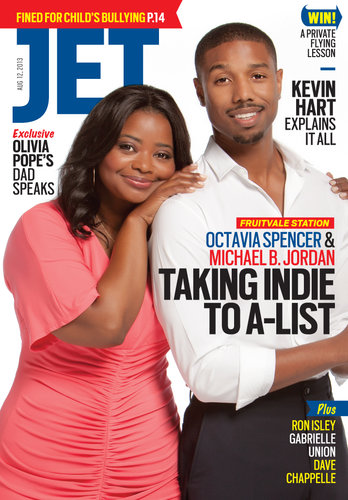
The Aug. 12 issue — which reflects the new design — has on the cover Octavia Spencer and Michael B. Jordan, the stars of the film “Fruitvale Station,” which is based on a 2009 incident when a black man was shot and killed by a police officer in an Oakland subway station. The film has gotten particular attention because its release coincided with the verdict in the trial of George Zimmerman in the shooting death of Trayvon Martin.

Ms. Miller said the magazine would also offer more service journalism for its readers. “It’s also about how can you get BeyoncĂ©'s look for less,” she said. “When you have her clothes, here are the top five detergents you need to get the stain out of that blouse.”

It will also offer short videos for users’ mobile phones. In the August issue, Ms. Miller added such a video to her editor’s letter.

One thing that won’t change, however, is the magazine’s unusual size — 5⅛ inches by 7⅜ inches. Ms. Rogers said the magazine enlisted the opinions of focus groups around the country for ideas on the makeover. “The one thing we kept hearing was, ‘Don’t change my size,'” she said.

Saturday, December 08, 2012

10823: Ebony Evolves.

From The New York Times…

Ebony Looks to Its Past as It Moves Forward

By Matt Haber

DESIRÉE ROGERS, the C.E.O. of Johnson Publishing, which owns the magazines Ebony and Jet, and Fashion Fair, a makeup line aimed at women of color, can see many sights from her 21st-floor corner office across from Millennium Park. “This is a good view of Chicago,” Ms. Rogers told a recent visitor, gesturing at a panorama of Lake Michigan, Grant Park, Navy Pier, the Adler Planetarium and Soldier Field. But the sight that holds the most personal meaning for Ms. Rogers may be a portrait by Robin Harper just above her purple retro sofa, depicting the boxer Jack Johnson with a soft, wounded expression.

The portrait, Ms. Rogers said, reminded her of looking at pictures of Muhammad Ali in the pages of Ebony with her grandfather as a little girl growing up in New Orleans. “My grandfather really liked fighters,” she said. As they flipped through the magazines, she said, he’d tell her: “I hope you’re great. And I hope one day you’ll be in those pages.”

Ms. Rogers, 53, has been in the pages of Ebony many times since her first appearance in April 1989 in a photo from George H. W. Bush’s inauguration. Her name now sits atop the magazine’s masthead, just below that of her best friend, Linda Johnson Rice, chairwoman of the company.

Ms. Johnson Rice’s father, the late John H. Johnson, founded Johnson Publishing in 1942 with a $500 loan he secured against his mother’s furniture when he was 24. Since then, Ebony (the name was the suggestion of Ms. Johnson Rice’s mother, Eunice Johnson) has gone on to become one of the most recognizable African-American publications in the world. The Harper image was part of the huge art collection of Mr. and Mrs. Johnson (no relation to the boxer), and it graced the cover of the magazine in March 1978.

Ms. Rogers joined Johnson Publishing just over two years ago after a short, controversial run as White House social secretary for President Obama. Among the tasks she has set for herself is making Ebony a lifestyle brand.

“We started looking at the assets that we have and also to really think about the Johnsons and what they were creating,” Ms. Rogers said. “We have incredible loyalty and love from the community. We have great relationships with our clients, who have been rooting for us to turn around and modernize.”

In early November, Ebony.com introduced The Ebony Collection, an online shop that sells framed prints of 2,000 photos selected from the magazine’s million-image archive. Reprinted from the original negatives stored in a climate-controlled room, the images were selected by Ms. Johnson Rice, who spent months poring over her father’s original commissions. “We kept everything,” Ms. Johnson Rice said. “Every major event that’s happened to African-Americans since 1945, with Ebony as a repository for all those photographs and as a voice for all that happened.”

Paying respect to history is a theme repeatedly invoked in the Johnson Publishing offices, so much so that it was no surprise running into Henry Louis Gates Jr., the director of the Harvard W. E. B. Du Bois Institute for African and African American Research, in a conference room. Professor Gates was there with a film crew shooting a PBS series, “Many Rivers to Cross: The History of the African American People,” and was being shown images from the archives by Ms. Johnson Rice for an episode that will cover 1940 to 1980. “My family got Ebony,” he said later. “Every family subscribed to Ebony and Jet if they were black.

“They still have cultural resonance among all classes of African-Americans,” Professor Gates said. “Very few organs of journalism reach a wider swath of the African-American community than Ebony and Jet.”

In 2013, that community will once again welcome the Ebony Fashion Fair, which began bringing high fashion to 160 cities across the country in 1958, but has been on hiatus since Eunice Johnson’s death in 2010. (“It’s the No. 1 question I get as I travel the country,” Ms. Rogers said. ‘When is the show coming back, DesirĂ©e?’”)

Ms. Rogers and Ms. Johnson Rice are also working closely with Suzanne Lovell, an interior designer, on a line of Ebony-branded textiles, with concepts being developed for bags, Hermès-inspired bangles and other accessories based on the flamboyant wall and floor coverings commissioned for Johnson Publishing’s original headquarters. Eunice Johnson’s personal style will be honored in March when the Chicago History Museum exhibits 60 pieces of haute couture culled from her collection of 7,000.

The coming year is also the 40th anniversary of Fashion Fair Cosmetics, which has grown from a direct-mail promotion in Ebony into an internationally available line of 240 products. Clarissa Wilson, president of Fashion Fair, said that the search is under way for the face of an anniversary campaign.

Then there are the magazines themselves. Ebony has been redesigned: its original logo, a red banner with white lettering based on Life magazine’s, has been replaced by one that Amy DuBois Barnett, the editor in chief, described as “retro cool.” Jet, the 61-year-old digest, is also due for a redesign, and has recently begun getting attention for a stronger, more youthful voice (the magazine recently featured its first same-sex wedding announcement).

In addition to commissioning the new logo, Ms. Barnett, who took over as editor of Ebony two years ago, added a slogan to the magazine’s spine that could function as a cri de coeur for all of Johnson Publishing as it extends Ebony across various platforms: “It’s More Than a Magazine, It’s a Movement.”

“It’s not just another magazine, it’s something far greater,” Ms. Barnett said. “There are very few magazines that hold the iconic place within their community and with their readers that Ebony does.”

That may explain why some readers were taken aback by the appearance of NeNe Leakes, one of the “Real Housewives of Atlanta,” on the cover of the December 2012-January 2013 issue. Ms. Leakes, who also stars in the NBC sitcom “The New Normal,” was photographed in a bathtub full of diamonds holding a gold-rimmed Champagne flute, an image that struck some as the wrong one for the magazine, especially given that the issue also contained the Ebony Power 100 list of the most influential African-Americans, a conceit celebrated with a gala at Lincoln Center in New York.

“I think NeNe Leakes is fabulous and I very much respect what she’s been able to accomplish in her life,” Ms. Barnett said. “We didn’t shoot NeNe in a business suit sitting behind a desk with a briefcase. We shot her in a very tongue-in-cheek setting to glorify the thing that turned her into a pop culture icon.”

She added: “That speaks to our sense of humor. That speaks to the sense of irony we can also have. There’s no reason Ebony magazine should only feature staid and conservative content.”

It’s hard to imagine another general-interest magazine editor having to justify putting a reality star on her cover. But then, few other editors are running a magazine that once employed Martin Luther King Jr. as an advice columnist and won a Pulitzer Prize for a photograph of Dr. King’s widow, Coretta Scott King. “As with any magazine, it’s the same kind of work, but there’s just another layer of historical responsibility,” Ms. Barnett said.

“We’ve been here so long,” said Ms. Johnson Rice in her own corner office, which has its own, equally impressive view of Lake Michigan. “The history and richness runs so deep within the community. We own this. It’s personal. It’s very personal.”

Tuesday, September 25, 2012

10558: Ad Age Salutes Eunice W. Johnson.

From Advertising Age…

Ebony Founder Eunice W. Johnson Lived a Life of Smart Moves

By Linda Johnson Rice

Eunice W. Johnson

Founder, Ebony; Creator, Fashion Fair

One thing a lot of people don’t know about my mother is that she actually selected the name Ebony for the magazine that she and my father founded. While my father was still in search of a name, she suggested that they reach for their roots and offered Ebony as a contender. Now, the magazine reaches millions of readers on a monthly basis. Coming up with the name was one of many smart moves made by my mother, Eunice Johnson.

Originally from Selma, Ala., she moved to Chicago and became what I would call a real steel magnolia. Her negotiation skills were very genteel and ladylike but tough. She was very smart and savvy in the way she conducted business, and this is one of the reasons she was one of the most successful businesswomen of her time.

A stickler for perfection, my mother believed in things being fair and equitable. I will never forget the time we visited a certain designer, and my mother was hoping to purchase key pieces for one of her fashion shows. She sat down with her checkbook open and was uncapping her pen to begin writing the check. She then paused and said to the designer, “I don’t think I like that price.” The designer tried to persuade my mother that the price was right, but she stuck to her guns and we left. The next thing I knew flowers, perfumes and phone calls were pouring into our hotel room—all from the designer, who was ready to give my mother a better deal!

When you came away from spending a day with Eunice Johnson, you came away with more knowledge than you had when you started. Her class, style and presence were second to none. My mother, who passed away in 2010, had an innovative, entrepreneurial spirit and because of her impeccable forward thinking, our brands—Ebony, Jet and Fashion Fair—are still revered in the African-American community. She always told me you had to strive for the best. Johnson Publishing is as relevant today as it was in 1942 when it was founded. As we move ahead, we are going to develop more into a lifestyle brand. We will evoke an Ebony lifestyle—but it will really be a Johnson lifestyle.

Friday, July 22, 2011

9055: Delivering News On John H. Johnson.


Postal Service Previews John H. Johnson Stamp Via Social Media
Trailblazing Publisher of Ebony, Jet, Immortalized on Forever Stamp

The Postal Service continues its sneak peek at some of its 2012 stamps, using social media outlets to preview the 2012 Black Heritage Stamp honoring legendary publisher John H. Johnson. Using social media to reach broader, more diverse audiences is an initiative that began Monday. Select stamps from the 2012 commemorative program will continue to be previewed one at a time.

Customers may preview the stamps on Facebook at facebook.com/USPSStamps, through Twitter @USPSstamps or on the website Beyond the Perf at www.beyondtheperf.com/2012-preview. Beyond the Perf is the Postal Service’s online site for the back story on upcoming stamp subjects, first-day-of-issue events and other philatelic news.

John H. Johnson Forever Stamp

“We are proud to immortalize John H. Johnson as our latest inductee in our Black Heritage stamp series,” said Stephen Kearney, manager, Stamp Services. “He was the trailblazing publisher of Ebony, Jet and other magazines as well as an entrepreneur. In 1982, he became the first black person to appear on Forbes magazine’s annual list of the 400 wealthiest people in America. His magazines portrayed black people positively at a time when such representation was rare, and he played an important role in the civil rights movement. President Clinton awarded him the Presidential Medal of Freedom in 1996.”

The stamp, designed by art director Howard Paine, features a color photograph of John H. Johnson taken by Bachrach Studios. The photographer was David McCann.

The Postal Service has recognized the achievements of prominent African Americans through the Black Heritage series since 1978. The series highlights outstanding individuals who helped shape American culture.

Other 2012 Forever stamps previewed this week were the 2012 Cherry Blossoms Centennial, the Edgar Rice Burroughs and Love Ribbons stamps.

The Postal Service receives no tax dollars for operating expenses, and relies on the sale of postage, products and services to fund its operations.

Friday, March 04, 2011

8579: The All-New 2011 Ebony.


From Advertising Age…

Ebony Aims for Rebound With Redesign and Circulation Consultants

Making New Pitch After Missing Rate Base for a Year and a Half

By Nat Ives

Ebony magazine is introducing what it calls its first cover-to-cover redesign since its introduction in 1945 as part of a bid to regain momentum after missing its paid circulation guarantees to advertisers for a year and a half.

Ebony missed its guaranteed rate base of 1.25 million by an average of 6.5% in the second half of 2009, 10.8% in the first half of 2010 and 20.2% in the second half of 2010, according to its statements with the Audit Bureau of Circulations.

It places most of the blame on its prior circulation management, which it says it has improved by outsourcing it to circulation veterans last October. Their diagnosis found insufficient direct-mail campaigns and prices that were occasionally more aggressive than other magazines.

“If you’re not constantly reaching out and asking people to come back on, they fall off,” said Rodrigo Sierra, senior VP-chief marketing officer at Johnson Publishing, which owns Ebony and Jet.

Last August Johnson Publishing named Desiree Rogers, the former White House social secretary, to take over as CEO, just one of several personnel changes that might play a role in Ebony’s effort to rebound.

Ebony’s latest step is the redesign from Amy DuBois Barnett, who was named editor in chief last June, and Darhil Crooks, who joined in January as creative director from Esquire, where he had been art director.

“This is a top-to-bottom redesign, not a small one,” Ms. Barnett said. “This is everything from introducing an evolution of our 65-year-old logo to really taking apart every single page in the magazine and putting it back together with an eye to the brand pillars that we now think best reflect our target demographic.”

“In talking to our demographic I saw that there are so many African-Americans who are doing extremely well and yet everybody talked about striving,” she added. “The people I really want to make sure read this are really goal-oriented and working on improving their lives. I’ve woven that theme throughout the book.”

A new eight-page section called Elevate, for example, focuses on inspiration, empowerment and advocacy—intended to deliver a mind, body and spirit perspective more than just tips on losing weight or what kind of berries to eat, Ms. Barnett said.

Other elements include four new editorial departments, a first “evolution” of the logo, cleaner design and a new color pallet.

Ebony has also been suffering in ad page sales. Ebony’s ad pages declined 11.2% in 2010, compared to a 0.1% slip across magazines as a whole, and sank 38.9% in 2009 while magazines on the whole fell 25.6%, according to the Publishers Information Bureau.

The circulation shortfalls didn’t help. “We can now go out in the marketplace and say we’ll be back to our 1.25 million in the first half,” said Stephen Gregory Barr, the former OK magazine publisher who was named senior VP and group publisher at Johnson Publishing last month.

“A lot of people were saying, ‘Oh, they’re damaged, they’re going to fold,’” Mr. Barr added. “Even with the slip we were a little under a million. The demand didn’t go away. We’re now coming to the table saying we’re still here.”

Thursday, August 19, 2010

7887: Dress Like A Millionaire.


From The Chicago Sun-Times…

Ebony auction nears
Affordable fashions to go days before big-name event

By Sandra Guy

A double-breasted faux leopard pony coat and a Claude Montana burgundy leather coat are among the fashions of Ebony Fashion Fair creator Eunice W. Johnson to be auctioned Sept. 16 by Chicago’s Leslie Hindman Auctioneers.

A tag sale of some of Johnson’s more affordable fashions will be held Sept. 11-15, along with an exhibition of her collection, at Leslie Hindman Auctioneers, 1338 W. Lake St.

The auction of the more expensive fashions—a total of 146 pieces—will be held at 5 p.m. Sept. 16 at the auction house.

Johnson, who died Jan. 3, came up with the name “Ebony” for the flagship magazine, and was known as an impeccably dressed Southern lady who spent millions each year in Paris and Milan on clothing for the Ebony Fashion Fairs. The fashion fair tours, which traveled 180 cities nationwide, were canceled in fall 2009, spring 2010 and for fall 2010, but the struggling Johnson Publishing Co. says it remains committed to the Fashion Fair brand.

The collection being auctioned includes dresses and evening gowns from Bill Blass, Bonwit Teller, Galanos, Gianni Versace, Halston, Oscar de la Renta, Carolina Herrera, and dresses, skirts and jackets by Thea Porter, Yves Saint Laurent, Zandra Rhodes and Jean Paul Gaultier.

Other items to be auctioned are jewelry, boots, shawls, scarves, belts, sunglasses and wardrobe trunks.

Wednesday, August 11, 2010

7866: Desiree Rogers Jets To New Job.


From The Chicago Sun-Times…

Desiree Rogers new Johnson Publishing CEO; Ebony, JET

By Sandra Guy, Chicago Sun-Times

CHICAGO—Desiree Rogers, former White House social secretary and Illinois Lottery director, has been named chief executive officer of Johnson Publishing Company, the Chicago-based publisher of Ebony and JET magazines, the company announced today.

Rogers had been working as a consultant to the company since June 5.
Linda Johnson Rice, daughter of the company’s founder who held the title, will remain as chairman.

“Desiree has a proven track record of successful business leadership,” Rice said in a statement.

Rogers will oversee day-to-day operations and be responsible for aligning core business strategies for all of the company’s brands.

Rogers said in a statement, “I consider it an honor to help continue the 68-year legacy of such a phenomenal company and its iconic brands.”

Johnson Publishing, beset by falling advertising revenues, recently started a management reshuffling, beginning with the June 3 announcement that the company is no longer for sale and the hiring that same day of Amy DuBois Barnett as the new editor in chief of Ebony magazine.

On July 13, the company announced that its president and chief operating officer, Anne Sempowski Ward, had resigned.

Tuesday, July 13, 2010

7781: Johnson Publishing President Edits Out.


From The Chicago Sun-Times…

Johnson Publishing president resigns
To join husband in family consulting biz

By Sandra Guy

The president and chief operating officer of Johnson Publishing Co., the Chicago-based company that publishes Ebony and JET magazines, has resigned.

Anne Sempowski Ward will be joining her husband, Kevin, in the couple’s business-consulting firm, according to a statement Monday from Johnson Publishing Co.

Ward was initially hired in 2007 as president and COO of Fashion Fair, the cosmetics division.

She was appointed president and COO of Johnson Publishing Company Inc. in 2008. She served in both roles for the last two years. Ward said in a statement, “It has been a phenomenal privilege to be the first member from outside of the Johnson family to serve as president and COO of both the publishing and cosmetics divisions of Johnson Publishing Co.”

Said Chairman and CEO Linda Johnson Rice, daughter of the company’s founder, “Her [Ward’s] contributions have helped to position the company for the future.”

Johnson Publishing, beset by falling advertising revenues, recently started a management reshuffling, beginning with the June 3 announcement that the company is no longer for sale and the hiring that same day of Amy DuBois Barnett as the new editor in chief of Ebony magazine.

On June 5, Johnson Publishing said it had hired former White House social secretary and Illinois Lottery director Desiree Rogers as a consultant.

Speculation immediately started that Rogers might take Ward’s place. Johnson Publishing issued a statement saying that Rogers is not being considered for the role of president and COO because her role remains as a strategic consultant.

“We are continuing to assess our current internal staffing needs to enhance our senior-level management positions; and as such, we will determine our next steps following our evaluation,” said Johnson Publishing spokeswoman Wendy Parks.

Saturday, June 05, 2010

7702: Rogers Consults With Johnson Publishing.


From The Chicago Sun-Times…

Desiree Rogers hired as Johnson Publishing consultant

By Sandra Guy, Staff Reporter

Former White House social secretary and Illinois Lottery director Desiree Rogers is working as a consultant with Johnson Publishing Co., owner of Ebony and Jet magazines, to help with corporate strategy, a Johnson Publishing spokeswoman said today.

The news comes just two days after Johnson Publishing Chief Executive Officer Linda Johnson Rice hired author and magazine turnaround expert Amy Dubois Barnett as the new editor-in-chief of Ebony magazine and declared that the company is not for sale.

A Johnson Publishing spokeswoman declined to give details about Rogers’ role.

Rogers left the Obama administration earlier this year after she got caught up in controversy over a White House security breach.

Johnson Publishing, the world’s largest African-American owned and operated publishing company, based at 820 S. Michigan, is facing the same dilemma as much of the print-media world—sharply declining advertising revenue. The company has recently redesigned Ebony and Jet magazines to appeal to younger readers and to reflect diverse opinions.

Thursday, February 25, 2010

7545: More On Magic And Johnson Publishing.


From Target Market News…

Magic Johnson says ‘advanced discussions’ with JPC didn’t reach ‘definitive agreement’

Earvin “Magic” Johnson released a statement today saying someone from Magic Johnson Enterprises really had been speaking with someone else at Johnson Publishing Co. about something, but that nothing had come out of the talks.

Without being straightforward about the details, the former NBA star tried to put to rest a week-long buzz about his interest in the company that publishes the legendary Ebony and Jet magazines. The story took on a life of its own, with columnists, critics and bloggers assuming that a sale of JPC was all but a done deal.

In a carefully crafted 88-word release, Los Angeles-based businessman Johnson offered his only comment since the Feb. 13 Bloomberg news service story appeared quoting an unidentified insider who said a sale of JPC was being negotiated. MJE president, Eric Holoman was also quoted, saying that there were discussions, but “there is no definitive agreement.”

In his statement Johnson mentions the word “sale,” but he claims that “advanced discussions to do business together” took place, though not between him and JPC chair and CEO, Linda Johnson Rice.

Here’s what the entire statement said:

“I would like to salute Linda Johnson Rice and the Johnson family for pioneering the iconic brand of the Johnson Publishing Company, which we have all come to love and respect. Ebony and Jet have been permanent fixtures on coffee tables in African-American homes for many years.

“Recently, an affiliate of Magic Johnson Enterprises and Johnson Publishing Company were in advanced discussions to do business together, but unfortunately we were unable to reach a definitive agreement. We will continue to look for opportunities to invest in African-American media.”

For its part, the 67-year-old Chicago-based firm continues to ignore conjecture about its future plans, while working to hold its ground in an advertising market hard-hit by the recession.

JPC recently introduce improvements to the nation’s two most successful black-owned titles. The weekly Jet just unveiled a new logotype and overall design, coming on the heels of a similar makeover of its flagship, Ebony magazine.

Friday, February 19, 2010

7529: Johnson Publishing Denies Magic Moments.


From Target Market News…

Johnson Publishing Co. officials deny negotiation talks with Magic Johnson

Executives with Chicago-based Johnson Publishing Co. have denied that there are negotiations taking place regarding a sale or partnership with businessman and former NBA star, Earvin “Magic” Johnson. A report published last week by the Bloomberg news service quoted Eric Holoman, president of Magic Johnson Enterprises, as saying “There have been discussions” with the nation’s largest African-American owned publishing company, but “there’s no definitive agreement.”

The story also quoted JPC spokesperson, Wendy Parks as saying that company chairman and CEO, Linda Johnson Rice “has never talked to Magic Johnson with respect to his interesting buying the company.”

JPC executives, who asked not to be identified, told Target Market News that the story “was a total surprise,” and that there are no talks taking place with MJE.

Magic Johnson most recently was in the news for suggesting to President Obama that a minority czar be appointed by the administration to act as a liaison between minority communities and the White House. He also said that he would be willing to assume the post if other candidates could not be identified.

Numerous stories have circulated about the fate of Johnson Publishing Co., which publishes Ebony and Jet magazines. Like all publishers, has had to address severe cuts in advertising revenues. In 2009 JPC reported to the Publisher Information Bureau ad revenues of $35.4 million, a drop of 37.5 percent from 2008. Ebony continued to be the largest revenue producer of all black-owned magazines. Essence, the leading magazine for black women and owned by Time Inc., had 2009 revenues of $100.6 million, a drop of seven percent from the previous year.

Though a host suitors and buyers have been cited as interested or holding discussions with the iconic company, no sales or partnerships have taken place.

Saturday, February 13, 2010

7519: Ads Honor Eunice W. Johnson.


The March 2010 issue of Ebony featured a series of advertisements saluting the late Eunice W. Johnson.


7518: Bringing Magic To Ebony And Jet.


From The New York Post…

Magic Johnson courts magazines

Earvin “Magic” Johnson is betting he can bring some magic to the venerable black magazines Ebony and Jet.

The Hall of Fame basketball player is said to be in talks to purchase Johnson Publishing Co., the company behind the two well-known magazines aimed at African-Americans.

“There have been discussions,” Magic Johnson Enterprises President Eric Holoman said in an interview with Bloomberg News, during which he noted, “There’s no definitive agreement.”

A spokeswoman for Chicago-based Johnson Publishing told Bloomberg that company Chairman and CEO Linda Johnson Rice “has never talked to Magic Johnson with respect to his interest in buying” the 58-year-old company.

Talk of a transaction comes as Ebony, like most magazines, has taken it on the chin because of the ad recession. According to the Publisher’s Information Bureau, Ebony’s ad revenue has tanked 38 percent to $35.5 million, driven by a 39 percent decline in ad pages. Jet, meanwhile, has recorded a 36 percent drop in ad revenue to $17.1 million on a 36 percent fall in ad pages.

Bloomberg, citing a person familiar with the matter, reported that a deal with Johnson would likely include the company’s headquarters, which has had liens placed on it by one of the company’s creditors.

Johnson, who’s armed with a $1 billion war chest, would fold Johnson into his Magic Johnson Enterprises, which has partnerships with Starbucks, health-club chain 24 Hour Fitness Worldwide and restaurant chain T.G.I. Fridays.

Sunday, October 04, 2009

7152: Real Mad Men Read Ebony.


Is AMC series Mad Men deliberately insulting Black viewers? This week’s installment opened with Pete Campbell in his office, reading the latest issue of Ebony magazine. Please. In a few years from the time period Mad Men purports to represent, John H. Johnson’s publication will produce advertising far more provocative and breakthrough than anything Don Draper and his team have presented so far.

Tuesday, June 09, 2009

6822: Out Of Touch, Out Of Print…?


From BlackVoices…

Bottom Line With Dr. Boyce: Why Ebony & Jet May Be Doomed

Posted by Dr. Boyce Watkins, PhD

I was saddened to hear about the recent financial trauma of Ebony and Jet Magazines. These two magazines formed powerful prototypes for success in black media, and may now find themselves to be casualties of the general decline of the magazine industry. They were black-owned and profitable economic institutions who set the standard for black business in America. What is saddest is that I saw this coming 3 years ago.

Warren Buffett, the billionaire investor, saw the same thing, but he saw a more general demise for both newspapers and magazines. When asked if he would ever buy into the print media industry, Buffett had this to say:

“For most newspapers in the United States, we would not buy them at any price,” he said. “They have the possibility of going to just unending losses.”

Ebony and Jet were no exception. The problem is that they didn’t seem prepared for the changing world around them.

The newspaper industry is shot and so are many magazines. Media has changed and these outlets are no longer the only game in town. Advertisers have more effective and cost efficient ways to get their message to the target audience and the extraordinarily high advertising costs of Ebony and Jet Magazine are no longer necessary.

The thing about Ebony and Jet (both owned by the Johnson family) is that much of their financial demise could possibly have been averted. If management had taken stronger steps to adjust to the advent of the Internet, perhaps they could have remained profitable. Essence magazine took note of the trend long ago, as they invested heavily in revamping their online business model. They now have one of the strongest black news websites in America (with traffic roughly 1/4 - 1/3 of AOL Black Voices, according to Alexa.com). Ebony and Jet didn’t seem to follow the lead of Essence, still holding onto the same old way of doing business that has worked for the past 40 years. That is what may cause them to go down with the rest of the industry.

It must be noted, however, that Essence Magazine was acquired by Time Warner, which may have given them a competitive advantage. Ebony Magazine did have the option of raising additional funds from the public to finance their multimedia expansion, but they did not seize this opportunity. Consistent tracking of their online growth implied that they were not transitioning as quickly as other media outlets.

There is an added challenge that perhaps the Johnson family was a little too anxious to “keep it in the family.” Sharron Hunter-Rainey, an Assistant Professor of Management at North Carolina Central University states that “Throughout the history of Ebony/Jet, Johnson Publishing seems to have been more insular. Mr. (John) Johnson positioned his (adoptive) daughter to run the firm after she completed her Kellogg MBA. Clearly she knew the most important person in this decision process, but the nepotism involved in the succession planning process obviously restricted the range of candidates in the applicant pool.”

During my recent trip to Nigeria, a business consultant explained that the strength of Ebony Magazine may have been it’s greatest weakness. Mr. Johnson, the founder of Ebony Magazine, was a tireless visionary. He was very hands-on and never took “no” for an answer. His models for the publishing industry were tried and true and he almost single-handedly turned his publishing empire into one of the great business models of the 20th century.

The problem is that some entrepreneurs have a difficult time letting go or adapting their management style to fit new operating environments. This argument may not apply completely to Johnson and his family, but the truth is this: The magazine subscription ship was sinking, and your online presence became your life raft. Those publishers who were not able to make the adjustment in enough time found themselves charging 1980s prices in a new millennium advertising market. Such an outcome is simply unsustainable.

Dr. Carlos Thomas, a professor of Management and E-Commerce at Southern University, argues that there is a general struggle that some family owned businesses have when it comes to securing the rational mindset necessary to expand and grow as the environment changes.

“There is extensive literature which cites that entrepreneurs who are used to micromanaging the company can sometimes have trouble adjusting their business model,” says Dr. Thomas.

Alliant International University Professor Alfred Lewis agrees with Dr. Thomas.

“Ebony and Jet failed to respond to the ‘Paradigm Shift’ in the industry-at-large by sticking to that which is familiar,” says Dr. Lewis. “There is also the socio-economic shift in that African Americans have been moving away from ‘traditional’ black/African American publications and Ebony & Jet may have missed this shift or decided to stay the course.”

Ebony and Jet Magazine are two publications that should receive black support. But this financial support should not come in the form of donations or fund-raising campaigns. It should come in the form of public financing in exchange for equity ownership in the company. The black community should not just give money to support the Johnson family, the Johnson family should give something in exchange.