Tuesday, April 03, 2007

Essay 1945


Three more online responses to the story presented in Essay 1937…

Jamaica, NY, you are absolutely correct about catch phrase, fad and face-of-the-week. Credibility, respectability, understandability and more can take 50 years in some cases and in some industries. For legal release, I currently own a Ford Mustang. Big deal. Ford is currently running at $10 billion a year MINUS for several years now. The idea that this company has vast resources may need to be re-examined? This is an opportunity to hit a gold mine with advertising Ford’s great new cars, trucks and choices. To promote a company’s product with digital and video…these corporations are soon going to own the medium and produce everything themselves. It will be the end of certain media companies like Fox or CNN, for example. What if Ford gave away 2 cars a day tax-free by watching their channel and shows? The announcement to call or email the Ford station for the car/truck/van could appear even during a commercial break??!! You will love Ford’s programming, which [gives you] special invitations to events if you actually purchase or recommend a purchase towards a Ford product (nagging your parents is acceptable — kids are allowed to call on a legal guardian’s behalf!). Now…take the word Ford away and replace it with any other company in the world in terms of video ownership (leave off the minus $10B part). Ford can produce and distribute shows and music with its cars worldwide if it chooses. — Brandon, FL

In spite of the no doubt great amount of research done before signing this deal, this comes across to the ‘urban’ community as a ‘knee jerk’ reaction. I agree wholeheartedly with Mr. Zimmerman! He's right on point with his assessment! Any hip-hop aficionado, African American or so called ‘urban’ individual can tell you that ‘street cred’ (itself, not an ‘urban’ catchphrase) is ‘earned’ and not bought. One cannot buy credibility within this market and certainly cannot gain it by co-opting the most visible ‘face’ to attach to your brand/product. How is it that Ford, with all of their resources, has not seen the evidence of this played out with so many other brands in the past? Evidently, Corporate America STILL ‘gets to the party late’ by recognizing the ‘hot’ personalities/trends/etc. well after they’ve already been made popular in the ‘urban’ community; a strategy that invites ridicule for the brand and widespread applause for the celeb involved for having negotiated such a deal. Does Corporate America not understand that with the ‘urban’ community, the media/marketing tenets of mass market metrics to validate your marketing ROI does not apply to identifying/developing/adopting the trends quickly enough to lend your brand some ‘cool’? Actually, the ‘urban’ market gives more props to Flex in this deal because he’s ‘gettin’ his paper’ by exercising his popularity and this isn’t necessarily going to give Ford the status it’s looking for. Actually, all this proves is that Ford and brands like them are still far off from having a meaningful dialogue with the urban community and even further away from beginning to understand it. Poor move by Ford, excellent move by Flex! — Jamaica, NY

HEY FORD…LISTEN UP. This is exactly what street cred is all about. Now…have a Rap version of American Idol. Make it kind of “underground” yet accessible by everyone. Ford loves music and entertainment! I think they proved that with radios in their cars and the #1 music show in TV history. Get this new DJ to get a huge national contest and star on the stage. Ford can allow downloads from its website of new acts and performers from around the world. Forget simply signing people up for cred…Ford has an opportunity to DEFINE what cred really means just like defining what an Idol can mean. Immediately announce this new music contest and you will receive millions of hits worldwide within a week for this star-making opportunity in the Rap music field. Oh by the way…sell some cars and trucks. — Brandon, FL

Essay 1944


Seeking spiritual guidance in a MultiCultClassics Monologue…

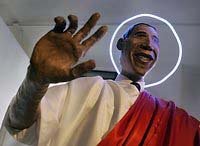
• A student artist in Chicago raised hell with his sculpture depicting Sen. Barack Obama as Jesus Christ (pictured above). “All of this is a response to what I’ve been witnessing and hearing, this idea that Barack is sort of a potential savior that might come and absolve the country of all its sins,” said the artist. “In a lot of ways it’s about caution in assigning all these inflated expectations on one individual, and expecting them to change something that many hands have shaped.” The kid sounds like a goddamn moron.

• Meanwhile, spiritual leader Rev. Al Sharpton continues to play politics, getting involved with the feud between rappers in New York that led to Tony Yayo assaulting a 14-year-old kid (see Essay 1905). Sharpton has threatened to launch a boycott against The Game and 50 Cent unless the battles end. “We put the i-n-g in your bling-bling,” said Sharpton. “All of us have children who listen to your music. Some of us listen ourselves. But we don’t want to feel like we’re investing in the demise of our community.” The worst part of this scenario will be the lame rhymes and rhetoric generated by folks like Sharpton.

Essay 1943

Essay 1942


There should be a bilingual caption beside the woman that reads: Here’s how much it will cost to wire one dollar overseas.

Monday, April 02, 2007

Essay 1941


One online response to the article presented in Essay 1937…

1) I do agree with the name “Fairlane” being much too “suburban” for a vehicle seeking an “urban” audience. But Flex? How desperate to pander is that marketing department; how bereft of ideas? Something tells me FF “licensed” his name; hence, of course he’s “fine” with its usage… 2) I will submit that Funkmaster Flex as a “showman” for the vehicle is much too transparent for so-called “street cred.” What Ford is forgetting is that Cadillac has a history in the so-called Urban demographic; and thus, an Escalade can be seen as “real.” Ford will always have connotations of truck-driving ‘necks for that same audience; and hence they will find it hard to find “crossover” appeal, commercial DJ endorsement or not. 3) Mr. Perry’s quote on FF sums up the article in a nutshell. A “multicultural” marketing manager, asserting FF is “multicultural,” and hence the soundness of this strategy. Disturbingly humorous… — Kreig Zimmerman, New Britain, CT

Essay 1940


From The Miami Herald…

-------------------------------------

‘Our young men are dying’

BY ANDREA ROBINSON

Dwight Jackson longs for those days 30 years ago when young black men settled their disputes the old-fashioned way: with loud trash talk and occasional fisticuffs. When the dust-ups were over, the combatants walked away and went home.

Not anymore. Simple disputes now too often turn deadly.

Jackson, 47, sees it in the back room of the Liberty City mortuary where he makes mangled bodies presentable for public viewing. Jackson, owner of Richardson Mortuary, receives at least 10 young, black homicide victims a month; that’s more than there were, say, 20 years ago, other longtime employees there remark.

“Inner-city [boys] are being killed over silly stuff … built on hate and envy,” he said, shaking his head.

Forty years after the Kerner Commission report -- in the wake of the Watts riots in Los Angeles -- tried to sort out why young black men were killing each other, Jackson keeps wondering how things could have gotten so bad in South Florida and the nation.

A new, first-time Florida initiative seeks to find the answers and save at-risk black males -- who state Sen. Frederica Wilson, D-Miami, calls “an endangered species.”

“This goes beyond public safety and prevention. It’s public health. It goes to our mental condition,” said state Rep. Frank Peterman, a St. Petersburg Democrat.

Peterman and Wilson sponsored legislation to create the Council on the Social Status of Black Men and Boys, which former Gov. Jeb Bush signed into law last June and which first met in February. The council, located in the Attorney General’s office and budgeted at $200,000 per year, will study a litany of conditions that negatively affect black males: escalating homicide, arrest and incarceration rates, poverty, violence, low income, the breakdown of the family structure and school performance and health issues.

And it will produce yet another report -- like so many other commissions have done around the nation over the past 40 years -- that will propose ways to change the driving forces that have left so many black males in prison or dead from Miami and Fort Lauderdale to Orlando and Jacksonville.

Wilson said the council will recommend legislative action to address the issues of concern. The first report is due by the year’s end.

Peterman promises the Florida commission won’t be a “touchy-feely exercise” and said it will examine the breakdown in the black family and the heavy toll it is taking on males. To do that, it will need solid information of the sort requested by council chairman Levi Williams last week. In a teleconference on Wednesday, Williams, a Fort Lauderdale attorney, asked the heads of state agencies for data on racial and ethnic disparities.

SCOPE OF THE PROBLEM

Black males, Wilson said, are like Florida’s panthers and manatees: dying young and at the mercy of human predators.

“We’re so disproportionately affected by all of this [black-on-black male violence]. There are no men available to teach black boys how to become responsible men,” Wilson said.

That sentiment is echoed by Beverly Colson Neal, executive director of the Florida NAACP office in Orlando: “Our young men are dying. This didn’t just start.”

Florida is among a handful of states, including Ohio and Indiana, to have panels looking for ways to stop the rising violence that is a festering national problem, one the U.S. Conference of Mayors also hopes to tackle. The mayors’ meeting was held last month in Miami -- an appropriate venue to discuss violence because South Florida is a region under siege.

[Click on the essay title above to read the full story.]

Essay 1939

Essay 1938


Why would you need a sport utility vehicle if you had the superhuman ability to walk on water?

Essay 1937


From AdAge.com…

---------------------------------

Ford Hopes DJ Signing Cranks Up Cred, Sales

Names Expedition after Funkmaster Flex, Eyes Caddy’s Path to Success

By Jean Halliday

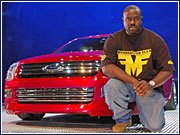
DETROIT – Ford’s got escalade envy. The automaker has been watching the sales escalation of GM’s Escalade, which has become the ride of choice for big-name rappers, professional athletes and hip-hop trendsetters. It wants those influencers driving its SUVs too -- and it’s starting with Funkmaster Flex.

Ford’s hoping to co-opt his cool by introducing editions of its Expedition and Mustang named after the DJ, as well as ditching the Fairlane name for its upcoming concept crossover vehicle and redubbing it Flex. (There will also be a limited-edition Funkmaster Flex version of the Flex). The DJ told Advertising Age he advised Ford that the name Fairlane name suggests a soccer-mom-mobile instead of the “urban vehicle” it is. “So when they asked if they could call it that, I was cool,” he said.

The move aims to win Ford more of the urban street cred owned by Escalade. The Cadillac SUV has been featured in numerous rap videos, popped up in song lyrics by everyone from Jay-Z to J. Lo, and was once piloted onstage by Ludacris at the MTV Video Music Awards.

That limelight led younger consumers to covet the brand once driven by doddering grandfathers. Some 19% of Escalade buyers are black, according to USA Today, compared to 6.5% for the total Cadillac brand. And the average age of consumers who say they would someday like to buy an Escalade is 27. Compare that to the average age of 48 for Ford Motor Co.’s Expedition, as reported by CNW Marketing Research.

In January and February, Ford sold 13,644 Expeditions, or 8.2% more than during the same period a year ago. By comparison, GM sold 4,826—or 15% more—of its Escalade model during that time, though its sticker price starts at $20,000 higher.

In addition to the new models, Ford will be the main sponsor of the second round of “Car Wars,” which is hosted by the DJ and hits cable’s ESPN2 in late May as a weekly, six-episode reality series in which specialists from around the U.S. will trick out 2007 Ford Expedition SUVs.

Funkmaster Flex, who has solidified his car-guru reputation with his six-year-old “Custom Car and Bike Show” tour, will also appear in a Ford Expedition spot to air during the show, created by Uniworld Group, New York. The first seven-week installment of “Car Wars” started yesterday and is backed by BP’s Castrol Syntec motor oil.

The 2008 Expedition Funkmaster Flex Edition will be unveiled by the DJ at the New York Auto Show this week. The automaker, which once told consumers they could have any color as long as it was black, is offering the Flex Edition in a unique red-and-black paint scheme with orange pinstripes. The version of the Ford Mustang will also carry a black-and-red color scheme, plus a six-cylinder engine that will produce more horsepower than Ford’s standard V-6 Mustang thanks to a special air-intake system, Funkmaster Flex said.

Although Mark Perry, multicultural marketing manager for Ford, Lincoln and Mercury, wouldn’t confirm the co-branded Mustang or Flex name, he hinted more Funkmaster Flex Fords could be coming. “We’ll march down the model line and see where he fits.” An executive close to the automaker said Ford’s research of the Flex name tested very well.

Funkmaster Flex’s main demographic is men in their early 20s to late 30s, and the celeb “brings coolness to the line,” Mr. Perry said. CNW President Art Spinella said the affinity of hip-hop urban males often trickles down to younger people in the suburbs.

What might be on the Expedition’s side is price. The Ford SUV starts at $29,995, a bit more affordable than the Cadillac Escalade, which starts at $54,000. Even so, most 25-year-olds aren’t likely to shell that out to buy the Ford, said Jeff Schuster, an exec director of auto consultant J.D. Power & Associates. Ford’s co-branded SUV can “create more of an image and awareness” among younger buyers, he added.

But that may just be the point. “Ford is doing this not for sales but for image,” said Mr. Spinella. A lot of 20-something males are buying used Cadillac Escalades to customize, especially in urban markets, he said. A used Escalade stayed on the lot for 12 days in Chicago and eight days in Los Angeles in the first quarter of 2007, compared to 39 days in Chicago and 32 days in L.A. for the Expedition, CNW data showed.

He added that virtually the only buzz the Ford brand gets among people under 30 is for its popular F-150 full-size pickup. Younger people perceive the brand as stodgy. “Ford needs to do something to get the attention of a significantly younger audience.”

But is Funkmaster Flex the one to do it? The Escalade was pretty much “discovered” on its own by the urban audience without a blatant association with a single celebrity. And then there’s the suggestion that Funkmaster Flex may be too mainstream to carry the same urban credentials as Escalade’s elite.

“Absolutely not,” said Ford’s Mr. Perry. “He crosses over very well, and that’s part of the attraction. He’s multicultural.”

Essay 1936


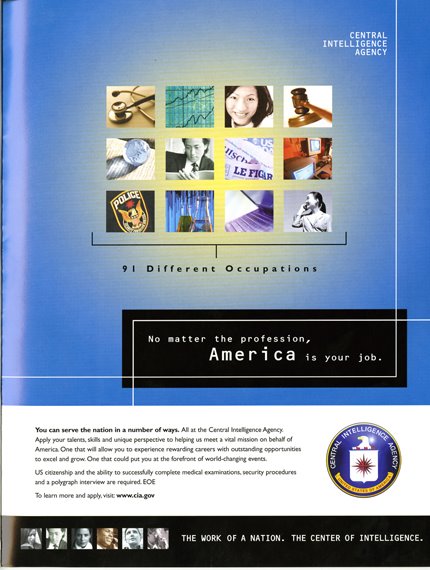
The CIA recruits Asian Americans by offering 91 different occupations — a veritable employment Chinese menu.

Essay 1935


From AdAge.com…

-------------------------------

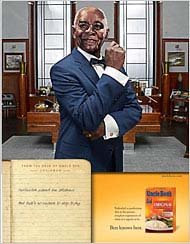
Mars to Give Uncle Ben Ad Icon Greater Role

No Longer an Image on a Box of Rice, Character to Star in Print, Web Effort

By Stephanie Thompson

NEW YORK -- Long relegated to a mere picture on the package, Uncle Ben is once again playing a starring role in Mars’ new campaign for the rice brand.

Promoted to CEO of the fictional Uncle Ben’s Inc., Ben will gain full mobility as a modern-day executive wise in the ways of life (and rice) in a print campaign and online efforts that breaks this month. Omnicom Group’s TBWA/Chiat/Day, Playa Del Rey, Calif., handles.

Post-modern moment
“It’s a very post-modern moment,” said Robert Entman, Shapiro Professor of Media and Public Affairs at George Washington University and co-author of the University of Chicago Press’s “The Black Image in the White Mind: Media and Race in America.” Mars, he said, has taken the Uncle Ben icon to the “extreme opposite, making him a busy executive vs. the faithful, loving slave in the house serving your meals” -- a clever approach to salvaging a brand they have invested money in for decades. Otherwise, he said, it would “require retiring the brand.”

“Uncle Tom characters designed to invoke the spirit of the South but not upset white values and dispositions don’t play a part anymore,” agreed Robert Passikof, founder and president of Brand Keys, New York. But that is hardly an issue for many of today’s consumers, he said, most of whom won’t remember when the Uncle Ben character was featured on the radio in a portrayal that today would be considered highly offensive. The new effort, Mr. Passikof said, “seems like a seamless way of migrating from the trade character on the box to something that allows [Mars] to create a better emotional bond between customers and the product.”

An initial first wave of “Ben knows best” print ads in publications such as People and Real Simple will feature “Benisms” such as “My rice is perfect with a side dish, like beef, chicken or fish.” Then Uncle Ben will become a walking, talking boss who welcomes employees to his office to share his knowledge about rice. According to Mars research, consumers said they saw Uncle Ben as a self-taught, self-made man who is witty, intelligent and wise, with a common-sense approach to solving problems and life in general.

Awareness vs. equity
Although Uncle Ben may be familiar to consumers, David Altschul, president of the Portland, Ore.-based agency Character, warned that “awareness is certainly not the same thing as equity.” But, he said, “it’s a great place to start.” Mars faces a situation, he said, not unlike Maytag, whose repairman character had “a lot of awareness and fondness but stood for something that was no longer motivating.”

Uncle Ben has a lot of heritage because he’s been on the package a long time, but Mars will need to use him to communicate something real and authentic about the brand today, Mr. Altschul said.

Mars aims to do that through a redesigned Unclebens.com, which offers a virtual tour of Ben’s office and will be updated to feature evolving aspects of the character.

Mars spent $181 million on Uncle Ben in the 52-weeks ended Feb. 25 in food, drug and mass stores excluding Wal-Mart, according to IRI.

Sunday, April 01, 2007

Essay 1934


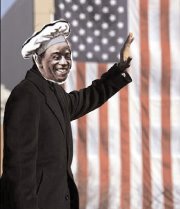
Masterfoods USA recently updated the Uncle Ben’s Rice icon as Ben the Corporate Chairman. Such a brilliant marketing move should inspire other brands to consider similar rebirths.


Introducing Rastus Ocreama! Rastus is not just running the premier hot breakfast cereal enterprise — he’s also running for President of the United States. Mark 2008 as the year America votes the first Black man into the Oval Office, while Cream of Wheat enjoys unprecedented approval ratings.


Reacquaint yourself with The Frito Bandito! The corn chip crusader is back, bringing a powerful voice to immigration rallies. The Frito Bandito draws the entire country together with tasty snack foods and a stirring speech titled, “Ay Yi Yii Yiii Have A Dream.”


Presenting Jemima! A media mogul and philanthropist, this bold heroine leads a breakfast foods company with heart and soul. Jemima built a $40 million waffle house for children in South Africa; plus, she’s funding research for the development of a maple syrup designed to eliminate diseases worldwide.

Essay 1933


Appealing to Asian Americans with Zen-like tonality plus Yin and Yang imagery is bad enough. But from Toyota?

Essay 1932


From The Chicago Sun-Times…

--------------------------------------

Are civil rights groups still relevant today?

BY MAUDLYNE IHEJIRIKA Staff Reporter

Chicago has long been a bastion for civil rights groups.

But are the Urban League, the NAACP and Rainbow /PUSH -- venerable foot soldiers in the decades-old battle for racial justice -- still relevant?

“It’s an insulting question,” the Rev. Jesse Jackson retorted. “It doesn’t reflect an analysis of what’s happening. Does voter registration matter? Does inequity in education matter? Of course it does.

“Those who ask that seek to diminish the historical significance of the relationship between protest and progress. Yes, things change,” Jackson said. “But they change because of protest. Then there is regress.”

The NAACP made headlines March 4 after the resignation of Bruce S. Gordon, its president of 19 months. Gordon and the board chaired by civil rights icon Julian Bond disagreed over his efforts to take the NAACP in a new direction. Bond had introduced Gordon with accolades in June 2005, and Gordon, at the outset, had proclaimed his goal of finding a new direction.

“It’s a family thing. Every family has its issues, and you don’t need to air it. But the NAACP is still very much relevant,” said Karl Brinson of the NAACP’s West Side chapter.

“I would have thought we would be out of business by now, but we still face the same issues. Instead of lynchings, it’s police brutality. Instead of segregated schools, it’s the quality of education …” Brinson said.

‘Crisis of divisiveness’
Confrontation used to be the weapon of choice to effect change. It was protests, press conferences and picket lines. Today, it’s negotiations and bridge-building. And when you talk to folks on the street, most feel disconnected to entities they once saw as champions.

“Civil rights organizations may not have the same profile we did 30 years ago, but that’s because, to a great extent, there’s a broader community of African-American leaders today,” said National Urban League President Marc Morial. “You have a large community of elected officials, many more nonprofit organizations, and mainstream organizations with African-American business and labor leaders. To a great extent, that was one of the objectives of civil rights.”

But to at least one observer, the apparent disconnect fuels the question of relevancy.

“We must become proactive about our own internal crisis of divisiveness; otherwise, it really doesn’t matter what the Urban League does, or the NAACP, or PUSH,” said the Rev. Hycel Taylor, professor emeritus at Garrett Theological Seminary in Evanston and a former national board president of Rainbow/PUSH. “We’re still going to be in the same predicament.”

Essay 1931


Say I Do … to the marriage of contrived and clichéd.

Essay 1930


From USA Today…

----------------------------

Report: Tuskegee Airmen lost 25 bombers

MONTGOMERY, Ala. (AP) — At least 25 bombers being escorted by the Tuskegee Airmen over Europe during World War II were shot down by enemy aircraft, according to a new Air Force report.

The report contradicts the legend that the famed black aviators never lost a plane to fire from enemy aircraft. But historian William Holton said the discovery of lost bombers doesn’t tarnish the unit's record.

“It’s impossible not to lose bombers,” said Holton, national historian for Tuskegee Airmen Inc.

The report released Wednesday was based on after-mission reports filed by both the bomber units and Tuskegee fighter groups, as well as missing air crew records and witness testimony, said Daniel Haulman, a historian at the Air Force Historical Research Agency at Maxwell Air Force Base in Montgomery.

The tally includes only cases where planes were shot down by enemy aircraft, Haulman said. No one disputed the airmen lost some planes to anti-aircraft guns and other fire from the ground.

The 25 planes were shot down on five days: June 9, July 12, July 18 and July 20, 1944 and March 24, 1945, the Montgomery Advertiser reported.

“All of these records have been here all along,” Haulman said. “It was just a matter of putting them together.”

The surviving members of the Tuskegee Airmen, the first group of black fighter pilots allowed into the U.S. Army Air Corps, received the Congressional Gold Medal on Thursday from President Bush in Washington.

With nearly 1,000 pilots and as many as 19,000 support personnel ranging from mechanics to nurses, the group was credited with shooting down more than 100 enemy aircraft and — for years — with never losing an American bomber under escort.

Haulman told the Advertiser he had discovered the claim that the Tuskegee Airmen had never lost a bomber they escorted to enemy fire first appeared on March 24, 1945, in an article in the black newspaper Chicago Defender. The newspaper’s headline read “332nd Flies Its 200th Mission Without Loss.”

The information was attributed only to “the 15th Air Force, Italy.”

“In fact, on the very day the claim was published, more bombers under 332nd Fighter Group escort were shot down,” Haulman wrote.

Saturday, March 31, 2007

Essay 1929


Sorry stories in a MultiCultClassics Monologue…

• In Richmond, Virginia, a slavery memorial was unveiled on Friday. A bronze sculpture of hugging figures is encircled by three benches resembling wooden ship planks, while a nearby deck spans a fountain designed to symbolize the Atlantic crossing made by Africans. “Virginia was not an innocent bystander in the matter of slavery,” said Gov. Timothy Kaine. “Some expression of apology or regret is natural.” So please accept this memorial in lieu of reparations.

• Circuit City is offering no apologies about firing its slaves, um, workers. On Wednesday, the retailer proceeded to cut 3,600 employees, announcing the company was dumping higher-paid folks and replacing them with cheaper laborers. The higher-paid employees were even being told they could be rehired at lower wages. So now customers can look to find cheap products and cheap sales help too.

• A study by the Washington-based National Community Reinvestment Coalition revealed most U.S. cities have a lot less bank branches in working-class and minority areas than in upper-class and White neighborhoods. “Home loans that originate at bank branches, rather than through brokers or other channels, tend to have a lower likelihood of being high-cost,” said the coalition, citing a Federal Reserve study. “If banks increase their branches in minority and working-class neighborhoods, it is likely that community residents will have more access to affordable and market-rate home loans.” So you can take that to the bank. Unless you live in working-class or minority communities.

• The University of Illinois alerted retailers that Chief Illiniwek merchandise will no longer be available after April 16; plus, all remaining stock must be sold by June 15. Guess you could call it a “Going Out of Bigotry Sale.”

Essay 1928


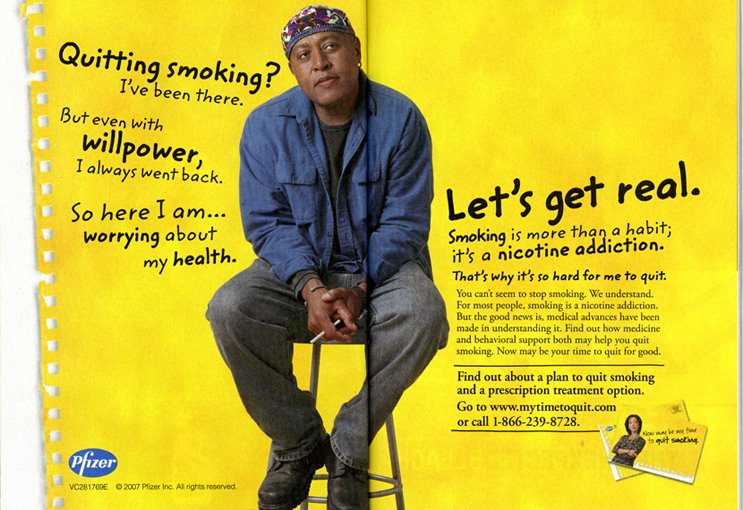
Let’s get real — was the Afrocentric headgear really necessary?

Friday, March 30, 2007

Essay 1927


Runaway news with a MultiCultClassics Monologue…

• Jennifer Wilbanks, the infamous “Runaway Bride,” inspired a recruitment campaign for New Mexico police (see above). “We’re hoping to get 1,100 officers, and this is a unique way to recruit,” said a police official. “I’m sure I’m going to get some harassment [for producing the ad].” What’s next, celebrity endorsements from the cast of Reno 911?

• The Game looks like a runaway rapper, as the recording artist failed to appear for court in Manhattan yesterday. The rapper is facing charges of impersonating a cop so he could convince a taxicab driver to run through red lights (see Essay 1574). Maybe he should apply for a job with the police in New Mexico.

Essay 1926


From The New York Times…

--------------------------

Uncle Ben, Board Chairman

By STUART ELLIOTT

A racially charged advertising character, who for decades has been relegated to a minor role in the marketing of the products that still carry his name, is taking center stage in a campaign that gives him a makeover — Madison Avenue style — by promoting him to chairman of the company.

The character is Uncle Ben, the symbol for more than 60 years of the Uncle Ben’s line of rices and side dishes now sold by the food giant Mars. The challenges confronting Mars in reviving a character as racially fraught as Uncle Ben were evidenced in the reactions of experts to a redesigned Web site (unclebens.com), which went live this week.

“This is an interesting idea, but for me it still has a very high cringe factor,” said Luke Visconti, partner at Diversity Inc. Media in Newark, which publishes a magazine and Web site devoted to diversity in the workplace.

“There’s a lot of baggage associated with the image,” Mr. Visconti said, which the makeover “is glossing over.”

Uncle Ben, who first appeared in ads in 1946, is being reborn as Ben, an accomplished businessman with an opulent office, a busy schedule, an extensive travel itinerary and a penchant for sharing what the company calls his “grains of wisdom” about rice and life. A crucial aspect of his biography remains the same, though: He has no last name.

Vincent Howell, president for the food division of the Masterfoods USA unit of Mars, said that because consumers described Uncle Ben as having “a timeless element to him, we didn’t want to significantly change him.”

“What’s powerful to me is to show an African-American icon in a position of prominence and authority,” Mr. Howell said. “As an African-American, he makes me feel so proud.”

[Click on the essay title above to read the full story.]