Tuesday, August 22, 2006

Essay 963


Busta Bits in a MultiCultClassics Monologue…

• More details have been published regarding Busta Rhymes’ latest confrontation with a Bronx man (see Essay 953). The alleged beating victim claimed he accidentally spat on the rapper’s ride on August 12. “Homie, did you just spit on my car?” said the rapper as he approached the man. “I said, ‘Sorry, I didn't mean to,’” claimed the spitter. “I said, ‘We’re big fans of yours.’” At that point, Rhymes and his posse kicked the man’s ass, dealing out a concussion, abrasions and lacerations (scarred victim pictured above). No word if the man is still a big fan.

• Meanwhile, Busta Rhymes remains silent regarding the shooting that left an aide dead last February 5 (see Essay 407). “No one has come forward as an eyewitness,” said a deputy police commissioner. “Some have acknowledged being there but didn’t see anything.” Rhymes didn’t say anything when pressed by cops last Sunday. “I got a lawyer,” he allegedly told detectives. “I’ve got nothing to say about that. I already told you that.” It’s safe to say the cops are not big fans.

Essay 962


Qwest doesn’t mince words when directing messages to Native Americans. It’s surprising the telecommunications company didn’t simply go with, “Attention, Poor Injuns.”

Essay 961


Here’s something that appeared in the latest issue of Adweek. The MultiCultClassics response immediately follows…

-------------------------------------------

Blacks, Hispanics Believe In Brands They Know

NEW YORK A new survey suggests that both African Americans and Hispanics have strong trust in brands. The Yankelovich Monitor Multicultural Marketing Study, released last week, found that both groups are increasingly reconnecting to their respective roots, which has implications for marketers who want to maintain their brand message in front of these consumers. The study shows that both groups are reconnecting to their cultures more than ever before, with 67 percent of African Americans and 71 percent of Hispanics acknowledging, “My roots and heritage are more important to me today than they were just five years ago.” The good news for marketers is that 58 percent of Hispanics and 55 percent of African Americans said, “It is risky to buy a brand you are not familiar with.” Only 42 percent of African Americans and 40 percent of Hispanics said they would “buy private label and generic brands” if their families unexpectedly found themselves with less money.

-------------------------------------------

Blurbs like this can be dangerous because they lack details and specificity. Click on the essay title above to view a more in-depth report at Hadji Williams’ blog.

Sadly, most advertisers will interpret the findings in the following ways:

• Since Blacks and Hispanics have stronger trust in brands, advertisers may feel more comfortable applying less of their marketing budgets against the audiences. Who needs an expensive multimedia campaign when you can capture a segment by sponsoring a gospel choir and/or salsa music celebration?

• Both groups are reconnecting with their cultures more than ever before, which means ads should prominently feature kente cloth and piƱatas more than ever before.

It would be interesting to see how the Yankelovich study has actually influenced or inspired great advertising for Blacks and Hispanics. Based on the multicultural work in the marketplace, there appears to be little evidence that the study — which has been updated regularly for many years — helps generate progress.

Essay 960


According to the IRS, everyone has it all. Recruitment ads offer identical benefits to different audiences. Native Americans are targeted in a pretty subtle style. Guess the assumption is that folks will recognize the depicted woman is a Native American. But just to be on the safe side, she’s wearing a turquoise pendant.

Essay 959


Immigrant activist holed up in church is no Rosa Parks

BY MARY MITCHELL, SUN-TIMES COLUMNIST

Elvira Arellano is definitely no Rosa Parks.

I even doubt that Arellano has any idea who Parks really was.

Because if she did, she wouldn’t have hid inside the Adalberto United Methodist Church instead of reporting to immigration authorities for deportation. But with her son in tow, Arellano and her supporters could have marched into the immigration office and showed America exactly what the present immigration laws really mean:

That a single mother can be separated from her child; that husbands can be snatched from their wives; that working-class families can be torn apart simply because America has waited far too long to craft a fair and reasonable immigration policy.

Maybe then more of us would respect her stance.

But a week ago, Arellano, who is being described as an immigration activist, fled to the West Side church seeking sanctuary. The church is pastored by longtime social activist Rev. Walter “Slim” Coleman. She has vowed to stay put, and Coleman has promised to let her stay put.

“I’m strong, I’ve learned from Rosa Parks – I’m not going to the back of the bus. The law is wrong,” Arellano told reporters last week.

Despite the rhetoric, the 31-year-old Arellano doesn’t seem to know much about black Americans' struggle for civil rights.

Didn’t break the law

Parks didn’t refuse to go to the back of the bus. She refused to give up her seat to a white man who couldn’t find a seat in the so-called “white section.” As onerous as the Jim Crow laws were, Parks didn’t break them. That’s why she could calmly go to the police station and sit in jail until her husband came to bail her out.

Because Parks wasn’t a lawbreaker, the local NAACP decided to use her as a test case to challenge the Jim Crow laws. Her righteous cause drew widespread support and launched the civil rights movement in earnest.

Arellano obviously doesn’t know anything about this important piece of history. If she did, she would care more about the circumstances of all illegal immigrants and not just her own.

As they say in the streets, Arellano is pimping the system. She is using Rosa Parks’ name to buy herself more time, and that disgusts me.

Arellano is not a victim of an unjust system. She crossed into the U.S. from Mexico in 1997, obtained a fake ID and was caught at the border and returned home. Three days later, she sneaked back into the country and made her way to Washington state, where she managed to get a driver’s license. She met her son’s father and gave birth to her son in 1998. Two years later, Arellano moved to Chicago and again managed to get a fake ID -- a Social Security card -- and landed a job as a cleaning lady at O’Hare Airport. Three years after that, she was caught and pleaded guilty to working under a false Social Security number.

Her chutzpah makes her a folk hero to some, but her blatant exploitation of Parks’ legacy undermines the fragile coalition between some blacks and Hispanics that has formed around the immigration issue.

Some of us -- particularly those who came to the urban areas during the Great Migration -- admire the courage it takes for someone to leave everything behind to strike out in search of a better life. But none should forget that blacks paid their dues.

Our ancestors didn’t come here looking for work. They were dragged here against their will to work someone else’s fields. They were the unpaid cotton, berry and peach pickers. They were the unpaid gardeners, construction laborers, nannies and domestics. If they stole an identity, it was to escape the cruel lash of the slavemaster. Their children weren’t born American citizens, they were born chattel.

But instead of thanking blacks for paving the way, other groups have walked across black backs without so much as a “thank you for your sacrifices.”

Should have returned to Mexico

The benefits that so many other groups -- women included -- now enjoy were purchased with black blood, sweat and tears.

As for Arellano, she’s extremely fortunate. Black people were lynched in the past for defying any ol’ white man, let alone one with authority.

Still, I understand why she garnered empathy from U.S. Rep. Luis Gutierrez and U.S. Sen. Dick Durbin. America’s immigration system is such a mess, both men stepped in in 2003 and secured a one-year extension from deportation on Arellano’s behalf. They secured another one-year extension in 2004 and again in 2005.

During that grace period, Arellano should have returned to Mexico and gone to the back of the line. But she chose instead to butt those who play by the rules.

Obviously fearing a publicity nightmare, immigration authorities say they will not storm the church to deport Arellano. Instead, they will wait her out. Although a wise decision, it nonetheless sends a dangerous message.

Hopefully, while Arellano is languishing she will brush up on black history.

Monday, August 21, 2006

Essay 958


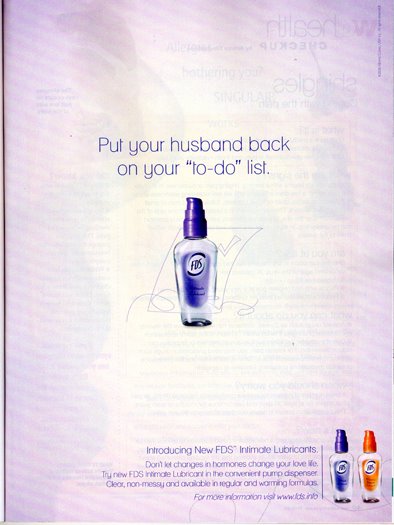
It’s extremely rare when an ad has the ability to offend all audiences. Kudos to FDS.

Essay 957


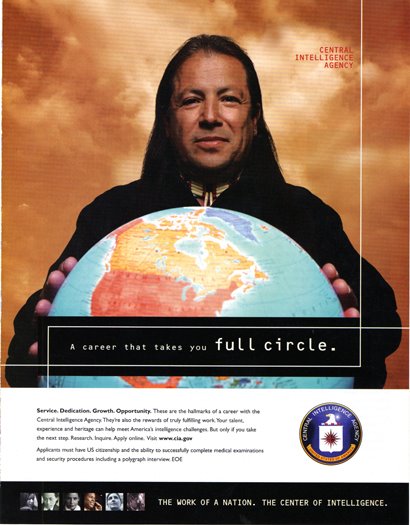
The CIA takes some interesting approaches when speaking to diverse audiences via recruitment ads.

For Native Americans, the headline reads, “A career that takes you full circle.” Looks like the man is handing over North America.

Asians are told, “Our mission depends on different views. Because nothing in the world is the same.” What in the world does that mean?

The Hispanic-targeted headline proclaims, “Work for the most important and respected employer of all. Your nation.” Never realized the CIA had such an ego.

Essay 956


Special K introduces a new flavor — fruit & yogurt & blue jeans. Yum!

Essay 955


For better or worse with a MultiCultClassics Monologue…

• Teens in Utah rallied in defense of polygamy. “Because of our beliefs, many of our people have been incarcerated and had their basic human rights stripped of them, namely life, liberty and the pursuit of happiness,” said one 19-year-old. “I didn’t come here today to ask for your permission to live my beliefs. I shouldn’t have to.” Hey, you’ve got to fight for your right to party with multiple spouses.

• The Boston Globe reported that Black teens have highly negative views on marriage. “I’m not looking forward to marriage,” said one 17-year-old, “and I don’t think we [people in general] should be married because I see how other marriages ended up in my family and on television. It’s always a disaster.” Hey, have these kids considered polygamy?

• The U.S. Census reported that Whites are now the minority Phoenix, Tucson and Denver. A demographer with the Brookings Institution predicts Whites will also fall below the 50 percent line in Charlotte, Las Vegas and Arlington, Texas, within the next two years. Across the board, Hispanic immigration influenced the shifts. “One thing that has changed is the overt demonstration of racism,” said an executive of the Tucson service organization Chicanos por la Causa Inc. “The element itself is very small but can be intimidating.” Or business as usual for The Minuteman Project.

Sunday, August 20, 2006

Essay 954


Wal-Mart takes credit for community renewal in this Hispanic-targeted message. Hey, maybe Andrew Young was right after all (see Essays 944 and 951).

Essay 953


Cross reactions in a MultiCultClassics Monologue…

• The Los Angeles Times reported on the increasing difficulty of crossing the U.S.-Mexico border for older and less-fit migrants. “If you hire the right [smuggler] and are willing to accept the higher degree of physical risk, you can get through,” said a UC San Diego professor who conducted a study on immigration. “But the older people are less tolerant of the kind of risks that young men are willing to take.” Click on the essay title above to read the full story.

• Busta Rhymes was busted for roughing up a man who accidentally spat on the rapper’s ride. Rhymes may also face additional charges because cops found a machete in his vehicle. Guess the spitter should feel lucky he only got beat up versus carved up.

• A group of angry lesbians beat and stabbed a man in the West Village area of New York City. According to the man’s side of the story, the attack was sparked after he made a pass at one of the women, infuriating her girlfriend. An argument ensued, leading to another woman spitting on the man, who spat back. The man was then pummeled with belts, slapped, kicked and stabbed. “It was a bias attack by 20 gay women,” said the man. The women deny his accusations. No word yet from Busta Rhymes on this melee.

Essay 952


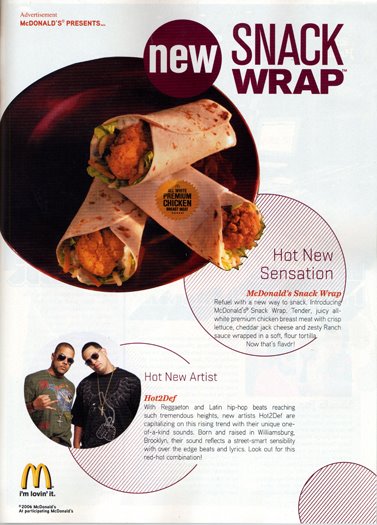
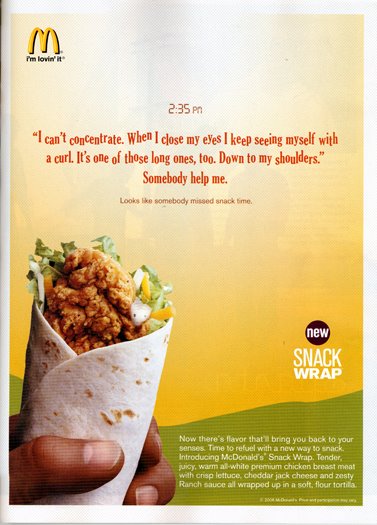
Mickey D’s continues its hype for the new Snack Wrap (see Essay 939) with consecutive pages in hip hop magazines.

The first page demonstrates “How to Make a Hot W(rap).” It’s enough to make Vanilla Ice look credible.

The next page presents hot new sensation Snack Wraps and hot new artist Hot2Def. The art direction is not hot or new. The copy sucks 2.

The final page features another “Looks like somebody missed snack time” execution. Looks like somebody missed art school.

Essay 951


Andrew Young’s melting pot boils over

By Clarence Page

WASHINGTON -- After making what he admits were “demagogic” remarks about Jewish, Asian and Arab business owners, Andrew Young has done the right thing. The former civil rights leader, Atlanta mayor and UN ambassador found himself guilty and sentenced himself to resign as head of a Wal-Mart advocacy group.

Wal-Mart Stores Inc. said it did not ask for Young to step down, but it did not stand in his way when he did. After all, what does it profit an international mega-corporation to hire a liberal feel-good front man if he makes people feel bad?

Young, 74, stuck his wingtips in his mouth during an interview that appeared in Thursday’s Los Angeles Sentinel, the West Coast’s oldest and largest black-owned weekly, when he was asked whether Wal-Mart squeezed small stores out of black neighborhoods.

“Well, I think they should; they (big stores) ran the mom-and-pop stores out of my neighborhood,” he told the Sentinel. “But you see those are the people (owners of mom-and-pop stores) who have been overcharging us--selling us stale bread, and bad meat and wilted vegetables. And they sold out and moved to Florida. I think they’ve ripped off our communities enough. First it was Jews, then it was Koreans and now it’s Arabs, very few black people own these stores.”

I don’t expect anyone to be nominating Young for an NAACP Image Award this year, although he might be a contender for the Mel Gibson Sensitivity Prize.

Unlike Gibson’s infamous drunken slurs against Jews, Young was apparently sober and trying to say something that anyone familiar with urban commerce knows to be quite true. He dug his grave with the way he said it.

There’s nothing new about the “black tax” that residents of economically abandoned urban neighborhoods have had to pay for goods and services in recent decades. It is part of the economic dynamic of old urban neighborhoods that waves of immigrants, including black immigrants from the South, have operated mom-and-pop stores, become successful, and eventually move on to better neighborhoods.

These “middle-man minorities,” as economist Thomas Sowell labeled them more than a decade ago, are a worldwide phenomenon reflecting how some ethnic cultures are more entrepreneurial than others because of culture and peculiar historical circumstances. They may be Cuban merchants in Latin America, ethnic Chinese in the Philippines or East Indians in East Africa.

This helps to explain, for example, why a survey of black-owned New York businesses in the 1980s found that more than half were owned by immigrants from Africa or the Caribbean, even though immigrants comprised only a tenth of New York’s black population overall.

In cities like Chicago, Detroit and New York, for example, many black neighborhoods saw black, Jewish or Italian merchants move their stores in the wake of riots in the 1960s, only to be replaced by Arab merchants displaced by the 1967 Six-Day War, and later, Korean merchants.

But like Wal-Mart, these middleman minority merchants provide commerce in communities that have little or none and they stir resentment from the very communities they serve.

Long-simmering resentments toward mostly Asian merchants in South Central Los Angeles boiled over into mainstream news during that city's 1992 riots. TV cameras caught armed Korean merchants guarding their stores against mostly black and Hispanic looters.

Young could hardly have picked a worse place to reopen old resentments than Los Angeles, a city that has been trying ever since 1992 to cool its heavily immigrant stir-fry of blacks, whites, Hispanics and Asians. Yet, he also provides what educators call a “teachable moment.”

Instead of getting mad at Young or at immigrant merchants, we should take a lesson from neighborhoods that are bringing businesses back, including a new wave of locally owned mom-and-pop stores and franchises. Through public-private partnerships, neighborhood-based community development corporations in many cities are pooling resources to help lure major chain stores to serve as anchors for the development of smaller businesses.

The real problem Young uncovered is not ethnic but economic and educational. Better schools provide the tools that enable people to take care of themselves and their families, ride out economic hard times and help their children move on to better lives.

And, in our market-driven society, economics determine the market conditions that create the engines of upward mobility that enable low-paid workers to move up to higher-paying jobs. Those who get left behind while others, including immigrant merchant families, get ahead are left more isolated and resentful than ever. Capitalism obviously works. Our challenge is to make it work for every American.

Essay 950


From The Associated Press…

---------------------------------------------

Recruiters molest, rape potential enlistees

BY MARTHA MENDOZA

More than 100 young women who expressed interest in joining the military in the past year were preyed upon sexually by their recruiters. Women were raped on recruiting office couches, assaulted in government cars and groped en route to entrance exams.

A six-month Associated Press investigation found that more than 80 military recruiters were disciplined last year for sexual misconduct with potential enlistees. The cases occurred across all branches of the military and in all regions of the country.

“This should never be allowed to happen,” said one 18-year-old victim. “The recruiter had all the power. He had the uniform. He had my future. I trusted him.”

1 in 200 recruiters disciplined

At least 35 Army recruiters, 18 Marine Corps recruiters, 18 Navy recruiters and 12 Air Force recruiters were disciplined for sexual misconduct or other inappropriate behavior with potential enlistees in 2005, according to records obtained by the AP under dozens of Freedom of Information Act requests. That’s significantly more than the handful of cases disclosed in the past decade.

The AP also found:

•The Army, which accounts for almost half of the military, has had 722 recruiters accused of rape and sexual misconduct since 1996.

•Across all services, one out of 200 frontline recruiters -- the ones who deal directly with young people -- was disciplined for sexual misconduct last year.

•Some cases of improper behavior involved romantic relationships, and sometimes those relationships were initiated by the women.

•Most recruiters found guilty of sexual misconduct are disciplined administratively, facing a reduction in rank or forfeiture of pay; military and civilian prosecutions are rare.

•The increase in sexual misconduct incidents is consistent with overall recruiter wrongdoing, which has increased from just over 400 cases in 2004 to 630 cases in 2005, according to a General Accounting Office report released this week.

Defense Department spokeswoman Lt. Col. Ellen Krenke said the Pentagon, which has committed more than $1.5 billion to recruiting efforts this year, doesn’t track sexual misconduct cases among recruiters and had no comment on the AP’s findings. She referred the question to the military branches.

In the Army, 53 recruiters were charged with misconduct last year. Recruiting spokesman S. Douglas Smith said the Army has put much energy into training its staff to avoid these problems.

“To have 53 allegations in a year, while it is 53 more than we would want, is not indicative of the entire command of 8,000 recruiters,” he said.

Recurring pattern

For this story, victims were interviewed in their homes and perpetrators in jail; and the AP scoured police and court accounts of assaults and in one case portions of a victim’s journal.

A pattern emerged. The sexual misconduct almost always takes place in recruiting stations, recruiters’ apartments or government vehicles. The victims are typically between 16 and 18 years old, and they usually are thinking about enlisting. They usually meet the recruiters at their high schools, but sometimes at malls or recruiting offices.

“We had been drinking, yes. And we went to the recruiting station at about midnight,” begins one girl’s story.

Tall and slim, her long hair sweeping down her back, this 18-year-old from Ukiah, Calif., hides her face in her hands as she describes the night when Marine Corps recruiter Sgt. Brian Fukushima climbed into her sleeping bag on the floor of the station and took off her pants. Two other recruiters were having sex with two of her friends in the same room.

Fukushima was convicted of misconduct in a military court after other young women reported similar assaults. He left the service with a less-than-honorable discharge last fall.

In Indiana, where National Guard recruiter Sgt. Eric Vetesy has been charged with 31 counts of rape, sexual battery, official misconduct and corrupt business influence, military officials have instituted a new “No One Alone” policy to prevent further incidents.

Apparently the first of its kind in the country, the male Army National Guard recruiters in Indiana cannot be alone in offices, cars, or anywhere else with a female enlistee. If they are, they risk immediate disciplinary action. Recruiters also face discipline if they hear of another recruiter’s misconduct and don't report it.

The result?

“We’ve had a lot fewer problems,” said Lt. Col. Ivan Denton, commander of the Indiana Guard’s recruiting battalion. “It’s almost like we’re changing the culture in our recruiting.”

Saturday, August 19, 2006

Essay 949


Working for justice and overtime with a MultiCultClassics Monologue…

• In Chicago, an illegal immigrant and her son (pictured above) have taken refuge in a church to avoid deportation. The woman stated that if she is forcibly removed from the church, she “will know that God wants me to be an example of the hatred and hypocrisy of the current policy of this government.” The director of the Illinois Minuteman Project said, “She’s spewing all this anti-American stuff. … The thing that scares me the most is her defiance, it really does.” Or maybe the Minutemen are frightened by the prospect of having to enter a church.

• An investigation by Apple discovered laborers at a Chinese iPod factory were working too many hours. However, the investigators “found no evidence whatsoever of the use of child labor or any form of forced labor.” But it’s still unlikely that any of the Chinese workers can afford an iPod.

• Built Ford tough? More like tough luck, as the automaker announced the temporary halt of production at 10 plants between now and the end of the year. “We know this decision will have a dramatic impact on our employees, as well as our suppliers,” said Chairman and Chief Executive Bill Ford. “This is, however, the right call for our customers, our dealers and our long-term future.” What makes Ford think there’s a long-term future?

• A former judge in Oklahoma was convicted of obscene acts made while he was on the bench. Between 2001 and 2003, the judge apparently exposed himself and used a penis pump under his robe during trials. He’s now being sent to prison for 4 years, where he’ll no longer need the sex devices.

Essay 948


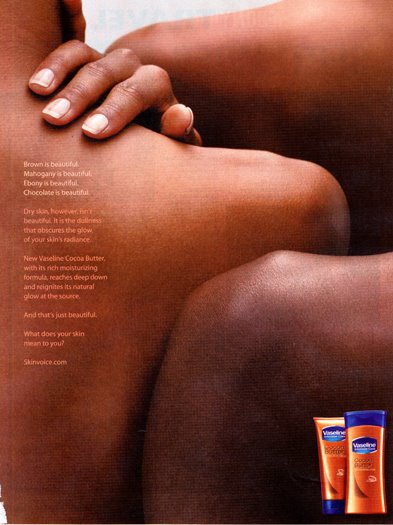
Depicting the range of Black skin tones is an interesting notion (albeit not new). But packing folks shoulder to shoulder seems awkward. The three-fingered hand is weird too.

Essay 947


Face it: Profiling makes sense
Race should be factor in detaining travelers

By Jonah Goldberg, editor at large of National Review Online

The Wall Street Journal reported this week that the Transportation Security Administration is testing sophisticated machines that use elaborate algorithms to determine whether air travelers have “hostile intent.” The machines measure your sweat output, pulse rate and other signs while asking questions such as: “Are you planning to immigrate illegally?” “Are you smuggling drugs?” “Do these stupid questions make you feel like committing a terrorist act?”

OK, I made the last one up, and I shouldn’t make fun because supposedly the Israelis have figured out how to make this stuff work. The thinking behind this program rests on the assumption that searching for every kind of potential weapon or explosive is too reactive. Find the bad motives, and the rest will follow.

If it works, great. But one of the frustrating reasons the U.S. government feels compelled to spend all of this time and energy coming up with computerized lie detectors is that civil libertarians can’t trust airport security personnel to do the same thing. Why? Because it's possible for humans to be racist.

The TSA’s more established security system, Screening Passengers by Observation Technique, or SPOT, relies on human intelligence instead of the artificial kind. Teams are trained to scrutinize passengers for more than 30 questionable behaviors, according to the Journal: “They look for obvious things like someone wearing a heavy coat on a hot day, but also for subtle signs like vocal timbre, gestures and tiny facial movements that indicate someone is trying to disguise an emotion.”

This apparently is unacceptable for civil libertarians.

“Our concern is that giving TSA screeners this kind of responsibility and discretion can result in their making decisions not based on solid criteria but on impermissible characteristics such as race,” the American Civil Liberties Union's Gregory T. Nojeim told the Journal.

In other words, while our enemies are coming up with ingenious ways to murder Americans, we’re coming up with ingenious ways to search for our enemies in the nicest manner possible. No amount of training, it seems, can immunize against the real threat to America: the possibility that somewhere, at some time, a TSA cop might pull an Arab or South Asian out of a line at an airport unfairly and talk to them for five minutes.

Note: We’re not talking about training security personnel to racially profile passengers. Quite the opposite. The ACLU’s problem is with training officers not to racially profile if that training nonetheless gives them enough autonomy so that it’s theoretically possible to take race into account.

What is so infuriating about this is that the ACLU favors policies that discriminate against all sorts of people--old people, women, children and others who, under random searches and other idiotic numerical formulas, are pulled aside for no reason at all.

All of this is happening against a backdrop of a war on terror in which roughly 99 percent of jihadi terrorists are of either Middle Eastern or South Asian descent and 100 percent of them are Muslim.

Critics of racial profiling say that it wouldn’t have stopped Richard Reid (the shoe bomber) or Timothy McVeigh (the Oklahoma City bomber). This is a red herring. Nobody ever proposed that race should be the only factor, or even the most important factor. But why can’t it be one of those 30-plus factors? The Brits who foiled this most recent plot were allowed to take race into account. Was that too high a price to pay for thwarting mass murder?

The terrorists we’re looking for are overwhelmingly young male Muslims from places such as Pakistan and Saudi Arabia. Why is it morally superior to inconvenience old Mormon women of Swedish descent--for no reason at all--as much as young men from Pakistan?

Two alleged members of the British liquid explosives plot were young men of British descent who converted to Islam, and one was a woman with a child. Only a fool would advocate a system that, as a rule, deliberately excludes such people from scrutiny. But isn’t it equally foolish to spend vast sums on machines designed to interpret the facial twitches and sweat glands of millions of passengers out of an irrational phobia of racial profiling?

Ron Suskind's new book, “The One Percent Doctrine,” explores Vice President Dick Cheney’s view that if there’s a 1 percent chance terrorists might detonate a nuclear bomb in an American city, the government must act as if there’s a 100 percent chance. Despite the guffawing this elicited from administration critics, it strikes me as eminently sensible. (If there were a 1 percent chance the snake in your back yard would kill your child, wouldn’t 1 percent equal 100 percent for you too?) The ACLU’s self-indulgent position, meanwhile, seems to be that if there’s a 1 percent chance a cop will be a racist, we must act as if it’s a 100 percent chance. And that means humans can’t ever be trusted.

Friday, August 18, 2006

Essay 946


Shopping for shoes? Um, girlfriend needs to shop for a hairstylist.

Essay 945


The New York Times wrote:

“More than a decade after the city created a special institute to prepare black and Hispanic students for the mind-bendingly difficult test that determines who gets into New York’s three most elite specialized high schools, the percentage of such students has not only failed to rise, it has declined.”

Click on the essay title above to read the full story.

Essay 944


It’s not shopping. It’s bad Photoshopping.