Thursday, March 22, 2007

Essay 1885


From The Los Angeles Times…

-----------------------------

‘Emmett Till’ poet protests teachers’ firing

By Carla Rivera, Times Staff Writer

The award-winning author of “A Wreath for Emmett Till,” a poetic memorial to the teenage civil rights icon murdered in Mississippi, said Wednesday it was “unconscionable” that a planned presentation of the work by students at a Los Angeles charter school sparked the firing of two teachers.

Marilyn Nelson, a former poet laureate of Connecticut and National Book Award finalist, wrote to the school, Celerity Nascent, and said that she was “troubled” and “shocked” at the events and urged that teachers Marisol Alba and Sean Strauss be reinstated.

Controversy erupted last month when the school canceled a special Black History Month presentation by the seventh-grade class that was to include the reading of a poem and laying of a wreath of flowers inspired by Nelson's book.

School officials had contended that the Till case — in which the black teenager was beaten to death in 1955 after allegedly whistling at a white woman — was too graphic for younger children and did not fit the mood of what was to be a celebratory event.

The students had been learning about Till and planning the presentation for two weeks, and many wrote letters of protest to urge administrators to reconsider their decision. Alba, who helped students prepare the presentation, and math teacher Strauss signed one of the letters and were later terminated.

“It’s a terrible injustice,” said Nelson, a professor of English at the University of Connecticut. “I wanted them to know that they’re not alone. They raised their voices and that took courage.”

In her letter, Nelson wrote, “Harriet Tubman, Frederick Douglass, Martin Luther King, Rosa Parks and Mamie Till-Mobley would have been proud of your students’ passionate and clear view of your decision to cancel their program. They would have signed the students’ letters of protest too.”

Alba and Strauss said they did not find anything offensive or threatening in the student letters. Celerity administrators would not characterize the letters and would not discuss specifics of the firings. Executive Director Vielka McFarlane said she believed that Nelson was misinformed that the school did not teach about Emmett Till. But she said the school is working with community groups to provide students and their families with a broader understanding of the Emmett Till story.

Several community leaders, including Earl Ofari Hutchinson, president of the Los Angeles Urban Policy Roundtable, met with administrators Tuesday and said that they were reassured that the school was committed to teaching all aspects of African American history and that the teachers’ rights to a hearing and appeal were protected. The school accepted an invitation to a screening of a documentary on Till this Saturday.

“We continue to believe black history should be taught throughout the entire school year and not just one month,” McFarlane said. “We’re hoping to expose families to all aspects of the struggle, including parents of kindergartners. We’re trying to make it a community event.”

Alba, meanwhile, said she was happy to have Nelson as an ally.

“I’m speechless,” she said. “She’s my favorite author.”

Essay 1884

Essay 1883


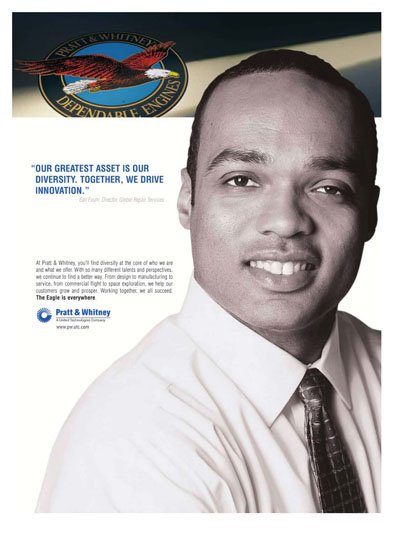
Together, we drive innovation. Just not in diversity advertising.

Wednesday, March 21, 2007

Essay 1882


From The Chicago Tribune…

--------------------------------------

Don’t ask, don’t tell, don’t leave

By Clarence Page

WASHINGTON -- How much harm do gays and lesbians really cause in the ranks of the military? Not much, it turns out.

Judging by the latest discharge figures, the military’s policy is really: “Don’t ask, don’t tell. Just keep fighting!”

Gen. Peter Pace, chairman of the Joint Chiefs of Staff, made more news than he wanted to last week when he called homosexual acts “immoral” during a meeting with the Chicago Tribune’s editorial board.

Pace expressed mild regret for divulging his personal views instead of sticking with the official Pentagon line. But he stopped short of an apology to all of the gay and lesbian military personnel whose service and sacrifices he had insulted.

That’s a shame, when you consider another less ballyhooed news development that came to light that same week: the release of the latest Pentagon figures on how many service personnel actually have been discharged for reasons connected to their being gay or lesbian.

In 2006, it turns out, gay-related discharges fell to 612 from a peak of 1,273 in 2001.

That continues a revealing trend: Gay-related discharges rose sharply after the “don’t ask, don’t tell” policy went into effect in 1994, when such discharges numbered only 617.

That rise came in spite of assurances from President Bill Clinton’s administration that the policy would respect everyone’s privacy rights. Instead, advocacy groups like the Washington-based Servicemembers Legal Defense Network, which formed in the wake of “don’t ask, don’t tell,” said the policy only entrenched anti-gay bigotry.

The terror attacks of Sept. 11, 2001, appear to have changed that. Gay-related military discharges fell to 906 in 2002 and 787 in 2003. The return of war brings about a sudden upsurge in tolerance among troops and commanders for their fellow soldiers, sailors, airmen and Marines (the Pentagon’s numbers do not include the Coast Guard). As a practical matter, bigotry toward gays and other groups fades rather quickly the closer one gets to the front lines of combat.

Also, Steve Ralls, a spokesman for the Servicemembers Legal Defense Network, observed that gays and lesbians in the military felt as big a patriotic boost after Sept. 11 as other Americans. That resulted in fewer homosexuals trying to leave the military and an upsurge in those trying to get in--or get back in.

“In the weeks following 9-11,” he said, “we were flooded with phone calls from gays and lesbians who had been dismissed under the ‘don’t ask, don’t tell’ law. They wanted to know if there was any possible way they could re-enlist and be part of the response to those attacks.”

Twelve of them are named in a case the organization filed in December 2004 to have them reinstated by the armed services.

It is painfully ironic, at a time when the military is facing recruiting and retention troubles, that gays and lesbians who want to serve are not officially being allowed to serve, even when they work in such valuable area as translation and weapons technology. Unofficially is another matter.

“We know for a fact that there are gay and lesbian service members who are serving openly,” Ralls said. “Their commanding officers are fully aware of their status and neither their commanders nor their fellow service members care one iota.”

As a Vietnam-era Army vet, that revelation does not shock me. There’s nothing new about the presence of gays or lesbians in the military. Military ranks reflect the diversity of the civilian world. Back in my day, it simply wasn’t talked about or debated in the open as much. But in these days of political culture wars, military commanders find they have to take a public stand, whether it matches their personal positions or not.

A chorus of gay activists has called for Pace to resign because of his remarks.

Ralls has another view. “Ironically, Gen. Pace has probably done more than anyone to move us toward repeal of the law,” Ralls said. “He pulled the veil off of this policy.”

Pace did reveal that the policy is less about military cohesion than personal feelings, which are changing over time. A younger, more tolerant “Will & Grace” generation is moving up, says Ralls, referring to the popular TV show that featured gay characters in leading roles.

A Zogby poll of Iraq and Afghanistan combat vets in December appeared to back him up. It showed almost three-quarters said they were comfortable serving with gays and lesbians. Members of Congress are renewing pressure to reopen the “don’t ask, don’t tell” policy. Instead of calling for Pace’s head, maybe gay activists should give him a medal.

Essay 1881


Want to boost minority representation in your company? Encourage nepotism.

Essay 1880


One more online comment responding to the Advertising Age story presented in Essay 1862…

It doesn’t look like it has changed a lot in 40 years. If at all. — Chicago, IL

Essay 1879


Working the news with a MultiCultClassics Monologue…

• Naomi Campbell stirred minor controversy by having a police officer act as her valet on Tuesday. When the supermodel arrived for her second day of community service work, her bodyguard handed a bag of personal stuff to a cop, who wound up carrying it for Campbell. “There was a state of confusion this morning. Naomi forgot her bag. There were personal items she needed, like her ID and clothes,” said a department spokesman. “It’s not our policy, but as a courtesy today, he carried it for her.” Just be careful if she asks for her cell phone.

• Mickey D’s is launching a campaign to change the definition of “McJob.” Dictionaries in the UK list the term as “an unstimulating, low-paid job with few prospects, esp. one created by the expansion of the service sector.” The fast feeder thinks the definition is wrong and too negative, and the company hopes dictionary officials will amend the entry. It would help if Mickey D’s stopped making its employees feel like they’re in “an unstimulating, low-paid job with few prospects, esp. one created by the expansion of the service sector.”

• A survey of New York City public schools showed White students are more likely to be targeted as buyers by drug pushers versus Black, Hispanic and Asian students. White kids are also more likely to be binge drinkers. “It’s often a matter of money and availability,” said the executive director of Camelot Counseling Services of Staten Island, a drug-prevention organization serving youth. “White families tend to have more money. Where there’s more discretionary money, it attracts drugs.” Guess White kids are making the most of their McJob wages.

Essay 1878

Essay 1877


Merrill Lynch presents the standard diversity bull.

Essay 1876


A single online comment to the Advertising Age story presented in Essay 1862, followed by random MultiCultClassics musings…

-------------------------------------------

What about increasing the starting salaries to attract more minorities? Engineers easily command $50-60K salaries upon graduation. MIS majors easily earn $55K starting out. Finance majors easily earn $50K. Petroleum Engineers easily earn $80K. Advertising pays between $21-30K starting out. — Bedford, TX

-------------------------------------------

First, Advertising Age deserves credit for its commitment to reporting on the industry’s diversity dilemmas.

At the same time, the latest story leads to more questions than answers. And it may actually spotlight key issues in the drama.

In terms of minorities, it appears that the ad world has old-timers and newbies. Yet there are virtually zero mid-level executives. It’s as if an entire generation doesn’t exist. And according to the findings by New York City’s Commission on Human Rights, the old-timers and newbies are in short supply too.

No disrespect to Doug Alligood — especially given that his historical efforts are clearly great and noble — but the man is 73 years old. He’s not exactly the typical senior-level executive. Although it would be interesting to hear the true tales this gentleman has to tell.

Erika Emeruwa is equally unique, although for different reasons. She said, “I pretty much grew up as the only African-American kid in my classes.” In many respects, the exclusive advertising industry may be a natural and comfortable progression for her. But what about students accustomed to integrated environments — or heaven forbid, graduates of Historically Black Colleges and Universities?

Alligood and Emeruwa ultimately symbolize a notion that may be lost on the common Advertising Age subscriber: Blacks have as much “diversity” in their ranks as any other group. Will readers recognize this? Or will most folks view Alligood and Emeruwa as proof that minorities are represented on Madison Avenue, and perhaps the diversity problems are not as bad as we think?

Then again, based on the fact that the story only drew one comment, does anyone even continue to give a shit about the topic?

Tuesday, March 20, 2007

Essay 1875


“More Than A Carpet Company.” Hey, if that doesn’t inspire candidates to apply, nothing will.

Essay 1874


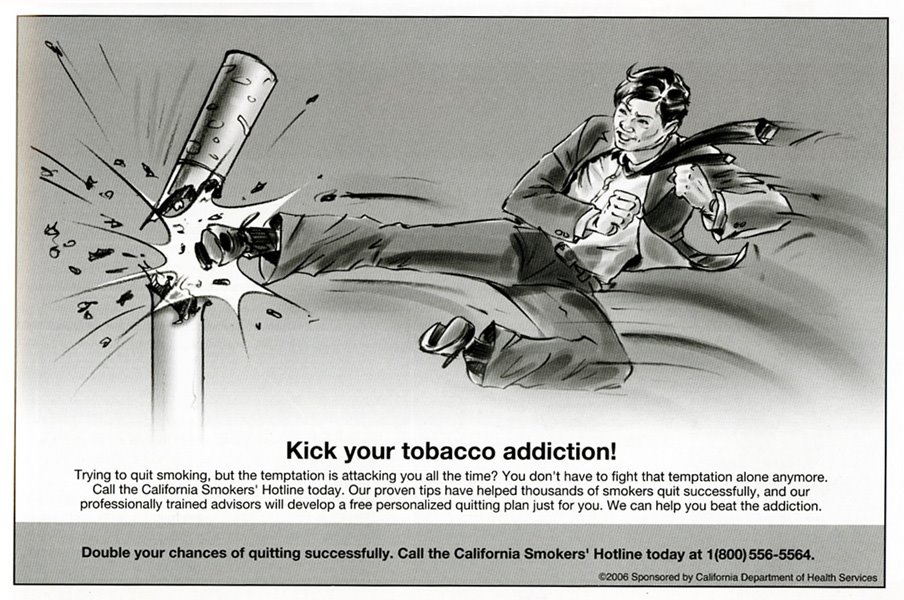
This anti-smoking ad targets Asian Americans. Looks like the California Smokers’ Hotline couldn’t afford an endorsement from Jackie Chan or Jet Li.

Essay 1873


From Multichannel.com…

-----------------------------

Diversity Gets Animated
Kids’ Shows Strive for Authenticity While Attracting Broad Audiences

By Luis Clemens

Audience demands and demographic reality have helped make kids’ animated programming on cable more culturally diverse than ever.

“We don’t live in Leave It To Beaver-land, where everyone is white,” Cartoon Network senior vice president of programming and development Bob Higgins said. Or, as Nickelodeon Television executive vice president and general manager Tom Ascheim put it, “It is important for kids to see themselves represented on screen.”

Nickelodeon should know, as two of the network’s biggest stars are Latino cousins who headline the consistently top-rated shows for viewers between 2 and 5 years old: Dora the Explorer and Go, Diego, Go!

“It is always good when you make money by sticking to your principles,” said Ascheim.

But more recent additions to networks’ animated lineups reinforce the popularity of diverse cartoons among young audiences. Among cable’s offerings:

> Disney Playhouse’s Handy Manny, launched last September, features a bilingual Latino handyman and “as diverse a cast as I think I am ever likely to be able to put together,” said Disney Channel senior vice president of programming Nancy Kanter. It was the highest-rated Playhouse Disney original series premiere ever among kids 2 to 5. The show was just renewed for 26 episodes.

> The March 3 debut of Nicktoon’s El Tigre: The Adventures of Manny Rivera earned Nickelodeon its best premiere performance ever for a Saturday morning series.

> Cartoon’s Class of 3000, created by and starring hip-hop artist André Benjamin of OutKast, just got renewed for 13 episodes. The overall number of viewers is up 3% for the same time period but up a dramatic 19% in the target demographic of boys 6 to 11.

Meanwhile, Disney continues to have success with Toon Disney show American Dragon: Jake Long. The show, featuring a Chinese-American hero, saw its audience grow from a 3.3 rating for kids 2 to 11 during its first season in 2005 to a 4.7 rating in its second season.

Adam Bonnett, Disney Channel senior vice president of original series, said, “The inspiration for American Dragon: Jake Long was Harry Potter — something that had absolutely nothing to do with Asian culture.”

But, aware of their increasingly diverse audience, programmers are making a concerted effort during the development process to include characters of different races and ethnicities.

“If there’s a way to make that character African-American, Asian or Hispanic, we will do that,” said Cartoon’s Higgins.

[Click on the essay title above to read the full story.]

Essay 1872


Princesses and Princes of Darkness in a MultiCultClassics Monologue…

• Disney presented images of Maddy, its first Black princess (pictured above). She’s bootylicious.

• Supermodel Naomi Campbell started her first day of community service on Monday. She announced plans to auction off the jeans and boots worn during the event, with proceeds benefiting the Nelson Mandela Children’s Fund. Although you’d think folks might be more interested in snagging the broom and toilet brush she’ll be using.

• Procter & Gamble received a $19.25 million jury award in the trial against former Amway distributors charged with spreading rumors tying P&G to Satanism. That’s a hell of a win.

• The U.S. National Slavery Museum is being urged by an anti-smoking group to return a donation from Big Tobacco’s Philip Morris USA. “This is indeed a laudable goal, but by taking receipt of this donation, the museum is joining forces with a company that continues to target children for another form of slavery,” wrote the president of the Campaign for Tobacco-Free Kids. “We’re happy that Philip Morris was progressive enough and stepped up to the plate and donated,” said a museum official. “We hope other corporations will follow suit.” Look for a contribution from a malt liquor producer soon.

Essay 1871

Essay 1870


Together, we are powerful and creative. But not very good painters.

Monday, March 19, 2007

Essay 1869


Fritos Brand Corn Chips celebrates 75 years with Limited Anniversary Edition packaging featuring the Frito Kid. According to the bag blurb, “From 1952 to 1967, the FRITO KID™ was the darling of America…”

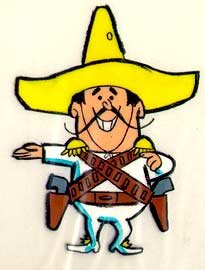
Why the hell didn’t the company produce a commemorative bag for the Frito Bandito?

Essay 1868


From The New York Daily News…

------------------------------------

GHETTO MENTALITY NO LONGER COLOR-CODED

By STANLEY CROUCH

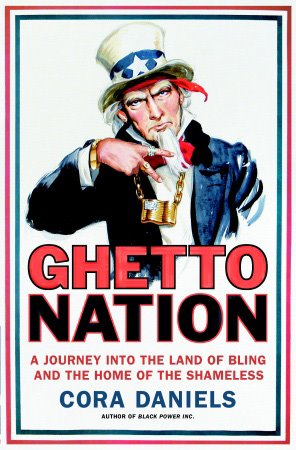
“Ghetto Nation” by Cora Daniels is part of a profoundly important moment in our culture. The book lets us know where we stand through a sharpening perspective that calls upon the heritage all modern women have in common. That common heritage is the inarguable fact that thinking women have played a significant part in waking up this nation and the world to backward policies and disinclined cultural traditions.

So we should not be surprised to see that Daniels is one of the women rising up against the misogynist and denigrating things that are basic to the popularity of hip hop. Her observations are important because she sees the problems as far more than the troubles of an ethnic group that has seemingly accepted the hatred of women and the glamorizing of thugs and violent behavior as normal.

Rather brilliantly, what she describes as “ghetto” behavior and thought is not color-coded. To Daniels, Britney Spears, Paris Hilton and Gwyneth Paltrow are, through their various ways and personal decisions, as “ghetto” as the stereotypical project tackhead with five children by five different men, not one of whom she married.

So when Daniels uses “ghetto” to describe something, she does not exclusively mean lower class or black. Nor does she only mean the super tacky bling of wealthy, upper-class black knuckleheads who couldn't recognize refined style if it slapped the taste out of their mouths.

No, her observations are mercilessly inclusive. They criticize and pull the covers off of a much larger problem that may rise most brutally out of projects across the nation, but have not stayed there. These troubles are common to all colors and all classes. Every person in this nation is threatened by an especially obnoxious kind of narcissism that justifies all actions or ignores everyone else — including one’s own children! — in the name of personal pleasure or profit or individual comfort.

What makes the book particularly effective is the fact that Daniels is proud to have come from a New York “ghetto” background that could playfully thumb its nose at conventional ideas of glamour and correct speech while creating the sort of vital ethnic subculture that all so-called minority groups tend to be ambivalent about or proud of — as much for what is wrong about it as for what is right.

Black Americans, Jews, Asians and Latinos can comically imitate the mispronunciations, the distinctive reactions and the sometimes bizarre visions of being well-dressed or “classy.”

What “Ghetto Nation” actually does is live up to its subtitle, “A Journey Into the Land of Bling and the Home of the Shameless.” Daniels does not long for the dull, manicured minds of the 1950s, but she does realize that much has been lost in the process of freeing this country from a puritanical and repressive culture.

Individuality seems to have come at the cost of community, as shame is set aside in favor of a self-serving sense of “the pursuit of happiness.”

That such a brave and unflinching book could be written by a black woman in this time is quite inspiring. Daniels not only reveals a sense of life about which and from which we hear very little, but proves that we should never expect less than a willingness to stand tall against our domestic monsters whenever the question of the human survival of our nation is unavoidably raised.

Essay 1867


Can’t beat the real MultiCultClassics Monologue…

• Coca-Cola’s kosher for Passover, and even non-Jews are drinking it up. The special version is made from pure sugar versus high-fructose corn syrup, creating a taste and feel that many think is better than the original formula. Looks like some folks just prefer the kosher side of life.

• Naomi Campbell will experience a different side of life when she begins her 5-day community service sentence today. The temperamental supermodel is slated to push a broom for most of the time, making a temporary transition from the catwalks to the sidewalks.

Essay 1866