Saturday, March 31, 2007

Essay 1929


Sorry stories in a MultiCultClassics Monologue…

• In Richmond, Virginia, a slavery memorial was unveiled on Friday. A bronze sculpture of hugging figures is encircled by three benches resembling wooden ship planks, while a nearby deck spans a fountain designed to symbolize the Atlantic crossing made by Africans. “Virginia was not an innocent bystander in the matter of slavery,” said Gov. Timothy Kaine. “Some expression of apology or regret is natural.” So please accept this memorial in lieu of reparations.

• Circuit City is offering no apologies about firing its slaves, um, workers. On Wednesday, the retailer proceeded to cut 3,600 employees, announcing the company was dumping higher-paid folks and replacing them with cheaper laborers. The higher-paid employees were even being told they could be rehired at lower wages. So now customers can look to find cheap products and cheap sales help too.

• A study by the Washington-based National Community Reinvestment Coalition revealed most U.S. cities have a lot less bank branches in working-class and minority areas than in upper-class and White neighborhoods. “Home loans that originate at bank branches, rather than through brokers or other channels, tend to have a lower likelihood of being high-cost,” said the coalition, citing a Federal Reserve study. “If banks increase their branches in minority and working-class neighborhoods, it is likely that community residents will have more access to affordable and market-rate home loans.” So you can take that to the bank. Unless you live in working-class or minority communities.

• The University of Illinois alerted retailers that Chief Illiniwek merchandise will no longer be available after April 16; plus, all remaining stock must be sold by June 15. Guess you could call it a “Going Out of Bigotry Sale.”

Essay 1928


Let’s get real — was the Afrocentric headgear really necessary?

Friday, March 30, 2007

Essay 1927


Runaway news with a MultiCultClassics Monologue…

• Jennifer Wilbanks, the infamous “Runaway Bride,” inspired a recruitment campaign for New Mexico police (see above). “We’re hoping to get 1,100 officers, and this is a unique way to recruit,” said a police official. “I’m sure I’m going to get some harassment [for producing the ad].” What’s next, celebrity endorsements from the cast of Reno 911?

• The Game looks like a runaway rapper, as the recording artist failed to appear for court in Manhattan yesterday. The rapper is facing charges of impersonating a cop so he could convince a taxicab driver to run through red lights (see Essay 1574). Maybe he should apply for a job with the police in New Mexico.

Essay 1926


From The New York Times…

--------------------------

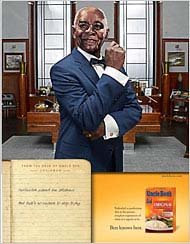
Uncle Ben, Board Chairman

By STUART ELLIOTT

A racially charged advertising character, who for decades has been relegated to a minor role in the marketing of the products that still carry his name, is taking center stage in a campaign that gives him a makeover — Madison Avenue style — by promoting him to chairman of the company.

The character is Uncle Ben, the symbol for more than 60 years of the Uncle Ben’s line of rices and side dishes now sold by the food giant Mars. The challenges confronting Mars in reviving a character as racially fraught as Uncle Ben were evidenced in the reactions of experts to a redesigned Web site (unclebens.com), which went live this week.

“This is an interesting idea, but for me it still has a very high cringe factor,” said Luke Visconti, partner at Diversity Inc. Media in Newark, which publishes a magazine and Web site devoted to diversity in the workplace.

“There’s a lot of baggage associated with the image,” Mr. Visconti said, which the makeover “is glossing over.”

Uncle Ben, who first appeared in ads in 1946, is being reborn as Ben, an accomplished businessman with an opulent office, a busy schedule, an extensive travel itinerary and a penchant for sharing what the company calls his “grains of wisdom” about rice and life. A crucial aspect of his biography remains the same, though: He has no last name.

Vincent Howell, president for the food division of the Masterfoods USA unit of Mars, said that because consumers described Uncle Ben as having “a timeless element to him, we didn’t want to significantly change him.”

“What’s powerful to me is to show an African-American icon in a position of prominence and authority,” Mr. Howell said. “As an African-American, he makes me feel so proud.”

[Click on the essay title above to read the full story.]

Essay 1925

Essay 1924


Three cheese references in the headline are bad enough — but why’s the girl dancing in a cheese puddle?

Essay 1923


Damn, if the 4As can’t even retain its Diversity Guru, how can the organization hope to reform the industry? Check out this story from Target Market News…

-------------------------------

Don Richards joins JobPlex as executive vice president and diversity leader

JobPlex has announced the addition of Don Richards, Executive Vice President and Diversity Practice Leader to the Chicago, IL office. Don has thirty-five years experience in the advertising agency industry, working both in Account Management and in Diversity Management.

Prior to joining JobPlex, Don spent two years as Senior Vice President, Agency Diversity Programs at the American Association of Advertising Agencies (AAAA), where he worked closely with member advertising agencies on both workforce and supplier diversity initiatives. He also spent two years at the Screen Actors Guild as Associate National Director of Diversity.

Previously, during his twenty-one year tenure at Leo Burnett USA in Chicago, he worked his way up through the Account Management Department to become Vice President, Account Supervisor. Don was the company’s first African-American Vice President. He continued on as Senior Vice President, Director of Resource Development, developing and implementing strategies to identify, hire and retain minority professionals as well as developing strategies to increase the agency’s utilization of minority suppliers.

Additional advertising agency experience includes six years as Senior Vice President, Management Supervisor and member of the Board of Directors at Marschalk Advertising in New York City, supervising a number of client businesses including brands from the Coca-Cola Company, Heublein, Inc. and Stroh’s and six years at DDB Needham in Chicago as Senior Vice President, Management Representative on several Anheuser-Busch brands.

Don earned both his Bachelor and Master of Arts degrees at the University of Chicago.

Thursday, March 29, 2007

Essay 1922


“Mi blog es tu blog: Notas y netas de este planeta” is the title of a terrific blog by Laura Martinez. A bilingual journalist and editor, Martinez originally served as the founder and editor in chief of Marketing y Medios, the premier trade magazine on the Hispanic market from the publishers of Adweek. Media conglomerate VNU made the asinine decision to drop Marketing y Medios in 2006. But Martinez continues to bring fresh, spirited and insightful perspectives via her blog. Click on the essay title above to check it out — and visit often for enlightenment and entertainment.

Essay 1921


Breakthroughs In Motherhood. Unfortunately, no breakthroughs in art direction or copywriting.

Essay 1920


Oxymorons and regular morons in a MultiCultClassics Monologue…

• A new Kaiser Family Foundation study showed kids between the ages of 8 to 12 are hit with about 21 TV advertisements for food every day. Also, half of the ads on children’s programs hawk food items. “The vast majority of the foods that kids see advertised on television today are for products that nutritionists would tell us they need to be eating less of, not more of,” said a vice president at the Kaiser Family Foundation. Some advertisers protested the findings. “If you look across our portfolio in our marketing, less than 1 percent of our total marketing dollars are toward children’s marketing,” said the vice president for health and wellness at PepsiCo. “If you look at us companywide, that’s not a huge effort that we spend toward marketing to children. We focus more of our ads on adults.” Not sure about the credibility of anyone with the oxymoron title of vice president for health and wellness at PepsiCo.

• Mark April 17 as the day that the rights to O.J. Simpson’s “If I Did It” book will be auctioned off. Auction proceeds and subsequent profits will go to the Goldman family. If the Goldmans want to really cash in, they’ll turn the event into a realty TV show. The working title could be: “If I Bid It.”

• Delta Zeta, the sorority charged with dumping unattractive and unpopular members, is now suing DePauw University for the school’s decision to cut the organization from campus (see Essay 1834). The ladies allege the university broke promises and contracts, defamed them and interfered with their business. What a bunch of high-maintenance divas.

Essay 1919


From The Associated Press…

----------------------------------

Black Aviators to Be Honored by Congress

By DARLENE SUPERVILLE

WASHINGTON — Six decades after completing their World War II mission and coming home to a country that discriminated against them because they were black, the Tuskegee Airmen are getting high honors from Congress.

That gratitude will be expressed Thursday when the legendary black aviators will receive a Congressional Gold Medal during a ceremony in the Capitol Rotunda. The award is the most prestigious Congress can offer.

“It’s never too late for your country to say that you’ve done a great job for us,” Ret. Col. Elmer D. Jones, 89, of Arlington, Va., said in an interview. Jones was a maintenance officer during the war.

President Bush, members of Congress and other dignitaries are expected to join some 300 airmen, widows and relatives.

Ret. Lt. Col. Walter L. McCreary, who was shot from the sky during a mission in October 1994 and held prisoner for nine months in Germany, said it hurt that the group had not been honored for its accomplishments.

“We took it in stride. It’s a recognition long overdue,” said McCreary, also 89, of Burke, Va.

The Tuskegee Airmen were recruited into an Army Air Corps program that trained blacks to fly and maintain combat aircraft. President Roosevelt had overruled his top generals and ordered that such a program be created.

But even after they were admitted, many commanders continued to believe the Tuskegee Airmen didn’t have the smarts, courage and patriotism to do what was being asked of them.

Nearly 1,000 fighter pilots trained as a segregated unit at a Tuskegee, Ala., air base. Not allowed to practice or fight with their white counterparts, the Tuskegee Airmen distinguished themselves from the rest by painting the tails of their airplanes red, which led to them becoming known as the “Red Tails.”

Hundreds saw combat throughout Europe, the Mediterranean and North Africa, escorting bomber aircraft on missions and protecting them from the enemy. Dozens died in the fighting; others were held prisoners of war.

It long had been thought that the Tuskegee Airmen had amassed a perfect record of losing no bombers to the enemy during World War II. But new research has cast doubt on that theory.

Two historians recently said Air Force records and other documents show that at least a few bombers escorted by the Tuskegee pilots were downed by enemy planes. A former World War II bomber pilot said last year that his plane was shot down while escorted by the unit.

Congress has awarded gold medals to more than 300 individuals and groups since giving the first one to George Washington in 1776. Originally, they went only to military leaders, but Congress broadened the scope to include authors, entertainers, notables in science and medicine, athletes, humanitarians, public servants and foreign officials.

Other black recipients include singer Marian Anderson, athletes Joe Louis, Jesse Owens and Jackie Robinson, civil rights activists Roy Wilkins, Martin Luther King Jr. and Coretta Scott King, the Little Rock Nine, Rosa Parks and Dorothy Height, and statesmen Nelson Mandela of South Africa and former Secretary of State Colin Powell.

The actual medal for the airmen, made possible through legislation by Sen. Carl Levin, D-Mich., and Rep. Charles Rangel, D-N.Y., will go to the Smithsonian Institution for display. Individual airmen will receive bronze replicas.

Essay 1918

Essay 1917


The Natives are growing restless…

Wednesday, March 28, 2007

Essay 1916


Luis Clemens is a freelance writer whose work often focuses on Hispanic marketing and media. His stuff has appeared in numerous news sources, including Marketing y Medios and Multichannel.com. After a long absence, Clemens has restarted his blog, Clemenseando: A Hack’s Observations on Hispanic Marketing and Media. Click on the essay title above to check it out.

Essay 1915


You found your creative director online… and still managed to land a White man.

Essay 1914


Unlocking the restraints in a MultiCultClassics Monologue…

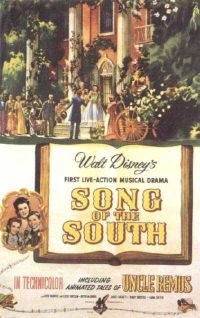
• Walt Disney Company is debating unlocking its 1946 film “Song of the South.” The movie has never been released on video in the U.S., as critics contend it features racist stereotypes of Southern plantation Blacks. But Disney President and CEO Bob Iger said folks are reconsidering releasing the picture. “The question of ‘Song of the South’ comes up periodically, in fact it was raised at last year’s annual meeting,” said Iger. “And since that time, we’ve decided to take a look at it again because we’ve had numerous requests about bringing it out. Our concern was that a film that was made so many decades ago being brought out today perhaps could be either misinterpreted or that it would be somewhat challenging in terms of providing the appropriate context.” Ain’t nobodys gonna fuss ‘bout it no mo, boss.

• The King unlocked the cages at Burger King. The company announced it will only deal with suppliers who do not keep animals caged or crated. Ironically, the typical BK employee continues to feel like they’re working in a cage.

Essay 1913

Essay 1912


Is it appropriate to label something as “borrowed interest” if the end result is not interesting?

Essay 1911


From The New York Daily News…

--------------------------------------

Hil’s awkward closeup
YouTube ad touched a chord because, unlike Obama, she’s cursed to be cold on camera

By Stanley Crouch

We appear to be entering a vastly new and significantly dangerous world of Internet politics. We are all aware of the old cliché of never believing anything you read, but that suspicion must now be extended to high-tech media communication.

Last week, Paul de Vellis was found to be the creator of an unofficial Web advertisement for Barack Obama that, parodying Apple Computer’s famous “1984” ad, depicted Hillary Clinton as a kind of totalitarian monster in the mold of George Orwell’s “Big Brother.” Almost 2 million people saw the spot, which ended by asking viewers to visit BarackObama.com.

The culprit proudly confessed his act of electronic mischief to Arianna Huffington and posted a note on her blog. His point, he said, was that politics was changing and that the average citizen will have a bigger influence on things in the future.

Given the uncountable number of loons who can operate personal computers, that fact creates an inarguable contemporary truth: Like everything else, this can be as bad as good. DeVellis, the citizen-consultant, reminded us of something that focus-group-tested TV commercials never could: For some unexplainable reason, the electronic mass media invariably serve up Clinton as an ice queen but project and perhaps enhance Obama’s warmth.

Hollywood’s liberal and limousine brigade understands this — just as it noticed the fact that Bill Clinton removed the redneck stigma of a Southern accent and made it no more than a regional sound.

Anyone who has had the revealing experience of first seeing a speech of Sen. Clinton’s in person and then watching it on the evening news or C-SPAN knows this much: The junior senator from New York has a problem as great as the shadow of her husband. That problem is not her hairdo or whether she will get an eye job. It is monumental: Television cameras seem to hate her and rob her of what is, in person, considerable charisma.

In other words, everyone knows Clinton has trouble connecting through mass media. But it took a crafty commercial on YouTube to write that problem in capital letters.

That said, for all the power of imagery, there is one very great danger in charisma — one that is enhanced by electronic media. It is this: We all need to pay much, much closer attention to details and the ideas behind the screen to make sure that we are not caught holding the bag for someone we, when informed, would love much less than the camera does. In the search for “authenticity” — no more than a fast-food cliché this election cycle — we must not fall prey to yet another form of slickness.

If we are careful, we can learn how to live with this latest development in our culture, just as we learned how to live with all of those things that entered our lives before this moment. The world will be changed quite surely — but we need not be taken in by the superficial.

Tuesday, March 27, 2007

Essay 1910


From the Letters To The Editor section in the latest issue of Advertising Age…

---------------------------------

We set the trends, but we’re underrepresented

RE: “Being Black on Mad Ave.: Tales From Young and Old” (AA, March 19).

This is always a great topic in the midst of America’s denial of racism. I am an advertising creative (black American) and let me tell you, yes, it is tough getting in and even tougher rising to the top. But is it different in any other industry? The answer is probably not.

I feel we are not grooming the next wave of kids properly or doing enough to pique their interest about the ad game until it’s too late—Erika Emeruwa, for instance, didn’t get hip to the game until college.

The most puzzling part of advertising and its exclusion of black people on the agency side—both creative and account (although there are more account people)—is that the trendsetters are black. So to be hip and cool and able to talk to the targeted millennials you’d think there’d be an influx of hip, in-the-know, cool black kids into shops, right? Wrong as calling dreadlocks braids.

Instead I’ve had middle-aged white dudes who don’t get out much tell me I’m not black enough. It’s such a good-ol’-boys club that I’m glad the dinosaurs are dying.

Here’s to letting the ideas flow on the basis of great creative and brilliant strategy and people with kick-ass hair.

The revolution will not be televised; it will be publicized.

Pardé Bridgett
Flow
Santa Monica, Calif.

Essay 1909


Sign of the times in a MultiCultClassics Monologue…

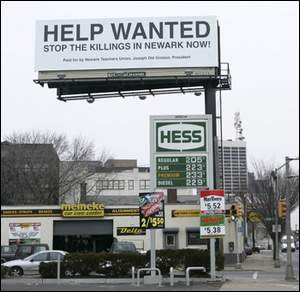
• The city’s teachers union in Newark, New Jersey has sparked controversy with a billboard campaign urging citizens to “Stop the killings” (pictured above). The mayor and local businesses want the signs taken down, arguing that the messages hurt business. Newark has a high homicide rate, and the campaign is intended to bring attention to the issue. “I think we have a serious problem,” said the president of the Newark Teachers Union. “It’s about people dying.” In other words, if you try to take down the signs, you might get killed.

• Citigroup is planning to kill about 15,000 jobs, according to the Wall Street Journal. However, Citigroup officials won’t confirm anything. The company’s chairman and chief executive said, “We are going to announce the results of our strategic structural review on or before our earnings announcement on April 16.” Which means 15,000 may have to amend the employment status on their tax forms.

• Eminem and his ex-wife have agreed to stop publicly dissing each other. During a court hearing on Monday, the two decided their verbal feuding could be harmful to their 11-year-old daughter. Look for the ex-Mrs. Mathers to erect billboards soon.

Essay 1908

Essay 1907


Turn “oh no” into “oh yeah” — oh no she didn’t!

Monday, March 26, 2007

Essay 1906


Here’s an article from Adweek.com. A brief MultiCultClassics response immediately follows…

----------------------------------

Diversity Rewrites Prime-time Script

By A.J. Frutkin/Mediaweek

NEW YORK Music snobs may be miffed that 17-year-old Sanjaya Malakar has stayed afloat on Fox’s American Idol. But his continued presence on the program underscores a profound truth about that show and other non-scripted programs this season.

From Idol to CBS’ Survivor to The CW’s America’s Next Top Model, reality offers viewers a level of onscreen diversity that remains unmatched on the scripted side.

Of course, casting scripted and nonscripted shows is vastly different.

Scripted series demand talent from actors, whereas nonscripted programs often hinge more on personality from cast members. And when acting talent is removed from the casting mix, “you have the entire U.S. population to choose from,” said Peter Golden, evp of talent and casting at CBS. White, black or otherwise, Golden said finding the right actor for the right role is a much more challenging process. “You’re looking for people with the skill to deliver certain characters, and very often with the strength to carry an entire series on their backs,” he said.

If a scripted show doesn’t call for diversity, it can be challenging to change the creator’s vision. Nonscripted shows, on the other hand, purposely throw strangers together. They virtually require variety. In the happiest of results, it’s effortless. That is the case of America’s Next Top Model, where The CW doesn’t even have to recruit ethnic contestants.

“Because our audience is so diverse, when we put out a casting call, the people who show up reflect that diversity,” said Jennifer Bresnan, svp of alternative programming at The CW. “And when you have a diverse group of people show up to a casting session, there’s no way you can’t cast a diverse group of girls.”

Not all shows are so lucky. CBS took enormous heat earlier this season for splitting the cast of Survivor: Cook Islands into four ethnic groups: African Americans, Asians, Caucasians and Latinos. But finding contestants to fill each of those teams forced the network’s casting department to aggressively recruit within those ethnic communities.

Whether “grabbing people off the street,” as Golden said, or advertising on ethnic Web sites, CBS helped establish recruitment policies that likely will be used to funnel diverse casts into other reality programs.

And advertisers are looking for those casts. “If you’re marketing to everybody, you want to reach everybody,” said Shari Anne Brill, vp, director of programming at Carat. “The more the cast of a TV show reflects what America looks like, the better the opportunity to draw all types of diverse audiences.”

----------------------------------

Adweek almost completely ignores the advertising industry’s diversity issues, yet presents a story on the topic as it pertains to reality TV programs. If Donald Trump were rating the publication’s diversity reporting, he’d probably proclaim, “Adweek, you’re fired.”

Check out this bizarre excerpt: “Scripted series demand talent from actors, whereas nonscripted programs often hinge more on personality from cast members. And when acting talent is removed from the casting mix, ‘you have the entire U.S. population to choose from…’”

What’s the implication — that minorities don’t have the talent to compete in scripted series?

Here’s another gem: “‘If you’re marketing to everybody, you want to reach everybody,’ said Shari Anne Brill, vp, director of programming at Carat. ‘The more the cast of a TV show reflects what America looks like, the better the opportunity to draw all types of diverse audiences.’”

Gee, wonder if anyone will apply that theory to Madison Avenue — that is, the more the staff of an advertising agency reflects what America looks like, the better the opportunity to draw all types of diverse audiences.

Essay 1905


Soft news in a MultiCultClassics Monologue…

• Soft drinks lead to soft bodies, according to researchers at Yale University. A study showed soft drinkers don’t appear to compensate for their consumption of sugary liquids by reducing calories in other areas of their diets. A scientist connected to the research said, “There is compelling evidence that soft drinks have negative effects, and so actions such as stopping their sale in schools and scaling back marketing to children are justified.” Sprite will probably change its “Sublymonal” campaign to actual subliminal messages.

• Now folks are worried that the scenario involving rapper Tony Yayo beating up a kid for wearing a Czar Entertainment t-shirt may lead to more violence (see Essay 1901). As it turns out, the kid is the son of Czar Entertainment chief Jimmy Rosemond. One source said Rosemond, a former gang member, is plenty pissed off. “If he wanted Yayo dead, he’d be dead already,” said the source. Hey, that line would make for a great t-shirt design.

• Snoop Dogg has been denied a visa by British authorities. The rapper had planned a European concert tour with P. Diddy. A spokesperson for Mr. Dogg said, “Snoop and his team are mystified at the decision and are hoping that the British government will reconsider this decision.” Mystified? Gee, wonder if it had anything to do with the melee staged by Snoop and his posse in London’s Heathrow Airport back in 2006 (see Essay 558).

Essay 1904

Essay 1903


Not in love with this ad.

Sunday, March 25, 2007

Essay 1902


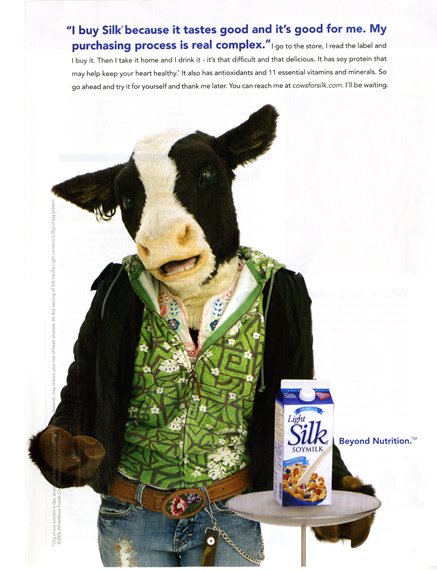
Holy cow! What’s with all the cattle ads lately?


Damn! Even the direct marketers are joining the herd.

Essay 1901


The changing times in a MultiCultClassics Monologue…

• The city of Largo in Florida sparked controversy by firing its longtime city manager after he revealed plans to undergo a sex change. The City Commission voted on the action after a six-hour hearing where supporters insisted the city manager would do the job just as well after becoming a woman. A few commissioners argued they chose to fire the man not because of his sex-change decision, but because he violated their trust and caused public disruption. Seems they missed an opportunity to reduce the city’s budget, as Largo probably would have paid the city manager less money as a woman.

• Rapper Tony Yayo was busted for beating up a teen wearing the “wrong” t-shirt. The 14-year-old was sporting a shirt for Czar Entertainment, a rival music company, when the rapper assaulted him. Yayo allegedly displayed a gun, threw the kid against a wall, demanded to know why he was wearing the shirt and slapped him around. The kid’s mom later hollered in a statement, “It’s a shame that 50 Cent & Tony Yayo could feel comfortable slapping and physically attacking an innocent 14-year-old minor that they market and promote their records to. … This is a cowardly act on my son who has done nothing to warrant the verbal and physical abuse he received … This should be looked as a step away from child molestation.” In that case, Yayo better call R. Kelly for legal advice.

Essay 1900


Does anyone else view this ad as sleazy versus cheesy?

Essay 1899


From The Chicago Sun-Times…

-------------------------------------

Ethnic identity isn’t black and white

BY MONROE ANDERSON

For the past two decades, Barack Obama has been a faithful member of the congregation at Chicago’s Trinity United Church of Christ. Trinity is no run-of-the-mill black church. It’s social activism and political awareness on pure, natural holy water. Trinity’s progressive pastor, the Rev. Jeremiah Wright, preaches the black theology of liberation. And he practices what he preaches. Back when apartheid was the law of the land in South Africa, when Nelson Mandela was a political prisoner and when American corporations, institutions and the U.S. government all gave their blessings to those evil doings, the dashiki-wearing minister planted a “Free South Africa” sign on the church’s lawn. Obama’s spiritual mentor has routinely been on the right side of morality, championing liberal causes from gay rights to opposition of the war in Iraq.

Shortly after Sen. Obama launched his run for the presidency last month, Erik Rush, a right-wing Christian blogger who happens to be African American, discovered what had been hiding in plain sight: The motto for Trinity United is “Unashamedly Black and Unapologetically Christian.”

Trinity’s motto, as well as its mission to eradicate what W.E.B. DuBois called “the problem of the color line” and “the strange meaning of being black here,” so incensed Rush that he wrote a blistering blog about it. It was unnerving for him to learn that the South Side church had adopted a “Black Value System” and that its 8,000 black members are committed to the “Black Community,” the “Black Family” and “the Black Work Ethic.” In his blog, Rush ignores -- or is just ignorant about -- the nearly 200-year-long tradition of the black church’s struggle to free and elevate its people while slyly substituting the words white for black and then disingenuously concluding that “like the Nation of Islam, a white separatist church or the Branch Davidians, Trinity United more resembles a cult than a church.”

No doubt that concept came as news to the thousands of well-heeled, professional and middle-class black Chicagoans who are members of the church. And no doubt media mogul Oprah Winfrey and rap star Common, who have both attended Trinity, were surprised to discover they were cultists. But quicker than you could say “holy fit,” the cable conservatives were clucking and complaining to the high heavens. Tucker Carlson, MSNBC’s very own Fox News-type right-wing host, opined that, “This stuff sounds separatist to me.”

Sean Hannity, the conservative half of Fox News’ lightweight talk show, “Hannity and Colmes,” sounded as if this country was going to hypocritical hell. If a white presidential candidate’s church had a similar statement and “you substitute the word white for black, there would be an outrage in this country,” Hannity preached. “There would be cries of racism in this country.”

True and Catch-22. If a white church plainly and proudly pronounced its whiteness, Hannity, Carlson and company would be right. But if it was the Holy Trinity Polish Church on Chicago’s North Side, proclaiming its Polishness, who’d care? This is how African Americans find ourselves in a trick bag. We’re defined racially even when we’re acting like any other of this nation’s ethnic groups. Issues knee-jerkily become black and white when in reality they may be African American and Irish American. Or Serbian American and African American. Remove black and substitute another American ethnic group so that Trinity’s Concept No. 6 reads: “Adherence to the Mexican Work Ethic.” Does that still sound separatist? Or racist? Of course not. But, if you’re insincerely espousing color blindness, while holding the race card up your sleeve, you know you can easily trump African-American ethnic pride every time.

Obama’s political advisers know this as well. That’s why, at the last minute, Obama disinvited Wright to speak last month when he officially announced his presidential candidacy. Wright says that Obama now realizes that his political handlers gave him bad advice and that all is well between him and the senator.

I say this is just one more sad example of how ethnic identity gets color-coded for African Americans. And I believe it’s just one more sign that there are those who would place Obama in political purgatory -- painting him not good enough to be black and not right enough to be white.

Essay 1898


From The New York Times…

-------------------------------------

Will Diners Still Swallow This?

By ANDREW MARTIN

CARROLLTON, Tex.

RICHARD SNEAD came up through the restaurant industry when bigger was better.

He earned his managerial stripes in the fast-food industry as Burger King, McDonald’s and Wendy’s waged war over who could offer bigger burgers, more fries and larger cups of soda. Few questioned the strategy, not even after casual dining restaurants embarked on their own supersizing battle in the 1990s.

Now Mr. Snead is breaking ranks. As chief executive of Carlson Restaurants Worldwide he has chopped portion sizes at T.G.I. Friday’s, Carlson’s chain known for calorie-rich items like deep-fried potato skins stuffed with Cheddar cheese, bacon and sour cream. In a closely watched experiment, Friday’s will see whether diners will order what it calls “Right Size” portions that, on average, are about two-thirds the size of the usual serving.

“I firmly believe that the consumer is demanding a change,” said Mr. Snead, who is 55 and has a runner’s trim build. Many consumers are tired of huge portions, especially on weeknights or at lunch when they do not want to indulge, he says. The time has come, he says, to think smaller. But, he added, “I’ll be honest with you, it’s scary.”

Mr. Snead has good reason to be concerned.

The strategy of serving consumers smaller servings has a lamentably unprofitable history. Many restaurateurs remember far too well what happened to the Ruby Tuesday chain in 2004 after it trimmed some portions and started printing nutritional information on the menu of calorie-packed burgers, steaks and ribs. Consumers complained about the changes, and after about five months, Ruby Tuesday plumped the portions and provided nutritional information only when asked.

“Even if they don’t eat everything on the plate,” said Richard Johnson, Ruby Tuesday’s senior vice president, “they like that it’s a generous portion.”

While the success of Friday’s smaller portions is far from certain, its heavily marketed Right Size campaign is among the boldest efforts yet to address problems in the restaurant industry that many had considered insolvable: How do you sell the idea of giving people less food? More important, how do you make money at it?

[Click on the essay title above to consume the full story.]

Saturday, March 24, 2007

Essay 1897


Technically, the door does not look like it’s wide open.

Essay 1896


Flying solo in a MultiCultClassics Monologue…

• 23-year-old Barrington Irving (pictured in plane above) is out to become the youngest person and first Black pilot to fly around the world solo. Irving built his own plane from over $300,000 worth of donated parts. Before takeoff, Irving proclaimed, “I want this completed before the year is over so kids can see that someone who started off with nothing set a goal and completed it.” Wonder which advertiser will be the first to tap Irving.

• Mel Gibson got into an argument with a college professor at California State University, Northridge, during a campus screening of “Apocalypto.” The professor was allegedly questioning the historical accuracy of the movie before Gibson told her, “Fuck off.” The woman, who was escorted out of the building, is now demanding an apology, “not only to me but to the Central American program at CSUN, to the university and most importantly to the Mayan people and Mayan community.” Looks like Gibson is out to become the first Hollywood superstar whose career goes down in flames around the world.

Essay 1895


From BusinessWeek.com…

----------------------------------

“A McKinsey Of Pop Culture?”
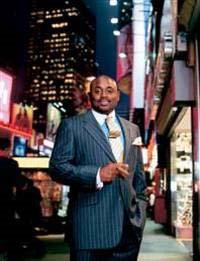
Steve Stoute is making hot sellers out of cold brands by turning execs on to “the tanning of America”

Several months into his new job as vice-president of U.S. marketing and advertising for General Motors, Mike Jackson came to the conclusion that the automaker was just not cool enough. Young, urban trendsetters on the East and West Coasts were not paying attention to GM’s cars. The message being sent to consumers, Jackson says, was all wrong. “We worried far too much about the sheet metal, color, etc.,” he explains. “What we really needed to worry about was connecting emotionally with our consumers.” So Jackson picked up the phone last spring and called Steve Stoute.

More executives overseeing brands that have gone stale are turning to the 36-year-old consultant and former music executive for help. Stoute’s agency, Translation Consultation & Brand Imaging, offers to imbue brands with a combination of hip-hop ethos and practicality to help reposition products, from Chevy Impalas to Crest Whitestrips to Reese’s peanut butter cups. The end result is for brands to resonate with a younger, more trendy audience. Other successful entrepreneurs have emerged from the hip-hop scene, such as Russell Simmons and Sean “P. Diddy” Combs, to help put urban fashion and lifestyle into the mainstream.

But Stoute is more closely aligned with a new guard of innovation consultants providing strategies that go beyond tricked-out sneakers and jeans. His message: Companies have not embraced the changes in the culture to be able to talk to a new generation of consumers. “So many executives,” says Stoute, “are lost in the confines of their own building.” Besides GM, Stoute has successfully taken his mantra to clients that include McDonald’s, Procter & Gamble, Hershey, Microsoft, and Estée Lauder.

Now Stoute seems to be gaining respect on Madison Avenue. Interpublic Group of Companies Inc., the $6.2 billion-a-year global advertising conglomerate, is in talks with Stoute to buy a majority stake in Translation, say sources close to those talks. If the deal is closed, IPG would get schooled on Stoute’s approach to brands and access to celebrities, while Translation would gain entrée to IPG's large client base and deeper pockets.

As an African American with strong relationships to hip-hop artists (music icon Jay-Z is a good friend and business partner), Stoute knows how easy it is to pigeonhole Translation as a black ad agency. He immodestly characterizes his firm as “a McKinsey of pop culture.” By that he means that Translation is called upon by companies facing strategic challenges. “These are companies who know they have to take advantage of global trends, but at the same time are afraid of jeopardizing core businesses,” says Stoute. “We show them how to walk that thin line. It often comes down to showing them the language and tonality needed to reach consumers.”

But Stoute also says he’s helping executives understand a phenomenon that he refers to as the “tanning of America.” It’s a generation of black, Latino, and white consumers who have the same “mental complexion,” he says, based on “shared experiences and values.” Rap and hip-hop, starting in the late 1980s when white suburban kids began snapping up music by mostly inner-city artists, provided the first glimpse into this shift. “Rap was a litmus test for where the culture was headed,” he says.

[Click on the essay title above to read the full story.]

Essay 1894


Whassup, circa 1962.

Essay 1893


From The New York Times…

---------------------------

After 5 Days of Mopping and Scrubbing, What Else Would a Model Wear?

By ANTHONY RAMIREZ

First there was a cry, then a murmur, and finally a swoon. Naomi Campbell, the millionaire fashion model, emerged yesterday from a grimy Department of Sanitation garage in a floor-length evening gown, marking the end of her court-ordered community service.

She waved with her right hand, pulled up the shimmering silver gown with her left, smiled for the cameras and then ducked into her Rolls-Royce limousine, a silver Phantom costing at least $340,000. She did not say a word.

The garage’s long driveway made for an effective catwalk. “Is that her?” cried a photographer, squinting at a distant, undulating figure. In unison, other photographers on stepladders swung telephoto lenses into position and began to murmur as she walked closer and into focus.

When the whites of Ms. Campbell’s eyes were in view, what could only be described as a collective swoon emerged from the dozens of reporters and paparazzi. A reporter with a British accent said out loud, “Smashing!” A photographer, not British, screamed: “Oh, what a shot! I love this!”

While paint peeled from an overpass directly overhead on South Street in Lower Manhattan, reporters quickly compared notes after Ms. Campbell left. Who designed the dress? What shade of silver was it? Was that a belt or a cummerbund? No one knew. It fell to Albert Durrell, deputy chief of the Sanitation Department, dressed in a drab-green military-style uniform, to answer reporters’ questions about Ms. Campbell’s public penance.

In January, Ms. Campbell, 36, pleaded guilty to a misdemeanor and admitted that she had thrown a cellphone at her maid, Ana Scolavino, striking her on the head. Ms. Campbell was ordered to pay Ms. Scolavino’s medical expenses, $363, attend a two-day anger management seminar and perform five days of community service.

As in the previous four days, Mr. Durrell told reporters, Ms. Campbell wore a dust mask, gloves and a vest, the usual garb provided by the department to those performing court-ordered sentences. She also wore her own stretch pants and work boots.

Ms. Campbell “completed her service successfully,” Mr. Durrell said. “From what I understand, she was pleasant the entire time.”

From 9 a.m. to 4 p.m., she swept, mopped and wiped at the garage, which has garbage and recycling facilities. She received no preferential treatment, Mr. Durrell said. Ms. Campbell ate pizza from Grimaldi’s in Brooklyn, like the others in her work crew.

Yes, Mr. Durrell acknowledged, Ms. Campbell did clean toilets. No, he said, she did not have to be taught how to use a mop or broom.

Ms. Campbell “was on her hands and knees at some point cleaning the walls and floors on the second floor,” he said.

But unlike Boy George, the singer who performed a similar sentence of community service last August, Ms. Campbell completed her sentence indoors. Mr. Durrell said it was a condition of her sentence. Why? “You’ll have to ask the judge,” Mr. Durrell said.

Mr. Durrell did report trouble inside. Someone took a digital photograph of Ms. Campbell as she scrubbed, presumably for sale to the press, but officials noticed and demanded the deletion of the image. The person was not punished, Mr. Durrell said.

Asked what he thought of Ms. Campbell’s attire at the end of her stay, Mr. Durrell replied, with a shrug, “You know, it was a gown.”

Essay 1892


Introducing The Diversity Cheer.

Friday, March 23, 2007

Essay 1891


Listen up with a MultiCultClassics Monologue…

• A pair of New Jersey radio personalities known as “The Jersey Guys” sparked controversy with an on-air segment featuring anti-immigration sentiments. “Operation Rat a Rat/La Cucha Gotcha” is a listener-participation bit that encourages people to turn in suspects to immigration authorities. Hispanic leaders are not too happy. “Scapegoating and stereotyping Latinos does nothing but give bigoted individuals a platform to make ethnic slurs and racist comments,” said Assemblyman Wilfredo Caraballo of Newark. The radio hosts disagree. “If you’re here illegally, you are breaking the law — no better, no worse than the guy who robs the liquor store or the guy who waits to case your house out and robs you of your belongings,” said one announcer. “You are a criminal.” Is it possible to deport The Jersey Guys?

• The cop who carried Naomi Campbell’s bag on Tuesday (see Essay 1879) has apparently been reassigned to Brooklyn. At least he wasn’t shipped off to New Jersey.

• A judge issued an arrest warrant for Foxy Brown after the rapper was a no-show in court. Foxy’s latest troubles come from allegedly fighting with a Florida beauty shop owner. The Jersey Guys will probably introduce a segment that encourages listeners to turn in fugitive rappers.

Essay 1890

Essay 1889


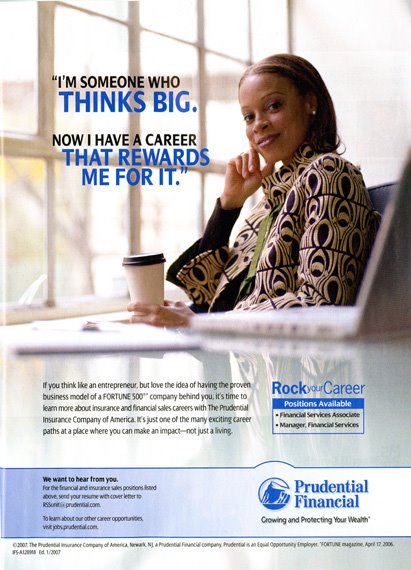
The creative team behind this ad didn’t think big.

Essay 1888


From The Chicago Tribune…

---------------------------------------

Flag protesters missing a point

By Steven Lubet
professor of law at Northwestern University

What is the proper way to hang a Confederate flag? According to artist John Sims, it’s from a noose. Not everyone agrees, of course, especially in the South. So it is unsurprising that protests quickly followed when the Mary Brogan Museum of Art and Science, in Tallahassee, Fla., displayed Sims’ installation of a Confederate flag suspended from 13-foot gallows. According to Robert Hurst, commander of the Tallahassee camp of the Sons of Confederate Veterans, it is offensive to show disrespect for the Confederate flag, which should be treated as a revered symbol of Southern heritage.

More than 140 years after the Civil War, defenders of the Confederate flag continue to fight a rear-guard action, proudly waving the standard while claiming that it stands for nothing more than pride in their ancestry and nostalgia for a vanished way of life. Denying that the flag has any association with slavery or segregation, they often seek its return to public prominence, notwithstanding the protests of civil rights organizations. For example, the Sons of Confederate Veterans boasts a “Flags Across Florida” project, seeking to “put Confederate flags on Florida’s major roads.”

But is it true that you can separate the Confederate flag from the institution of slavery? Is it possible to long for the antebellum South--and its vanished dream of independence--without recalling that nearly 4 million men and women were held in bondage?

Certainly not.

Any candid historical appraisal of the Confederacy has to recognize that it was motivated by slavery, built on slavery and deeply committed to slavery. Attempts to deny that relationship are naive at best and dishonest at worst. Here are some indisputable facts.

On Dec. 24, 1860, South Carolina became the first state to declare its secession from the Union. Its Declaration of Causes included 18 references to the sanctity of slavery, repeatedly justifying secession as necessary to protect the “right to hold property in slaves.” Indeed, the declaration gives only one reason for secession: The Northern states “have denounced as sinful the institution of slavery. … They have encouraged and assisted thousands of our slaves to leave their homes.” They have elected a president “whose opinions and purposes are hostile to slavery.”

Other state secession decrees were to the same effect. Alabama proclaimed its intention to unite with the “slaveholding states of the South.” Texas condemned the Lincoln administration as “a weapon with which to strike down the interests and property of the people of Texas and her sister slaveholding states.” Virginia bemoaned “the oppression of the Southern slaveholding states.”

The Confederate Constitution itself was explicit about the heart of its enterprise. Its “Bill of Rights” stated that no law “denying or impairing the right of property in Negro slaves shall be passed.”

It is true, of course, that the great majority of Confederate soldiers were not slaveholders. Most of the enlisted men fought for their homes, families and comrades-in-arms rather than for the abstract principles of a distant government. But there is still no escaping the fact that defense of the Confederacy meant the perpetuation of slavery for millions of African-Americans. It is impossible to separate the war from the cause.

So if you are tempted to think there might be something benign, or even admirable, about the Confederate flag, just remember that we pledge allegiance not only to the flag of the United States of America, but also “to the republic for which it stands.” In the case of the Confederacy, the republic undeniably stood for slavery, which is something that John Sims’ provocative artwork will not allow us to forget.

[Steven Lubet is a professor of law at Northwestern University.]

Essay 1887


PepsiCo + Diversity = Obesity.

Thursday, March 22, 2007

Essay 1886


Criminal clothing and suits in a MultiCultClassics Monologue…

• Naomi Campbell spent her third day of community service cleaning lockers and scrubbing toilets. Now some critics are questioning the supermodel’s intention to auction off her work clothes for charity. The plans may violate state laws prohibiting felons from generating profits for their crimes. “Clearly this is income generated from the commission of a crime,” said a New York criminal-defense lawyer. “While it may not have violated the letter of ‘Son of Sam [laws against criminal profiteering],’ it certainly violated the spirit of it.” Look for legislators to introduce the Naomi Amendment.

• A couple in New York is suing a Park Avenue fertility clinic for screwing up the sperm used during in-vitro conception. The couple — the husband is White and the wife is Hispanic — accidentally received sperm from a Black man. They filed an emotional distress suit with numerous charges: they fear the natural father may claim rights to the child; they question whether additional screw-ups may mean they have other natural children or half-children out there; the child will be unaware of her full medical history; and they believe the child “may be subjected to physical and emotional illness as a result of not being the same race as her parents and siblings.” The kid’s had a rough childhood and she’s not even 3 years old.

Essay 1885


From The Los Angeles Times…

-----------------------------

‘Emmett Till’ poet protests teachers’ firing

By Carla Rivera, Times Staff Writer

The award-winning author of “A Wreath for Emmett Till,” a poetic memorial to the teenage civil rights icon murdered in Mississippi, said Wednesday it was “unconscionable” that a planned presentation of the work by students at a Los Angeles charter school sparked the firing of two teachers.

Marilyn Nelson, a former poet laureate of Connecticut and National Book Award finalist, wrote to the school, Celerity Nascent, and said that she was “troubled” and “shocked” at the events and urged that teachers Marisol Alba and Sean Strauss be reinstated.

Controversy erupted last month when the school canceled a special Black History Month presentation by the seventh-grade class that was to include the reading of a poem and laying of a wreath of flowers inspired by Nelson's book.

School officials had contended that the Till case — in which the black teenager was beaten to death in 1955 after allegedly whistling at a white woman — was too graphic for younger children and did not fit the mood of what was to be a celebratory event.

The students had been learning about Till and planning the presentation for two weeks, and many wrote letters of protest to urge administrators to reconsider their decision. Alba, who helped students prepare the presentation, and math teacher Strauss signed one of the letters and were later terminated.

“It’s a terrible injustice,” said Nelson, a professor of English at the University of Connecticut. “I wanted them to know that they’re not alone. They raised their voices and that took courage.”

In her letter, Nelson wrote, “Harriet Tubman, Frederick Douglass, Martin Luther King, Rosa Parks and Mamie Till-Mobley would have been proud of your students’ passionate and clear view of your decision to cancel their program. They would have signed the students’ letters of protest too.”

Alba and Strauss said they did not find anything offensive or threatening in the student letters. Celerity administrators would not characterize the letters and would not discuss specifics of the firings. Executive Director Vielka McFarlane said she believed that Nelson was misinformed that the school did not teach about Emmett Till. But she said the school is working with community groups to provide students and their families with a broader understanding of the Emmett Till story.

Several community leaders, including Earl Ofari Hutchinson, president of the Los Angeles Urban Policy Roundtable, met with administrators Tuesday and said that they were reassured that the school was committed to teaching all aspects of African American history and that the teachers’ rights to a hearing and appeal were protected. The school accepted an invitation to a screening of a documentary on Till this Saturday.

“We continue to believe black history should be taught throughout the entire school year and not just one month,” McFarlane said. “We’re hoping to expose families to all aspects of the struggle, including parents of kindergartners. We’re trying to make it a community event.”

Alba, meanwhile, said she was happy to have Nelson as an ally.

“I’m speechless,” she said. “She’s my favorite author.”

Essay 1884

Essay 1883


Together, we drive innovation. Just not in diversity advertising.

Wednesday, March 21, 2007

Essay 1882


From The Chicago Tribune…

--------------------------------------

Don’t ask, don’t tell, don’t leave

By Clarence Page

WASHINGTON -- How much harm do gays and lesbians really cause in the ranks of the military? Not much, it turns out.

Judging by the latest discharge figures, the military’s policy is really: “Don’t ask, don’t tell. Just keep fighting!”

Gen. Peter Pace, chairman of the Joint Chiefs of Staff, made more news than he wanted to last week when he called homosexual acts “immoral” during a meeting with the Chicago Tribune’s editorial board.

Pace expressed mild regret for divulging his personal views instead of sticking with the official Pentagon line. But he stopped short of an apology to all of the gay and lesbian military personnel whose service and sacrifices he had insulted.

That’s a shame, when you consider another less ballyhooed news development that came to light that same week: the release of the latest Pentagon figures on how many service personnel actually have been discharged for reasons connected to their being gay or lesbian.

In 2006, it turns out, gay-related discharges fell to 612 from a peak of 1,273 in 2001.

That continues a revealing trend: Gay-related discharges rose sharply after the “don’t ask, don’t tell” policy went into effect in 1994, when such discharges numbered only 617.

That rise came in spite of assurances from President Bill Clinton’s administration that the policy would respect everyone’s privacy rights. Instead, advocacy groups like the Washington-based Servicemembers Legal Defense Network, which formed in the wake of “don’t ask, don’t tell,” said the policy only entrenched anti-gay bigotry.

The terror attacks of Sept. 11, 2001, appear to have changed that. Gay-related military discharges fell to 906 in 2002 and 787 in 2003. The return of war brings about a sudden upsurge in tolerance among troops and commanders for their fellow soldiers, sailors, airmen and Marines (the Pentagon’s numbers do not include the Coast Guard). As a practical matter, bigotry toward gays and other groups fades rather quickly the closer one gets to the front lines of combat.

Also, Steve Ralls, a spokesman for the Servicemembers Legal Defense Network, observed that gays and lesbians in the military felt as big a patriotic boost after Sept. 11 as other Americans. That resulted in fewer homosexuals trying to leave the military and an upsurge in those trying to get in--or get back in.

“In the weeks following 9-11,” he said, “we were flooded with phone calls from gays and lesbians who had been dismissed under the ‘don’t ask, don’t tell’ law. They wanted to know if there was any possible way they could re-enlist and be part of the response to those attacks.”

Twelve of them are named in a case the organization filed in December 2004 to have them reinstated by the armed services.

It is painfully ironic, at a time when the military is facing recruiting and retention troubles, that gays and lesbians who want to serve are not officially being allowed to serve, even when they work in such valuable area as translation and weapons technology. Unofficially is another matter.

“We know for a fact that there are gay and lesbian service members who are serving openly,” Ralls said. “Their commanding officers are fully aware of their status and neither their commanders nor their fellow service members care one iota.”

As a Vietnam-era Army vet, that revelation does not shock me. There’s nothing new about the presence of gays or lesbians in the military. Military ranks reflect the diversity of the civilian world. Back in my day, it simply wasn’t talked about or debated in the open as much. But in these days of political culture wars, military commanders find they have to take a public stand, whether it matches their personal positions or not.

A chorus of gay activists has called for Pace to resign because of his remarks.

Ralls has another view. “Ironically, Gen. Pace has probably done more than anyone to move us toward repeal of the law,” Ralls said. “He pulled the veil off of this policy.”

Pace did reveal that the policy is less about military cohesion than personal feelings, which are changing over time. A younger, more tolerant “Will & Grace” generation is moving up, says Ralls, referring to the popular TV show that featured gay characters in leading roles.

A Zogby poll of Iraq and Afghanistan combat vets in December appeared to back him up. It showed almost three-quarters said they were comfortable serving with gays and lesbians. Members of Congress are renewing pressure to reopen the “don’t ask, don’t tell” policy. Instead of calling for Pace’s head, maybe gay activists should give him a medal.

Essay 1881


Want to boost minority representation in your company? Encourage nepotism.

Essay 1880


One more online comment responding to the Advertising Age story presented in Essay 1862…

It doesn’t look like it has changed a lot in 40 years. If at all. — Chicago, IL

Essay 1879


Working the news with a MultiCultClassics Monologue…

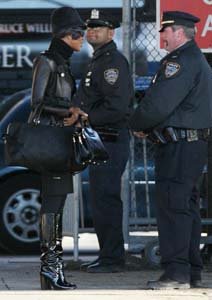
• Naomi Campbell stirred minor controversy by having a police officer act as her valet on Tuesday. When the supermodel arrived for her second day of community service work, her bodyguard handed a bag of personal stuff to a cop, who wound up carrying it for Campbell. “There was a state of confusion this morning. Naomi forgot her bag. There were personal items she needed, like her ID and clothes,” said a department spokesman. “It’s not our policy, but as a courtesy today, he carried it for her.” Just be careful if she asks for her cell phone.

• Mickey D’s is launching a campaign to change the definition of “McJob.” Dictionaries in the UK list the term as “an unstimulating, low-paid job with few prospects, esp. one created by the expansion of the service sector.” The fast feeder thinks the definition is wrong and too negative, and the company hopes dictionary officials will amend the entry. It would help if Mickey D’s stopped making its employees feel like they’re in “an unstimulating, low-paid job with few prospects, esp. one created by the expansion of the service sector.”

• A survey of New York City public schools showed White students are more likely to be targeted as buyers by drug pushers versus Black, Hispanic and Asian students. White kids are also more likely to be binge drinkers. “It’s often a matter of money and availability,” said the executive director of Camelot Counseling Services of Staten Island, a drug-prevention organization serving youth. “White families tend to have more money. Where there’s more discretionary money, it attracts drugs.” Guess White kids are making the most of their McJob wages.

Essay 1878

Essay 1877


Merrill Lynch presents the standard diversity bull.

Essay 1876


A single online comment to the Advertising Age story presented in Essay 1862, followed by random MultiCultClassics musings…

-------------------------------------------

What about increasing the starting salaries to attract more minorities? Engineers easily command $50-60K salaries upon graduation. MIS majors easily earn $55K starting out. Finance majors easily earn $50K. Petroleum Engineers easily earn $80K. Advertising pays between $21-30K starting out. — Bedford, TX

-------------------------------------------

First, Advertising Age deserves credit for its commitment to reporting on the industry’s diversity dilemmas.

At the same time, the latest story leads to more questions than answers. And it may actually spotlight key issues in the drama.

In terms of minorities, it appears that the ad world has old-timers and newbies. Yet there are virtually zero mid-level executives. It’s as if an entire generation doesn’t exist. And according to the findings by New York City’s Commission on Human Rights, the old-timers and newbies are in short supply too.

No disrespect to Doug Alligood — especially given that his historical efforts are clearly great and noble — but the man is 73 years old. He’s not exactly the typical senior-level executive. Although it would be interesting to hear the true tales this gentleman has to tell.

Erika Emeruwa is equally unique, although for different reasons. She said, “I pretty much grew up as the only African-American kid in my classes.” In many respects, the exclusive advertising industry may be a natural and comfortable progression for her. But what about students accustomed to integrated environments — or heaven forbid, graduates of Historically Black Colleges and Universities?

Alligood and Emeruwa ultimately symbolize a notion that may be lost on the common Advertising Age subscriber: Blacks have as much “diversity” in their ranks as any other group. Will readers recognize this? Or will most folks view Alligood and Emeruwa as proof that minorities are represented on Madison Avenue, and perhaps the diversity problems are not as bad as we think?

Then again, based on the fact that the story only drew one comment, does anyone even continue to give a shit about the topic?

Tuesday, March 20, 2007

Essay 1875


“More Than A Carpet Company.” Hey, if that doesn’t inspire candidates to apply, nothing will.

Essay 1874


This anti-smoking ad targets Asian Americans. Looks like the California Smokers’ Hotline couldn’t afford an endorsement from Jackie Chan or Jet Li.

Essay 1873


From Multichannel.com…

-----------------------------

Diversity Gets Animated
Kids’ Shows Strive for Authenticity While Attracting Broad Audiences

By Luis Clemens

Audience demands and demographic reality have helped make kids’ animated programming on cable more culturally diverse than ever.

“We don’t live in Leave It To Beaver-land, where everyone is white,” Cartoon Network senior vice president of programming and development Bob Higgins said. Or, as Nickelodeon Television executive vice president and general manager Tom Ascheim put it, “It is important for kids to see themselves represented on screen.”

Nickelodeon should know, as two of the network’s biggest stars are Latino cousins who headline the consistently top-rated shows for viewers between 2 and 5 years old: Dora the Explorer and Go, Diego, Go!

“It is always good when you make money by sticking to your principles,” said Ascheim.

But more recent additions to networks’ animated lineups reinforce the popularity of diverse cartoons among young audiences. Among cable’s offerings:

> Disney Playhouse’s Handy Manny, launched last September, features a bilingual Latino handyman and “as diverse a cast as I think I am ever likely to be able to put together,” said Disney Channel senior vice president of programming Nancy Kanter. It was the highest-rated Playhouse Disney original series premiere ever among kids 2 to 5. The show was just renewed for 26 episodes.

> The March 3 debut of Nicktoon’s El Tigre: The Adventures of Manny Rivera earned Nickelodeon its best premiere performance ever for a Saturday morning series.

> Cartoon’s Class of 3000, created by and starring hip-hop artist André Benjamin of OutKast, just got renewed for 13 episodes. The overall number of viewers is up 3% for the same time period but up a dramatic 19% in the target demographic of boys 6 to 11.

Meanwhile, Disney continues to have success with Toon Disney show American Dragon: Jake Long. The show, featuring a Chinese-American hero, saw its audience grow from a 3.3 rating for kids 2 to 11 during its first season in 2005 to a 4.7 rating in its second season.

Adam Bonnett, Disney Channel senior vice president of original series, said, “The inspiration for American Dragon: Jake Long was Harry Potter — something that had absolutely nothing to do with Asian culture.”

But, aware of their increasingly diverse audience, programmers are making a concerted effort during the development process to include characters of different races and ethnicities.

“If there’s a way to make that character African-American, Asian or Hispanic, we will do that,” said Cartoon’s Higgins.

[Click on the essay title above to read the full story.]

Essay 1872


Princesses and Princes of Darkness in a MultiCultClassics Monologue…

• Disney presented images of Maddy, its first Black princess (pictured above). She’s bootylicious.

• Supermodel Naomi Campbell started her first day of community service on Monday. She announced plans to auction off the jeans and boots worn during the event, with proceeds benefiting the Nelson Mandela Children’s Fund. Although you’d think folks might be more interested in snagging the broom and toilet brush she’ll be using.

• Procter & Gamble received a $19.25 million jury award in the trial against former Amway distributors charged with spreading rumors tying P&G to Satanism. That’s a hell of a win.

• The U.S. National Slavery Museum is being urged by an anti-smoking group to return a donation from Big Tobacco’s Philip Morris USA. “This is indeed a laudable goal, but by taking receipt of this donation, the museum is joining forces with a company that continues to target children for another form of slavery,” wrote the president of the Campaign for Tobacco-Free Kids. “We’re happy that Philip Morris was progressive enough and stepped up to the plate and donated,” said a museum official. “We hope other corporations will follow suit.” Look for a contribution from a malt liquor producer soon.

Essay 1871

Essay 1870


Together, we are powerful and creative. But not very good painters.

Monday, March 19, 2007

Essay 1869


Fritos Brand Corn Chips celebrates 75 years with Limited Anniversary Edition packaging featuring the Frito Kid. According to the bag blurb, “From 1952 to 1967, the FRITO KID™ was the darling of America…”

Why the hell didn’t the company produce a commemorative bag for the Frito Bandito?

Essay 1868


From The New York Daily News…

------------------------------------

GHETTO MENTALITY NO LONGER COLOR-CODED

By STANLEY CROUCH

“Ghetto Nation” by Cora Daniels is part of a profoundly important moment in our culture. The book lets us know where we stand through a sharpening perspective that calls upon the heritage all modern women have in common. That common heritage is the inarguable fact that thinking women have played a significant part in waking up this nation and the world to backward policies and disinclined cultural traditions.

So we should not be surprised to see that Daniels is one of the women rising up against the misogynist and denigrating things that are basic to the popularity of hip hop. Her observations are important because she sees the problems as far more than the troubles of an ethnic group that has seemingly accepted the hatred of women and the glamorizing of thugs and violent behavior as normal.

Rather brilliantly, what she describes as “ghetto” behavior and thought is not color-coded. To Daniels, Britney Spears, Paris Hilton and Gwyneth Paltrow are, through their various ways and personal decisions, as “ghetto” as the stereotypical project tackhead with five children by five different men, not one of whom she married.

So when Daniels uses “ghetto” to describe something, she does not exclusively mean lower class or black. Nor does she only mean the super tacky bling of wealthy, upper-class black knuckleheads who couldn't recognize refined style if it slapped the taste out of their mouths.

No, her observations are mercilessly inclusive. They criticize and pull the covers off of a much larger problem that may rise most brutally out of projects across the nation, but have not stayed there. These troubles are common to all colors and all classes. Every person in this nation is threatened by an especially obnoxious kind of narcissism that justifies all actions or ignores everyone else — including one’s own children! — in the name of personal pleasure or profit or individual comfort.

What makes the book particularly effective is the fact that Daniels is proud to have come from a New York “ghetto” background that could playfully thumb its nose at conventional ideas of glamour and correct speech while creating the sort of vital ethnic subculture that all so-called minority groups tend to be ambivalent about or proud of — as much for what is wrong about it as for what is right.

Black Americans, Jews, Asians and Latinos can comically imitate the mispronunciations, the distinctive reactions and the sometimes bizarre visions of being well-dressed or “classy.”

What “Ghetto Nation” actually does is live up to its subtitle, “A Journey Into the Land of Bling and the Home of the Shameless.” Daniels does not long for the dull, manicured minds of the 1950s, but she does realize that much has been lost in the process of freeing this country from a puritanical and repressive culture.

Individuality seems to have come at the cost of community, as shame is set aside in favor of a self-serving sense of “the pursuit of happiness.”

That such a brave and unflinching book could be written by a black woman in this time is quite inspiring. Daniels not only reveals a sense of life about which and from which we hear very little, but proves that we should never expect less than a willingness to stand tall against our domestic monsters whenever the question of the human survival of our nation is unavoidably raised.

Essay 1867


Can’t beat the real MultiCultClassics Monologue…

• Coca-Cola’s kosher for Passover, and even non-Jews are drinking it up. The special version is made from pure sugar versus high-fructose corn syrup, creating a taste and feel that many think is better than the original formula. Looks like some folks just prefer the kosher side of life.

• Naomi Campbell will experience a different side of life when she begins her 5-day community service sentence today. The temperamental supermodel is slated to push a broom for most of the time, making a temporary transition from the catwalks to the sidewalks.

Essay 1866

Essay 1865


From The Los Angeles Times…

-------------------------------------

Not the lesson they intended
Two L.A. charter school teachers lose their jobs over a planned Black History Month presentation.

By Carla Rivera, Times Staff Writer

Administrators at a Los Angeles charter school forbade students from reciting a poem about civil rights icon Emmett Till during a Black History Month program recently, saying his story was unsuitable for an assembly of young children.

Teachers and students said the administration suggested that the Till case — in which the teenager was beaten to death in Mississippi after allegedly whistling at a white woman — was not fitting for a program intended to be celebratory, and that Till’s actions could be viewed as sexual harassment.

The decision by Celerity Nascent Charter School leaders roiled the southwest Los Angeles campus and led to the firing of seventh-grade teacher Marisol Alba and math teacher Sean Strauss, who had signed one of several letters of protest written by the students.

The incident highlights the tenuous job security for mostly nonunion teachers in charter schools, which are publicly financed but independently run. California has more than 600 charter schools, and their ranks continue to swell. According to the California Teachers Assn., staff at fewer than 10% of charter schools are represented by unions.

“I never thought it would come to this,” said Alba, who helped her students prepare the Till presentation, in which they were going to read a poem and lay flowers in a circle. “I thought the most that would happen to me [after the event was canceled] is that I’d get talked to and it would be turned into a learning and teaching experience.”

School officials refused to discuss the particulars of the teachers’ firings but said the issue highlights the difficulty of providing positive images for students who are often bombarded by negative cultural stereotypes.

“Our whole goal is how do we get these kids to not look at all of the bad things that could happen to them and instead focus on the process of how do we become the next surgeon or the next politician,” said Celerity co-founder and Executive Director Vielka McFarlane. “We don’t want to focus on how the history of the country has been checkered but on how do we dress for success, walk proud and celebrate all the accomplishments we’ve made.”

[Click on the essay title above to read the full story.]

Essay 1864


Why are they pointing and waving a fist at the Black guy?

Essay 1863


From The Los Angeles Times…

---------------------------------------

Erasing a line drawn in the sand
Manhattan Beach renames a park to honor a black couple forced to give up their resort in the 1920s.

By Deborah Schoch, Times Staff Writer

In two weeks, Manhattan Beach city leaders and residents plan to gather at a small park by the ocean to lift the veil from a commemorative plaque, revealing a piece of little-known local history.

“This two-block neighborhood was home to several minority families and was condemned through eminent domain proceedings commenced in 1924,” the plaque reads. “Those tragic circumstances reflected the views of a different time.”

After debate last summer, the City Council voted to rename the park Bruce’s Beach, acknowledging the African American couple who bought the land overlooking the Pacific in 1912.

There, Charles A. and Willa Bruce created one of the few places in Southern California where black families could swim and relax along its sun-bathed shores. They ran an inn called Bruce’s Lodge, a cafe and a dance hall.

By the mid-1920s, city leaders contended that the land occupied by the Bruces’ resort would better serve the community as a public park. The city used its powers of condemnation to buy the land from the Bruces and other nearby residents, removing most of Manhattan Beach’s African American residents and visitors.

No park was built there for three decades.

Some who know this slice of history believe that the story of Bruce’s Beach merits more than a commemorative plaque and should be explained in a more detailed exhibit that speaks to the issue in the context of segregationist practices of the time. The City Council has not embraced that idea, approving only the name change and plaque.

It’s not known yet how many people will attend the dedication March 31; planning started just last week. But among those committed to show up are Robert L. Brigham and Alison Rose Jefferson — historians generations apart — who researched the story of Bruce’s Beach. They and others took the issue to City Hall, winning the backing of Mitch Ward, the city’s first black elected official, who requested the ceremony.

An invitation will probably be extended to Bernard Bruce, 72, the grandson of Charles and Willa, welcoming him to the town that forced his ancestors out.

[Click on the essay title above to read the full story.]

Sunday, March 18, 2007

Essay 1862


From AdAge.com…

----------------------------------------

Being Black on Mad Ave: Young and Old Sound Off
Two Minority Execs From Different Generations Discuss Diversity Issue

By Lisa Sanders

NEW YORK (AdAge) -- Doug Alligood and Erika Emeruwa are a study in similarities and contrasts.

Both BBDO Worldwide executives are passionate about advertising and work with top marketers from DaimlerChrysler to Federal Express, PepsiCola and Target. Both hail from Middle America -- Mr. Alligood, the son of a handyman-craftsman, grew up in St. Louis, while Ms. Emeruwa, the daughter of an accountant and a media consultant, was raised just outside Cleveland. Both built a career on storied Madison Ave. And both are blacks in a predominantly white industry, committed to attracting more minorities into the businesses and believe that retention is a crucial element in building a more diverse industry.

Yet Mr. Alligood, 73, began his first stint with BBDO back in 1963; Ms. Emeruwa, 27, joined the agency six months ago, after five years at Ogilvy & Mather. The nearly four decades’ difference in experience factors into their differing perspectives on diversity in the ad business, and influences the personal philosophy each has crafted over the years about how to succeed.

Let’s start at the beginning. How did you get into advertising?

Mr. Alligood: My dad was in private-family work -- he was a yard man, he’d paint the house if you wanted him to, wash the car. As such he was given a lot of magazines to bring home -- Life, Look, Saturday Evening Post. … I pored over those magazines. Something as a kid struck me: Nobody in these magazines looks like my family. I’ve got a couple of good-looking aunts, but they’re not here. I’d see Aunt Jemima, I’d see the I.W. Harper waiter, and that was about it. My attitude was, “I think the world is more than this. I would like to be a part of this to change things.” I was a kid.

How I got that attitude, I don’t know. At Bradley University, I majored in commercial art. Before BBDO, my first job in advertising was in 1956, at a black agency in Detroit: Seymore, Leatherwood & Cleveland. In 1959, worked at a radio station as a merchandiser. One of my clients there was PepsiCola. [Through that I met] Bob Anderson, head of BBDO Detroit.

Ms. Emeruwa: I stumbled upon it in my senior year of college [George Washington University]. I was a marketing and finance major. My senior year, I needed to fill a requirement, so I checked out an advertising class, and absolutely loved it. It was so much fun. We broke into teams, acted like agencies to market a product. I had a ball pulling it all together and presenting it. Right there, I got the bug.

In 1968, the New York City Commission on Human Rights investigated minority hiring in advertising and found that minorities were under represented. A year later, after the agencies pledged to improve, a follow-up said little progress was made. What was happening in the industry then?

Mr. Alligood: When I came back to BBDO in the early 1970s, though there hadn’t been a lot of progress, a lot of people wanted to change that. We had this organization called the Group for Advertising Progress (GAP).

GAP called a meeting in New York, and discovered 75 or 80 people in the industry who we didn’t even know about. Others came -- photographers, producers -- who wanted to get in the business. I was president of GAP. Our philosophy was not to tear down the industry, but improve it. We were part of it. So we set up workshops, with help from Doyle Dane; N.W. Ayer, BBDO, Y&R, they all pitched in, they sent guys to run the workshops.

At that point, a number of blacks were recruited into the industry in middle and senior positions, correct?

Mr. Alligood: Yes. There was an article in The New York Times one year and that showed all the black account executives in New York at that time. I think JWT had six. I was in it; I think I was the only one from BBDO. There were a couple of others at other agencies. There were like 10 guys; 10 years later not one of them except me was in the business.

How did that happen?

Mr. Alligood: Because of the problems that are inherent in this business. People get disenchanted after a while. Many people -- particularly blacks – they’re high-profile, well-educated, work hard, very good at what they do, and outside industries can buy them off a lot easier than advertising can. That’s what happened. And a lot of the goods ones left to form their own firms and become CEOs: Sam Chisholm, Frank Mingo. There were some who were less than stellar and who wanted to move faster than they probably should have. You still have that today among all people, not just minorities. I think it was that combination. I think there was another reason, too: I think middle management at a lot of places made it difficult.

Was it racism?

Mr. Alligood: I can’t cite an example where I can say it was because of personal bias. But the progress was slow in advancing up. There was a glass ceiling. The top title in those days was account executive. There were no senior account executives. You just didn’t make that next jump. Many agencies would tell you, “Our clients won’t like this.” Nobody ever proved that, but what are you going to say?

Clearly there’s been a change in the industry over time, but how do you explain the low numbers of minorities at agencies, particularly in middle and senior ranks?

Mr. Alligood: It goes back to what we found when we had GAP many years ago. The industry in my view never really made an all-out effort to recruit minorities. At the same time, maybe because of that, minorities never really looked at the industry. The biggest impetus was not what the city did, but what clients said.

Did you have any concerns about coming into a predominantly white industry?

Ms. Emeruwa: To be honest, no. I pretty much grew up as the only African-American kid in my classes. George Washington is a very international school, but again, there were very few minorities. This was no different from my previous experience, being the only one.

When you heard about the investigation by the Human Rights Commission, were you surprised? What was your response?

Ms. Emeruwa: I wasn’t surprised that they were looking into this. Many minorities don’t know about this industry and the different careers in it. The nature of it is that when you first start you’ve got to spend time doing [basic, detail-oriented tasks] that will get you to where you want to be. People see other ways of making money, regardless of race or background. But I don’t think the issue is getting people in. I think it is retention. You’ve got to keep people in the industry.

You’ve been involved with the American Advertising Federation’s Most Promising Students program. This year, you were selected as one of the industry’s rising stars. How did that happen?

Ms. Emeruwa: I was one of the Most Promising Minority Students program in 2001. Last year, the AAF sent out a notice asking all program participants what they’ve been up to, how they’ve grown. They also asked what advice I’d give to people coming in to the industry. Be focused. Understand the rules of engagement. Look at those who are phenomenal about what they do.

It is often said that one of the reason minorities don’t stay in the business is that they don’t see other minorities at the top. Does that bother you?

Ms. Emeruwa: No. One question I was asked in the American Advertising Federation’s Rising Star questionnaire is whether I’ve experienced any barriers. My answer is no, thank goodness. No, I haven’t, from a racial standpoint. I don’t worry about not seeing anyone at the top because -- maybe I’m being overly optimistic -- I feel like when you are doing the job that you are supposed to be doing, if you are doing the job well, all of that will come.

Do you believe that change will happen now? And what is your role with BBDO’s diversity council?

Mr. Alligood: Diversity is not just going out and hiring people. You’ve also go to make them feel comfortable when they come here. [The council] develops guidelines and programs. One example is diversity training. Another is an initiative that launches this week, an internal website that introduces all staff to each other. It’s like a BBDO Facebook.

Are there any recommendations you’d make to the industry?

Ms. Emeruwa: The industry is starting to do a very good job expanding its college recruitment effort, and it should do more. Once the kids are here, we need to invest more in making them realize that what they do early on paves the way to do great work. Then, two to three years in, when people are starting to get antsy, there needs to be some mentorship to really grab them, and keep them interested. Continuing programs throughout a career will keep minorities -- and everyone -- here.

Essay 1861


Hanging out with a MultiCultClassics Monologue…

• In Florida, a local chapter of the Sons of Confederate Veterans has taken offense to an art exhibit that they believe presents the Confederate flag in a disrespectful fashion. The work is titled “The Proper Way to Hang a Confederate Flag” and depicts the flag being lynched (photo above). The veterans group cites a Florida law stating it’s illegal to “mutilate, deface, defile or contemptuously abuse” the Confederate flag. That Florida has such a law on the books may be cause for spirited protest — or at least the censoring of broadcasting “The Dukes of Hazzard” reruns.

Essay 1860


One company. Endless possibilities. Infinite clichés.

Essay 1859

From The Chicago Tribune…

----------------------------------------

Black immigrants collect most degrees
But affirmative action is losing direction

By Clarence Page

WASHINGTON -- Do African immigrants make the smartest Americans? The question may sound outlandish, but if you were judging by statistics alone, you could find plenty of evidence to back it up.

In a side-by-side comparison of 2000 census data by sociologists including John R. Logan at the Mumford Center, State University of New York at Albany, black immigrants from Africa averaged the highest educational attainment of any population group in the country, including whites and Asians.

For example, 43.8 percent of African immigrants had achieved a college degree, compared with 42.5 of Asian-Americans, 28.9 percent for immigrants from Europe, Russia and Canada and 23.1 percent of the U.S. population as a whole.

That defies the usual stereotypes of Asian-Americans as the only “model minority.” Yet the traditional American narrative has rendered the high academic achievements of black immigrants from Africa and the Caribbean invisible, as if that were a taboo topic.

Instead, we should take a closer look. That was my reaction in 2004 after black Harvard law professor Lani Guinier and Henry Louis Gates Jr., chairman of Harvard’s African-American studies department, stirred up a black Harvard alumni reunion with questions about precisely where the university’s new black students were coming from.

About 8 percent, or about 530, of Harvard’s undergraduates were black, Gates and Guinier said, but somewhere between one-half and two-thirds of the black students were “West Indian and African immigrants or their children, or to a lesser extent, children of biracial couples.”

If we take a closer look, I said at the time, I bet we’d find that Harvard’s not alone. With all of the ink and airwaves that have been devoted to immigration these days, black immigrants remain remarkably invisible. Yet, their success has long followed the patterns of other high-achieving immigrants.

Now comes a new study that finds a consistent pattern of Ivy League and other elite colleges and universities boosting their black student populations by enrolling large numbers of immigrants from Africa, the West Indies and Latin America.

Immigrants, who make up 13percent of the nation’s college-age black population, account for more than a fourth of black students at Ivy League and other selective universities, according to the study of 28 colleges and universities. The authors of the study, published recently in the American Journal of Education, included Douglas S. Massey of Princeton University and Camille Z. Charles at the University of Pennsylvania. The proportion of immigrants was higher at private institutions, 28.8 percent, than at the public colleges, where they comprised 23.1 percent of enrollment.

Are elite schools padding their racial diversity numbers with black immigrants who do not have a history of American slavery in their families? This development immediately calls into question whether affirmative action admission policies are fulfilling their original intent.

But, as Walter Benn Michaels, a professor of English at the University of Illinois at Chicago, writes in his book “The Trouble With Diversity,” the original intent of affirmative action morphed in the 1970s from reparations for slavery into the promotion of a broader virtue: “diversity.”

Since then, it no longer seems to matter how many of our colleges’ black students have slavery in their families. It only matters that they’re black.

That said, I don’t begrudge black immigrants or any other high-achieving immigrants for their impressive achievements. I applaud them. I encourage more native-born American children, particularly my own child, to take similar advantage of this country’s hard-won opportunities.

But I also think we need to revisit the question of diversity. Unlike our system of feel-good game-playing, we need to focus on the deeper question of how opportunities can be opened to everyone who was left behind by the civil rights revolution. We tend to look too often at every aspect of diversity except economic class.

Essay 1858


Can you hear me now? This. Ad. Sucks.

Essay 1857


From The Chicago Sun-Times…

----------------------------------------

Why Sharpton is badmouthing Obama

BY MONROE ANDERSON

Al Sharpton is on a jealousy trip, power trip, ego trip and is tripping over his own two right feet. Last week, the New York preacher declared that presidential candidate Barack Obama should not take the black vote for granted. He also bad-mouthed Obama for supporting Sen. Joe Lieberman. Sharpton’s Obama-drama took center stage last week when the New York Post reported a pro-Hillary activist charged that a jealous Rev. Al was out to do deadly damage to Obama’s presidential bid. “He’s saying that Obama never did anything for the community, never worked with anybody from the community, that nobody knows the people around him, that he’s a candidate driven by white leadership,” the Post quoted the activist.

Bathing in the warmth of glowing television cameras and hyped by headlines, once again, Sharpton denied and deflected. He wasn’t jealous; he was just doing what he’s always done, he said. “I want to talk about a civil rights agenda as a priority.”

That civil rights agenda Sharpton wants to talk about is just fine if you’re in the presidential race to see if you can get more votes than the Rev. Jesse Jackson did back in the ‘80s so that you can claim the de facto Leader-of-Black-America crown. But it won’t play in Peoria if you are seeking to become Ruler of the Free World. That calls for universal, not racial, appeal. And whether Sharpton knows it or not, universality in good hands is great for civil rights. Universal health care appeals to all Americans but will help African Americans proportionately more. An African-American president, elected on universal appeal, can launch a public school initiative that will ensure that each child is well-educated and that voting rights are enforced.

To say that Sharpton is jealous is about as obvious as saying that America’s not about to elect a black man who wears his hair conked. Why should the media again seek out Rev. Sharpton, a self-appointed leader, when it can call on Sen. Obama, the first competitive African-American presidential candidate? Why go to Sharpton to get a quick quip on how we’re losing the war on poverty, when you can go to top-tier candidate Obama for a substantial response on what he’d do about us losing the war in Iraq?

Some of the over-the-hill New York politician’s over-the-top anti-Obama snipes and gripes are transparent. Lieberman for one. While both he and Obama opposed the Iraq war, Sharpton tongue-lashed the Illinois senator for campaigning in Connecticut for the pro-war Lieberman. Sharpton failed to mention that Obama’s support came during the primary with the balance of power in the U.S. Senate up for grabs. In the general election, Obama backed the party nominee, Ned Lamont. In both elections, Obama was acting as a loyal Democrat. Sometimes Sharpton does not.

In his 2004 presidential loss, Sharpton strangely fellowshipped with GOP Watergate trickster Roger Stone. Back during that symbiotic relationship between the civil rights leader and the right-wing operative, I’m not sure who was tricking whom. A Village Voice investigation revealed that Sharpton’s campaign was staffed, financed and finessed by Stone and other rich Republican conservatives. The Stone hookup also helped pave the way for Sharpton’s unlimited access to Fox Cable News, the semi-official Voice of the Bush White House. The Republican strategy was to keep hope alive in Sharpton’s campaign, allowing him to bloody the eventual Democratic nominee, undermining the chances of the Democrats winning the presidential election. With a war chest of a mere $600,000 for the 2004 race — Richard M. Daley had 10 times that amount for a run in a sure-win contest — I’m not sure what was Sharpton’s strategy.

Power to the people protests aside, Sharpton has a history of hanging with the GOP — from 1986 when he endorsed Republican Al D’Amato for the U.S. Senate to his 2004 presidential bid when his campaign co-chairman gave as much money to the Bush-Cheney campaign as to Sharpton’s.

Sharpton hasn’t said whether he’ll endorse Obama or make another run for the presidency himself. He may be waiting for Fox’s flamethrower Bill O’Reilly to cheer him on before he makes the big decision.

Essay 1856


From The Miami Herald…

------------------------------------

Don't ask this general about morality

By LEONARD PITTS JR.

I believe homosexual acts between two individuals are immoral and that we should not condone immoral acts. I do not believe the United States is well served by a policy that says it is OK to be immoral in any way.

— Gen. PETER PACE, chairman of the Joint Chiefs of Staff

In other words, it’s wrong because it’s wrong.

Boil down Gen. Pace's controversial comments in a recent interview with the Chicago Tribune to their essence, and that’s what you get. Bypass intellect, detour around critical reasoning, and there you are: wrong because it’s wrong. No other explanation necessary.

That, says the general, is why he opposes repeal of the military’s “don’t ask, don’t tell” policy. He doesn't want homosexuals to serve openly — they already serve clandestinely — in the armed forces.

People like the general — in other words, bigots — often wrap up their objections in claims of fundamental right and wrong where sexual orientation is concerned: I have a moral objection to homosexuality, they will say, loftily.

I’ve always thought “visceral” would be a better and truer adjective. As in, a gut-level objection to people of the same sex engaging in physical or emotional intimacy.

PRETENSE OF PRINCIPLE

If those who feel that objection would admit to being driven by instinct and not principle, I could at least respect their honesty. Frankly, it’s not uncommon for heterosexual people to flinch at the idea of homosexual intimacy. But the problem is, that admission would cost gay-haters the pretense of principle.

After all, to admit that a response is visceral is to admit you haven’t thought it through. Ergo, frame it as a “moral” issue. As a practical matter, it comes out the same, but it sounds more high-minded. And never mind that it makes no sense.

I have never understood how a people — meaning individuals bonded by some racial, sexual, religious or geographical commonality — can be immoral. Is it immoral to be Jewish? Immoral to be male? Is it immoral to hail from Idaho? How, then, can it be immoral to be gay?

At this point, of course, someone is frantically pointing to an obscure Old Testament passage as his or her authority for the immorality of homosexuality. Thing is, the Old Testament also requires the death penalty for disrespectful children, forbids the eating of meat cooked rare, and obligates the man who rapes a virgin to buy her from her father and marry her. I’ve seen no groundswell of support for those commands.

Morality, it has always seemed to me, has less to do with commonalities of existence than with how you treat other people. Do you lie to or about them? Do you steal from them? Do you cheat them? Do you walk by their suffering, oblivious? Do you, except in self-defense, harm them physically or mentally? The answers to those questions, I think, define morality more exactly than whether you’re sharing a bed with someone who has the same sexual equipment you do.

PAINFUL IRONY

That’s why, four years into the Iraq debacle, there is painful irony in hearing the president’s top military advisor give a lecture on morality. Team Bush misled the nation into war against the wrong enemy. It hospitalized wounded Americans in squalor and filth. It left the people we “liberated” without electricity, gasoline or medical services for months turning to years because of its failure to plan.

How moral is that? And how moral is it for the chairman of the joint chiefs to insult soldiers who are still in harm’s way, soldiers who have been wounded, soldiers who have died, because they do not love as he would choose? The answer in two words: not very.

So the general will have to forgive me if I cannot take seriously his maundering on right and wrong. Where morality is concerned, his words serve only to make one thing clear: He doesn’t know the meaning of the word.

Saturday, March 17, 2007

Essay 1855


Being recognized for diversity is a testament to our unique relationships — with media sources like DiversityInc.

Essay 1854


From The Chicago Sun-Times…

--------------------------------------

Factory raid doesn’t make us any safer

BY SUE ONTIVEROS

So this is what safety feels like? Because that’s what our government must want me to feel after watching TV footage of big, burly guys with “Homeland Security” plastered on their backs haul away a bunch of little immigrants working at a factory in New Bedford, Mass. A factory where that same report said the workers were making safety vests for our troops in Iraq.

I wonder who’s making sure those orders are being finished and shipped where they’re needed now that the workers are in detention centers. How nice that Homeland Security swooped in just in time to delay the job getting done. Our government in action: keeping us safe and our troops even safer. Gives you a warm and fuzzy feeling, doesn’t it?

Ever since the carnage of Sept. 11, 2001, the murderous acts our government was so unprepared for, the Bush administration has been trying to make us all feel safer. For that’s what we lost that sunny September day: the feeling that the United States of America was the safest place in the world. I think about that a lot, about how my family and I happily watched a ballgame the night before Sept. 11 under clear blue skies and got back on the L that night without a care in the world. Well, we might have made sure no one lifted our wallets on the ride home, but we didn’t feel unsafe. Not the way we feel now.

And Homeland Security knows that, and wants us and the rest of Americans to feel safe. If Homeland Security was using its energies to find a theme song, it would choose the old Barry Manilow song, “Tryin’ to Get the Feeling Again.” (But, of course, the department isn’t looking for a theme song. How silly. That would be a waste of its efforts, and we know it doesn’t do that.) Homeland Security wants you and me to feel safe again.

Instead, I looked at that footage and thought: This is what is keeping me safe? Taking scared and compliant people in handcuffs away from their children? This is what is supposed to be making me feel better? Well, it didn’t. Instead, I was thinking, why the heck aren’t our Homeland Security dollars being used to round up actual terrorists?

Have any of these raids turned up even one would-be terrorist? (If they had, don’t you think we would have heard about it by now?) After raid after raid, you’d think Homeland Security could have figured out that not one potential terrorist is under cover working too many hours in a factory for little pay at a job that went begging for American citizens to do it.

Nope, I don’t feel safer. Instead, I feel even less safe than before. Now I saw with my own eyes that Homeland Security isn’t out rounding up terrorists.

I hate that my government is wasting its time and putting its efforts into hurting families. Yes, the “family values” administration is spending my tax dollars to rip apart families. I am sorry, but legal or illegal, all I can think of is crying children. That raid left babies without mothers to nurse them. According to one news story, a nursing baby ended up in the hospital because its mother was taken in that raid. Little children came home to empty apartments and didn’t know where their parents were. Yeah, I feel safer.

About the same time as that raid, coyotes ended up on a runway at O’Hare Airport and caused delays. Turns out the coyotes, which are getting more used to our city’s urban areas, show up on the runways pretty often.

If an animal can get onto those runways, how hard do you think it would be for a trained terrorist with a mission in mind? Don’t you think if Homeland Security were doing its job, nothing could get onto our airport runways?

So, if watching Homeland Security cart off mommies and daddies makes you feel safer, you’re pretty lucky. Naive, but lucky.

Me, I’m scared as hell that Homeland Security is more interested in offering an illusion of safety than the real deal.

Essay 1853


Powerful news in a MultiCultClassics Monologue…

• The photo above features Jessica Reynolds, who broke Florida’s state record for girls’ weightlifting. The New York Times reported on the Herculean feats of girls in Florida high schools. Click on the essay title above to catch the full story.

• A federal judge ordered Big Tobacco to refrain from hawking its products overseas with terms like “low tar” and “light.” Cigarette makers have already been banned from using the labels in the United States, but they hoped to continue their misleading advertising in foreign nations. However, the judge wrote that there was no reason to believe Congress wanted tobacco companies “to tell the rest of the world that ‘low tar/light’ cigarettes are less harmful to health when they are prohibited from making such fraudulent representations to the American public.” Joe Camel and the Marlboro Man will probably seek an appeal.

• A report in the Journal of the American Medical Association showed the life-span gap between Blacks and Whites in America “remains substantial,” despite narrowing over the past decade. The authors wrote that homicide, HIV and infant death “continue to keep the Black-White gap unnecessarily large.” Let’s not forget the efforts of Joe Camel and the Marlboro Man.

• Add Maryland to the states offering apologies over their historical connections to slavery. The Maryland Senate voted to express “profound regret” for the state’s role in the slave trade, admitting the responsibility Maryland had in operating “the institution of slavery and its attendant evils.” One critic remarked, “It can be potentially damaging in that [the apology] concentrates attention on historical discrimination and leaves out the more modern discrimination. … If the state legislature wants to apologize for something, how about the quality of education that students in Baltimore City are getting?” Hey, you can expect that apology in the next 150 years.

Essay 1852


At Marriott, minorities know how to use high-tech devices.

Friday, March 16, 2007

Essay 1851


These consecutive print ads for Uncle Ben’s Rice are odd. First, Ben proclaims, “Perfection cannot be attained.” But the next ad declares, “My rice is perfect with a side dish, like beef, chicken or fish.” The creative team responsible needs to perfect their conceptual skills.

Essay 1850


Dead ideas in a MultiCultClassics Monologue…

• Sinbad experienced a short-lived death when Wikipedia mistakenly listed that the comedian died on March 14. The “news” quickly spread across the Web, leaving fans stunned and grieving. Wikipedia quickly corrected the error, and a spokesperson said, “We are currently looking into who made this [false entry], and have protected the page. We regret any confusion or distress this may have caused Sinbad and his fans everywhere.” Actually, it’s probably the most attention Sinbad has received in the past decade.

• Georgia state legislators are rejecting any notions of apologizing for historical acts involving slavery, but they’re moving forward with plans to commemorate Confederate history. A proposal was drafted to mark April as Confederate History and Heritage Month, saluting Confederacy and “all those millions of its citizens of various races and ethnic groups and religions who contributed in sundry and myriad ways to the cause of Southern Independence.” Maybe instead of a slavery apology, the lawmakers could create a Slave Trade History and Heritage Month.

Essay 1849

Essay 1848


25,000 employees worldwide. 25,000 unique perspectives. And not one of them could come up with a better ad than this?

Thursday, March 15, 2007

Essay 1847


Comic tidbits in a MultiCultClassics Monologue…

• Public health advocates in Virginia have targeted Hispanics with a comic book warning against statutory rape. The fotonovela is titled “Gracias Papa,” featuring a young woman, an older guy and her father. Captain America is spinning in his comic book grave.

• Not surprisingly, O.J. Simpson’s “If I Did It” book has been leaked to news sources. Newsweek magazine received excerpts, which the publication described as featuring “crude, expletive-laced … classic language of a wife abuser.” Can’t wait to see the comic book version.

• The leading Southern Baptist seminary’s president ignited controversy with his article titled “Is Your Baby Gay? What If You Could Know? What If You Could Do Something About It?” The article suggested there’s proof of a biological basis for homosexuality; plus, the president opined a prenatal treatment to reverse gay orientation would be justified from a biblical perspective. The spiritual leader is very aware of the resulting protests and said, “I wonder if people actually read what I wrote. … But I wrote the article intending to start a conversation, and I think I’ve been successful at that. … I realize this sounds very offensive to homosexuals, but it’s the only way a Christian can look at it. … We should have no more problem with that than treating any medical problem.” He should have presented it all as a comic book.

Essay 1846


[From the latest issue of Adweek.]

Essay 1845

Essay 1844


Um, not sure which skin colors are being represented by this ad.

Essay 1843


From nationwide news sources…

---------------------------------------

Captain America may return, but will our liberties?

By Leonard Pitts

When your time comes to die, pray the Maker grants you a Marvel Comics death. Because death in the comic book universe, unlike death in the real world, has a way of being only temporary.

Spider-Man’s Aunt May died, but it turned out she was being held hostage and the dead woman was an imposter.

The Vision died, but his operating system was downloaded into a new body.

The Thing died, but his partners in the Fantastic Four stormed heaven to retrieve his soul.

In comic books, casket lids have handles on the inside. So I was initially amused last week at the outpouring of attention generated by Marvel’s latest death, the assassination of Captain America on the steps of the federal courthouse in New York City. It made “CNN,” for goodness sake! And Fox News. It also made international headlines, covered in newspapers from New York to Los Angeles to Ottawa to London to Sydney.

On reflection, I suspect there are two reasons the world took notice. The first: the graphic nature of the murder. Captain America — Steve Rogers — is shot by a sniper. Then a sometime girlfriend, acting under post-hypnotic suggestion, finishes the job by pumping three bullets into his stomach at close range. Even in comic books, there’s a certain finality to three in the gut, point blank.

The second reason Captain America’s death resonates has more to do with what’s going on in our world than his. Meaning terrorism, war and this creeping sense some of us have that our country is being stolen.

Captain America’s shooting culminates an allegorical post 9/11 storyline that has seen him leading the resistance against an edict requiring people with super powers to register with, and be regulated by, the federal government. Those who refuse are designated “unlawful combatants” and disappeared without trial into secret prisons. “Am I even in America?” gasps one young hero as he is being led away.

That’s something many of us have asked in these last years of government-sanctioned torture, secret surveillance and Patriot actions.

Captain America has, since his creation in 1941, served as a mirror of American moods, fears and aspirations. In the ‘40s, he reflected American determination to defeat the Axis powers, in the ‘50s, American preoccupation with communism, in the ‘70s, American disillusionment.

It is a stark sign of our times, then, to see him led to court for defying the federal government. For 66 years, Captain America has been the conscience and moral center of the universe he inhabits, the good soldier, the decent American, the one who did the right thing. Now he lies bleeding out on courthouse steps, having tried and failed to stop the federal government from betraying core American values. The symbol of freedom lies dying with handcuffs on.

In the real world, meantime, American troops continue to die in a conflict predicated on bad readings of worse intelligence. And the National Security Agency eavesdrops on American phone calls and e-mails. And the Transportation Security Administration might put your name on its “no-fly” list and you can neither find out why nor appeal. And prisoners at Guantanamo Bay, Cuba, are in their fifth year of indefinite detention, no charges filed.

And if all that’s just fine with some of us — “We’re at war!” they like to shout — others of us watch with trepidation. We marvel — no pun intended — at how blithely the nation has mortgaged its moral authority, international prestige and sense of national mission. We wonder where America went. We wonder if we will ever get her back.

By my count, this is the fourth time Captain America has died — though never this emphatically. Still, I’m sure he will eventually return.

I am less sanguine about the nation whose name he bears.

[LEONARD PITTS is a columnist for the Miami Herald.]

Wednesday, March 14, 2007

Essay 1842


Ain’t worth diddley in a MultiCultClassics Monologue…

• A judge blocked O.J. Simpson from getting any more profits from his canceled book and TV program deal; plus, money from the book rights will be auctioned off to pay the family of Ron Goldman. Pretty ironic that proceeds from “If I Did It” will ultimately become compensation for a verdict indicating O.J. did it.

• Vaginas are cool at school after all. The suspensions of three New York high school girls for using the word while reading from “The Vagina Monologues” have been rescinded (See Essay 1811). Guess folks decided the reprimanding school officials were being dickheads.

Essay 1841

Essay 1840


This ad is not a hit.

Tuesday, March 13, 2007

Essay 1839


Here are a bunch of special diversity ads commemorating National Women’s History Month — ultimately demonstrating the ladies receive equal treatment when it comes to corny, clichéd and patronizing messages.


Essay 1838


Carmen Van Kerckhove of Racialicious.com talks to Hadji Williams on the latest episode of Addicted to Race, New Demographic’s weekly podcast about America’s obsession with race. Click on the essay title above to check it out. While you’re there, be sure to vote for Carmen’s work on Podcast Alley — or review the stuff on Yahoo’s podcast directory and iTunes. Carmen continues to cover a range of race-related and cultural topics with intelligence, insight and incredible wit. She’s really cute too.

Essay 1837


News Flashes in a MultiCultClassics Monologue…

• The Rock Hall of Fame inducted its first hip-hop act by honoring Grandmaster Flash and the Furious Five. “Thirty years later rappers have become rock stars, movie stars, leaders, educators, philanthropists, even CEOs,” said Jay-Z, reading his speech from a Blackberry. “None of this would have been possible without the work of these men. … There were some that called it a fad. They called it a flash of brilliance, excuse my pun. I think the significance of going into this organization is it’s the final place for corporate respect. … They all finally accepted and embraced this wonderful culture we call hip-hop.” Somebody break open a bottle of Cristal.

• Mickey D’s is considering adding Pepsi products to its menu. The fast feeder has been an exclusive Coca-Cola source for generations. “McDonald’s restaurant operators are seeing more and more of their customers bringing in beverages from convenience stores, and they’d like to see less and less of it,” said the editor of Beverage Digest. BYOBB — bring your own beverages and burgers.

• A new study showed Black kids are far more susceptible to second-hand smoke than White kids. The research indicated Black children with asthma had significantly higher levels of toxins in their hair and blood versus White kids when exposed to about five cigarettes per day. That’s not Kool.

Essay 1836

Essay 1835


Are you managing your company’s diversity advertising successfully? In this case, no.

Monday, March 12, 2007

Essay 1834


Girls Gone Wild and Gone For Good in a MultiCultClassics Monologue…

• Delta Zeta sparked controversy at Indiana’s DePauw University when the sorority ousted its minority and unattractive members (see Essay 1766). Now the university has struck back, cutting its ties with the sorority. “We at DePauw do not like the way our students were treated,” wrote the university’s president. “We at DePauw believe that the values of our university and those of the national Delta Zeta sorority are incompatible.” Starting next fall, the sorority will be banned from allowing members in its house on campus. Talk about revenge of the nerds.
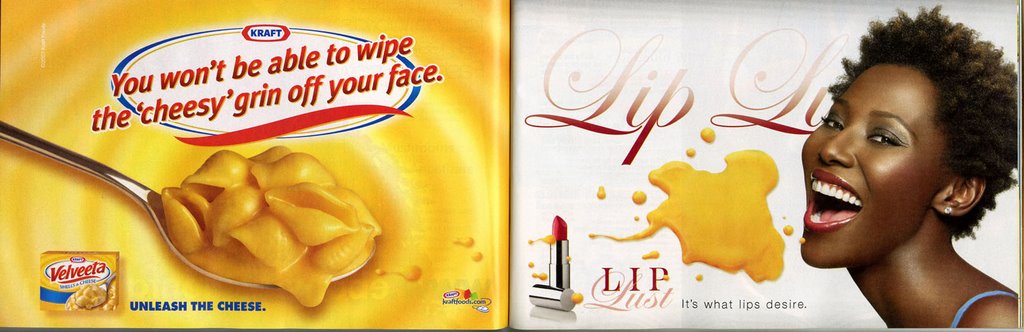
• The New York Daily News reported that Foxy Brown has more legal problems — this time with the state’s DMV. Seems the rapper has racked up 16 traffic violations in less than three years, owing $4,780 in fines and surcharges. “She has to answer all these different summonses before she’s allowed to drive,” said a DMV spokesman. Until then, Foxy will play Run DMV.

Essay 1833


Coca-Cola concocts a quiz to identify the culturally clueless. Wonder how many Madison Avenue executives could pass this test.

Essay 1832

Sunday, March 11, 2007

Essay 1831


Delayed reactions in a MultiCultClassics Monologue…

• In last week’s episode of The Apprentice, Donald Trump immediately fired a contestant for referring to himself as White Trash. Yet Trump also sent the winning team to record a rap track with Snoop Dogg, who has been known to occasionally utter a controversial phrase.

• Major League Baseball will present the inaugural Civil Rights Game on March 31 (see Essay 1830). The competition will include the Cleveland Indians, one of the few professional teams still incorporating a politically incorrect mascot.

Essay 1830


From MLB.com…

-----------------------------

First Civil Rights Game set for March 31

By Barry M. Bloom / MLB.com

LAKE BUENA VISTA, Fla. -- Major League Baseball will stage its inaugural “Civil Rights Game” this coming March 31, when the defending World Series champion St. Louis Cardinals play the Cleveland Indians in an exhibition game at AutoZone Park in Memphis, the home of the National Civil Rights Museum and the city where Rev. Martin Luther King Jr. was assassinated on April 4, 1968.

The 5:30 p.m. ET game, expected to annually precede the opening of the regular season, will be broadcast live on ESPN, and is planned to culminate a day during which baseball will celebrate the nation’s civil rights movement.

“I’m nervous up here because this project is very near and dear to me,” Jimmie Lee Solomon, MLB’s vice president of baseball operations, said during a press conference on Monday to announce the event. “The idea of doing it in Memphis has always been important because it was the place where Dr. King was assassinated and everyone thought that was the figurative end to the dream. I’m very proud, about the proudest I’ve been during my time at MLB.”

Baseball has long been considered to have foreshadowed the civil rights movement. The sport was integrated on April 15, 1947, when Jackie Robinson played his first game for the Brooklyn Dodgers. That act came nearly a decade before U.S. public schools were integrated and African-Americans were allowed to sit in the fronts of buses in the South or were admitted into what were then all-white universities.

“This game is designed to commemorate the civil rights movement, one of the most critical and important eras of our social history,” MLB Commissioner Bud Selig said in a statement. “I am proud of the role that Major League Baseball played in the movement, beginning with Jackie Robinson’s entry into the big leagues on April 15, 1947, and very pleased that we have this opportunity to honor the Movement and those who made it happen.”

Baseball didn’t become fully integrated until 1959, when the Red Sox, the lone team to hold out, signed Pumpsie Green.

[Click on the essay title above to read the full story.]

Essay 1829


Springing ahead with a MultiCultClassics Monologue…

• Naomi Campbell spent five hours in an anger-management class, part of her court-mandated sentence for hurling a cell phone at a maid. “I do honestly feel very sorry. I don’t know if people will believe that,” said Campbell during the class. “I mean I cannot believe I am sitting here. And, I have said it before, but this time I truly mean it. I feel sorry and I am really going to learn from my mistakes.” And anyone who doesn’t believe her is gonna get an ass-whupping.

• Busta Rhymes was booted from the set of a movie he’s filming because the NYPD views him as a “public-safety threat.” The film’s director said, “This is tremendously unfair to Busta, who has been nothing but professional during this project.” Before this is all over, Busta will probably be joining Naomi Campbell in anger-management class.

Essay 1828


First things first: this ad is lame.

Essay 1827


From The Chicago Tribune…

-----------------------------------

Thomas colorblind in his own mind

By Clarence Page, a member of the Tribune’s editorial board

WASHINGTON -- The late U.S. Supreme Court Justice Potter Stewart famously declared that he could not define pornography but he knew it when he saw it. Justice Clarence Thomas does not define affirmative action in the same way that a lot of other people do, but he knows when he has not benefited from it.

He reveals that view and more in a rare and surprisingly expansive interview with Business Week senior writer Diane Brady, posted on the magazine’s Web site.

Thomas has a reputation for saying little on the bench and even less to reporters. He granted this rare interview because Brady was writing an article about Thomas’ beloved college mentor, Rev. John E. Brooks, former president of College of the Holy Cross.

Brooks’ story is instructive. Back in 1968, when American cities were on fire with riots, assassinations and war demonstrations, Brooks was the prestigious Massachusetts college’s academic dean who set out to recruit African-Americans.

To him, that meant doing something more than placing a want ad in the newspapers that said, “We’re here.” He personally went out to inner-city Catholic schools (most public schools turned him away, he says) and offered scholarships. He even drove some promising kids to the Worcester, Mass., campus to check it out. One of them was Edward P. Jones, who more recently authored the Pulitzer Prize-winning novel “The Known World.” “The fact that he had driven down from Massachusetts [to Jones’ home in Washington, D.C.,] told me something in a very quiet way,” Jones told the magazine.


That year the number of blacks entering the school of 650 soared to 28 from an average of about two per class. Brooks promised opportunities and scholarships to the youngsters but no special breaks or programs to ease their transition. He pushed them not only to meet, but also to exceed the high academic standards of the school.

Brooks, born in 1923, wanted to open the college to women too but was blocked until after he became president of the Jesuit school in 1970. “Jesuits, he argued, were supposed to educate leaders, and it was clear to him the pool of potential leaders was widening fast,” Brady wrote.

Besides Thomas and Jones, that pioneer group also included Ted Wells, the National Law Journal’s 2006 lawyer of the year and, more recently, I. Lewis “Scooter” Libby’s attorney. Other alumni of that group include investment banker Stanley E. Grayson, a former New York City deputy mayor; and former pro football player Eddie J. Jenkins, who chairs the Massachusetts Alcoholic Beverages Control Commission.

Today, Thomas is a fierce opponent of affirmative action while Wells, a co-chair of the NAACP Legal Defense Fund Board of Directors, strongly defends it. Yet, like many of their classmates, both think the world of Brooks, and it is easy to see why. He did precisely what an ideal affirmative action plan is supposed to do. He was not satisfied with waiting for a diverse talent pool to come to him. He went out, found it and recruited it. Once they were enrolled, he kept an eye on them as he would with any other students, but by their own accounts left them largely to find their own way and succeed without special breaks.

Yet, when Brady asked him directly, Thomas was quick to deny that he benefited from affirmative action. “Oh, no,” he said. “I was going to go home to Savannah,” after he left a Missouri seminary, “when a nun suggested Holy Cross. That’s how I wound up there,” Thomas said.

“I was never recruited,” he said. “The others were recruited. … I just showed up, but somebody had to recognize it was a good place to be, and it was a Franciscan nun.”

Fine. As I have often said, what’s important in such matters is not how you got into college but how you leave. Affirmative action at its best opens doors, but it does not guarantee results. For that, you’re on your own.

What concerns me more is Thomas’ own enlistment policies. When he and Justice Anthony Kennedy testified in the high court’s budget hearing last Thursday before a subcommittee of the House Appropriations Committee, Rep. Jose Serrano, a Democrat from New York, asked about the diversity of their clerks. Thomas expressed an odd sort of pride in his clerks’ uniformity. “Mine happen to be all white males,” he said of his current clerks. “I don’t have quotas.”

In other words, the sort of program Brooks followed to increase non-white enrollment at Holy Cross is precisely what Thomas has no intention to do with the Supreme Court’s highly competitive clerk positions. I respect Thomas’ view, but I prefer Brooks’ idea.

Essay 1826


Here’s our distinctive viewpoint: this ad is weak.

Essay 1825


From The Los Angeles Times…

----------------------------------

A Minuteman meets his hour of crisis

Minuteman Project co-founder Jim Gilchrist is battling three of his board members in court for control of the organization.

By Jennifer Delson, Times Staff Writer

Minuteman Project co-founder Jim Gilchrist was confronted by three associates who had been his closest allies when he arrived at his group’s headquarters in Lake Forest in late January.

“Jim,” said Marvin Stewart, “the board has terminated you as president.”

Gilchrist recalled that it felt like his heart sank to his stomach, prompting him to instinctively yell, “You’re all fired.”

“No, Jim, you are fired,” Stewart said.

Gilchrist, who rose to fame in 2005 as the leader of the citizen group that began patrolling the U.S.-Mexico border for illegal immigrants, soon discovered that the trio had gained control of the Minuteman bank accounts and website. In a recent news conference outside Orange County Superior Court, the three board members said the takeover was triggered by Gilchrist's mismanagement and by missing money, though they provided no evidence of misappropriated funds.

Gilchrist, who denies the allegations, has filed suit in Orange County Superior Court to regain control of the Minuteman Project, claiming that he was illegally ousted from a corporation he formed and was the sole voting board member.

“These are people I would have trusted my life with and they were conspiring against me behind my back,” Gilchrist said. “They are kidnapping my child.”

The story behind the vote to dismiss America’s most famous anti-illegal immigrant fighter contains allegations of hubris and missing money, jealousy and greed, backstabbing and extremism.

It may also be the almost inevitable result of a rapidly growing organization whose membership is swollen with passionate individualists not known for getting along with others.

“They are taking the law into their own hands and doing it in a dramatic way,” said Luis Cabrera, a political science professor at Arizona State University. “It’s tailor-made for attracting people who want attention and a thrill and want to execute their agenda.”

Though others had proposed similar ideas, Jim Gilchrist’s battle cry for citizens to guard the border — amplified in appearances on conservative talk radio shows — launched 200 Minuteman groups, garnered intense media coverage and set off a national debate on immigration.

Gilchrist’s first sortie to the Arizona-Mexico border in April 2005 attracted 200 volunteers, who used cars, trucks, private planes, radios and night-vision goggles to spot illegal immigrants for U.S. Border Patrol agents.

The event drew heavy criticism, including some from then-Mexican President Vicente Fox and President Bush, who called the participants vigilantes. But it also made Gilchrist an overnight leader in the fight against illegal immigration.

Although many of his supporters were leery of the media, which they perceived to be left-leaning and biased, Gilchrist, a one-time journalism major at the University of Rhode Island, welcomed the questions and cameras.

The 58-year-old made a striking appearance with his green eyes and well-coiffed silver hair. At outdoor events, he was partial to windbreakers, polo shirts and baseball caps with military logos or anti-illegal immigration slogans. On television, he wore blue suits with crisp shirts and colorful, but tasteful, ties.

Gilchrist “is the real reason the Minuteman Project took off … that is what inspired me,” said Eileen Garcia, a Laguna Beach resident who helped form a women’s Minuteman auxiliary called Gilchrist Angels.

Steve Eichler, former executive director of the Minuteman Project, said that Gilchrist “started with a lawn chair at the border and embarrassed the White House. Millions of people have been affected by him and the Minutemen. Jim Gilchrist is a rock star.”

The rapid growth of the Minuteman Project created friction with veteran anti-illegal immigration activists such as Chris Simcox, who had patrolled the Arizona-Mexico border for years in near anonymity. Their relationship initially cordial, he and Gilchrist formed the Minuteman Project, but Simcox left after a month and now runs a splinter group, the Minuteman Civil Defense Corps.

“I think he was jealous and it was clear he wanted my segment of the Minuteman campaign to fail,” Gilchrist said.

Simcox declined to comment for this article.

Saturday, March 10, 2007

Essay 1824


Wonder what the creative team behind this Philip Morris ad was smoking.

Essay 1823


Weekend Whassupdate with a MultiCultClassics Monologue…

• Walt Disney Co. announced its next animated musical fairy tale will star the studio’s first Black princess. “The Frog Princess” will have a New Orleans setting and its heroine will be named Maddy. Randy Newman is slated to score the film. Guess Disney isn’t ready to consider the obvious notion of tapping a Black music artist for the project.

• Earlier this week, the New Jersey town of Bloomfield denied a permit to the creators of HBO’s Sopranos, who wanted to film in the area. Bloomfield’s mayor and council originally said they were concerned that the popular mob series portrayed Italian Americans in a disparaging style. As it turns out, the officials did not have authority to block the filming request, and the town clerk has granted permission. Don’t mess with Tony Soprano.

• Coca-Cola Company CEO E. Neville Isdell received $32.3 million in salary, stock options and performance-based awards last year, as the soft drink leader posted a 20 percent jump in sales. The Coke Side of Life is more like Lifestyles of the Rich and Famous.

• Chrysler announced a recall of over 489,000 vehicles — the second such action by the automaker in two weeks. Dr. Z is starting to look like Dr. Kervorkian.

Friday, March 09, 2007

Essay 1822


Somebody owes a few answers for this lame ad.

Essay 1821


Appreciations and apologies in a MultiCultClassics Monologue…

• Jacko’s back in Japan, feeling the love via lots of “fan appreciation” events. The King of Pop said, “While some have made deliberate attempts to hurt me, I take it in stride because I have a loving family, a strong faith and wonderful friends and fans who … continue to support me.” But mostly in Japan.

• Black legislators in Georgia are proposing that the state officially apologize for slavery and segregation-era laws. “It is time for Georgia, as one of the major stake-holders in slavery, as one of the major players in lynchings, to say it’s sorry,” said one leading Democrat. “If the capital of the Confederate states can lead the way in issuing an apology, then surely all of the other states that maintained slavery can consider doing the same.” Hey, an apology in lieu of 40 acres and a mule or reparations seems like a fair swap.

Essay 1820

Essay 1819


This ad — like a Pepsi that has lost its fizz — is flat.

Essay 1818


From The Chicago Tribune…

--------------------------------

Refocus on immigration

By Juan Rangel

Last year, I joined hundreds of thousands of Hispanic immigrants who marched in cities across the country under the generic banner of “immigration reform.” However, their faces told a more profound story: America’s newest immigrants also yearn for America’s promise.

Unfortunately, today’s immigration debate has been led--or better, misled--by extremists on both sides of the political spectrum. Immigrants are depicted as vulnerable victims who suffer from American greed and abuse, or as foreign opportunists who demand and take America’s generosity and benefits, but refuse to commit to her future.

Both sides have it wrong.

Immigrants, legal or not, seek a shot at economic prosperity--they always have. And today’s illegal immigrants, mostly Mexican, are no different.

They replenish America’s workforce with an unparalleled work ethic. They follow job opportunity to every corner of the United States, whether it’s Chicago’s factories, Nebraska’s farmland, Los Angeles’ restaurants, New York’s hotels or even New Orleans’ rebuilding effort. No job is ever considered too low—it’s the next step up.

They breathe life into our economy with entrepreneurial vigor, building thriving businesses in every community they live in. As consumers, their brand loyalty and growing purchasing power have big business catering to their every want and need.

They rejuvenate aging neighborhoods by purchasing homes at a record pace. They repopulate great American cities that have lost families to suburbia. They celebrate traditional family and religious values and are optimistic about their economic future.

Like their European predecessors, their optimism leads them to embrace assimilation.

In myriad ways, they live and bolster the classic American dream: get better jobs, buy bigger homes, drive the newest sport-utility vehicles and watch satellite TV. What a country! What a people!

Yet, if their faces told this story at those massive marches last year, their hopeful voices have been drowned out by the angry rhetoric from leftist activists who have taken up the immigrant cause.

Worse, the left has taken a topic that most Americans, including a Republican president, can build consensus on and have turned it into a wedge issue that divides even the most centrist of middle America.

What has emerged are the demands for rights, charges of American discrimination and the ever-vague “fight for justice.” The inspiring story of immigrant aspirations has morphed into the usual chant for entitlements and social services.

The left seized the moment with nationalist displays of Mexican flag waving, protesting teenagers staging school walkouts and foreign music stars bastardizing our national anthem in Spanish. Could the claim of “reconquering our stolen land for Aztlan” be far behind?

White liberals, who thrive on minority “struggles,” create symbolic victims who seek sanctuary, while the newest “poverty pimps” demand government/philanthropic funds for a newfound constituency.

Not to be outdone, the extreme Republican right, which in essence has been organized and motivated by the left, espouses its equally hollow rhetoric, seducing the pragmatic center into this melee.

The “minutemen,” a small inconsequential volunteer border group, demands the erection of a useless wall along our southern border to stop this “invasion.” Local officials have turned their police into quasi-immigration agents. Others contemplate denying education services to undocumented children. Fearing a Spanish version of French Canada, English-only laws are being proposed across the U.S. Alarmists demand the immediate deportation of the “12 million criminals,” disregarding its impact to our economy, or more simply, its logistical impracticality.

And of course, politicians, who never miss an opportunity to pander, respond in typical knee-jerk fashion to each side.

Extremists have succeeded at creating a vigorously do-nothing environment, which serves them just fine. In fact, their survival and relevance depends on it.

Again, they are both wrong!

To be sure, immigration reform is not easy to address. The undocumented or illegals, whichever term you prefer, bring new opportunities as well as additional burdens to our nation. Rather than allow fringe groups to distort the debate, we need an earnest discussion on how best to continue integrating immigrants into America’s future.

It’s time for a pragmatic and centrist leadership to recognize the contribution of the undocumented by creating a legal process that regulates their status and satisfies our nation's economic self-interest. To focus on anything else diminishes immigrant success, past and present, and threatens our potential, as well as our legacy, as a nation.

[Juan Rangel is the chief executive officer of the Chicago-based United Neighborhood Organization.]

Thursday, March 08, 2007

Essay 1817


Zzzzzzzzzzzzzzzzzzzzzz.

Essay 1816


From USA Today…

---------------------------------------------------

Racial tensions are simmering in Hawaii’s melting pot

By Martin Kasindorf, USA TODAY

HONOLULU — A violent road-rage altercation between Native Hawaiians and a white couple near Pearl Harbor two weeks ago is provoking questions about whether Hawaii’s harmonious “aloha” spirit is real or just a greeting for tourists.

The Feb. 19 attack, in which a Hawaiian father and son were arrested and charged with beating a soldier and his wife unconscious, was unusual here for its brutality. It sparked a public debate over race relations that is filling blogs and newspaper websites with impassioned comments along stark ethnic lines.

These divisive exchanges come as the U.S. Supreme Court and Congress are being asked to tackle another inflammatory racial issue in a state where no race is a majority: special benefits for Native Hawaiians, ranging from preference at an elite private school to free houses on government land. One side says the long-established perks compensate Hawaiians for past wrongs and preserve their valuable culture for the islands. The other side says the benefits discriminate against other racial groups.

The current controversies are exposing racial tensions below the surface of a tropical paradise that Gov. Linda Lingle says is “a model for the world” in diversity and peaceful integration. Simmering divisions pit Hawaiians against other groups, and “locals” of all races against newcomers including immigrants and military members.

At issue now is whether Hawaii will acknowledge and overcome these threats to its friendly reputation.

[Click on essay title above to read the full story.]

Essay 1815


Pills and pep talks in a MultiCultClassics Monologue…

• The EEOC has accused Walgreens of systematically discriminating against Black employees, spurred by gripes from managers and pharmacists in Florida. “It’s a systemic pattern or practice of discrimination in promotion and assignments for their management employees,” said one EEOC official. Another official added, “Essentially, Walgreens has made store assignments based on race. This policy has served to restrict the opportunities for advancement of African-American employees at Walgreens stores nationwide.” The drugstore chain’s slogan reads, “The Pharmacy America Trusts.” Not sure that will continue to include all Americans.

• Here’s an interesting story from the Associated Press:

School pep talks divide students by race

CONCORD, Calif. — A high school divided students by ethnicity for separate pep talks on boosting test scores, featuring jazz music for black students and flags of Asian students’ foreign homelands.

Mount Diablo High School in Concord also held separate assemblies Friday for white and Hispanic students, stirring accusations of segregation from some students’ parents.

“In this country, everybody is supposed to be treated equally. It sounds like racism to me,” said Filipino parent Claddy Dennis, mother of freshman Schenlly Dennis.

Principal Bev Hansen said she held the divided student assemblies this year and last year to avoid one ethnic group harassing another based on test scores, arguing that the state has long reported test results based on race.

“In this country, race is a very uncomfortable topic, and it’s time we got over it,” Hansen said.

The principal of a San Ramon high school apologized last year after holding pre-test pep talks for black and Hispanic students but not white students.

Essay 1814

Essay 1813


There’s something creepy about this image — in a Frankenstein kinda way.

Wednesday, March 07, 2007

Essay 1812


Adage.com presents video clips from last week’s 4A’s Media Conference in Las Vegas. Highlights include commentary from Group M North America CEO Marc Goldstein, E. Morris Communications founder Eugene Morris, Tapestry CEO Monica Gatsby and TV One CEO Johnathan Rodgers. Click on the essay title above to view the videos.

Essay 1811


Making a killing with a MultiCultClassics Monologue…

• Comic book icon Captain America is dead. In a special issue hitting the stands today, a sniper kills Cap as he’s leaving a courthouse. Talk about anti-American sentiments.

• As America continues to struggle with obesity problems, Mickey D’s is introducing a larger, higher-end burger in test markets. The new Angus Third Pounder is the biggest burger on the menu. Isn’t this the equivalent of Big Tobacco launching a larger cigarette with more tar and nicotine?

• Three high school girls in New York were suspended for saying the word “vagina” — during a reading from The Vagina Monologues. Some parents protested the suspension as “a blatant attempt at censorship.” But the school principal insisted the girls were reprimanded because they disobeyed orders versus using the word. What a hard-assed dick.

• A radio station fronted the loot to get Bobby Brown out of jail (see Essay 1776), but the deal fell apart once the star was released. Washington’s Hot 99.5 FM paid nearly $20,000, thinking the gesture would land the station an exclusive interview. But Brown immediately backed out of the deal on the air. “We thought we clearly communicated to Bobby our intentions, but once we had him on the air this morning it was clear that we were not on the same page,” said a station personality. Brown’s lawyer said the artist will repay the station. Probably after he pays all his other delinquent bills.

Essay 1810

Essay 1809


At Deloitte, all Blacks are expected to be proficient jazz musicians.

Essay 1808


From The Chicago Tribune…

-------------------------------

A dream dies at the NAACP
Gordon’s departure puts focus squarely on ideological schism

BALTIMORE -- Bruce Gordon’s abrupt departure from the National Association for the Advancement of Colored People, after only 19 months as its president, marks the end of a marriage between old-time movement idealism and new-wave corporate problem solving. The marriage now appears to have been doomed from the start.

The former Verizon executive came into office amid grand hopes that he would modernize the nation’s oldest and largest civil rights organization.

The 98-year-old organization’s civil rights mission has been diminished by the hard-won success of the civil rights movement. Gordon had the audacity to hope for an expanded NAACP mission. He set out with a corporate CEO’s sense of urgency to target, for example, the continuing crises of undereducated black males.

Gordon understood something that NAACP Chairman Julian Bond and numerous others in the organization’s breathtakingly huge 64-member board refuse to face: White racism is not the biggest problem holding back the advancement of people of color.

Yes, overall black poverty is down to about 24 percent today from well over 60 percent in the mid-1960s. But since the mid-1990s, recent studies show young, undereducated black males are worse off by every statistical measure of unemployment, drug abuse, disease and imprisonment.

If we Americans--all Americans--focused our energies on wiping out the black-white test score gap, employment equality would follow. Close the race gaps in joblessness, income and family stability and the final victories of the equal rights revolution would be within reach.

“We are going to be very outcome-oriented, very results-oriented,” Gordon said last July, “as opposed to activity- and effort-oriented.”

Unfortunately, activity and effort--and endless talking about activity and effort--were just fine with the organization’s old guard. They mischaracterized Gordon’s vision, not as an expansion but as a shift of mission away from civil rights.

“There are many organizations that provide social services,” Bond told The New York Times, in response to Gordon’s resignation. “We say, ‘good for them.’ But we are one of the very few that provide social justice. It is popular to say that we are in a post-civil rights period, but we don’t believe that.”

Actually, Gordon was calling for a better balance of the organization’s two important roles of advocacy and service. He’s right. Unfortunately, his vision, nurtured in the greenhouse of corporate life, clashed with that of the old-time movement folks.

In the business world, you have to adapt to changing market conditions or you lose market share and die. The civil rights movement world is different. You can hang on indefinitely to a 1960s paradigm of problems (racism) and solutions (marches, boycotts and lawsuits), despite changes in both, even as old problems persist and take on a new urgency.

“It is almost analgesic to talk about what the white man is doing against us,” Bill Cosby told the annual convention of the Rev. Jesse Jackson’s Rainbow/PUSH Coalition in 2004. “It keeps you frozen in your hole you are sitting in.”

Cosby gave a grouchy but perceptive voice to a widespread sentiment in black America. Although in the eyes of offended civil rights traditionalists he had stopped preaching and gone to meddling, Cosby expressed a growing sense that the old-style civil rights strategies are ceasing to be relevant.

That’s why, with its 100th anniversary approaching in 2009, the NAACP boasts 500,000 members, but its conventions look like a mostly black version of the AARP. Its original agenda was largely won in the 1960s with passage of the Civil Rights Act, the Voting Rights Act, the Fair Housing Act and the rise of a new black middle and political class.

Still, there remains a shamefully high percentage of black children who don’t have access to a decent education. It is even more shameful that so much of this deterioration of opportunity has occurred under the watch of local governments largely dominated by black politicians. Fortunately, many of the NAACP’s 2,000 affiliates have taken that new civil rights battle to local communities, even while the national organization’s leaders battle internally for its soul and its future.

The NAACP will continue to have work to do in fighting for equal rights. But in the great battle to help those that the civil rights revolution left behind, civil rights is just one skirmish in the larger war.

Essay 1807


Tuesday, March 06, 2007

Essay 1806


Excerpts from Adweek’s report on last week’s 4As Media Conference in Las Vegas…

--------------------------------------

While [Group M North America CEO Marc] Goldstein urged media companies to get more involved with content creation, his most pointed remarks took aim at the industry itself for not doing enough to foster ethnic diversity within the industry. “Suffice it to say, our industry’s track record in attracting young, multicultural professionals to join our ranks has been lacking and it’s time we fix the problem,” he said.

The lack of diversity not just among executives but the public’s viewing options, and how that is negatively affecting advertisers, was raised during a panel discussion led by Eugene Morris of E. Morris Communications. “There is a vast untapped audience not being served,” he said, noting that African-Americans watched more TV than average viewers but had fewer channels targeting them, leading media execs to believe that black audiences want nothing more than hip-hop programming.

Jonathan Rodgers of TV One backed up that sentiment. “The content and value in the ads [on black television] are right on, but the shows on which they are placed” are missing the mark, he said.

The diversity issue was a hot topic among attendees, many of whom were pleased that Goldstein and the topic-specific panel addressed the issue head-on. Renetta McCann, CEO of Publicis Groupe’s Starcom MediaVest Group, said acknowledging diversity is inseparable when agencies and marketers consider the best ways to engage consumers on individual levels.

Essay 1805


Stack it up. Throw it down. Shit it out.

Essay 1804


Bad Girls in a MultiCultClassics Monologue…

• Naomi Campbell threw a cell phone at her maid, and now she’ll be working as one. A judge ordered the supermodel to mop floors and sweep hallways as her community service punishment. Wonder if she’ll show up wearing a French maid outfit.

• American Idol is being targeted with charges of racism again. This time, it involves contestants with racy photos. In the show’s second season, Frenchie Davis was booted after topless photos of her appeared on the Internet. But this season, Antonella Barba displayed similar online pics, and she has yet to be eliminated. Davis is Black and Barba is not. Civil rights activists are protesting, demanding that the show allow Davis to return. Somebody needs to produce a spin-off — American Idols Gone Wild.

Essay 1803


From The Chicago Tribune…

----------------------------------

Reality of slavery’s past still present

By Leonard Pitts, a syndicated columnist based in Washington

Somewhere, the gods of irony are laughing.

Can you blame them? Last month came news that Ancestry.com, a genealogical Web site, had documented a startling link between two very unalike men. It turns out an ancestor of the late South Carolina Sen. Strom Thurmond once owned an ancestor of the Rev. Al Sharpton. Two icons of 20th Century racial politics--the one a strident foe of integration, the other regarded by some as a bogeyman of racial activism--linked by ownership.

Somewhere, the gods are amused.

Sharpton is not. He has pronounced himself torn by conflicting emotion: humiliation, anger, pride and, above all, shock.

The reaction from Thurmond’s family, meanwhile, has been characterized by that curious shrug of shoulders, that ambivalence and eagerness to change the subject one often finds in white people when slavery gets personal.

“I don’t feel one way or the other,” Thurmond’s 74-year-old niece, Doris Strom Costner, told The Washington Post.

“I have no comment,” Paul Thurmond, the senator’s youngest son, told the New York Daily News.

And then there’s Essie Mae Washington-Williams, product of a liaison Thurmond had with a 16-year-old black maid when he was in his 20s. She says Sharpton is guilty of “overreaction” about her father. “In spite of being a segregationist, he did many wonderful things for black people,” she said.

Too bad those wonderful things did not include renouncing his hateful views or publicly acknowledging his black daughter.

William Faulkner was right: “The past is not dead. It’s not even past.”

It’s a truth from which many of us instinctively recoil where slavery is concerned. We reject anything that threatens to bring us in too close or make too plain the connections between then and now, that and this.

A man asked me just the other day how much longer I intend to make “excuses” for the problems of black kids. Racial oppression is in the past, he said. We’ve been pumping money into “minority programs” for more than 40 years, he said. Where’s the progress, he said.

And I’m thinking to myself, Lord, give me strength.

Surely I have not been derelict in pointing out the failures of and the need for the black community to be active and proactive in its own salvation. But if it’s true that black folk have work to do, it’s also true that the need for that work did not spring from nowhere but, rather, from a 350-year epoch of physical and--this is important--emotional brutalization. And some of us are impatient that 40 years of mostly half-hearted attempts at a remedy have not made things hunky dory? Oh, please.

Of course, by this point maybe he has stopped listening. Maybe you have too. Mention of that 350 years tends to have that effect.

Hence the ambivalence—“nervous chuckles,” reported the Orlando Sentinel of a visit to Thurmond’s hometown--that greeted last week’s news in some quarters. Small wonder. It removed the shield of abstract. It put a face on the thing. And the danger is that if we can imagine that face, we can imagine others.

Condoleezza Rice purchased as breeding stock.

Oprah Winfrey raped on a nightly basis.

Will Smith, his back split open by a whip.

Sen. Barack Obama (D-Ill.) living with the same rights under the law, the same expectation of dignity, as a horse or a chair.

We spend a lot of time running from this. But we never escape. That’s the lesson of Sharpton’s experience, the reason for nervous chuckles and ambivalent shrugs. It’s an unwelcome reminder that some stains don’t wash out, some dead things do not rest.

And we live in the presence of the past.

Essay 1802


News bites in a MultiCultClassics Monologue…

• New research published in the Archives of Pediatrics & Adolescent Medicine indicates obesity surgery for children has tripled in recent years. Wonder if there’s any connection to fast feeders’ increase in sales of triple cheeseburgers.

• NBA star Shaquille O’Neal is producing a reality TV show designed to help overweight kids. His advice will probably include, “You shouldn’t weigh 325 pounds if you’re not at least 7-foot-one.”

Essay 1801

Essay 1800


Abercrombie & Fitch believes in diversity — provided you look like an exotic supermodel.

Monday, March 05, 2007

Essay 1799


From The New York Times…

---------------------------------

President Is Leaving N.A.A.C.P.

By RAYMOND HERNANDEZ

WASHINGTON — The president of the National Association for the Advancement of Colored People said on Sunday that he was stepping down after only 19 months on the job, signaling divisions within the organization, the nation’s oldest and largest civil rights group.

The president, Bruce S. Gordon, 61, a former Verizon executive who was relatively unknown in the civil rights community when he was tapped to run the N.A.A.C.P., said he resigned because of differences with the board over his role and the direction of the organization.

“In order for any organization to be effective, there has to be a tight alignment between the C.E.O. and the board,” Mr. Gordon said. “That alignment in this case does not exist.”

In interviews, black leaders close to the organization said the reasons behind his departure stemmed from a dispute over its future role in a nation where the battlefront for civil rights has shifted.

“We want it to be a social justice organization; he wanted it to be more of a social service organization,” said Julian Bond, the chairman of the N.A.A.C.P. board. “Our mission is to fight racial discrimination and provide social justice. Social service organizations deal with the effects of racial discrimination. We deal with the beast itself.

“There are many organizations that provide social services,” Mr. Bond continued. “We say, ‘Good for them.’ But we are one of the very few that provide social justice. It is popular to say that we are in a post-civil rights period, but we don’t believe that.”

Mr. Gordon said he did not believe that the organization should abandon its civil rights mission but rather that it should expand its role to include providing social services. “This is not an either/or,” he said. “There needs to be the right balance between advocacy and service.”

“It would be insane to give up on advocacy,” he continued. “I just think we can do more than that, and should.”

[Click on the essay title above to read the full story.]

Essay 1798

Essay 1797


Not sure where this classic character falls in the caballeros cavalcade. Probably between the Cisco Kid and the Frito Bandito.

Essay 1796


From the Advertising Age report on last week’s AAAA Media Conference and Trade Show in Las Vegas…

YET ANOTHER AWKWARD MOMENT IN MADISON AVE’s DIVERSITY QUAGMIRE: A panel on diversity followed [Procter & Gamble honcho Jim] Stengel’s presentation, and a large chunk of the audience registered its interest by streaming out of the room. “How do you expect to change diversity practices when half the audience leaves?” asked one who remained.

(The panel was titled, “The Business Case for Diversity in Media.” Eugene Morris of E. Morris Communications, Inc. was the scheduled moderator; panelists included Linda Jefferson of Burrell, Johnathan Rodgers of TV One and Lisa Torres of MPG.)

Sunday, March 04, 2007

Essay 1795


Walking the walk with a MultiCultClassics Monologue…

• Presidential contenders Hillary Clinton and Barack Obama will be wooing Black voters when they salute the 1965 Selma voting rights march on Sunday. Senator Clinton is slated to bring former President Bill Clinton. “There is no white politician in America who is more popular in the African-American community than Bill Clinton,” said a Democratic strategist. “So she has a very strong card to play.” Hillary’s playing the political race card.

• Foxy Brown has been marching out of a trendy New York restaurant without paying her bills, leading management to ban her from the establishment. The owner at Junior’s Restaurant on Flatbush Avenue decided to bar the rapper for two reasons: “One, she tries to skip out on checks and, two, she’s not polite.” Another manager said, “I don’t know, I think she needs therapy. … She’s been coming in for years, and it’s always a little drama.” Think she needs therapy? Um, a judge ordered her to undergo treatment.

• Speaking of therapy candidates, Ann Coulter sparked controversy at the annual Conservative Political Action Conference by saying, “I was going to have a few comments on the other Democratic presidential candidate John Edwards, but it turns out you have to go into rehab if you use the word ‘faggot,’ so I — so kind of an impasse, can’t really talk about Edwards.” Democrats condemned the political commentator, who insisted the line was just a joke. She must have hired Grey’s Anatomy star Isaiah Washington as her comedy writer.

Essay 1794


Wonder if the creators of this classic ad would now feel red-faced…

Saturday, March 03, 2007

Essay 1793


This ad blows.

Essay 1792


Losers, winners and competitors in a MultiCultClassics Monologue…

• Hundreds of folks flocked to the original Wendy’s restaurant for a final visit before it was closed for good on Friday. Even Wendy Thomas, the daughter of founder Dave Thomas and inspiration for the chain’s name and logo, made an appearance to greet people and sign autographs. “You can’t tell me that Wendy’s doesn’t make enough profit that they can continue to keep this open,” said one unhappy customer. “If Dave Thomas knew he would roll over in his grave.” Hey, maybe the deceased Dave Thomas could do a commercial with the deceased Orville Redenbacher.

• The NAACP Image Awards saluted Oscar winners Forest Whitaker and Jennifer Hudson on Friday. “There is nothing like being recognized and honored by your own,” said Hudson. Whitaker commented, “Doing this role gave me so many blessings. … One was being able to go back to Africa and touch my roots.” Another winner was Grey’s Anatomy star Isaiah Washington. “The first time I was up here I felt deserving of something,” said Washington. “This time I feel privileged.” He was beaming with gay pride.

• A lawyer who worked for the firm founded by the late Johnnie L. Cochran Jr. has filed a lawsuit against the practice — accusing the place of racial discrimination. The lawyer, who is Black, charges that after Cochran’s death, the firm was led by White men who discriminated against Black lawyers and clients. The lawyer released a statement that read, “In deference to the memory of Johnnie Cochran and in deference to his family, I do not intend to engage in a public airing of our disagreements. The lawsuit speaks for itself, and this matter will be litigated in the courts.” Time will tell if the lawsuit fits.

Essay 1791


Is Allstate doing a tie-in with the Lexus December to Remember Sale?

Friday, March 02, 2007

Essay 1790


Rats and rap in a MultiCultClassics Monologue…

• As a result of the televised rats in a Greenwich Village KFC/Taco Bell (see Essay 1759), 13 more restaurants have been shut down. “We are embarrassed by the situation and stress that certain restaurants did not meet the very high standards that we set for ourselves,” said the president of ADF, the restaurants’ franchisee. “We apologize to our customers and are working around the clock to resolve this matter.” In the meantime, customers are encouraged to avoid The 4th Meal at Taco Bell.

• Wendy’s yanked nutrition posters with calorie details from its New York restaurants, hoping to avoid dealing with a city regulation requiring some food joints to display calorie information on menus and menu boards. “We fully support the intent of this regulation,” announced Wendy’s on its Website, “however, since most of our food is made to order, there isn’t enough room on our existing menu boards to comply with the regulation.” What a bunch of sleazy rats.

• Hillary Clinton is going hip-hop. Timbaland will host a fund-raiser for the presidential candidate in Miami this month. Looking forward to hearing Clinton drop some rhymes.

Essay 1789

Essay 1788


If Scott toilet paper is so soft it bends against bubbles, how will it react upon making contact with your ass?

Thursday, March 01, 2007

Essay 1787

From the latest issue of DiversityInc. You be the judge.


Essay 1786


Watching what we say in a MultiCultClassics Monologue…

• The New York City Council approved a resolution asking people to voluntarily stop using the N-word. “Using that word is a very dangerous and hateful thing to do,” said Council Speaker Christine Quinn. “It is a hateful word that we all need to stop using.” No rebuttal comments yet from Michael Richards or 50 Cent.

• A state senator from Miami wants to ban the term “illegal alien” from state documents. “To me an alien is somebody who is from another planet,” said the state senator. “There are so many other synonyms that would be more dignified for human beings. … All of us are immigrants except the American Indian. … Now how would we like it if they called us aliens?” Technically, most Blacks in America might not think of themselves as immigrants.

• Is “That’s so gay” a slang term or hate speech? A lawsuit in California seeks to answer the question. When a high school freshman used the phrase, she was sent to the principal’s office and reprimanded. Her parents filed a lawsuit, charging the kid’s First Amendment rights had been violated. The girl testified in court and insisted the phrase means, “That’s so stupid, that’s so silly, that’s so dumb.” The school argues they are protecting students. “The district has a statutory duty to protect gay students from harassment,” said the district’s lawyers. This is all so retarded.

• An editor from the weekly newspaper AsianWeek — the self-labeled Voice of Asian America — apologized for publishing a column titled “Why I Hate Blacks.” Following complaints from Asian American and city leaders, the editor called the decision to run the piece a “mistake” and “is sorry that this got published.” The editor insists the piece does not reflect the views of the newspaper. That’s so gay and retarded.

Essay 1785


From The New York Daily News…

--------------------------------

He tries to N-d it all in city

Pol has the vision, let everyone follow

By Stanley Crouch

Councilman Leroy Comrie, the sponsor of the resolution unanimously passed yesterday that calls upon New Yorkers to voluntarily stop using the N-word, seemed naive to those who thought there was no hope of inspiring a dialogue that would educate young people about the history of the word.

It has been used to dehumanize an entire ethnic group and make it that much easier to commit various forms of injustice against it. Those injustices include everything from labor exploitation to ritual murder, lynchings that symbolized the inferior position of the black person and the superior position of the white.

Part of the problem that Comrie hopes to address comes not just from knuckleheads and obnoxious or uninformed kids following the contemporary crude behavior of the streets. There has been a very great change in our culture at large and that change, as usual, is felt most strongly at the bottom. In the middle ‘60s, there was no definition of black authenticity that came from the bottom, an authenticity defined by how far it seemed to be from those who inhabited the white suburbs. In those days, a mush-mouthed, strutting fool was neither considered a role model nor was thought to be attractive to women.

There was no way for a man like 50 Cent, the symbol of the arena in which the N-word has entered prime time, to become stupendously popular.

By the end of the ‘60s, a commercial vision of black authenticity that called upon revolutionary black nationalism and insipid vulgarity was on its way to pushing aside everything that seemed to have its roots in the middle class. The pimp and the thug became heroes in blaxploitation films, where black people who could speak the English language were sneered at by gargoyle clowns in tasteless outfits.

The stage was set for the emergence of rap. It was rough, crude, narcissistic and sometimes given to political pretensions. It was mostly talk and little music but it was largely boasting and had some version of adolescent charm and moxie.

We all know how rap devolved into gangster rap and we have read over and over about all of the beefs. For many years, people bit their tongues about all of the ugly things that rose from the idiom, celebrating thug behavior, violence, hatred of women and a crude materialism that ravenously bows down before whatever led to wealth.

None of this would be possible without the support of the big corporations that are responsible for the dissemination of this dreck, but the corporations are not alone. They work in a partnership with these new minstrels who well know that without this business and the descent of public taste, they would not become wealthy men.

The most inspiring thing that has begun to emerge in the last few years is a body of thought that comes from the other end of the field. These people will not shut up because they fear being called middle class or being accused of hating themselves of wanting to be white. They are not impressed by arrest records of the rappers and are too sophisticated to believe that civilized behavior is somehow the exclusive province of white people.

Essence magazine led the charge under the leadership of Diane Weathers; the women of Spellman College rose up in rebellion; and young black college men started a group called bent on banning the N-word. Byron Hurt’s film “Hip Hop: Beyond Beats and Rhymes” exploded recently on PBS. I am now reading “Ghetto Nation,” a new weapon against this madness by Cora Daniels, a writer, wife and mother who was born and lives in Brooklyn. All of these people share one idea: They will neither sit still for denigration parading as vital art.

It may just be starting, but it will not stop. Too many people are tired of it, and we will see them begin to show up in larger and larger numbers. Leroy Comrie and the City Council have joined a meaningful struggle and will be remembered for it.

Essay 1784

Essay 1783


Break through the glass ceiling? Allstate needs to break through the corny clichés.