Showing posts with label jet. Show all posts

Thursday, July 07, 2016

13249: Fade To Blacks.

The New York Times reported on how Black-owned media is in a death spiral. Which runs parallel with the near-death state of Black-owned advertising agencies. Which coincides with the dearth of Blacks in the advertising and media fields.

Pillars of Black Media, Once Vibrant, Now Fighting for Survival

By Sydney Ember and Nicholas Fandos

For the black community in Chicago and elsewhere, Johnson Publishing Company represented a certain kind of hope.

The company’s magazines, most notably Ebony and Jet, gained prominence during the struggle for civil rights — Jet published graphic photos of the murdered black teenager Emmett Till that helped intensify the movement — and made it their mission to chronicle African-American life.

At a time when much of the media was ignoring black people, or showing them primarily in the context of poverty or crime, Ebony and Jet celebrated their success, featuring stars like Muhammad Ali and Aretha Franklin on their covers. When Barack Obama was elected president in 2008, the first print publication he granted an interview to was Ebony.

So when Johnson Publishing, which is based in Chicago, announced a little more than two weeks ago that it had sold Ebony and Jet to a private equity firm in Texas, there was a sense of loss.

“It was a very heartbreaking day,” said Melody Spann-Cooper, the chairwoman of Midway Broadcasting Corporation, which owns a Chicago radio station, WVON, aimed at a black audience. “Ebony gave to African-Americans what Life didn’t.”

Ms. Spann-Cooper’s reaction underscored a deeper concern: As racial issues have once again become a prominent topic in the national conversation, the influence of black-owned media companies on black culture is diminishing.

“Ebony used to be the only thing black folks had and read,” Ms. Spann-Cooper said. “As we became more integrated into society, we had other options.”

To that end, Time Inc. now owns the magazine Essence and Viacom owns Black Entertainment Television. The Oprah Winfrey Network, a partnership between Ms. Winfrey and Discovery Communications, has been around since 2011. The Undefeated, ESPN’s site covering the intersection of race and sports, debuted in May. The emergence of Black Twitter has also given African-Americans a powerful voice on social media.

Johnson Publishing stressed that the Clear View Group, the private equity firm that bought Jet and Ebony, was an African-American-led company and positioned the sale more as a partnership. “We are very, very committed to Ebony,” said Michael Gibson, the chairman of Clear View.

Traditional media companies have struggled for years to adapt to a digital world, but the pressure on black-owned media has been even more acute. Many are smaller and lack the financial resources to compete in an increasingly consolidated media landscape. Advertisers have turned away from black-oriented media, owners say, under the belief that they can now reach minorities in other ways.

Since well before the Civil War, publications and, more recently, radio and television stations owned and operated by African-Americans have provided an important counterweight to mass market media, simultaneously celebrating and shaping black culture — from politics and government to fashion and music.

Johnson Publishing was started in 1942 with a modest $500 loan, and eventually turned into a media empire big enough that in 1982, its founder, John H. Johnson, became the first black person to make Forbes magazine’s list of the 400 wealthiest Americans. When the radio station WVON ran a program in 2007 for Black History Month called the “28 Blacks Who Changed America,” Mr. Johnson, who died in 2005, was No. 7 on the list, behind luminaries like Martin Luther King Jr., Rosa Parks and Thurgood Marshall.

“If we don’t own our press, we don’t have a platform to speak,” said Leonard Burnett Jr., whose company, the Uptown Ventures Group, owns Uptown Magazine, a lifestyle publication aimed at affluent African-Americans.

Several owners also pointed to another benefit: Their companies hired more minorities. Ms. Spann-Cooper of the Midway Broadcasting Corporation said 90 percent of her employees were African-American. “When we are African-American-owned, the work force looks like us,” she said.

But as financial resources dwindle, black-owned media companies are struggling to maintain their presence. Jet, for instance, became a web-only publication in 2014.

“It’s tougher and tougher for African-American companies,” said DesirĂ©e Rogers, the chief executive of Johnson Publishing, “to have the capital to compete in a landscape that’s increasingly crowded, increasingly changing.”

Mr. Burnett, who also owns Hype Hair, a magazine for African-American women, said his company was “marginally profitable.” But he said supporting his print business had been challenging largely because advertisers, particularly luxury brands, would rather connect with African-American consumers “by speaking broadly.”

“I think at times there’s a feeling that they do not want to directly speak to that audience because there’s a fear of bringing down their brand perception,” he said.

Earl G. Graves Jr., the president and chief executive of the business-focused magazine Black Enterprise, said his company was “not as strong as it was,” but preferred that it remain independent. Like many magazines, it has cut its publication schedule and focused more on its events business as a potential revenue source.

The picture is bleak in radio and television as well. In 2013, there were 166 black-owned radio stations and 68 black-owned radio companies, compared with 250 stations and 146 companies in 1995, according to the National Association of Black Owned Broadcasters.

Only 12 commercial television stations in the country are black-owned, and they tend to serve very small markets. The future of Howard University Television, the country’s only black-owned public television station, is also in question, as the university’s participation in Federal Communications Commission spectrum auction has raised the possibility that it could end up selling its place on the airwaves or stop broadcasting entirely.

“Black ownership is dying,” said Armstrong Williams, whose Howard Stirk Holdings owns seven of the black-owned commercial television stations. “Newspaper ownership, radio ownership — but it’s probably hit TV the hardest.”

In the late 1970s, the F.C.C. put into place a minority ownership policy that used credits and deferrals on capital gains taxes to help make minority businesses more competitive in the bidding process and promote the sale of existing stations to minorities.

The policy, while not without critics, was largely considered a success among advocates of minority ownership. But in 1995, after a Supreme Court ruling that established new standards for race-based government policies, the F.C.C. began to disassemble the program. A year later, Congress ended the tax-deferral policy that had helped drive sales to minorities. It also did away with most restrictions on the number of radio stations a single company could own.

The resulting wave of consolidation in the broadcast industry has made it more difficult for black entrepreneurs to enter the industry, said Alfred C. Liggins III, the president and chief executive of Radio One, which while publicly traded is the country’s largest black-controlled multimedia company.

“That means that the likelihood that minority owners are going to own a TV station in New York or Los Angeles gets lower and lower,” said Mr. Liggins, whose mother founded the company with a single radio station in 1980.

For Johnson Publishing, which also owns the Fashion Fair cosmetics line, pressures on the business proved too difficult to overcome. In the last several years, it sold its historic building on Michigan Avenue in Chicago, brought on JPMorgan Chase as a minority investor and reduced its staff.

“We did not feel that we had adequate capital and resources,” said Cheryl Mayberry McKissack, who was chief operating officer of Johnson Publishing and is now chief executive of Ebony Media Operations.

Yet as stories like Johnson Publishing’s have become more common across the industry, those who see their companies as following in its footsteps say the notion of black ownership continues to resonate.

Mr. Williams, who referred to Ebony as “a staple” of his upbringing, said that young African-Americans regularly expressed awe that he, a black man, really owned television stations.

“It does change the dynamic,” he said, “of what they believe they can become.”

Monday, June 20, 2016

13228: Johnson Publishing Quits Publishing.

From The Chicago Tribune…

Johnson Publishing sells Ebony, Jet magazines to Texas firm

Johnson Publishing sells magazines that have chronicled African-American life since 1945

By Robert Channick • Contact Reporter

After a 71-year run in Chicago, Johnson Publishing is getting out of publishing.

The company said Tuesday it has sold Ebony, its iconic African-American lifestyle magazine, and the now digital-only Jet magazine to Clear View Group, an Austin, Texas-based private equity firm, for an undisclosed amount.

Johnson Publishing will retain its Fashion Fair Cosmetics business and its historic Ebony photo archives, which remains up for sale. The deal, which closed in May, also included the assumption of debt.

A family-owned business throughout its history, Ebony has documented the African-American experience since it first hit newsstands in 1945. It has shaped culture ever since, coming into its own as it reported from the front lines of the civil rights movement during the 1960s in powerful photos and prose.

In recent years, though, Johnson Publishing has seen declining media revenues as it struggled to evolve from print to digital platforms.

Linda Johnson Rice, chairman of Johnson Publishing and daughter of founder John Johnson, will serve as chairman emeritus on the board of the new company.

“This is the next chapter in retaining the legacy that my father, John H. Johnson, built to ensure the celebration of African-Americans,” she said in a statement Tuesday.

The new publishing entity, Ebony Media Operations, will maintain the magazine’s Chicago headquarters and its New York editorial office, as well as much of the current staff, according to Michael Gibson, co-founder and chairman of African-American-owned Clear View Group.

It is the first investment in the publishing business for Clear View.

“We made this purchase because this is an iconic brand — it’s the most-recognized brand in the African-American community,” said Gibson, 59. “We just think this is a great opportunity for us.”

Cheryl McKissack, who has served as chief operating officer since 2013, will assume the role of CEO of the new publishing entity under Clear View, operating out of the magazine’s Chicago office. Kierna Mayo is stepping down as editor-in-chief of Ebony to pursue other opportunities, Gibson said.

Chicago-based Kyra Kyles, who has headed up digital content for Ebony and Jet since last June, will add the role of editor-in-chief of Ebony, Gibson said.

“When we make an investment, that’s what we look for — a strong team that can actually run the company,” Gibson said. “We’re not managers or experts by any stretch of imagination in the media business. What we bring to the table is very strong networking and the ability to raise financing and the ability to establish a vision for the company.”

Desiree Rogers, the former social secretary for President Barack Obama who has been steering Johnson Publishing since 2010, will remain CEO, focusing on the cosmetics business, which represents about half of the company’s total revenue.

“The overall strategy of separating these two distinct businesses — media and cosmetics — will ensure that both iconic brands are positioned for future investment and growth,” Rogers said in a statement.

Under Rogers, Johnson Publishing made a number of moves in an effort to shore up finances. Those included taking on a minority partner in 2011, and taking the money-losing weekly digest Jet out of print circulation in 2014.

In January 2015, Johnson Publishing put its entire photo archive up for sale, hoping to raise $40 million. The historic collection spans seven decades of African-American history, chronicling everyone from Martin Luther King Jr. to Sammy Davis Jr.

The collection is still for sale, Rogers said Tuesday.

While the publishing industry continues to face headwinds — year-over-year magazine revenue is down 9 percent through April, according to Standard Media Index — Gibson said Ebony will remain in print for the foreseeable future. At the same time, he recognizes the need to ramp up digital growth.

“There’s a lot of good reasons to keep the print,” Gibson said. “That will always be our anchor. We want to grow the digital platform more consistently with both Ebony and Jet.”

Gibson also sees opportunity in leveraging and expanding Ebony’s events business. But in the end, the greatest asset he acquired was the legacy of a brand, one which he hopes will be influential for years to come.

“It’s a dream come true,” Gibson said. “Growing up, we had Ebony and Jet in our household all along. You knew you made it when you made it to the cover of Ebony or Jet. It is just exciting — I pinch myself every morning.”

Tuesday, February 23, 2016

13092: BHM 2016—JET.

JET celebrates Black History Month with Soul Food Snatchers, calling out “culture co-opting” colored cuisine.
Wednesday, July 24, 2013

11297: JET Refuels.

From The New York Times…

Jet Magazine Stays Compact, but With a New Design

By Tanzina Vega

Jet magazine is getting a makeover.

On Friday, the magazine’s owner, Johnson Publishing, announced a complete redesign for Jet in print and online — the first in the 62 years of the publication, long a staple in the black community. The new look for Jet includes brighter colors against a white background, more informational graphics, larger photos and new fonts.

Almost a year and a half ago, its sister publication, Ebony, unveiled an online redesign of its own, which was preceded by a print redesign. Since then, traffic to Ebony.com has increased substantially to more than 600,000 visitors in July from less than 100,000 visitors a year ago, said Desiree Rogers, the chief executive of Johnson Publishing, who is hoping for a similar bounce at Jet.

“People really did feel that it was time for a little bit of a makeover here,” said DesirĂ©e Rogers, the chief executive of Johnson Publishing. “These brands have been around for almost 70 years. You’ve got to change with the times.”

As part of the redesign, the Web sites Ebony.com and Jetmag.com will each link to the other’s Web site.

The Ebony redesign may also have helped the magazine’s advertising. The number of ad pages increased 4.2 percent from the second quarter in 2012 to the second quarter in 2013. Revenue from advertising also increased to $13.6 million in the second quarter of 2013 from $11.7 million in that quarter a year ago.

Ad revenue for Jet magazine increased a slight 2 percent in the second quarter in 2013, to $2.7 million, up from $2.62 million a year earlier, while the number of ad pages dipped 7.8 percent in the same time period.

While the redesigned Jet will keep some of its franchises — including its “Beauty of the Week” feature — it will also include condensed sections that focus on celebrity, news, entertainment and lifestyle.

The changes will also be felt in the editorial content, with Jet writers doing more original reporting and less aggregation, said Mitzi Miller, the magazine’s editor in chief. “Magazines in general are trying to figure out how we stay relevant,” Ms. Miller said. “We have a clearly defined voice again so when people come here they say ‘O.K. this is a Jet position.’”

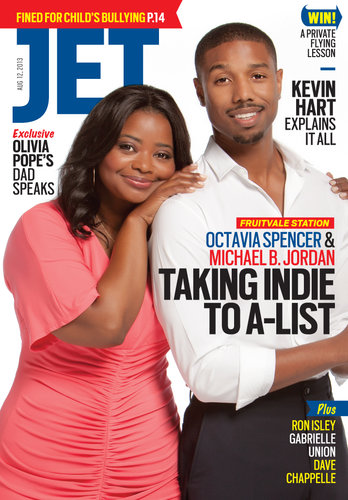
The Aug. 12 issue — which reflects the new design — has on the cover Octavia Spencer and Michael B. Jordan, the stars of the film “Fruitvale Station,” which is based on a 2009 incident when a black man was shot and killed by a police officer in an Oakland subway station. The film has gotten particular attention because its release coincided with the verdict in the trial of George Zimmerman in the shooting death of Trayvon Martin.

Ms. Miller said the magazine would also offer more service journalism for its readers. “It’s also about how can you get BeyoncĂ©'s look for less,” she said. “When you have her clothes, here are the top five detergents you need to get the stain out of that blouse.”

It will also offer short videos for users’ mobile phones. In the August issue, Ms. Miller added such a video to her editor’s letter.

One thing that won’t change, however, is the magazine’s unusual size — 5⅛ inches by 7⅜ inches. Ms. Rogers said the magazine enlisted the opinions of focus groups around the country for ideas on the makeover. “The one thing we kept hearing was, ‘Don’t change my size,'” she said.

Wednesday, July 10, 2013

11264: Newport News.

Advertising Age reported the launch of new Newport cigarettes will likely boost ad spending in magazines. The folks at Ebony and JET are alive with pleasure!

New Newport Smokes Likely to Give Publishers Spending Boost

Not Just E-Cigs: Ad Spending Behind Traditional Smokes Could Grow

By Michael Sebastian

Print publishers, get ready: There could be some substantial dollars coming your way as Lorillard Tobacco Co. prepares to launch two new cigarettes.

Magazines are already seeing a spending uptick from e-cigarette ads. But now ads for actual cigarettes could rise. For the first time since Congress granted it broad powers to regulate tobacco in 2009, the Food and Drug Administration has given a green light to two cigarette introductions. Lorillard’s Newport Non-Menthol Gold Box 100s and Newport Non-Menthol Gold Box will launch in the fourth quarter.

“We are proud to be the first company in the industry to receive authorization to begin marketing these new products in the U.S.,” said Murray Kessler, Lorillard’s chairman, president-CEO, in a statement.

It may not be the last to get the go-ahead. The move is seen as a signal that the FDA will begin ruling on roughly 4,000 requests from tobacco companies. The agency also rejected four applications, but said it cannot say why or who submitted them.

A spokesman said Lorillard will roll out the products with some marketing support, but wouldn’t elaborate. The nation’s third-largest tobacco company, Lorillard is already the industry’s second-biggest spender on print. The company spent $28.9 million promoting its Newport brand in print magazines last year, according to Kantar Media. Measured media accounts for only a portion of Big Tobacco’s marketing dollars; marketers have poured money into direct-mail campaigns, in-store promotions and product discounts.

The approval comes at an opportune time for Newport, which accounted for roughly 87% of Lorillard’s net sales in 2012. Newport Menthol is the top-selling menthol cigarette in the U.S., but the FDA is considering restrictions or a ban on menthol flavoring.

Thursday, August 19, 2010

7887: Dress Like A Millionaire.


From The Chicago Sun-Times…

Ebony auction nears
Affordable fashions to go days before big-name event

By Sandra Guy

A double-breasted faux leopard pony coat and a Claude Montana burgundy leather coat are among the fashions of Ebony Fashion Fair creator Eunice W. Johnson to be auctioned Sept. 16 by Chicago’s Leslie Hindman Auctioneers.

A tag sale of some of Johnson’s more affordable fashions will be held Sept. 11-15, along with an exhibition of her collection, at Leslie Hindman Auctioneers, 1338 W. Lake St.

The auction of the more expensive fashions—a total of 146 pieces—will be held at 5 p.m. Sept. 16 at the auction house.

Johnson, who died Jan. 3, came up with the name “Ebony” for the flagship magazine, and was known as an impeccably dressed Southern lady who spent millions each year in Paris and Milan on clothing for the Ebony Fashion Fairs. The fashion fair tours, which traveled 180 cities nationwide, were canceled in fall 2009, spring 2010 and for fall 2010, but the struggling Johnson Publishing Co. says it remains committed to the Fashion Fair brand.

The collection being auctioned includes dresses and evening gowns from Bill Blass, Bonwit Teller, Galanos, Gianni Versace, Halston, Oscar de la Renta, Carolina Herrera, and dresses, skirts and jackets by Thea Porter, Yves Saint Laurent, Zandra Rhodes and Jean Paul Gaultier.

Other items to be auctioned are jewelry, boots, shawls, scarves, belts, sunglasses and wardrobe trunks.

Tuesday, July 13, 2010

7781: Johnson Publishing President Edits Out.


From The Chicago Sun-Times…

Johnson Publishing president resigns
To join husband in family consulting biz

By Sandra Guy

The president and chief operating officer of Johnson Publishing Co., the Chicago-based company that publishes Ebony and JET magazines, has resigned.

Anne Sempowski Ward will be joining her husband, Kevin, in the couple’s business-consulting firm, according to a statement Monday from Johnson Publishing Co.

Ward was initially hired in 2007 as president and COO of Fashion Fair, the cosmetics division.

She was appointed president and COO of Johnson Publishing Company Inc. in 2008. She served in both roles for the last two years. Ward said in a statement, “It has been a phenomenal privilege to be the first member from outside of the Johnson family to serve as president and COO of both the publishing and cosmetics divisions of Johnson Publishing Co.”

Said Chairman and CEO Linda Johnson Rice, daughter of the company’s founder, “Her [Ward’s] contributions have helped to position the company for the future.”

Johnson Publishing, beset by falling advertising revenues, recently started a management reshuffling, beginning with the June 3 announcement that the company is no longer for sale and the hiring that same day of Amy DuBois Barnett as the new editor in chief of Ebony magazine.

On June 5, Johnson Publishing said it had hired former White House social secretary and Illinois Lottery director Desiree Rogers as a consultant.

Speculation immediately started that Rogers might take Ward’s place. Johnson Publishing issued a statement saying that Rogers is not being considered for the role of president and COO because her role remains as a strategic consultant.

“We are continuing to assess our current internal staffing needs to enhance our senior-level management positions; and as such, we will determine our next steps following our evaluation,” said Johnson Publishing spokeswoman Wendy Parks.

Saturday, June 05, 2010

7702: Rogers Consults With Johnson Publishing.


From The Chicago Sun-Times…

Desiree Rogers hired as Johnson Publishing consultant

By Sandra Guy, Staff Reporter

Former White House social secretary and Illinois Lottery director Desiree Rogers is working as a consultant with Johnson Publishing Co., owner of Ebony and Jet magazines, to help with corporate strategy, a Johnson Publishing spokeswoman said today.

The news comes just two days after Johnson Publishing Chief Executive Officer Linda Johnson Rice hired author and magazine turnaround expert Amy Dubois Barnett as the new editor-in-chief of Ebony magazine and declared that the company is not for sale.

A Johnson Publishing spokeswoman declined to give details about Rogers’ role.

Rogers left the Obama administration earlier this year after she got caught up in controversy over a White House security breach.

Johnson Publishing, the world’s largest African-American owned and operated publishing company, based at 820 S. Michigan, is facing the same dilemma as much of the print-media world—sharply declining advertising revenue. The company has recently redesigned Ebony and Jet magazines to appeal to younger readers and to reflect diverse opinions.

Thursday, February 25, 2010

7545: More On Magic And Johnson Publishing.


From Target Market News…

Magic Johnson says ‘advanced discussions’ with JPC didn’t reach ‘definitive agreement’

Earvin “Magic” Johnson released a statement today saying someone from Magic Johnson Enterprises really had been speaking with someone else at Johnson Publishing Co. about something, but that nothing had come out of the talks.

Without being straightforward about the details, the former NBA star tried to put to rest a week-long buzz about his interest in the company that publishes the legendary Ebony and Jet magazines. The story took on a life of its own, with columnists, critics and bloggers assuming that a sale of JPC was all but a done deal.

In a carefully crafted 88-word release, Los Angeles-based businessman Johnson offered his only comment since the Feb. 13 Bloomberg news service story appeared quoting an unidentified insider who said a sale of JPC was being negotiated. MJE president, Eric Holoman was also quoted, saying that there were discussions, but “there is no definitive agreement.”

In his statement Johnson mentions the word “sale,” but he claims that “advanced discussions to do business together” took place, though not between him and JPC chair and CEO, Linda Johnson Rice.

Here’s what the entire statement said:

“I would like to salute Linda Johnson Rice and the Johnson family for pioneering the iconic brand of the Johnson Publishing Company, which we have all come to love and respect. Ebony and Jet have been permanent fixtures on coffee tables in African-American homes for many years.

“Recently, an affiliate of Magic Johnson Enterprises and Johnson Publishing Company were in advanced discussions to do business together, but unfortunately we were unable to reach a definitive agreement. We will continue to look for opportunities to invest in African-American media.”

For its part, the 67-year-old Chicago-based firm continues to ignore conjecture about its future plans, while working to hold its ground in an advertising market hard-hit by the recession.

JPC recently introduce improvements to the nation’s two most successful black-owned titles. The weekly Jet just unveiled a new logotype and overall design, coming on the heels of a similar makeover of its flagship, Ebony magazine.

Friday, February 19, 2010

7529: Johnson Publishing Denies Magic Moments.


From Target Market News…

Johnson Publishing Co. officials deny negotiation talks with Magic Johnson

Executives with Chicago-based Johnson Publishing Co. have denied that there are negotiations taking place regarding a sale or partnership with businessman and former NBA star, Earvin “Magic” Johnson. A report published last week by the Bloomberg news service quoted Eric Holoman, president of Magic Johnson Enterprises, as saying “There have been discussions” with the nation’s largest African-American owned publishing company, but “there’s no definitive agreement.”

The story also quoted JPC spokesperson, Wendy Parks as saying that company chairman and CEO, Linda Johnson Rice “has never talked to Magic Johnson with respect to his interesting buying the company.”

JPC executives, who asked not to be identified, told Target Market News that the story “was a total surprise,” and that there are no talks taking place with MJE.

Magic Johnson most recently was in the news for suggesting to President Obama that a minority czar be appointed by the administration to act as a liaison between minority communities and the White House. He also said that he would be willing to assume the post if other candidates could not be identified.

Numerous stories have circulated about the fate of Johnson Publishing Co., which publishes Ebony and Jet magazines. Like all publishers, has had to address severe cuts in advertising revenues. In 2009 JPC reported to the Publisher Information Bureau ad revenues of $35.4 million, a drop of 37.5 percent from 2008. Ebony continued to be the largest revenue producer of all black-owned magazines. Essence, the leading magazine for black women and owned by Time Inc., had 2009 revenues of $100.6 million, a drop of seven percent from the previous year.

Though a host suitors and buyers have been cited as interested or holding discussions with the iconic company, no sales or partnerships have taken place.

Saturday, February 13, 2010

7518: Bringing Magic To Ebony And Jet.


From The New York Post…

Magic Johnson courts magazines

Earvin “Magic” Johnson is betting he can bring some magic to the venerable black magazines Ebony and Jet.

The Hall of Fame basketball player is said to be in talks to purchase Johnson Publishing Co., the company behind the two well-known magazines aimed at African-Americans.

“There have been discussions,” Magic Johnson Enterprises President Eric Holoman said in an interview with Bloomberg News, during which he noted, “There’s no definitive agreement.”

A spokeswoman for Chicago-based Johnson Publishing told Bloomberg that company Chairman and CEO Linda Johnson Rice “has never talked to Magic Johnson with respect to his interest in buying” the 58-year-old company.

Talk of a transaction comes as Ebony, like most magazines, has taken it on the chin because of the ad recession. According to the Publisher’s Information Bureau, Ebony’s ad revenue has tanked 38 percent to $35.5 million, driven by a 39 percent decline in ad pages. Jet, meanwhile, has recorded a 36 percent drop in ad revenue to $17.1 million on a 36 percent fall in ad pages.

Bloomberg, citing a person familiar with the matter, reported that a deal with Johnson would likely include the company’s headquarters, which has had liens placed on it by one of the company’s creditors.

Johnson, who’s armed with a $1 billion war chest, would fold Johnson into his Magic Johnson Enterprises, which has partnerships with Starbucks, health-club chain 24 Hour Fitness Worldwide and restaurant chain T.G.I. Fridays.

Wednesday, February 03, 2010

7495: Jet Reset.


Jet redesigns to get more readers on board

By Sandra Guy

JET magazine, billed by publisher Johnson Publishing Co. as “the world’s No. 1 African-American newsweekly,” is getting a new design, layout and logo in an effort to expand its content and appeal to a multigenerational readership.

The inaugural Feb. 15 issue, on newsstands Feb. 8, is described as “the most sweeping evolution of its iconic brand [JET] in the company’s history.”

The first redesigned issue (left) is described as “the most sweeping evolution of its iconic brand in the company’s history.”

“Given the evolving landscape for the media, we thought now is a good time to re-establish our standing in the industry,” Mira Lowe, JET’s editor in chief, said Tuesday. “We want to maintain our leadership position in the marketplace. … We’re looking to appeal to a broader audience, including younger readers as well as our core readers.”

JET has a nationwide circulation of 900,000 and a full-time editorial staff of seven.

JET will showcase a variety of points of view on topics impacting black America, ranging from diet guru Dr. Ian Smith to radio talk-show host Warren Ballentine, to MTV personality and Sean Combs’ former valet Fonzworth Bentley, according to a JET press release issued Tuesday.

The magazine will keep its mainstay JET Beauty and JET Love sections, formerly known as Beauty and Happiness, while introducing new sections JET Perspective, Buzz and Style.

The makeover follows by three months a revamp of the iconic Ebony magazine, which announced Nov. 13 a new “Power 150” list and other new features.

Sidmel Estes, a media strategist and the first woman president of the National Association of Black Journalists, confirmed in October that she and four other journalists were seeking venture capital to remake the ailing Ebony and Jet magazines into dominant African-American presences online.

Johnson Publishing, which has declined comment on investor-takeover efforts, hasn’t denied a report in Newsweek magazine that the Chicago-based company is seeking a buyer or investor for its storied flagship publication. Johnson, the world’s largest African-American owned and operated publishing company based at 820 S. Michigan, is facing the same dilemma as much of the print-media world—sharply declining ad revenue.

The Media Industry Newsletter reported in September that Ebony’s advertising pages were down 40 percent from January through October 2009 compared with 2008.

Saturday, December 26, 2009

Friday, September 25, 2009

7122: Ebony Not In The Black.


From Newsweek…

Ebony: Up for Sale?

The advertising slump hammers the nation’s oldest magazine devoted to African-American life.

By Johnnie L. Roberts | Newsweek Web Exclusive

For 50 years, the Ebony Fashion Fair has been a glamorous social event in dozens of U.S. communities. The traveling fashion show has raised $55 million in college scholarships for African-American students. But this year the company behind the show, Johnson Publishing which publishes Ebony, pulled the plug on the event, citing lack of corporate sponsorship due to the recession. “This is devastating to us,” Ann Lee, publicity chairwoman for the Charmettes, a civic group that staged the event in Broward County, Fla., told The Miami Herald.

It’s been a year of excruciating decisions for publishing companies—layoffs, pullbacks, closures. Now it appears Johnson Publishing’s chairman and CEO, Linda Johnson Rice, has reached what must have been an agonizing decision: Johnson Publishing is seeking a buyer or investor for its flagship publication, Ebony, in an effort aimed at securing the survival of the nation’s oldest magazine devoted to African-American life. It’s unclear whether the company’s other properties, including Jet, would be part of a possible sale.

According to media and investment executives familiar with the developments, Chicago-based Rice, the daughter of Ebony’s legendary founder, the late John H. Johnson, has approached, among others, Time Inc., Viacom, and private investors that include buyout firms. Time Inc., the world’s largest periodical publisher, already owns Essence, a monthly lifestyle, beauty, and fashion magazine for African-American women. Viacom, meanwhile, owns BET (Black Entertainment Television).

Nothing has yet resulted from any of Johnson Publishing’s overtures, however. And it’s unclear whether negotiations are underway between the publishing company and any of the identified parties or other potential rescuers.

Time Inc. declined to comment, as did Viacom. “Your facts are incorrect with respect to Time Inc. and Viacom,” a spokeswoman for Johnson Publishing said. Johnson Publishing likely made its overtures through the media giants’ properties, NEWSWEEK’s sources indicate. They also declined to elaborate much beyond acknowledging, on condition of not being named, that they were aware of Johnson’s efforts. According to one top magazine executive, Johnson Publishing is requiring potential bidders to sign a confidentiality agreement to access the company’s financial information, a standard practice in the dealmaking world.

One publishing executive familiar with the situation said that Rice, given the magazine’s historical significance and its deep roots in her family, hopes to remain an integral part of it. This suggests she prefers to woo a partner rather than sell the magazine outright. In any case, a purchase by a mainstream media company or publisher—a move that would end African-American control—might cause a stir in some quarters of the African-American community, as was the case with Viacom’s acquisition of BET. And Ebony’s woes would appear to dash hopes that African-American-owned or -oriented media would see a big lift in the marketplace with the election of Barack Obama, the nation’s first African-American president. Ebony landed the first post-election print interview with the president-elect and his wife. Rice is a close member of the Obamas’ Chicago social circle.

The economic downturn has killed off scores of magazines, including such prominent titles as CondĂ© Nast Portfolio and Domino, while forcing others onto the auction block, including BusinessWeek. But the historic Ebony has fared worse than average amid the industry’s woes. In fact, Ebony’s advertising pages and ad revenues have declined in each of the last three years, even during periods when the industry was flat to positive. Among the 243 magazines tracked by the Publishers Information Bureau, ad pages plunged an average of 28 percent, with revenues falling by 21 percent, in the first half of 2009 compared with the same period a year earlier. But Ebony’s decline was sharper, as advertising dived almost 35 percent, dragging revenues down almost 32 percent, to $18.8 million from 2008’s $27.7 million. And the deterioration of Jet magazine, Ebony’s sister publication, was even more severe—about 40 percent in ad pages and revenues.

And according to industry tracker Media Industry Newsletter, things have only turned grimmer for Ebony since the first half. Total ad pages sank by 40 percent this year through the October issue, now on newsstands and featuring Whitney Houston on the cover, compared with 2008’s January–October editions. The company is “in big, big trouble,” a publishing executive close to the developments told NEWSWEEK. “It’s a sad thing, because they are so important to [African-American] communities.”

In 1942, with a $500 loan collateralized with his mother’s furniture, John Johnson launched what would become the world’s largest African-American-owned publishing company. Three years later he began publishing Ebony, which changed the face of publishing and media merely by its existence and mission. “Ebony,” Johnson once said, “was founded to project a dimension of the black personality in a world saturated with stereotypes. We wanted to give blacks a new sense of somebodiness, a new sense of self-respect.” Covers graced with positive images of African-American celebrities and politicians are a staple of the magazine, as are articles extolling African-American achievement. Johnson, who died in 2005, was awarded the Presidential Medal of Freedom in 1996.

Tuesday, June 09, 2009

6822: Out Of Touch, Out Of Print…?


From BlackVoices…

Bottom Line With Dr. Boyce: Why Ebony & Jet May Be Doomed

Posted by Dr. Boyce Watkins, PhD

I was saddened to hear about the recent financial trauma of Ebony and Jet Magazines. These two magazines formed powerful prototypes for success in black media, and may now find themselves to be casualties of the general decline of the magazine industry. They were black-owned and profitable economic institutions who set the standard for black business in America. What is saddest is that I saw this coming 3 years ago.

Warren Buffett, the billionaire investor, saw the same thing, but he saw a more general demise for both newspapers and magazines. When asked if he would ever buy into the print media industry, Buffett had this to say:

“For most newspapers in the United States, we would not buy them at any price,” he said. “They have the possibility of going to just unending losses.”

Ebony and Jet were no exception. The problem is that they didn’t seem prepared for the changing world around them.

The newspaper industry is shot and so are many magazines. Media has changed and these outlets are no longer the only game in town. Advertisers have more effective and cost efficient ways to get their message to the target audience and the extraordinarily high advertising costs of Ebony and Jet Magazine are no longer necessary.

The thing about Ebony and Jet (both owned by the Johnson family) is that much of their financial demise could possibly have been averted. If management had taken stronger steps to adjust to the advent of the Internet, perhaps they could have remained profitable. Essence magazine took note of the trend long ago, as they invested heavily in revamping their online business model. They now have one of the strongest black news websites in America (with traffic roughly 1/4 - 1/3 of AOL Black Voices, according to Alexa.com). Ebony and Jet didn’t seem to follow the lead of Essence, still holding onto the same old way of doing business that has worked for the past 40 years. That is what may cause them to go down with the rest of the industry.

It must be noted, however, that Essence Magazine was acquired by Time Warner, which may have given them a competitive advantage. Ebony Magazine did have the option of raising additional funds from the public to finance their multimedia expansion, but they did not seize this opportunity. Consistent tracking of their online growth implied that they were not transitioning as quickly as other media outlets.

There is an added challenge that perhaps the Johnson family was a little too anxious to “keep it in the family.” Sharron Hunter-Rainey, an Assistant Professor of Management at North Carolina Central University states that “Throughout the history of Ebony/Jet, Johnson Publishing seems to have been more insular. Mr. (John) Johnson positioned his (adoptive) daughter to run the firm after she completed her Kellogg MBA. Clearly she knew the most important person in this decision process, but the nepotism involved in the succession planning process obviously restricted the range of candidates in the applicant pool.”

During my recent trip to Nigeria, a business consultant explained that the strength of Ebony Magazine may have been it’s greatest weakness. Mr. Johnson, the founder of Ebony Magazine, was a tireless visionary. He was very hands-on and never took “no” for an answer. His models for the publishing industry were tried and true and he almost single-handedly turned his publishing empire into one of the great business models of the 20th century.

The problem is that some entrepreneurs have a difficult time letting go or adapting their management style to fit new operating environments. This argument may not apply completely to Johnson and his family, but the truth is this: The magazine subscription ship was sinking, and your online presence became your life raft. Those publishers who were not able to make the adjustment in enough time found themselves charging 1980s prices in a new millennium advertising market. Such an outcome is simply unsustainable.

Dr. Carlos Thomas, a professor of Management and E-Commerce at Southern University, argues that there is a general struggle that some family owned businesses have when it comes to securing the rational mindset necessary to expand and grow as the environment changes.

“There is extensive literature which cites that entrepreneurs who are used to micromanaging the company can sometimes have trouble adjusting their business model,” says Dr. Thomas.

Alliant International University Professor Alfred Lewis agrees with Dr. Thomas.

“Ebony and Jet failed to respond to the ‘Paradigm Shift’ in the industry-at-large by sticking to that which is familiar,” says Dr. Lewis. “There is also the socio-economic shift in that African Americans have been moving away from ‘traditional’ black/African American publications and Ebony & Jet may have missed this shift or decided to stay the course.”

Ebony and Jet Magazine are two publications that should receive black support. But this financial support should not come in the form of donations or fund-raising campaigns. It should come in the form of public financing in exchange for equity ownership in the company. The black community should not just give money to support the Johnson family, the Johnson family should give something in exchange.

Friday, September 05, 2008

5914: Time To Jet.


From The Chicago Sun-Times…

Publisher of Ebony and Jet steps down

By Associated Press

The publisher of Ebony and Jet magazines has stepped down.

Kenard Gibbs left the magazines’ Chicago-based parent company, Johnson Publishing, on Wednesday.

Company spokeswoman Staci R. Collins Jackson says “it was an amicable parting.” She did not offer further details.

According to Johnson Publishing, Gibbs was appointed publisher in June of last year. He also oversaw the Ebony/Jet Entertainment Group.

The 44-year-old is a former president of Vibe magazine. He also co-founded Madvision Entertainment, which has purchased the “Soul Train” franchise.

Messages left for Gibbs were not immediately returned Thursday.