Friday, February 09, 2007

Essay 1686


Shirt happens in a MultiCultClassics Monologue…

• Wal-Mart continues to take heat for selling t-shirts with Nazi symbols (depicted above). The mega-retailer agreed to remove the items from stores months ago, but they’ve struggled to get it done. “Everyone agreed that these shirts have to go, including Wal-Mart; it’s just that they didn’t do anything about it,” said Rep. Jan Schakowsky (D-IL). “Either at the time they really weren’t serious, or their capacity to do that is limited, which makes one wonder about recalls of potentially dangerous products.” Wal-Mart replied, “We’re working as quickly as we can to get them off [store shelves] … We expect to reach 100 percent completion of this task in a few days.” So much for thinking Wal-Mart operated with Nazi-like efficiency.

• 50 Cent won’t pay a cent for canceling a concert. A concert promoter sought to sue Fiddy for damages after the rapper failed to show for a show, but a judge ruled against it. Fiddy had “promptly refunded” a $50,000 deposit after the cancellation. So if the promoter hoped to get rich, he’ll die tryin’ at this point.

• Rapper Jadakiss was indicted for gun and drug charges stemming from an October arrest in Yonkers, New York. Police allegedly found a gun after stopping the artist’s car and detecting marijuana. “I have yet to see or hear of any evidence connecting my client to possessing this weapon,” said the rapper’s lawyer. Gee, isn’t it just a given?

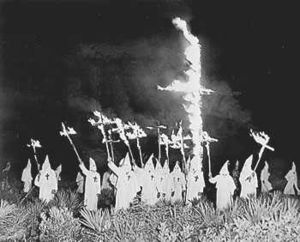
• Immigration has inspired recruitment efforts for the Ku Klux Klan. “They use this immigration issue to bring in others who feel like America is under siege,” said the Anti-Defamation League’s national civil rights director. “It’s easy for hate to spread.” An email from a KKK leader stated, “Everyday that our government allows this Illegal Mexican Invasion to continue, our membership numbers continue to grow in the KKK.” Wow, the KKK is starting to get more diverse in directing their hate.

Essay 1685

Essay 1684


From The New York Daily News…

---------------------------------------

Black history now: demagoguery vs. decency

By Stanley Crouch

As we step into Black History Month, there is much the nation can learn about the complexities that face the black community by scrutinizing things that are happening in New York — some tragic, some noble, some naive and some the very definition of irresponsible.

First, there’s the killing of Sean Bell in what appears to have been a Keystone Kops episode, in which 50 shots were fired on three unarmed black men. In the middle of all the anger and sorrow, Nicole Paultre, the woman Bell was to marry the day he was killed, carried herself with a dignity that so surprised Larry King that he asked her on his TV show why she didn’t express the kind of theatrical anger that has become a cliché since the days of Black Power.

King had the wrong guest on his show. He should have brought on Charles Barron, a former Black Panther and a rabble-rouser of the most irresponsible stripe. Following the Bell killing, Barron spoke at a Brooklyn rally and proved himself an incendiary at best when he made an apparent attempt to incite violence against the police, saying, “We need to let the system know that they have to fear us.”

Barron also deeply troubles black cops, whom he refers to as “house Negroes,” or faithful slaves. Interestingly, Barron has made no similarly aggressive commentary about what community people should do to pimps, drug dealers, serial rapists and the sellers of illegal firearms. Without our cops, they would wreak much more havoc on the black community than they already do.

Then, just last week, Ronell Wilson, a young black man, was sentenced to death for the murder of two black undercover detectives in 2003. Men such as the murdered cops, of course, are of no interest to the Charles Barrons, the loons among us ever ready to make empty threats and spew endlessly divisive commentary. They remain intellectual blights on the black community.

Finally, in the interest of Black History Month and partially in response to the infamous tirade by supposed comedian Michael Richards, Council member Leroy Comrie has submitted a resolution to the New York City Council that calls for a “symbolic moratorium on the use of the N-word in New York City.” Good luck.

Michael Richards is not the problem. The actual problem is the continual use of the word by black comedians and rappers, ever since Richard Pryor made it a basic part of his routine. Even the fact that Pryor himself came to think he had made a mistake could not stop the word’s use from spreading, across racial lines, among young people. Congressman Charles Rangel has expressed the intention of drafting a similar resolution for Washington senators and congressmen to decide on.

These are the sorts of messes we can easily see these days, but it is important that we recognize what Sean Bell’s intended wife represents. It is she who reflects the heart of the civil rights movement. She wants nothing less than justice and holds no malice toward the NYPD as a whole. She is too noble and mature to allow the worst blunders of a few to indelibly stain the majority. Having police officers in her family, she is too sensible to traffic in brutal stereotypes.

Charles Barron and all those like him need to follow her example. Don’t back down, but rise above petty hysteria. That would give real meaning to Black History Month.

Essay 1683


BHM RETRO EXTRA: This ad might hold the record for most “Get Down” references.

Thursday, February 08, 2007

Essay 1682


More badvertising in a MultiCultClassics Monologue…

• Another Super Bowl spot is taking heat from activist groups. The GM spot depicting a fired auto factory robot has caught the attention of the American Foundation for Suicide Prevention because the robot is shown jumping off a bridge. “We wouldn’t see this ad around cancer or heart disease,” says the group’s executive director. “Why’s it OK to make fun of mental illness or depression?” Better not show this guy the heart attack spot from King Pharmaceuticals.


• Mike Tyson checked himself into a treatment center to address “various addictions.” He’s also awaiting trial for felony drug possession charges — to which he has pleaded not guilty. You’d think the treatment center visit might impact the credibility of his legal defense.

• The Nashville City Council voted to make English the city’s official language. Since when did folks in Tennessee start speaking English?

Essay 1681


BHM2007: The Marines salute Black History Month. Literally.

Essay 1680

Wednesday, February 07, 2007

Essay 1679


From AdAge.com…

--------------------------------

Locked in a Cultural Battle of the Ages

Generation Gap: Age Issues Are Often More About a Power Struggle

By Mya Frazier

COLUMBUS, Ohio (AdAge.com) – “Who’s Bernbach?”

Bruce Kelley was taken aback at that response from a young colleague who’d just plopped the Martin Agency vice chairman firmly into the generation gap.

Mr. Kelley, feeling that a campaign idea from the young creative was misguided, had just quoted Bill Bernbach, one of the fathers of modern advertising. The quote was vintage Bernbach: “If you have a man stand on his head, you’ll get people to look. But you won’t sell anything unless you’re selling a product to keep things from falling from a man’s pockets.”

The young agency executive’s idea, on the other hand, “was creative and fun; it just had nothing to do with selling the client’s product,” recalled Mr. Kelley, 57, who also holds the titles of partner and director-account services at the Richmond, Va., agency. The response was particularly stinging, considering that Mr. Kelley, in his 30-year agency career, did a stint at Doyle Dane Bernbach during the 1970s.

As generations collide
It’s not just the Bernbach quote falling on deaf ears as generations collide in the workplace.

A New York magazine sales executive joked about his experience at a family-owned publisher where the boss, who was retired for all practical purposes, visited a few times a week. “For security, the office had a numerical key pad for entry, but either because the old man didn’t like technology or was forgetful, the code was, shall we say, a consecutive sequence starting with 1 and ending in 4.”

Sometimes the generation gap underlines a power struggle. A New York copywriter lamented about a boss who used his age as a mark of superiority and excuse not to read e-mail. “It was as though he was above all this newfangled e-mail,” the copywriter said. The boss “preferred face-to-face meetings, which was catastrophic when accounts were pushed beyond deadline because it was impossible to reach him for sign-offs on ads. It was also looked down upon that we didn’t know instrumental rock bands of the ‘60s.”

Executives such as Mr. Kelley, a father of three teenagers, are the first to admit shortcomings on emerging pop-culture trends, especially music. He admitted with a laugh that he can’t remember a list of current bands.

Beyond Bernbach and bands
But beyond Bernbach and bands, the differences spill over into such areas as dress codes. A 34-year-old Midwestern magazine sales rep recalled a boomer manager who required all women on staff to wear nylons with skirts, even in the summer. “She actually didn’t think it was professional to wear sandals without them,” she said.

So if baby boomers find themselves marginalized as dinosaurs, they shouldn’t blame younger colleagues for the label.

“You have to position yourself to not say dated things,” said Lynne Lancaster, a consultant on generational issues and co-author of “When Generations Collide.” “You have to be a real media junkie and accept that in an agency … you have to dabble around in new media, visit social-networking sites, blog.”

Indeed, many are. “The boomers I work with are very hip; they all had iPods before me and are very up with what is going on,” said Christie Hadley, 26, assistant account manager at Northlich, in Cincinnati.

For Nancy Kramer, who is known to refer to her 30-and-under employees as “my kids,” the vast age gap is rarely an issue. But the 51-year-old Ms. Kramer -- who is CEO of Resource Interactive, a Columbus, Ohio, shop where nearly half of the 150 employees are under the age of 30 -- admitted her young employees fail to grasp what the business world was like when she started 25 years ago.

Life before ‘1984’
“They don’t understand what the ‘1984’ commercial was for Apple, they don’t understand business life before e-mail or what it was it like before there was FedEx,” she said.

Then there’s the example of 42-year-old David Swaebe, corporate-communications director at Wenham, Mass.-based Mullen. Around Thanksgiving he was interviewing a 20-something job candidate and mentioned the story of Arlo Guthrie’s “Alice’s Restaurant.” He explained how the saga that commented on the 1960s’ counterculture movement took place in nearby Stockbridge, Mass., around the holiday.

“The job candidate looked at me with the blankest of stares,” Mr. Swaebe said. “She had no idea what I was talking about. It was a classic I’m-getting-old moment.”

But Katie Yontz, 25, project coordinator at Resource Interactive, puts a positive spin on the differences. The coordinator celebrated her last birthday on the same day her agency turned 25. “That was a really poignant moment for me,” she said. “These are the same people who were starting a business the day I was being born. … They have so much experience and insight.”

Experience vs. the hotshots
There’s the very serious and often confusing problem for agency managers facing the dilemma of whether to keep the experienced 55-year-old on the longtime drug account or to hand over a hard-won new technology account to the new hotshot creative with almost no experience.

It shouldn’t be such a dilemma, argued Patty Bloomfield, 50, VP-account director at Northlich, who spent 20 years at Leo Burnett Co. before joining the Cincinnati-based agency.

“We are all, hopefully, in the business where people and consumers come first,” she said. “That makes the experiences of even those of us who are a little bit older still relevant.”

Age bias has led some agencies to disregard a key target market.

“There is still a love affair with the 18-to-34 group in this business because of the conventional wisdom that people make brand choices when they are young, so don’t target people when they are older,” Ms. Bloomfield added.

Northlich’s BoomBiz practice has documented this problem and reminds marketers of the competitive advantage to buck the youth trend. “There are 78 million boomers in the U.S, but only 10% of ads are directed at them,” she said.

“This is a young person’s business,” said Debbie Strobel, managing partner of Advertising Recruitment Specialists, who added it’s rare she gets a call from an agency asking for her to hunt for a baby boomer. “I don’t care what anyone says, agencies want the young, hot talents.”

(Brooke capps, Ken Wheaton contributed to this report.)

Essay 1678


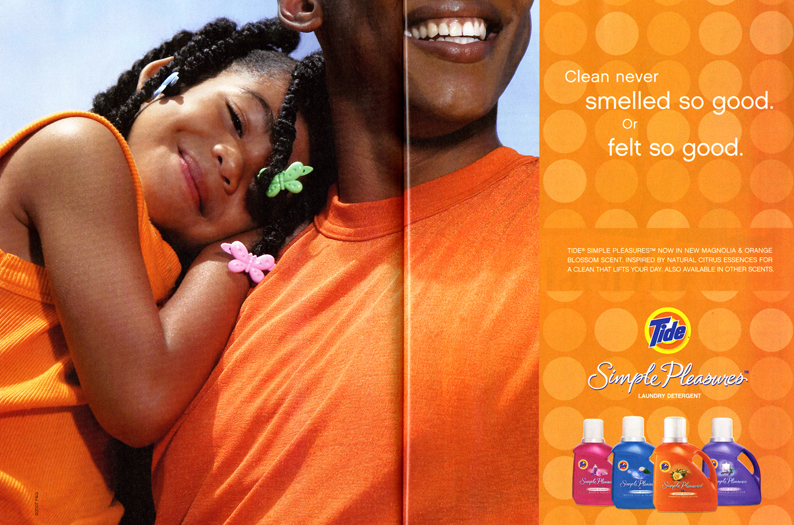
Clean never smelled so good. Or felt so good.

This ad is not so good.

Essay 1677


Paw & Order in a MultiCultClassics Monologue…

• Two Los Angeles Fire Department captains charge they are victims of reverse discrimination in the infamous dog food case (see Essay 1451), and they’re going to trial with a lawsuit. The incident involved an alleged firehouse prank, where firefighters served spaghetti laced with dog food to a Black team member. The two captains were punished for the event, but insist they were unaware of the dog food in the spaghetti. Now a court will decide if they should not have been sent to the doghouse.

• Wal-Mart is facing a class-action lawsuit that charges up to 1.5 million female employees experienced discrimination in pay and promotions, and the ultimate result could be billions of dollars in damages. Perhaps the mega-retailer should set up special in-store departments to deal with all the lawsuits.

• A new study shows kids who don’t get enough sleep are more likely to be overweight. A researcher said, “It’s also quite possible that when (children are) really fatigued, they are less likely to go outside and play or engage in a sport, and they may be more likely to slouch in front of the television.” Or maybe they’re visiting the 24-hour Taco Bell for the Fourth Meal.

Essay 1676

Essay 1675


From The Associated Press…

-------------------------------------

Immigrant Protests Energize KKK, Neo-Nazis

By ERIN TEXEIRA

NEW YORK (Feb. 6) - Huge street protests made millions of immigrants more visible and powerful last year, but they also seem to have revived a hateful counter force: white supremacists

Groups linked to the Ku Klux Klan, skinheads and neo-Nazis grew significantly more active, holding more rallies, distributing leaflets and increasing their presence on the Internet — much of it focused on stirring anti-immigrant sentiment, a new report released by the Anti-Defamation League says.

“Extremist groups are good at seizing on whatever the hot button is of the day and twisting the message to get new members,” Deborah M. Lauter, ADL Civil Rights director, said Monday. “This one seems to be taking hold with more of mainstream America than we’d like to see.”

Old Klan chapters have been revived and new ones started throughout the South, historically the heart of the group, and in other places such as Michigan, Iowa and New Jersey, says the report, which was scheduled for official release Tuesday.

Last May in Alabama, an anti-immigration rally included slogans such as, “Let’s get rid of the Mexicans!” according to the document, titled “Ku Klux Klan Rebounds.”

“The Klan is increasingly cooperating with other extremist groups and Neo-Nazi groups,” Lauter said. “That’s a new phenomenon.”

Between 2000 and 2005, hate groups mushroomed 33 percent and Klan chapters by 63 percent, according to Mark Potok, director of the Southern Poverty Law Center, which tracks hate crimes.

Precise data are difficult to pin down, but Potok’s group counts as many as 150 Klan chapters with up to 8,000 members nationwide. More than 800 hate groups exist around the country, Southern Poverty research shows.

In the late 1990s, memberships in such groups was crumbling as they lost leaders and struggled to organize, said Brian Levin, director of the Center for the Study of Hate and Extremism at California State University, San Bernardino. Many hit bottom around 2000.

“Whenever you think the Klan is down and out, they find another way to reinvent themselves,” he said of the recent resurgence.

Historically, the Klan’s focus had been to terrorize African-Americans — through race riots, lynchings and other killings — but it reached peak membership at more than 4 million in the 1920s by focusing on immigration.

Newcomers from Ireland and Germany were portrayed as Catholic usurpers invading the United States, taking jobs from native-born Americans and undermining national fabric, Levin said.

Said Potok: “It’s remarkable to look back at the nativist sentiments toward Catholics — it’s very similar to what we're seeing with Mexicans now.”

Today, many white supremacists blame immigrants, particularly Hispanics, for crime, struggling schools or unemployment, for instance. With many Americans already divided on how to revamp laws and practices to address the nation’s swelling immigrant communities, immigration “is an issue that works for hate groups,” Potok said.

Many Latinos are feeling the effects firsthand. Last September, a Kentucky family originally from El Salvador found a wooden cross burning on their front lawn just weeks after they moved in. Earlier last year, a Latino teenager in Houston was brutally beaten and sodomized while one attacker screamed “White Power!” The victim barely survived, and one attacker was sentenced to life in prison.

“I’ve been doing (Hispanic advocacy work) for a long, long time and the atmosphere has never been as poisonous as it has been in the last few years,” said Lisa Navarrete, a vice president at the National Council of La Raza. “The level of vitriol is new.”

Increasingly, fear permeates many Hispanic communities as individuals and businesses are targeted. Last year, La Raza held a workshop at its annual convention titled “Keeping Our Institutions Safe.”

“It was very well attended, unfortunately,” Navarrete said.

Essay 1674


BHM RETRO EXTRA: Bet the Boys Club would run for their lives from O.J. now.

Tuesday, February 06, 2007

Essay 1673


Admen behaving badly in a MultiCultClassics Monologue…

• Snickers became the first major advertiser in 2007 to offend via cultural cluelessness — and the candy company did it during the Super Bowl to boot. Eat your hearts out, Justin Timberlake and Janet Jackson. It started with a spot depicting two men who accidentally kiss while sharing a Snickers bar, then prove their manliness by pulling out their own chest hair (click on the essay title above to view it). Brilliant. The Snickers website later offered three alternative endings for the commercial, allowing visitors to vote for their favorite. However, gay and human rights groups pressured Snickers officials to end the madness. “That Snickers, Mars and the NFL would promote and endorse this kind of prejudice is simply inexcusable,” said GLAAD President Neil Giuliano. “We know that humor is highly subjective and understand that some people may have found the ad offensive. Clearly that was not our intent,” said parent company Masterfoods in a statement. “As with all of our Snickers advertising, our goal was to capture the attention of our core Snickers consumer.” Guess the core Snickers consumer is a homophobic jackass. All the work has been pulled from the website, and the spot will no longer air. Kudos to advertising agency TBWA/Chiat/Day New York for producing the mess. The New York City Human Rights Commission should check into the shop’s record on hiring gays and lesbians. Or have the Queer Eye team visit Lee Clow — he could use a makeover.

Essay 1672


Cooking up trouble in a MultiCultClassics Monologue…

• First Maytag recalled millions of dishwashers. Now Hasbro has recalled about 1 million Easy Bake Ovens. Little bakers are at risk of being burned when hands and fingers get caught in the oven’s opening. Hey, are kids still able to land Creepy Crawlers kits?


• Michigan is joining the debate over trans fats in restaurants. “Protecting the public health is a basic function of government agencies,” said the executive director of the non-profit Center for Science in the Public Interest. “When the federal government moves too slowly, states and cities will sometimes fill the void. That’s what’s happening with trans fats.” Has anyone checked for trans fats in Easy Bake Oven desserts?

Essay 1671


From The Chicago Sun-Times…

-----------------------------------------

‘History’ came in late from sidelines

BY LEWIS LAZARE, Sun-Times Columnist

Eight days ago, it was just an idea in Phil Gant’s head. On Sunday, “This Is History” was a full-blown 30-second Super Bowl commercial. We’re talking about a commercial that actually ran during the Super Bowl, not the pregame.

Gant had been a creative director at Element 79 for all of a week when he went to chief creative officer Dennis Ryan’s office Jan. 29 to tell him about a concept for a commercial celebrating a historic moment in Super Bowl annals: the first time African Americans would be head coaches of teams in the big game.

Gant, who had been chief creative officer at BBDO/Chicago, wanted to do a commercial showing groups of people in different settings watching the game. As the commercial progressed, we would see that all the people were African Americans. A message would appear on screen asking “Who's winning?,” followed by the answer “We all are,” before a final reminder to “Enjoy the game.”

Ryan was immediately taken with the concept. Within an hour, Ryan had sold the spot to Element 79 client Frito-Lay. That left Gant just days -- about four, give or take -- to get the spot made and approved by Frito-Lay, CBS and the NFL.

Ryan tapped another Element 79 talent, creative director Scott Smith, to direct the commercial. On Jan. 30, Gant and Scott looked at 150 local actors and cast 40 for the commercial. On Wednesday they scouted and selected several sites on Chicago’s South Side where they would film. On Thursday a film crew shot the commercial.

Footage was delivered to the Whitehouse edit facility as quickly as it was shot, while CBS Super Bowl commentators Jim Nantz and Phil Simms in Miami kindly agreed to record simulated football game voiceover copy that would seem to be emanating from television sets in the commercial, and Joel Corelitz at Underscore Music quickly whipped up an original piece of music.

By midnight Thursday, Gant and Smith had a rough cut of “This Is History.” By midday Friday, several cuts later, Frito-Lay had signed off on the finished commercial. By Saturday morning, CBS and the NFL had given their approval as well.

All that remained was to decide where in the big game the spot would run. Smith first heard word it might air during the most prestigious first break after kickoff, but that wound up not being the case. “This Is History” in fact, aired near the end of the first half.

And the commercial turned out to be a welcome moment of quiet dignity in what was mostly a parade of spots going for laughs.

[Click on the essay title above to view the spot.]

Essay 1670


BHM2007: Well Fargo rolls out the annual depiction of Black inventions. Somebody ought to get credit for inventing this advertising concept.

Essay 1669

Monday, February 05, 2007

Essay 1668


Pardon the obsessive musings, but here are additional random thoughts inspired by the Coca-Cola Black History Month spot that debuted during the Super Bowl (see Essays 1665 and 1661):

• It’s not surprising that two of Adfreak’s critics — Marian Salzman and Tim Arnold — praised the spot, as both have demonstrated cultural cluelessness in the past year. To be clear, the spot is not awful. But it is contrived and expected from a Black History Month perspective. Visit this blog during February and you’ll see a few BHM ads with identical concepts (or review the BHM ads presented in February 2006). As noted in Essay 1665, copy from the commercial almost completely matches a BHM ad from IBM.

• It’s likely that the commercial’s creators opted against literally identifying people (i.e., hint at individuals via their accomplishments versus calling out Jackie Robinson, Rosa Parks, Dr. Martin Luther King Jr., etc.) in order to avoid paying rights management fees.

• On a side note, couldn’t Adfreak have invited at least one minority representative to participate in its esteemed panel of industry leaders? It might have demonstrated an attempt to recognize and right the historical exclusivity in our business.

• On another side note, were any Super Bowl spots hatched by minority advertising agencies? This year, ordinary consumers had a better shot at generating Super Bowl spots than minorities. Tony Dungy and Lovie Smith made history on the field. Perhaps the ad industry will do likewise someday.

• It would be interesting to learn which Coke advertising agency produced the commercial. Perhaps it was even created by one of the advertiser’s minority shops. Regardless, the spot reveals lots of the continued inequities on Madison Avenue. For example, Coke’s Super Bowl lineup presented super-high-budget productions. Except for the minority commercial, which featured bottles and titles. Plus, it’s a safe bet that Coke’s minority shops have submitted and executed similar ideas for the client over the years.

In the end, the commercial symbolizes the Coke side of life… in the ad industry.

Essay 1667


From the latest issue of Newsweek…

---------------------------------

Colorblind at Last?

This year, a record five black actors received Oscar nominations. That’s amazing progress—maybe.

By Sean Smith and Allison Samuels

Black Hollywood has been keeping a secret. For decades, African-Americans had been so consistently overlooked by the Academy Awards that a private group began sponsoring the “Black Oscars.” Every year, on the night before the actual Oscars, members of the community—including James Earl Jones, Whitney Houston, Samuel L. Jackson and Will Smith—gather at a Beverly Hills hotel to honor their own. “Everyone has on their tuxes, and you see all these people you want to work with who are cheering you on,” says Malcolm D. Lee, director of “Undercover Brother” and cousin of Spike Lee. “It’s a great feeling, and intimate—nice.”

But on March 24, 2002, Halle Berry crossed the stage at the Kodak Theatre to become the first African-American woman to win an Oscar for best actress. (She also set the record for most tears shed during an acceptance speech.) Minutes later, Denzel Washington took the best-actor award, the first black man to do so in 38 years. It was, by any measure, historic. Since 2002, 11 black actors have earned Oscar nominations. Jamie Foxx and Morgan Freeman have both won, and at least one black actor has been nominated every year. This year a record-breaking five—Forest Whitaker, Jennifer Hudson, Eddie Murphy, Will Smith and Djimon Hounsou—will be walking the red carpet on Feb. 25. “I certainly always hoped I’d see this day,” says Sidney Poitier, the first African-American man to win best actor. “I would have thought it would have occurred sooner.”

Yet breaking the color barrier hasn’t exactly been met with unmitigated joy in black Hollywood. The decades of exclusion have left a scar of skepticism. “I’m pleased all this is happening, but I hope and pray it’s not just a phase,” says Louis Gossett Jr., who won the 1982 best-supporting-actor Oscar for “An Officer and a Gentleman”—and never got another role of that stature. History is peppered with bursts of high-profile work for black actors that blazed out just as fast. Angela Bassett couldn’t find work for a year after being nominated for “What’s Love Got to Do With It.” In the early ‘70s, Diana Ross, Cicely Tyson and Diahann Carroll all earned best-actress nominations—and then no African-American woman was nominated in that category again for more than a decade. Even Washington questions the long-term impact of his own win. After Foxx won the 2004 best-actor Oscar, Washington told NEWSWEEK, “Who knows what it means for the future? I think we have to take it for just what it is—African-Americans winning awards. Beyond that, we have to wait and see.”

What’s most startling is that the 2002 Oscars have left a bitter aftertaste because of the kinds of roles that scored Washington and Berry their statues. He played a corrupt cop in “Training Day”; she starred as a woman who falls in love with a racist in “Monster’s Ball.” A segment within black Hollywood believes that white Academy voters reward black actors for roles that reinforce stereotypes—the angry black man, the noble slave, the sexualized black woman—rather than challenge them. “There’s a sense that in order to be embraced by the white community, you probably did something that violates your integrity within the black community,” says actress Kerry Washington, who stars opposite Whitaker in “The Last King of Scotland.” For black actors, succeeding in Hollywood comes at a price. “The playing field is not even, but I don’t know that it’s as evil as everyone likes to think it is,” says Antoine Fuqua, who directed “Training Day.” “People make films about what they experience, about what they know, and the film business was created by people that weren’t African-American.”

It would be unfair to leave the impression that African-Americans don’t value the recognition and their increasing power within the industry. The success of Will Smith’s “The Pursuit of Happyness”—a serious drama that has grossed more than $200 million worldwide and earned him his second Oscar nomination—is a milestone. “That movie is a story about determination and the American Dream,” Lee says. “And it has nothing to do with being black.” No one doubts that there’s more, and better, work available now for actors of color than at any time in American history. In addition to the five black actors nominated this year, there’s a Japanese actress and a Mexican actress, plus one Latino director. That’s not altruism—it’s business. The majority of theatrical revenue on studio films now comes from foreign box office, not domestic. And young audiences—the movie industry’s bread and butter—care much less about race than their parents do. “We read trend reports that high-school and junior-high kids are much more comfortable in a multiracial world,” says Stacey Snider, CEO of DreamWorks, which released “Dreamgirls.” “That has to have an impact, not just on music and fashion, but on movies as well.”

But rewriting history isn’t easy. Actresses still haven’t benefited much from Berry’s win—no black woman has been nominated for best actress since she won. “We still don’t have a female African-American superstar,” says black-film historian Donald Bogle. “There’s not even a female equivalent for Samuel L. Jackson or Morgan Freeman.” The next generation of men, however, has flourished. Five men have gotten lead Oscar nods since 2002. “Ten years ago Denzel was the only black actor who could get a lead in a quality movie,” says John Singleton, who directed the landmark film “Boyz n the Hood.” “Now, actors like Terrence Howard can get an Oscar nod with their first starring role.” That change, Singleton says, will not be undone. “There’s no going back to the back of the bus.” He may be right. Perhaps the biggest indicator that the world has changed is that the Black Oscars have been canceled. After being a necessity for more than 25 years, they have succeeded by becoming redundant. “We only had the event to acknowledge those who weren’t being acknowledged,” says a member of the (secretive) Friends of the Black Oscars board. That’s no longer the case. “This year, the Black Oscars will be at the Kodak.”

Essay 1666


From The New York Times…

-------------------------------------------

The Racial Politics of Speaking Well

By LYNETTE CLEMETSON

SENATOR JOSEPH R. BIDEN’S characterization of his fellow Democratic presidential contender Senator Barack Obama as “the first mainstream African-American who is articulate and bright and clean and a nice-looking guy” was so painfully clumsy that it nearly warranted pity.

There are not enough column inches on this page to parse interpretations of each of Mr. Biden’s chosen adjectives. But among his string of loaded words, one is so pervasive — and is generally used and viewed so differently by blacks and whites — that it calls out for a national chat, perhaps a national therapy session.

It is amazing that this still requires clarification, but here it is. Black people get a little testy when white people call them “articulate.”

Though it was little noted, on Wednesday President Bush on the Fox News Channel also described Mr. Obama as “articulate.” On any given day, in any number of settings, it is likely to be one of the first things white people warmly remark about Oprah Winfrey; Richard Parsons, chief executive of Time Warner; Secretary of State Condoleezza Rice; Deval Patrick, the newly elected governor of Massachusetts; or a recently promoted black colleague at work.

A series of conversations about the word with a number of black public figures last week elicited the kind of frustrated responses often uttered between blacks, but seldom shared with whites.

“You hear it and you just think, ‘Damn, this again?’” said Michael Eric Dyson, a professor of humanities at the University of Pennsylvania.

Anna Perez, the former communications counselor for Ms. Rice when she was national security adviser, said, “You just stand and wonder, ‘When will this foolishness end?’”

Said Reginald Hudlin, president of entertainment for Black Entertainment Television: “It makes me weary, literally tired, like, ‘Do I really want to spend my time right now educating this person?’”

So what is the problem with the word? Whites do not normally object when it is used to describe them. And it is not as if articulate black people do not wish to be thought of as that. The characterization is most often meant as a form of praise.

“Look, what I was attempting to be, but not very artfully, is complimentary,” Mr. Biden explained to Jon Stewart on Wednesday on “The Daily Show.” “This is an incredible guy. This is a phenomenon.”

What faint praise, indeed. Being articulate must surely be a baseline requirement for a former president of The Harvard Law Review. After all, Webster’s definitions of the word include “able to speak” and “expressing oneself easily and clearly.” It would be more incredible, more of a phenomenon, to borrow two more of the senator’s puzzling words, if Mr. Obama were inarticulate.

That is the core of the issue. When whites use the word in reference to blacks, it often carries a subtext of amazement, even bewilderment. It is similar to praising a female executive or politician by calling her “tough” or “a rational decision-maker.”
“When people say it, what they are really saying is that someone is articulate … for a black person,” Ms. Perez said.

Such a subtext is inherently offensive because it suggests that the recipient of the “compliment” is notably different from other black people.

“Historically, it was meant to signal the exceptional Negro,” Mr. Dyson said. “The implication is that most black people do not have the capacity to engage in articulate speech, when white people are automatically assumed to be articulate.”

And such distinctions discount as inarticulate historically black patterns of speech. “Al Sharpton is incredibly articulate,” said Tricia Rose, professor of Africana Studies at Brown University. “But because he speaks with a cadence and style that is firmly rooted in black rhetorical tradition you will rarely hear white people refer to him as articulate.”

While many white people do not automatically recognize how, and how often, the word is applied, many black people can recall with clarity the numerous times it has stopped them in their tracks.

[Click on the essay title above to read the full story.]

Essay 1665


BHM2007: Here’s some more commentary regarding the Coca-Cola Black History spot that ran on the Super Bowl (see Essay 1661 and click on the essay title above to view the commercial)…

At Adfreak’s special Super Bowl review, self-proclaimed futurist guru Marian Salzman posted the following: “Maybe it’s just me with so many African-American players on the field, but it was genuinely refreshing to see Coke celebrate Black History Month with such grace and ease. I wonder how the public will recall the spot, but I know I learned something from it.”

Um, it’s revealing to see someone state “I know I learned something from it.” After all, the spot referenced Tuskegee Airmen, Rosa Parks, Jackie Robinson and Dr. Martin Luther King Jr. These are hardly figures someone like Salzman should need schooling on.

Then again, it was somewhat breakthrough for the exposition to be presented to a general market (and international) audience. Yet anyone familiar with Black History Month advertising probably recognized the spot as being painfully contrived and expected.

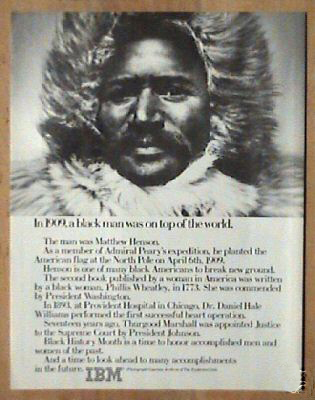
The only potentially obscure reference in the spot is the first one: “North Pole, 1909. A black man is on top of the world.”

The reference is to Matthew A. Henson, pictured above and below. When Robert E. Peary allegedly discovered the North Pole in 1909, Henson was the person standing beside him.

But as seen in the BHM IBM ad below, Coke is hardly the first advertiser to honor the man. What’s more, they ripped off IBM’s headline.

Essay 1664


Monday Morning MultiCultClassics Monologue…

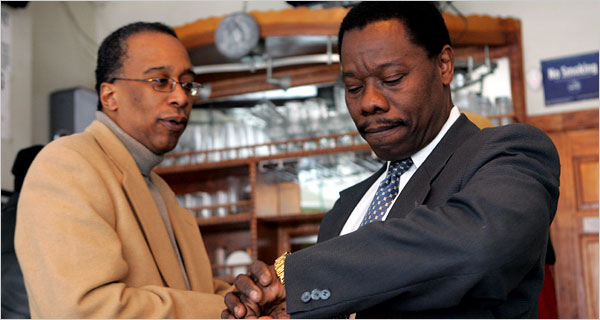
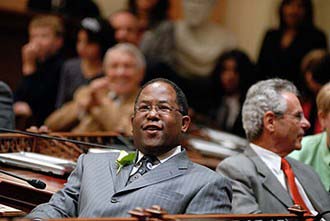
• The New York Times reported on Dr. Mathieu Eugene (pictured above, right) and his goal to become the first Haitian-born member of the New York City Council. “Has the time come?” asked Dr. Eugene. “Yes, I believe the time has come. We Haitians have been participating in the political system for some time, and we have helped others get into elective office. Many people believe that it’s our turn. And they look at this as a historic and important moment.” Click on the essay title above to read the full story.

• A new study showed getting kids to watch less TV does not translate to increased exercise routines. However, the researchers found that prolonged TV viewing does expose children to unhealthy dietary choices — plus, kids tend to eat more while watching. Whoever invents a combination refrigerator-microwave-TV is gonna make a fortune.

• The Rev. Al Sharpton wants to sue New York City over increased racial profiling by the NYPD. Law enforcement officials revealed that of the 508,540 people stopped by cops in 2006, 52 percent were Black and 29 percent were Hispanic. “It’s an outrage. It’s enough. No matter how productive you are, to be cast as a suspect rather than a citizen is intolerable in this country,” declared Sharpton. “One will have to explain how [nearly] 55 percent of the people stopped are Black when we’re not nearly 50 percent of the population.” Do we really need a formal explanation?

Essay 1663

Essay 1662


BHM RETRO EXTRA: Hired help hypes Hires.

Sunday, February 04, 2007

Essay 1661


Quick Hits From The Super Bowl In A MultiCultClassics Monologue…

• Congratulations to Indianapolis Colts Head Coach Tony Dungy, who becomes the first Black man to lead his team to a Super Bowl victory. Chicago Bears Head Coach Lovie Smith gains the distinction of being the first Black man to lead his team to a Super Bowl defeat — but Smith had the crummier quarterback.

• Budweiser Select presented Jay-Z versus Don Shula playing an animated football game. This one deserves a flag for roughing the viewer. Please, let’s not review the spot.

• Coca-Cola presented a corny commercial with the typical Black History timeline alongside the Coke bottle evolving over the years. The soft drink leader forgot at least one significant moment — 2000: Coca-Cola settles racial discrimination lawsuit for $192 million. (Click on the essay title above to view the spot.)

Essay 1660


Updated lack of progress reported in a MultiCultClassics Monologue…

• The New York Daily News reported the latest regarding Busta Rhymes’ slain bodyguard. Nearly a year ago, Israel Ramirez was shot during a music video production. Although numerous people were present, including Rhymes, no one is talking to police. “[Rhymes is] not talking,” said a police source. “He doesn’t want to lose money by getting the reputation for talking to cops, so a killer remains free.” The victim’s sister said, “We’re still very much grieving, but we’re not holding Busta Rhymes responsible. … We’re hoping that somebody will eventually come forward and say something to the police to help bring this lowlife to justice.” Rappers like to rhyme about murder, but talking is another story.

• The Los Angeles Times reported the latest regarding the wrongful-death lawsuit filed by the family of slain rapper Biggie Smalls against the city of Los Angeles. The family charges a rogue LAPD detective helped organize the murder. The lawyer representing the family said, “There are documents that we have looked at in the LAPD file that support our theory. The documents indicate that [LAPD detective] David Mack killed Christopher Wallace.” If it’s tough getting rappers to talk with cops about murders, imagine trying to persuade cops to talk with cops.

Essay 1659

Essay 1658


From The Los Angeles Times…

-----------------------------------

Activists hailed for improving neighborhoods
The L.A. advisory group Empowerment Congress honors seven residents and organizations. One woman worked to end a glut of liquor stores.

By Robert J. Lopez, Times Staff Writer

Elizabeth McClellan remembers walking past the liquor stores that dotted her South Los Angeles neighborhood, where addicts smoked crack cocaine and drank alcoholic beverages wrapped in brown paper bags.

She and her neighbors began organizing with the help of a then-newly formed advisory group called the Empowerment Congress. Eventually, they were able to reduce the number of area liquor stores and crimes.

On Saturday night, 15 years after McClellan began working with the congress, she and six other activists and organizations were honored at a dinner at USC celebrating the group and the people who helped turn a lofty experiment in micro-governance into the prototype for L.A.’s neighborhood councils.

Among those recognized were a Cal State L.A. educator who began a certificate program to train gang-intervention workers and a Jefferson Park couple who rallied residents against dozens of sex offenders living in a halfway house near an elementary school and church.

“It’s very, very exciting and deeply encouraging that these people and others continue to commit themselves to making the space they occupy better,” said state Sen. Mark Ridley-Thomas (D-Los Angeles).

He started the Empowerment Congress in 1992, when he was a Los Angeles councilman representing parts of South Los Angeles. The group, formed after the rioting over the Rodney G. King police beating verdict, was seen as a way to spark activism by electing people to local councils and hosting workshops on such topics as community organizing and leadership training.

The group has spread to parts of Ridley-Thomas’ Senate district in Hancock Park and Culver City and seeks nonprofit status, said Chairwoman Kara Carlisle, vice president of the city Human Relations Commission.

The congress has no formal authority, but it has become a potent organizing tool for activists such as McClellan, who worked with other members to stop the proliferation of liquor stores around her neighborhood at 91st and San Pedro streets.

Many of the stores had been damaged or burned down during the riots and were seeking to reopen. McClellan, 73, said residents were able to get the attention of city officials and stop owners who had allowed their businesses to become crime magnets from reopening. “We awakened City Hall to the fact that they had a responsibility over land-use authority,” she said. “Prior to that, everybody closed their eyes.”

Another activist honored Saturday, Bill Martinez, began working with Ridley-Thomas’ council office in the early 1990s after becoming the director of a city-sponsored gang-intervention program. Six years ago, Martinez helped start a 15-week course at Cal State L.A. that has trained more than 350 gang-intervention workers. The workers, many of them former gang members, learn to teach gang leaders conflict-resolution skills.

The workers are also taught about community organizing based on the model developed by the Empowerment Congress, Martinez said. “These guys can take that to the neighborhoods they’re working with and do the same thing,” he said.

Two other honorees, Michael and Dollinda Sampson, became involved with the congress five years ago when they discovered that an adjacent property was a halfway house where 31 registered sex offenders lived.

The men often peered over a waist-high fence into his yard, frightening his then-12-year-old daughter, Sampson said. The house, near Arlington Avenue and Exposition Boulevard, was about three blocks from a church and elementary school. “We had kids going back and forth to school,” Sampson said. “It was not a comfortable feeling.”

He said he and his wife met with congress members, who helped residents hold meetings and stage a protest march and sit-in at the house, where they met with the owner. He ultimately moved the men out, but recently started a sober-living residence for half a dozen drug offenders, Sampson said. “We’re still fighting,” he said.

Other honorees were Lark Galloway-Gilliam, who has worked to provide healthcare for low-income families, and the Korean American Coalition and City Watch, which have organized neighborhoods across L.A.

Essay 1657


BHM2007: Here’s a rather sobering message from Red Lobster. Maybe it would have been better to celebrate Black History Month with Blackened Salmon.

Essay 1656


From The Washington Post…

--------------------------------------

Athletes Black and Blind

By Michelle Singletary

Are black athletes wasting their considerable wealth?

Sportswriter William C. Rhoden thinks so.

Considering that February is Black History Month, I thought it was a perfect time to discuss whether black athletes are failing to use their money and influence to significantly tackle the social ills -- such as poverty and unemployment -- that are still plaguing the black community.

Rhoden adds a powerful voice to this debate. It’s why I’ve chosen his book “Forty Million Dollar Slaves: The Rise, Fall, and Redemption of the Black Athlete” (Crown, $23.95) for the February Color of Money Book Club.

Rhoden’s book raises provocative questions about wealth and responsibility. If wealthy black athletes donate money to charity, are they obligated to donate their personal time as well? If they donate their time, are they obligated to become spokesmen for a political or social cause as well? How much is enough? And who decides? Such questions are particularly important to ask of those among us who have been blessed with considerable economic resources.

Rhoden, who is African American, has been a sportswriter for the New York Times since 1983. He’s written the “Sports of the Times” column for more than a decade. He’s been up close and personal with the best-paid black athletes in this country. In his new book, Rhoden gives a much needed slap-down to wealthy, spoiled and socially unconscious African American professional sports figures.

Rhoden acknowledges that calling millionaire athletes slaves would stir up controversy. Even so, he says he uses that term because these players’ professional lives are controlled by white team owners.

“To the general public, athletes have achieved the Promised Land,” he writes. “The inference never far from the surface is that they should be grateful -- more grateful than their white peers -- for the money they make.”

Rhoden’s point is timely, considering all the media attention on the fact that for the first time two black men are head coaches in the Super Bowl. However, what I find fascinating about this book is that Rhoden doesn’t just criticize white sports-team owners. He spends far more time criticizing black athletes for not being more vocal about social issues important to the community.

Perhaps it’s not fair to swipe at them without a full analysis of all their personal charitable contributions, but I was nodding in agreement at Rhoden’s assessment of the modern black athlete.

We shouldn’t strive to be like Mike, according to Rhoden. Because what exactly has Michael Jordan stood up for off the basketball court?

Well, little more than making money and hawking products, Rhoden argues. Jordan has again and again chosen commercialism over important community and political advocacy, he says.

Jordan takes a great many hard shots from Rhoden, who says today’s black athletes like Jordan “have abdicated their responsibility to the community with an apathy that borders on treason.”

“When the face of black sports is Kobe Bryant or Mike Tyson or even a raging capitalist like Bob Johnson, it’s clear that the sense of a larger mission has collapsed,” he writes. “More than politicians or clergy, contemporary black athletes have unfettered access to young minds, even when at times they seem to have lost their own. They exercise phenomenal influence on styles and tastes, but their reach could potentially extend so much wider, and deeper.”

For example, Rhoden feels black athletes did not do enough in 2005 when Hurricane Katrina destroyed thousands of homes and displaced thousands of families, many of them black. While some athletes did donate their time and money, Rhoden notes that no one really stepped up to “galvanize the collective power of African-American professional athletes to create a more far-reaching initiative,” he says.

Where was the teamwork many of these athletes display in their sports? Rhoden asked.

But as his book title suggests, these players can redeem themselves. Rhoden proposes creating a national organization of professional black athletes to use their wealth and influence to improve the economic condition of many black folks who can’t afford to even go to their games.

I agree with Rhoden: To whom much is given, much is required.

Saturday, February 03, 2007

Essay 1655


Feet in mouths in a MultiCultClassics Monologue…

• CBS News published a story about senators’ growing fear over becoming the next George Allen. Allen’s political career was hurt after he was caught on tape mocking a rival’s volunteer staffer as a “macaca” — a slur to folks of Indian descent. “You hear it every day,” said a California media consultant. The paranoia “is more than sitting in the back of their minds. It is very much in the forefront.” People have even coined the term “George Allen-ed” to describe being revealed and exposed in such a way. “You can’t ignore the fact that every word you say is being recorded,” said one politician. “It is hard to make jokes, and a large part of my routine, my view of life, carries humor with it.” Not sure what the real problem is. Perhaps these guys could simply refrain from being bigoted morons. Click on the essay title above to read the full sob story.

• Despite Del. Frank D. Hargrove being “George Allen-ed” when he declared Blacks should “get over it” regarding slavery (see Essay 1590), the Virginia House of Delegates approved a measure expressing “profound regret” for the state’s role in the slave trade. “The General Assembly hereby expresses its profound regret for the Commonwealth’s role in sanctioning the immoral institution of human slavery, in the historic wrongs visited upon native peoples, and in all other forms of discrimination and injustice that have been rooted in racial and cultural bias and misunderstanding,” the resolution reads. Wonder if Hargrove will get over his gaffe.

• Maytag’s recall of 2.3 million dishwashers (see Essay 1650) resulted in flooded phone lines. “We have had high call volume and there have been some delays and some of those continue today, but I can tell you that the system is up and running,” said a company spokeswoman. “We expect to have that reconciled shortly.” Is the Maytag repairman qualified to fix phone systems?

• President Bush declared the child obesity problem is costly for the nation and stressful for families. “One way for this nation to cope with the issue of obesity is to get people outside — whether it be through sports or hiking or conservation,” suggested the president. Hey, maybe the fat kids should be shipped off to fight the war in Iraq.

Essay 1654


BHM RETRO EXTRA: Black History Month wouldn’t be complete without a salute to Rastus, Aunt Jemima and Uncle Ben.


Essay 1653


From The Chicago Tribune…

--------------------------------

There’s more to race than meets the eye

By Dawn Turner Trice

One of my best friends is a white man named Ken. He’s married to an African-American woman named Denise. They’ve been married for 16 years and have two beautiful children, a son, 14, and a daughter, 9.

These children, despite having parents who are of different races, look absolutely white. I tease Ken about this because it’s been my experience that the offspring from interracial unions are endowed with a hint of color.

Even if the skin is rather fair, the hair may have an extra kink; the nose an extra curve; the lips more than a little pout. It’s a beautiful thing. But looking at Ken and Denise’s children, the mother (her medium brown latte-ish complexion and African-ish facial features) is barely visible.

The children, for now, identify themselves as biracial. But society will look at them and check the “white” box.

In recent months I’ve received lots of e-mail from readers who complain about Sen. Barack Obama (D-Ill.) calling himself African-American when he is the offspring of a white mom from Kansas and a black dad from Kenya.

One testy reader wrote to me: I read Barack Obama’s autobiography and this is what I got from it. His mother was white, carried him for 9 months, supported him financially and emotionally … and is basically responsible for everything he turned into. His father left right after Barack was born, went back to Africa and was absent emotionally and financially from Barack’s life. Now Barack Obama is being called African-American? Well, isn’t that special? It’s such a slap in the face to his mother.--M.D., Chicago.

If I may, here’s why I believe Obama identifies as an African-American: It comes down to the way he looks, and he looks like a black man. I can’t imagine he’s ever denied being biracial.

It’s just, unfortunately, we as Americans tend not to be a society so given to nuance that upon meeting someone we wait to find out a person's racial lineage.

What we tend to do is assign race based on what we see. Even though DNA tests can reveal racial complexities far beyond what the eye can discern, we still think we know a boatload about a person (enough to make us feel safe or unsafe, comfortable or uncomfortable) based on how much melanin is in his or her skin.

That’s why if Obama were standing on a corner in Chicago, or any other town or hamlet, trying to hail a cab, he’d be seen as a black man, not as a Harvard Law School grad, husband, father, senator or son of a white mother.

I understand why Obama’s decision to call himself a black man is upsetting to some people, mostly non-black people. He’s a credit to the white race, and some white people simply want to claim him.

It reminds me of how wounded some blacks felt when Tiger Woods described his racial background as “Cablinasian,” for his Caucasian, black, American-Indian and Asian ancestry. Folks were even ticked off because within his word, the black part took a back seat to the Caucasian part.

But if the golfer were walking down a street at dusk in a white neighborhood and the police were called, he, too, would be described as a black man--albeit one with funny spiked shoes.

Racial identity can be such a silly albatross. Oddly, no matter how Obama defines himself, some blacks still won’t see him as being a candidate who’s black enough. The litmus test for being black enough simply eludes me. (What white candidate has been black enough?) Some non-black people might say he’s exceptional because he’s not all-black. OK, they won’t say it, but they sure as heck will think it.

My friends Ken and Denise say they knew that when they fell in love and married, their children would have some uniquely tough decisions to make regarding race. Of course, they couldn’t have predicted that his little white genes would overwhelm her little black ones and the children would look far more like him than her.

Still, when it comes time for their children to check one of those race boxes, they want their kids to define themselves--even though a lot of people (of many different races) will want desperately to do it for them.

Essay 1652


From The New York Times…

--------------------------------------

Push to Resolve Fading Killings of Rights Era

By SHAILA DEWAN

ATLANTA — For every infamous killing that tore at the South in the 1950s and ‘60s, there were many more that were barely noted, much less investigated.

Virtually all such cases gained momentum only when the victims of the past found voices in the present, like those that helped arrest a 71-year-old man last month in connection with the Klan killings of two black teenagers in Mississippi in 1964. Rather than police officials, it has often been journalists and filmmakers who have combed through documents and tracked down witnesses, fueling some 15 years of successful prosecutions.

Only now, with time running out because potential witnesses and suspects are dying off, have law enforcement officials begun to take a systematic approach to unsolved civil rights crimes. The Federal Bureau of Investigation recently canvassed its field offices for the first time, compiling a list of 51 victims in 39 cases, most of which were never investigated by the bureau.

The list was prompted not by the string of convictions, but by a letter about the lynching of two black couples at the Moore’s Ford Bridge, east of Atlanta, in 1946, said Chip Burrus, the assistant director of the F.B.I.’s criminal investigative division.

“When I read the letter, I said, ‘I’ve never heard of Moore’s Ford. What is this about?’” Mr. Burrus said. “There’ve got to be more of these things.”

That a single letter prodded the F.B.I. to action illustrates how slender are the time-brittled fibers that knit together the outcome in these fading crimes.

[Click on the essay title above to read the full story.]

Friday, February 02, 2007

Essay 1651


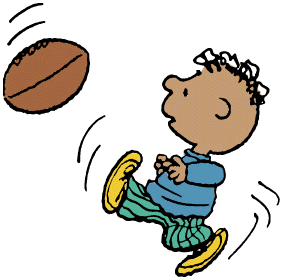
BHM2007: Good grief! Where’s Franklin?

Essay 1650


Calling out and recalling in a MultiCultClassics Monologue…

• Somebody call the Maytag repairman out of retirement. The company just recalled 2.3 million dishwashers.

• Somebody call to see if hell just froze over. Consumer Reports magazine says Mickey D’s coffee is better than Starbucks’ offerings. However, the review essentially stated the fast feeder’s Premium Roast “was decent and moderately strong. Although it lacked the subtle top notes needed to make it rise and shine, it had no flaws.” Now that’s a strong recommendation.

• A Queens Councilman proposed an official ban on the N-word. “It’s my hope this resolution will spark a dialogue in all communities and begin to move our society, especially in our entertainment culture, toward a place where the N-word is simply unacceptable to be used in any context,” said Councilman Leroy Comrie. A counterpoint rebuttal will be delivered by Michael “Kramer” Richards.

• A leading pastor from Atlanta proposed that Black churches officially denounce gangsta rap. “The church ought to say, ‘If you can’t do more positive rap, shut up and get the hell out,’” said the Rev. Michael A. Battle at the third annual Pastors and Laity Conference in Los Angeles. Now awaiting a rapper to battle Battle.

Essay 1649

Thursday, February 01, 2007

Essay 1648


From The New York Daily News (another take on the study presented in Essay 1646)…

------------------------------------------------

Racism is alive and well, black youth say in national survey

BY ADAM NICHOLS, DAILY NEWS STAFF WRITER

Many young blacks believe they are treated as third-class citizens in the U.S., ignored by a government that considers them the lowest of the low, researchers said yesterday.

The most comprehensive survey of black youth for years has found a community that sees itself as ravaged by poverty, crime and poor education - and kept down by leaders who represent only white America.

The University of Chicago survey found 48% thought even new immigrants are treated with more respect than blacks are.

Their sense of marginalization is so strong that the overwhelming majority believes the government sidelined the struggle against AIDS because it affected more blacks that whites.

“The most disheartening thing about this is that these are young people who have this feeling of isolation and secondary status,” said Cathy Cohen, who led the research.

“What shocked me was the matter-of-fact way that young people, in what's supposed to be the post-civil rights period, just expect that the government will not respond to their needs,” she said.

The nationwide survey questioned 1,590 blacks, whites and Hispanics between 15 and 25.

The findings included:

Most young black people believe racial discrimination stands in the way of success.

They think they get an inferior education to whites, they live in greater poverty, are more likely to be involved in crime and face police discrimination.

They believe the government is run by big interest groups and powerful people who care only about serving themselves and people like them.

Most put faith in their own communities uniting to deal with their own problems.

Only 11% believe they’ll see an end to racism in their lifetime.

Many believe their own role models put down their communities. Though most said they listened to rap music regularly, they considered it violent, sexist and degrading.

“I don’t think anything new is being said here,” Sonya Jonson, a hairdresser from the Bronx, said yesterday.

“Why is anybody surprised we feel alienated? Do they remember what happened in New Orleans?”

Essay 1647

Essay 1646


From The Chicago Sun-Times…

-----------------------------

Youths to rappers: Clean it up
Can raunchy music make ‘Hip Hop is Dead’ a reality?

BY ANDREW HERRMANN, Staff Reporter

They look, and they listen. But they don’t always love what they see and hear.

A University of Chicago survey shows 58 percent of black youths listen to rap daily, and nearly half watch music videos at least several days a week.

But most also say they think the videos contain too much sex and violence. Two-thirds of young black women say rap music videos portray African-American females “in bad and offensive ways.”

About 57 percent of young black men agree.

“At one point, we asked, ‘Why don’t you just stop listening to it?’ And they said, ‘Well, there’s not much else. This is what’s been given to us,’” said Cathy J. Cohen, a U. of C. political science professor who was the principal investigator for the Black Youth Project.

Too much sex, violence
The rap question was part of a wide-ranging survey of almost 1,600 young people of all races, ages 15 through 25. About 600 of those queried were black.

Additionally, about 40 young African Americans were interviewed in-depth in five Midwestern cities, including Chicago and Gary.

About 72 percent of black youths said there is too much sex in videos, and 68 percent said they think there is too much violence.

A sidewalk sampling Wednesday outside of Jones Academic Magnet High School, 606 S. State, found that some African-American teens have mixed feelings about rap -- yes, it can be vulgar, but, hey, it’s got a good beat, and you can dance to it.

“I say, OK, it’s disrespectful, but it’s good music,” said Janese Evans, 17, of Englewood. “It’s about the beat. I ignore the lyrics. I don’t let them dictate how I feel.”

Keyanna Taylor, 17, of the South Side, said, “Every time you watch a video, every time you listen to a CD, they’re always talking about something sexual or somebody’s going to kill somebody or hurt somebody. You get used to it after a while. That’s just how the song goes.”

“A lot of it is pointless, disrespectful. I used to watch videos all the time, but people started wearing less and less clothing, and more videos [made] women just look like nothing,” said Deandria Kelley, 17, of Ashburn.

Spencer Slaton, 14, of Chatham, considers rap to be poetry, though some of it is harsh, he said. But “just because 50 Cent says I should do something doesn’t mean I’m going to do it. I don’t take it to heart.”

‘Addicted to the images’
Parents have long worried about the music their kids listen to, noted Mark Anthony Neal, an associate professor of African-American studies at Duke University who specializes in pop culture. But young people today are “bombarded in ways we weren’t” through videos and iPods and the Internet, he said.

When it comes to consuming media, “the same way we watch the train wrecks on “American Idol” or Donald Trump, the kids are addicted to the images in music videos,” Neal said.

This spring, U. of C. researchers will begin analyzing the content of the top rap songs over the past 10 years.

Cohen said the survey may indicate that “a coalition across generations” is building to force the rap music industry to clean itself up.

Essay 1645


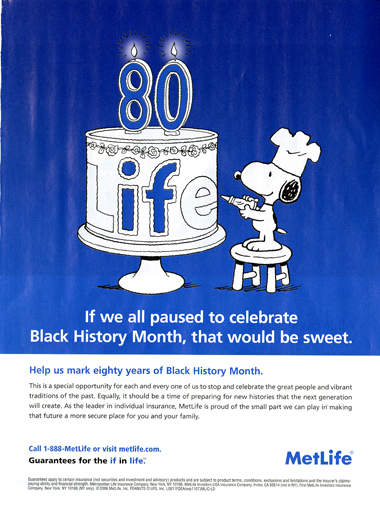
Another year, another collection of Black History Month ads.

A few advertisers opted to rerun last year’s BHM messages.

Ford takes credit for helping to create the Black middle class.

Nationwide Insurance presents family portraits, while Budweiser pours out its Great Kings and Queens of Africa portrait collection.

IBM reprints a concept that was also reworked for Hispanic Heritage Month.

Funny thing is, the new ads don’t seem any fresher than the reruns. Stay tuned.

Essay 1644


From The New York Daily News…

--------------------------------------------

Badillo is taking naysayers to school

By Stanley Crouch

Herman Badillo is a hero for our time.

Badillo, born in Puerto Rico and raised in the Bronx, has impeccable credentials — he’s been a congressman, a borough president, a deputy mayor of New York and chairman of the board of the City University of New York. He has not only been around the block, he has been in the neighborhoods and has thought long and hard about the various obstacles to those minorities presently given to accepting low levels of performance as “normal” or “cultural.” He knows enough about human beings to recognize that once their value system includes and celebrates high academic achievement, most of the problems disappear.

One of the things that has held minorities back is that many have lost sight of the value of the high standards that provide success in this country.

The result was that too many people have begun to see actual shortcomings as “cultural” styles that have to be defended against racism. Not being able to read, for instance, or not being able to speak English are not “cultural choices”; they are examples of an impermanent condition that can be cured by instruction.

Badillo, in his new book, “One Nation, One Standard,” shows he is well aware of the fact that minority students from the Middle East and Asia don’t rebel against high standards of academic performance; they go about mastering them, which is the only explanation when it is obvious that the same level of performance is seen in black and Latino students who do the same thing.

At one point, there was even a discussion in America of “black English,” as though it was a cultural choice and not a lack of mastering the language.

Arguments about cultural relativity did not serve black and Latino students well, nor did so many special programs that did not live up to the ultimate job, which is educating children so well that they can make career choices rather than have to settle for what little their skills can do for them in the workplace.

The liberals who secretly did not believe that black and Latino students were capable of rising to the challenge chose to remove as many challenges as possible in the interest of “fairness,” while the world of work moved along as it always had, not hiring them. It was never recognized that being trapped in the world of the poor because one is barely educated is a lot harder on the individual than putting in long hours of study when necessary.

Badillo recognizes the problems and rightly believes that Latinos and the nation at large will benefit from the imposition of high standards and the removal of the lower standards that express more condescension than any kind of actual regard for student potential.

In a period when public education is so slippery with snake oil, it is inspiring to read the words of someone who is not afraid to stand up to a self-serving and incompetent vision that sabotages black and Latino students.

Badillo knows that an inferior education is the equivalent of offering a pat on the back with hands that have razor blades between the fingers.

The little cuts are disguised by the backslapping but, in the long run, the wounds will result in one career corpse after another. Herman Badillo is trying to shed a light on the situation. He is a hero for our time.