Monday, July 31, 2006

Essay 879


Here’s a follow-up to a column from The Chicago Tribune that appeared in Essay 824…

-------------------------------------------

Values separate blacks, not cash, readers opine

By Dawn Turner Trice

Recently, I asked you to send your thoughts on whether the black middle class is doing enough to help poorer blacks. I heard from so many of you. This is the first installment--with minor editing--of your responses. I think it is a combination of the middle and upper classes not doing enough and the push to “keep it real.” We are inundated with negative images and stereotypes of black life.

Growing up, I was so happy to watch “The Cosby Show.” I came from that type of upper middle-class upbringing that most of America, blacks included, felt was a myth. Even today, whites find it amazing that I did not grow up in the ‘hood; that I had grandparents who went to college; and I have highly educated professional parents. During an exercise in a law school class, a white woman and I argued after I described my upbringing and what I wanted for my children. She could not believe that a black person could go to mostly white private schools and want an Ivy League education for her children. Middle and upper class blacks can adopt schools, mentor and put money back in the community all day long, but until we as a people want something better and see something better on a mass scale, the cycle of intractable poverty will not end. --Pam M.

I live in a black community where people who are involved in the mainstream economy live next door to people who are involved in the underground economy. The two groups see each other every day. One group passes the other on its way to work, school, church and family outings. The other group is usually running from something (police, gangs, personal responsibility etc.). Instead of defining our community by economic status only, we need to consider the values. There are two black communities, and each community is shaped by its values more than by income. I think that is what Bill Cosby was trying to say. --Alicia B.

I read with fascination your article. Being from New York City I see a lot of similarities. You wrote, “Is the black middle class not doing enough from close up and from afar?” I think that the black middle class is not doing enough to teach the youth of our community that there is more to life than ESPN, basketball and music. I am the youngest of 10 and I was blessed to have an extended family and support from my grandparents on both my mother’s and father’s side. I hear a lot of talk about the differences in our black communities, but little about our similarities and how we can uplift our youth. --Michael R.

I think the data you cited confirm what many of us in the black community have long been aware of but perhaps have forgotten over the past decade or so. That is, the degree of social differentiation in the black community is not as large or significant as it may be, for example, for whites or Asians. I have cousins who, like me, are graduates of Ivy League colleges and universities. I also have cousins--no further removed in terms of kinship--who have been in prison, struggled with drugs and have been involved in gangs. They are still members of my family, but I wouldn’t leave them alone in my house. The reasons for these disparate outcomes are complex. But one factor may be related to duration. The white middle-class families I know have been in the middle class for several generations and remained so even during the Great Depression. The percentage of black families who could make a similar claim is much smaller. --Darryl C.

From my humble perspective, I think the African-American community is satisfied with its current state of affairs. The census data suggest that the public education system is failing the urban youth of America, especially African-American children and more specifically African-American boys. Yet, what is the community doing to help these young men? I’m not talking about the teachers and the standout volunteers. I’m talking about the collective community. We talk a good game, but ultimately we are doing nothing. If we are doing nothing to change the situation, we must be satisfied with the situation. I ask you this: Why should the black middle class feel guilty about moving onward and upward? --Brandon S.

Essay 878


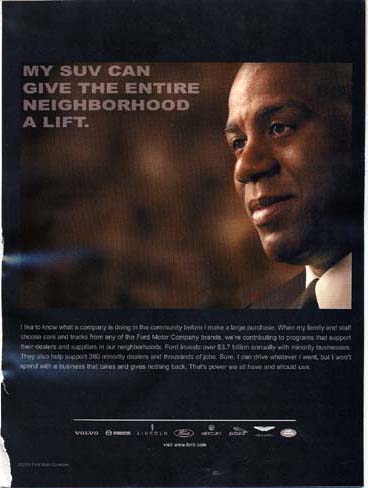
Talk about a Bold Move. Ford desperately seeks to woo Black consumers by having Magic Johnson put in a good word for them. The NBA legend says, “I like to know what a company is doing in the community before I make a large purchase. … Ford invests over $3.7 billion annually with minority businesses. They also help support 360 minority dealers and thousands of jobs.” Sounds like Magic is reading straight from the strategy brief. Oh, and Ford plans to cut about 30,000 jobs.

Sunday, July 30, 2006

Essay 877


Advertising Age reported Chrysler’s campaign starring Dr. Z failed to stop the automaker’s sales skid.

Additionally, people were not impressed with Chrysler’s messaging on German engineering.

To top things off, 80 percent of potential consumers thought Dr. Z was a fictional character — and thanks to his German accent, a bunch of folks had trouble understanding what the hell he was saying.

Is anyone on Earth surprised to hear this? Anyone at all?

Essay 876


Pepsi presents another print ad featuring urban art. Kinda looks like K-Fed breaking.

Essay 875


Inconvenient truths in a MultiCultClassics Monologue…

• News reports show over 60 percent of the country is suffering from extraordinary dry or drought conditions. Which means Al Gore is celebrating the hottest sales ever for his movie and book.

• Mel Gibson is definitely not suffering from a drought, as the actor-director is still reeling from his DUI arrest. News reports show a drunken Gibson went on an anti-Semitic rant during the incident, screaming at a Jewish police officer, “The Jews are responsible for all the wars in the world!” Maybe, but Gibson is responsible for directing most of the really bad movies in the world.

• Ford Motor Company is promoting its Fusion car by dropping 600,000 toy models into Kellogg’s cereal boxes. The automaker will follow up by dropping 30,000 employees. They’re gr-r-reat!

Essay 874


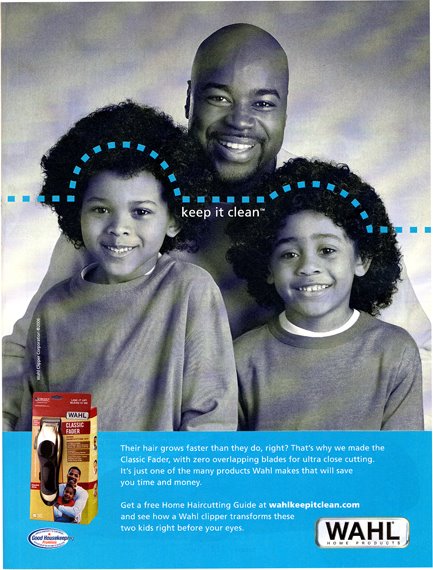
Wahl continues to unintentionally produce quirky ads (see Essay 607). This time, it looks like the kids are sporting some serious wigs.

But the craziest part awaits visitors at the company’s Web site. Folks can learn about “Womanscaping” — trimming below the belt for fun and fashion. The site tells women that “pretty is better than hairy.” There are even cool stencil designs to shape your pubic hair. Clip — uh, we mean click — on the essay title above to check it out.

Saturday, July 29, 2006

Essay 873


Saturday Evening Post (aka MultiCultClassics Monologue)…

• Target was targeted by the NAACP and fired back.

It started when NAACP President and CEO Bruce Gordon blasted retailers including Target for failing to participate in the 2006 NAACP General Merchandising survey, a 10-year-old reporting process designed to measure “corporate America’s financial relationship with the African American community.” At the recent NAACP convention, Gordon awarded an F grade to Target while announcing, “We have companies that haven’t responded [to the survey] for two years. … Some folks in our community like Target because you know they have good prices and a nice product line. They don’t even care to respond to our survey. Stay out of their stores.”

The ultra-cool retailer responded, “Target did not participate in the 2006 NAACP General Merchandising survey because Target views diversity as being inclusive of all people from all different backgrounds, not just one group. The information requested in the NAACP survey was about African American teams members only. In addition, the NAACP asked for specific information on minority populations and other company initiatives that Target considers to be proprietary. Therefore, while our company has a genuine and extensive commitment to diversity, our grade reflects the fact that we did not participate in this particular survey.”

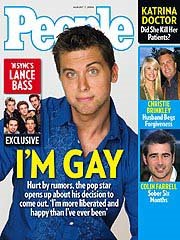
• Did anyone else respond to the Lance Bass revelation by wondering who the hell is Lance Bass?

Essay 872


A MultiCultClassics Monologue doesn’t require a subscription…

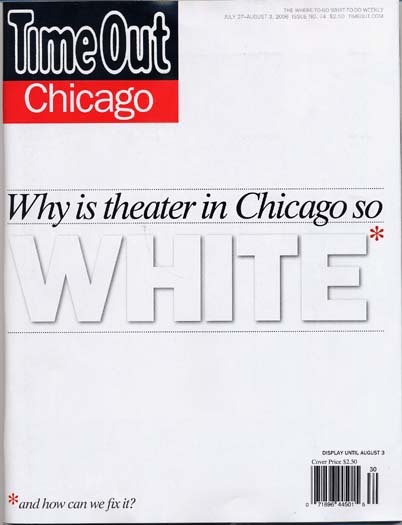
• Time Out Chicago magazine presented a cover story on the lack of diversity in the Chicago theater community (pictured above). “Most of the time the reason that people don’t consider diversity in their projects is because they quite frankly just don’t think about it,” said one Chicago theater official. Unfortunately, accessing the story online requires a subscription. Click on the essay title above to learn more.


• Babytalk magazine has sparked outrage among women with its latest cover (pictured above). “There’s a huge Puritanical streak in Americans … and there’s a squeamishness about seeing a body part — even part of a body part,” said the magazine’s editor. “It’s not like women are whipping them out with tassels on them! Mostly, they are trying to be discreet.” Not sure why folks are so upset. The typical magazine rack (pun intended) displays much worse — and we’re talking about women’s magazines, not Playboy and Juggs.

• The President of Iran ordered governmental and cultural agencies to stop using foreign words like “pizza” and “chat” — replacing them with “elastic loaves” and “short talk.” Somebody needs to send the president a subscription to Babytalk magazine.

Essay 871


MultiCultClassics presents the Sins of Synergy…

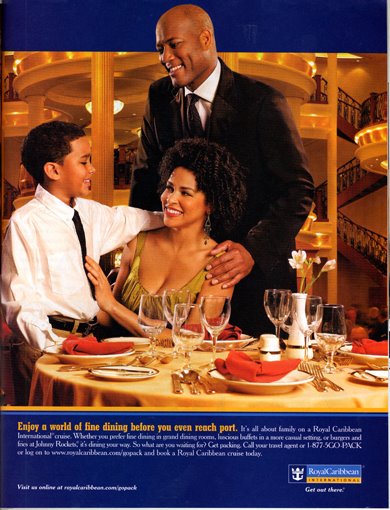
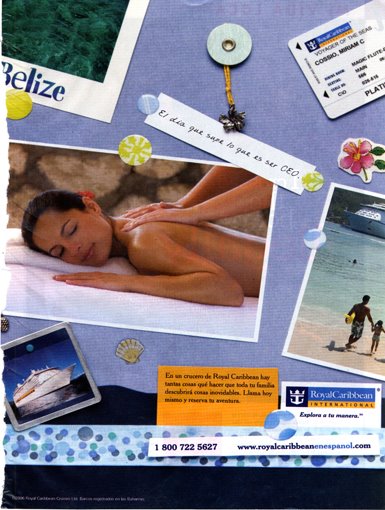
Royal Caribbean International actually produces distinct messages and layouts for Black and Hispanic consumers. But it’s hard to decide which ad sucks more.

Essay 870


Mary Mitchell of The Chicago Sun-Times continues her blog discussion on race. Click on the essay title above to catch the latest…

---------------------------------------

WHAT IS RACISM?

Having read every comment posted on this site, it’s clear to me that most of us are frustrated when it comes to race relations.

For the most part, the majority of you are willing to express that frustration without resorting to nasty insults. Despite our reluctance to talk face-to-face about race, even people who said they didn’t want to have this discussion posted a comment. What does that tell you?

Still, in order to have a real conversation about race, we have to be clear about what racism is and what it is not.

The tragic beating of Ryan Rusch in Beverly Park seemed a logical point to jump start this conversation.

Whether or not the Cook County State’s Attorney’s Office charged the three teens accused of brutally beating Ryan with a hate crime isn’t the issue. Race is involved simply because this is not black-on-black violence. If it was, most of you would not have heard about Ryan. So that’s the first thing we've got to get straight.

What role, if any, do you think race played in how this crime was covered by the media?

In other words, had Ryan been beaten up by white teenagers, or if he had been a 14-year-old black boy who was attacked by three black teenagers, would this have been front-page news? And if you believe race was a factor in how this crime is being covered, is that racism?

A reader who sent me an e-mail about the recent murder of one of his students certainly believes it is. Alexander Reed, 18, was gunned down in a South Side neighborhood while standing on the porch at his sister’s house.

“There was some type of altercation in the street and one young man pulled a gun. Alex was not involved in anyway, but he was the one who got hit,” the teacher said. “He was in his senior year in high school. It just seems to me that something should have been said at least on TV, a 10-second spot or something.”

In this reader’s eyes, the lack of attention by media “devalued” his student’s life.

“I looked at it as being racial,” he said in a telephone interview. “I feel if he was white, more attention would have been paid to it in the media. I honestly believe that. Just like the young man who was driving the car that got hit by the U-Haul Truck.”

As a member of the media, I’ve seen how these decisions are made, and I can honestly say most of what readers complain is racist, is actually insensitivity bubbling up under deadline pressure. My point is, every offense isn’t necessarily motivated by racism.

So what is racism?

Give me an example of a racist act you experienced, or an incident where you were accused of being racist. And I’m not talking about slights that ticked you off, such as being passed up by a cab or being followed around in a department store. I’m talking about those times you were convinced beyond a doubt that you were being discriminated against because of your race.

And white people, you need to come clean.

Blacks are often accused of seeing racism everywhere--a mantra that a lot of Latinos are beginning to pick up--but many of you don’t see racism at all. If you do see it, you fail to acknowledge it has a negative impact on our quality of life.

Thank you for taking the time to have this chat. Unfortunately, I’m unable to personally answer every comment from readers who have a bone to pick. But you can still drop me an e-mail at marym@suntimes.com.

Friday, July 28, 2006

Essay 869


MultiCultClassics presents the Sins of Synergy…

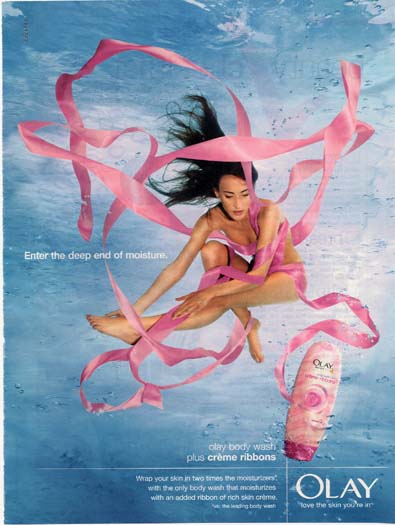
Olay goes off the deep end with its body wash, segregating the messages by product flavor — crème ribbons for the mass market and body butter ribbons for Blacks. The images are kinda striking; but the Black woman is so heavily retouched, she almost looks like an illustration.

Essay 868


Super-sized idiocy in a MultiCultClassics Monologue…

• The New York Times reported on the fast food industry’s continued super-sizing of portions. From Burger King touting its new BK Stackers to Denny’s Extreme Grand Slam Breakfast, stuff gets bigger and — from a health perspective — badder. “People know that a quadruple burger or extreme breakfast is not the healthiest choice, but I don’t think they expect to eat a whole day’s worth of calories in one sitting,” said an official of a nutrition group. “Restaurants are giving customers these choices without telling them anything about what the impact on their diet will be.” Not only are the fast feeders not telling, they’re asking if you’d also like a megaton dessert and keg of soda chaser. Click on the essay title above to read the full story.

• The charges against New York’s DJ Star — who threatened another DJ’s wife and daughter on the air — were dropped (see Essay 650). The foul-mouthed DJ must serve two days of community service and remain on good behavior for six months, including staying away from the rival’s family. Outside of the courthouse, DJ Star told reporters, “At this point in time, I am just going to be moving forward and making people aware of such things as the U.S. Bill of Rights and the establishment clause, which people don’t seem to know about or care about.” Maybe DJ Star could also become aware of things like common decency.

• A Fresno radio station switched formats from Christian content to obscene. Dubbing itself “Porn Radio,” the station now plays music with suggestive lyrics, even embellishing the tamer tunes with moans and groans. “It would appear this is another of those promotions that are simply designed to create controversy,” said a longtime Fresno radio personality. “This format belongs on Sirius or XM, not on over-the-air.” Hey, this guy needs a lecture from DJ Star.

Essay 867


MultiCultClassics presents the Sins of Synergy…

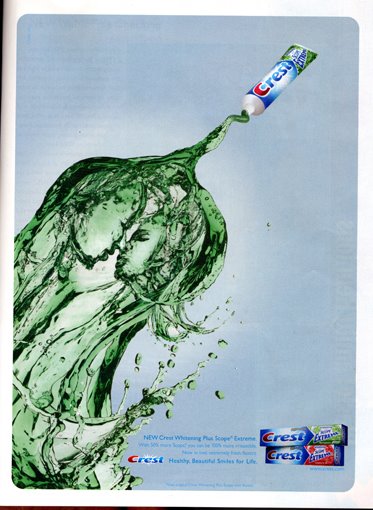
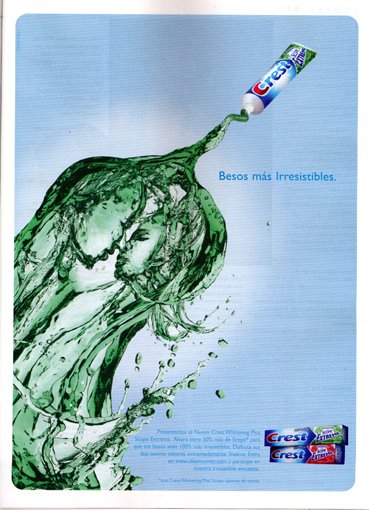
Crest uses the same imagery for its Black and Hispanic ads. Maybe the toothpaste brand believes all minorities look alike — even when they’re made from mouthwash.

Thursday, July 27, 2006

Essay 866


Political partying with a MultiCultClassics Monologue…

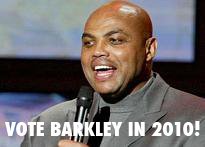
• NBA legend Charles Barkley has switched political parties and is talking about running for governor of Alabama again. “I really believe I was put on Earth to do more than play basketball and stockpile money,” said Barkley. “I really want to help people improve their lives, and what’s left is for me to decide how best to do that.” As for his decision to switch over to the Democratic Party, Barkley declared, “I was a Republican until they lost their minds.” It’s not like Barkley has never been accused of taking leave of his senses.

• A former Chicago Police Lieutenant facing charges of torturing suspects for nearly 20 years is now taking heat from three Black Chicago aldermen. The trio is seeking to stop the city from providing pension payments and legal defense to the ex-cop — and they’re likening the alleged torture to slave murders and the Holocaust. “What he did to our men was no less than what was done to Nazi Germany,” said one alderman. “The statute of limitations did not run out in Nazi Germany. People are still chasing the people. … But, when it comes to the Black people in this country, there’s always a statute of limitations.” Another alderman remarked, “We will not allow our tax dollars to be spent on criminal behavior, be it from the community or those who are serving the community.” Considering the history of political corruption in Chicago, that’s a pretty bold statement for an alderman to make.

Essay 865


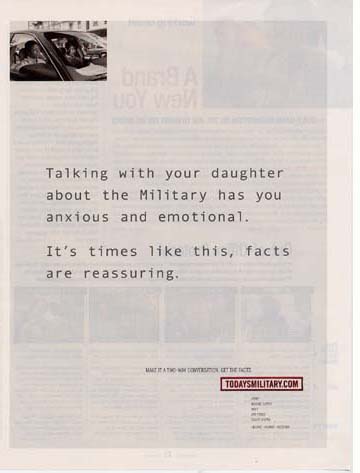
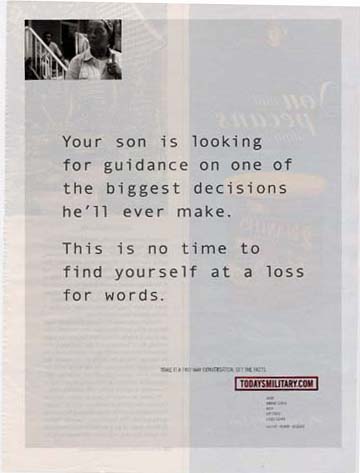
Hey, Black Moms! The Military wants you to talk to your daughter about signing up. Then talk to your son too. Who’s next? Pops? Grandma? Spot?

Looks like Uncle Sam wants your whole damn family.

Essay 864


Raising the minimum rage with a MultiCultClassics Monologue…

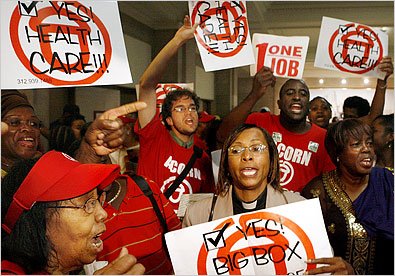
• Chicago alderman passed a bill that forces large retailers like Home Depot and Wal-Mart to pay employees a “living wage” — which translates to $10 per hour by 2010 and $3 per hour for benefits. Supporters celebrated the measure (pictured above), while retailers planned to fight it in court. Wonder how long Wal-Mart will be able to maintain low prices with high employee wages. Then again, if the employees receive more money, is it asking too much to have them act interested while on the job?

• Folks continue to debate the effectiveness of the National Guard troops deployed to support the U.S. border patrol. “This buildup is not decreasing migration at all,” said a pro-immigration activist. “Claims by the U.S. border patrol that this increased manpower does have an effect fits a pattern in which they implement some new strategy or idea when there is already a natural lull in migrant activity and then claim credit for it.” The troops will require even more help once immigrants learn that they can make $10 per hour at Wal-Mart in Chicago.

• DMX rejected a plea bargain in his traffic violations case. The rapper-actor spent a night in prison last month after failing to show up in court, but was released upon posting $25,000 bail. “I don’t feel good about this at all,” said DMX after his court appearance. “It’s not fair — $25,000 for traffic tickets? Come on. Let’s keep it real.” Hey, it’s not much crazier than $10 per hour for Wal-Mart employees.

Essay 863


MultiCultClassics presents the Sins of Synergy…

Palmer’s Cocoa Butter Formula evens skin tone — for all skin tones. And the brunette plays for Hispanic and general market audiences.


Wednesday, July 26, 2006

Essay 862


From The Chicago Sun-Times…

------------------------------------------

FX’s ‘30 Days’ flips the script on immigration

BY DOUG ELFMAN, TELEVISION CRITIC

Frank George gets his kicks when he locks and loads and heads to the Mexican border to keep people from crossing over illegally. He’s a “Minuteman,” members of a volunteer group inspired by 9/11 to put the nonviolent smackdown on Mexicans who want to cross over. But for one month, he lived with illegal aliens to see what their lives are like for the second-season debut of the FX series “30 Days.”

This is not a traditional documentary, filming what would happen naturally. It’s a pop doc that creates a situation, then records results. Show creator Morgan Spurlock and his crew do a fair job of stepping out of the way after they create situations, leading to surprisingly emotional, seemingly natural scenes. It's a contrived concept but not a contrived execution.

George is no villain, and neither is the family that takes him in. Everyone’s personal and intellectual flaws are laid bare.

But to me, George seems to represent an axiom of world history, which teaches us that once people rise into a higher class, they turn their backs on the next wave of people trying to do the same. George was brought to America as a child by his parents from Cuba. Thanks to their status as political refugees, many Cubans get in freely. Mexicans do not, by and large.

Yet in “30 Days,” George says of his Cuban family, “We weren’t given any breaks.” Um, what?

In the most effective scenes, George goes to Mexico to see where this family was living before they came here. In Mexico, they were essentially homeless, living in a field, drinking water out of a “well” that was a disgusting, glorified puddle of nastiness.

Now in Los Angeles, the patriarch takes day jobs and squeezes under houses for repair work. The matriarch’s hobby is sifting through trash and selling recyclables to save money, in a can, for her children’s future.

“I’ve collected $49 since January,” she says eagerly, unaware she is breaking my middle-class heart.

George shows the capacity to understand his opponents, the illegals, as flesh and blood. He says he would help them be Americans -- but only legally, which of course he can’t do for millions of others.

He says men don’t cry, so he doesn’t. And he says cynically that it’s funny and unrealistic that the daughter, Armida, wants to be an American and go to college. Ha, ha. How funny America is, with its hopes and dreams.

This is what defines George and Armida. She tries and fails and tries and succeeds, just as her family tried to get a better life than homelessness and are now providing for their kids. Armida represents evolution, the process of attempting. He represents conservatism, the attempt to stop change.

The grace of “30 Days” is looking at both types of people not as types, but as human beings, not just the immigrant who releases tears of joy, but the first-generation citizen whose brain won’t yield to his heart.

Essay 861


MultiCultClassics presents the Sins of Synergy…

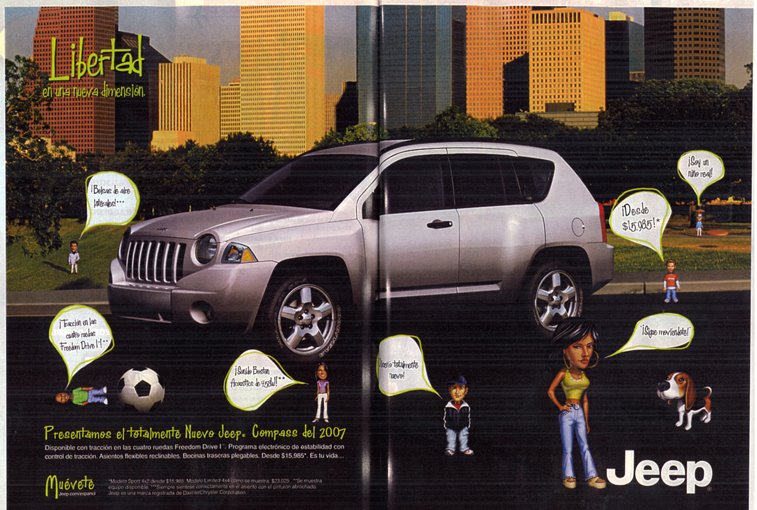
Not sure what the hell is conceptually going on with these Jeep ads. But the comic figure beside the logo switches between versions based on the audience (i.e., Black dude for Blacks, Black Latina for Hispanics). With Jeep, even cartoon characters are segregated.

Essay 860


Ugly suits are always in style with a MultiCultClassics Monologue…

• A Miami woman is suing Bacardi after being burned by a rum drink. The lawsuit stated that a bartender was pouring shots when someone lit a menu on fire and placed it in the stream of alcohol, turning the bottle of Bacardi into a flame thrower and spraying flaming rum on the victim. Where are Bacardi and Cola when you need them?

• Mo’Nique is calling for a lawsuit and boycott against United Airlines after she and her entourage were kicked off a flight. It started with a confrontation between the star’s hairdresser and a flight attendant over storage in an overhead compartment. When Mo’Nique threw a fit, another flight attendant remarked, “Tell your people that the next time they have an attitude, they are being thrown off. … Since 9/11, we don’t play around.” Upon being compared to terrorists, Mo’Nique allegedly went ballistic, leading to the official ejection. Now she’s charging racism, calling the incident “humiliating” and “something that happens to Black people all the time. They don’t have a voice. I have a voice.” Hey, now Mo’Nique can commiserate with Snoop Dogg (see Essay 586).

• A lawsuit accusing AT&T of delivering customers’ records to the government was dismissed by a federal judge. “First, the [lawsuit’s] plaintiffs cannot establish whether AT&T has unlawfully disclosed their records in the past,” wrote the judge. “Second, the plaintiffs cannot establish whether AT&T is currently disclosing their records, which would tend to show that there is a real and immediate threat of repeated injury.” So for now, customers only have to worry about the real and immediate threat of their records being given to direct marketers.

• California is seeking a 300 percent increase for the state’s tobacco tax. “Taxing tobacco will reduce smoking. That’s been proved in every state that’s raised tobacco taxes,” said a lobbyist for the American Lung Association of California. “It makes it more difficult for people to smoke and purchase cigarettes.” In contrast, a 2004 report by the General Accounting Office (a former investigative arm of Congress) stated, “As cigarette taxes increase, so do the incentives for criminal organizations, including terrorist organizations, to smuggle cigarettes into and throughout the United States.” Heaven forbid cigarettes should be categorized along with illegal drugs.

• General Motors reported a Q2 loss of $3.2 billion. “It’s rewarding to see our automotive business return to profitability on an operating basis and a clear sign that we’re on the right track, but there is more work to be done,” said GM Chief Executive Rick Wagoner. Wow, talk about seeing the gas tank as half full.

Essay 859


Mary Mitchell, columnist at The Chicago Sun-Times, is launching a discussion on race on her blog. Click on the essay title above to check it out.

-------------------------------------------

WHY I TALK ABOUT RACE.

Whether you are a well-to-do white male from Lincoln Park or are a barely-making-it single mother living in subsidized housing, you are likely to hold some misguided perceptions about race and class.

How could you not?

We live in a city that is still divided by race--and class--to the point that wherever I go, someone reminds me that Chicago is one of the most segregated cities in the nation. But do we talk about that? Nooooo.

That’s just odd.

Earlier this year, when Men’s Fitness magazine named Chicago the nation’s fattest city, we got on it. Fitness programs popped up everywhere. And you couldn’t go a day without reading or hearing about the latest dieting trends.

So why don’t we talk about race?

O.K. I’ll re-phrase that question. Why don't white people talk about race? Why don’t Asians talk about race? Why don’t Latinos talk about race?

Black people talk about race all the time.

We talk about it when we bemoan the state of public education. We talk about it when we complain about police brutality. We talk about it when we shop at neighborhood stores that sell loose cigarettes and single sticks of margarine.

Last month, I participated in a panel discussion of the movie “Crash” that was held at DePaul University. I was surprised that so many people turned out for the event. Other members of the panel included a black poet, black public defender, Puerto Rican lawyer, a black judge, a Latino lawyer, and a white lesbian/feminist/politician.

The audience included about a dozen white people.

Everyone seemed passionate about the racial themes depicted in the movie. But at the end of 1-1/2 hours of talking, we didn’t hear from one white person.

Not one white person asked a question. Or made a comment. Or shared a story about race relations. For all practical purposes, we were a roomful of black and Latinos talking to ourselves.

So what I want to know is this: Why is it so hard for white people to talk about race?

Black people aren’t shy about telling white people what irks them. White people shouldn’t be shy either. Besides, getting this weighty issue out in the open would not only clear the air, but may just help improve race relations in this city.

But be warned. This is my blog. While I welcome spirited debate, I’m not putting up with the disrespect. Please refrain from using racial slurs, hurling insults and posting comments that are meant to shock and offend.

Hopefully, this daily journal about race and class will be a true reflection of how we interact across racial and ethnic lines. Hopefully, our candid conversations will pave the way to some honest public dialogue on the subject.

If that happens, maybe one day we really won’t need to have this conversation.

Essay 858


From The Detroit Free Press…

--------------------------------------

Howell looks racism in the eye and won’t blink

By DESIREE COOPER

Striving for diversity

Some residents of Howell have spent this summer -- and the past decade -- trying to end bigotry in their area.

“A healthy community is one that accepts diversity and that clearly and outwardly rejects racism,” said Lee Reeves, president of the Livingston 2001 Diversity Council.

Formed in 1989 by business, religious and community leaders, the council has tried to help the predominantly white county -- and Howell in particular -- become a more welcoming place for people from all walks of life. The group had hoped its work would be done by the time that year’s kindergarteners graduated from high school in 2001, hence its name. But experience has taught them that true racial reconciliation requires constant work.

First step: Talk it out

In June, the council completed a two-month Community Conversation about Diversity, cohosted by Howell and the Howell Area Chamber of Commerce Foundation. About 150 people attended four public discussions.

At first, the council was “concerned that it would be a bunch of white people talking about diversity,” said Pat Convery, a council member and president of the Howell Area Chamber of Commerce. “What do we know about the black experience in our city?”

So they encouraged diverse voices to attend the conversations. Facilitators from the Detroit chapter of the National Conference for Community and Justice, an anti-bigotry organization, helped guide the dialogues.

One of the facilitators, Shea Howell, was impressed that a community like Howell, which according to the last census was 96% white, is focused upon addressing racism.

“It’s a community that could have chosen to stay in denial but hasn’t,” said Howell.

Everyone’s problem

For council members, denial isn’t an option.

“Our businesses were finding it difficult to hire the right people for jobs,” said Convery. “People of all colors and backgrounds won’t come here because of the perception that this community is close-minded.”

But the council feels its efforts have ushered in change.

“There are people who say, ‘I never thought of it like that,’ or ‘I never understood that,’” said Reeves.

“People aren’t deeply racist; they just don’t realize how hurtful behaviors can be. Anything we can do to prepare our kids for the diverse world is good.”

Howell agreed.

“People build communities based on the white, American dream,” she said. “But in our focus groups, their children are saying that the homogenous environments make them feel disadvantaged. They feel unprepared to deal with people who aren’t like them.”

The upshot has been to pull more people into standing committees that will report to the council bimonthly on their efforts to address diversity.

“If we keep moving forward,” said Reeves, “there will be a critical moment when we’ll arrive at the next level.”

If you ask me, they already have.

--------------------------------------

The vision for Howell’s Community Conversation about Diversity is to create “a welcoming, open and economically vibrant community that embraces diversity and the inclusion of people from all walks of life, where the rights of everyone are honored.” To that end, it has suggested:

Creating a welcoming statement that businesses can display in support of diversity.

Inviting a leader in the area of diversity to address the community.

Supporting the diversity efforts of the public schools.

Organizing cultural exchanges with students and community leaders.

Essay 857


From The New York Daily News…

--------------------------------------

Time to kill ‘ghetto tax’

By Stanley Crouch

The black American keeps reminding us of the best and the worst and the most backward things that we can do as a nation. There are so many problems that seem to drop like butterfly nets of barbed wire on the lives of black Americans — especially those in the lower and underclass — that we find it hard to pretend that things are exactly the same for any and everybody in the good old U.S.A.

That does not mean that we should fall easily into untenable grousing, or lean on the bent adage that nothing has changed. It is true that much has changed, and for the better. Still, we do have problems that we cannot ignore because of the demagogues and hustlers who forever take advantage of the naive among us, manipulating and taking money.

We have found over the past couple of decades that insurance companies have gouged black communities across this nation, that certain police departments have planted drugs and sent intimidating numbers of black men to prison, and now, according to research by the venerable Brookings Institution, we learn of what is being called “the ghetto tax.”

There is a significant difference in what white middle-class people and black lower-class people pay for many of the same things, such as car insurance. It has been reported that in New York, Hartford and Baltimore, the difference can average out to $400 more for the black as opposed to the white.

Brookings calls this sort of thing a “ghetto tax.” This also applies to other merchandise, produce and services like check-cashing outlets.

This is a broad extension of the fact that was discovered about a decade ago — that young black people might be denied employment on the basis of where they live, the assumption being that some communities produce good, disciplined and trustworthy workers and others do not.

In this era, when there is such a hatred of publicly declared taxes, I wonder how many of this nation’s elephants will lift their trunks to trumpet the need to remove the “ghetto tax” from business practices, which, the elephants say, would reduce the cost of living for lower-income families.

As we have seen in Harlem, where the real estate frenzy has become as loud as a sonic boom, businesses can be encouraged to open in areas that are thought fertile once the police drastically reduce crime.

This complex of law enforcement, quality education and fair business practices must be effectively orchestrated to move us closer to our national goal of virtual equality. But unless all of this is taken into consideration and woven together like a strong quilt against the chill of discrimination and deprivation, we can stop pretending that all complaints are no more than the annoying sounds of demagogues and hustlers.

We also can stop pretending that we have any serious interest in the betterment of our society.

Tuesday, July 25, 2006

Essay 856


Guess this ad serves as counterpoint to the perspectives presented in Essays 845 and 854.

Essay 855


MultiCultClassics presents the Sins of Synergy…

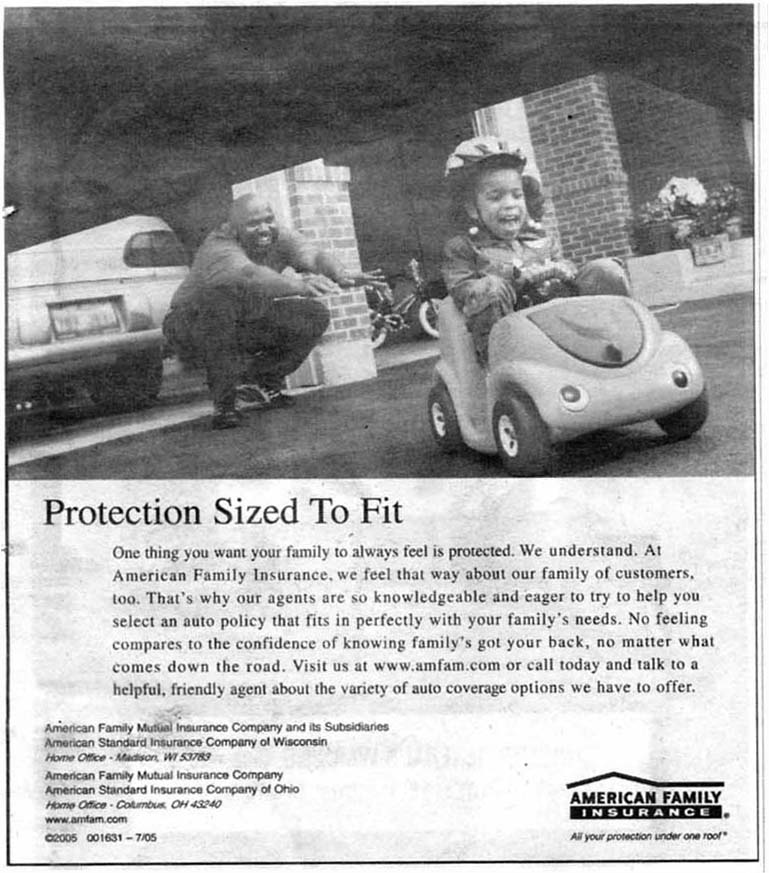
American Family Insurance must think minorities are one big, happy family. These ads for Blacks and Hispanics feature identical themes. There’s probably an Asian version with a kid riding a Japanese-model toy car.

Essay 854


From USA Today…

-------------------------------------------

Race doesn’t reflect on women’s poor body image

By Marilyn Elias, USA TODAY

Contrary to popular belief, white and non-white women are about equally unhappy with their looks, according to an analysis of 98 studies published in the July issue of Psychological Bulletin. It is the largest U.S. research ever done on feminine body dissatisfaction.

“A lot of theorizing and myths,” along with small studies, have emphasized white women’s poor body images, says psychologist Shelly Grabe of the University of Wisconsin-Madison. Minority women, it has been thought, enjoy more sensible, forgiving expectations for body shape. But Grabe and co-author Janet Shibley Hyde find little evidence of that.

There’s no significant difference between whites, Asian-Americans and Hispanics in how dissatisfied they are with their bodies, they say. And there’s no difference between whites and blacks over age 22.

White teens and college-age women do feel somewhat worse about their looks than blacks this age, the studies show. “This is the age group bombarded with ads and media messages about the ideal feminine shape: a tall, thin white woman,” Grabe says. “So white women this age may be affected.”

But as it becomes increasingly difficult to be reed-thin, older white women may compare themselves less to the media ideal and feel better as they are, she says.

TV viewing during high school affects how college coeds feel about their bodies but in different ways for whites and blacks, says University of Michigan psychologist L. Monique Ward.

In her studies, the more TV a white girl watched, the worse she later felt about her body. Watching shows with mostly white casts didn’t affect black girls’ self-images, but seeing TV shows with largely black casts improved it, possibly because a fuller range of sizes are shown, Ward says.

Body-satisfaction scores hardly tell the full story, says Deborah Schooler, a psychologist at San Francisco State University. Latino teens score more satisfied than whites in some studies, but they have the same rates of eating disorders as white girls, she says.

“We’re treating a lot more black, Hispanic and Asian women with eating disorders,” says psychologist Ann Kearney-Cooke, director of the Cincinnati Psychotherapy Institute and author of Change Your Mind, Change Your Body. In her nearly 25 years of experience, minority patients were a rarity until about a decade ago. “They’re buying into values of the upwardly mobile, and that means an ultra-thin ideal.”

Women of different races have much more similar body satisfaction levels than the two sexes, Kearney-Cooke says.

“Men are less satisfied with their bodies than they used to be, but they’re nowhere near as unhappy as women, and they’re not willing to try extreme dieting or vomiting, as women do.”

Essay 853


From The Chicago Sun-Times…

-----------------------------------------

Bush’s NAACP address just a start

BY JESSE JACKSON

After five years, President Bush finally addressed the annual NAACP conference. He said he wanted to reach out to the African-American community -- suggesting it was a mistake for African Americans to be locked into one party.

But blacks have not always voted for Democrats. After the Civil War, they voted Republican in the party of Lincoln. When the Depression hit -- and the poor were hit the hardest -- they turned to Roosevelt and the New Deal. In the 1950s, blacks voted in large numbers for Eisenhower, in part because he vowed to get us out of the war in Korea.

When Kennedy reached out to Dr. King in his Birmingham jail cell, and Nixon did not, African Americans began voting Democratic again. As Johnson helped pass civil rights legislation, culminating in the Voting Rights Act and the launch of the war on poverty, African Americans rallied in support. This was reinforced as Republicans rose to power in the South as the party of white sanctuary, profiting from politics of racial division. African Americans are not locked into any one party -- they are voting their interest.

Bush says he wants to reach out. Here’s what he could do if he were serious about reaching out:

First, pay us the respect of communicating with us. We did not always agree with Kennedy -- he opposed the March on Washington for example -- but he talked with us. The same is true of Johnson, Carter and Clinton. There were disagreements, some sharp and intense, but we kept in communication.

Second, come into the discussion with questions, not just pat answers. Let’s agree on the subjects -- and discuss the solutions. We know we disagree about some policy questions. But by talking together, we can find common ground in some places, and agree to disagree in others. For example, any conservative should be providing incentives to businesses to invest in impoverished areas -- from Appalachia to rural America to the ghettos and barrios. Providing incentives doesn’t bust the budget. It relies on private markets and it helps even the playing field so capital, the lifeblood of capitalism, flows to all parts of the body politic.

Third, don’t assume that African-American leaders are concerned only with an ethnic agenda. We worry about poverty and decent wages -- and more poor people are white than black. We worry about war -- and all Americans are concerned about war. We are particularly hit by the outsourcing of jobs and by the loss of affordable housing -- and so are working and poor Americans of all races.

Fourth, enforce the Voting Rights Act, don’t just sign it and gut its enforcement. For too long, African Americans have been locked out of voting. Now, from Florida to Texas to Ohio to Georgia, we see increasing evidence of systemic efforts by Republicans to block blacks from registering and from voting. Too often, your political appointees to the Justice Department and your nominees to the Supreme Court choose state rights over federal enforcement.

Similarly, you can speak clearly against private-sector discrimination and work to open up opportunity for all. Equal opportunity is a pro-family value. Even to this day, minorities suffer discriminatory practices in employment and in gaining loans -- business loans, mortgages and personal loans. This impedes free markets and retards economic development. Again, this doesn’t cost money -- and it demonstrates leadership.

Finally, understand that you can’t choose the leaders for African Americans or Latinos or small farmers. If you want to reach out to the African-American community, you have to talk with the leaders we choose. For years, J. Edgar Hoover sought to create a black leader who could compete with Dr. King, but he could not be displaced from above. That remains true to this day. That’s why you can pump millions into selected black churches and still lose over 90 percent of the black vote.

Your belated address to the NAACP is a beginning. It’s late. The record is clear. Our disappointments are many. But African Americans have problems to solve and miles to travel -- so we look constantly for allies. We are open to talk and looking for action. The door isn’t shut; see us through the door, and not the keyhole. Let’s meet at the door and make this a more perfect union.

Monday, July 24, 2006

Essay 852


Don’t mean to diss Bob Garfield too much, but the man continues to build on the ignorance of his previous column (see Essay 820). Last week, Garfield sensed racial undertones in an Oreos commercial starring American Idol’s Randy Jackson. Now he turns his cultural critic’s expertise on teen marketing (click on the essay title above to read the complete column).

Oddly enough, Garfield opens with the whining of a stereotypical Baby Boomer in the throes of a mid-life crisis. Check it out:

“You think this job is easy?

“Walk a mile in AdReview’s shoes. Try to find something different to say week after week for 20 years. Try to be simultaneously serious and entertaining. Try to keep a level head. Try not to damage any careers along the way.

“Is there anything more excruciating than some lametard adult copy writer trying to speak to teenagers in their own language? To see this stuff is to cringe.

“51-year-old man
Oh, and if you happen to be an incredibly macho and worldly 51-year-old man, try putting yourself into the head of the many demographic target cohorts to which we, strictly speaking, do not belong. Not only are we not in the bull’s-eye-18 to 34 years-old — we’re also not a skateboarder/gamer, a soccer mom or, to the best of our knowledge, Japanese.”

You’d think Garfield would have stopped right there. Instead, he proceeds to skewer a Wal-Mart campaign for its irrelevant copy and imagery. Has Wal-Mart ever produced anything that wasn’t lame? Do we need Garfield to identify what’s been obvious for decades?

But here’s the real point of this rant: Bob Garfield symbolizes a lot of the negative issues in America’s advertising industry.

After all, the man admits to being clueless on the cultural tip, yet he still feels compelled, comfortable and competent to comment on everything with a sense of authority. This demonstrates the blatant arrogance so prevalent on Madison Avenue.

Another quote from the column reads, “This week it’s teenage and preadolescent girls and boys. And, we’re like, that is soooo gay.” Leave it to Bob to successfully turn off gays and teens with a single sentence. He also manages to deliver statements that smack of ageism, implying that an “adult copy writer” may not have the know-how to communicate to youth. This demonstrates the discriminatory attitudes running rampant in the industry.

The cultural cluelessness and discriminatory attitudes exhibited here are deeply rooted in our business. From judging awards shows to judging job candidates, too many decisions are made through limited — and often narrow-minded — perspectives.

To be clear, this is not intended to be a direct attack on Bob Garfield. It’s highly likely that he’s a loving family man and law-abiding citizen. And it’s highly unlikely that he’s a racist or even mean-spirited. But like too many of our industry’s leaders, he is culturally clueless. And probably a little biased as well.

Maybe we should start to criticize the relevance and qualifications of the culturally clueless types among us.

Essay 851


MultiCultClassics presents the Sins of Synergy…

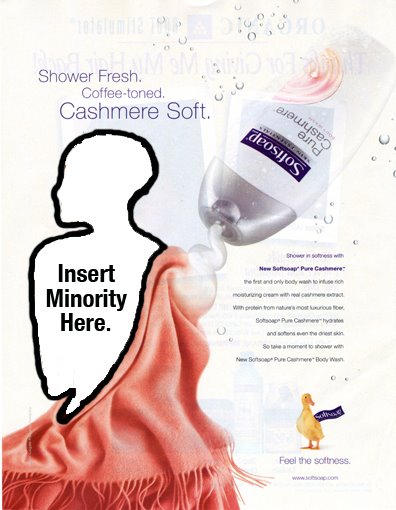
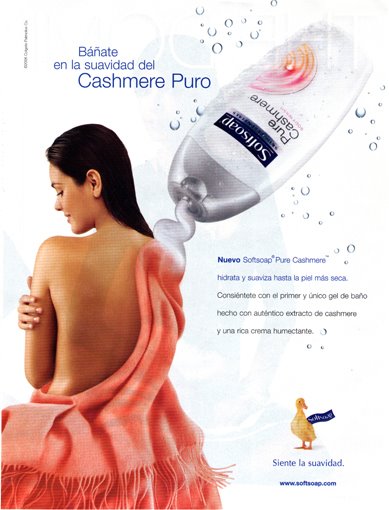
With Softsoap, the directions are easy: Just add minority.


Essay 850


Cherry Bomb and other explosive devices in a MultiCultClassics Monologue…

• John Mellencamp managed to piss off former vice president Dan Quayle during a recent concert. Before performing the song “Walk Tall,” Mellencamp told the audience, “This next one is for all the poor people who’ve been ignored by the current administration.” Mellencamp didn’t know Quayle was in attendance, and the comment inspired the ex-veep to walk out. “I still feel there are many people left behind by this administration,” said Mellencamp. “Not talking about problems doesn’t make them go away. It’s kind of telling that he chose to walk out as I was doing a song about tolerance.” Hey, sometimes you fight authority, and authority doesn’t always win.

• The Washington Post continues its series titled, “Being a Black Man.” The latest installment focuses on “Paths to Success: A Forum on Young African American Men,” which was co-sponsored by the Kaiser Family Foundation, The Washington Post and Harvard University. “Every institution is failing our young men,” said the chairman of a national commission on the “life options of young black, Hispanic and Native American men.” “We’re grinding young men of color up like glass … We’re not hearing them.” Click on the essay title above to hear the latest.

Sunday, July 23, 2006

Essay 849


MultiCultClassics presents the Sins of Synergy…

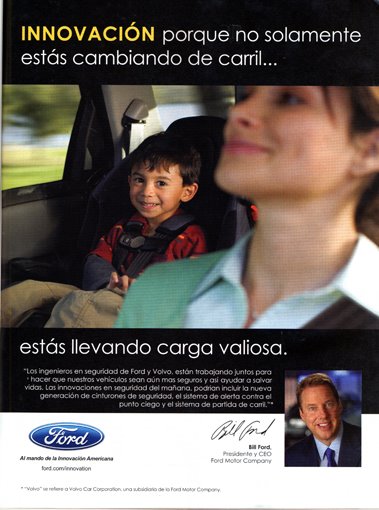
Ford Motor Company touts innovation to Whites, Blacks and Hispanics with identical executions that are anything but innovative.


Essay 848


Legal dramas in a MultiCultClassics Monologue…

• In what sounds like an episode straight out of “Law & Order: Special Victims Unit,” a makeup artist fired from the TV drama is suing for sexual harassment and wrongful termination. The makeup artist charges a female production manager invited her to participate in group sex, and ultimately fired her when rebuffed. Somebody get Ice-T on the case.

• An independent investigation showed former Rep. Randy Cunningham, currently in prison, used classified bills for schemes that brought big money to himself and partners — including $2.4 million in bribes and payments for a mansion, Rolls Royce and yacht. The classified budgets, which remain private for national security reasons, are known as “black” budgets. Funny how “black” budgets don’t benefit Blacks, but manage to keep plenty of shady White folks in the black.

Essay 847


MultiCultClassics presents the Sins of Synergy…

One of the toughest challenges for advertisers producing multicultural efforts — and the advertising agencies doing the work — involves creating synergy between messages across campaigns. This week, MultiCultClassics examines various tactics and executions employed by folks seeking to reach diverse audiences.

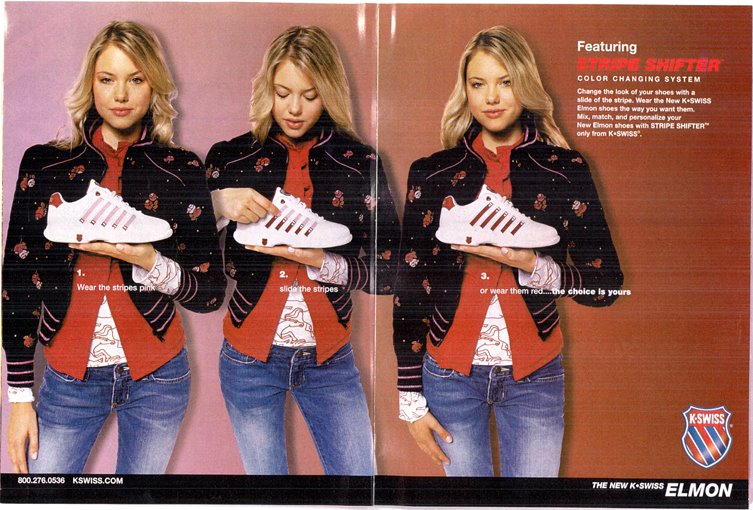
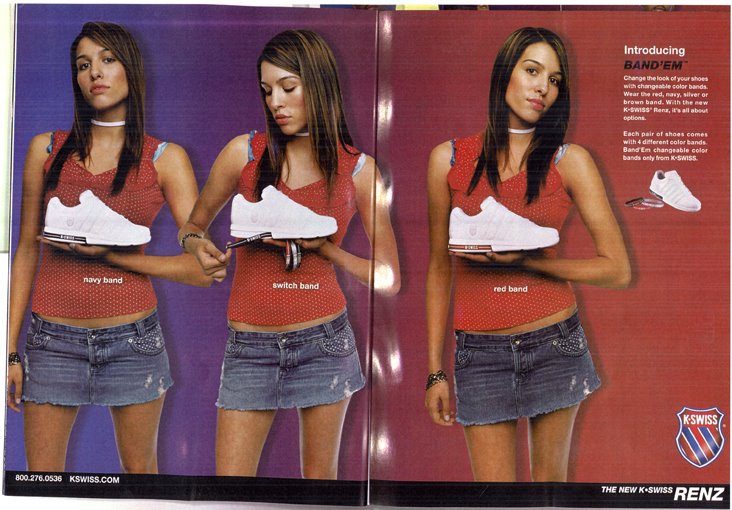
K-SWISS likes to produce identical layouts depicting people of different ethnicities. Can you guess which ad appeared in Vibe, Latina and Teen People magazines?


Essay 846


From The Chicago Sun-Times…

---------------------------------------------------------------

Mexican immigrants bring negative image of blacks

BY MONROE ANDERSON

In Mexico, the n-word is negritos. The word, which refers to dark-skinned Mexicans and non-Mexicans alike, does not carry the virulent, vicious hatred it historically has stateside. Some argue that the word, which loosely translates into little black people, is more like a term of endearment. That’s the same argument the hip-hop set employs to defend the use of the United States’ very own n-word. Last year, President Vicente Fox didn’t use either Mexico’s word or ours when he defended his government’s sale of the minstrel-modeled cartoon character Memin Pinguin on a commemorative stamp. Nor was he reported to have used either word when he said last year that “there is no doubt that Mexicans, filled with dignity, willingness and ability to work, are doing the jobs the not even blacks want to do there in the United States.”

They say it’s the thought that counts, and as it turns out, El Presidente may have been expressing what his fellow countrymen think. At least, that’s what I concluded after reading the results of a new study released in the August issue of the Journal of Politics.

The 2003 survey, conducted in Durham, N.C., found that Mexican immigrants come to the United States with negative stereotypes of black Americans. According to the Duke University study, “Racial Distancing in a Southern City: Latino Immigrants’ Views of Black Americans,” a majority of Latino immigrants, almost all from Mexico, believed that black Americans were lazy liars. A third of the immigrants believed African Americans to be troublesome.

Among those immigrants surveyed, 58.9 percent felt that “few or almost no blacks are hardworking”; 32.5 percent felt that “few or almost no blacks are easy to get along with,” and 56.9 percent felt that “few or almost no blacks could be trusted.”

The study’s findings remind me of that old black folk saying: “If you’re white, you’re right. If you’re brown, stick around. But if you’re black, get back.”

The survey reveals that while more than half of the immigrants feel “they have the least in common with blacks,” more than three-fourths of those same respondents feel “they have the most in common with whites.”

But this is the era of the new South, and the feelings aren’t mutual. The study reports “that while 45.9 percent of white respondents see themselves as having the most in common with blacks, just 22.2 percent of whites see themselves as having the most in common with Latinos.”

To further distort this new paradigm of race relations, half of the blacks surveyed felt close to Latinos and half the blacks felt they had “the most in common with whites.”

Ironically, the white Southerners, whose ancestors authored the old black stereotypes, no longer subscribe to them. Only 9.3 percent of the whites “indicate that few or almost no blacks are hardworking; only 8.4 percent believe that few or almost no blacks are easy to get along with…”

“We were depressed about a lot of our study,” Duke University Professor Paula McClain, who headed the study, told me in a telephone interview, because the Latino immigrants are “not coming into this country with a blank slate on this issue.”

Mexico has a colonial past and all the racial baggage that historically comes with it. That many recent Mexican immigrants bring racist attitudes should come as no surprise. But as our nation moves forward, this backward thinking must be addressed in Durham, Chicago and nationwide. We have too many homegrown racists. We don’t need to import any more.

When the next wave of pro-illegal immigrant demonstrations sweeps our nation, I hope African-American leaders will have talked to Latino leaders about the need to talk to the new arrivals and explain to them that we’re all in this together. Such a bicultural, bilingual dialogue could forge a black-Mexican bond too powerful for words.

Essay 845


From The Chicago Tribune…

----------------------------------------

Think a stroke is sexy?
Those promoting the idea ‘big is beautiful’ endanger the health of black women

By Kayce T. Ataiyero

80 percent of black women older than 40 are OVERWEIGHT, according to a study released this month by The Cleveland Clinic.

53 percent of black women over 40 are OBESE, according to the study.

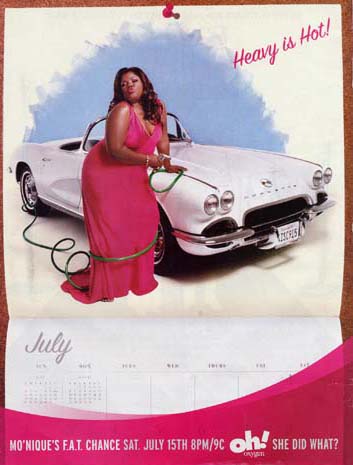
Last weekend, black comedian Mo’Nique held her second “Mo’Nique’s F.A.T. Chance,” a beauty pageant for full-figured women who are “fabulous and thick.” The popular show, on the Oxygen network, encourages fat women--and the world--to believe they are beautiful by shattering myths about big girls. Fat girls can look sexy in lingerie. Fat girls can ride horses. Fat girls can do choreographed dance numbers.

But what Mo’Nique doesn’t tell you is that big girls also have big health problems, such as heart disease and diabetes. Ain’t nothing sexy about a stroke.

Obesity in women is one of the most serious public health threats in the country. Of women ages 20 to 74, 62 percent are overweight, according to the American Obesity Association. And 34 percent are obese, which is defined as having a body mass index of 30 or higher. Body mass index is a measure of body fat based on height and weight.

The situation is particularly dire in the black community. More than 80 percent of black women older than 40 are overweight, according to a study released this month by The Cleveland Clinic. More than 53 percent are obese. And the incidences of heart disease, high blood pressure, hypertension and diabetes among black women are at epidemic levels.

These women are the ones Mo’Nique is targeting. She has made a career out of being an overweight woman. And she is at the forefront of one of the more socially irresponsible movements of our time.

For generations, obesity among black women has been deeply rooted in our cultural heritage. African women’s wide hips and thick bodies were viewed as well-endowed, affluent, sturdy enough to bear many children. These women ate high-calorie, fatty foods to get the energy they needed to work in the fields.

On a subtle level, African girls learned that African men and families valued large women, said Ruth Johnson, an associate professor of nursing at Fayetteville State University in North Carolina. Those cultural values were transmitted to the United States during slavery, Johnson said in an article analyzing obesity trends in African-American women.

These early ideals have lingered among black women, despite mainstream society’s emphasis on thinness. A 2004 Boston College study of body-image issues among African-American adolescent girls found that they have high self-esteem about their bodies and, by and large, do not accept white notions of weight.

Many black women have a distorted view of their weight, and that view is reinforced by their cultural aesthetic, said Dr. Cheryl Rucker-Whitaker, assistant professor of preventive medicine at Rush University Medical Center.

“I had a woman in a workshop whose [body mass index] was higher than 30 say to me, ‘I am not obese, look at me,’” Rucker-Whitaker said. “They might look good in their clothes or be attractive to their boyfriends, and you have these cultural icons saying it’s OK. That is really the wrong message to send.”

To be certain, notions of beauty are not the only culprits. Many factors are converging in this epidemic.

Some researchers point to diet, saying the eating habits of black women have long been influenced by cultural tradition. A LaSalle Bank study released last week said blacks who live in “food deserts”--neighborhoods where there are more fast-food restaurants than grocery stores--tend to make poor food choices.

Other studies suggest that black women, particularly those with low income, might be using food to cope with “psychosocial stress.” High rates of single motherhood have many black women assuming sole responsibility for sustaining their families, pressure that can prompt compulsive overeating. But higher rates of obesity in black women are seen at all socioeconomic levels.

Though the medical community has mixed opinions on what is hurting black women, it’s clear that encouraging them to be overweight is not helping.

Persuading women to love themselves is a good thing. Far too few women of any size have a positive self-image. But too many black women are using our culture’s affinity for thicker bodies as a license to carry too much weight. And Mo’Nique’s celebration of obesity sets a dangerous example for women who wrongly equate loving themselves with accepting a size that is unhealthy.

It’s a mistake I’ve made myself. As a woman who has struggled all my life with being overweight, I thought that my size was an aesthetic issue. That was until my mother, who also has been overweight her whole life, suffered congestive heart failure earlier this year. At age 50, she was near death. Only 25 percent of her heart functioned properly. My mom has been forced to lose the weight, and so have I.

My wanting to lose weight isn’t about buying into societal beauty standards or about hating myself. And it has nothing to do with whether I think I am cute.

It’s about self-preservation. A beautiful corpse is still a corpse.

Essay 844


Seems like a lot of adfolks are publishing books lately — Phil Dusenberry, Pat Fallon, Allen Rosenshine, Sally Hogshead, Steve Lance/Jeff Woll and God knows who else. Must be a Boomer thang.

Add Ernie Schenck to the list with his upcoming book, The Houdini Solution (pictured above).

To quote the author’s own hype, “The Houdini Solution (McGraw-Hill) turns the conventional wisdom on creativity on its ear. Where most creativity books are pretty much dedicated to the idea of thinking outside the box, The Houdini Solution sees it differently, arguing that it’s the presence of constraints, not their absence, that ultimately leads to breakthrough thinking.”

Schenck’s career highlights include creating tons of award-winning advertising, writing the advertising column for Communication Arts and running a provocative blog — Ernie Schenck Calls This Advertising?

Ernie’s a good guy. That alone should make purchasing his book mandatory for everyone.

The Houdini Solution is slated for an August 31 release. Pre-order the book via Amazon.com or Barnes & Noble.

Saturday, July 22, 2006

Essay 843


This is an interesting concept, but it almost looks like the car is zipping across the track to beat out an oncoming train. Bet the legal department was sweating over this one.

Essay 842


ICE and other chilly news in a MultiCultClassics Monologue…

• U.S. Immigration and Customs Enforcement doubled the number of employers arrested for hiring illegal immigrants this year. So far, ICE has nabbed 445 folks and picked up about 2,700 others suspected of violating the rules. “ICE is taking an increasingly tough stance against egregious corporate violators that knowingly employ illegal aliens,” said an ICE official. “This is a wholesale departure from the past system of sanctioning corporate violators with minor fines, which were rarely paid in a timely manner or at all.” In other words, ICE has decided to start living up to the enforcement part of their name.

• Federal prosecutors are cracking down on migrant smugglers. Three Florida men allegedly involved in a smuggling ring were slapped with a 68-count indictment, and they face possible life sentences after a woman died during a car chase across the border. “I do believe smuggling ventures go well beyond individual drivers and are part of larger organizations,” said a federal lawyer. Somebody better tell it to ICE too.

• Ice queen Naomi Campbell has taken her tantrums beyond housekeeper beating. The supermodel was arrested for staging a disturbance outside an ex-boyfriend’s home. Campbell claimed she was trying to return belongings. Probably wanted to give back jeans and a cellphone.

Essay 841


The folks responsible for this stupid campaign ought to be slapped.

Essay 840


From The Chicago Sun-Times…

----------------------------------------------

Racism still blocks opportunity for blacks, Hispanics

BY RALPH MARTIRE

Last month, the U.S. Supreme Court agreed to review whether race can be considered when assigning children to schools. The cases concern Seattle and Louisville, Ky., but the practice is followed in various ways by school districts from coast to coast. For instance, Downstate Champaign is under long-standing judicial supervision to ensure none of its schools have concentrations of black pupils that are significantly greater than the overall percentage of black students in the district. Having a district under court supervision isn’t novel, considering the numerous desegregation cases that followed Brown vs. Board of Education. Recall that the Brown case exposed the fallacy that racially segregated public schools provided “separate, but equal” education.

Brown vs. Board was decided five decades ago. Some believe that’s long enough to render the case an anachronistic vestige of America’s racist past. Under this reasoning, American society has effectively become color-blind, so affirmative action programs are no longer needed, and in fact are unconstitutional. In a color-blind society, giving any consideration to the race of a minority applicant when making job or school admission decisions would violate the constitutional rights of the white person who lost the applicable slot.

Roger Clegg, president of the Center for Equal Opportunity, is a proponent of this world view. He denigrates affirmative action as a “touchy-feely” social science that has no role in American society when admitting individuals to any schools. Similarly, Clegg rails against affirmative action in jobs, claiming ‘there is no logical, empirical or moral justification” for the practice. Were that it was so.

There’s all too much data that indicate racism is still very much with us, going to the very heart of what America is supposed to be all about: opportunity. Nationally, blacks and Latinos have lower wages and higher unemployment rates than whites. Meanwhile, according to a 2006 Harvard University study, school segregation for blacks and Latinos has worsened since 1992. Some of the problems Latinos experience may be attributed to the immigrants’ willingness to take low-paying jobs and English proficiency issues. None of those factors, however, are at play for blacks.

The Illinois data are as bad or worse. In K-12 education, Illinois ranks as the third most segregated state for blacks, with 82 percent of black children attending majority minority schools. Latinos don’t fare much better, as 76 percent of Latino children attend predominantly minority schools. Ninety percent of white kids go to virtually all-white schools. Clearly, the Illinois school system is still separated by race, but is it now more equal by race? Not from a funding standpoint. Minority school districts in Illinois start out with $1,154 less per child to spend on education than do predominantly white school districts, the second worst funding gap nationally.

It should come as no surprise that economic data reveal striking disparities in wages and unemployment levels between whites and minorities in Illinois. Over the past 15 years, the wage gap between whites and Latinos in Illinois worsened by 24 percent, while the wage gap between whites and blacks worsened by an outrageous 162 percent. Hard to believe that this wage discrepancy would manifest in a “color-blind” society. But wait, there’s more. In addition to wage disparities, blacks and Latinos in Illinois also have much greater unemployment rates than whites. These racial discrepancies exist across all age levels and, notably, across all education levels. So if you’re black or Latino in Illinois, even if you successfully complete college and graduate with a B.A. or better, you’re statistically less likely to get a job, and more likely to be paid less than a white.

Martin Luther King Jr. described the American dream as: “A dream of equality of opportunity, of privilege and property widely distributed, the dream of a land where men no longer argue that the color of a man’s skin determines the content of his character; the dream of a land where everyone will respect the dignity and worth of human personality.”

By any metric, America has failed to realize this dream. Until we do, it is a moral imperative that the nation not only be willing to consider the role race plays in society, but that we address it head-on. Only then will we identify and destroy the social structures that, intentionally or not, keep racism alive.

Essay 839


From The New York Times…

----------------------------------------

Young Latinas and a Cry for Help

A recent series in the Spanish-language New York newspaper El Diario/La Prensa sheds some light on a mostly overlooked national phenomenon, the misunderstood and endangered young Latina, who represents one of the fastest-growing segments of the American population. Hispanic teenage girls attempt suicide more often than any other group. They become mothers at younger ages. They tend not to complete their education. They are plagued by rising drug use and other social problems.

A federal study found that a startling one in six young Hispanic women had attempted suicide, a rate roughly one and a half times as high as that among non-Hispanic black and white teenage girls. If there was any good news, it was that these young women usually survived. A five-year study now in its second year in New York is being led by Dr. Luis Zayas, a professor of social work and psychiatry at Washington University in St. Louis, who says the self-destructive behavior seems to affect Latinas of every origin and every region of the country.

El Diario tracked several young women and found that they faced particularly acute social pressures, especially if their parents were foreign-born. Dr. Zayas and other experts note that the suicide attempts trend higher for Latinas who are the first generation born in the United States.

Adolescent and teenage girls with families recently rooted in Latin America are expected to adhere to old culture traditions, including tending to other family members and putting themselves last. Self-esteem issues are common among teens generally, but they appear magnified for young women who cannot seem to fit in at home or away from it.

About one-quarter of Latina teens drop out, a figure surpassed only by Hispanic young men, one-third of whom do not complete high school. Latinas, especially those in recently arrived families, often live in poverty and without health insurance.

Another piece of the puzzle is how to address the complication of very early, usually unmarried motherhood. Religious beliefs in Hispanic families often limit sex education and rule out abortion. Federal statistics show that about 24 percent of Latinas are mothers by the age of 20 — three times the rate of non-Hispanic white teens.

Solving these problems will require more than research. What is needed is a larger effort that includes educators, policymakers, families and communities. Here’s one more statistic: One in four women in the United States will be Hispanic by the middle of the century. The time to help is now.

Essay 838


A hard-driving MultiCultClassics Monologue…

• NASCAR has been running its “Drive For Diversity” program to build diverse participation and audiences. Hey, if NASCAR can make deliberate efforts to create diversity, you’d think it would be a cakewalk for the advertising industry. Click on the essay title above to learn more about the “Drive For Diversity” program.

• Ford Motor Company recorded a $123 million loss for 2Q. Chairman Bill Ford said, “We are well aware of the need to act quickly and decisively to reduce our losses and regain our momentum.” If not, the automaker will need to consider changing its tagline to “Fold Moves.”

Friday, July 21, 2006

Essay 837


Published in USA Today…

---------------------------------------

‘Gangsta lit’ poisons black audiences

Commentary by Yolanda Young

Gangsta rapper 50 Cent has partnered with MTV/Pocket Books to create graphic novels as explicit as his lyrics: “They say I don’t sound like a killer well how a killer sound? I bet I grab a foe pound and back that ass down.” (I’m A Hustler 2000).

“Fitty” will fit right in to the gangsta lit/ghetto fiction/street lit genre in which venereal disease and automatic handguns are practically characters.

A 2004 study by the National Endowment for the Arts found that Hispanic and black males had the lowest rates of literary reading, at 18% and 30% respectively. Though reading rates are falling for all groups, from 1992-2002 African-Americans had the largest decline, from 45.6% to 37.1%.

Reading literature is important because it expands one’s vocabulary, perspective and intellectual capacity. And though some might argue that any reading is better than none, the reader ingests poison when metaphor and imagery are replaced with sex, violence and expletives.

There is a lot of it out there already. Though it is difficult to obtain accurate sales numbers because of their guerrilla marketing tactics (these books can be found at car washes, street vendor tables and martini parties), the telltale of their profitability is that titles such as G-Spot, Bad Girlz and Payback Is a Mutha are showing up in mainstream publishers’ catalogues.

At a forum on the subject at this year’s Book Expo in Washington, it was suggested that these books merely provide readers with what they crave and know. Perhaps in part, but these publishers are just doing a better job of reaching blacks in less traditional settings.

Consider Vickie Stringer, who was in prison from 1994-2001. She self-published her first novel, Let That Be the Reason, which depicts the lives of women in drug trafficking. In 2001, she founded Triple Crown Publications, the imprint of choice among many young black readers. Her publishing house is named for the crew she hung with during her drug days. Stringer seems to hustle books much the way she did drugs.

An unseemly prospect to many, but so too was the dearth of blacks I found at a Washington book signing for the thirtysomething African-American writer Colson Whitehead. In their stead was a crowd of white seniors who live in the affluent neighborhood where the signing was held. The MacArthur Foundation Fellowship recipient and writers of his ilk must do what 50 Cent, Stringer and even Pulitzer Prize-winning novelist Toni Morrison have done — find and seduce a black audience. Morrison found hers at church gatherings for her Love tour, but they can also be found in classrooms, social clubs and beauty salons.

Distasteful maybe, but not as much as a generation consuming venom.

Yolanda Young is author of On Our Way To Beautiful.

Thursday, July 20, 2006

Essay 836


President Bush at the NAACP Convention:

“I understand that racism still lingers in America … It’s a lot easier to change a law than to change a human heart. And I understand that many African-Americans distrust my political party.”

“I consider it a tragedy that the party of Abraham Lincoln let go of its historical ties with the African-American community … For too long, my party wrote off the African-American vote, and many African-Americans wrote off the Republican Party.”

“President Johnson called the right to vote the lifeblood of our democracy. That was true then and it remains true today.”

“I come from a family committed to civil rights … My faith tells me that we are all children of God — equally loved, equally cherished, equally entitled to the rights He grants us all.”

“For nearly 200 years, our nation failed the test of extending the blessings of liberty to African-Americans. Slavery was legal for nearly 100 years, and discrimination legal in many places for nearly 100 years more.”

Essay 835


A Miniature MultiCultClassics Monologue…

• A new report by the Pew Internet & American Life Project showed 76 percent of bloggers are online to express themselves and share experiences versus seeing their work as a form of journalism. Additionally, there is great diversity in the blogosphere, with 11 percent Blacks, 19 percent English-speaking Hispanics and 10 percent identifying themselves as another race. And there’s probably a significant percentage who don’t qualify as being part of the human race.

Essay 834


From nationwide news sources…

----------------------------------------

‘The Class’ unbelievably white

BY DOUG ELFMAN, TELEVISION CRITIC

PASADENA, Calif. -- CBS is wheeling out a new sitcom in the fall called “The Class.” It stars eight actors. All of them are white. The show is entirely ivory, except that in the first episode, a white character has a white daughter named Oprah and an Asian-American daughter who has one word of dialogue. Nothing to be alarmed about, right?

Last week, a reporter asked the producers at a press conference, “Why aren’t there any people of color in this show set in 2006?”

“It is something that is unfortunate,” one of the two white co-creators said. “It happened because when we wrote the script, we wrote it color-blind.”

Color-blind? White’s not a color? Eight white hues blended together don’t create white bread?

This week, I relayed that “color-blind” story to Chris Rock -- narrator of his race-conscious comedy “Everybody Hates Chris” on UPN -- and he asked me if the show is supposed to be set in multicultural New York.

“If it’s in New York, then f--- ‘em,” Rock said.

Actually, “The Class” is set in multicultural Philadelphia, which is 46 percent white, 44 percent black and 8 percent Hispanic.

Come fall, Rock’s show and others with black leads will be piled together on Sunday nights on the new CW -- a merger of UPN and the WB -- and these shows will compete in a time slot against NBC’s new night of pro football.

In other words, most black-staffed shows on broadcast television belong only to one night on one network.

Pathetic.

But at a press conference on Monday, it was TV critics (a largely white group) who focused on this situation more than the black producers of the CW’s “Chris” (Rock and Ali LeRoi), “All of Us” (Jada Pinkett Smith), “Girlfriends” and “The Game” (Mara Brock Akil).

Indeed, Chicago-reared LeRoi suggests it’s not necessary for TV to air specifically “black” shows. He contends black people generally don’t dominate American cities, so they don’t have to lead TV shows, either. The ensemble casts of “Grey’s Anatomy,” “The Wire” and “Lost” are the best models of integration, he says.

“There are certain models out there where you just deal with this community of people, and you involve them in the program,” he says. In “Chris,” he says, “We have white characters on the show, black characters, we fold in some Asians and some Latinos. We just put them in there and we don’t make a big deal out of it.”

But that’s the point. “Chris” attempts to portray heritages of a microcosm in New York, whereas the makers of “The Class” chose to set that comedy in the big white city of ... Philadelphia?

LeRoi argues, from the perspective of a successful producer, that TV is “about making a good show for the audience that’s buying the product. Find your audience and sell them what you can sell them.”

He’s right that not every show has to be as diverse. And diversifying doesn’t guarantee a show will be good -- but neither does non-diversifying a show.

When white people are writing white shows for white TV executives who have white viewers in mind, that’s not America. That’s Disgustica. TV is art for the masses. If on the whole it’s not an echo of America, it is false art influencing pop culture, and many viewers would be justified in wondering why people who look like them can’t be leaders.

Away from the CW (which also has Tyra Banks fronting “America’s Next Top Model”), Dennis Haysbert is a co-lead in “The Unit,” and that’s about it for black leads on broadcast networks.

There’s a more glaring lack of Hispanic leads. There are 41 million Hispanic people in America. On the fall broadcasting schedule, there is one notable Hispanic-fronted show, “Ugly Betty,” produced for ABC by actress Salma Hayek.

Even the producers of “The Class” admitted their mistake in an awkward explanation. They spoke about how this white character was adopted by Korean parents, and how that character has a Hispanic boyfriend, la la la.

“If we had it to do over again,” creator David Crane said, “I think we would have approached the piece differently.”

Unfazed, Akil -- who is promoting “The Game” as a comedic and biting portrayal of football wives and their men -- looks at the CW’s night of black stars as an opportunity akin to when Bill Cosby “rebuilt the half-hour” on NBC, and when Fox (now fairly white) once forged a whole network around black actors.

“This,” she says, “is a night to prove that the other networks are making a mistake.”

Essay 833


You’d think a promotional tie-in with a pirate movie would lead to a Black-targeted ad incorporating phrases like “Yo, ho, ho!” and “booty.” Guess somebody deserves credit for avoiding the stereotypical clichés. At the same time, given the growing concerns surrounding trans fat cooking, it’s strange to see a Mickey D’s ad containing the words “Dead Man’s Chest.”

Wednesday, July 19, 2006

Essay 832


Spelling it out in a MultiCultClassics Monologue…

• President Bush will speak at the NAACP convention on Thursday, breaking a 5-year run of refusing to address the group. Aides are probably working around the clock, trying to teach Bush how to spell NAACP.

• The Brookings Institution presented a study showing the urban poor pay a “ghetto tax” on costs for everyday necessities — including higher car insurance rates, and prices for furniture and appliances from “rent to own” retailers. “There’s a large and for the most part overlooked opportunity here to help low-income families get ahead,” said a researcher who wrote the report. “That is to reduce their costs.” Sounds like a topic for Bush’s NAACP address: “Read my lips. No more ghetto taxes.”

• Congressional investigators discovered hundreds of thousands of dollars of waste and abuse in Homeland Security Department expenses. Officials allegedly bought iPods, beer and more. The iPods were needed for Secret Service “training and data storage.” There’s got to be an awesome iPod ad campaign idea here.

Essay 831


Advertisers shouldn’t settle for ads like this. Advertising agencies shouldn’t sell ads like this.

Tuesday, July 18, 2006

Essay 830


A few more comments from AdAge.com in response to Bob Garfield’s column (see Essay 820)…

-----------------------------------------------------------------

>Bob Garfield may be the Simon Cowell of the ad industry, but I’m sure as hell glad someone is finally starting to talk about race as a neutral subject matter, not as an emotionally charged battleground. I’m sick of people tip-toeing around the most innocuous comments in fear of offending. The disconnect between message and context has become ridiculous — things are taken out of context all the time, as if we need to look for more sources of conflict. Forget the “n-word” — “race” itself has become a taboo word. Kudos, Bob, for putting it back in our vocabulary for what it actually is - just a word.
— PHILADELPHIA, PA

>This is becoming quite the limber column with how far Mr. Garfield is stretching to cull controversy from mediocre advertising. From reading homophobia into a seemingly harmless and playful Dodge Calibur ad to questioning the racial undertones of a childish Oreo spot, it’s becoming quite the odd, little pattern — and it leaves me wondering what could possibly be next. Perhaps that the Take 5 “Taste and Believe” campaign has religious significance? Maybe that the stampeding of the old Six Flags mascot is an affront to senior citizens? Please. How about reviewing some truly different, big-time advertising or giving us all examples of quality work that’s making a difference in the marketplace? While I enjoy a good laugh, this is really kind of silly. Or, maybe I’m reading too much into this...
— New York, NY

>Bob, methinks thou dost protest too much.
— Westfield, NJ

Essay 829


From the July 3rd issue of Advertising Age…

-----------------------------------------------------------------

How to target blacks? First, you gotta spend
P&G, GM, others aren’t advertising heavily in African-American media

By Lisa Sanders

Although hispanic ad agencies complain that marketers devote only about 3% of their ad budgets on average to reach Latino consumers, advertisers spend far less to target African-Americans.

Procter & Gamble Co., by far the largest advertiser to both groups, spent $157 million on Hispanic advertising in 2005 and $52.5 million in African-American media outlets, according to TNS Media Intelligence. General Motors Corp., the No. 2 advertiser in both rankings, spent $112 million on Hispanic advertising and $29.4 million in African-American media. Neither company returned calls for comment.

In its July issue, Black Enterprise magazine takes a look at those companies it says excel in reaching African-American consumers. As part of its “40 Best Companies for Diversity” report, the magazine’s editors examined how companies use their marketing dollars to reach black consumers. They examined TNS data to see which companies spent most on black-owned and black-targeted media (see chart) and combined that with data gleaned from surveys sent to corporations to compile a list of the 10 best in marketing diversity. It includes: Altria Group; DaimlerChrysler Corp.; Ford Motor Co., Procter & Gamble Co. and Wal-Mart Stores.

Perceptions about diversity clearly vary. Only two of those companies appear on DiversityInc magazine’s annual Top 50 list of the best companies for diversity, which is based on wider measures including CEO commitment and supplier diversity. Ford and DaimlerChrysler are Nos. 37 and 43, respectively.

“We tried to identify those companies that do a good job. Who takes black consumers seriously? Who embraces them?” said Alfred Edmond, Black Enterprise’s senior VP-editor in chief. “Part of it is based on where they’re spending, but not all of it.”

He believes that the companies that tend to do the best in marketing diversity are those that are most dependent on individual consumers, because they’re best attuned to the needs of their varied ethnic groups.

The Escalade

As an example, he points to GM, and how the company has capitalized on the Cadillac Escalade’s popularity with African-American men. “The original market for sports-utility vehicles was suburban families,” he said. “But GM found that the car was popular among single black men, and not only built campaigns around them but also produced products to appeal to them right off the assembly line.” Noting that GM’s chief designer, Ed Welburn, is the first African-American to run the design studio of any major automaker, he comments: “They have diversity all the way down the line.”

Retailing behemoth Wal-Mart got on the list for initiatives launched earlier this year that aim to better serve its ethnic customers. About 1,500 of its U.S. stores are located in areas with “significant” African-American populations, and to meet the needs of those customers, the company is merchandising carefully. A newly opened store in Evergreen Park, Ill., just outside Chicago, carries an improved choice of ethnic hair-care products as well as a music selection that focuses on gospel, rap and other types of urban fare. Wal-Mart also plans to introduce an urban fashion brand called Exsto in 300 urban markets.

Mr. Edmond praises recent print ads from Wal-Mart. “One shows a black woman optometrist interacting with customers and her family and kids. It humanizes African Americans without homogenizing them. It also showcases some of their concerns, which turn out to be the same as those of the larger general market.”

Still, Mr. Edmond cautions that even those companies that made Black Enterprise’s list have room to improve. “We’re talking about the best of the worst,” he said, noting that many companies continue to ignore black-owned and targeted media, assuming they can reach African-Americans via general-market media.

Essay 828


Special Delivery: letters published in the July 3rd issue of Advertising Age…

----------------------------------------------------------

Attracting minorities not new challenge

Re: “Still so white; still no one really wants to discuss it.” (AA, June 19). There was a time when lots of people in the ad business discussed the dearth of blacks in this business. It was mid 1960s in Chicago when I came up with the idea of a 14-week Basic Ad Course sponsored by the 4As. Its objective: Teach blacks who want to be in the ad business enough for them to qualify for entry-level positions.

With help from such people as Vernon Friburger at the Medill School of Journalism, Tom Burrell at Needham, Bob Edens at JWT, M. Carlson Johnson at McCann, Bob Ross at Burnett, Don Richards, Frank Mingo at Mingo Jones, Bill Ross and many more, we managed to get more blacks hired as professionals in ad agencies than at any other time in the history of the business.

We did a lot of things that worked. For example, blacks had to prove to screeners that they desired to work in the ad business in order to be considered for inclusion in the course. The luminaries in the business served as teachers. Before classes began, a dozen or so agencies agreed to interview graduates and consider them for professional positions. It was a tough 14 weeks for which few applicants were accepted and few graduated.

The ad business is a great business. It is one of the most important businesses in the world — not only because it is the cornerstone of our capitalistic economic system, but there are enormous opportunities for people who work in ad agencies to realize a lot of life’s greatest benefits. And, while entry salaries are low, the really talented people make a lot of money.

One last thing: The ad business, when compared to other industries, is quite small. While some conditions may keep a lot of minorities from applying, it’s hard to get non-minorities to want to work in this business, too.

Bill Sharp
Professor of Advertising
Goizueta Business School
Emory University

••••••••••••••••••••••••••••••••••••••••••••••••

Activists, government and the ad industry are blaming and targeting the wrong industry for advertising’s lack of minority employees.

The Association of Black-Owned Advertising Agencies’ (ABAA) position is that the real culprit is corporate America, which refuses to practice diversity in the soliciting and awarding of general-market advertising and public relations contracts to independently owned African-American, Latino and Asian marketing companies. Can you name more than two of the top 100 advertisers that have agencies of color as their general-market agencies?

The effects of fairness in the awarding of general-market contracts should be obvious. Increased revenue and staff needs would lead us to aggressively recruit, train and develop candidates. That means more college students would choose advertising and public-relations majors because they would see improved career opportunities in those industries. With a larger applicant pool for all agencies, workplace diversity would ultimately increase.

So, if federal and local governments, activists and the ad industry truly desire staff diversity, they should push for contract diversity.

Robert J. Dale
President-CEO
R.J. Dale Advertising & Public Relations
Chicago

Essay 827


Red Bull, meet Pit Bull — the hip hop energy drink. Needless to say, the advertisement and package design are dogs. Click on the essay title above to check the Web site.

Essay 826


Fat factoids and other heavy news in a MultiCultClassics Monologue…

• Perhaps in response to being named America’s fattest city by Men’s Health magazine, Chicago lawmakers are now considering making it illegal for restaurants to use oils with trans fats. So far, the proposal has received mixed reviews. “If it were just about adults, I would say, ‘O.K., we should butt out,’” said the alderman behind the effort. “But youngsters are assuming diets that are unhealthy.” Tell it to Ronald McDonald, whose corporation is headquartered near Chicago.

• Nicholos “Fat Nick” Minucci received a 15-year prison sentence for his hate crime in Howard Beach. “Black people think I’m a racist now … They made me to be a monster, which is nothing of what I am,” said Minucci. Hey, let’s not limit it to Black people.

Essay 825


Looks like Chevy is going all out with celebrity endorsements (see Essay 809). But despite the automaker’s “An American Revolution” tagline, the ads remain anything but revolutionary.

Monday, July 17, 2006

Essay 824


From The Chicago Tribune…

----------------------------------------------

Community’s woes may not be matter of class

By Dawn Turner Trice

An African-American colleague, who happens to be a master numbers cruncher, and I were talking about the guilt that sometimes befalls some of us in the “black middle class” who have left the ‘hood.

It’s important to note that neither Mr. Numbers Cruncher nor I grew up middle class. If we had to affix a label, it would have been working class.

I grew up in the South Side neighborhood called Bronzeville, but I no longer live in the city. My colleague grew up farther south, in Washington Heights, and now lives closer to downtown Chicago.

When I was a child, my neighborhood was this odd mix of three disparate communities that straddled 35th Street. On one side of the street was the Lake Meadows development, a middle-class enclave with doctors and lawyers. On the other side was the Ida B. Wells public housing project. And not far away stood the Theodore K. Lawless Gardens apartment complex, where I grew up. Classwise, it was neither Lake Meadows nor Ida B. Wells, but somewhere in the middle.

As poverty and crime grew in Ida B. Wells, a tall fence was built around Lawless Gardens. Over the years, the fence evolved from wire link, to wire link with barbed wire, to wrought iron.

Anyway, Mr. Numbers Cruncher and I were talking about one particular refrain that sticks out when folks--including academics, commentary writers and even Bill Cosby in his talks about blacks and self-reliance--posit why impoverished black communities are so mired in gangs, drugs and violence.

One reason that’s often given is that there are too few role models because the best and the brightest have moved out. Too many times, what’s left is a preponderance of people who weigh the community down.

Of course this is true for some communities. But, said Mr. Numbers Cruncher, U.S. Census data reveal something else in Chicago.

Take the Austin community. We tend to hear more bad news than good news from it. Part of it lies in the Harrison District, which Chicago police recently called the city’s most violent district.

But according to the 2000 U.S census--the latest data we have at the neighborhood level--41.4 percent of the households in Austin would be considered middle class, defined by the census as a household with an income of more than $40,000. (By comparison, Chatham, a neighborhood long known for its strong middle class, had 38.9 households considered middle class. West Englewood had 34 percent.)

Consider Roseland, an area we are often told is beset by crime, where good and bad blocks hopscotch the community. Nearly half of the households there were middle class.

A Tribune analysis of census data three years ago found that 78 percent of black middle-class block groups in Chicago were within half a mile of block groups where at least one-third of residents lived in poverty.

As my old neighborhood showed, blacks of varying classes have always clustered, by choice or by force. There have always been opportunities for an exchange of ideas and ideals. (Despite the fence around my community, many of the Lawless Gardens and Ida B. kids went to school together.)

Of course, there are far more factors that determine a viable community than how much money people make. Having what politicians often call “middle-class values” is more catchphrase than classifier.

What’s ailing embattled communities is extremely complex. But the assumption that poor communities don't have nearly enough role models may not be the right assumption, especially when you consider that the role models aren’t just the area’s highly paid professionals.

They’re the people, no matter their income, who promote education, have high moral standards and work hard, particularly at strengthening the family structure.

As I look back at my old community, I know there’s value in what I had behind the fence. But there was something about being able to peer across the street into the two other worlds that broadened my perspective and goal set.

I wonder: Is the view these days so clouded that it’s nearly impossible to see the other side? And is the black middle class not doing enough from close up and from afar? I’d love to hear your views.

----------

dtrice@tribune.com

Essay 823


Below are comments posted on AdAge.com in response to Bob Garfield’s crazy column criticizing ads for Oreos and Sony (see Essay 820).

-----------------------------------------------------------------------

>Garfield shows some personal visions in the Oreos work that hopefully aren’t shared by the general (or minority) public. Wonder how he reacted to the classic ads using Andy Griffith to hawk Ritz Crackers — did he see racial undertones there too?
— Anytown, NY

>Seriously AdAge... this is the first time I have disagreed with anything you have written. The spot didn’t communicate anything racial... he’s the face for the contest, it plays off of American Idol... I don’t see the derogatory feel you are writing about. The PSP spot sounds way more fishy.
— Irvine, CA

>Unfortunately, many people desire to sweep under the rug, an issue that truly, and loudly exists TODAY, and hasn’t relegated to past wounds that are slow to heal. On one hand I can see a point for the attempt to lessen racially charged advertising, but at the same time, I feel it’s really not a bad idea to put those messages out there. If for no other reason, to create a forum for discussion that doesn’t exist elsewhere--to keep society from forgetting that racism has not, and is not going away. The longer we suppress it, the more volatile the tender box becomes. If we open forums more often, of any sort, this offers relative relief valves for the pressure cooker that becomes suppression and not reduction or elimination.
— Las Vegas, NV

>As a black woman, it never occurred to me that the Oreo ad with Randy Jackson was racially provocative. And I certainly haven’t heard any negative comments about him from anyone I know. I just thought it was a perfect fit, since Jackson is an Idol judge. Period. I do know how people of color (not just blacks, by the way) can react to someone who they deem as “too white” – I’ve been on both sides of the debate. But jackasses aside, I can’t see why this particular ad is an issue at all. And honestly, I haven’t heard anyone use the term “Oreo” as an insult since 1975!
— NEW YORK, NY

>I saw no relation to race in the ad at all, sorry Garfield. I am biracial, black and white, and I haven’t heard any of Oreos representing any other racial usage beside mocking us mixed folks. Black folks who act white, supposedly, are referred to as proper, uppity, or boughy in our bling vernacular. This was harmless, I’m hyper-sensitive to racial marketing and this ad struck no nerves.
— Normal, IL

>I totally agree with what you said, using race to provoke emotion is a tactic used by bottom feeders who have no other legs to stand on. It’s always the cheap and safe route when it comes to stirring up some controversy. What I don’t like is the fact that race is only called out in certain cases. When a product that is popular amongst African-Americans uses race to advertise, race is no issue and advertisers are free to do and say anything that would relate to African-Americans but when a product like Oreo, that isn’t as tightly knit with the African-American community, decides to do something targeted then arms start flailing and all of a sudden sensitivities flare. Why can companies like Ecko or Phat use advertising that can be racially slanted? Is it because their products are more desirable and African-Americans are willing to turn a blind eye? Negative stereotypes like graffiti artists, gang members and so on are freely used in these campaigns. You can’t have it both ways; it’s like the Seinfeld episode of the dentist who converted to Judaism so he can tell Jewish jokes... If the African-American community is interested in cleaning up its image and is going to be offended by mainstream companies then they should also target some of the smaller brands who openly use these negative stereotypes to peddle their wares.
— New York, NY

>Dude, how does your foot taste? Caveats of “I didn’t make these misconceptions up” should not be an excuse for “that being said, let me devote a few hundred words to calling Randy Jackson an Oreo and bringing up half the stereotypes still left in the book.” Okay. Randy’s the host of the contest. People come audition for him. Got it. Had Simon been the host, you could have had the same concept, and it wouldn’t have been a problem. I seem to remember a laudatory review some years ago for a deodorant commercial wherein the smelly guy happened to be black. The reviewer commented, to paraphrase, Finally, we’ve reached the age where anyone can be the goat, and we don’t even think of crying racism or sexism. Guess that age is over.
— Parsippany, NJ

>What do you do when a well-known brand becomes subsumed by the popular culture to represent something other that what it was originally? Take as a case in point, SPAM. Not a universally enjoyed product, but one of some consumer value (and comic value as well with thanks to Monty Python). Surely SPAM has no racial undertones, but issues of acceptability nonetheless. Clearly, you cannot control all aspects of any brand or product once it is part of the fabric of life. Yet, there is no reason why a company, Nabisco included, needs to acknowledge or even directly address such underlying intonations about their product. And further, why debate each and every instance of communication from a company with its consumers just because some small-minded group has chosen to tag a segment of the population with the name to incite hate or demonstrate a level of (self-perceived) superiority? This is JUST an ad for a cookie.
— Ambler, PA

>Randy Jackson is not relevant enough within the circle of black America to warrant for any black person labeling him an “oreo”; and believe you me, the only way he could be considered one is if WE label him as such. He simply doesn’t matter that much to us. Randy can yell out “dawg” as much as he wants to. The only thing you’ll ever hear us calling him — consequently — is corny or lame. The moment he starts tap dancing and screaming “mammy” across the airwaves, those labels will change. But until then — frankly — we just don’t give a damn.
— New York, NY

>This has to be the same guy that thought the fairy commercial is anti-gay. He’s got to be a 60s style, rabble-rousing, socialist or just a tabloid writer that luckily got hired by AA.
— Highland, IN

>I guess I am a fool -- I did not see the Oreo ad as anything but a man and a cookie promotion. Maybe more people should be as foolish and take things at face value, without trying to find a hidden agenda -- especially because the issues they find come from within and are their own.
— Tampa, FL

Essay 822


Labor pains and assorted ailments in a MultiCultClassics Monologue…

• A U.S. Labor Department survey showed 40 percent of folks don’t think their boss pays the market value. Additionally, the average employee hasn’t seen a decent raise in three years. Conversely, the survey showed most employers believe they are paying competitively. Which just proves that typical bosses are clueless liars.

• The Chicago courthouse that will stage the upcoming R. Kelly child pornography trial is getting a makeover. New brass doors have been installed and carpeting is being renewed — and some folks believe it’s all part of an effort to make the place presentable for the inevitable media circus. “We’ve been stressing the need to have all of our facilities clean and comfortable for the members of the general public,” said the Cook County Chief Judge. “We’ve specifically been working with [the R. Kelly courthouse] because that facility was not being maintained as well.” Guess they’re hoping for photo ops to appear in an R. Kelly music video.

• Maryland rights groups are seeking to oust Comptroller William Donald Schaefer for his allegedly intolerant statements. Schaefer has managed to irk women, Latinos, Blacks and Asians over time. During a recent discussion on approving money for proficiency tests at public schools, Schaefer said, “Oh, we don’t worry about any of those things like money. Or illegals crossing the border. That’s nothing. That’s just a given. Oh, come on. Korea is another one. All of the sudden, they’re our friends, too, shooting missiles at us.” Schaefer also created controversies when complaining about a personal interaction with a Latino McDonald’s worker, and he even made inappropriate remarks to a female aide (see Essay 407). Now the rights groups are converging to deal with the comptroller. “We have the power, we have the capacity, to remove the policymakers who hate us,” said one group leader. “And let me tell you, we are going to do this.” Looks like Schaefer’s about to have political missiles fired in his direction.

Essay 821


Now here’s a curious and probably controversial product: vitamins genetically engineered exclusively for Black women. Maybe GenSpec will replace Flintstones vitamins with a Boondocks brand.

Sunday, July 16, 2006

Essay 820

The following appeared on AdAge.com. The MultiCultClassics response directly follows…

---------------------------------------------------


[‘Oreo’ -- the name of the cookie that is black on the outside and white on the inside -- has long been a street epithet for blacks who are supposedly ‘too white.’]

Provocative Racial Imagery in Ads: Where to Draw the Line

And Have Recent Oreo and Sony Spots Crossed it?

By Bob Garfield

Poor Randy Jackson. He’s the “American Idol” judge sandwiched between hardhearted Simon Cowell and softy Paula Abdul. He’s also the one who says “dawg” -- sort of an urban version of “dude,” uttered by some black people, white people trying too hard to sound cool, and, to read the ravings on the Internet, “too-white” black people desperately striving for sufficient negritude.

Hip-hopisms
We have no opinion on Randy Jackson’s blackness bona fides, although you can mark us down as brokenhearted that anyone is still keeping score. There is however a lot of online speculation about his hip-hopisms, namely that he’s trying to cover up his Uncle Tom-ness with some verbal bling.

Sigh. Can’t we all just get along?

But that's the way things are, so the AdReview staff is just amazed, under the circumstances, that Jackson’s a frontman for Nabisco’s Oreo cookies.

Just like racial epithet
Oreos! The cookies with the creme filling sandwiched between chocolate wafers. Black on the outside, white on the inside. Just like the racial epithet says.

We’d be less astonished if the campaign -- in which Jackson serves as judge for a new Oreo jingle -- were intentionally confronting the jackasses who trade in such internecine insults. But there’s no such attitude evident. Moreover -- and most bizarre of all -- when criticism of racism surfaced recently, all parties publicly disclaimed awareness of the double entendre.

Incredible. No racism is afoot here, but someone’s either a liar or a fool.

Of course, there are worse things to be.

An Aryan princess
Consider TBWA’s Dutch campaign for the Sony’s PSP portable game player. In an attempt to dramatize the introduction of a white-encased PSP in addition to the familiar black one, it shows a white woman and a black woman in various scenes of physical confrontation. In one, the black model seems to have the advantage; in another, the white. That one has just been pulled -- also over racism accusations -- and no surprise there. The white model is an Aryan princess wearing a cross that’s very KKK.

An obnoxious stunt, but it isn’t racist, either.

You can invoke race without committing racism. You can say, for instance, that American blacks suffer disproportionately from high blood pressure. You can even make observations that fuel hateful stereotypes without being yourself racist. To wit: Blacks are incarcerated, in percentage terms, far more than whites. It’s not a happy fact, but it’s a fact -- one central to all the dispassionate sociological research aimed at untangling the pathologies of poverty, racism and crime.

Inflammatory race talk
The point being that inflammatory race talk is not only not necessarily racism, it is often the opposite of racism.

But what about in advertising, which is certainly not social science? Apart from demographically narrowing down your user base, why invoke race at all? Why, especially, toy with its imagery?

The answer is that it triggers emotion, which so little advertising does. If racial imagery can confront consumers’ conflicted feelings about race without exploiting or disparaging anyone, and the brand gets some attention, where’s the harm?

Trick question. There is harm, because provocative racial imagery absent any direct relevance to the brand is by definition exploitive -- of the consumer’s emotions and of the tortured social history of race. The wounds of slavery and Jim Crow are still too raw for anyone to scratch at them for the purpose of selling video games. It’s not racist for Sony to pit white against black in ambiguous scenes suggesting hatred and violence, but it sure is sleazy.

That’s why the PSP campaign is uncalled for. As for the Oreo campaign, that one is just too oblivious for words.

---------------------------------------------------

After multiple readings of the column, it’s still difficult to decipher Garfield’s point. Sorry if this rant is as confusing as the perspective that inspired it.

The most immediate response: What the fuck?

Not sure what possessed Garfield to venture into an area where his cluelessness (i.e., Whiteness) is so greatly exposed.

Perhaps Garfield was playing off the Oreo references, but Jackson is not sandwiched between Cowell and Abdul on “American Idol” — he anchors one end of the panel, while Cowell is on the opposite end. Abdul is sandwiched between the men.

Saying that “dawg” is sort of an urban version of “dude” is sort of pathetic.

And why is Garfield citing “a lot of online speculation” to question Jackson’s credibility? Why even go there?

Plus, Garfield manages to misquote Rodney King.

To find racial undertones or overtones in the Oreo advertising seems like a hypersensitive reaction.

To dedicate a column to the subject seems just plain ignorant.

Garfield continues the bizarre musings with the Sony campaign, actually labeling the White female as an Aryan princess.

When Garfield proceeds to lecture that “you can invoke race without committing racism,” the column veers into really awkward moments, almost making you feel embarrassed for the man. Garfield as social scientist is nothing short of ridiculous.

Not sure if there’s a typo in the final sentence (oblivious or obvious?). But Bob Garfield’s oblivious commentary is obviously asinine.

Essay 819


Reserved. But Not Tame. But Lame.

(Plus, what’s the implication here — Black men are wolves/dogs and Black women are wildcats?)

Essay 818


Setting the record straight, literally and figuratively, in a MultiCultClassics Monologue…

• Oprah Winfrey and long-time pal Gayle King are not gay (pictured above), according to remarks published in the August issue of O magazine. “I understand why people think we are gay,” said Oprah. “There isn’t a definition in our culture for this kind of bond between women. … People think I’d be so ashamed of being gay that I wouldn’t admit it? Oh, please.” Great, now Oprah thinks her relationships are beyond society’s comprehension.

• The Minutemen in Illinois have zero official opinions on immigration. The state’s tow-truck workers have used the name for over 40 years, and despite confusion with the anti-immigration Illinois Minuteman Project, the drivers plan to keep their title. “Upon consideration we are not going to go in that direction [of changing the name],” said a spokesperson for the Illinois Department of Transportation. “We feel very confident that the motoring public understands that the Minutemen are there to help them when their car breaks down — regardless of what they look like or where they come from.” Great, that should calm any concerns from Hispanic drivers in Illinois.

• Sophia Danenberg became the first African American — plus, the first Black woman from anywhere — to climb atop Mount Everest (pictured below). Yet Oprah’s insistence that she’s not gay received a lot more press than Danenberg’s breakthrough feat. Don’t let the news pass you by. Click on the essay title above to read about Danenberg’s history-making achievement.

Essay 817


Rapper battles and assorted bitch-slappings in a MultiCultClassics Monologue…

• The feud between 50 Cent and The Game has dropped another level, as Fiddy released the mixtape depicted above. Talk about hitting below the belt. The Game responded gamely by saying, “G-Unit got a new mixtape out, got me dressed up like a stripper, it looked kinda cute. But, the motherfuckin’ Game don’t do no stripping.” Guess the continued battling won’t be G-rated.

• Eminem is being accused of attacking a man at a Detroit strip club. The altercation took place in the club’s bathroom, after the alleged victim complained to Eminem’s bodyguard about telling another patron to shut up. “Eminem got done [using the bathroom] and boom,” said the 48-year-old victim. “He started swinging. I wasn’t even expecting it. I was just minding my own business and taking a leak.” Better watch your P-Unit around rappers.

• Peter Coors had his driver’s license revoked as a result of his DUI stop (see Essay 808). No word yet if he’ll lose his liquor license too.

• An AP-Ipsos poll revealed most Americans check food labels, but will buy and consume stuff even if the labels offer bad news. Hey, “America Runs On Dunkin’” is sounding more prophetic every day.

• A gay ex-employee is suing rental car company Hertz, saying he was repeatedly sexually harassed during his 11-year tenure in Manhattan. “I was given pornography during work hours,” said ex-worker. “I was called by an effeminate name. I was groped. It was horrible.” The charges also include accusations of racial discrimination, where Black and Hispanic male employees were called names like “Shamequa” and “Beyoncé.” The ex-employee claims, “It was totally wrong and inappropriate. My name was ‘Sade.’” Hertz probably thinks the ex-employee is a smooth operator.

• The Detroit News reported that Ford plans to fire up to 24,000 employees by the end of the year. It’s all part of the company’s turnaround effort, which employees are probably calling “Cold Moves.”

• NAACP President Bruce Gordon announced that 1,000 members will head to Capitol Hill to confront senators on the Voting Rights Act. “My hope,” said Gordon, “is that for the first time in his administration, the president of the United States will see fit to join the oldest and largest civil rights organization when the Voting Rights Act is on the table.” The ex-Verizon executive then probably added, “Can you hear me now? Good.”

Essay 816


Bacardi Silver unveils The Ultimate Treatment Sweepstakes. But the type treatment is damn ugly — and the ad needs a serious makeover.

Essay 815


The National Hip-Hop Political Convention kicks off in Chicago this week. The event debuted in New Jersey in 2004, with the goal to “funnel the political and cultural power of the hip-hop generation into mainstream political activities.” 2006 Convention Chair T.J. Crawford said, “I think hip-hop is innately political. … If I’m rapping about the ills I see in my community, how people are being treated halfway around the world or about regimes and policies I want to see changed, what do you do? Do you just keep talking about it? Or do you make all that talk a reality?”

The Chicago Tribune reported on the upcoming convention. Click on the essay title above to check it out.

Saturday, July 15, 2006

Essay 814


The latest trends and trials in a MultiCultClassics Monologue…

• The Wall Street Journal reported on the latest consumer category that the Japanese may ultimately conquer — hip and trendy fashion. “People don’t just think of shrines and temples when they think of Japan now,” says Nobuo Domae, chief executive officer of Uniqlo USA. “This is the perfect time to take advantage of our Japan-ness.” Click on the essay title above to check it out.

• Edgar Ray Killen, sentenced to 60 years in prison for murdering three civil rights workers in 1964, failed in another appeal to win release because of poor health. The ruling judge did not “see any special circumstances” to approve the request, noting other prisoners were in worse physical condition. Gee, let’s hope Edgar Ray Killen isn’t too inconvenienced.

• Michael Jackson’s latest dueling court dramas ended in split verdicts. An ex-associate sued Jacko to recover alleged debts, while the King of Pop counter-sued, claiming the ex-associate was a swindler (see Essay 788). In the end, Jackson received $200,000, and the former business pal won $900,000. Hey, looks like Jacko got swindled after all.

Essay 813


Mr. Goodwrench continues to pool out the “Family Reunion” campaign (see Essay 724). Goodwrench technicians boast having “the right tools and information” for your GM vehicle. Yeah, the tire checker card being used in this ad is a totally exclusive, state-of-the-art device.

Friday, July 14, 2006

Essay 812


Irritation with immigration in a MultiCultClassics Monologue…

• The city of Hazleton in Pennsylvania passed a tough law to battle illegal immigration. The law will deny business licenses to anyone hiring illegal immigrants, slap $1,000 fines on landlords renting to illegal immigrants and mandate English-only city documents. “The illegal citizens, I would recommend they leave,” proclaimed Mayor Lou Barletta (pictured above), who wore a bulletproof vest to the voting meeting. In all the demonstrations to date, packed with hundreds of thousands of people, has anyone even come close to firing a gun?

• The head honcho at the Army National Guard announced they’ll meet the August deadline for assigning troops along the border. Rumors and reports claimed the obligation would not be met, but the guard chief said, “That number [of troops] will grow to up to 6,000 by the first of August, as promised.” Unless they need to be deployed to protect the mayor of Hazleton, Pennsylvania.

Essay 811


The headline reads, “Right. Now.” However, there’s plenty wrong with this ad.

For starters, the copy printed on the photo records: Sunday With My Boyz 3:11 PM. But it sure looks like they’re watching a night game. The carefully choreographed cans and bottles are awkward too. Plus, the art director even managed to sneak some titties into the shot (Check the issue of King magazine under the chips bowl).

Was Peter Coors drunk when he approved this ad too (See Essay 808)?

Essay 810


A Bling-Free MultiCultClassics Monologue…

• Mr. T has abandoned his bling after working with Hurricane Katrina victims. “As a spiritual man, I felt it would be a sin against my God for me to wear all that gold again because I spent a lot of time with the less fortunate,” said the actor. Guess he pities the folks in New Orleans.

• Sex workers in Las Vegas staged a demonstration demanding rights and respect. The workers seek enhanced legal protection and decriminalization of prostitution. Wonder if any of the protestors carried signs reading, “We shall overcome and come again.”

• Dunkin’ Donuts is preparing for battle against Starbucks with plans to nearly double the number of stores over the next four years. The company admits that donuts are no longer its primary business, with nearly 60 percent of sales coming from coffee. Time to make the lattes.

• Naomi Campbell is in trouble again, as a third assistant has leveled charges that the supermodel beat her. The assistant filed a lawsuit against Campbell “for assault, battery, [and] intentional infliction of emotional distress.” Can’t believe someone hasn’t initiated a reality TV series yet.

• A new poll by the Pew Hispanic Center showed 54% of Hispanics think the immigration policy debates have led to an increase in discrimination against them. The number probably increases among Hispanic housekeepers who’ve worked for Naomi Campbell.

Essay 809


Chevy goes the safe route by connecting the Cobalt SS Supercharged Coupe with R&B superstar Omarion — via obvious Photoshop® compositing.

Essay 808


White Men Behaving Badly in a MultiCultClassics Monologue…

• Coors Chairman and commercial spokesperson Peter Coors (pictured above) was nabbed for drunk driving, according to The Denver Post. The arrest took place on May 28, after Coors rolled through a stop sign and cops determined his blood-alcohol level was over the legal limit. “I made a mistake,” admitted Coors. However, it was later learned that the statement referred to having greenlighted the Silver Bullet Love Train campaign.

• Michael Jackson’s ex-wife is seeking $250,000 from the King of Pop, which she’ll use to pay legal fees to continue suing him for child custody. You know things are getting bad for Jacko when he’s bankrolling defense and prosecuting attorneys.

• Former American Idol contestant Daniel James “DJ” Boyd is facing child pornography charges after being accused of videotaping sex acts with teenage girls. Maybe he was just emulating his idol, R. Kelly.

• Intel Corp. is slashing 1,000 management jobs, and the company may cut 9,000 more workers in the next six months. An Intel spokesperson said, “Our analysis shows that we have too many management layers from the top of the company to the first line of supervisors to be effective.” Now the chip manufacturer will probably compensate with illegal immigrants or sweatshop labor.

• Wal-Mart announced new policies regarding shoplifting at its stores. The mega-retailer will no longer prosecute all thieves, opting to pursue legal action only in cases involving lifting over $25 in merchandise. Look for at least 1,000 ex-Intel managers to visit the nearest Wal-Mart soon.

Thursday, July 13, 2006

Essay 807


Note to Tampax Pearl: Your advertising needs an Upgrade!

Essay 806


Dispelling popular notions and name-calling with a MultiCultClassics Monologue…

• The Washington Post published a piece on Virginia Indians (pictured above). Contrary to popular belief, the tribes have not completely vanished. “People like to say that post-mid-17th century, there were no Virginia Indians,” said Stephen Adkins, chief of the Chickahominy tribe. “We’re going to dispel that notion. We’ve been kind of the best-kept secret in Virginia for 400 years.” Get in on the secret by clicking on the essay title above.

• The New York Times published a story detailing the evolution of the word, “Slut.” The term is allegedly becoming commonplace and positive. According to the story, “’Slut’ is tossed around so often and so casually that many teenagers use it affectionately and in jest among their friends, even incorporating it into their instant messenger screen names.” A senior editor at Gurl.com said, “It’s definitely a term of familiarity with teens … They’ll say ‘Hi, slut!’ the way my generation would say ‘Hi, chick!’ or ‘Hi, dawg!’” Hey, slut is the new N-Word.

• Foxy Brown delayed her upcoming trial (for allegedly beating manicurists with a cell phone) by firing her lawyer. It’s the second time the rapper has terminated an attorney. Wonder if this latest ex-lawyer remarked, “Bye, slut!”

Wednesday, July 12, 2006

Essay 805


Here are two letters that appeared in the latest issue of Advertising Age. The MultiCultClassics viewpoint immediately follows…

----------------------------------------------------------------

Some minority progress being made

RE: “NYC slaps subpoena on ad chiefs” (AA, June 12). It is important for someone with industry experience to speak out before the pretenders, the outside charlatans, carpetbaggers and supposed spokespeople for our race get into the act and begin to seek “consulting” contracts to assist everyone with their “process.” Been there, done that!

I want to say that, from my point of view, not all is gray in Mudville. That’s not to say it is all peaches and cream, either. As a whole, our industry has traditionally lagged behind the mainstream in virtually all causes and trends. But change, as slow as it seems to take, is a’ comin.’

How many of us danced in the streets the day Ann Fudge’s appointment as CEO of Y&R was announced? The African-American extension of the multicultural grapevine was buzzing. My phone lines lit up like a Christmas tree for three straight days with calls of pride from all across the nation. How many of us rejoiced at the announcement of Heide Gardner as director of diversity for IPG Corporate? And then applauded when Arnold Worldwide went ahead and swept up Tiffany R. Warren from the Four A’s? These are heady milestones, for while the advertising industry has a long way to go, they signal change … positive change.

Next I want to say to those who dare (and you know who you are) say that programs like the Four A’s Multicultural Advertising Internship Program do not work, you need to get your heads out of the sand and take notice. MAIP is one of the more progressive methods for multicultural candidates to matriculate into the advertising industry. MAIP has produced some hidden treasures that stand today as proud role models for those who have come behind them. I speak of Sheldon Levy of Saatchi & Saatchi, Jack Dempsey Sutherland of OMD, D. Mark Williams of Digitas, R. Vann Graves of BBDO, just to name a few. MAIP has achieved significant credibility with agency heads of HR and recruiters. Why? Because the talent is very, very good. Check out the recent MAIP hire rate before you “hate.”

The recent decision to hold diversity hearings is a good thing. You always need a little dust-up to make some people see the light. And there is nothing like a few subpoenas coupled with the threat of hefty fines to get some folks to pay attention. This was the path to success for virtually every civil-rights and equality measure ever moved forward in this wonderful nation, so why not again? Works for me!

The collective issue of racial diversity needs to be addressed, but let’s not forget the dynamic of retention. The industry can get us in, but they also have to work harder at welcoming us and keeping us. Is everything fine? No way! Does the industry need to stand together, take a stand and change, not just talk about it again for her next twenty years? Absolutely! However, I still believe that if you are talented, work hard and seek terra firma where you can plant your particular flag, multicultural professionals can and will succeed in this wild, crazy world of advertising. The business that I love.

Marc Stephenson Strachan
Managing Partner
S/R Communications Alliance
MAIP Class of 1981
New York

••••••••••••••••••••••••••••••••••••••••••••

I’m sure we’ll soon see the Human Rights Commission send subpoenas to the management of the New York Jets. According to the Jets’ website, only 40 of the 91 players on their current roster are white. The New York Knicks have only one white player on their roster. This underrepresents Caucasians by a large margin. Where’s the outrage?

Exactly — there isn’t any. Most of us accept the fact that our country’s proverbial melting pot is never going to be mixed perfectly and that some vocations attract more of one race than another.

Chris Klett
Creative Director
John Miles Co.
Minneapolis

----------------------------------------------------------------

The letters above continue the stereotypical two-part response to any attempt ever made to address the advertising industry’s diversity issues:

Part 1 — Have a minority present statements to create the perception that things aren’t so bad after all.

Part 2 — Have a (usually White) person present an argument using professional sports as the great equalizer.

Despite the first letter’s headline (most likely penned by an Advertising Age editor), the writer actually shows strong support for the subpoenas and events taking shape in New York City.

Also, a few other points should be considered.

When Ann Fudge assumed her role, she quickly realized there was a “dearth of diversity” at Y&R. In fact, those were her exact words. And she expressed surprise and dismay at the discovery. Incidentally, Advertising Age published Fudge’s comments in 2004.

As for other agencies appointing directors of diversity and recruiting minorities from organizations like the Four A’s, well, what’s the real progress here? The commission in New York City first reported problems back in the late 1960s. That’s about 40 years ago, ladies and gentlemen. The truth is, we should be way beyond naming diversity directors.

While the MAIP may have critics, most would agree it’s a good thing. However, honest people would admit it’s the minimum that should be done. Unfortunately, real change rarely occurs by applauding the minimal efforts. Additionally, there are plenty of enhancements that could be made to the MAIP.

The writer recognizes that retention is another key hurdle. The next organized initiative focused on retention will probably be the first.

Marc Stephenson Strachan is undoubtedly an honorable adman. But he’s not a “spokesperson for our race” either. No one has earned that title.

The second letter writer probably thinks his position is unique. Hopefully, he brings more originality to his role as a creative director.

“Most of us accept the fact that our country’s proverbial melting pot is never going to be mixed perfectly and that some vocations attract more of one race than another,” wrote Chris Klett.

The statement may appear factual. But WHY do some vocations attract (and repel) certain races? That’s the million-dollar question, ladies and gentlemen.

Sorry, Mr. Klett, but most of us do not accept the fact that you submitted. Especially when it smells like bullshit.

Essay 804


Business as usual in a MultiCultClassics Monologue…

• In 1998 Robert Greene (pictured above) wrote “The 48 Laws of Power” — a best-selling business book featuring anecdotes and insights culled from figures like Casanova, Machiavelli, Chairman Mao and more. Over the years, Greene’s work has been embraced by the hip-hop world, and Greene is even slated to team up with 50 Cent on another business book. The working title is probably “Which Motherfucker Moved My Cheese?” The Los Angeles Times wrote about it all — click on the essay title above to check it out.

• Two rounds of firings have happened at Vibe magazine, courtesy of new CEO Eric Gertler. The actions have been swift and allegedly brutal, as some ex-staffers were denied the chance to even say good-bye. “We all understand business is business, but morally and ethically, you can’t [dismiss people so callously],” said one source. “It’s totally whack.” Yo, looks like folks need to read “The 48 Laws of Power.”

• Mickey D’s is yanking the new Hot ‘n Spicy McChicken sandwich, citing lackluster interest. Guess it wasn’t so hot after all.

• The celebrations in Italy over its World Cup victory have included ugly racial incidents. Swastikas were painted in Rome’s ancient Jewish ghetto, and a former government minister remarked the French soccer team was made up of “Negroes, communists and Moslems.” Given the continued nastiness attached to the soccer tournament, maybe officials should rename it “World Crap.”

• A new study showed Blacks and Latinos in L.A. are more likely to be searched during traffic stops. However, researchers are still attempting to determine why the numbers skew differently for minorities. “If we had cameras in our cars we’d know a lot more about what happens on these stops,” Commissioner Shelley Freeman said. “So I hope we will get cameras in our cars someday.” Sounds like the makings of a new reality TV series.

• The family of slain rapper Notorious B.I.G. asked a judge to expand their wrongful-death lawsuit against L.A. A 94-page motion included charges that there’s a pattern linking cops to crimes involving rappers. Maybe rappers need to install cameras in their cars too.

Essay 803


Before landing his current role, NAACP President Bruce Gordon spent many years overseeing the advertising for Verizon. One would think Gordon might demand better than this print ad.

Tuesday, July 11, 2006

Essay 802


The following appeared on AdAge.com…

------------------------------------------

Closing Minority Gap Could be Business Opportunity for Some

An Interview with Eugene Morris of Chicago’s E. Morris Communications

By Rance Crain

Eugene Morris, head of his own agency that does advertising aimed at the black community for companies such as Wal-Mart and Tyson, has a bone to pick with us.

Gene sees very few black faces in the pages of our publication, and when he does run across them on our picture page they are invariably athletes or entertainers. What’s more, when we do our sections on multicultural advertising they are mostly about Hispanics. “We are the forgotten folks,” Gene told me.

Negative perception
He acknowledged that media in general often have a negative perception of blacks. When an Illinois Department of Tourism audit determined $500,000 couldn’t be accounted for, Gene’s agency was mentioned in the Chicago Tribune as one of three on the account, but what wasn’t mentioned was that its shortfall was only a few hundred dollars.

“If we get any coverage at all it’s not particularly positive,” he said. “Unbalanced and biased coverage exists.” One problem for the press is they have “no real roots” within the black community. “They don’t understand the nuances. ... They could be right on top of something and not understand what’s going on.”

The ad industry has difficulty recruiting young talent, and Gene said that’s “particularly acute” with blacks. “Our industry is just not competitive. We offer an M.B.A. $40,000, and he or she can get twice that much on the client side.” Blacks as a rule don’t have the same connections as white people, and so they don’t go looking for an agency job. “The guy living next door to you, or your uncle, doesn’t work at an ad agency, so it makes it much more difficult for African-Americans to think of a career in advertising,” he said. “They don’t see anybody who looks like them, and they wouldn’t be welcomed with open arms anyway.”

‘No net gain’
So there’s very few places to recruit from, Gene says. “You can hire from clients but you’re not likely to raid your own clients,” or you recruit from African-American agencies, but that doesn’t help the black-agency-employee count as a whole. “There’s no net gain. The needle doesn’t move at all,” Gene noted.

A lot of the blame he added, must “lie at the feet” of clients. They have the power to force change, but many clients don’t demand diversity, and they don’t hire African-American agencies to reach the African-American market or the general market. “It’s disingenuous to tell your agency to be diverse if you yourself aren’t hiring people of color.”

Those same issues could be raised this fall in New York when the Human Rights Commission holds hearings on agencies’ dismal record of hiring black employees. “It’s appalling,” Gene said.

I asked Gene if it wouldn’t be easier to work for black clients. The problem, he said, is that they don’t have the money to spend, or they want to save money by doing ads themselves or they don’t understand the role of advertising and marketing.

“The problem I’ve had when I’ve been tempted to work with young companies is that they run out of money,” he said. “We don’t work cheaply, and even though we try to accommodate them to a certain degree, we’ve never had any luck” servicing black companies.

Achieving full potential
My father always believed that our economy can’t achieve its full potential unless black people were full participants. That, of course, includes their fair share of employment at ad agencies and everywhere else, but it also includes success as small-businesspeople. The number of black-owned businesses in the U.S. increased 45% from 1997 to 2002.

To get bigger, they need help, and if black-owned ad agencies, for their own good and sufficient reasons, don’t want to lend a hand, who will step up? Wouldn’t it be ironic if small white-owned agencies saw this situation as a terrific opportunity?

Essay 801


Making a killing with a MultiCultClassics Monologue…

• The second editions of the Cancer Atlas and the Tobacco Atlas predict tobacco may ultimately kill 1 billion people this century. Published by a group of organizations including the American Cancer Society, the two atlases were released on Monday. A World Health Organization senior policy adviser said, “We know with cancer, if we take action now, we can save 2 million lives a year by 2020 and 6.5 million by 2040.” Not if Big Tobacco has anything to say about it.

• Mickey D’s announced plans to introduce a new chicken wrap product. Seems like the Golden Arches has been launching a lot of items lately — nearly everything except new burgers. Hmmm… There’s a global obesity epidemic, and Mickey D’s continues to boast about billions served. Wonder how fast food stacks up against tobacco as a killer product.

Essay 800


The headline of this Mickey D’s ad reads: Delicious food for evenings we both have homework.

Here’s a homework assignment for the responsible creative team: Learn to write and art direct.

Essay 799


From The Chicago Sun-Times…

---------------------------------------

Voting rights are under assault

BY JESSE JACKSON

The right to vote is fundamental to democracy. Not surprisingly, a central struggle of the civil rights movement was to pass a Voting Rights Act that would provide federal enforcement of voting rights in those states and counties with a history of discrimination. The federal remedy was essential if the entrenched discriminatory practices of local governments were to be ended.

Now, that commitment to voting rights -- enforced by the federal government -- is under assault. Facing an uprising of Southern and anti-immigrant legislators, the Republican leaders in Congress blocked a vote on renewing the Voting Rights Act. This comes in the wake of a dramatic retreat from federal enforcement in both the administration and the judiciary.

When Tom DeLay forced through off-year reapportionment of congressional seats in Texas, the professionals in the Justice Department said it violated the law. The administration’s political appointees overruled them and let it go forward. In a remarkably partisan vote, the Supreme Court just reaffirmed local control over federal enforcement.

Similarly, the Republican Legislature in Georgia passed a law requiring a state-issued ID to vote in Georgia -- with the discriminatory effect of excluding hundreds of thousands of legally registered voters from the polls. Again, the pros at Justice called for the federal government to block the law and Bush's political appointees overruled them. This week, a state court in Georgia ruled that the law violated the state constitution -- but once more federal enforcement was frustrated.

It is time for President Bush to stand up. The right to vote is not a partisan issue. It is essential to our democracy. Surely the United States cannot be an effective advocate of democratic rights abroad while trampling them at home.

Bush should call upon his party to stop blocking renewal of the act, to pass it and send it to his desk so he can sign it into law.

Bush is justifiably infamous for making a public gesture of decency while simultaneously acting quietly against decency. In 2003, he hailed Dr. Martin Luther King’s birthday and then chose that moment to advocate rolling back our civil rights laws, sending his lawyers into court to challenge the University of Michigan’s affirmative action program.

Moreover, this administration seems remarkably callous -- or worse -- about minorities’ right to vote. In Florida in 2000 and Ohio in 2004, racially discriminatory practices -- from voter purges to inadequate places to vote -- contributed directly to Bush’s election. In New Orleans, the administration not only scattered the poorest residents across 50 states, but also refused to allow them to vote at satellite stations across the country. This is the same administration that allowed Iraqis to vote in the United States for the Iraqi elections; and allowed Mexicans in America to vote in the Mexican elections. Thus far, the administration would rather protect the rights of Mexicans in the United States to vote in Mexican elections than protect the rights of Mexican Americans to vote in U.S. elections.

Voting rights shouldn’t be controversial, but the administration and Republicans in Congress clearly are conflicted. The reasons for this are obvious. Republicans have consolidated their hold on the South as the party of white sanctuary. The legislators who benefit would like to return to states’ rights and roll back, if not repeal, the Voting Rights Act. Those who want to pander to the backlash on immigration seek to repeal the mandate to provide significant minorities with voting materials in their languages.

On the other hand, Karl Rove, the president’s political Rasputin, understands that to consolidate power, Republicans have to be able to reach across lines of race to appeal to minority voters. Thus the efforts to woo African-American ministers with grants to their churches and to appeal to Latino voters through cooperation with Mexico and attention to the Latino media. But these efforts will mean nothing if the administration can’t produce a renewal of the Voting Rights Act.

What is the measure of this administration and this Congress? On the question of voting rights, the time for evasion and double talk is over. It is time to stand up for basic justice -- or to inflict injustice. Bush now must decide where he stands.

Monday, July 10, 2006

Essay 798


Corporations often run recruitment ads to lure job candidates. Imagine what might be produced if the advertising industry tried similar tactics to address its diversity dilemmas.

Essay 797


From The Associated Press…

----------------------------------------

Slavery Reparations Gaining Momentum

By ERIN TEXEIRA

Advocates who say black Americans should be compensated for slavery and its Jim Crow aftermath are quietly chalking up victories and gaining momentum.

Fueled by the work of scholars and lawyers, their campaign has morphed in recent years from a fringe-group rallying cry into sophisticated, mainstream movement. Most recently, a pair of churches apologized for their part in the slave trade, and one is studying ways to repay black church members.

The overall issue is hardly settled, even among black Americans: Some say that focusing on slavery shouldn’t be a top priority or that it doesn’t make sense to compensate people generations after a historical wrong.

Yet reparations efforts have led a number of cities and states to approve measures that force businesses to publicize their historical ties to slavery. Several reparations court cases are in progress, and international human rights officials are increasingly spotlighting the issue.

“This matter is growing in significance rather than declining,” said Charles Ogletree, a Harvard law professor and a leading reparations activist. “It has more vigor and vitality in the 21st century than it’s had in the history of the reparations movement.”

The most recent victories for reparations advocates came in June, when the Moravian Church and the Episcopal Church both apologized for owning slaves and promised to battle current racism. The Episcopalians also launched a national, yearslong probe into church slavery links and into whether the church should compensate black members. A white church member, Katrina Browne, also screened a documentary focusing on white culpability at the denomination’s national assembly.

The Episcopalians debated slavery and reparations for years before reaching an agreement, said Jayne Oasin, social justice officer for the denomination, who will oversee its work on the issue.

Historically, slavery was an uncomfortable topic for the church. Some Episcopal bishops owned slaves — and the Bible was used to justify the practice, Oasin said.

“Why not (take these steps) 100 years ago?” she said. “Let’s talk about the complicity of the Episcopal Church as one of the institutions of this country who, of course, benefited from slavery.”

Also in June, a North Carolina commission urged the state government to repay the descendants of victims of a violent 1898 campaign by white supremacists to strip blacks of power in Wilmington, N.C. As many as 60 blacks died, and thousands were driven from the city.

The commission also recommended state-funded programs to support local black businesses and home ownership.

The report came weeks after the Organization of American States requested information from the U.S. government about a 1921 race riot in Tulsa, Okla., in which 1,200 homes were burned and as many as 300 blacks killed. An OAS official said the group might pursue the issue as a violation of international human rights.

The modern reparations movement revived an idea that’s been around since emancipation, when black leaders argued that newly freed slaves deserved compensation.

About six years ago, the issue started gaining momentum again. Randall Robinson’s “The Debt: What America Owes to Blacks,” was a best seller; reparations became a central issue at the World Conference on Racism in Durban, South Africa; and California legislators passed the nation’s first law forcing insurance companies that do business with the state to disclose their slavery ties. Illinois passed a similar insurance law in 2003, and the next year Iowa legislators began requesting — but not forcing — the same disclosures.

Several cities — including Chicago, Detroit and Oakland — have laws requiring that all businesses make such disclosures.

Reparations opponents insist that no living American should have to pay for a practice that ended more than 140 years ago. Plus, programs such as affirmative action and welfare already have compensated for past injustices, said John H. McWhorter, a senior fellow at the conservative Manhattan Institute.

“The reparations movement is based on a fallacy that cripples the thinking on race — the fallacy that what ails black America is a cash problem,” said McWhorter, who is black. “Giving people money will not solve the problems that we have.”

Even so, support is reaching beyond African-Americans and the South.

Katrina Browne, the white Episcopalian filmmaker, is finishing a documentary about her ancestors, the DeWolfs of Bristol, R.I., the biggest slave-trading family in U.S. history. She screened it for Episcopal Church officials at the June convention.

“Traces of the Trade: A Story From the Deep North,” details how the economies of the Northeast and the nation as a whole depended on slaves.

“A lot of white people think they know everything there is to know about slavery — we all agree it was wrong and that’s enough,” Browne said. “But this was the foundation of our country, not some Southern anomaly. We all inherit responsibility.”

She says neither whites nor blacks will heal from slavery until formal hearings expose the full history of slavery and its effects — an effort similar to South Africa’s Truth and Reconciliation Commission after apartheid collapsed.

Essay 796


Someone should take serious heat for this ad.

Sunday, July 09, 2006

Essay 795


Two more comments for the story about racism and exclusivity in the industry presented on AdAge.com (see Essays 722 and 708)…

>I am a marketing professional of 11 years, during which I strived to become ad agency professional. I was acknowledged as one of the Most Promising Advertising Students in 2002 by the American Advertising Federation. The Most Promising program presented the opportunity for students to meet with some of the top ad agencies at that time. From my experience, I believe not only race presented an issue, but also gender and age. As far as race being focused on, the definition of minority has been redefined from African American to Hispanic. This is my Opinion. — Akron, OH

>It’s a combination of many of the things you brought up. I was in an ad agency and as a person of color, I just didn’t really feel they were that interested in me staying. Yes, it was partially the pay — why not stick it out and try to make a change within, but when the pay is crap, what’s the point — AND when you can just jump over to the client side for double your pay — why bother? As for the prejudice — it’s there — otherwise we wouldn’t have to have black agencies, hispanic & asian agencies ... but I also understand it because you’re selling hard so your belief is that you need to emulate what the client looks & talks like ... whether you’re selling jets or golf balls — there is that belief ... but it seems out of touch in the 21st century. If a black guy cannot pitch your creative to a client in Louisiana, who’s the idiot now? It’s also because advertising requires people to form close bonds as teams, so of course, people tend to gravitate towards people like them and exclude those not in the clique — it starts subtly like who gets invited to watch a game at their house, a BBQ and goes from there ... so it’s hard to say who should or should not be your after-work friends, but when the agency starts to pick advancements or team projects based on that — it’s not flat-out racism but it certainly is not based on merit or even giving an opportunity to someone while someone else gets mentoring or many opportunities to get it right. If agencies out there now haven’t fixed it — they need to, but that’s why advertising is fast becoming irrelevant and out of touch with today’s society — because 90% of the ads are white frat boy ads based on humor of Dave Letterman, Mad magazine & SNL ... and the rest have to be filled in with “specialized” agencies ... who “really” understand anyone who’s not Johnny Knoxville. Just look at the client side marketing managers — ad agencies are still in the 1950’s when America was homogenized, so it was okay for agencies to be homogenized, but everyone else (even hockey) has moved beyond the old boys network ... — Danville, CA

Essay 794


Aunt Jemima. Rastus. Uncle Ben. The Pine Sol Lady.

And now, The Honey Bunches of Oats Factory Worker. Are you hungry?!!!

(Click on the essay title above for more.)

Essay 793


It takes a village to raise a MultiCultClassics Monologue…

• Annapolis is celebrating the 30th anniversary of the integration of women in the Naval Academy. This year’s class set a new record with 22.4 percent female participation. However, problems still arise, as a recent survey revealed 59 percent of female midshipmen and 14 percent of men reported sexual harassment; plus, 93 percent of women and 50 percent of men reported sexist behavior. Village People should have been invited to perform “In the Navy” at the swearing-in ceremony. (Click on the essay title above to read the full story from The Washington Post.)

• The show must go on. Chappelle’s Show will open its third season tonight without its star, as Comedy Central has pieced together three episodes from sketches produced before the infamous departure. At least the network didn’t try to replace Chappelle with DL Hughley.

• Snoop Dogg is embroiled in legal battles, hoping to get out of his contract with music publisher EMI-Blackwood. The rapper has only produced two albums for the label, and the contract calls for four. Who does Snoop think he is — Dave Chappelle?

• Liverpool officials were initiating efforts to rename streets with historical ties to the slave trade, until they realized it would include the famous Penny Lane. The street was named after James Penny, an 18th-century slave ship owner. “I don’t think anyone would seriously consider renaming Penny Lane,” said the city council member behind the renaming effort. “My proposal is to rename several of the streets and to replace them with the names of people who have done something positive.” Bet if you play Beatles tunes backwards, you’ll hear slavery messages.

Essay 792


Ford’s new Bold Moves campaign features an inane commercial with a woman picking up her laundry at a drive-through dry cleaner (Hey, the scenario had to showcase the car!) and ultimately paying for the laundry of the guy in the car behind her. The woman in the spot is White, but Ford chose to depict a Black woman in the corresponding print ad. Seems odd that Ford didn’t use the same actress for both messages. Or maybe there’s research showing a trend in women paying for men’s laundry services. If so, when can we expect a hottie to pick up our drawers?

Essay 791


Residents of the historically Black community of DeBerry, Texas, insist they are victims of “environmental racism.” Folks have been unable to use water from the town’s wells ever since the Environmental Protection Agency found the groundwater to be contaminated with arsenic, lead, benzene, mercury and more. A lawsuit filed in June accused the Texas Railroad Commission, the organization charged with regulating the state’s oil and gas industry, with “intentionally giving citizens false information based on their race and economic status.” The Rev. David Hudson, whose aunt and uncle live in DeBerry, said, “I look at this as poisoning the only source of groundwater as tantamount to lynching.”

The New York Times story can be viewed by clicking on the essay title above.

Essay 790


MultiCultClassics recently observed that Tanqueray spokesperson Tony Sinclair rarely shows up in Black media (see Essay 636). Lo and behold, he’ll now be appearing at the 36th Annual Indiana Black Expo Inc. Summer Celebration. Book your travel arrangements today.

Essay 789


A recent segment of NPR’s “News & Notes with Ed Gordon” featured VNU Media’s Deborah Patton and Knock The Hustle’s Hadji Williams. Although the topic title was “Teen Consumers and the Trials of Youth Marketing,” Williams still managed to blast the ad industry for its racist tendencies. Click on the essay title above to hear it all.

Saturday, July 08, 2006

Essay 788


A super-quick MultiCultClassics Monologue…

• Certain illegal immigrants caught sneaking into the country are being flown back home. According to a report from the Associated Press, the flights are “part of the Homeland Security Department’s so-called repatriation program, [designed] to reduce the chances of migrants recrossing the porous Arizona border by flying them deep into the interior of Mexico.” Sounds like a job for Superman.

• The former associate suing Michael Jackson (see Essay 785) now claims the King of Pop asked him to adopt boys in Brazil. Even the associate’s lawyer was surprised by the new allegation made on the witness stand and said, “It’s not really relevant to this case. … I thought we were not going to go there. We’ve tried to be upstanding.” Hey, trying to be upstanding during a Michael Jackson trial will never lead to victory — or inevitable book and made-for-TV movie deals.

Essay 787


MultiCultClassics presents mo’ diversity ads…

Verizon applauds its own diversity. But if you bring up the topic with Verizon’s advertising agencies, the response will probably be, “Talk to the hand.”

Friday, July 07, 2006

Essay 786


Sony Playstation Portable has inspired new controversy with ads appearing in the Netherlands. The images depict conflicts between a White woman and a Black woman, and critics have called it all racist. These ads would probably not be embraced in the States. But it’s no big deal in Holland, where they still celebrate December holidays with Saint Nicholas and Black Peter.


Essay 785


Showing our pride with a MultiCultClassics Monologue…

• Gay Games VII is set to start on July 14 in Chicago. “Chicago is a great gay and lesbian destination, but it’s never been seen globally the same way as San Francisco or Amsterdam or New York,” said a spokesman. “The Gay Games puts in the minds of the international traveling public that Chicago is a great gay and lesbian destination.” All visitors are encouraged to catch a White Sox game (see Essay 757).

• The highest courts in New York and Georgia ruled against gay marriage. Can anyone guess where they won’t be holding Gay Games VIII?

• Michael Jackson said he was surprised to learn a former associate produced gay porn. The King of Pop made the statements during a videotaped testimony played at his latest court drama. When asked how he knew it was gay pornography, Jacko said, “Because it was. I was shown a videotape. [The former associate] … was directing two guys naked from head to toe telling them what to do with each other. They were touching their penises. I was surprised that was what he was doing. It was inappropriate, knowing what my agenda is.” Gee, it sounds almost as inappropriate as sleeping with young boys.

• A watchdog group reported that the military’s recruiting troubles have resulted in “large numbers of neo-Nazis and skinhead extremists” joining our armed services. A Defense Department investigator was quoted as saying, “Recruiters are knowingly allowing neo-Nazis and white supremacists to join the armed forces, and commanders don’t remove them from the military even after we positively identify them as extremists or gang members.” Guess the “Don’t Ask, Don’t Tell” policy applies to hate groups too.

Essay 784


MultiCultClassics presents mo’ diversity ads…

Sprint weaves technology and diversity to enhance everything. But does Sprint have the technology to reprogram the workforces of its advertising agencies?

Essay 783


From The Washington Post…

-------------------------------------------

A Multi-Hued National Team Thrills Racially Uneasy France

By John Ward Anderson
Washington Post Foreign Service

PARIS -- In the French National Assembly, 11 of the 577 members are minorities. In French boardrooms, white men are the rule. But on the French national soccer team, 17 of the 23 players are minorities, and that gave the black and Arab population here added cause for celebration when France beat Portugal this week to advance to the World Cup final match on Sunday in Berlin.

“I think the French team reflects the cultural diversity of France,” said Amely-James Koh-Bela, 42, who immigrated here from Cameroon in 1985 and has been seeking French citizenship ever since. “There’s nothing like it in the social, political or business fields. This is why I love the French team.”

France endured weeks of rioting last fall by minority youths protesting deep-seated discrimination and lack of opportunities, particularly in housing, employment and education. But when it comes to supporting the national soccer team, many minority members said they set hard feelings aside, because the team represents multiethnic France at its finest -- even if it underscores the country's failures in other areas.

“I like what they stand for, and I love France,” said Salah Zerouki, 38, who was born in France to Algerian parents. But, he said, “It’s racist to have the feeling that minorities can only make it in sports” and not in fields such as politics. “That showcases the reality of France -- a mixed sports team but not mixed politics.”

The French national team had to confront the issue of its racial mix when a former presidential candidate from the far-right National Front party, Jean-Marie Le Pen, told the daily sports newspaper L’Equipe that “perhaps the coach went overboard on the proportion of colored players.”

“The French don’t feel totally represented, which surely explains why the crowds are not as supportive as eight years ago,” when France won the World Cup, he said. The rallying cry of the ‘98 team was “black, blanc, beur” (black, white, Arab), to celebrate its broad racial mix.

“Hurrah for France -- not the one he wants, the real one!” responded Lilian Thuram, 34, a black member of the national team from the French Caribbean island of Guadeloupe.

“Mr. Le Pen is not aware that there are black, blond and brown French people,” he told L’Equipe. “It’s like looking at the U.S. basketball team and being shocked that there are black people in the U.S.A.”

Following the riots last fall, French philosopher Alain Finkielkraut created controversy by telling Israel’s Haaretz newspaper that despite its earlier slogan, “the French national team is in fact black-black-black.” He added: “France is made fun of all around Europe because of that.”

“I think a lot of work remains to be done for this France called ‘black-white-Arab’ to be a reality, beyond the moments of national gathering like great soccer victories,” French government spokesman Jean-Francois Cope said this week on Radio J. “That is our goal.”

In France, it is illegal to collect data on race and ethnicity, and affirmative action is frowned upon. According to unofficial estimates, about 10 percent of France’s 61 million residents are of Arab or African descent.

But few people dispute that discrimination is rampant across society -- French-born children of immigrants suffer unemployment rates as high as 40 percent, double those of whites -- and that was one reason why many said they took special pride in the French team.

Koceila Bouhanik, 21, a French student from north of Paris whose parents came from Algeria, noted the large number of minorities on the team “who speak and think like me” -- including the captain, Zinedine Zidane, also of Algerian descent. He called the team “a model of integration and success.”

But Nicolas Bonachera, 21, a semi-employed white man from western Paris, doubted what practical influence the team could have. “This team has the power to make a nation dream of diversity and success, but I think it's an illusion,” he said. “I can’t believe that everybody feels united over soccer, whereas nobody is [united] on other issues the rest of the year.”

“The French football team shows the mix and the diversity of French society as a whole, but it doesn’t represent what is occurring in French society today,” said Dogad Dogoui, 42, president of Africagora, a group that promotes racial integration and diversity. Especially in business and political spheres, he said, “Power is in the hands of a small ruling minority that doesn’t represent France as a whole. A real cultural revolution has to occur here for the situation to change.”

Camille Gauthier, 23, a white business school student in the city of Lyon, sees racial progress in how the team has been received. In Gauthier’s view, people haven’t made as much of the racial composition of this year’s national team as they did for the one eight years ago because French fans are now accustomed to having a mixed squad.

“It takes more time in society than in sports” for integration to take hold, Gauthier said. “In soccer, if you are good, you are on the field no matter how you look.”

Racist incidents among fans have waned in French stadiums in recent years, even as they proliferated in other European countries, particularly Germany, Italy and Spain. There, spectators have pelted black athletes with bananas and screeched at them like monkeys. Analysts say this kind of behavior mirrors growing concern about immigration across Europe.

A U.N. report last year criticized “the comments and behavior of coaches of famous teams who trivialize racist or xenophobic incidents” and said meager sanctions “do not reflect the seriousness of the situation.”

Though not specifically cited in the report, the most widely publicized example was a $3,760 fine levied in 2004 against Spain’s national coach, Luis Aragones, after he was caught on TV using a racial expletive in reference to France’s star striker Thierry Henry. Aragones later explained that he was trying to motivate one of his players.

This year’s World Cup has been largely free of racist incidents. An exception was monkey chanting by Spanish fans before France’s June 27 game against Spain. France won it, 3-1.

“This is a fight against the devil which still exists, unfortunately, in our sport,” Sepp Blatter, president of FIFA, soccer’s international governing body, said in response to the incident.

Researcher Corinne Gavard and special correspondent Habibou Bangre contributed to this report.

Thursday, July 06, 2006

Essay 782


Fast food for thought in a MultiCultClassics Monologue…

• USA Today reports companies are ditching junk food in employee vending machines, opting for healthier alternatives. Additionally, corporate cafeterias charge more for unhealthy stuff, and some places have banned cakes and candy at company celebrations. “For years, we did doughnuts. Doughnuts are great, but we wanted to avoid the mixed messages of doughnuts and weight loss,” said one human resources manager. Time to make changes to the “America runs on Dunkin’” tagline.

• A new study shows folks will eat whatever is put in front of them, regardless of the portion size, because of a “culturally induced” belief that the presented portion is appropriate. So there’s clearly a connection between America’s super-sized servings and super-sized humans. Other countries with smaller portions tend to have smaller citizens. “It is our belief that a small percentage change in portion size would change consumption by the same percentage,” the study stated. Too bad American fast feeders realize bigger percentage changes lead to bigger profits.

• Is Western Union discriminating based on customers’ names? Arab money transfers have allegedly been delayed or rejected when recipient names included Mohammed or Ahmed, fearing there were links to terrorists. A company official said, “We have an obligation to do all we can to keep money out of the hands of terrorists.” You would think the outrageous fees would be enough to dissuade criminals and crazy people.

• Three people were charged with stealing confidential information from Coca-Cola in the hopes of selling the stuff to rival Pepsi. Remember the good old days, when spying and selling secrets were activities confined to terrorists?

Essay 781


MultiCultClassics presents mo’ diversity ads…

PricewaterhouseCoopers does some deep thinking on diversity. Maybe it’s time for the company to question its advertising agencies’ position on the issue.

Wednesday, July 05, 2006

Essay 780


A meaty MultiCultClassics Monologue…

• Moo & Oink, a Chicago meat company, has a new jingle. Chicagoans have listened to the original quirky jingle for 24 years, but now there’s a new tune to enjoy after a contest let customers offer ideas. A young rapper from suburban Country Club Hills — Kent Jones, a.k.a. Kenlo Key — penned the winning entry. Click on the essay title above to hear the top finalists.

• Hip-hop producer Dallas Austin won’t have to cook in a Dubai prison after all. The producer was caught carrying cocaine at the country’s airport, and he received a sentence to serve four years behind bars. But Dubai ruler Sheik Mohammed bin Rashid Al Maktoum granted Austin a pardon. Not sure what the ruler gets in return, but it will probably involve a recording deal or a plane full of chickenheads.

• Another celebrity caught with drugs at an airport is also off the hook. Rush Limbaugh was detained at Palm Beach International last month when authorities discovered a bottle of Viagra in his bag, and he potentially faced prosecution. But the drugs turned out to be legit, as Limbaugh’s doctor had prescribed the erectile dysfunction pills. So Limbaugh will not face any punishment. However, the same can’t be said for the females who may encounter Limbaugh on Viagra.

Essay 779


MultiCultClassics presents mo’ diversity ads…

Hewitt proudly hypes its commitment to diversity. Maybe the HR company could help its advertising agencies figure things out too.

Essay 778


The New York Times spotlights a gift shop in Harlem selling memorabilia of racist America. “The main reason that Black people collect” this stuff, said owner Glenda Taylor, is “that they love that item and hate that item at the same time. … It’s like the ‘n’ word. African-Americans are very good at turning a painful thing into something else.” Click on the essay title above to check it out.

Tuesday, July 04, 2006

Essay 777


It’s safe to say that Barbara Walters would have a field day with this magazine cover.

Essay 776

The lengthy article below originally appeared in the April 2006 edition of diversityinbusiness.com. A lengthy MultiCultClassics response immediately follows…

-------------------------------------------


by Matthew Jones

Diversity has proven to be a very complicated issue in the advertising industry — depending on whose lens you are using, the views are quite different. The advertising industry exists to assist clients in reaching current and potential consumers, but a subset of the industry, comprised primarily of minority-owned agencies, has carved out a successful niche helping clients to reach diverse racial and ethnic communities. Although these communities comprise the fastest growing segments of the U.S. population, most general market agencies have been slow to embrace diversity. However, general market agencies command most of the dollars spent by industry clients.

In the midst of these dual and complex realities is Don Richards who started his advertising career 40 years ago. During his career, Richards has worked for some of the largest and most prestigious agencies in the business, and on some of the most visible accounts. He began his four-decade journey at Leo Burnett Company, where he was the agency’s first African American account executive and, many years later, the agency’s first Black vice president.

Today, Richards serves as the Senior Vice President, Agency Diversity Programs at the American Association of Advertising Agencies (AAAA), an organization that advocates for greater diversity in the advertising industry. Richards’ considerable career experience helping agencies to achieve greater diversity among their ranks made him an ideal choice to help lead the associations’ efforts to promote diversity throughout the advertising industry.

Pressure on Madison Avenue

Richards took the post at the AAAA in September of 2005, and has established a solid footing in his new role. However, pressure on the advertising industry to reflect greater diversity has only intensified since Richards assumed his current post. New York City Councilman Larry Seabrook and New York City’s Human Rights Commission have launched a potentially embarrassing diversity probe among the city’s top advertising agencies. Seabrook is determined to examine all aspects of the industries activities and has even threatened to subpoena agencies’ clients.

The investigation points to a common perception of minimal diversity among advertising’s elite agencies. While declining to comment on the subpoenas, Richards has a lot of valuable insights into the state of diversity in today’s advertising arena.

Richards has what he regards as a realistic and pragmatic view of diversity in advertising. He acknowledges that there are not large numbers of minorities in upper or middle management at leading general market agencies. But he argues that that reality does not reflect the entire picture of what is happening in the industry as a whole.

“We have to be very precise when we talk about the lack of minorities in the business,” said Richards. “I don’t want to marginalize the Tom Burrells, the Carol H. Williams and the Don Colemans of the business.”

According to Richards, ethnic and urban marketing are big business, and there are minorities making good money doing it. In the eyes of many industry observers, this is a good thing for minority marketers because the multicultural arena creates greater opportunity for people of color to own their own agencies and run their own businesses.

While Richards highlights a significant and positive development within the advertising industry, the problem for the industry is not that Council Seabrook is ignoring the success of established minority agencies, the problem is Councilman Seabrook is concerned with the lack of diversity within New York City’s most distinguished advertising.

Why is it so hard to embrace diversity?

What Councilman Seabrook and many others want to know is why general market agencies are unwilling or unable to achieve acceptable levels of diversity among their employees. From Richards’ perspective, that’s a very difficult problem to define, and even more difficult to answer. According to Richards, the reasons are not as simple as most people might imagine.

“I’m not working in a discriminatory industry,” said Richards. “It certainly has its problems — and that’s what we’re focusing on. I think the problems that we have are more complex than just being discriminatory.”

One of the greatest complexities of the advertising business is that it is both a political and subjective arena. Who gets hired, who gets promoted, who gets fired — these questions are generally clouded by a political fog. Within this political landscape, it can be very difficult to separate the politics that run the business from decisions that are racially based. There can be a thousand reasons why someone is not hired or promoted in advertising — race is only one of them.

Add in the fact that, in advertising, much of the work — and the evaluation of the work — is subjective, and the problem magnifies. “In accounting, there is a right answer. If you can find the answers, you got a job,” said Richards. “There are no right or wrong answers in advertising. There is only the perception of right or wrong answers.”

The Efforts of the AAAA

For all the complexities with diversity in advertising, there are some points of clarity, and Richards spends much of his time focusing on where he knows the AAAA can make a difference.

The most influential arena is at the recruiting and entry levels. To that end, the AAAA has one of the most effective and longstanding efforts in the industry with its Multicultural Advertising Internship Program (MAIP). MAIP has been a mainstay of advertising diversity for decades, and it shows no sign of slowing down.

“We placed 97 interns (at major general market agencies) in 2005, which was our highest level to that point,” said Richards. “We have more than 100 interns already placed this year, which will again be our largest effort.”

The MAIP interns will work in more than 50 advertising offices around the country.

“We have the premiere diversity internship program in the industry,” said Richards. “It’s a huge initiative. INROADS (a very well-regarded effort that places minority graduates into corporate internship programs) has a comprehensive internship program, but they span a lot of industries, not just advertising.”

The strength of the program is reflected in the number of students trying to get in — a number that seems to be growing each year. “We get lots of applications from students from across the country,” said Richards. “We probably get more than 250 applications each year.”

When a program has been around as long as MAIP, word tends to get around. “Most colleges know (about our programs). Students hear about it in the campus career centers, through word-of-mouth — a variety of ways.”

The application process is challenging. Applicants must qualify by submitting their GPAs, application essays, letters of recommendation and undergo initial interviews. To aid in the selection process, the AAAA teams up with participating agency representatives who also evaluate the resumes.

“Then it comes down to the finalists,” explained Richards. “At that point, we do a one-on-one interview with the finalists.

Since applications come from all regions of the country, the AAAA makes good use of its national influence and agency partners. “If (an applicant) is in California, we’ll find someone from one of our member agencies in California to do the interview. This is a very structured program. Applicants are screened very carefully.”

The success of the program does not rest solely on the shoulders of the AAAA, or even the students that apply for internships. “In order for a program like this to work, we need a commitment from our member agencies. And we’ve been getting more and more commitments from them,” said Richards.

It is important to the AAAA that students have some support at the end of their internships. Each year, the AAAA and its member agencies host a grand finale for the students that successfully complete the program. The interns are flown to an official “graduation” program at New York University (NYU).

“And here’s the best part — after that, there’s a job fair,” explained Richards. “We host about 30 to 40 agencies, and they come in and interview the interns. Some students actually get hired on the spot.”

Richards is also looking at new ways to help keep in contact with the program alumni — maintaining relationships with past interns helps to extend the AAAA’s relationship with different agencies around the country. To further the relationships, Richards is creating a web site where participants can more easily keep in contact. The site will also feature relevant news and information on the industry.

“We want to give them a reason to keep visiting the site,” said Richards. “We’ll stay close to them that way.”

Operation Jump Start

Since MAIP concentrates on the client service and media sides of the advertising field, AAAA created a special effort to increase diversity among the creative ranks through an initiative called Operation Jump Start. As industry insiders know, creative recruitment is a completely different than the account services side, and it has presented some additional challenges to diversity over the years.

“Agencies don’t recruit that much at the entry level — and the few times that they do, they typically concentrate on the portfolio schools,” explained Richards.

The advertising portfolio schools are small in number, and can be relatively expensive to attend. Top agencies look only at the cream of the crop, and tend to limit their recruiting efforts to institutions like The Miami Ad School in Florida, the Portfolio Center in Atlanta, Georgia, or the Art Center in Pasadena, California.

In an effort to infuse greater diversity into the creative pool, the AAAA offers 20 minority scholarships to the industry’s top schools. To date, the program has worked well, with nearly 100 percent of the scholarship recipients eventually landing creative jobs at ad agencies.

“No one else is doing that (kind of scholarship program)” said Richards of Operation Jump Start. From his perspective, the success of the program shines a ray of hope on the issue of racial prejudice in advertising. “If the industry was truly discriminating as a rule, I don’t think you’d have those kinds of numbers.”

Operation Success

Although the advertising industry has had some success in getting minorities into the advertising industry, the larger challenge involves retention and development. As time goes on, an increasing number of rising stars drop out of the industry, and for a variety of reasons — some redefine their life’s goals and switch industries all together, some move into the multicultural area of the business, some become full-time parents, and some people just aren’t a good fit for the industry.

“There’s a lot of attrition in the advertising business,” said Richards. “People come and go all the time. That’s part of the business. I don’t think that’s going to change.”

But just because “churn” is part of the industry, does not mean that initiatives cannot be implemented to increase the retention rates for minorities. AAAA’s third initiative, Operation Success, may be the most challenging — and also the most important of the association’s diversity initiatives.

“The diversity problem in the advertising industry is not at the entry level,” said Richards. “It’s when you look six years down the road, and (candidates) are no longer in the industry.”

Developing solutions for the diversity retention has not been a focal point of the advertising industry, so the AAAA sought more ideas from advocates outside the industry. “AAAA put together an Advisory Board from outside the marketing industry that seem to demonstrate best practices,” Richards explained. “There is also a steering committee to work with the board, which is comprised of leaders within the advertising industry.”

The two groups worked together extensively to develop a compendium of what they regarded as the best and most effective ideas, which they named The Principles and Best Practices for Diversity and Inclusion in Advertising Agencies.

“In May of 2005, we sent a document to all of our member agencies, summarizing the work of the two committees,” said Richards. “Part of my job is to come in and oversee the implementation — help the agencies implement the initiatives contained in the document, to find additional best practices, and to find minority-owned companies that can help agencies implement their diversity plans.”

Such efforts are needed to help advance diversity within the advertising industry, particularly among the big New York agencies that are now the target of Councilman Seabrook’s investigation. Whether they are sufficient to satisfy the demands of Councilman Seabrook remains to be seen.

The End

-------------------------------------------

Don’t mean to play the hater, as Don Richards deserves much respect for his personal and professional milestones. But there are many points that warrant careful consideration and even rebuttal.

Richards is the Jackie Robinson of Leo Burnett, having been the company’s first Black suit and first Black vice president. Most of us would be damned lucky to retire with just those two titles on our resume. Yet how many minorities followed him? After all, Leo Burnett is not exactly the Mecca of Diversity. And despite the online references claiming Richards ultimately headed up Leo Burnett’s global diversity efforts, there are virtually zero published examples of his success in the endeavor. No doubt the man made contributions. But how the historical accomplishments might be leveraged in his current broader role has yet to be seen.

Richards’ advertising career included stints with Marschalk (now Lowe & Partners) and DDB. Not sure what he did at these shops, but neither one has positive records with diversity.

As it turns out, Richards left Leo Burnett and spent a brief time running his own multicultural agency — D.C. Richards & Associates. There’s little online information about the shop, except a short blurb revealing Richards worked for the U.S. Army, an ex-client of Leo Burnett. One can only imagine what Richards learned in the experience, as operating a minority agency must have been quite a culture shock compared to Leo Burnett.

Richards also became associate national director, affirmative action and diversity, with the Screen Actors Guild. Heaven knows what he developed at SAG, an organization that may rival the ad industry with its own diversity dilemmas.

Given the preceding biographical data, it’s tough to understand why the diversityinbusiness.com writer penned, “Richards’ considerable career experience helping agencies to achieve greater diversity among their ranks made him an ideal choice to help lead the [4As’] efforts to promote diversity throughout the advertising industry.” The alleged achievements are hardly considerable or visible. And so far, it appears that Richards has essentially helped organize existing 4As internship programs.

“We have to be very precise when we talk about the lack of minorities in the business,” said Richards. “I don’t want to marginalize the Tom Burrells, the Carol H. Williams and the Don Colemans of the business.” No, the 4As and ad industry in general continue to do a fine job of marginalizing those folks.

The article stated, “According to Richards, ethnic and urban marketing are big business, and there are minorities making good money doing it. In the eyes of many industry observers, this is a good thing for minority marketers because the multicultural arena creates greater opportunity for people of color to own their own agencies and run their own businesses.” Well, besides Tom Burrell, Carol H. Williams and Don Coleman, you’d be hard-pressed to name more Blacks making good money. Hell, some might insist Burrell, Williams and Coleman still struggle to stay in the black. And who are these industry observers championing segregation?

“I’m not working in a discriminatory industry,” said Richards. “It certainly has its problems — and that’s what we’re focusing on. I think the problems that we have are more complex than just being discriminatory.” No kidding. However, proclaiming he’s not working in a discriminatory industry is downright ludicrous. In recent months, the critics of our industry have included Patricia Gatling, Larry Seabrook, Earl Graves Jr., Richard Wayner, Renetta McCann and a host of online commentators responding to stories on AdAge.com. Ann Fudge was disturbed by the “dearth of diversity” she witnessed when joining Y&R. Neil French exposed the bias aimed at women in our ranks. A current lawsuit against McCann Erickson highlights the real potential for ageism discrimination. Yes, Mr. Richards, the problems are complex. But if you’re not working in a discriminatory industry, well, you’re just not paying enough attention.

Richards’ arguments surrounding the subjective nature of our business are tired, outdated and bullshit. “In accounting, there is a right answer. If you can find the answers, you got a job,” said Richards. “There are no right or wrong answers in advertising. There is only the perception of right or wrong answers.” Hey, if that’s true, the accounting departments in agencies should have plenty of minority representation. Show me the money minorities, Mr. Richards.

The internship programs Richards gushed about are worthy of praise. But those initiatives should have been orchestrated and executed without 4As intervention. That agencies today require guidance in such areas clearly underscores the deep mess.

Don Richards is certainly a man of honor and great accomplishments. Attacking him is absolutely not the goal here. At the same time, the majority of his background is connected with general market agencies, where excuses flourish and diversity remains a dream deferred. Plus, some of his diversity-related comments have been pretty peculiar, hinting at clueless and out-of-touch positions. We should respect Richards — but think twice before accepting his perspectives as gospel.

(Everyone is encouraged to review Essays 710 and 763 for more on this topic.)

Essay 775


MultiCultClassics presents mo’ diversity ads…

Hess Corporation understands the power of seeing things from diverse perspectives. But finding diversity at Hess’ advertising agencies would probably require using the Hubble Space Telescope.

Essay 774


Depressing news in a MultiCultClassics Monologue…

• A new study showed a link between obesity and depression. A researcher for the study said the results “suggest that the cultural stereotype of the jolly fat person is more a figment of our imagination than a reality.” Maybe Mickey D’s should change the name of Happy Meals to Bipolar Disorder Meals.

• General Motors announced its U.S. sales dropped 25.9 percent in June. Last year, the automaker experienced increases of 41 percent when it gave consumers the same discounts as GM employees. Maybe they should offer folks the same buyouts being doled out to exiting workers.

• An Illinois study showed minority drivers still get stopped at a higher rate than White drivers. Plus, the percentage of minorities involved in consent searches statewide actually increased. GM could probably halt their sales skid by offering to pay for consumers’ traffic tickets.

Monday, July 03, 2006

Essay 773


Here are more comments posted on AdAge.com in response to the Jay-Z vs. Cristal article featured in Essay 747…

--------------------------------------------

>If Jay-Z chooses to boycott Cristal, more power to him! Jay-Z is not concerned with the history of Cristal, he is concerned with his investment and support he made to Cristal and the company’s standards. If I feel a certain company that I have supported and invested in for years has made a racist comment, I would no longer support the company no matter the history. It boils down to ethics and support. I must say, if companies don’t adjust to the shift in the power of the ethnic buyer, they will sink, slowly but surely. — New York, NY

>I wonder if the writer of the original story — as well as the writer of the subsequent comment (Sydney below) — mistakes hurting the brand for hurting the sales. Consider Jay-Z’s global following, and his ability to create demand for say, a type of sneakers, by simply wearing a pair onstage. Then double that ability by factoring in girlfriend Beyoncé. That’s more "influencer" firepower than most advertisers can muster with full-blown ad campaigns. A limited product like Cristal may not suffer damage to sales. But one can only imagine the short- and long-term collateral damage inflicted upon the brand. — Anytown, NY

>Although some may disagree with much of hip-hop music and its content, one cannot deny its influence on popular culture over the last 20 years. Whether it was Run DMC mentioning Adidas in their songs in the 80s or Jay-Z talking about Cristal recently, certain people listen to those statements and buy according to the popular culture brands. Celebrity sells and Jay-Z is arguably one of the greatest lyrical geniuses to ever rap and an influencer among youth and other celebrities alike. Cristal did not just offend Jay-Z by those comments but every person who listens to hip-hop, especially African-Americans. — Chicago — Cincinnati, OH

>After living in France and visiting fine champagne houses, you soon realise they are not interested in Jay-Z and how or what champagne he guzzles with no regard for the quality and principles in place for the production of fine champagne. He is not a good figurehead for the brand and getting pissy-pissy is not what Cristal is created for. — Sydney

Essay 772


Beating the rap with a MultiCultClassics Monologue…

• Lil’ Kim is free (pictured above). She was released today after spending about 10 months behind bars. The original sentence called for incarceration for a year and a day, but the rapper was let go for good behavior. Lil’ Kim will remain under house arrest for 30 days. Although in her case, it will probably be house party arrest.

• Michael Jackson appeared in his latest court drama via videotaped testimony (see Essay 745). A former business associate is suing the King of Pop for $3.8 million he claims Jackson owes him. Prior to hooking up with Jackson, the associate worked in the adult entertainment field. Jackson’s lawyer claimed the King of Pop cut ties with the associate when he discovered the man had connections with gay pornography — but probably because Jacko’s interests are more in the child pornography category.

Essay 771


MultiCultClassics presents mo’ diversity ads…

Harrah’s proclaims, “Even our chips are diverse.” MGM Mirage makes similar statements. Bet the same can’t be said for the employees at the entertainment companies’ advertising agencies.

Essay 770


Bad habits and bad ideas in a MultiCultClassics Monologue…

• Experts are arguing over the best way to tell kids they have obesity problems. The Center for Disease Control and Prevention opts to avoid the word “obese,” fearing it carries too much of a stigma. But others think dealing with things more openly — that is, telling kids they’re fat — is more effective because it prohibits denial of a serious problem. Wonder how many cases of obese children involve obese parents. It must be rough in these cases of the pot calling the kettle black — especially when everyone’s overeating from both of them. Then again, obese children are probably already hearing it on the playground.

• LG Electronics invented the first cellphone that deals with drunk driving and drunk calling. The model features a real Breathalyzer. Plus, users can shut off access to certain numbers at specific times to prevent intoxicated calling and text messaging. So far, LG has sold over 200,000 cellphones. There’s got to be a TV commercial concept involving the Budweiser “Whassup” characters here.

• The latest Ariel Mutual Funds/Charles Schwab Black Investor Survey showed high-income Blacks save far less for retirement than their White counterparts. “[Blacks have] been banking on the pension promise. That’s why we’ve saved less,” said financial expert Mellody Hobson. “It’s a national crisis that will hit Blacks especially hard because we’ve bought all the promises.” And probably bought most of it on credit too.

Essay 769


MultiCultClassics presents mo’ diversity ads…

Given Denny’s continued struggles with discriminatory treatment of diners, it’s hard to imagine the restaurant chain could be named among the Best Companies for Diversity by Black Enterprise. Nonetheless, it would be interesting to learn how Denny’s advertising agencies might rank with Black Enterprise.

Sunday, July 02, 2006

Essay 768


From the latest issue of XXL magazine…

----------------------------------------

Hey Lady

The country’s most influential woman hates hip-hop, and a lot of people aren’t happy with that.

Dear Oprah,

We’ve been debating whether we should get at you for hating on hip-hop and your treatment of Ludacris when he was plugging Crash on your show or just let it go. It’s not like your dislike for rap is breaking news. Yet, as the weeks have rolled by, some of our favorite MCs like Luda, 50 Cent, Ice Cube and Killer Mike have spoken out against your disdain for the culture. That’s odd, since for the most part hip-hop has loved you. Rappers have rhymed about you, wished to conquer you (Chappelle’s Show style) and begged behind the scenes to be on your show. Hell, it’s practically Jay-Z’s life goal. But you just keep having his boo, Beyoncé, on.

The only MC who gets any love is Kanye West, the most nonthreatening rapper alive. Still, you had to justify Kanye’s appearance by making the show about surviving a car crash then becoming a superstar. Now you started as a journalist, tell us, who has a better rags-to-riches, I-almost-died story of survival: the college dropout or 50 Cent? Must be Fif, even though you don’t want to admit it. Because as soon as he said you catered to old White women, you ran to New York radio station Power 105 to assure everyone you had hip-hop on your iPod. “Hip-hop is like jazz and gospel music, evolved from the people, a form of protest, a form of expression. So you can’t deny that, nor would I try…,” you explained. Forget trying, it’s what you’re doing.

Maybe you don’t realize that some Americans still live in hoods where they have to fight to survive. The things you don’t like to hear in rap music are real. There are areas of the U.S. where drugs and guns are a part of life and men get shot every day. Probably not far from Harpo Studios, ’cause we all know Chi-Town is gangsta. Maybe you can explore the criminalization of a generation of young men who identify with these rappers.

Like Cube said, you’ve had rapists, child molesters and fake writers on your show. You’ve had some of the lowest people as guests. Rappers are worse? You do a show with Superhead, talking about the issues with girls trying to be video hoes, yet you won’t talk to the rappers themselves. Not even a video director or a casting agent. Real investigative work, ma.

The truth is, Oprah, hip-hop is not going anywhere. It’s the music your audience’s kids are listening to. Maybe you should help educate and enlighten them. Go ahead and challenge it, but don’t ignore it. We’re too big for that. Some of us are making close to Oprah dollars. And one day we might be giving you a run for your money.

Peace, Love & Respect,

XXL

Essay 767


MultiCultClassics presents mo’ diversity ads…

ARAMARK boasts about being a great and diverse company, consistently ranking high in various industry surveys. But do ARAMARK’s advertising agencies extend a welcome hand to minorities?

Essay 766


Legal briefs and other dirty laundry in a MultiCultClassics Monologue…

• Rosa Parks’ relatives and the folks she appointed to handle her affairs appear to be headed to court over the validity of the civil rights icon’s will. Wonder if they’ll take a bus to the courthouse.

• The Los Angeles Times reported that the LAPD is having trouble recruiting Black cops. “I used to want to be a police officer, but now I’m just afraid of them,” said one citizen whose brother was killed by sheriff’s deputies. A 2004 survey showed only about 39 percent of Blacks had positive feelings about the LAPD, and nearly 65 percent said they would not want their children to join the force. Wonder what the LAPD could do to beat those figures.

• Officials in Tennessee are seeking to oust a small-town mayor who allegedly used racial slurs and targeted Hispanic drivers for tickets. One incident happened when the mayor swore in a new cop on Martin Luther King Day and allegedly said, “Happy James Earl Ray Day.” The mayor also ordered cops to ticket Hispanics for traffic violations because they’re “mostly illegal anyway.” “I’ve done nothing wrong,” insisted the mayor in a recent interview. “They better be able to prove every word in that [17-page complaint filed by citizens].” The mayor then probably tried to pass a measure officially recognizing James Earl Ray Day.

Essay 765


MultiCultClassics presents mo’ diversity ads…

The issues involving the lack of minorities in advertising agencies continue to heat up. Meanwhile, advertisers employing the agencies continue to hype corporate commitments to diverse workplaces. To further complicate matters, a fresh crop of diversity-hawking ads appeared in the latest issue of Black Enterprise — the publication whose president-CEO recently proclaimed the advertising industry is “licensed to practice racism” and called for consumer and political activism to address the problems (see Essay 687).

This week, MultiCultClassics will once again examine diversity ads — and wonder why advertisers don’t demand the same commitment from their advertising agencies.

American Airlines plays off its own name, creating a graphic statement on diversity. Wonder if there are any African Americans, Asian Americans, Hispanic Americans and Native Americans working at American’s advertising agencies.

Saturday, July 01, 2006

Essay 764


At last, the real reason so many Blacks failed to evacuate during Hurricane Katrina.

Essay 763


The New York Public Radio broadcast on segregation and exclusivity in the advertising industry (see Essay 759) demands further study. Anyone who missed it is strongly encouraged to click on the essay title above and listen carefully.

Host Danyel Smith led the talks, joined by Advertising Age reporter Lisa Sanders, True Agency President/CEO Richard Wayner and 4As Senior Vice President of Agency Diversity Programs Don Richards.

The conversation was (stereo)typical of nearly every attempt to discuss the continuing drama; that is, it was too unfocused, too imbalanced and too short.

The show even featured the standard Black-folks-complaining-about-the-cultural-clichés-prevalent-in-Black-advertising. Heaven forbid a White person would have been permitted to air such grievances.

Lisa Sanders offered insights based on her journalistic inquiries, stating that New York advertising agencies have submitted their employee statistics for inspection, and the numbers are very bad.

Richard Wayner explained his recent contention that the advertising industry practiced “sanctioned segregation,” ultimately managing to back his position in a calm and thoughtful style (see Essay 582).

Don Richards’ performance on the panel was downright disturbing.

At one point, Richards tried to argue the industry’s lack of diversity was not the fault of advertising agencies; rather, it was rooted in clients’ decision to hire minority shops to handle multicultural initiatives. Additionally, minority shops have greatly benefited and profited from the specialized arrangements.

Richards proclaimed, “If you ask the owner of an African American agency whether he’s done well, many of them have done well in that environment because they were the experts.”

Say what? The Black agencies in America that have “done well” could probably be counted on a single hand. ET’s hand, that is. And these enterprises certainly don’t enjoy profit levels equal to general-market agencies in any fair proportion. Behind closed doors, most minority shop officers salivate at the prospect of making “general-market money.” These folks aren’t pursuing general-market assignments just for the bragging rights.

Richards’ apparent unfamiliarity with Wayner and the True Agency was also very odd. Wayner’s aforementioned observations on “sanctioned segregation” were highlighted in the trade press. And while MultiCultClassics has criticized the work of the True Agency in the past, the shop has received a lot of attention — including almost merging with TBWA\Chiat\Day. How can the man tapped by the 4As to champion diversity programs not be aware of Wayner and the True Agency?

When he proceeded to give Wayner advice on creating advertising, Richards was nothing short of condescending and clueless. Based on published records of Richards’ career, the man has never toiled at a minority shop. But like most general-market dinosaurs, Richards is quick to assume an authoritative and all-knowing stance. What an arrogant jackass.

The current investigations of Madison Avenue have agencies and the 4As scrambling to hook up with lawyers and lobbyists. The excuses Richards served up — including the nonsense contained in a recent AdAge.com story (see Essay 710) — may hint at the new smokescreens being concocted by industry officials. One can only imagine what role Richards has played in all these actions. The 4As obviously knew what they were doing when they hired this guy.

Essay 762


Xenadrine orders Americans to “Lighten Up” with its weight-reducing benefits. Not sure what drugs were taken by the advertising creatives responsible for the X Man character depicted here. Click on the essay title above to check it out.

Essay 761


MultiCultClassics presents hard-core Hip Hop hype…

Who says Hip Hop doesn’t have a heart? This public service announcement speaks “to everyone who has lost someone.” Given the frequent rap-related shootings, they may already need a double-page spread for this message.

Essay 760


Being a man with a MultiCultClassics Monologue…

• The Los Angeles Times presented the story of Torrence Brannon-Reese (pictured above), who runs a program for fatherless students called “See A Man, Be A Man.” The program teaches young men a host of things including responsibility, cleanliness, the importance of caring for family and more. Click on the essay title above to see a man worth checking out.

• Rapper-actor DMX spent the night in jail before posting $25,000 bail. A judge had ordered an arrest warrant after DMX failed to appear in court for recent speeding and traffic charges (see Essay 757). Upon posting bail, DMX probably sped off in a fancy sports car.

• USA Today admitted it cannot prove key elements in its story accusing telecommunications companies of providing customer records to the National Security Agency (see Essay 606 and more). An article in the newspaper stated, “Members of the House and Senate intelligence committees confirm that the National Security Agency has compiled a massive database of phone call records. … But some lawmakers also say that cooperation by the nation’s telecommunication companies was not as extensive as first reported by USA Today on May 11.” USA Today should know better than to use members of the House and Security intelligence committees as sources, as these intelligence committees rarely exhibit intelligence.