Wednesday, January 31, 2007

Essay 1643


Work and play in a MultiCultClassics Monologue…

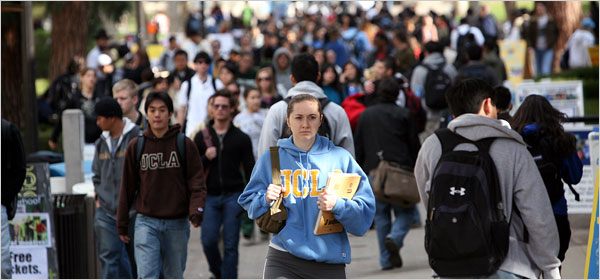
• The Los Angeles Times reported that Latino students are less inclined to seek college loans, opting to work their way through school. “My parents have always said, ‘If you don't have the money to pay for it, then work for it,’” said one student. Educators worry that job demands hurt the students academically. “I see this happen all the time in my classroom, students who are overworked and under-prepared for class,” said an instructor. “When I ask them about taking out loans instead of working so much, their thinking is, ‘If you can’t pay it in cash, then it’s not a good idea.’” Click on the essay title above to read the full story.

• The NAACP and Clemson University officials are investigating another Martin Luther King Jr. party that took place off campus. Partygoers wore Blackface and drank malt liquor. The university’s president was “appalled, angered and disappointed” to learn about the event. Maybe these students should emulate their Latino peers and get jobs.

• The local chapter of the California Restaurant Assn. volunteered to ban trans fat within 18 months. Los Angeles County officials had sought to legally mandate the move, but counsel informed them that they didn’t have the authority to do so (see Essay 1623). “We will be using incentives and education rather than the heavy hammer of an ordinance,” said one official. No comment yet from Fatburgers officials.

Essay 1642

Tuesday, January 30, 2007

Essay 1641


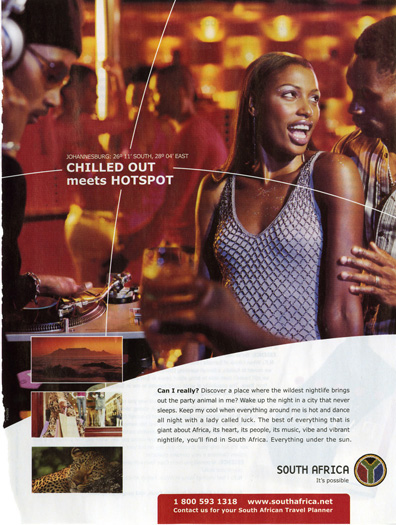
If Blacks can be persuaded to visit South Africa, surely a few can be lured to Madison Avenue.

Essay 1640


More letters from Adweek.com responding to Tim Arnold’s column (see Essay 1544)…

-------------------------------------------------------

Tim Arnold’s Diversity Column Sparks Debate


I loved [Tim Arnold’s “It’s All About the Music,” Jan. 8] piece and agree with a lot of what he had to say. As an industry veteran of both general market (D’Arcy, BBDO, K&E, JWT) and targeted shops (UniWorld), I remember his Budweiser work.

I always thought of his agency as one of the few that “got it right,” and even lured one of his young African-American art directors to New York. I can’t believe, however, that he’d think there is no pervasive prejudiced behavior in the agency business. It’s there, it’s real, and in the most benign way of thinking, it springs from having one dominant point of view about what “good” creative is, and who is talented. Look at the tone of the responses to the Human Rights Commission agreement. There’s a lot of hooey about “lowered standards” and the industry hiring based solely on “talent.” Having toiled in general market agencies alongside Caucasians who were hired based on everything from personal connections to great legs, I can personally say it ain’t so. And, having seen what happens to the “talent” assessment of creatives who voluntarily leave the general market world to work in multicultural shops, I know how our industry devalues those who choose to work in a more culturally expressive environment.

I don’t know if it’s an accident that we both got our start at D’Arcy (Bloomfield Hills, in my case). Perhaps there was a more progressive mind-set. But I do know this: Despite a long career full of successes, accolades, great jobs and salaries, I remain convinced that the industry is rife with bias and white entitlement. We can’t both be right, and the numbers tell a pretty clear story. I wish you were right. I hope the ad industry you write about comes to pass.

Valerie Graves
Chief creative officer
Vigilante
New York

It’s amazing the diversity you nurtured purely out of the instinct for what’s right, and what makes sense in creating the right kind of climate to make great advertising. It seems obvious that the more diversity you have represented by your creatives, the more authentic and honest the work. As an advertiser, you have to be able to “authentically” communicate with all kinds of demographics, and you need all of the ammunition you can get to achieve that.

The problem is, not everyone has the ability to see the obvious. If every agency were as open-minded as you, there wouldn't be a need for mandates, protests and hearings (if you look at the senior management of any of the top agencies, I assure you that you'll see an obvious absence of diversity). I doubt that forcing people to be more conscious will work; it has to come from within. But sometimes you have to force an issue to make people aware of the obvious. That’s pretty much what MLK and others sacrificed their lives for not too long ago.

Kevin Jordan


One of the things that continues to disappoint is that as much as we say, “It’s about the work—period,” I’ve seen creatives and account folks alike offered jobs based solely on their resumes and portfolios, yet lose those opportunities once the creative directors and account directors realize (in the interview) that the talent is actually of color.

I’ve known headhunters who are so frustrated with various general market shops because they send them top candidates who happen to be of color, only to have the shops send them back with excuses of “not right for our culture.” Yet when they’ve sent white candidates who in their opinion weren’t as good, they got hired. Some headhunters have recently said certain agencies still tell them in no uncertain terms “do not send black talent.”

I think educational programs and internships are a great idea, but it will take more folks who are willing to actually do something about this. I still think the issues are too one-sided in terms of solutions. People of color can do a lot, but you (metaphorically) can’t expect people to consistently fix problems that they’re not responsible for creating, while not at least encouraging those who are breaking things/benefiting from the damage to join in. It’s just not productive enough.

Hadji Williams
Author/consultant
KnockTheHustleBlog.typepad.com

Essay 1639


Word on the street in a MultiCultClassics Monologue…

• New York transit honchos are irked over a new subway-themed line of condoms. Approved by the city Health Department, who didn’t need the transit department’s ok, the condoms feature the Metropolitan Transportation Authority logo. “I don’t think it’s the appropriate thing for the MTA to be involved with,” said an MTA board member. “We have enough trouble servicing our clients, doing the right thing, making sure the buses are on time … that’s what the MTA’s mission is.” Hey, a potential tagline could be: Get off on the bus.

• Borat may be facing a new lawsuit. Now an Israeli comedian charges the character has ripped off his trademark phrase — Wa wa wee wa. The alleged victim claims he coined the exclamation 16 years ago for the hit comedy show “Zehu Zeh.” It all should make for interesting opening and closing arguments.

• The Mayor of Moscow declared a gay-rights parade to be “satanic” and vowed the event would never happen in the Russian city. Last year, activists ignored the ban and wound up being attacked by protestors and detained by the cops. No word yet if “Borat” will be allowed to play in local theaters.

Essay 1638


From The Chicago Sun-Times…

-----------------------------------

Super Bowl equality still eludes many

BY JESSE JACKSON

Super Bowl Sunday. It’s an American celebration, spectacle and annual ritual. The Chicago Bears pitted against the Indianapolis Colts -- two great teams, tested and victorious, head to head. Already the arguments have started. The Colts offense against the ferocious Bears defense. The Bears running game against the Colts passing wizardry. Manning against Urlacher. Dungy against Smith.

Tony Dungy facing off against Lovie Smith? That’s right, this Super Bowl will feature an extraordinary milestone -- two African-American head coaches leading their teams into the biggest show of all. Sixty years after Jackie Robinson broke the color barrier in sports; 42 years after the right to vote. Our progress is now on display at the Super Bowl, a great American moment.

Both are men of dignity and unblemished character. Both have demonstrated the skill and will it takes to mold strong and independent athletes into a great team -- in an age of free agents, multimillion-dollar contracts, and 24/7 media. And both have understood what this moment means; they are close friends, who have rooted for one another to get to the final stage.

Coming from Chicago, I’ve followed Lovie Smith and Da Bears through the season’s trials and triumphs. But I pay particular tribute to Tony Dungy of the Colts. He is, in many ways, the godfather of African-American football coaches. He faced the closed doors. He dealt with the disappointments of being passed over without consideration. He knows how hard the struggle was to get to this moment. And strikingly, of the six African-American head professional football coaches, three others came from Tony Dungy’s Tampa Bay team: Herman Edwards, Mike Tomlin and Lovie Smith himself.

When the whistle blows on the Super Bowl, the game will be played on a level playing field. The rules will be the same for all. Two great teams will line up, the players will face off head to head, and -- at the end -- however great the disappointments or thrills, all will accept the outcome. The fans will be focused on uniform color, not skin color. They'll cheer the team from their region, not the one from their race. In some way, this is Dr. Martin Luther King’s view of the Promised Land. Level playing fields, equal rules, equal opportunity.

As we celebrate the success of these two teams and these remarkable coaches, let us not ignore the struggle. It was not so long ago that Dungy and Smith would not even be considered as head coaches. That blacks were not “qualified” to be quarterbacks. That the doors were closed to the playing field, the voting booth, the restaurant counter.

Dave Duerson, formerly all-pro defensive back for the Chicago Bears and now a businessman and scholar, is chairman of the Rainbow PUSH Coalition Sports Commission, and Dextor Clinkscale, a former Dallas Cowboy, is now our sports director. We work closely with the Black Coaches Association, executive director, Floyd Keith, and with Dr. Richard Lapchick, documenting college graduation rates. One result has been the passage of what are called the Rooney Rules, mandating that an African-American coach must be considered for every opening.

That same struggle has taken place across our society. Too often, Americans celebrate the change when it succeeds, but slight or scorn the struggle needed to make that change take place.

We cannot afford to be complacent, because we still have a long way to go to make the playing field even for all Americans. Sunday's football game is an occasion of joy, but it’s not the end of the struggle. Too many children in this affluent nation are born to poverty, deprived of adequate nutrition, health care and early education. They are raised on mean streets, and go to crowded schools not ready to learn. They are expected to pass the same hurdles, but with shackles on their feet. We need to create equal opportunity from the start.

So on Super Bowl Sunday, as we celebrate the success of Dungy and Smith, let us commit ourselves to the continued struggle that made this success possible. And … go Bears.

Essay 1637

Essay 1636


MultiCultClassics feels compelled to respond to the letter posted in Essay 1635, especially since the author referenced comments from this blog.

First, we want to stress again that this is not an attack on Tim Arnold. The man deserves respect for his willingness to openly confront matters. No one doubts for a second that Arnold sincerely intends to do the right thing. Let’s agree there is much to be accomplished, and it will entail collaboration and serious sweat.

At the same time, Arnold does not represent everyone. Neither do the writers of this blog. However, there are attitudes and beliefs symbolic and symptomatic of various factions in the drama. Opinions should be thoughtfully examined versus viewed as gospel.

So let the examination commence.

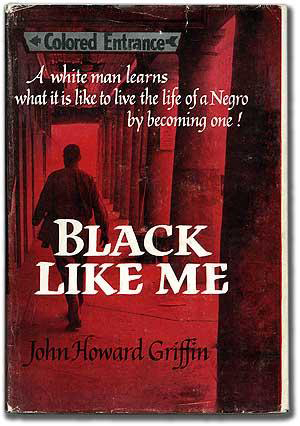
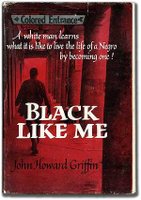
Arnold’s raw exposures call to mind a book published in 1961, and produced as a movie in 1964 — “Black Like Me” by John Howard Griffin. The book detailed the experiences of a Caucasian man who darkened his skin and posed as a Black man, traveling through racially segregated Louisiana, Mississippi, Alabama and Georgia. Eddie Murphy twisted the idea for comedic effect on “Saturday Night Live,” and a contemporary version of the theme was presented with the FX series “Black. White.”

There are lots of similar moments on display with Arnold. The man brings it all — from navel-gazing angst to flashes of enlightenment to hardcore cluelessness. Yet is he really trying to relate to perspectives besides his own and analyze situations from multiple angles?

Arnold now realizes the advertising industry’s diversity issues are indeed complicated. He knows that what his editorial “painfully lacked was an overt recognition of the problem.” But does he comprehend the contradictions and complexities compounded by his admittedly simplistic writings?

Arnold says he wants “to urge minorities — the ones who still feel they’re being excluded from this predominantly white business, and want in — to take advantage of the demands of the recent HRC agreement signed by some 11 general market agencies, and come bang on our doors. What the hell, it’s a start — and it will demand that these agencies at least meet you halfway.”

Has Arnold considered that minorities are no different than majorities when it comes to seeking jobs? That is, people hope to be judged by their skills and potential. No one wants to “take advantage” of the signed agreements. And anybody who suggests such a strategy just doesn’t get it.

Minorities do not require Arnold’s coaching and cajoling. The truth is, the man is directing the wrong audience. Minorities weren’t asked to change. Let’s be clear, folks. The general market agencies crafted — and absolutely inspired — the pacts. Arnold and his Madison Avenue peers are the ones who must alter their behavior. Minorities should not plead for anyone to meet them halfway; rather, majorities are obligated to traverse the full way.

This isn’t a modern-day Emancipation Proclamation. Do not expect minorities to rejoice and swarm in droves for job openings. Instead, advertising agencies need to proactively recruit with honesty, enthusiasm and an inclusive spirit. Arnold and his pals must strive to woo and embrace — otherwise, they face stiff financial penalties, public humiliation and worse.

Additionally, progress will be damned difficult if folks label the agreements as nettlesome chores they’ve been commanded to address. The HRC and Jesse Jackson are not coercive enemies. They’re merely spanking an industry that has lied to them since 1973.

The people who harbor disgust for the HRC and Jackson need to get over it. Want to avoid hearings and mandates? It’s easy. Be professional. Make demonstrable and measurable revisions. Honor your word.

It will be interesting to watch agency leaders ultimately execute new initiatives. People who have been turned off to the business are thriving in other fields. Locating qualified mid- and senior-level talent will be hard. It’s a safe bet that shops will opt to raid the “multicultural” firms for bodies. Sadly, the industry that boasts of its creativity tends to concoct obvious, lazy solutions in these scenarios.

Of course, minorities will have to play significant roles. Those already in the business need to lead and train the culturally clueless, which is certainly a Herculean task. Plus, there is a great deal of mentoring and networking necessary for success. Everyone will have to join forces on a myriad of levels for this revolution.

Arnold ends with typical (unintentional?) condescending preaching: “Yes, there’s a problem. But why not call it an opportunity, and agree to do something about it, together? I’m not done with this issue, not even close. Neither are you.”

Not sure who Arnold is targeting with the very last sentence. Minorities have been dealing with the dilemmas forever. Welcome to the party, Tim. Where the hell have you been for the past 30 years of your career?

Arnold ought to aim his closing remarks at the general market agencies’ masses. They must start calling it an opportunity and commit to doing something about it — although technically, their bosses’ signatures already sealed the inevitable compliance. This endeavor will be palatable when it becomes a vocational and moral imperative.

Arnold says he’s not even close to being done. But is he even close to being truly qualified to cope with the challenges ahead?

Are any of us?

Monday, January 29, 2007

Essay 1635


The following appeared at Adweek.com — it’s a follow-up to stuff presented in Essays 1560 and 1544…

---------------------------------------

Letter

By TIM ARNOLD

Arnold Responds

The issue of diversity in our industry—meaning, the profound lack of it—is complex, and, with a few notable exceptions, runs deep and wide historically, currently and emotionally.

What my column painfully lacked was an overt recognition of the problem. I do not for one minute imagine this problem doesn’t exist. My intentions with the column were simple and twofold: to urge minorities—the ones who still feel they’re being excluded from this predominantly white business, and want in—to take advantage of the demands of the recent HRC agreement signed by some 11 general market agencies, and come bang on our doors. What the hell, it’s a start—and it will demand that these agencies at least meet you halfway. Secondly, I wanted to share my own experiences and the personal privilege of being part of some genuine multicultural and ethnic advertising and communications successes inside general market agencies, and early on with the Budweiser business.

Fortunate as I’ve been to be part of diverse teams whose only issue was the work and its genuineness—along with the shared joy of making it happen (and yeah, it was “all about the music”)—it’s clear that many, if not most, have not had the benefit of such experiences.

And so I heard from some of you. I’ve responded to every one of you, and invited you to meet with me and at the very least continue the dialogue, regardless of point of view or tone. Two of us are going to work together to see if we can find an agency for a black internship. One of you has invited me to join the New York Advertising Club’s diversity committee, and I’m honored to accept. I’ve also been accused of embracing “colored stereotypes” and been called an unknowing, “grinning old white man,” which I’ll accept as only half right. Maybe the point is, in a small way, we’ve ripped the scab off an ugly, insidious wound. And isn’t this kind of dialogue every bit as valuable as the more formal, and more removed, HRC hearings?

Remarkably, last Friday I’m sitting in Memphis Marriott’s restaurant, still feeling the unsettling impact of the responses to my column, and none other than Rev. Jesse Jackson passes. You cannot mess with this kind of thing; it must be embraced. So I go over and introduce myself. And tell him that after 30 years in the ad business, and having the great experience of running the Bud account back when he came to St. Louis, I’ve written this column about agency diversity. He asks me to send him the piece, which of course I do. Maybe he’ll be moved to respond. In any case, encountering him at this juncture speaks volumes to me.

Yes, there’s a problem. But why not call it an opportunity, and agree to do something about it, together? I’m not done with this issue, not even close. Neither are you.

Essay 1634

Essay 1633


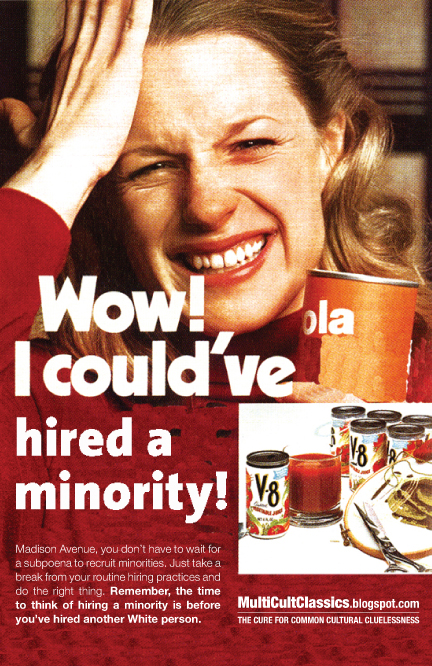
The copywriter and art director responsible for this ad are underachievers.

Essay 1632


From The New York Times…

---------------------------------------------

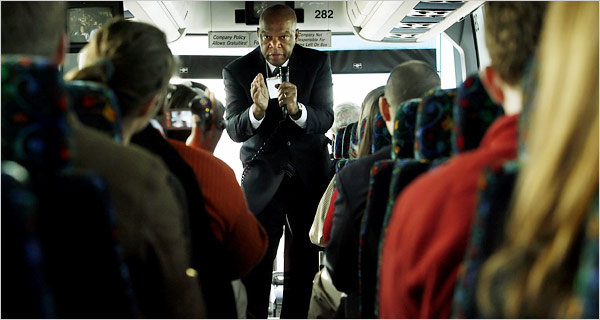
On a Trip Through History, Students Join Freedom Riders

By THEO EMERY

BIRMINGHAM, Ala. — More times than he remembers, La’Markus Cook has traveled south on Interstate 65 from Nashville, where he attends American Baptist College, to his home outside Montgomery, Ala. But never, he said, as he did this weekend.

Air brakes hissing and motors rumbling, four buses retraced segments of the 1961 Freedom Rides on Saturday and Sunday, giving students aboard a front-seat view of a pivotal moment in civil rights history. On the rides 46 years ago, activists armed with only their convictions braved white mobs to defy segregation of interstate bus travel.

There have been many previous expeditions to locations where riders were beaten, bloodied and jailed, but this weekend’s was probably the largest and most ambitious attempt to keep the history alive.

“I don’t know that any students have ever had this opportunity before,” said Raymond Arsenault, the author of the 2006 book “Freedom Riders,” considered an authoritative history.

About 100 students from Vanderbilt University, Tennessee State University, Fisk University and American Baptist College accompanied veterans of the civil rights movement, some of whom came close to death in the bloody confrontations over interstate travel in the South.

[Click on the essay title above to read the full story.]

Sunday, January 28, 2007

Essay 1631


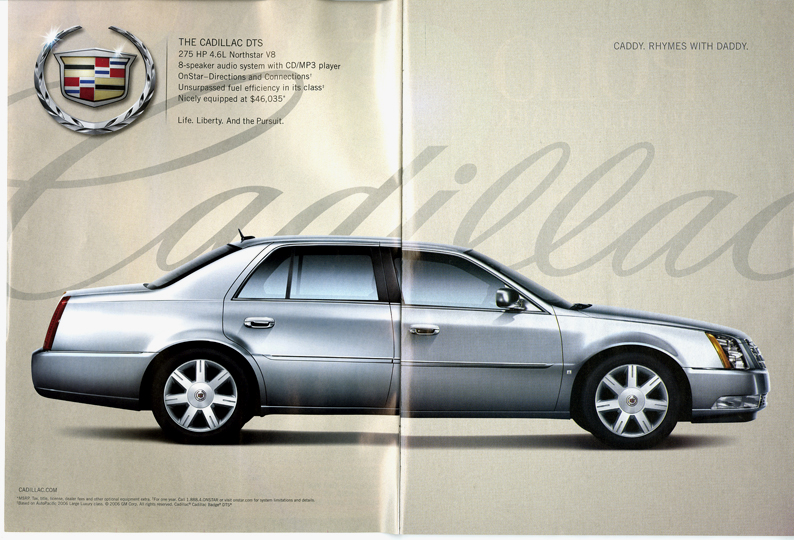
Caddy. Rhymes with daddy.

Um, are baddy and saddy actual words?

Essay 1630


From The Chicago Tribune…

---------------------------------------

Illiniwek: Symbol or mascot?

By Jodi S. Cohen, the Tribune's higher education reporter

It’s common knowledge that Chief Illiniwek, the mascot of the University of Illinois at Urbana-Champaign, is controversial.

But until last week, I didn’t realize that the sentence above also would be controversial.

Those who support Chief Illiniwek--the barefoot student who performs in a buckskin costume and feather headdress during halftime--believe that calling him a mascot reveals an anti-chief bias.

They were quick to tell me that I had made a mascot misstep in stories reporting that the Oglala Sioux tribe wants the university to return the regalia used by Chief Illiniwek.

The chief’s supporters prefer the term “symbol” and say that “mascot” has become the politically correct word used by critics who believe the chief is a politically incorrect representation of Native Americans. They say the anti-chief camp uses the word “mascot” to make it sound as if the chief is demeaning to Native Americans.

What chief supporters don’t seem to realize is that their choice of the word “symbol” is just as political as “mascot.” They think “symbol” makes the chief sound more dignified and better describes their view that the chief is a respectful tribute to the native people of Illinois.

Framing language to advance a particular agenda is not new. The American Civil War was called by some the War Between the States, the War of Northern Aggression and the War of the Rebellion, said lexicographer Erin McKean, editor of Chicago-based Verbatim magazine.

The current Iraq war has its own politically charged vocabulary. The proposed troop increase has been variously called a surge, an escalation and an augmentation, for example.

“Anyone strongly for or against a particular position will use any means necessary rhetorically to strengthen their position,” said McKean, who also is editor-in-chief of The New Oxford American Dictionary. “If saying ‘symbol’ instead of ‘mascot’ convinces someone that Chief Illiniwek is a dignified representative of the earlier peoples of Illinois, that is what they want to do.”

According to Merriam-Webster’s Collegiate Dictionary, a mascot is “a person, animal, or object adopted by a group as a symbolic figure, especially to bring them good luck.” The word has French origins that can be traced to an 1880 operetta called “La Mascotte.”

To be sure, a dictionary definition or expert linguists won’t solve the yearslong battle over the chief and the language to describe him.

[Click on the essay title above to read the full story.]

Essay 1629


Change happens in a MultiCultClassics Monologue…

• Ebony magazine has new blood. This month, Harriette Cole was named Ebony’s creative director. Cole is an etiquette advisor and author, currently writing a syndicated column for the New York Daily News. “What we have to do is get that younger reader to pick [Ebony] up,” said Cole. “Is it relevant for the younger reader? I would say yes, but when you go to the newsstand and have 100 titles to choose from, what are you choosing? We need to redesign.” Although Johnson Publishing Company, which publishes Ebony and Jet magazines, is headquartered in Chicago, Cole will work from New York. Vice President and Editorial Director Brian Monroe was hired last August by Johnson Publishing Company President and CEO Linda Johnson Rice. “[Ebony and Jet] have been successful for 60 years in the Black community, but in the last decade or so, they’ve gotten a little bit stagnant,” said Monroe. “The [February issue of Ebony] exemplifies where we’re headed. We are going to be newsy and timely, but we also want to be fun. … You’ll be seeing a lot of changes over the next 12 months. Black America is ready for a new Jet, a new Ebony.” Hey, Black America’s been ready for quite some time. The question has always been: Is Johnson Publishing Company ready?

• Mickey D’s has allegedly concocted a trans-fat-free oil that the company feels works with its World-famous french fries. Secret tests were conducted last summer, and the fast feeder is allegedly supplying about 1,200 restaurants with the amazing oil. However, company officials said it won’t go global until early 2008. “We don’t want to jeopardize the iconic nature of the french fry, which is so important to our brand,” said McDonald's chief executive. “Yet we have a responsibility to serve the best french fry … that balances between value and nutrition.” Of course, Mickey D’s will define the balances on its own dubious scales.

• A blogger in China sparked huge reactions when he called for Starbucks to shutter its restaurant in the Forbidden City, Beijing’s imperial palace. A Starbucks statement insists the company “appreciates the deep history and culture of the Forbidden City and has operated in a respectful manner that fits within the environment.” The blogger, who is actually surprised over the furor he created, said, “This is not an issue of nationalism. The message I am trying to send is about preservation of our national heritage. I am totally in favor of globalization. And China is in favor of globalization.” The Starbucks will probably be replaced by a McDonald’s.

Essay 1628


From The New York Times…

----------------------------------------

Study of Immigrants Links Lighter Skin and Higher Income

By THE ASSOCIATED PRESS

NASHVILLE (AP) — Light-skinned immigrants in the United States make more money on average than those with darker complexions, and the chief reason appears to be discrimination, a researcher says.

The scholar, Joni Hersch, a professor of law and economics at Vanderbilt University, looked at a government survey of 2,084 legal immigrants to the United States from around the world and found that those with the lightest skin earned an average of 8 percent to 15 percent more than similar immigrants with much darker skin.

“On average,” Dr. Hersch said, “being one shade lighter has about the same effect as having an additional year of education.”

The study also found that taller immigrants earned more than shorter ones, with an extra inch of height associated with a 1 percent increase in income.

Other researchers said the findings were consistent with other studies on color and pointed to a skin-tone prejudice that went beyond race.

Dr. Hersch took into consideration other factors that could affect wages, like English-language proficiency, education, occupation, race or country of origin, and found that skin tone still seemed to make a difference in earnings. That meant that if two similar immigrants from Bangladesh, for example, came to the United States at the same time, with the same occupation and ability to speak English, the lighter-skinned one would make more money on average.

“I thought that once we controlled for race and nationality, I expected the difference to go away,” Dr. Hersch said, “but even with people from the same country, the same race, skin color really matters.”

Although many cultures show a bias toward lighter skin, she said her analysis showed that the skin-color advantage was not based on preferential treatment for light-skinned people in their country of origin. The bias, she said, occurs in the United States.

Essay 1627


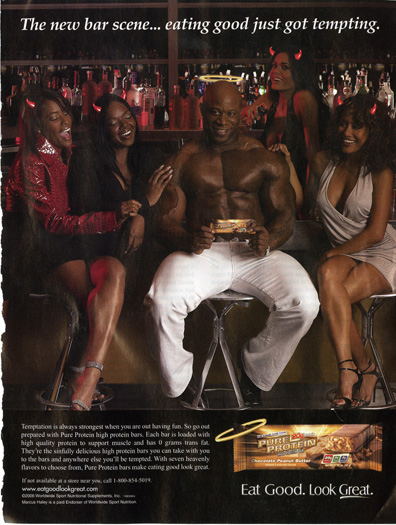
Pure Protein? Pure Bullshit.

Essay 1626


From The Chicago Sun-Times…

----------------------------------------------

Why black kids have negative self-image

BY MONROE ANDERSON

Next Sunday, Lovie Smith will be the first black head coach in the Super Bowl -- as will his mentor, Tony Dungy of the Indianapolis Colts. So no matter who wins -- the Chicago Bears or that other team -- Super Bowl 41 guarantees that for the first time in professional football the world champions will be coached by an African American. That’s the two steps forward. Now the giant step back.

After more than two decades of Oprah, the Queen of All Media, you’d think that young black girls would have a better self-image. They don’t. Black boys neither. In our world of bleached blonds -- white-skinned, brown-skinned and black – black’s not beautiful, at least not among the majority of African-American preschool children interviewed by Kiri Davis, a high school student at Manhattan’s Urban Academy. As part of a school film project, Davis re-conducted psychologist Kenneth B. Clark’s “doll test” to see if progress has been made. Clark’s 1940s study, which had an impact on the Brown vs. Board of Education Supreme Court decision, determined that young black children preferred white dolls over dolls that looked like them.

History repeats in “A Girl Like Me.” Davis’ seven-minute movie asks some tiny tots in a Harlem day-care center to choose between two dolls that are identical, except one is brown, the other white. Fifteen of the 21 preschoolers decided white was all right.

“Can you show me the doll that looks bad?” Davis asks a little black girl, who is holding the one she’d selected as “the doll you like to play with.” The girl puts down the doll she’s holding and picks up the brown one.

“And why does that look bad?”

“Because she’s black,” the little girl answers.

“And why is this the nice doll?” Davis asks as the girl touches the white doll. “Because she's white,” the girl says.

“A Girl like Me” also features African-American teenage girls talking about perceptions of race. Two of the girls discuss the “good hair/bad hair” standard, explaining that the more naturally straight the hair, the better quality it is thought to be.

It’s amazing that two generations after the “Black is Beautiful” mantra of the 1960s, some African Americans still believe that it’s not. It’s amazing that four decades after James Brown’s chart-topper, “I’m Black and I’m Proud,” so many African Americans aren’t. It’s amazing that in the same year hip-hop artist Kanye West told the world that “President Bush doesn’t care about black people,” Davis was discovering that neither do shorties in Harlem.

It’s amazing, but I can see how it’s come about. Our children receive mixed messages. In the world of hip-hop, where black blonds proliferate and the N-word resonates, children are bombarded with video images of butt-shaking, almost-naked, black Kewpie dolls.

In the world of the Internet, Davis’ movie, with its disturbing tests, has been making the rounds through e-mail. Another e-mail chain, just as disturbing, is also in circulation.

“The sad thing about this article is that the essence of it is true. The truth hurts. I just hope this sets more black people in motion toward making real progress,” the e-mail bemoans before admonishing the receiver to “help prove them wrong! Read and pass on.”

Beneath that is a photograph of a white woman, Dee Lee, a certified financial planner, who, the e-mail tells us, reads these words on an unidentified New York radio station: “They are still our slaves. We can continue to reap profits from the blacks without the effort of physical slavery. Look at the current methods of containment that they use on themselves. Ignorance, greed and selfishness.”

The e-mail continues with the rest of the words it says Dee Lee read, and they are no less insulting. There is one problem with the provocative e-mail: mistaken identity. There is another Dee Lee. He looks like the brown doll. This Dee Lee is a black comedian and host of Dee Lee Reality Radio.

Ahhhh, how about those Bears?

[Click on the essay title above to view Kiri Davis’ video.]

Saturday, January 27, 2007

Essay 1625


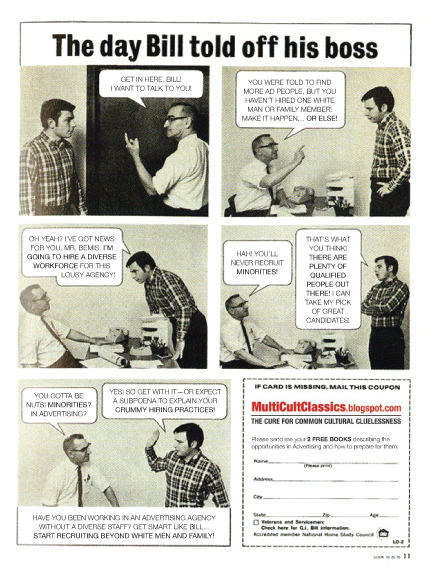
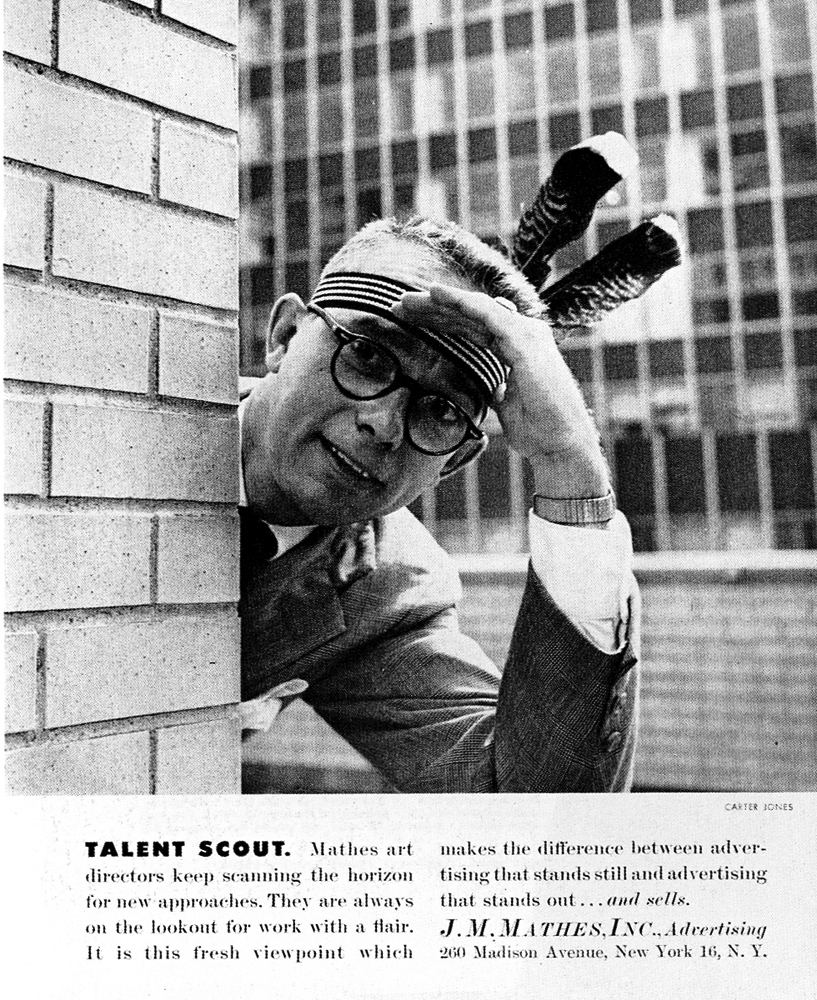
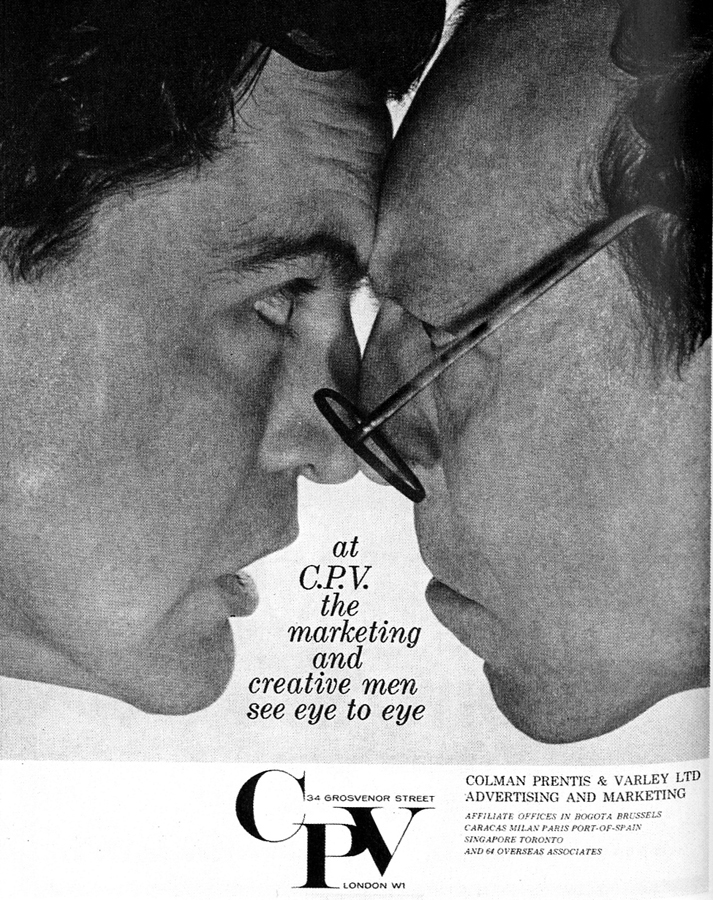
Here are two classic self-promotional messages for advertising agencies. J. M. Mathes scouts for talent, but it’s unlikely the search will include the Native Americans J.M.M.’s mocking. Meanwhile, at C.P.V. the marketing and creative men see eye to eye — and they’ll see that only White men run the business.

Essay 1624


Lantus side effects include an uncontrollable urge to park your motorcycle in the living room.

Essay 1623


Lessons learned in a MultiCultClassics Monologue…

• In Yonkers, New York, a teacher was expelled from classes after instructing seventh-grade students to draw male genitalia on the chalkboard. “There was no way we were going to let him be in front of children,” said a school spokesperson. The teacher was leading a lesson on human anatomy and sexuality. One parent actually supported the teacher and declared, “This is biology, it’s anatomy, it’s human sexuality. … They’re in puberty. They’re aware of it on one level or another.” Wonder how the parent will feel when his daughter shows him her homework assignments.

• Los Angeles County failed in its proposal to ban trans fat in restaurants, as the county counsel declared the state has jurisdiction on the matter. It was suggested that the county could create a voluntary program to get restaurants to alter their menus. Right, let’s count on Mickey D’s to comply without legal or physical threats.

• Jacko’s back. The King of Pop has been popping up throughout the U.S. lately, with plans that include a Las Vegas show and more. Jackson has even scheduled a tour in Japan. “My friends and fans in Japan have been so supportive of me and my family for many, many years,” said Jacko. “My fans in Japan helped me achieve historic milestones in the music industry.” Memo to Japan: Hide your male children to prevent Jacko from achieving historic milestones in other areas.

Friday, January 26, 2007

Essay 1622


In Black-targeted automotive advertising, style is always in style.


Essay 1621


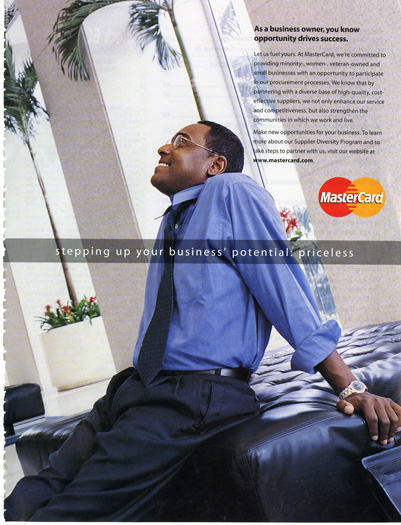
Creating lame, concept-free diversity ads: priceless.

Essay 1620


School Daze in a MultiCultClassics Monologue…

• The New York Times reported on the efforts of colleges and universities to recruit minority students in light of Michigan’s new ban on affirmative action. “You’d think public universities are charged with special responsibility for ensuring access, but it could come to be exactly the opposite, if there are a lot of these state initiatives,” said the dean of the University of Michigan Law School. “In terms of public values, it’s a big step backward.” Ward Connerly, the black California businessman backing anti-affirmative action initiatives in California and Michigan, argued, “Every individual should have the same opportunity to compete. … I don’t worry about the outcomes.” Click on the essay title above to read the full story.

• Wisconsin state lawmakers proposed mandating schools to teach students about the Hmong people, hoping the effort would ease racial tensions fueled by homicides involving Hmong hunters. “All of the difficulties that the Hmong face and experience in the U.S. are due to the fact that there is no formal teaching about the Hmong to the general public,” said the president of the Hmong Community of Wisconsin. Wonder how initiatives like this might play in Michigan.

• A report by the 2007 California Childhood Obesity Conference in Anaheim shows about half of the highly-marketed kids’ food with images or names of fruit on packaging actually contain no fruit. A dietitian for Prevention Institute, an Oakland-based nonprofit promoting community-based health and safety programs, said, “I really don’t think a lay person knows that fruit drink doesn’t mean fruit juice, especially if it has these beautiful pictures of fruit on it.” Maybe “food” manufacturers should create critters based on chemicals.

Essay 1619


Thursday, January 25, 2007

Essay 1618


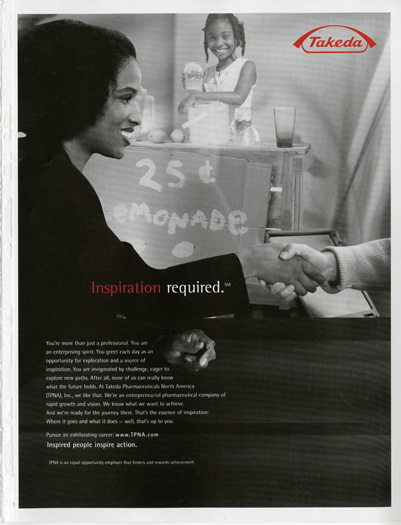
For a company that service-marked “Inspiration required,” this ad is awfully uninspiring.

Essay 1617


Partying hard with a MultiCultClassics Monologue…

• Students at Tarleton State University in Dallas sparked controversy by staging a Martin Luther King Jr. Day party, complete with fried chicken, malt liquor and gangsta gear. Online event photos displayed students in Afro wigs and gold teeth mocking step shows. Another photo showed a student decked out like Aunt Jemima. “I am personally insulted by these photographs and am disappointed that Tarleton students have demonstrated such insensitivity,” said the university’s president. Somebody better warn him that we’re about a week away from Black History Month.

• “Grey’s Anatomy” star Isaiah Washington signed up for a counseling program (see Essay 1612). The actor released a statement to announce, “With the support of my family and friends, I have begun counseling. I regard this as a necessary step toward understanding why I did what I did and making sure it never happens again. I appreciate the fact that I have been given this opportunity and I remain committed to transforming my negative actions into positive results, personally and professionally.” Perhaps his first counseling assignment could be to organize a cast party to celebrate Martin Luther King Jr. Day.

• Ford Motor Company lost $5.8 billion in 4Q, the worst loss in its history. “We began aggressive actions in 2006 to restructure our automotive business so we can operate profitably at lower volumes with a product mix that better reflects consumer demand for smaller, more fuel-efficient vehicles,” said CEO Alan Mulally. “We fully recognize our business reality and are dealing with it. We have a plan and are on track to deliver.” Being “on track” includes the biggest loss in history? Now that’s a bold move.

Essay 1616

Wednesday, January 24, 2007

Essay 1615


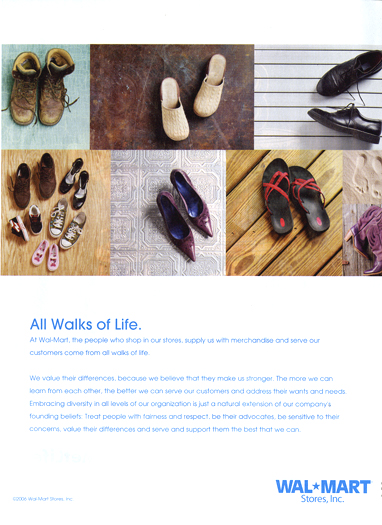
If Wal-Mart’s really committed to diversity, don’t advertise it — just walk the walk.

Essay 1614


From The Chicago Sun-Times…

--------------------------------------------

Kraft takes Cream of Wheat off its breakfast menu

BY CHERYL V. JACKSON, Business Reporter

Kraft Foods Inc. is dumping the Cream of Wheat line, selling the century-old hot cereal brand to a New Jersey-based food business for about $200 million.

A new subsidiary of B&G Foods Inc., the canned meat, spices and other food products company that owns Ac’cent, Emeril’s, Ortega and Red Devil brands, also will get the Cream of Rice brand and some manufacturing equipment in the cash deal expected to close this quarter, the companies announced Tuesday.

Cream of Wheat, around since 1893, has been a Kraft operation since 2000 when then-Kraft parent Philip Morris Cos. bought Nabisco Holdings, which owned the cereal.

The hot cereals, which generated about $60 million in sales last year, didn’t jibe with Kraft's slimming portfolio, said spokesman Charlie Simpson.

“We’re focusing on businesses that have the greatest long-term sustainable competitive advantage,” he said.

Kraft, the Northfield-based food and beverage giant that owns Oreo, Kool-Aid and Oscar Mayer, is preparing to be spun off from parent Altria Group Inc. and is putting resources behind brands it thinks have long-term growth potential. New York-based Altria plans on Jan. 31 to announce the date it will separate Kraft from its tobacco units, Philip Morris USA and Philip Morris International.

The cereal sale is part of an initiative to cut about 10 percent of the products accounting for its $34 billion in annual revenue and eliminating 14,000 jobs and about 40 plants to save $1.16 billion by 2010, said Gregg Warren, equity analyst at Morningstar Inc.

“It’s in the same line as Milk-Bone and Minute Rice,” Warren said of brands Kraft sold last year. Milk-Bone pet snacks was sold for $580 million; Minute Rice for $280 million. “They’re going in the direction similar to that of a lot of packaged food companies, trying to narrow down their focus into core categories and spending on growing categories and lines that really resonate with consumers.”

The B&G subsidiary is borrowing money to make the purchase.

Essay 1613

Essay 1612


From The Associated Press…

----------------------------------------

‘Grey’ Star Meets With Gay Activists

By LYNN ELBER

LOS ANGELES — “Grey’s Anatomy” star Isaiah Washington, under fire for using a gay slur about a co-star, met Monday with gay rights activists who said he agreed to help educate the public about the cruelty of such language.

“He seemed very sincere in his interest in working with us in an ongoing basis,” Kevin Jennings, executive director of the Gay, Lesbian and Straight Education Network. “We emphasized that this is not a one-shot deal, but an ongoing thing. He was very open to doing this.”

The star of the hit ABC medical drama met with Jennings, who spoke after the private meeting, and Neil G. Giuliano, president of the Gay and Lesbian Alliance Against Defamation. A call to Washington’s publicist for comment was not immediately returned Monday.

According to Jennings, Washington said he wanted to explore ways to work with GLSEN to address issues of “name-calling and how he might use his various platforms to educate people about how painful and wrong it is.”

By coincidence, Jennings noted, Monday was the start of “No Name-Calling Week,” coordinated by GLSEN with national educational partners to help schools find ways to eliminate bullying and slurs of all kinds. His group welcomed Washington’s help in promoting the group’s agenda, Jennings said.

Washington, himself a father, said he understands how the issue effects young people, Jennings said.

Washington, who stepped away from filming for the hour-long meeting, said he is interested in pursuing various options, such as public-service announcements, according to Jennings. No firm agreements were reached, the GLSEN director said.

“I think this is a very good first step toward him showing he really wants to do something. We take him at his word,” Jennings said.

Last October, it was reported that Washington used the term “faggot” about castmate T.R. Knight during an on-set argument with co-star Patrick Dempsey. He used it again backstage at the Jan. 15 Golden Globes as he denied ever uttering it.

Washington issued an apology after he was publicly criticized by GLAAD and chastised by ABC.

“Grey’s Anatomy” led nominees announced Sunday for the 18th annual GLAAD Media Awards, recognizing "mainstream media for their fair, accurate and inclusive representations of the lesbian, gay, bisexual and transgender … community and the issues that affect their lives.”

Tuesday, January 23, 2007

Essay 1611

Essay 1610

Essay 1609


Macy’s says: Making stars is what we do best.

Making diversity ads is what they do worst.

Essay 1608


Hard news in a MultiCultClassics Monologue…

• Drug company Pfizer announced plans to cut 10,000 jobs by 2008. Workers are encouraged to take advantage of any employee discounts on Viagra, because they’re about to get royally screwed.

• Now Mike Tyson is pleading not guilty to drug and DUI charges stemming from an arrest last month (see Essay 1492). “Drug addiction is a victimless crime … the kind where you shouldn’t go to prison,” said Tyson’s lawyer. Gee, sounds like the ex-champ is guilty as hell.

• Virginia Delegate Frank D. Hargrove — who pissed off folks by declaring Blacks should “get over it” regarding slavery — now proposed a resolution to celebrate Juneteenth, a holiday saluting the end of slavery. “I think it’s very worthy because it’s positive that we here in Virginia — and it has nothing to do with the apology — that we celebrate the end of slavery,” said Hargrove. Looking forward to celebrating the end of this guy’s political career.

Essay 1607


From The New York Times…

----------------------------------------------

In Douglass Tribute, Slave Folklore and Fact Collide

By NOAM COHEN

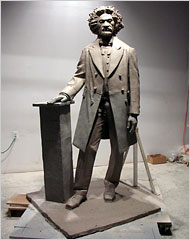
At the northwest corner of Central Park, construction is under way on Frederick Douglass Circle, a $15.5 million project honoring the escaped slave who became a world-renowned orator and abolitionist.

Beneath an eight-foot-tall sculpture of Douglass, the plans call for a huge quilt in granite, an array of squares, a symbol in each, supposedly part of a secret code sewn into family quilts and used along the Underground Railroad to aid slaves. Two plaques would explain this.

The only problem: According to many prominent historians, the secret code — the subject of a popular book that has been featured on no less a cultural touchstone than “The Oprah Winfrey Show” — never existed. And now the city is reconsidering the inclusion of the plaques, so as not to “publicize spurious history,” Kate D. Levin, the city’s commissioner of cultural affairs, said yesterday.

The plaques may go, but they have spawned an energetic debate about folklore versus fact, and who decides what becomes the lasting historical record.

The memorial’s link between Douglass, who escaped slavery from Baltimore at age 20, and the coded designs has puzzled historians. But what particularly raised the historians’ ire were the two plaques, one naming the code’s symbols and the other explaining that they were used “to indicate the location of safe houses, escape routes and to convey other information vital to a slave’s escape and survival.”

It’s “a myth, bordering on a hoax,” said David Blight, a Yale University historian who has written a book about Douglass and edited his autobiography. “To permanently associate Douglass’s life with this story instead of great, real stories is unfortunate at best.”

[Click on the essay title above to read the full story.]

Essay 1606


Monday, January 22, 2007

Essay 1605


“Motorcycles drenched in smokey gold. … At Harley-Davidson we are committed to developing a supplier base as diversie as the markets we serve.”

Harley-Davidson’s supplier base could use a proofreader.

Essay 1604


From The New York Daily News…

-------------------------------------------

Obama’s the elephant hunter Dems need

By Stanley Crouch

During a recent stint as a guest on a radio talk show, the question was whether or not Sen. Barack Obama would become the presidential candidate for the Democratic Party in 2008.

It seems to me that if Obama does become the candidate, it will be because the donkeys have not lost their minds to the extent that they would think that Sen. Hillary Clinton could possibly get to the Oval Office. Why? No matter how far in the background he tries to keep himself, Bill Clinton is too large a shadow, there to remind the astute of the Lurleen Burns Wallace story.

In 1967, Wallace followed her husband, George, with a run for the governorship of Alabama. With Alabama governors not allowed to serve consecutive terms, Lurleen and George admitted frankly that if Lurleen was elected, George would continue to make the administrative decisions. The apparent purpose of Lurleen’s candidacy was to make sure that her husband's segregation policies stayed in place. She won with 63% of the vote.

Whether or not they are getting along on good terms, Hillary Clinton cannot expect voters or the opposition party to take her on her own terms. This will hold her back. The separation from her husband’s reputation as gun-shy may have been the deepest reason for initially supporting the Iraq invasion, and it may have been her biggest mistake, because now, as she changes her position, Clinton will appear to be making decisions with a wet finger in the wind.

Beyond that, we must remember this is more a media age than a human one and the TV cameras do not love Hillary Clinton, who seems brittle and self-righteous on video. In person, however, she has extraordinary charisma. That is why her campaign for senator of New York included running all over the state. I don’t know if a whistle-stop presidential campaign will work for a candidate in our time.

Obama, on the other hand, is not only good-looking but gains power on television, which probably has as much to do with his attraction to the liberal moneybags of Hollywood as anything else. He also has a very good-looking wife and has made an obligatory confession about his earlier drug use, which in our time of talk show redemption should not work against him.

That Obama is the son of a man from Kenya and a woman from the Midwest should not hurt him when we saw even lifelong redneck Strom Thurmond speak of praying with big, black Clarence Thomas and his blond wife before his Supreme Court confirmation, as if race and miscegenation were issues Thurmond had never thought about. Now is another time.

What of Obama’s lack of experience and his apparently favoring almost anyone who will give him money? The experience factor will not work against him because he appears to have a sort of optimism that does not put him at odds with the many factors that need to be improved to ready this nation for global competition. The acceptance of money from interests opposed by environmentalists will not be an important issue.

But above all else, I think that Obama is actually positioning himself for the race in 2012, which may be an open sky of possibility if the Democrats lose in 2008. That is a defeat he would share, because there is little doubt that Obama will be the second half of the ticket in 2008 if someone else becomes the presidential candidate.

By 2012, however, he should have gained experience in Washington, be an even bigger fund-raiser and be perfectly ready to take down whomever the elephants have to offer.

Essay 1603


Wells Fargo presents a semi-tardy, sleep-inducing tribute to Dr. Martin Luther King Jr.

Essay 1602


From Adweek.com…

------------------------------------

McCann in Push for Diversity

By Kathleen Sampey

NEW YORK McCann Erickson said it is making a concerted effort to ethnically diversify its workforce and has named three executives to further advance the initiative.

Sallie Mars, director of creative services, will add the title director of diversity. The agency also hired Toni Thompson as multicultural program developer and recruiter. She joins from the New York office of research firm Millward Brown. David Hamlin comes aboard as manager of supplier diversity in June. He had been executive director of procurement at Rutgers University in New Jersey.

All three are new positions at the New York-based Interpublic Group agency.

Brett Gosper, president of McCann’s U.S. operations, said the team would “reach beyond the usual sources for minority candidates, and help ensure that McCann meets the needs and expectations of those we recruit.”

The move comes amid pressure for heightened diversity throughout the agency business.

Mars is a nine-year McCann veteran who manages print and broadcast production services in the creative department in New York.

As chairman of the American Association of Advertising Agencies’ diversity committee, Mars and her peers have bolstered the ranks of the multicultural advertising intern program from 45 to more than 100 nationwide.

Thompson has worked as an account planner at IPG’s Campbell Mithun in Minneapolis.

Hamlin has spent most of his career in academe. Before Rutgers, he was director of purchasing management for Carnegie Mellon University, from which he also graduated. In his McCann role, he will ensure that companies owned by non-white owners will get an equal chance at bidding on goods and services provided to McCann.

McCann Erickson is a division of McCann Worldgroup whose sibling companies include Momentum and MRM. Its client roster includes, Coca-Cola, GM, Hewlett-Packard, Intel, L’Oreal, MasterCard, Microsoft and Unilever.

Essay 1601


Monday Morning Quarterbacking with a MultiCultClassics Monologue…

• With their Sunday victories, Chicago Bears head coach Lovie Smith and Indianapolis Colts head coach Tony Dungy became the first Black men to lead their teams to the Super Bowl.

• ESPN cited anonymous sources to report Atlanta Falcons quarterback Michael Vick was not concealing marijuana in a water bottle when the star was stopped at Miami International Airport recently (see Essay 1590). Unfortunately, Vick does not become the first Black man falsely accused of carrying drugs.

• An AIDS treatment group has targeted Pfizer with a potential lawsuit, accusing the drug manufacturer of illegally hyping Viagra for recreational use. Despite Pfizer’s protests of innocence, its ads do feature headlines like, “What are you doing this New Year’s Eve?” and “Be this Sunday’s MVP.” Somebody double-check Michael Vick’s water bottle.

• Singer Alicia Keys is offering scholarships to students in Jacksonville, New Orleans, Atlanta and New York. “We’re just looking for standout students who are definitely college-bound and need a little bit of help financially to really achieve their dreams,” said Keys.

Essay 1600


Sunday, January 21, 2007

Essay 1599

Essay 1598


Eyeing the news in a MultiCultClassics Monologue…

• American Idol judge Simon Cowell offered an apology to a contestant he referred to as a bush baby. “If he’s offended,” said Cowell, “then I apologize.” But like Rosie O’Donnell, Cowell insists he can’t guarantee he won’t offend people again. In fact, it’s safe to guarantee that he will.

• A Canadian sitcom — “Little Mosque on the Prairie” — is hoping to debunk misconceptions about Muslims. The show follows a group of Muslims living in a prairie town in Saskatchewan. “I want the broader society to look at us as normal, with the same issues and concerns as anyone else,” said the show’s creator. Let’s hope the show doesn’t run opposite Fox TV’s “24.”

• The University of Illinois is facing a new controversy regarding its Chief Illiniwek mascot. The Oglala Sioux tribe demanded that the school return the Chief’s headdress and assorted regalia. As it turned out, the headdress had already been returned in the 1990s. Nonetheless, tribe officials want the rest of the stuff returned; plus, they want the mascot to be retired. Talk about Indian givers.

Essay 1597

Essay 1596


From The Chicago Tribune…

------------------------------------------

Rapper not content to play society’s ills

MV Bill has channeled his wealth and fame into bettering the lives of youths trapped in Brazil’s favelas, symbolizing the street activism taking hold across Latin America’s developing democracies.

By Colin McMahon

RIO DE JANEIRO -- The Brazilian rapper, writer and social activist MV Bill worries about protection.

Arranging an interview is complicated. Security checks are run. Calls are made. A meeting is set up with Bill’s people a couple of miles from the community center he started to give the young people of City of God a safe place to play and learn, a haven where kids can be kids.

Finally, an escort is assigned to bring a reporter to Bill.

Only it’s not Bill’s safety that concerns him. It’s his visitor's.

MV Bill does not surround himself with the bodyguards or posses of his hip-hop brethren in America. But outsiders to City of God, the Rio slum that Bill calls home, are wise to arrange safe passage before paying the man a visit.

Alex Ferreira is Bill’s real name. His “official name,” as he puts it. And though music brought Bill money and fame, his real work has become something else too: Building bridges. Helping kids. Combating the violence and other social ills that plague City of God and the other poor communities known as favelas.

“I learned with hip-hop how to move between the two Brazils, how to bring together two worlds that are very different,” Bill said. “A Brazil where people speak Portuguese, and a Brazil where people speak Favelese.”

Bill, 31, is an increasingly important figure in Brazil, and not just for the CDs he sells, the stands he takes or the activities his center organizes for young people in City of God.

Bill is a symbol of the kind of activism--street level, independent of political parties, skeptical of authority--that is taking hold not just in Brazil but across Latin America as democracy develops in the region.

[Click on the essay title above to read the full story.]

Saturday, January 20, 2007

Essay 1595


Flying high with a MultiCultClassics Monologue…

• Donald Trump has been battling officials in Palm Beach over the size of a flag flying at one of his Florida resorts. The flag violates local ordinances, and Trump is now being fined $1,250 per day. “They want me to pay a daily fee for the privilege to fly the American flag, or preferably, they want me to rip it down,” said Trump. “I’m just not going to do it. … This is amazing to me. The flag is magnificent, and everyone who sees the flag says that it is in magnificent proportion to [the resort].” Trump probably added that the flag is no larger than Rosie O’Donnell’s panties.

• Rosie O’Donnell attacked American Idol hosts for belittling contestants. “That’s compassion for you,” said O’Donnell. “Isn’t that what America thinks is entertainment, to make fun of someone’s physical appearance? And then, when they leave the room, laugh hysterically at them — three millionaires, one probably intoxicated.” Um, somebody remind Rosie that she’s been generating laughs with her references to Trump’s hair, Kirstie Alley’s weight and the Chinese language.

• Motorola, citing poor sales, announced plans to terminate 3,500 employees. Nothing like getting slashed with a Razr.

Essay 1594


Are the crazy sunglasses part of the high-tech devices used by the National Geospatial-Intelligence Agency?

Essay 1593


From The New York Post…

----------------------------------------

‘OSAMA’ MUD FLIES AT OBAMA

By MAGGIE HABERMAN

The 2008 White House race turned dirty yesterday when a report charged that Sen. Barack Obama had been raised as a Muslim and that he concealed it — claims the Democrat’s campaign promptly slammed as a smear.

The story on the Web site of the conservative magazine Insight alleged that Democrats “connected” to Hillary Rodham Clinton had discovered that Obama had studied at a madrassa — a Muslim religious school — for four years while living in Indonesia with his mom.

The story, citing anonymous sources, claimed that opposition research “within the Democratic Party” turned up the information, and that Obama had omitted the details from his two top-selling memoirs, “Dreams of My Father” and “The Audacity of Hope.”

Instead, the article claimed, Obama only “alluded” to attending a mostly Muslim school.

The claims were clearly aimed at both punching holes in Obama’s biggest asset — his authenticity — while trying to instill fears among voters who connect Islam to terrorism. It also painted the Clinton camp as being behind the slime job.

Obama’s top strategist, David Axelrod, strongly denounced the story as a fabrication.

“This is the kind of divisive, destructive garbage that has littered our politics for a long time,” Axelrod said.

“He was not raised as a Muslim, and he did not go to a madrassa. It is a complete contrivance, and its purpose is clear. They’re just selling people short.”

In his book and in interviews, Obama has talked about his father, a non-practicing Muslim who divorced his mom when he was 2 years old and moved back to Kenya.

His mother remarried and moved to Indonesia, where Obama studied for two years at a private school and then two years at a Catholic school — all before his teenage years. Axelrod said the private school was not religious.

He said it was attended predominantly by Muslim kids, and there was a weekly comparative religion course.

Obama and his family currently attend the Trinity United Church of Christ in Chicago.

The Insight piece claimed the “research” about Obama was done by people “connected” to Clinton’s camp, but Axelrod said he didn’t “believe that for a second.”

Clinton’s aides blasted the story as an attempt to tar both her and Obama. “We have no connection to this story,” said spokesman Howard Wolfson, noting the magazine is owned by the Rev. Sun Myung Moon-founded Unification Church.

“It is an obvious right-wing hit job by a Moonie publication and an attack on both Sen. Clinton and Sen. Obama.”

Friday, January 19, 2007

Essay 1592


Creative standards. Lowered by Tyson.

Essay 1591


This ad is pretty literal in its execution. Let’s hope the literalness does not mean the one-per-day pill is being shown actual size.

Essay 1590


Asking for help in a MultiCultClassics Monologue…

• Grey’s Anatomy star Isaiah Washington is catching major heat for allegedly referring to co-star T.R. Knight with an anti-gay slur. ABC even slapped the guy for a subsequent comment made at the Golden Globes and stated, “His actions are unacceptable and are being addressed.” Washington ultimately released the following statement: “I apologize to T.R., my colleagues, the fans of the show and especially the lesbian and gay community for using a word that is unacceptable in any context or circumstance. … I can neither defend nor explain my behavior. I can also no longer deny to myself that there are issues I obviously need to examine within my own soul, and I’ve asked for help.” He’s probably seeking counsel from Mel Gibson and Michael Richards.

• Usher was fined $425 and slapped with 20 hours of community service after being found guilty of speeding 103 mph in Georgia last July. He has not yet issued a formal apology or asked for help from any minority group.

• The NAACP in Virginia called for the censure of Delegate Frank D. Hargrove, who recently said Blacks should “get over” slavery (see Essay 1574). “I think we ought to just kick up some hell,” said the Rev. J. Rayfield Vines Jr. That’s the spirit, Reverend.

• Atlanta Falcons star Michael Vick is in trouble for trying to pull a quarterback sneak at Miami International Airport. Vick allegedly had a water bottle with a secret compartment containing what appeared to be marijuana. Wonder what the Falcons are packing in their Gatorade jugs.

Essay 1589


From AdAge.com…

----------------------------

Racist Row Roils U.K.’s ‘Celebrity Big Brother’
Reality TV Show Loses Its Biggest Sponsor

By Emma Hall

LONDON (AdAge.com) -- A bizarre reality-TV racism row is dominating the U.K. and Indian media after Carphone Warehouse, the biggest sponsor of “Celebrity Big Brother,” pulled out of a $6 million deal this week. Jade Goody, the contestant at the heart of the racist allegations, has seen her perfume withdrawn from all 134 branches of The Perfume Shop in the U.K.

Accusations of racism in the “Celebrity Big Brother” house this week have blanketed the front pages of every U.K. newspaper and TV-news bulletin, as well as sparking questions in the House of Commons and dominating a visit to India by Gordon Brown, who is likely to become the next U.K. prime minister this year.

Record number of complaints
Ofcom, the U.K. TV watchdog, has so far received a record 36,000 complaints from viewers about racism and bullying in the show. And in India, effigies of producers of the Channel 4 show have been burnt in the streets.

Reality TV is no stranger to allegations of stirring up racism. In the U.S., “Survivor” courted controversy by starting this past season with four tribes split into teams of Caucasians, African-Americans, Hispanics and Asian-Americans. After a few weeks, the CBS show began blending the tribes -- but not before Procter & Gamble Co. had decided not to renew its “Febreze Family Moments” sponsorship from the previous season.

The U.K.’s “Celebrity Big Brother” follows a group of minor celebrities 24 hours a day as they live together in a house, devoid of contact with the outside world. Contestants include Dirk Benedict, better known as Templeton “The Face” Peck in the 1980s TV show “The A-Team,” and Jermaine Jackson, brother of Michael and former member of the Jackson Five.

Sponsor warned Channel 4
Carphone Warehouse said in a statement: “We are totally against all forms of racism and bullying. We had already made it clear to Channel 4 that, were this to continue, we would have to consider our position. Nothing we saw last night gave us any comfort. Accordingly, we have instructed C4 to remove our sponsorship name and branding.”

The row centers on the behavior of Ms. Goody -- who qualifies as a celebrity because she won the “Big Brother” show (which doesn’t feature celebrities) in 2002 and has since made an estimated $8 million fortune through her own TV shows, books, videos and perfume -- toward Shilpa Shetty, a Bollywood star and India's answer to Cameron Diaz.

Ms. Shetty has suffered housemates calling her “Shilpa Popadom” and ranting, “She can’t even speak English properly. … I think she should f**k off home.”

A furious media debate is raging about whether the contestants are guilty of racism or a clash of class. Ms. Shetty is a high-caste Indian, while Ms. Goody -- who was controversially described as “white trash” by Mr. Jackson -- is from an underprivileged background.

Public vote coming
Viewers will have a chance to show their loyalties as Ms. Goody and Ms. Shetty are both up for eviction from the house tomorrow and face a public vote to decide who stays and who goes.

Viewers can see the show evenings at 9 p.m. on Channel 4. They can also watch frequent online updates (www.channel4.com/bigbrother) or sign up for a $10 season pass to watch 24-hour-a-day video from the house.

The media storm may have cost Channel 4 its main program sponsor, but it has had a very positive effect on ratings. An audience of 5.7 million tuned in on last night, up 1.2 million from the previous day’s show and a significant increase from the series low of 2.8 million.

Essay 1588

Essay 1587


Given the constant layoffs in Detroit, pursuing a career with DaimlerChrysler could be a very short ride.

Essay 1586

Thursday, January 18, 2007

Essay 1585


From The New York Daily News…

----------------------------------------------

No is the new N-word

Brooklynites find many follow their push to end hate speech

By Errol Lewis

What began as a few scattered pleas to abolish use of the N-word is fast turning into a full-blown national movement to drive careless, degrading racial hate-speech into a dark, cramped corner of our culture — and then out of existence altogether.

There have always been teachers, ministers and politicians who called on Americans to abandon use of what the Merriam-Webster dictionary — after protests from the NAACP and other groups — now defines as “perhaps the most offensive and inflammatory racial slur in English.”

What’s different now — and it’s a beautiful thing to see — is that people all over the country are jumping into the fight with little or no prompting, launching a thousand different teach-ins, lectures, boycotts and letter-writing campaigns to let Hollywood, Madison Avenue and the music business know that people are sick of being insulted and degraded at every turn.

The new militancy was on display last week, when more than 100 people crowded into a midtown club at an event called “Celebrities put an end to the N-word,” organized by two young Brooklynites, Jill Merritt and her husband, Kovan Flowers. Screenwriters, authors, film producers, news anchors, actors and comedians gave brief, impassioned speeches about the hate and harm of the N-word and vowed to do whatever they could to take it out of circulation.

The meeting was hosted by comedian Paul Mooney, who once ran a cottage industry of N-word humor as a writer for Richard Pryor but recently announced a change of heart.
“I want to live in a world without the N-word. And I believe one person can make a difference,” Mooney said. “That word is an evil word, and it conjures up all kinds of demons.”

Merritt and Flowers, who both work in the television business, are the creators of a powerful Web site — www.abolishthenword.com — that displays stark images of lynchings before asking visitors to pledge to drop the word from everyday speech.

After enjoying phenomenal success with the Web site — “we get e-mail from the KKK and the Aryan Nations on a regular basis, so we know we are doing something right,” says Merritt — the couple decided to stage events at the New York and L.A. Laugh Factory comedy clubs.

The space was donated by club owner Jamie Masada, who has been on a one-man crusade ever since the recent racist tirade by actor Michael Richards at Masada’s club in L.A. Masada now fines and suspends comics who include the N-word in their acts at the Laugh Factory.

Something good is stirring in the land. City Councilman Leroy Comrie (D-Queens) has introduced a resolution asking New Yorkers to swear off the N-word. In Chicago, Bryan Monroe, editorial director of Ebony and Jet magazines, recently announced that the N-word will no longer appear in either publication unless he personally approves it.

Everyone involved in this movement is a hero. Together, they are helping the N-word go the way of blackface minstrel shows, spittoons and other unappealing habits that America grew up with and learned to do without.

Essay 1584


One comment posted in response to the Advertising Age story presented in Essay 1562…

>I am a Hispanic native speaker from Colombia and I submitted my info to BBDO several times, because of BBDO Sancho in Colombia, but they never responded. Finally, I did what Ogilvy did — try to open my own [shop] because nobody would hire me. Right now, I am trying to get new clients by doing small seminars that would help them understand and target the very intercultural U.S. Hispanic market. After all, the Hispanic market is 21 different countries with different language dialects, different cultures, etc. When it comes to Hispanic or Latino market, it’s more that just language, it’s about culture. — Oklahoma City, OK

Essay 1583


Foxy Failures in a MultiCultClassics Monologue…

• Foxy Brown was expelled from anger management counseling — for being too angry. “Staff members said she threatened to become physically harmful,” said a probation lawyer. Maybe Foxy should be enrolled in an advanced-level program, along with Naomi Campbell and Michael Richards.

• Time Inc. is planning to fire up to 250 employees today. “It is safe to say it will be more than 200, it could go as high as 250, but it certainly won’t be 300,” said one source. Another person remarked, “It’s going to be bloody.” Time magazine named “You” as its Person of the Year. Wonder how they’ll tell employees that “You” have been terminated.

• Publishing company HarperCollins announced plans to shutter ReganBooks, the imprint launched by Judith Regan. Regan was the editor — later fired amid controversy — behind the infamous cancelled “If I Did It” O.J. Simpson book. The publisher also axed 10 employees. The list of O.J. victims just keeps on growing.

Essay 1582

Essay 1581


We want to share our expertise: Next time, hire a decent art director and copywriter.

Essay 1580


From The Christian Science Monitor…

------------------------------------------------

The spread of the credit check as civil rights issue

Minorities are starting to fight employers over the use of credit history in hiring.

By Ben Arnoldy, Staff writer of The Christian Science Monitor

BOSTON - Lisa Bailey worked for five months at Harvard University as a temp entering donations into a database. When the university made the job a salaried position, Ms. Bailey, who is black, saw a chance to lift herself out of dead-end jobs.

Bailey’s superiors encouraged her to apply, she says, but turned her down after discovering her bad credit history.

Bailey, with her lawyer, has lodged a complaint against Harvard charging racial discrimination. The reason: Studies show that minorities are more likely to have bad credit, but credit problems have not been shown to negatively affect job performance.

Some privacy and minority advocates are now seeing credit as a civil rights issue as minorities start to fight employers and insurers who base decisions on credit histories. Their effort could slow the near doubling in credit checks by employers in the past decade, which impacts millions of Americans who are struggling with debt.

“It’s definitely a civil rights issue because of the growing use of credit reports and credit scores for hiring, renting an apartment, insurance, and the fact that people of color have not been integrated into the credit scoring system as much as traditional, white, middle-class America,” says Evan Hendricks, author of “Credit Scores & Credit Reports: How the System Really Works, What You Can Do.”

In a 2004 study involving 2 million people, the Texas Department of Insurance found that blacks have an average credit score roughly 10 percent to 35 percent worse than whites; Hispanics have scores 5 percent to 25 percent worse than whites.

Credit checks are a growing factor in hiring, with 35 percent of employers checking applicants’ credit in 2003, up from 19 percent in 1996, according to the Society of Human Resource Management (SHRM). Typically credit reports are done if a person is going to deal with money, says John Dooney, a manager of strategic research at SHRM.

[Click on the essay title above to read the full story.]

Essay 1579

Wednesday, January 17, 2007

Essay 1578


From The Chicago Tribune…

----------------------------------------

Ready for Obama’s big test--and ours

By Clarence Page

WASHINGTON -- This time he’s not kidding.

“As many of you know, over the last few months I have been thinking hard about my plans for 2008,” Sen. Barack Obama said Tuesday in his groundbreaking announcement of his presidential intentions on his Web site.

In those initial moments, the Illinois Democrat reminded me of the gag video he recorded with a very similar beginning for ABC's “Monday Night Football.”

But this time Obama was not pulling our collective leg. He’s beginning the process of a presidential run.

And unlike every other candidate of known African descent who has come before him, Obama actually has a chance to be nominated and, perhaps, even win the grand prize.

Win or lose, he now faces the big questions, like what does he stand for? Can he take the heat and go the distance of a rigorous national campaign? Does he have enough experience? Will he be hurt by his middle name, Hussein? Will he quit smoking?

That last one, interestingly enough, causes the most concern among Democrats with whom I have spoken. The party that reveres the memory of Franklin D. Roosevelt, who jauntily flaunted his smokes in a fancy cigarette holder, now is the first to exile those who pollute their own lungs. Senator, snuff it out!

Yet, as much as we wait to hear what a presidential run will tell us about Obama, I expect the run to tell us even more about America. Already the national conversation about Obama has been like that surrounding no other presidential candidate that I have seen or imagined.

I hear, for example, from readers who admonish me to stop calling him black, since he is the mixed-race offspring of a white mother from Kansas and a black father from Kenya. Now hear this, folks: Media people call Barack black or African-American for several reasons, not the least of which is his own preference.

We are captives of this country’s peculiar custom, the almost unique one-drop rule dating to slavery times that defines as “black” anyone who has at least one drop of black Africa-originated blood.

Obama has not run away from the label, unlike, say, Tiger Woods, who famously told Oprah Winfrey that he likes to call himself a “Cablinasian,” for “Caucasian, Black, Indian and Asian.”

As a longtime observer of black politics, especially in Chicago, I can tell you that a substantial number of black voters are mightily suspicious and even personally offended by black folks who don’t want to be called black. Many are wary of anyone who sounds, for whatever reason, a bit too eager to abandon the tribe.

Absurd? Blame the inadequacies of our language to describe the historical complexities of the largely political and social construct that we call race. The chance to cut American life loose from such absurdities may, in itself, be boosting Obama’s popularity, even among those who don’t know much about his political beliefs. His sheer winnability as a black candidate or, if you prefer, not-all-white candidate offers a comforting reassurance to many that this country is not as racist as many Americans fear it still might be.

Black author and essayist Debra Dickerson in the Los Angeles Times called “the swooning from white people” about Obama “a paroxysm of self-congratulation.” That’s OK, America. Pat yourself on the back. Until 1967, marriages like the one that produced Obama still were illegal in 16 states.

Like then-Sen. John Edwards (D-N.C.) in 2004, Obama is fresh, new and exciting, in spite of his lack of national political experience. And, unlike Edwards, he offers a bonus: He assuages white guilt.

He also offers an alternative to the more extreme race-based politics of other media-anointed leaders like, say, Rev. Jesse Jackson or Rev. Al Sharpton. That might explain why Jackson and Sharpton have been noticeably restrained in their critiques of Obama.

Harry Belafonte, the singer-activist who called Colin Powell and Condoleezza Rice “house slaves” on the Bush plantation, says America needs to be “careful” about Obama, according to the London Times: “We don’t know what he’s truly about.” The London Times headlined their piece “Obama’s charm lost on America’s black activists.” But, really, chaps, that’s stepping a bit too far past the cricket wicket. You wouldn’t have black leaders endorse Obama just because he’s black, would you?

Besides, much of Chicago’s black political establishment greeted Obama’s initial rise to the state Senate in 1996 with skepticism, since he had not been anointed by the kingmakers. Yet, he eventually won their support, including that of Mayor Richard Daley. Obama will have to do the same across America, as he pursues his presidential campaign. That’s what elections are for.

And that's why it’s good for America that Obama has decided to run. This is a big contest for him to enter. It’s just as big a test for the rest of us.

Essay 1577


Believe it, this ad sucks.

Essay 1576


Essay 1550 presented the debut issue of Muslim Girl magazine. Here’s another ad that appeared in the publication. The magazine even featured an article about Fox TV series 24. Talk about trying to defuse the potential time bomb of anti-Muslim sentiments the show might ignite — especially given Jack Bauer’s battles with Muslim terrorists.

Essay 1575


From The New York Daily News…

------------------------------------------------

Black Republicans have gall to call Dr. King one of them

By E.R. Shipp

Some boneheads who think of themselves as the black vanguard of the Republican Party have managed to offend not just Democrats but also Republicans in a new ad campaign claiming that, were he alive today, Martin Luther King Jr. would be one of them.

“Dr. King was a real man. You know he was a Republican,” a hands-on-her-hips sounding female says in the radio spot. Not only are Republicans every black person’s friend, she says, but — by promoting same-sex marriage and abortion for teenagers without parental consent — Democrats are enemies to all that’s traditional about black life. “Democrats have talked the talk, but the Republicans have walked the walk,” the ad actress goes on to say, in what can only be called a delusional conversation in a universe parallel to the one in which we live.

The ads are intended to boost the candidacies of Maryland’s Lt. Gov. Michael Steele, who is campaigning for the U.S. Senate, and Ohio Secretary of State Ken Blackwell, who wants to become governor — both of whom are black and Republican. But unless the residents of both states have terrible memories and intellects to match, they will fail miserably.

Rep. John Lewis (D-Ga.), whose bona fides in the black American struggle for civil rights are unparalleled, put it this way. “I knew Martin Luther King Jr.,” he said. “He was my friend. He was my colleague. We worked together, and I know that he voted for John F. Kennedy, the Democratic candidate for President, in 1960. I know he voted for Lyndon Johnson for president in 1964 and not Barry Goldwater. And if he had lived, he would have voted for Hubert Humphrey in 1968 and not the Republican candidate Richard Nixon.”

Fortunately, one of the men the ads are supposed to help — Michael Steele himself — has demanded that these “slash-and-burn partisan politics” stop — and the ad campaign end.

Good for him. King was a lot of things, but, especially given that he was assassinated 38 years ago, he was not a Republican of the 2006 mold.

Can you imagine King’s 1968 Poor People’s Campaign being led by George Bush or Trent Lott or Dennis Hastert? These are the folks who don’t want to raise the minimum wage, which, even raised, would be inadequate. These are the folks who cannot figure out a way to make health insurance universally available. These are the folks who talk loud while doing nothing to promote what King called “the beloved community” — a way for all of us to live in this world in peace and harmony.

“Both parties made mistakes and blunders when it came to the issues of civil rights and race,” Lewis has said, “but the great majority of African Americans identify with the Democratic Party because of its great history of championing the causes of those who have been left out and left behind.”

The National Black Republican Association, which refuses to respond to telephone calls or e-mail messages, should be ashamed of itself. If it really believes in the message of the GOP in 2006, it needs to try making that case on its own merits — and not confuse attention-deficit disordered Americans by distorting and abusing a great man’s proud legacy.

Essay 1574


(Cartoon above from The Chicago Sun-Times)

Sorry commentary in a MultiCultClassics Monologue…

• A state legislator in Virginia sparked controversy by proclaiming Blacks “should get over” slavery, and Jews should apologize “for killing Christ.” 79-year-old Frank D. Hargrove was commenting on a measure for the state to apologize to descendants of slaves. The man observed slavery ended 140 years ago and added that “our Black citizens should get over it.” He later asked, “Are we going to force the Jews to apologize for killing Christ?” Ironically, Hargrove will probably apologize for his remarks.

• The Game may be headed for trial on charges of impersonating a cop. Last November, the rapper allegedly jumped into a New York cab, flashed a badge and claimed to be an undercover officer to persuade the driver to run red lights. The Game’s lawyer says the rapper would never do such a thing, arguing his client has a great relationship with police. “He sees them all the time, and he’s very polite to them. He and his guys give them cigars all the time. When they’re in the same restaurant together, they send over food,” said the lawyer. In other words, The Game doesn’t impersonate cops, but he’s not above bribing them.

Essay 1573

Essay 1572


Imagine the power of the new Sara Lee? Well, their diversity ad’s not very imaginative or powerful.

Tuesday, January 16, 2007

Essay 1571


Celebrity bookings in a MultiCultClassics Monologue…

• Supermodel Naomi Campbell pleaded guilty to assaulting a maid with a cell phone. “I threw a cell phone in the apartment. The cell phone hit Ana,” said Campbell in court. “This was an accident because I did not intend to hit her.” Campbell will perform 5 days of community service, attend an anger-management workshop and pay for the victim’s medical bills. She should also pay for the maid’s cell phone bills.

• OJ Simpson insists a ghostwriter penned a chapter from his cancelled “If I Did It” book that specifically showed how he would have killed his ex-wife and her friend. “I’m saying it’s a fictional creation,” claimed Simpson. “It has so many holes in it that anybody who knew anything about it would know that I didn’t write it.” Of course, OJ would definitely know if the murder details were not accurate.

Essay 1570


Community > Communication > Connection
Imagine What We Can Do Together.

Um, can you hire a hairstylist?

Essay 1569


From The New York Daily News…

------------------------------------------------

This team of black men fought & won

By Stanley Crouch

We celebrate the Rev. Martin Luther King Jr. today because he represented a movement that brought about monumental change in American society.

And there can be no greater example of what preceded King’s arrival on the scene in the mid-1950s than a big decision made by a company interested in selling something so seemingly unimportant as a soft drink.

Pepsi-Cola made a decision in the 1940s that addressed the ongoing struggle between profit and ethics at the center of American capitalism. In other words, there should be a morality upon which one bases the making of money.

Pepsi was in a furious battle with Coca-Cola. Pepsi needed something to push it out in front. Black Americans, still hampered by racist stereotypes, were on the long march to get into the corporate world, which was closed to them because their social cause had not been associated with high revenues and first-class corporate performance.

Walter Mack, the president of Pepsi-Cola, decided to hire a team of African-American men to develop the company’s access to the black wing of the ethnic market. This decision foreshadowed the revolution that we would later see in corporate America.

Last week, I had the opportunity to meet Edward Boyd, the black man hired by Mack who headed the team of marketers that boosted the sales of Pepsi and who experienced the roller coaster of celebration and denigration that was common to black people who traveled the country and were forced to deal with segregation and unabashed bigotry.

The story of Boyd’s pioneering team is the subject of a book, “The Real Pepsi Challenge,” by Stephanie Capparell, which details how Boyd & Co. were able to prove the value of black employees beyond the normal corporate positions of janitors and cleanup crews.

Despite the hardships of dealing with Jim Crow laws, Boyd and his team stood up to the challenge and worked on the ground in black communities as they developed support, raised sales, created ads and got endorsements from celebrities like Ralph Bunche, Duke Ellington and Gordon Parks. They even got Ron Brown in an ad as a little boy in 1947.

While it is no longer unusual to see black men, women and children depicted as normal human beings in advertisements for any product from the most luxurious to the most insipid, it was quite unusual when Boyd and his crew went to work. The ads they produced were revolutionary.

Listening to Boyd and the other surviving members of the team that led the corporate revolution was satisfying. And it would have made Martin Luther King Jr. himself quite proud. It was, as one black corporate executive in attendance said, “quite inspiring to see and hear these men who sacrificed, led the way and did so much for us in the corporate world. Now we have a chance to make it better for those who come after us.”

Essay 1568


Is M. Scott Peck writing diversity ads now?

Essay 1567


From The Chicago Sun-Times…

-------------------------------------------

Your $5 can help preserve MLK’s legacy on capital’s mall

BY MARY MITCHELL, Sun-Times Columnist

If you’re one of those people who treated Martin Luther King Jr.’s birthday just like any other Monday holiday, there’s still hope. With a little effort, you can do something truly special to preserve King's legacy long after people stop quoting his “I Have a Dream” speech.

For as little as $5, you can help build the $100 million National Memorial for King in Washington, D.C., on the National Mall. That’s less than it costs to go to a movie.
To date, nearly $70 million has been raised for the $100 million project. Most of the money has come from corporations. Indeed, after members of Alpha Phi Alpha kicked up a fuss about how black fraternities are depicted in “Stomp the Yard,” Sony Pictures popped for an undisclosed donation to the King memorial.

But as a matter of pride, every black person in America ought to be able to scrape up $5 for this effort.

Because it’s not like black people -- as a whole – can’t afford to give to this cause.

Many of us overburdened
Many of us tithe -- to our churches or to broke relatives. We help our mothers pay past-due utilities. We raise nieces, nephews and grandchildren, and don’t get a dime from the child welfare system. We are regularly called on to help support triflin’ siblings, and do so because we can’t bear to see them begging in the street.

So it’s not like black people are too cheap to give.

It’s more like many of us are so overburdened with our day-to-day responsibilities that we put off things like this.

Last summer, for instance, Atlanta Mayor Shirley Franklin had to hustle up the money from corporate and private donors to save King’s papers from being auctioned by New York-based Sotheby’s. Included were handwritten versions of his famous “I Have a Dream” speech, and his 1964 Nobel Peace Prize acceptance speech.

Franklin cobbled together $32 million from more than 50 corporate and government and private donors to rescue King’s papers.

Yet small donations -- the kind of money raised at church dinners, bake sales and car washes, could have spared Franklin the indignity of having to pass the hat.

‘An appropriate tribute’
According to the latest U.S. Census, 36.4 million people, or 12.9 percent of the total U.S. population, reported as black or African American in 2000. Of the people who reported as black, 54 percent lived in the South, 19 percent lived in the Midwest, 18 percent lived in the Northeast and 10 percent lived in the West.

While New York City had the largest number of black people (2.3 million), Chicago came in second, with 1.1 million. Detroit, Philadelphia and Houston each had between 500,000 and 1 million African Americans.

Yet it is the African-American leaders in Denver who are urging residents to donate $2 each to fund the King memorial.

These leaders argue that “a fund-raiser that involves many people coming together to achieve a common goal is an appropriate tribute to King.”

We must do our part
Chicago can’t afford to get left behind.

After all, Chicago is the headquarters for two of the most prominent black organizations in the country: the Rev. Jesse L. Jackson’s Rainbow/PUSH Coalition and the Nation of Islam, headed by Minister Louis Farrakhan. All eyes are also on the Chicago Urban League, which recently installed Cheryle Jackson as its CEO -- the first woman to head up the 90-year-old civil rights organization.

In fact, Chicago is home to the most powerful and fascinating black people in the country, including Oprah; Linda Johnson Rice, CEO of Johnson Publishing; John Rogers, CEO of Ariel Capital Management, and Christopher Gardner, CEO of Gardner Rich & Co.

But it is the ordinary citizen who stands to lose by not chipping in.

Because if we don’t do our part to honor our own today, what will we tell our children tomorrow?

Please make your tax-deductible donation payable to Martin Luther King National Memorial Foundation, and mail to: Washington, D.C., Martin Luther King Jr. National Memorial Project Foundation Inc., Department 211, Washington, DC 20055.

Essay 1566


From The New York Times…

-----------------------------------------

Layoffs at Paper Prompt Uproar Over Diversity

By MARIA ASPAN

The recent layoffs at the embattled Philadelphia Inquirer have resulted in a round of finger-pointing over their disproportionate impact on diversity in the newsroom.

On Jan. 3, the Inquirer began laying off 71 newsroom employees, or 17 percent of its staff, based on seniority guidelines in the newspaper union’s contract. According to the Newspaper Guild of Greater Philadelphia, 17 of the 71 journalists laid off, or about 24 percent, are minorities.

In a Jan. 3 letter to Brian P. Tierney, the publisher of The Inquirer and The Daily News, the National Association of Black Journalists protested the sharp decline in newsroom diversity.

Mr. Tierney and union leaders expressed dismay at the impact on newsroom diversity — and promptly blamed each other.

Mr. Tierney responded to the black journalists’ association in a Jan. 5 letter, saying that he had repeatedly attempted to change the seniority system in order to consider diversity in the course of staff cuts. But, he said, the guild’s insistence on maintaining that system tied his hands.

The union responded with a bulletin on Wednesday, defending the seniority system and noting that the paper had managed to partially circumvent that system with “carveouts” of certain beats, to protect some reporters with specialized knowledge.

“It’s a serious moral issue. We must maintain the diversity of the newsroom,” said Henry J. Holcomb, the president of the Newspaper Guild of Greater Philadelphia. He said that if the paper were willing to offer buyouts to senior employees, the paper could call back several junior African-American reporters.

Mr. Tierney said that while he was committed to maintaining diversity, he was financially unable to offer buyouts. “If we offer buyouts on top of severance, then I’m going to have to lay off more people. That would not be fair to anybody,” he said in a telephone interview.

Bryan Monroe, the president of the black journalists’ group, expressed frustration with both the union and the paper. “They both agree that this is wrong,” he said. “If they can’t do something about this, who can? Get out of the blame game and fix the problem.”

Essay 1565

Monday, January 15, 2007

Essay 1564


Leave it to a pharmaceutical company to create a diversity ad with a disclaimer-style line.*

*Image: Natural agents exhibiting antibacterial, antifungal or antiviral properties.

Essay 1563


From The Los Angeles Times…

----------------------------------------------

For many minorities, UC Riverside is the campus of choice

It offers race-based programs to assist them on campus. The school celebrates its diversity, but some critics charge that the UC system funnels minority students to that campus over others.

By Richard C. Paddock, Times Staff Writer

When it was time for Woodrow Curry to decide where to go to university, he had several choices. An African American with good high school grades and test scores, he was accepted by UC Berkeley, among other schools.

But Berkeley is not where he ended up. Spurning one of the nation’s premier public universities, he picked UC Riverside. Although Riverside is sometimes scorned as the lowliest of UC campuses, it offered Curry something that Berkeley did not: a place where he felt welcome.

“I liked the atmosphere,” said Curry, 22, who plans to go to law school after he graduates next year. “I liked the black community on campus. I knew that UC Riverside had the most African American students of any UC and that they had a lot of programs geared toward helping African Americans succeed.”

UC Riverside, sometimes viewed as a dumping ground for students who can’t get into other UC campuses, has become the university of choice for many black and Latino students, whose numbers remain disproportionately low at other UC campuses.

While campuses like UCLA and UC Berkeley struggle to attract students from underrepresented minority groups, UC Riverside increasingly enjoys a reputation as one of the most ethnically diverse research universities in the nation.

“Maybe they should be looking at what UCR is doing right in attracting minorities,” said Jayna Brown, an assistant professor of ethnic studies there.

Since 1996, state law has forbidden using race in college admissions. But at Riverside, administrators say they have worked hard over the last decade to reach out to eligible minority applicants, giving financial aid packages to promising students such as Curry, and creating race-based programs to assist minority students once they enroll.

UC Riverside Chancellor France A. Cordova, hailed as the first Latina chancellor in the UC system, notes that more than half the students say Riverside was their first or second choice.

“We are not UC rejects,” says Samantha Wilson, 19, a white student who chose Riverside because of its diversity. “We are UC on the rise.”

[Click on the essay title above to read the full story.]

Essay 1562


From AdAge.com (Click on the essay title above for more, including a chart detailing Agencies’ 2007 Goals For Minority Hires)…

------------------------------------

NYC Ad Agencies Scramble to Hit Diversity Targets

As City Reveals Minority Goals, Mad Ave. Giants Start Recruitment Drives

By Lisa Sanders

NEW YORK (AdAge.com) -- Tall, tanned, silver-haired and distinctly WASP-y, Bill Gray, co-CEO of Ogilvy North America, is not exactly the person you’d expect to lead advertising’s charge to attract and retain minorities.

Hiring goals
But since New York City’s Commission on Human Rights ended its investigation of Ogilvy and 15 other New York ad agencies, Mr. Gray has become an evangelist for diversity hiring. He has to be: Ogilvy and its brethren are under more pressure than ever after the commission last week released agencies’ goals for minority hires in 2007. Mr. Gray’s targets? For new hires at executive level, 16% must be minority. For general new hires, 33% must be minority.

There is still some fuzziness around these targets. First, it’s impossible to know how percentages will translate into human beings because agencies can’t predict how many people they’ll hire (or lay off) in a given year -- that hinges on the winning or losing of business. Moreover, the definition of “minority” has been left up to each agency. One executive said the definition at his shop is “nonwhite,” meaning that white women won’t count toward the goal. But that won’t be enough to appease critics who claim the bulk of minority hires will be Asians and Latinos, with African-Americans still lagging behind.

Agency accountability
Still, even with the potential for different interpretations of the targets, they make the agencies accountable for diversity hiring and have many shops panicking about how they’re going to make their numbers, a task they say is particularly challenging at the executive level where their poor hiring record is coming back to haunt them.

Realizing that this is now serious enough business to require a structural as well as cultural shift, Mr. Gray has taken several steps to make sure Ogilvy isn’t left behind. One tactic he is employing to ensure that its senior employees champion diversity consistently: tying attainment of corporate-diversity goals to performance reviews and pay. “You’ve got to ask leaders to make it a priority,” said Mr. Gray. (DraftFCB is doing the same.)

Culture assessment
Mr. Gray’s involvement in diversity started several years ago. Sensing that Ogilvy needed to beef up its performance, the agency hired consultant FutureWorks to assess the company’s culture and programs, and make recommendations for improvement. Like most large agencies, Ogilvy participated regularly in industry internship programs such as the American Advertising Federation’s Most Promising Minority Students Program. In addition, its recruiters attended annual recruitment fairs at historically black colleges and career events targeting minority students. But those efforts weren't sufficient.

Hiring minorities, particularly mid- and senior-level employees, into the business is tough for several reasons. “You’ve got to have senior, visible minorities who can act as validation” that the industry has opportunities, said Mr. Gray.

Renetta McCann
Renetta McCann, CEO of StarcomMediaVest Group and the industry’s highest-ranking African-American woman, takes seriously the influence she has on minority employees. In December, she flew from Chicago to New York to attend a holiday party thrown by a group of MediaVest minority employees who regularly gather to share experiences and offer support. “It was inspirational,” said Kendra Hatcher, senior VP-contextual planning, MediaVest. “And powerful. She flew in specifically for that, and [MediaVest CEO] Laura [Desmond] came up, too.”

The industrywide practice of “just-in-time” staffing, which means agencies hire only when someone leaves, is another reason more minorities don’t come in at middle and senior levels. Time’s limited, and particularly in the clubby world of advertising, word of mouth is one of the best tools for sourcing talent. “It’s often: ‘Call someone you know.’ In many cases, no one knows an African-American,” said Robert Brown, director of new business and account services at Carol H. Williams.

Ogilvy, Arnold, BBDO and the Interpublic Group of Cos. have put on retainer several executive-search firms, including Tangerine-Watson and Wesley, Brown & Bartle, each of which is building a pipeline of minority executives for agencies to tap when positions open. “We introduce two or three candidates a month,” said Carol Watson of Tangerine-Watson. This, she said, “helps for an industry that hasn't had a history of relationships in the minority community.”

Lower pay scale
Advertising’s lower pay scale vs. other industries is widely cited as a barrier to hiring and retaining minorities. “Advertising’s centered in cities that have high costs of living and doesn’t pay well in the early years. A higher number of kids who are not minorities can live off of mom and dad for the first couple of years,” said Jason White, account director for Nike at Wieden & Kennedy, Shanghai. “The best and the brightest are heavily recruited out of college, and there’s a percentage of minority prospects who figure advertising just isn't worth it.”

Interpublic’s combating that problem by offering 10 top minority candidates jobs in Inter-Act, a two-year talent-and-diversity program. Each employee takes on four six-month assignments in various Interpublic-owned agencies. At every placement, students have a coach and regular performance reviews, and they are exposed to and trained in multiple advertising disciplines. “We don’t have to compete on money alone,” said Heide Gardner, Interpublic’s VP-diversity management. “In our program, candidates know the agency is investing in them. They’re valued, nurtured and provided with access to senior people.” Interpublic’s investment is “in line with what other Fortune 500 companies with robust diversity programs spend,” Ms. Gardner said. Generally, that’s between $3 million and $5 million.

Ms. Gardner, Mr. Gray and others say getting young minorities to stay in the business is one of the greatest challenges of all. Common land mines, in addition to the lure of jobs in higher-paying fields, are isolation and a lack of career development.

Arnold Worldwide outreach
“I beg, I plead with [young minorities]: I tell them they’ll make a real difference,” said Tiffany Warren, director of multicultural programs and community outreach at Arnold Worldwide and a former manager of diversity programs at the American Association of Advertising Agencies. At Arnold, Ms. Warren launched numerous programs, including a diversity internship program and Arnold’s Multicultural Employee Network to foster support, development and retention.

BBDO, New York, is executing a strategic plan for retaining its minority employees, and Y&R is forming diversity-leadership committees in each North American office that will oversee outreach, recruitment and retention. John Osborn, president-CEO of BBDO New York, maintains his agency will make its targets.

“We’re confident,” he said. He’d better be, because as Mr. Osborn and his counterparts are clearly now realizing, the diversity issue can no longer be ducked.

Essay 1561


Click on the essay title above to visit The King Center.

Essay 1560


Took a minute to reconsider the inane and incoherent Adweek editorial by Tim Arnold (see Essay 1544). Here’s a second rebuttal…

Back in Essay 1222 (click on the essay title above to review), MultiCultClassics introduced a culturally clueless advertising critter — Marc Brownstein. We’re roughly two weeks into 2007, and there’s already a brand new figure.

Presenting the patented purveyor of passive bias.

Once again, it’s important to note this recognition is not a direct attack on the real Tim Arnold, who is undoubtedly a fine patriot and upstanding citizen with good intentions. Rather, we’re calling out the beliefs, badges and behaviors that represent countless individuals in the advertising industry. For this dissertation, we’ll draw focus away from Tim Arnold by referring to the fresh character as “P. Didn’t” — with apologies to Sean Combs.

First, let’s define passive bias. In 1997, Lawrence Otis Graham wrote Proversity, the title being a term the author coined to stand for Progressive Diversity. In the book, Graham identified three types of bias: active bias, deceptive bias and passive bias. Active bias describes obvious, openly prejudiced actions, where all parties are aware of the bias (e.g., a Ku Klux Klan rally would fall into the active bias category). Deceptive bias entails the biased party being aware of their nasty attitudes and actions, while the other parties/recipients are unaware. With passive bias, the source of the bad actions is unaware of their bias, but the other parties/recipients are keenly aware.

If you follow Graham’s typology, you’ll probably decide there is little active bias in the industry. And let’s hope deceptive bias is rare (although minorities may suspect deceptive bias — particularly in the recent dealings between Madison Avenue and New York City’s Commission on Human Rights). The majority of our diversity problems fall into the passive bias realm. In short, most of us unintentionally demonstrate insensitivity and cultural cluelessness.

So who is P. Didn’t?

P. Didn’t has latent — and blatant — disgust for leaders like Jesse Jackson. Too bad Jackson is painfully familiar with the tactics of P. Didn’t and his ilk. Jackson knows that the arrogance, lethargy and outright lies are best confronted via legal fights, financial penalties and public humiliation. P. Didn’t doesn’t see that Jackson wouldn’t have a platform if the P. Didn’ts of the world kept their promises and operated professionally. Instead, P. Didn’t condemns activists like Jackson for shining a spotlight on the bullshit.

P. Didn’t begs us all to search our collective souls. However, P. Didn’t doesn’t realize such navel-gazing is incomplete until making a sincere attempt to view the situation from perspectives besides his own. Sadly, P. Didn’t’s cultural cluelessness prohibits an honest, full examination. And P. Didn’t usually lacks the integrity and fortitude required to gain enlightenment. There’s just too much physical and emotional sweat involved.

P. Didn’t remembers encountering minorities through the years. P. Didn’t closely collaborated with a few on occasion. Yet despite a long and storied career spent at premier advertising agencies, P. Didn’t doesn’t recall ever directly hiring a minority. Oh, P. will boast about appointing a White female candidate — the easy minority choice. But the standard P. Didn’t employer résumé rarely features Black, Hispanic, Asian or Native American reports. Imagine that.

P. Didn’t believes an affinity for minorities’ cultural art forms — R&B music, for instance — makes him acutely hip to the broader issues. Are suburban Wiggers who rock to rappers truly down with thug life? Would Elvis and Picasso make skilled negotiators for diversity debates? Granted, common interests can help bridge differences. Curing the deeper cancers, unfortunately, demands more than similar tastes in CDs.

P. Didn’t refuses to acknowledge his contributions to the dilemmas. Newsflash to P. Didn’t: Segregation is not typically initiated by the segregated. Rather, the segregated tend to react to the situations thrust upon them. It’s essentially basic survival instincts kicking in.

P. Didn’t also seems oblivious to the fact that his constant use of the word “we” confirms the literal and figurative divisions. To deflect feelings of responsibility, P. Didn’t unveils personal volunteer and multicultural milestones, as if to say, “Hey, I did my fair share.”

P. Didn’t boldly proclaims, “There simply ain’t no ‘exclusion policies.’” Sure, we may not uncover instructional discrimination documents in HR files — but primarily because a manual is unnecessary. At the same time, P. Didn’t gives zero decent explanations for the dearth of diversity. He’ll declare it’s the fault of minorities for not showing up.

Again, P. Didn’t can’t envision his contributions to the dilemmas. Although he’s a seasoned ad veteran, P. Didn’t won’t admit the industry thrives on personal contacts. Who you know trumps what you know. Friends hire friends. Internships are awarded to clients’ kids, neighbors’ neighbors, etc. Nepotism is as destructive to progress as racism, sexism or assorted ism variations. Hell, big agency staffers can identify people who landed gigs for their sexual prowess or equally dubious expertise. Honchos want to bring on protégés, so it helps if you resemble the hiring employer. It may not appear racist at first blush, but the end result is the same. When White people just hire White people, it can certainly be labeled as bias. The “exclusion policies” are alive and well — the advertising industry was born and raised on them. Oh, and there are still a bunch of hardcore bigots too.

Let’s not forget that Madison Avenue pledged to change its ways in the 1970s. Three decades later, the bare minimum has not been addressed. And P. Didn’t opts to cast blame on the victims. Is the bias tipping towards active and deceptive regions?

Adding stink to his own steaming pile of fecal matter, P. Didn’t charges the “rainbow bureaucracy” to militarize the revolution he annually failed to launch himself.

Then P. Didn’t ultimately challenges minorities to step forward and earn a position. After erecting an environment averse to diversity, our culturally clueless critter can’t fathom that the least effective recruiting would incorporate double dares from a grinning old White man.

Essay 1559

An assortment of ads commemorating Dr. Martin Luther King, Jr. — from contrived to confusing.


Sunday, January 14, 2007

Essay 1558

Essay 1557


In 2005, The Art Directors Club created entry materials for its 85th annual awards show that were nothing short of racist (see above). The ADC’s latest effort takes another bad turn, this time attacking consumerism, politicians, religious leaders, foreigners and more (see below). Somebody give this club an award for consistently demonstrating the exclusivity, insensitivity and just plain stupidity so prevalent in the advertising industry.

Essay 1556


From The Washington Post…

---------------------------------------

Brokering Peace

In neighborhoods where violence is rife, Peaceoholics confront troublemaking youths to persuade them to settle their beefs nonviolently.

By Robert E. Pierre
Washington Post Staff Writer

Word raced through the wide hallways at Roosevelt High School in Northwest: Troublemakers would be showing up after school. And they’d be bringing guns.

Police were on notice outside the gate as Jauhar Abraham walked up. “Peaceoholics?” asked a security guard, waving him through to the office where his partner, Ronald Moten, huddled with students and worried administrators.

Fights had erupted throughout the day: One student was said to have lost teeth. A brawler wanted a ride home to avoid being jumped. Across from the main gate, a dozen teenagers sat on rowhouse steps as two girls recounted the fight.

Abraham and Moten approached the group and asked if there would be more trouble. Spotting a teenager who had previously tried to sneak a gun into the school, Moten’s tone remained light even when the boy confirmed his fear: He had a gun.

Moten looked the boy in the eye, leaned in and whispered so no one could hear: Don’t start anything stupid, or you’ll go to jail. The two shook hands. The teen shifted for a moment, made eye contact with his friends and turned to leave. The others followed.

Another crisis averted by Peaceoholics.

Moten, 37, and Abraham, 38, are the brains behind Peaceoholics, a grass-roots nonprofit group that confronts young people with reputations as killers and persuades youths to settle their beefs peacefully. The men have learned to toggle between the streets and the establishment without losing credibility in either world.

[Click on the essay title above to read the full story.]

Saturday, January 13, 2007

Essay 1555


The New York Times advertising columnist Stuart Elliott presented the following five sentences to close his story on Wal-Mart choosing the Martin Agency as its White shop:

“Also yesterday, Wal-Mart named three agencies to handle assignments aimed at multicultural consumers. Those assignments were being reviewed separately from the creative and media assignments for the general market.

“Global Hue was named to create ads aimed at black shoppers. The IW Group was chosen for ads for Asian-American consumers. And López Negrete Communications was selected for ads aimed at Spanish-speaking shoppers.”

On the one hand, it’s tough to complain about the brief reporting, as most news sources didn’t even mention the minority appointments. But it does demonstrate the continued invisibility of the industry’s non-White agencies.

For starters, the IW Group and López Negrete Communications were Wal-Mart’s incumbents for their respective segments. López Negrete Communications — whose consumer audiences go beyond the label of “Spanish-speaking shoppers” — has serviced the mega-retailer since 1995.

GlobalHue, whose name Elliott had misspelled, is connected to Interpublic — as are the IW Group and the Martin Agency. So despite DraftFCB’s infamous spanking, IPG profits greatly in the end.

GlobalHue actually hypes itself as a truly multicultural enterprise, offering Asian and Hispanic expertise in addition to Black-targeted work. The Michigan-based agency was favored to win the Wal-Mart account even when Julie Roehm was still at the client’s helm, as GlobalHue and Roehm had partnered in the past on the Chrysler account.

The only big loser on the multicultural scene is Black incumbent E. Morris Communications. The Chicago-based shop had handled Wal-Mart’s Black efforts for about 13 years. The shift is catastrophic, as the mega-retailer was EMC’s major account.

Essay 1554


Alarming news in a MultiCultClassics Monologue…

• A British ballerina (pictured above) is dancing with controversy for being a member of the far-right British National Party and publicly declaring her views on immigration. “I have been labeled a racist and a fascist because I have a view on immigration, and I mean mass immigration, but isn’t that something that a lot of people worry about?” said the dancer. “Everything will be different now. I will be known as the ‘BNP ballerina.’ I think that will stick with me for life. I’d rather it wasn’t like that but I don’t regret anything. I will stay a member.” A professional ballet artist has conservative political beliefs — how alarming!

• Michael Jackson settled a legal fight with a pharmacy claiming the artist owed them in excess of $100,000 for prescription drugs over the past two years. Jacko was facing a lawsuit— how alarming!

• How tall was James Brown? The answer led to gunfire between two Alabama men arguing over the trivial point, with one dude catching two bullets in the abdomen. There are morons in Alabama — how alarming!

Essay 1553


Helps prevent heart attacks. And heartbreak. Not sure how it helps prevent heartbreak — unless you give it to your partner when they beg off romance with the “Not tonight, I have a headache” excuse.

Essay 1552


From The New York Daily News…

-------------------------------

Our American queen

By Stanley Crouch

No kind deed goes down without drawing self-righteous insults. But I find the recent carping about Oprah Winfrey’s building a school for delinquent and abused children more out of the box than usual.

There are those who will cite race in response to the insults made against Winfrey. They will say that, as a black woman, she has far too much power and that is just more than many can take. She should be cleaning their house, preparing dinner for their family, accompanying one of their children to and from school. Rightfully, she should be a maid or a nanny, not the most powerful woman in America and, perhaps, in the entire world.

There may be something to that, but Winfrey could not have the influence or the popularity that she does if she were not liked by people of all hues. That has been true even though she has never allowed her audience to sink into that convenient liberalism in which one often hears, “Oh, I never think of him or her as any color. In fact, I don’t see color when he or she is coming. I just see the individual.”

Whether she looked like an inflated inflatable doll of flesh and blood or a glamourous and vastly reduced brown beauty who ran marathons but continued to struggle with her calories, Winfrey always presented herself as what she is.

She is clearly a black woman from Mississippi whose magical combination of down-home warmth and actual compassion guaranteed a peerless human quality to her talk show that could move even the most hard-hearted among us.

But what Winfrey could not and cannot do is change the nature of the world, which means that to certain people — almost all of whom we can be sure are doing absolutely nothing but producing hot air — that she is not doing enough. When she opened her school in South Africa, garbage papers ran editorials in which Winfrey was reminded that there were black students in Chicago who could have used a new school. On the Internet, bloggers of one hue or another felt the need to inform her that $40 million was not much to spend, given her billionaire status!

We are lucky that Winfrey finds ways to do good with her riches, and so is the world at large. Perhaps we all need now, as much as we ever did, a human symbol of true compassion. That is the impulse that drives Oprah Winfrey and we are all fortunate that she remains what she is in a time when fraud and manipulative lies hold dominance. Our American queen of goodwill is the real thing and she continues to prove it.

Essay 1551


From USA TODAY…

----------------------------------------------

Civil rights for a new generation

By Wendy Koch, USA TODAY

WASHINGTON — College freshman Simone Hall hasn’t joined a civil rights group, although her mother belongs to three of them. She says she’d like to sign up and wishes they were more active on campus.

Kendra Clark, a sophomore, says she joined a campus chapter of the NAACP, the nation’s oldest civil rights group, because racism still exists. Agbanyim Ugwuomo, a senior, teamed up with the Hip Hop Caucus, an activist group formed in 2004. He says he supports a fresh approach to racial problems.

The three black students at Howard University are exactly the kind of new members sought by civil rights groups. The students say activism is as necessary today as it was 40 years ago when Martin Luther King Jr., whose birthday is Monday, led hundreds of thousands of people in marches for desegregation and blacks’ right to vote. They say, however, that the focus now should be on issues such as inner-city school funding.

Civil rights groups, beset by aging or stagnant membership, are recasting their messages to appeal to young people. They’re putting up discussion boards on youth-oriented websites and talking about jobs, education, housing, entrepreneurship and financial literacy.

“The role of civil rights organizations has evolved,” says Marc Morial, president of the National Urban League. He says their priorities in the 1950s and 1960s reflected a lack of black officeholders. Today, with more such elected leaders and victories that include the right to vote, he says the civil rights movement needs to focus on persistent racial disparities in income and education. “Now we’re at the stage of closing the economic divide,” he says.

Young people often don’t grasp “civil rights” but they understand “equal rights,” says Stephanie Brown, 25, national director of the youth and college division at the NAACP. “We try to put it in terms they understand,” she says, because students, unlike their parents or grandparents, may not fully comprehend what it means not to have equal access to education and jobs.

[Click on the essay title above to read the full story.]

Friday, January 12, 2007

Essay 1550


The perfect gift for Rep. Virgil Goode: a subscription to all-new Muslim Girl magazine, complete with targeted advertisements.


Essay 1549


Food, folks and fury in a MultiCultClassics Monologue…

• Pizza and pesos piss off people, as a restaurant in Dallas discovered. After the place offered to accept Mexican pesos, it became a target for hate mail and even death threats. “This is the United States of America, not the United States of Mexico,” emailed one person. “If people would understand that the majority of our customers are Hispanic, then it might make more sense for a company to sell pizza for pesos,” said a restaurant spokesman. “It doesn’t make sense in Connecticut. And it doesn’t make sense in North Dakota or in Maine. But it makes perfect sense here in Dallas, in Phoenix, in Denver — areas far from the border that have significant Hispanic populations.” The restaurant should make a donation to the Minuteman Project. But pay the group with pesos.

• A theatre in Springfield, Illinois refuses to play new movie “Stomp The Yard,” fearing it will lead to violence. But the theatre owner insists he didn’t make the decision based on race, but out of concern the flick would lure gang members. An official with the NAACP said, “We don’t think this is going to attract young Black males who are part of a gang. … It would be good if it did, this is a positive movie, the message is you can go to school.” And stomp a rival gang member on the schoolyard.

• The Washington Post presented the latest installment of its series titled, “Being a Black Man,” profiling FBI agent Mike Mason. Click on the essay title above to read the full story.

Essay 1548


From The Christian Science Monitor…

--------------------------------------

In officially colorblind France, blacks have a dream — and now a lobby

By Susan Sachs, Correspondent of The Christian Science Monitor

PARIS – Patrick Lozès has a dream: One day France’s black citizens will enjoy the equality granted them under law.

“To be black and proud — that’s not being anti-French,” says Mr. Lozès, whose vision challenges France’s colorblind model of assimilation. “It’s simply the liberation of a people who don't see themselves reflected in their country’s public life — in its theater, television, medicine, and universities — except in negative images.”

It is not an accident that Mr. Lozès’s words often contain echoes of Martin Luther King Jr. and other luminaries of the American civil rights movement. The African- American struggle for racial equality has been his prototype for France’s first national black lobbying organization.

His group, called the Representative Council of Black Organizations (Le Conseil Représentative des Associations Noires, or CRAN), was founded in late 2005, just after widespread rioting in the suburban ghettos populated largely by the families of African and Arab immigrants.

The riots were not the motivation for creating CRAN, according to Mr. Lozès. But they gave the group immediacy, momentum, and a high public profile.

Its leaders have spent the past months holding conferences, setting up committees, and building a grass-roots network across the country through the more than 130 local black civic associations that make up its membership. The group has also regularly protested — against a television host who insulted Africans, against the way one French dictionary defined colonialism, and against laws prohibiting the collection of racial and ethnic statistics.

[Click on the essay title above to read the full story.]

Essay 1547

[Variations on a Theme.]


Thursday, January 11, 2007

Essay 1546


From AdAge.com…

----------------------------

Human Rights Commission Releases Agencies’ Minority Hiring Goals
Numbers Include Percent of Hires for Management Positions

By Lisa Sanders

NEW YORK (AdAge.com) -- The numbers are in. The New York City Commission on Human Rights today released the first set of goals submitted by the 15 advertising agencies that in September pledged to increase minority hiring and retention.

Presented as a percentage of total hires for 2007, the goals vary widely by agency. Each of the 15 companies set its own numbers, presumably based on what could reasonably be achieved. (Sixteen agencies originally signed deals, but Draft and FCB have since merged.) Some agencies presented detailed breakdowns of their plans -- Interpublic Group of Cos. agencies outlined the percent of minority employees it intends to recruit, promote and retain; others, such as Omnicom Group’s BBDO, DDB, Merkley and PHD, presented goals for new minority hires in two categories: management and professional.

Lacking clear definition
And while the numbers have become clear, there is no single definition for what “minority” means; that has been left for the agencies to decide. One agency executive said the working definition is “non-white” (meaning that white women won’t count toward the goal). But Interpublic has set what it calls aspirational goals for recruiting, promoting and retaining women.

The move comes as tensions around the already-touchy issue mount and threaten to become a matter of national debate -- as well as a public relations issue beyond agencies’ control.

Earlier this week, Sen. Charles Schumer, D-N.Y., speaking at a breakfast hosted by Jesse Jackson’s Rainbow Coalition/Wall Street Project, took up the issue of minority representation in the industry’s senior-most ranks, with the comment, “We’re saying to the ad industry, ‘We’re waiting for you.’”

Already frustrated by the commission’s interest in their agencies’ staffing matters, some executives earlier this week expressed frustration over Mr. Schumer’s comment and the possibility of more pressure from political organizations. “When does this end? It’s never enough,” said one.

Welcoming the scrutiny
Other agency executives welcome increased attention to issues of diversity and hiring. “Why should advertising and marketing communications have a pass on addressing the same issues that other industries have had to tackle?” said Heide Gardner, VP-diversity management at Interpublic.

Agencies submitted these goals 30 days after signing the accord as the first part of a multipronged, three-year program hammered out between the commission and agencies. The program was the result of a long-running probe by the commission begun in 2003. It culminated with the agreements reached last summer.

Advertising Age contacted each of the 15 agencies earlier this week, asking what each has done and is doing to in the area of diversity recruitment, and what goals each submitted to the commission. Not one agency divulged its goals. Some executives expressed concern over the possibility of negative press, should they be unable to meet their goals.

Public accountability
“I don’t want my accountability to be public,” said Gunnar Wilmot, chairman-CEO, Gotham. “I have every intention of making the goals, but if I don’t make them, I want to preclude your calling me [on it],” he said.

Specific goals, categorized by holding company and agency, are:

Omnicom: BBDO aims to achieve minority employment of 15% in management new hires and 28% in professional; DDB, 10% in management new hires and 20% in professional; Merkley, 10% in management new hires and 22% in professional; PHD, 10% in management new hires and 25% in professional.

Havas: Arnold Worldwide aims to achieve minority management and professional hires of 30% of all new hires; Euro RSCG is aiming for 5% of all new hires.

Publicis Groupe: Saatchi & Saatchi pledged 16% of total new hires will be minority officials and managers, and 23% will be minority professionals; Kaplan Thaler Group pledged 13% of total new hires will be minority officials and managers, and 15% will be minority professionals.

WPP Group: G2 Direct & Digital set goals to place 17% of its total hires as minority officials and managers, and 25% as professionals; G2 Interactive set goals of 16% as minority officials and managers, and 20% as professionals; Ogilvy & Mather, 16% as minority officials and managers, and 33% as professionals; Young & Rubicam, 18% as minority officials and managers, and 30% as professionals.

Interpublic Group of Cos.: Gotham set as its goals 10% of all new hires will be minority executive-officials and managers and 5% of all promotions will be minority executive-officials and managers; 10.5% of all new hires will be minority other officials and managers; 7.5% of promotions will be minority other officials and managers; 17% of all new hires will be minority professionals and 7% of all promotions will be minority professionals. DraftFCB’s goals include 10% of all executive-officials and mangers as minorities; 5% of all executive-officials and managers promotions will be minorities; 9% of all new hires will be other officials and managers; 5% of all other official and manager promotions will be minorities; 24% of all new high-level professionals will be minority and 9% of high-level professional promotions will be minority; 28% of all entry- and mid-level professionals will be minorities and 5% of all entry- and mid-level professional promotions will be minority. At Avrett, Free & Ginsberg, goals are for 5% of all new executive-officials and manager new hires to be minority; and 5% of all promotions will be minority executive-officials and managers; 9% of all other officials and manager new hires will be minorities; 3% of all other officials and managers promotions will be minority; 24% of all professional hires will be minority and 6% of all professional promotions will be minorities.
Interpublic set separate goals for hiring and promoting women.

Changes to workplace
Some agencies or holding companies, such as Arnold, Ogilvy & Mather and Interpublic, have created and implemented significant programs to recruit and retain minorities as well as to foster a workplace that embraces diversity. Arnold’s New York office holds quarterly agency seminars on multicultural marketing to provide information and help build awareness among staff on creating an inclusive body of work; participants of another program, dubbed AMEN, for Arnold Multicultural Employee Network, meet regularly to provide each other with support and advice.

“At the end of the day, it’s not just about hiring, but getting people to stay,” said Tiffany Warren, Arnold’s director of multicultural programs and community outreach.

At the end of this year, agencies must submit report cards to the commission with details on, among other things, numbers of hires, with salary range and title, and a set of new hiring goals for 2008. The process will continue for three years, and if agencies do not meet their goals, they must hire outside consultants to help them do so.

Essay 1545

Essay 1544


The piece below appeared in the latest issue of Adweek. It’s long, but try to muddle through it. A MultiCultClassics response immediately follows…

--------------------------------------

It's All About The Music

We are making this diversity issue way too hard

By Tim Arnold

I suspect the 11 agencies that signed agreements with the Human Rights Commission committing them to minority hiring guidelines in the next three years came back to work last week wondering, “Now what?” Failure to comply is punishable by fines, and just to make sure this action remains top of mind, the Rev. Jesse Jackson is planning more multicity hearings in the coming months. Happy Kwanzaa to all.

And while I think we probably asked for it — given the dearth of diversity within our ranks — this action alone is not going to work without some sincere soul searching on our collective parts. All of us. And it certainly did not have to come to this. At least not the way I saw it, coming up in this business.

Straight out of Missouri University’s School of Journalism, I sign on with D’Arcy St. Louis as a wide-eyed young account guy. This was a wonderful agency with major businesses, including Ralston-Purina, Southwestern Bell, Ozark Airlines, Brown Shoe and most of the Anheuser-Busch accounts. I land in the beer business a year later, and my first priority is to get next to the creatives. They’d already produced a ground-breaking, general market, Clio-winning TV spot called “Five Kings,” featuring four black card players plus the King of Beers. Soon enough the creative group would include three blacks (two writers, one art director) and a black producer. And three young (white) women (two writers and an art director) — all of whom could hold their own and always did. They were all there because they were good, that’s all. There they were, no big deal. We also had a middle-aged, larger-than-life, take-no-prisoners woman running Ozark Airlines, one of our biggest accounts. There she was, too; no big deal either. Later on I hired the first woman ever to run an Anheuser-Busch account, Natural Light Beer. She was the best person for the job. Period.

It can be argued that we first established major brand market segmentation after that, slicing up Budweiser’s vast beer market into targets under the umbrella of “This Bud’s for you.” We teamed close with these young black creatives to produce authentic, honest programs aimed at this diverse market: the “Great kings of Africa” print campaign for Ebony and Jet magazines, commissioning talented black artists to interpret historic black leaders in original works, donating millions of reprints to schools across America; killer, all-music radio spots by famous but unidentified black musicians, including BB King, Rick James, the Temptations, Herbie Hancock, Johnny “Guitar” Watson, Frankie Beverly, et al. (we kept it real, and the audience knew …); we hired Lou Rawls as our national spokesperson, and then brought him to the United Negro College Fund and produced fund-raising television specials that raised millions upon millions of dollars for needy students over the next 25 years. We were also producing mainstream “This Bud’s for You” TV spots saluting blacks as working heroes (fireman, record producer, etc.) All of this helped spawn A-B’s extremely successful “Superfest” summer concert series, presenting major black artists in sold-out stadium venues across the country for several years running.

These things seemed perfectly natural to us, following the birth of the civil and women’s rights movements the previous decade. Besides, I grew up with rhythm and blues music, the kind that crawled up out of the Mississippi Delta, fermented in Memphis and stewed in St. Louis before landing in Chicago. And I played in electric R&B bands. BB King, James Brown, Muddy Waters were our heroes (still are); we played their music, and we played it in bands with black musicians, brothers, joined by the music — an early incubation in what would be called “integration.” We didn’t see it as bold social commentary; we were just playing the real shit, together, just like the dudes down at Stax Records in Memphis and the Paul Butterfield Blues Band up in Chicago. It was all about the music. Still is.

Our marketing and advertising efforts — fully embraced, encouraged and funded by Anheuser-Busch — were so effective that when Jesse Jackson came to St. Louis in 1982 on behalf of his Operation Push to declare “Bud’s a dud,” and call for a national black boycott against Anheuser-Busch products, black beer drinkers simply would not follow him. They knew. Budweiser was for real. So real that A-B did not hire a “black agency” until years later. Didn’t need to. In fact, it wasn’t until sometime after this that specialized black and Hispanic agencies began to emerge, creating new opportunities for talented minority agency types, including management, to seek careers in the business. It was a time when we all assumed and embraced the notion that it took their own to communicate with these special segments. The marketplace got segmented, and the advertising industry responded with specialized, independent, minority agencies.

The Hispanic market, already growing in the mid-‘70s, was still dominated by first-generation immigrants, most of whom spoke only Spanish. And we didn’t. So we helped A-B hire their first Hispanic ad agency, and then worked with them to adapt our general market campaign to this segment. Hispanics, like blacks, wanted to be included in the mainstream — but also wanted to retain their own distinctiveness and language. This was seen then as a natural thing, a good thing.

Today, many of these same black and Hispanic agencies are embracing “diversity” themselves — at least as it pertains to minorities. And now I’m wondering if this protracted agency independence that emerged in response to market segmentation isn’t actually contributing to the problem the HRC has been challenged to address. Talented as they are, aren’t they providing a self-perpetuating haven for minorities? I also think it’s fair to pose the following question to Jackson and company: “Which way do you want it?”

Back then we planned and created this advertising together. We did the same thing with women: first-ever-women-as-hero beer spots featuring a “Hotdogger” skier and later, an all-female “This Bud’s for you” montage. And it was all about the advertising. All we ever thought was, this is cool. We knew it was good business. All this rainbow magic working together. We were breaking rules. We jammed together. We made it work.

(This was way before anybody would consider the validity of marketing to gays, way before “Don’t ask. Don’t tell.” In fact, back then it was “Don’t even think about it.” But we did get one inquiry from The Advocate, now the longest-running gay publication anywhere, offering to run a particular Budweiser print ad at no cost. It pictured a locker room full of bare-chested, after-shower athletes, and one of them had discovered a magic beer tap in his locker. We thought it was funny enough to run in Rolling Stone. They thought it was buff enough to run in The Advocate).

It was all about the advertising. And the results it produced.

And none of it came from the top down. Or from outside pressure. None of it was legislated, demanded, demonstrated for, threatened or otherwise mandated. Wasn’t necessary. Now Jackson is making well-intentioned demands on our business. He and the Rev. Al Sharpton are concerned about “advertising industry exclusion policies” and are calling for all kinds of human rights actions and multi-city hearings.

First of all, there simply ain’t no “exclusion policies.” They do not exist, literally or prejudicially. Not simply for equal-opportunity reasons. Because it would be stupid. It would ignore the opportunity for agencies to make money, for their clients and for themselves, something all the grumpy old white men that run these agencies fully understand.

We’re at the proverbial tipping point of the pop culture melting pot. The growth of the minority population is real and inevitable, and along with it, genuine, positive influence and cultural diversity. Today the influence of minority and ethnic culture on our entire, multi-textured universe is obvious and everywhere and wonderful. So, simply, we must have diverse, minority influence on our collective marketing efforts. This ain’t altruistic, or driven by a justifiable embrace of equal rights or even simply doing the right thing — all of which are and should be the universal mandates. This is simply good business, and how’s anybody going to argue with that?

Personally, I have no doubt the general agency rank and file, most of whom are a hell of lot younger than me, want to (and in many cases, already do) embrace minorities on their teams. They want help getting out on the edge of pop culture cool to sell their clients’ stuff to an advertising world that’s gone way, way young. Why else would they be bustin’ your moves, jammin’ your music, talkin’ your talk and wearing your clothes? And despite the fact that I suspect many agency leaders are genuinely out of touch with this stuff, all any of them want is talented people producing effective marketing and communications solutions for their clients. And all any damned client wants is to absolutely sell as much of their shit to as many people as possible, gender/race/sexual preference/beliefs/height or weight be damned.

So here’s what I’m sayin’ to our new rainbow bureaucracy:

Less talk, more walk.

Fewer mandates, more candidates.

Less protests, more prospects.

Interviews, not interventions.

Communications, not committees.

Not hearings — hirings.

Make it all about the advertising.

And here’s my question for anybody out there feeling excluded: Do you want in? Because if you do, come on. Bring your talent and your desire. You’ll absolutely get a look. You’ll get a shot in this crazy business to prove yourself capable — just like the rest of us schmucks. Truth is you have the advantage. We all look alike and sound alike. You’re out there, you have something unique to offer. And you get it. So, come on! You don’t need no stinking mandate. Come on. No way it takes three years, either. It’s way past time, right now.

It’s all about the advertising. You’ll see.

--------------------------------------

Wow.

As always, any white person willing to speak so openly deserves a certain amount of respect. At the same time, the inability to see one’s own cluelessness continues to astound. It’s like, kudos for taking a stand — but what the hell were you thinking?

Would individuals sharing Tim Arnold’s viewpoints feel comfortable mounting their soapboxes at a minority marketing convention? Or a minority advertising agency?

OK, let’s work from top to bottom. Apologies in advance if this appears to be a personal attack. It’s merely a different perspective. Visit again in a few days — there may be a more thoughtful response posted.

First of all, Mr. Arnold, Kwanzaa is only celebrated by about 1.6 percent of Americans. So anyone who wasn’t offended by your sarcastic remark most likely didn’t even understand it.

You wrote, “And while I think we probably asked for it…” We? Kindly refrain from drafting the rest of us into your soul searching. There’s not a GPS device capable of navigating everyone through that winding trip.

It’s wonderful to see you were part of a multicultural Mecca at D’Arcy. Did that inclusive spirit die along with the agency?

You claim to have “teamed close with these young black creatives” on various projects. Yet it sounds as if they were pigeonholed and encouraged to generate the stereotypical garbage that has become the colored clichés of the category. Is it possible that your actions partly established the exclusivity and divisions you insist ain’t in existence?

Oh, and thanks a million for the generous acts you performed to benefit minority communities. That’s mighty white of you.

You stated that “specialized black and Hispanic agencies began to emerge” after 1982. Better check your Black History Facts, Mr. Arnold. The leading Black agencies emerged in the late 1960s and early 1970s. Hispanic shops have been around as long too. But perhaps you didn’t notice because you were busy jammin’ the real shit with your homies.

Nice to learn a general market agency helped Anheuser-Busch hire its first Hispanic agency. Heaven forbid those Hispanics could have figured it out on their own. And muchos gracias for partnering with them to adapt your general market campaign for their audience. Guess you guys needed to stay in charge of everything since back in the day.

You wrote, “Today, many of these same black and Hispanic agencies are embracing ‘diversity’ themselves — at least as it pertains to minorities.” Please elaborate. Then again, please don’t.

Are these shops “providing a self-perpetuating haven for minorities” — or have they been forced into playing self-perpetuating roles by clients and general market agencies mandating corporate ghettos?

Which way do you want it, Mr. Arnold?

Most minority shops would love to receive the benefits awarded to general market agencies. Hey, the perks of minority ownership ain’t that great.

You recalled a time when “we planned and created this advertising together.” Quiet as it’s kept, a lot of your “co-planners” launched their own places — or left the industry altogether — in order to gain some control of their efforts.

You declared, “…there simply ain’t no ‘exclusion policies.’ They do not exist, literally or prejudicially.” Well, you better tell the 11 agencies that signed agreements with the Human Rights Commission. And while you’re at it, explain it to the Human Rights Commission too. Then break it down for the numerous folks who stepped forward to air grievances inspired by the industry’s biased behavior. Do you suspect our leaders have been so bamboozled that they would autograph any document presented by Jesse Jackson — who, incidentally, was not involved in the proceedings when they took place?

Remember, the bulk of this mess stems from Madison Avenue’s broken promises and ignored initiatives. It’s time to face the music, Mr. Arnold.

Yo, Tim, we’re not “at the proverbial tipping point of the pop culture melting pot.” The pot boiled over a few decades ago, friend. The Arnold grandkids are undoubtedly rockin’ the latest urban gear. You’re cordially invited to join the rest of us in the 21st century.

Regarding your proclamations to the “rainbow bureaucracy,” try directing the rants to the infamous 11 agencies. Or the mirror.

Finally, for anybody out there feeling excluded, please do not allow your ultimate decisions to be affected by the likes of Mr. Arnold. He really does means well. The truth is, we are making this diversity issue way too hard. But the simple solutions never seem to come easy in the advertising game.

P.S., In case you missed it, Mr. Arnold, your beloved Anheuser-Busch was forced to pull a Bud Light campaign last year after offending Native Americans with ugly stereotypes. Too bad nobody ever assisted them in hiring a minority agency to handle that segment.

Wednesday, January 10, 2007

Essay 1543


[Sen. Charles Schumer, D-N.Y., was sharply critical of the advertising industry’s lack of diversity in its C-level ranks.]

From AdAge.com…

----------------------------

Diversity Hiring Returns as Topic in ‘07 for Ad Industry
Rev. Jackson-Backed Group Keeps Pressure on Madison Avenue

By Lisa Sanders

NEW YORK (AdAge.com) -- The advertising industry can add Democratic politicians and civil rights leaders, along with the New York City Commission on Human Rights, to those scrutinizing its efforts to diversify its work force and use more minority-owned suppliers.

‘Waiting for you’
“We’re saying to the ad industry, we’re waiting for you,” said Sen. Charles Schumer, D-N.Y., speaking at a breakfast today hosted by the Wall Street Project Economic Summit, a venture of the Rev. Jesse Jackson’s Rainbow Push Coalition.

Mr. Schumer said leadership of the ad industry, which historically has been heavily concentrated in New York, contrasts sharply with other industries such as financial services and media and entertainment, where African Americans are visible in the top echelons. To bolster his argument, Mr. Schumer named three African-American chiefs: Merrill Lynch Chairman-CEO Stan O’Neal; American Express CEO Kenneth Chenault and Time Warner CEO Richard Parsons.

Future leaders
He said the ad industry can have positive impact in creating future generations of leaders. “Look around: if you see those in power look like you, that sallies forth a sense of possibility,” he said.

Mr. Schumer is a longtime ally of Mr. Jackson, who through his Wall Street Project has for a decade sought to broaden opportunities for black financial executives and firms. This year, Mr. Jackson is broadening his focus to include the advertising industry.

‘Trade imbalance’
“We call upon them to end their long-standing, multibillion-dollar trade imbalance with minority vendors, consumers and employees,” Mr. Jackson said. “The issue is not about talent. One cannot say we’re not creative, or that we cannot draw. It has to do with how Americans see each other. It’s about breaking down irrational barriers. When these barriers come down, everyone wins.”

Mr. Jackson said his organization will host similar conferences in Atlanta, Chicago and Los Angeles.

Messrs. Schumer and Jackson’s early-morning comments were followed by a panel at which participants from agencies, corporations and consultancies discussed how minority business owners and job seekers can forge successful relationships with advertising agencies.

‘Talk about what works’
“The industry really wants to talk about what works,” said Wally Snyder, CEO of the American Advertising Federation, who moderated the panel.

Agencies in New York are increasing their efforts at reaching out to minority suppliers and employees following the end of a nearly two-year investigation by the city’s Commission on Human Rights into the recruitment, hiring and retention of minorities. In September, 16 agencies reached agreements with the commission, and they agreed to meet goals -- set by each individual agency -- in hiring and retention that will be reviewed annually by the commission for the next three years.

Essay 1542


From The Washington Post…

---------------------------------------------

The Conflicting Rules of Race Trip Up a Principal’s Tongue

By Marc Fisher

After a bunch of kids fought outside Churchill High School in Potomac last week, the police caught them and they were charged with assault and various other infractions. So far, so good.

Then Churchill’s principal, Joan Benz, sent parents a letter describing what had happened and what she planned to do about it. That's when a fight among teenagers over a boy-girl relationship gone sour -- the oldest story in the book -- became a particularly modern kind of mess.

Knowing that schools are classic incubators of rumor, Benz followed her admirable instinct: Get the details out accurately and quickly. In her letter, she spelled out the events that led to the fight, the police response, the evidence of gang involvement and the new policies the school has adopted.

But then Benz got defensive: “A small group of students have changed our educational climate,” she wrote. “The many behavioral interventions I’ve put into place for these students have not assisted them to make good choices.”

Benz knew that many Churchill parents were talking about the fact that the kids in the fight were black, as are only 6 percent of the school’s students. The principal, trying to address that chatter head-on, stumbled over the murky, contradictory rules that govern language in our oh-so-sensitive times.

Probably something felt wrong -- too blunt, too raw -- about writing, as Benz did, that “every incident revolving around this two month ordeal has been Black-on-Black violence.” So she tried to add balance to her letter, noting that “the SAT mean scores for our African-American students [have] risen an amazing 203 points. …”

Benz’s awkward attempt at smoothing out the news drew an instant and furious response. Some people thought she was wrong to mention race because it would allow white parents to conclude that this was not their concern or foster a poor image for all black students at Churchill. Others thought she was wrong to point to race when the real divide at Churchill is one of class.

Truth is, Benz fell into an all-too-common trap in this era of unwritten rules about language and race.

Increasingly -- and happily -- we talk about admirable acts without resorting to categorizing people by race. In New York last week, when Wesley Autrey wowed the nation by leaping to the rescue of a stricken man who had fallen in front of an oncoming subway train, the hero’s race was generally accepted to be immaterial. I checked 273 news stories written about Autrey’s heroics, and only two mentioned that he is black. What he did was essentially and beautifully human; injecting race would only diminish the act.

But when someone behaves poorly, things get confusing. The tributes to President Gerald Ford reminded us that nobody raised the alarm on white women when two of them separately tried to kill him in the ‘70s. Yet almost anytime the paper reports on a violent crime committed by a black person, I get e-mails from readers alleging that The Washington Post failed to specify the bad guy’s race because we seek to suppress public awareness of high crime rates among blacks. (Our rule is simple: We report a suspect’s race or ethnicity if it’s relevant to the crime -- an act of bigotry, for example -- or as part of a specific physical description that could help police catch the offender.)

At Churchill, Benz rushed to apologize. “I did not intend to single out one group of students in a negative light,” she wrote the next morning. “I value each and every student. … Churchill is a safe school. … I am sorry that my initial letter caused hurt to members of the Churchill community.” Benz’s apology read like she’d been packed off to reeducation camp.

What’s missing is any recognition that singling out black students for praise is as problematic as fingering them for criticism, even if praise is more pleasant. The achievements of black students have no more to do with the fight in front of the building than do the activities of the school’s Young Intellectuals or Advanced Motor Sports clubs.

The kids who scored well on the SAT did so because each of them worked hard and made smart choices when confronted with the strains of adolescence. The kids who fought in front of school did so for any number of reasons. Perhaps some could point to racial discrimination as a root of their aggression. But in neither the good news nor the bad is the students’ race automatically the cause of their behavior.

When five Whitman High students held up a Bethesda Smoothie King at gunpoint in the spring, nobody thought to mention the kids’ race. In Texas this fall, when the wayward activities of a high school’s cheerleading squad -- boozing, posing for sleazy photos, defying teachers -- led to the resignation of the principal, again no one mentioned race.

Those students were white; somehow, in those cases, the authorities knew what to say.

Essay 1541


From The New York Post…

--------------------------------------

TRUMP BLABS ON BABS
TAUNT FOR ROSIE — WALTERS HATES YOU

By PAULA FROELICH and TODD VENEZIA

Donald Trump lowered the boom on Rosie O’Donnell yesterday — telling the corpulent commentator that “The View” boss Barbara Walters has been saying nasty things behind her back like a high-school drama queen.

In a “Dear Rosie” letter, the big-mouthed building baron claims Walters has been “lying” to Rosie — and she told The Donald the decision to hire O’Donnell was like getting “into the mud with pigs” and that working with her is like “living in hell.”

Trump’s mean-spirited missive came a day after Page Six exclusively reported that O’Donnell and Walters had a massive backstage fight before they went on television and made nice Monday.

O’Donnell was angry that Walters didn’t give her more support while Trump was going around last month calling her names like “slob” and “loser.”

Yesterday, Trump told Rosie that she didn’t know the half of it.

“An article in today’s New York Post indicates that you blew up at Barbara Walters for being a ‘liar.’ Actually, I don’t blame you, but in fact she lied to both of us!” he wrote.

Trump went on to say that after the feud started last month — when Rosie blasted Trump for how he handed the debacle over hard-partying Miss USA — Walters called him and asked him not to be too hard on her co-host.

“After your maniacal and foolish rant against me two weeks ago, Barbara called me from her vacation (I did not call her) in order to apologize for your behavior,” Trump wrote, referring to how Rosie mocked Trump’s hair on “The View.”

“She had heard that I was going to retaliate against you and tried to talk me out of it. She very much wanted me to go on the show as soon as she got back so that she could ‘patch things up’ (I said no).

“To be exact, she said that ‘working with her is like living in hell’ and, more pointedly, ‘Donald, never get into the mud with pigs’ and ‘don’t worry, she won’t be here for long.’”

Such a scathing statement from Walters would be a far cry from her public support of O’Donnell during the height of her feud with Trump last month. At that time, Walters said, “I do not regret for one moment my choice to hire Rosie O’Donnell.”

Yesterday, O’Donnell told The Post: “I love Barbara Walters — I always have and always will.”

And a publicist for both O’Donnell and Walters denied there was any friction between the two.

“It’s over — it’s business as usual,” said rep Cindi Berger. “They are strong and united. They will walk out on the show tomorrow hand in hand.”

While the over-hyped feud has been a win-win for everybody in terms of p.r. exposure, Trump’s brutal letter takes the ribbing even further.

Trump writes that Walters has been regretting hiring her since the comic replaced Star Jones on the show. Trump writes that “when I saw [Walters] eating at Le Cirque about two months ago and asked how ‘Rosie was doing,’ she sarcastically rolled her eyes and said, ‘Donald, do you have to ruin my meal.’”

Additional reporting by Michael Starr

Essay 1540

Essay 1539


Passing through security with a MultiCultClassics Monologue…

• The Transportation Security Administration has stepped up its cultural-awareness training for airport workers as an estimated 20,000 American Muslims will be returning from the annual hajj in Mecca. “Their efforts are a modest but important beginning,” said the professor emeritus of mass communications at Southern Illinois University. “But until such time that we react to the vilification of and discrimination against Arabs in the same way we react to the vilification of others like Jews, Blacks, and Hispanics, I’m not going to go dancing in the streets.” Despite the enhanced training, it’s not recommended that you dance in airport terminals either.

• The Transportation Security Administration announced plans allowing ads to appear on the plastic bins that hold stuff passing through X-ray machines. Seems like the perfect vehicle to showcase trips to Mecca.

• Rev. Al Sharpton is contemplating a run for the presidency. Sharpton said, “I don’t hear any reason not to. … If we’re talking about the urban agenda, can you tell me anybody else in the field who’s representing that right now? We clearly have a reason to run, and whether we do it or not we’ll see over the next couple of months.” Wait a minute —Hillary’s hubby doesn’t represent the urban agenda?

• 50 Cent is launching a line of condoms. “The kids become immune when you constantly beat them over the head — read a book, read a book,” said the rapper. “We have to be a little more creative about it. It’s the same with safe sex. As opposed to being part of a safe-sex campaign, I’m going to make condoms and donate a part of the proceeds to HIV awareness.” Potential slogan: “For your G-Unit.”

Essay 1538


Does this mean you can now visit your “Good Neighbor” State Farm Agent for hair braiding?

Tuesday, January 09, 2007

Essay 1537


Kirstie Alley and Jenny Craig have already presented some unique moments. Now there’s a TV commercial with Kirstie acting like a sistah girl. Click on the essay title above to check it out, girlfriends.

Essay 1536

Essay 1535


The copywriter and art director responsible for these consecutive half-page ads do not want to give their real names.

Essay 1534


New business bitches in a MultiCultClassics Monologue…

• Advertising Age, putting a spin on Time magazine naming “You” as Person of the Year, crowned the consumer as Agency of the Year. Of course, the trade publication was poised to give the title to DraftFCB before the Wal-Mart fiasco. So does this mean AdAge thinks DraftFCB is not better than the average Joe?

• Rapper and Co-Brand Director for Budweiser Select Jay-Z worked with General Motors to create a stylish color for the Yukon Denali SUV. Some folks seem to have no problem drinking and driving.

• Cell phone service provider Sprint plans to cut 5,000 employees in the first quarter, citing a net loss of 300,000 customers in the fourth quarter. Wow, that’s a lot of dropped callers.

• An analysis by researchers at Children’s Hospital in Boston found that beverage studies tend to boast health benefits and downplay concerns when financed by manufacturers and industry organizations. Gee, the children at the hospital could have figured that out.

• Rosie O’Donnell fired the latest shots in the feud with Donald Trump, calling the man obsessed. O’Donnell said, “It’s the way I look. He can’t resist. I love when people say you’re fat like you don't know. … It’s always the first comment of someone who disagrees with you if you happen to be on the plus side. … The guy, he’s obsessed with me, obviously.” Trump responded, “I used the word ‘slob,’ I used the word ‘degenerate’ and I used the words ‘not very smart.’ The word ‘fat’ played a very small role, if any, in my description of her.” Hey, Trump, you’re tired.

Monday, January 08, 2007

Essay 1533


Here’s the hardest-working man in Black advertising.


Essay 1532


From AdAge.com…

------------------------------------------

Multicultural Agency of the Year: Conill
Connecting Cultures via Feelings That Resonate

By Laurel Wentz

NEW YORK (AdAge.com) -- When Toyota’s Jim Farley told his Hispanic agency Conill that he liked their concept for a Camry spot so much that he would run it in the Super Bowl, the agency team was stunned.

“They couldn’t believe it,” says Mr. Farley, group VP-marketing for the Toyota Division of Toyota Motor Sales USA.

Exceptional results
Conill combined exceptional results in 2006 for its clients, an estimated 20% growth in revenue for the Publicis Groupe agency, and creative kudos as one of the biggest winners of Advertising Age’s Hispanic Creative Advertising Awards and the Hispanic winner of the Association of National Advertisers' Multicultural Excellence Awards.

After Conill did the first Hispanic spot to ever air on the Super Bowl, featuring a father and son who compare their Camry Hybrid to their own bilingual family, Hispanic Camry registrations grew 32%. Although American football might not seem like the best place to reach a group better known for a passion for futbol, it fits right into a process Conill calls interacculturation. (And, in fact, 25% of Hispanics over 18 do watch the Super Bowl.)

‘Interacculturation’
According to Conill, interacculturation is all about the immigrant culture becoming more like the host culture as the host culture adapts to become more like the immigrant culture. VP-Creative Director Pablo Buffagni says he sees this in his own life in Los Angeles, where the mayor is Mexican-American, the music scene features artists such as Shakira and tortillas outsell bread. The agency also looks for ideas that transcend culture to connect with people of multiple backgrounds and ethnicity.

“American culture has a huge influence on Latins and how they act,” says Cynthia McFarlane, Conill’s managing director. “Conversely, Latins are having a huge influence on mainstream culture as well.”

[Click on essay title above to read the full story.]

Essay 1531


Heavy news in a MultiCultClassics Monologue…

• The Journal of Pediatrics released a study showing tween girls are especially at risk for obesity. Additionally, overweight kids have a tenfold risk of growing up to be overweight adults. Is it a coincidence that advertisers like Mickey D’s have always targeted tweens as a unique segment, even giving them distinct ad campaigns?

• Donald Trump is being sued for age discrimination after a 49-year-old man charges he was dissed from being a contestant on “The Apprentice.” The guy also plans to launch a class-action suit, which could bring thousands of rejected folks. No plans yet to turn the scenario into a reality TV series.

• The Los Angeles Times reported on potential censorship taking place at the school of the Art Institute of California at San Francisco. A student and former instructor said a student magazine was yanked because of a piece on racial stereotypes in videogames. School officials won’t confirm the true reasons for pulling the magazine. “Art is supposed to provoke and make people think, and as an art institute, especially in a city like San Francisco, they should seriously consider the commitment to their mission,” said a spokesperson from a nonprofit watchdog group monitoring censorship issues. “If anywhere should encourage free speech, it should be an art institution.” Click on the essay title above to read the full story.

Essay 1530

Essay 1529


From The New York Times…

------------------------------------------------

As Obesity Fight Hits Cafeteria, Many Fear a Note From School

By JODI KANTOR

BLOSSBURG, Pa. — Six-year-old Karlind Dunbar barely touched her dinner, but not for time-honored 6-year-old reasons. The pasta was not the wrong shape. She did not have an urgent date with her dolls.

The problem was the letter Karlind discovered, tucked inside her report card, saying that she had a body mass index in the 80th percentile. The first grader did not know what “index” or “percentile” meant, or that children scoring in the 5th through 85th percentiles are considered normal, while those scoring higher are at risk of being or already overweight.

Yet she became convinced that her teachers were chastising her for overeating.

Since the letter arrived, “my 2-year-old eats more than she does,” said Georgeanna Dunbar, Karlind’s mother, who complained to the school and is trying to help her confused child. “She’s afraid she’s going to get in trouble,” Ms. Dunbar said.

The practice of reporting students’ body mass scores to parents originated a few years ago as just one tactic in a war on childhood obesity that would be fought with fresh, low-fat cafeteria offerings and expanded physical education. Now, inspired by impressive results in a few well-financed programs, states including Delaware, South Carolina and Tennessee have jumped on the B.M.I. bandwagon, turning the reports — in casual parlance, obesity report cards — into a new rite of childhood.

[Click on essay title above to read the full story.]

Essay 1528


You can literally come out of the closet at IBM.

Essay 1527


(From The Chicago Sun-Times.)

Sunday, January 07, 2007

Essay 1526

Essay 1525


Changing minds with a MultiCultClassics Monologue…

• Toys “R” Us reversed its decision to deny a $25,000 prize to the first New Year’s baby because her mom was not a legal U.S. resident (see Essay 1522). Instead, the toy seller will award grand prizes to three kids who were eligible to win. “We love all babies,” said Toys “R” Us. “Our sweepstakes was intended to welcome the first baby of 2007 and prepare for its future. We deeply regret that this sweepstakes became a point of controversy.” Embarrassed “R” Us.

• A Duke University study showed foreign-born entrepreneurs accounted for 25 percent of the nation’s technology start-ups in the past 10 years. “It’s one thing if your gardener gets deported,” said a researcher involved with the study. “But if these entrepreneurs leave, we’re really denting our intellectual property creation. … The advantage of entrepreneurs is that they’re generally creating new opportunities and new wealth that didn’t even exist before them. … Just by leaving your home country, you’re taking a risk, and that means you’re willing to take risks in business. You put them in an environment that supports entrepreneurship, and this is the logical outcome.” Maybe Toys “R” Us can sponsor an appreciation contest.

Essay 1524


From nationwide news sources…

-------------------------------------------

Oprah’s ‘truth’ shouldn’t hurt

By Clarence Page

WASHINGTON -- Oprah Winfrey’s poke at the short-sighted materialism of some of America’s low-income students has delighted conservative commentators, but that doesn’t mean she’s wrong.

Liberals love to speak “truth to power,” but the powerless need to hear the truth too. Knowledge, after all, is power. Don’t keep it to yourself, I say. Spread it around.

That’s why the Queen of Daytime Talk did poor folks a favor when she candidly explained in a recent Newsweek interview why she decided to build the lavish $40 million Oprah Winfrey Leadership Academy for Girls for impoverished teenagers in South Africa instead of in an American city. South Africa’s students, she said, had a greater need and appreciation for education.

“I became so frustrated with visiting inner-city schools [in America] that I just stopped going. The sense that you need to learn just isn’t there,” she said. “If you ask the kids what they want or need, they will say an iPod or some sneakers. In South Africa, they don’t ask for money or toys. They ask for uniforms so they can go to school.”

Having reported from South Africa at various times since the 1970s and as the parent of a teenager, I agree with Winfrey. She’s not blaming the victims. Our kids are a reflection of us, their parents. Kids don’t know anything except that which they are taught by parents, peers, teachers and other role models. My folks didn’t even need college degrees to know that, as they let me know on a daily basis.

Yet, these sentiments sound so politically incorrect these days that it is easy to understand why Fox News Channel’s John Gibson sounded shocked--Shocked!--at Winfrey’s quote. “Uhh, just asking, but can anybody else in America say that and get away with it?” he opined.

And Rush Limbaugh responded with similar astonishment. “This is quite Cosby-esque of the Oprah,” he said, approvingly. That, of course, was a direct reference to Bill Cosby. The Cos sparked a backlash from some quarters for lashing out at parents who buy their kids overpriced gym shoes instead of assisting them with their homework.

Indeed, there were some critics who accused Cosby (incorrectly, in my view) of blaming the victims. But having paid close attention to the reactions Cosby has received, I have heard more positive than negative responses from black parents and from educators of all races. But, to conflict-driven news media, it’s conflict that sells. The same Cosby-esque frenzy has swirled up in recent days around Herman Badillo. Badillo, 77, the first native-born Puerto Rican elected to Congress, is being criticized for writing in his new book, “One Nation, One Standard,” that too many of his fellow Hispanic-Americans are stuck in poverty because they don’t value education.

“Education is not a high priority in the Hispanic community,” wrote Badillo. “Hispanic parents rarely get involved with their children’s schools. They seldom attend parent-teacher conferences, ensure that children do their homework or inspire their children to dream of attending college.”

Unfortunately, Badillo is right and not only about Hispanics. Indifference to education is unfortunately epidemic across racial and ethnic lines, and it is particularly damaging to the poor. For earlier waves of immigrants to America, unskilled jobs were much more plentiful. Upward mobility for most of today’s kids already requires at least a couple of years of schooling beyond high school.

Yet, instead of discussing the points Badillo raises, many will try to shout him down. Bronx Democratic leader Jose Rivera already has blasted Badillo in a New York Post interview as being a “total insult” to Latino parents. That’s OK, Badillo says. He wanted to stir up a dialogue. The controversy will help him sell a few more books too. Puerto Ricans certainly are not the only Americans who need to read it.

With that in mind, I don’t mind the lavishness of Oprah’s academy, which has come under fire from critics on the right and the left. Sure, the $40 million could have serviced at least 10 times more South African students in more modest structures. But, alas, why shouldn’t bright and promising future African leaders have a learning environment at least as nice as that enjoyed by the Ivy League elites who populate America’s leadership class?

We want our kids to appreciate education. We should follow Oprah’s example and fix up the crumbling structures into which we herd too many of our students here at home. If we want our kids to appreciate education, we grown-ups have to show some respect for it too.

Essay 1523


In 2006, Anheuser-Busch named Jay-Z Co-Brand Director on Budweiser Select. This music video-style commercial has been around for a while, with the rapper performing “Show Me What You Got.” Um, please don’t boycott this blog for asking, but is that all you got?

[Click on the essay title above to watch the spot.]

Saturday, January 06, 2007

Essay 1522


Art and commerce in a MultiCultClassics Monologue…

• A North Carolina artist has drawn attention with her painting that depicts Angelina Jolie as the Virgin Mary (pictured above). “My intention was to ask a question and get people to think,” said the artist. “I had no idea so many people would be asking a question and thinking.” What Would Jesus Think?

• Busta busted the bus rules. Rapper Busta Rhymes caused minor controversy by having two courthouse workers shuttle him away in a prisoner transport bus in order to dodge photographers. A police official said Rhymes’ “preferential treatment” violated department policy. The department has a policy for rappers?

• The U.S. Army will apologize to the families of nearly 275 officers killed or wounded in battle who were sent letters urging them to re-enlist. “Army personnel officials are contacting those officers’ families now to personally apologize for erroneously sending the letters,” said the Army. The apologies will probably include notes signed by General George S. Patton.

• Toys “R” Us sparked controversy for denying a Chinese-American infant a $25,000 prize in a contest for the New Year’s first baby because the kid’s mom is not a legal U.S. resident (pictured below). “People are just pretty much outraged,” said the president of the New York-based Asian American Business Development Center. “[The newborn] was deprived of $25,000 intended to be used for her college education because of who her parents are.” Welcome to America, baby.

Essay 1521


You Gauguin, Girl!

Essay 1520


From The Washington Post…

-------------------------------------------

Blacks’ Long Anxiety Over Churchill Grows
Letter on Fight Latest Slight, Some Say

By Daniel de Vise and Lori Aratani
Washington Post Staff Writers

Students who ride the bus from the modest townhouses of Scotland past million-dollar McMansions to Winston Churchill High School say they have always felt singled out -- for dress-code infractions, for culpability in a fight and, ultimately, for transfer to another school.

At the close of this week, students and parents in one of Montgomery County’s oldest black enclaves said their unease about the celebrated high school had deepened immeasurably. Four young men from Scotland, a 10-acre swath of affordable housing tucked among the sprawling homes of Potomac, have been charged in a fight that unfolded Wednesday in front of the school, reprising a long-simmering feud that started after a boy and a girl broke up.

A letter from the school principal sent home with students Thursday has widened the rift. “Every incident revolving around this two month ordeal has been Black-on-Black violence,” wrote Principal Joan C. Benz at a moment when Scotland residents felt particularly unwelcome on campus.

“Their problem is that this is their address,” said Kay Freeman, whose son was among those involved in Wednesday’s fight. “It’s always ‘those Scotland kids.’”

Leaders of the Montgomery school system quickly condemned the principal’s statement as racially insensitive, even as some Churchill parents, black and white, rose to defend her as a caring educator who tripped over some ill-chosen words. Benz held a forum with students at lunch yesterday to discuss her comments and has scheduled meetings with parents for next week.

Disquiet over the principal’s comments have all but overshadowed the fight, an unusually violent episode preceded by skirmishes going back months, distracting school-system leaders from their usual no-tolerance message regarding students who fight. A group of students from Scotland were at the center of Wednesday’s fight. Police said four of the five students charged as juveniles are affiliated with 54 MOB, a Scotland gang that had been feuding with another group of black youths.

Benz apologized in a second letter, sent home via e-mail Thursday and on paper yesterday. But the intensity of the reaction among community leaders suggests the dispute is far from over.

“That paragraph was insulting. I’m sorry,” said Christopher Barclay, a black community leader from Takoma Park who is newly appointed to the school board. “If I was a parent at that school, she would have gotten a call from me, if not a personal visit.”

[Click on the essay title above to read the full story.]

Essay 1519


The Washington Post series titled “Being a Black Man” presented its latest installment. “In or Out Of the Game?” by Kevin Merida follows an ex-con seeking to recreate his life and resist the lure of the streets. Merida will be online on January 8 (Noon ET) to discuss the project. Click on the essay title above to read the story.

Friday, January 05, 2007

Essay 1518

Essay 1517


From The New York Times…

-----------------------------------------------

Massachusetts Swears in a Black Democrat as Governor

By PAM BELLUCK

In a ceremony rich with gestures of openness and symbols of conquering adversity, Deval L. Patrick, the first black governor of Massachusetts, took his oath of office on Thursday. He promised far-reaching changes in attitude and policy and asked people to “see our stake in each others’ dreams and struggles as well as our own, and act on that.”

In the state’s first outdoor inauguration, part of four days of events intended to include people across the state, Mr. Patrick, the first Democratic governor here in 16 years, said, “For a very long time now we have been told that government is bad, that it exists only to serve the powerful and well-connected, that its job is not important enough to be done by anyone competent, let alone committed, and that all of us are on our own.”

“Today we join together in common cause,” he said, “to lay that fallacy to rest.”

[Click on the essay title above to read the full story.]

Essay 1516


Big, fat liars in a MultiCultClassics Monologue…

• The Federal Trade Commission fined four diet pill makers for creating false advertising claims. “What we challenge is the marketing of the claims,” said an FTC official. “The marketers are required to back up the claims with the science and if they can’t do that they can’t make the claim. But we don’t ban the products from the shelves.” The money collected will allegedly go back to consumers. The FTC official added, “We always try to get money back when consumers have been deceived. … In this instance I’m pleased to say that I believe we’re going to get millions back from some of these products to be able to return it to consumers.” Consumers will probably use the loot to buy junk food.

• Experts say people who drink diet sodas may actually wind up gaining weight. A researcher from the University of Texas Health Science Center at San Antonio said, “What we saw was that the more diet sodas a person drinks, the more weight they were likely to gain.” Nutritionists and doctors across the nation agree, but no one knows for sure why it’s happening. Some speculate diet soda drinkers may eat more because they think they can. Or maybe they’re counting on the diet pills to work.

• The Union of Concerned Scientists released a report charging ExxonMobil paid 43 ideological groups $16 million to diss the science behind global warming. ExxonMobil insists the report is “yet another attempt to smear our name and confuse the discussion of the serious issue of CO2 emissions and global climate change.” Is it a matter of inconvenient truths or convenient lies?

• Busta Rhymes has been ordered to pay $100,000 for attacking a fan in 2005 (see Essay 142). The fan had approached Rhymes in a deli, seeking an autograph. Instead, he received a knuckle sandwich and other assorted beatings. “Busta adamantly denies the charges,” said his lawyer, who then probably went back to dealing with the rapper’s other assault incidents.

• A Los Angeles judge froze the advance loot O.J. Simpson collected for his cancelled “If I Did It” book. Simpson claims he already spent the advance, but opposing lawyers insist he laundered the money to hide it. Lawyers for Simpson will probably write a defense statement titled, “If I Spent It.”

• A former Duke lacrosse player is suing the school after receiving an F in a class. The guy thinks the professor failed him because he was part of the infamous team accused of raping a stripper at a party. The school changed his grade to a D, but he wants a P for passing, plus $60,000 in damages. Talk about exaggerating the details of an alleged offense.


• Folks in New Jersey are baffled over a metallic object (pictured above) that dropped from the sky and punched a hole into a house. Somebody tell Superman to curb Krypto.

Essay 1515


Baby got back pain.

Thursday, January 04, 2007

Essay 1514


Despite praise from Kelis fans posted at YouTube, the Ford Edge spot titled “Bold Makes An Entrance” makes you head for the exits.

[Click on the essay title above to view the spot.]

Essay 1513


This condominium ad — which appeared in The Advocate — is trying too hard. Pun intended.

Essay 1512


By the book (and bookings) with a MultiCultClassics Monologue…

• Rep.-elect Keith Ellison, the first Muslim elected to Congress, plans to take his oath of office with a Koran originally owned by Thomas Jefferson. Ellison said, “It demonstrates that from the very beginning of our country, we had people who were visionary, who were religiously tolerant, who believed that knowledge and wisdom could be gleaned from any number of sources, including the Koran. … A visionary like Thomas Jefferson was not afraid of a different belief system. … This just shows that religious tolerance is the bedrock of our country, and religious differences are nothing to be afraid of.” Don’t expect the critical Rep. Virgil Goode to say, “Amen.”

• Toyota surpassed Chrysler to take the No. 3 position in the U.S., closing in on No. 2 Ford. “I don’t think Ford is going to do more than continue to struggle,” said one analyst. Toyota’s living up to its “Moving Forward” slogan, while Ford’s “Bold Moves” seems like old moves.

• Ford CEO Alan Mulally was about to buy a new Lexus before taking the top job with the U.S. automaker, but he ultimately cancelled the order. Regarding his recent meeting with Toyota honchos, Mulally called Toyota “the finest machine in the world, the finest production system in the world. So we went to study with the master. I really wanted to connect with each of the manufacturers in the industry and to do it quickly.” That may have been the boldest move to date.

• The Donald Trump vs. Rosie O’Donnell saga continues, with Barbara Walters entering the fray. “Donald Trump … said that I am not happy with my decision to bring Rosie O’Donnell to this table. Nothing could be further from the truth. I have never regretted, nor do I now, the hiring of Rosie O'Donnell,” said Walters on the show. Trump continued to insist O’Donnell’s role on The View would not last long and proclaimed, “I mean, that thing will explode because Rosie’s wacko.”

• Mike Tyson may be facing up to seven years in prison for his latest drug-related bust. According to information posted online, the cop that arrested Tyson initially told the boxer he did not appear to be on drugs. But Tyson argued, “I know man, but I am fucked up.” He may soon be locked up.

• Busta Rhymes turned himself in over allegedly beating up a former driver (see Essay 1506). Rhymes remained tight-lipped during the booking process, and he’s scheduled to face a judge today. You do not want to be the person driving Rhymes to the courthouse.

• Beyoncé was dissed by the Oscars. A committee decided to remove her name from the list of songwriters eligible to be nominated for “Dreamgirls” tune “Listen.” The rules apparently allow for only three people to be named as primary songwriters, so the recording artist was dumped from a submitted quartet. Look for boyfriend Jay-Z to organize a boycott.

Essay 1511


From The Los Angeles Times…

-------------------------------------

White, but his heart is Latino

By Hector Becerra, Times Staff Writer

When George Cole moved to southeast Los Angeles County looking for factory work in the early 1970s, the mostly white and working-class area was being transformed by waves of Latino immigration.

Cole applied for an apartment and the landlady bestowed her approval.

“It will be nice to rent to a good white boy,” he recalled her saying. “We’ve been doing a good job of keeping the blacks out, but the Mexicans are like cockroaches. They’re hard to keep out.”

Soon, he got a job — $3 an hour at a plastic bag factory. He was the only white worker in a plant full of illegal immigrants. He got the job by tricking the white owner into thinking he spoke fluent Spanish by reciting lines he remembered from high school Spanish. He received 50 cents an hour more than the immigrants on the line.

Back then, Cole only knew enough Spanish to trick a gullible businessman. But from the moment he began working alongside the immigrants, he began to learn — and never looked back. It would help forge his identity.

Over the next 35 years, his adopted town of Bell — along with surrounding cities such as Huntington Park, Bell Gardens South Gate and Maywood — were transformed from mostly white to more than 90% Latino. Most of the manufacturing plants, such as Bethlehem Steel, Firestone Tire and General Motors, disappeared.

Cole remained.

He was elected to the Bell City Council when it was still all-white and now is its only white member.

Cole has emerged as a leader for southeast Los Angeles County. He took a prominent role in making sure overwhelmingly Latino cities served by the Los Angeles Unified School District have a voice in Los Angeles Mayor Antonio Villaraigosa’s takeover plan, which a judge threw out last month.

“George Cole is a Latino leader,” Supervisor Gloria Molina said, “even though he is not Latino.”

Consider a community meeting last year where state Sen. Martha Escutia (D-Whittier) introduced her Democratic successor, Ron Calderon.

Calderon spoke in English. Escutia translated. A few people got annoyed.

South Gate Councilman Henry Gonzalez said one woman in the crowd referred to Cole and cracked, “Here’s a white man who can speak better than you can!”

Cole, 56, is not embracing another culture as much as trying to fit into the world around him. It was a lesson he learned from his father, a Presbyterian preacher and activist who ministered to Latino farmworkers in Arizona in the late 1950s.

“My father taught me to embrace change,” Cole said. “A lot of people were afraid of the changes that were taking place, but I just accepted it.”

[Click on the essay title above to read the full story.]

Essay 1510


Will somebody please explain the meaning of this headline? Anyone?

Wednesday, January 03, 2007

Essay 1509


Your morning cup of MultiCultClassics Monologue…

• Starbucks is banning trans fats from its New York menus this week, with plans to eventually do likewise in markets including San Francisco, Los Angeles, Chicago, San Diego, Boston and Philadelphia. The majority of Starbucks beverages have always been free of trans fats, but the snack items were full of it. However, the price of a latte grande can still cause a heart attack.

• What’s going on? Marvin Gaye III is being sued by Lou Rawls Jr., who claims he was attacked by a group of dogs during a 2005 visit to Gaye’s home. The suit charges the dogs “bit, clawed and physically and mentally injured” Rawls, resulting in “loss of blood, tearing of flesh, multiple dog bite wounds, fear of disease.” Who let the junior dogs out?

• CNN apologized for hyping a feature on the search for Osama bin Laden with the headline, “Where’s Obama?” Wolf Blitzer said, “We want to apologize for that bad typo. … We also want to apologize personally to Sen. Barack Obama. I’m going to be making a call to him later this morning to offer my personal apology.” That sounds like a bush league excuse.

• Pat Robertson claims God told him a terrorist attack will lead to “mass killing” in 2007. “I’m not necessarily saying it’s going to be nuclear,” said Robertson. “The Lord didn’t say nuclear. But I do believe it will be something like that.” Regarding his prediction skills, the religious broadcaster bragged, “I have a relatively good track record. … Sometimes I miss.” Maybe CNN should ask Robertson, “Where’s Osama?”

Essay 1508


From The New York Times…

------------------------------------------------

Giving Minority Students a Push Along the Path to Leadership Roles

By CLARA HEMPHILL

On a recent cold Saturday, when most children around the city were relaxing after a week at school, 320 boys and girls, ages 10 to 13, filed into Nightingale-Bamford, a private girls’ school in a stately brick building on the Upper East Side.

The children, most black or Hispanic, were going to be interviewed for a shot at admission to a private day or boarding school, or an elite suburban public school, through A Better Chance, a nonprofit group. The boys wore jackets and neckties. The girls were in prim skirts or nicely pressed trousers. Some were confident, but many were nervous, folding and unfolding their hands, sitting up extra straight as they waited to be interviewed. The stakes, after all, were high.

The program’s mission is to increase the number of minority men and women in leadership positions. It is really about social mobility, whisking children out of their environment in urban neighborhoods and transporting them to institutions that are incubators for presidents, senators and titans of industry — like Phillips Academy in Andover, Mass., President Bush’s alma mater.

“These schools are pathways to influence and power in our society,” said Sandra Simmons, the president of the group, pointing out that Governor-elect Deval L. Patrick of Massachusetts, the state’s first black governor, is an alumnus of the program.

[Click on essay title above to read the full story.]

Essay 1507


Here’s the latest Honda advertisement saluting Black college students. If Honda wants to really be breakthrough, they’d present the next great Black creative director.

Tuesday, January 02, 2007

Essay 1506


Being bossy in a MultiCultClassics Monologue…

• A new study from Florida State University showed there are lots of lousy bosses in America. About 39 percent of workers say honchos fail to keep their word, while 27 percent say bosses bad mouth their reports to coworkers. “They say that employees don’t leave their job or company, they leave their boss,” said an associate professor of management involved with the study. Look for a new catchphrase for 2007 to be: You ain’t the boss of me.

• The ex-employee charging Busta Rhymes assaulted him claims the rapper’s two bodyguards helped deliver the beating (see Essay 1502). Describing the incident, the victim said, “I told [Busta Rhymes], ‘I ain’t scared of you.’ … That’s when his bodyguards grabbed me, and he punched and kicked me.” Rhymes probably deserves a special category in the Florida State University study on bosses.

Essay 1505


The creative folks responsible for this ad appear to have lost their drive.

Essay 1504


Ironically, MadScam is an advertising book that could use a better advertising campaign.

Author George Parker and Entrepreneur Press target owners and founders of small- to medium-sized businesses. And technically, the book delivers the intelligence and guidance to help these professionals succeed.

Parker is the Obi-Wan Kenobi of the advertising world, a wizardly warrior imparting wisdom with clarity, focus and integrity — although visitors to his blogs know Parker drinks and cusses a lot more than Kenobi.

Yet there are at least three audiences who would also benefit from reading MadScam. In fact, the other audiences may ultimately show greater need, enthusiasm and profitability.

Hence, MultiCultClassics humbly presents positioning concepts for selling MadScam to the alternative groups.

Target Audience One: Students and Entry-Level Adpeople.

Advertising apprentice, here’s a rare opportunity to develop your knowledge and skills under the tutelage of a legendary expert. It’s like learning the power of the Force from a Jedi Master. The career you pursue demands courage, cunning and discipline. MadScam offers sage advice so you can conquer an ever-evolving media universe. Gain insight, instruction and innovation. Beware of the dark side, where twisted charlatans only teach borrowed interest and Photoshop® to produce armies of creative-free clones. Regardless of your specific industry aspirations, let George Parker mentor you on the craft of advertising. Do or do not — there is no try.

Target Audience Two: Freelancers and Entrepreneurial Adpeople.

The Jedi Code states, “There is no ignorance; there is knowledge.” In the advertising industry, it’s imperative to continually improve yourself through knowledge and training. Always in motion is the future, changing with technological advances. Staying on the cutting edge has never been an option — it’s a mandate. MadScam presents the tools to remain flexible, productive and prepared. Face the chaos with professional poise and confidence. Keep in mind your objectives, customer, message and client. Respect different perspectives and generate extraordinary solutions. Size matters not. Budget matters not. Consider all points of view, then establish your own. George Parker demonstrates there is honor in being an adho.

Target Audience Three: Big Dumb Agency Adpeople.

A long time ago in a galaxy far, far away — Madison Avenue, to be exact — advertising was a noble profession with smart risk-takers and entrepreneurial spirits. But 20th century mergers built awesome empires of tyranny and oppression, where billable hours outrank big ideas. Now underground freedom fighter George Parker opposes the status quo with MadScam. More than a book, it’s a call to arms — a summons to reignite your creative soul. Parker stresses the fundamentals and classic common sense, applying it all to today’s marketing challenges. Discover how the next wave of successful adpeople — especially your competitors — will thrive in the years ahead. Or better yet, start your own revolution. Rededicate yourself to the principles that made the business special. You can’t afford to continue playing the corporate lemming. Parker protégé Obi-Wan Kenobi once asked, “Who’s the more foolish? The fool, or the fool who follows him?”

[MadScam is available at most bookstores and online via Amazon.com]

Monday, January 01, 2007

Essay 1503


The following appeared in The Chicago Tribune…

-----------------------------------------

Hard lessons from Duke case

By Earl Ofari Hutchinson, political analyst and social issues commentator and the author of “The Emerging Black GOP Majority”

Mike Nifong, the district attorney for North Carolina’s Durham County, should do the right thing, cut his losses and drop the remaining charges against the three Duke University lacrosse players. That would close what has to be one of the dreariest episodes in the history of rape and racial victimization cases.

But Nifong, who is facing ethics charges from the North Carolina bar, has given no hint that he has learned any lesson from the fiasco. Whether it’s ego, to save face or just plain bullheadness, he’s determined to barge ahead and pile more embarrassment on himself with a prosecution. But there are compelling lessons that can be learned from the aborted rape case, even if Nifong hasn’t learned them.

One is the danger of shouting race in a rape case. Women’s groups have waged a relentless and oftentimes frustrating fight to get police, prosecutors, the courts and the media to treat rape as a serious crime, especially when the victims are poor, black or minority women and the alleged attackers are white males. But a suspect cry of rape in an impassioned racially charged case does great harm to that fight.

It leaves rape victims of any color and income wide open to the charge that they will falsely shout rape to cover up their sexual misdeeds. That could make police more hesitant to make arrests and prosecutors even more gun-shy about vigorously prosecuting rape cases.

It also makes black leaders, who are mostly male, more reluctant to vigorously denounce genuine sexual victimization crimes. That puts women, particularly black women, at greater risk from sexual attack. That’s a tragedy because sexual victimization is a deadly fact of life for countless numbers of women.

The next lesson is that in racially charged and politically tainted rape cases, the battle lines quickly form. That happened almost the instant the charges were filed in the Duke case. Black and women’s groups squared off against a legion of coaches, sports jocks and a deeply skeptical public. One side screamed that it was a case of elite, privileged white males victimizing a black woman, while the other side screamed that the athletes were legally victimized because they were white and athletes.

The scream that the case was a bogus racial hit by an overly ambitious district attorney, or that the case proved how badly black women are victimized, grew louder at each revelation in the tortured case. The confusing and contradictory statements that the alleged victim gave about the attack, the failure of DNA tests to match the alleged assailants to the alleged victim, the infamous public recant by the principal witness on “60 Minutes,” and the disclosure that the alleged victim had sexual contact with others immediately prior to the alleged assault stoked public fury. The three players indicted in the case and their attorney quickly pounced on each revelation and loudly shouted that the players were not guilty and demanded that the charges be dropped. They also protested that the case had irreparably damaged the good names and reputations of the athletes. They were right and that engendered even more sympathy from the public.

There was a lesson too for black leaders. To their credit, Al Sharpton and Jesse Jackson didn’t stampede to the barricades and demand conviction and severe punishment for the accused assailants. In the past they have done that in hot-ticket, racially tinged cases. Who can forget Tawana Brawley and the black students who tore up a football stadium in Decatur, Ill., a few years back? Sharpton and Jackson instantly screamed racism. Every time they did, they hopelessly muddled the case and inflamed racial tensions.

In the Duke case, a reflexive shout of racism would have further discredited the legitimate fight against sexual victimization. Because of that, black leaders should have gone one step further and urged the Duke protesters to cool their rhetoric until all the facts were in. They didn’t. The great fear of black leaders is that if they rebuke blacks who abuse race to grab headlines, it’s tantamount to race treason.

Then there’s Nifong. He was roundly denounced for rushing to judgment on the case to curry favor with blacks and women’s groups, and to boost his re-election chances. There’s no evidence that Nifong purposely used the case to do that. But there’s no doubt that politics and race badly clouded the case from the start.

The Duke case bruised lives, gave the justice system a momentary black eye, stirred racial divisions on one of America’s elite campuses and riled the public. The final lesson is that when politics, race and passions collide in a questionable case, caution and good sense go out the window. The Duke case proved that.

Essay 1502


The all-new 2007 MultiCultClassics Monologue…

• The King of Jordan thinks Israel stinks — literally. Jordanian King Abdullah II griped about the bovine odors from a livestock facility that drift across the border to his palace. Israeli officials ordered the facility operators to get their shit together and clean up the animal waste that had piled up. No comment yet from the King of Burger King.

• Busta Rhymes is busting up folks again. The rapper allegedly attacked one of his drivers the day after Christmas. The employee claimed he approached Rhymes to collect money he was owed, and received a whupping instead. Rhymes is allegedly out of the country, but authorities intend to charge the artist with third-degree assault upon his return. You don’t want to be the driver who picks him up at the airport.

• CBS’ 60 Minutes has no immediate plans to replace the late Ed Bradley, opting to spread his responsibilities across a number of reporters and producers. Bryant Gumble is probably whining and weeping in a corner somewhere.

Essay 1501


The creative team responsible for this ad could have used a helping hand with the copy and art direction.