Showing posts with label campbell ewald. Show all posts

Wednesday, December 25, 2024

16896: On Holiday Parties & DEIBA+ Heat Shields.


Mediapsssst at MediaPost spotlighted a Harris Poll survey showing office holiday parties mirror DEIBA+ initiatives—that is, there is declining dedication and interest for the annual festivities.


Companies are orchestrating fewer in-person holiday events, which also mirrors diminishing DEIBA+ heat shields.


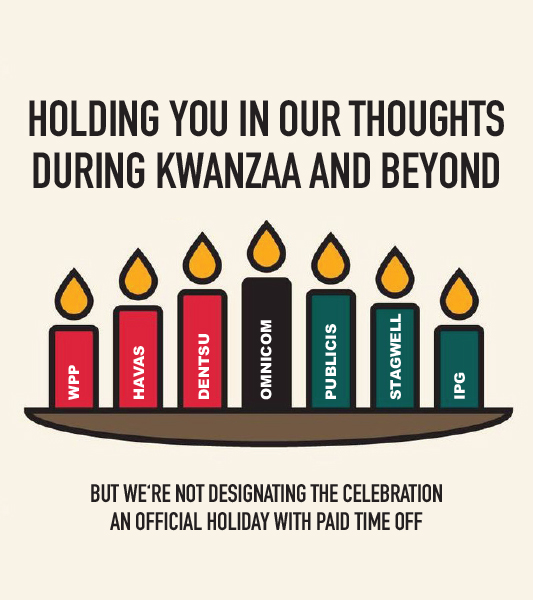
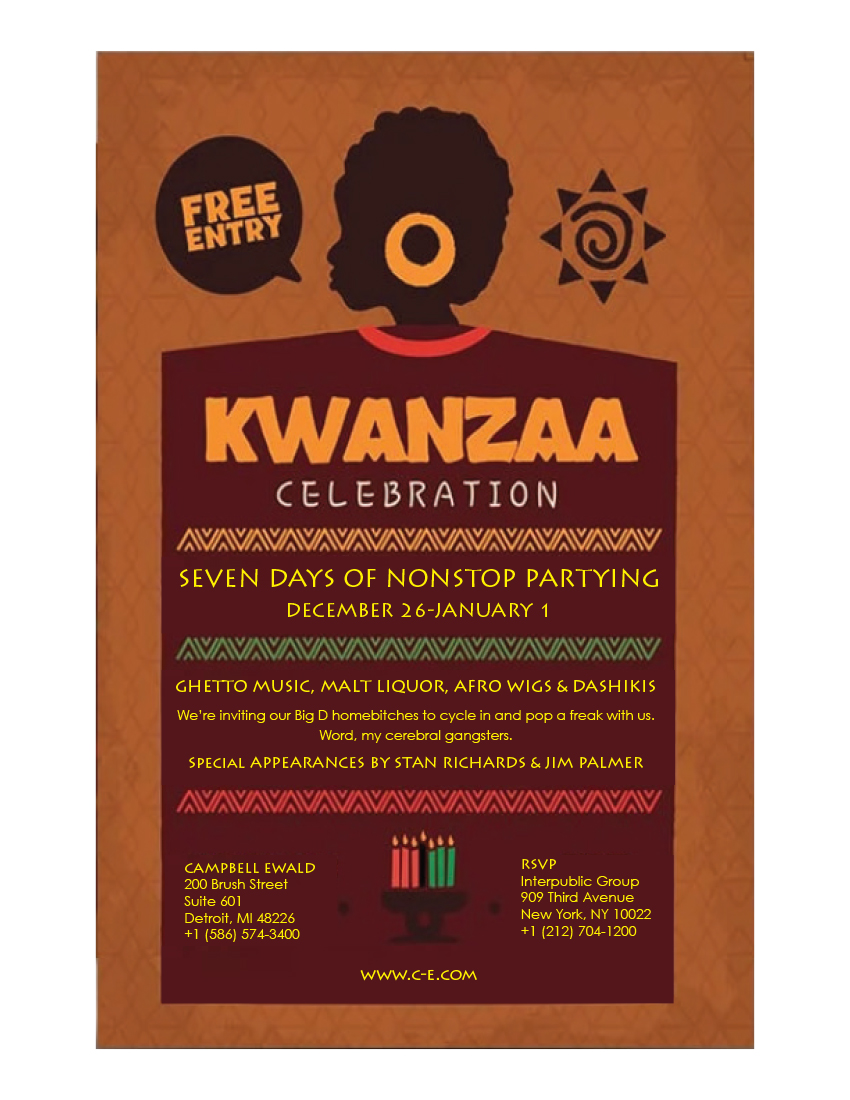
Expect Campbell Ewald to halt plans for a Ghetto Days–Kwanzaa celebration.


Poll: Office Holiday Parties Fall Out Of Favor


By Richard Whitman


There was a time when just about everybody looked forward to the office holiday party, if not recovering from it.  


But no longer, according to a new Harris Poll which found that just 48% of workplaces now host regular in-person holiday events. 


Apparently, the younger generations, Gen Z and Millennials are driving the decline, according to the poll. 


“Holiday parties are no longer a one-size-fits-all tradition,” says Libby Rodney, Chief Strategy Officer and Futurist at The Harris Poll. “Younger generations are calling for celebrations that align with today’s workplace values-interactive, inclusive, and respectful of employees’ time and contributions.”  


Younger employees polled cited awkward conversations, alcohol-fueled discomfort, and the fear of standing out in the wrong way as their primary concerns.  


42% of Gen Z prefer alcohol to be served in moderation or not at all, while 66% of Millennials want lighthearted features, such as executive roasts, to make celebrations more engaging and inclusive, and 65% advocating for a ban on work-related conversations. 


Harris surmises that “The future of workplace holiday parties lies in creativity and inclusivity,” noting that Gen Z showed a preference for interactive and themed events like escape rooms or creative workshops that allow employees to connect in innovative ways. Millennials want “Holiday Lite” celebrations that prioritize team bonding and relaxation in low-pressure environments.  


Across all generations the poll found that “practicality reigns supreme” in that 79% of employees would prefer a monetary bonus, and 71% would opt for additional time off instead of a holiday party. 


The survey was conducted online in November among a nationally representative sample of 1,238 employed adults. The research includes 222 Gen Z (ages 18-27), 447 Millennials (ages 28-43), 391 Gen X (ages 44-59), and 178 Boomers (ages 60 and older). See the full results here.

Tuesday, July 02, 2024

16692: DEI Tractor Pull.

MediaPost reported on Tractor Supply Company taking a chainsaw, mower, and shredder to its DEIBA+ jobs.


If the rural lifestyle retailer is seeking a White advertising agency, TRG and Campbell Ewald are ready to serve. Dylan Mulvaney is available for Influencer Marketing too.


Tractor Supply Yields To Anti-Woke Backlash


By Tanya Gazdik


Rural lifestyle retailer Tractor Supply Company apparently is afraid of going the way of other brands that have come under fire recently for appearing to be liberal.


The company issued a statement on its website Thursday — which it also shared on social media — stating that it is eliminating its diversity, equity and inclusion jobs at the company.


“The changes come amid a growing wave of anti-DEI sentiment in the wake of a U.S. Supreme Court decision in 2023 to strike down affirmative action in colleges,” according to CNBC. “Experts at the time predicted the ruling could have implications for corporate hiring or recruiting. Companies, including Starbucks, Disney and Target have faced legal challenges over DEI initiatives for LGBTQ customers and employees. In February 2023, pharmaceutical giant Pfizer dropped race-based eligibility requirements for a fellowship program designed for college students of Black, Latino and Native American descent, the Associated Press reported.”


The company statement said the retailer will also no longer submit data to the Human Rights Campaign and will withdraw carbon emissions goals.


“The Fortune 500 company has been nationally recognized as an inclusive and diverse workplace, including last year in Bloomberg’s Gender Equality Index and Newsweek’s inaugural list of America’s Greatest Workplaces for Diversity,” according to NPR. “But it recently became the target of conservative ire for that very reason, as the latest in a growing series of retailers to face backlash over — and ultimately walk back — its DEI initiatives.”


The statement says the company will “further focus on rural America priorities including ag education, animal welfare, veteran causes and being a good neighbor and stop sponsoring nonbusiness activities like pride festivals and voting campaigns.”


Robby Starbuck, a music video director and Republican who ran unsuccessfully to represent Tennessee's 5th Congressional District in 2022, launched the campaign against Tractor Supply earlier this month, according to NPR.


“These changes mark a stunning shift in policy and messaging from Tractor Supply, which once touted its diversity and inclusion efforts,” according to The Associated Press. “Just earlier this month, Tractor Supply President and CEO Hal Lawton maintained that the company remained ‘very consistent’ in how it approaches its own DEI and ESG — environmental, social and governance — programs for a number of years.”


The decision to abandon minority communities “has ignited a vigorous debate about the role of corporations in fostering inclusive environments and the sway of political extremism over corporate policy,” according to The Advocate.


The company has disabled commenting on its Facebook and Instagram pages and CEO Hal Lawton has changed his X profile to private. In an attempt to erase its diversity legacy, Tractor Supply removed some DEI-related content from its website, per The Advocate.


The Human Rights Campaign denounced the move, with Eric Bloem, vice president of programs and corporate advocacy, criticizing the company’s decision in a statement to The Advocate.


“Tractor Supply Co is turning its back on their own neighbors with this shortsighted decision. LGBTQ+ people live in every zip code in this country, including rural communities. Companies from every industry work closely with us to be sure their employees and customers are respected, valued and can get the job done for their workforce and shareholders. Caving to far-right extremists is only going to hurt the same folks that these businesses rely on.”

Tuesday, January 09, 2024

16498: Puzzling Poop From IPG And Its Affiliates.


Advertising Age published a lengthy report featuring more analysis on the IPG fire sale of Hill Holliday and Deutsch New York to Attivo Group. At least two excerpts warrant commentary.


Here’s Excerpt 1:


“IPG regularly reviews its portfolio to look for opportunities to simplify its structure and better orient the company to areas of growth,” a spokesman for IPG told Ad Age. “While DNY and Hill Holliday continue to deliver value and creativity for brands, their areas of expertise duplicated existing assets within the holding company.”


This point was pondered by another pundit. Can’t help but note it’s a pile of bullshit. Since the beginning, White holding companies have taken advantage of the sameness of White advertising agencies within networks, offering up replacement shops when clients expressed unhappiness.


For example, after USAA fired IPG shop Campbell Ewald for being racist, the client ultimately picked another White advertising agency within the IPG global outhouse. Don’t think for a nanosecond that IPG did not serve up droves of duplicate dumpsters.


Here’s Excerpt 2:


Both [Deutsch New York CEO Val] DiFebo and [Hill Holliday CEO Chris] Wallrapp said the Attivo acquisition will allow the shops to invest in new and growing capabilities. In particular, DiFebo said Deutsch NY will be looking to grow its graphic and design expertise. Wallrapp said Hill Holliday is looking to invest more in media and data and analytics.


Um, wasn’t access to greater resources a key benefit of being in a White holding company—so why are Deutsch NY and Hill Holliday eager to expand their capabilities? Plus, if these shops were deemed to have duplicate areas of expertise, won’t that pose a duplicate problem for Attivo Group?


Finally, there’s one area of interest where neither shop cares to invest: DE&I. Deutsch NY has already gone on record regarding the topic. Hill Holliday arguably made a failed investment. Both shops have demonstrated an abject lack of success with investing at all—so Attivo Group better think twice before providing any type of financial support.


Inside IPG’s sale of Deutsch New York and Hill Holliday—and what ad experts think of the move


IPG selling two of its legacy agencies to Attivo Group could spur other holding companies to follow suit


By Brian Bonilla and Lindsay Rittenhouse


The new year started with a surprise yesterday when Interpublic Group of Cos. announced it was selling two of its creative agencies, Deutsch New York and Hill Holliday, to Auckland, New Zealand-based global marketing services company Attivo Group.


Although the move is the latest in a slew of acquisitions and mergers within the ad industry over the past year, it’s still relatively rare for a holding company to sell two legacy agencies.


Most of the mergers and acquisitions to date have come from independents: Gut, L&C NYC, Majority, Movers+Shakers, and Uncommon all sold various stakes of their agencies last year. Brainlabs and Barkley accepted investments from private equity firms last year, and Stagwell sold its healthcare marketing agency ConcentricLife to Accenture.


What makes IPG’s move stand out further is that it’s unwinding two agencies it has held for more than two decades. Industry insiders believe that it could signal a bigger trend of holding companies selling underperforming assets—and that the buyers will increasingly come from outside of the traditional agency realm.


“To be competitive, [IPG has] to find efficiencies,” said Sasha Martens, industry recruiter and president at talent firm Sasha the Mensch. “It wouldn’t surprise me to see more companies sold off.”


“It speaks volumes that IPG valued the immediate payoff higher than they did the ongoing asset,” said Steve Boehler, founder of consultancy Mercer Island Group.


Given that the buyer came from an unexpected place—a global consultancy in New Zealand—another industry executive predicted more unconventional acquirers would follow. “It’s going to be an interesting year,” he said.


Financial terms of the deal were not disclosed.


Why sell


In IPG’s latest earnings call in October, CEO Philippe Krakowsky alluded to several underperforming parts of its business, including its digital shops R/GA and Huge. IPG’s Integrated Advertising and Creativity-Led Solutions segment, which includes all its creative agencies, decreased by 4.1% organically in the third quarter.


“IPG regularly reviews its portfolio to look for opportunities to simplify its structure and better orient the company to areas of growth,” a spokesman for IPG told Ad Age. “While DNY and Hill Holliday continue to deliver value and creativity for brands, their areas of expertise duplicated existing assets within the holding company.”


The headwinds that have battered agencies in recent years—capricious clients, rising reviews, a rocky new-business environment, margin pressures and more—are forcing a divest-versus-build approach, said one industry executive. Holding companies “are neutral,” said a former Deutsch executive who spoke on the condition of anonymity. “They are there to count the money.”


“Holding companies went through such a spree, it’s likely we will see more divestment like this [referring to the Hill Holliday and DNY acquisition] or else consolidation as WPP and Dentsu have been doing,” said Greg Paull, principal of consultancy R3.


But Matt Ryan, CEO of consultancy Roth Ryan Hayes, said there is still untapped potential in creative agencies, which is why he isn’t surprised to see private equity firms show more interest in the advertising space.


“It’s kind of a fallacy that there are too many agencies out there that are losing money, and the reason is simple: If they were losing money, they’d have to close,” Ryan said. “The truth is more in that the agencies are getting smaller or they have flat to little growth so they’re not really appealing from a public company standpoint.”


Paull predicts that Havas could be the next shop to be spun off; in December, Bloomberg News reported that French billionaire Vincent Bolloré was weighing a breakup of his holding company Vivendi. (Havas did not immediately respond to a request for comment.)


“It’s not hard to create a potential list. Just take a look at the smaller agency brands that are still in existence at some holding companies,” said Boehler, who declined to name them.


Business losses


Deutsch NY hasn’t made the same strides as its LA counterpart since Deutsch was split into two entities in 2020. At one point, the New York office counted Anheuser-Busch InBev, Reebok and Microsoft among its clients.


Deutsch New York CEO Val DiFebo, who will remain in her position, admitted that the agency isn’t at its peak. In October the agency set plans to lay off an estimated 19% of its staff at the beginning of 2024.


“Losing our PNC business last year definitely set us back,” DiFebo said. “And it’s really unfortunate that that happened because at the same time we were winning lots of pieces of business. We probably won five or six pieces of business at the same time that PNC was migrating out the door.”


In 2023, Deutsch New York won business with Dr. Praeger’s, Simple Mills and Kenvue’s Band-Aid brand. Its other clients include Galderma, Lactaid and Betway. In June, PNC Bank selected Arnold Worldwide as its integrated marketing and creative agency of record.


“Once Deutsch lost PNC, which was 60% of their revenue, there was no business left,” the former Deutsch executive said, noting that smaller account wins couldn’t “keep the infrastructure in place” following that loss. The agency denied PNC accounted for that much revenue but declined to specify an exact figure.


“I would say we have a ton of momentum right now, but we’re not at our peak,” DiFebo said.


Hill Holliday CEO Chris Wallrapp, who will also remain in the role, also pushed back on the notion that the agencies were sold due to underperformance within IPG.


“The entire industry has been up and down, and the way that we approached even going into the pandemic, and last year we ended strong with two new client wins,” he said. “We’ve seen strong organic growth across the board on our current clients. And so I’m really happy with the steady growth that we’ve been able to provide the agency in our business.”


Both DiFebo and Wallrap said the Attivo acquisition will allow the shops to invest in new and growing capabilities. In particular, DiFebo said Deutsch NY will be looking to grow its graphic and design expertise. Wallrapp said Hill Holliday is looking to invest more in media and data and analytics.


From family to affiliates


The two agencies will maintain an affiliate status with IPG, which means they can utilize the holding company’s other agencies and resources. One major benefit of this is less pressure around working with conflicting clients.


“There have been times where we’ve wanted to pitch something and [IPG] was like, ‘Yeah, sorry, IPG has a healthcare brand in that space, or IPG has a beauty brand,’ but because we’re not part of the same network, we will now be able to pursue some of those things,” DiFebo said.


“It allows more flexibility, unique strategic approaches on how we can work with our clients and how we can attract new clients. “I do think there is a nimbleness to working with a privately held independent holding company,” Wallrapp added.


While flexibility could certainly be a benefit, the new structure could be confusing at first glance.


“This agency complexity should not be made to be the client’s problem. And this deal between IPG and Attivo Group is nothing if not complex and confusing,” said Jay Pattisall, VP and principal analyst at Forrester. “How can marketing executives be expected to keep all this straight? In a market where clients are asking for streamlined partner solutions, where nearly a third of new business reviews result in consolidation, I can’t quite put my finger on the logic.”


Deutsch vs. Deutsch


Another point of potential confusion could be Deutsch’s name, which now exists within both IPG and Attivo. (Deutsch LA will remain part of IPG; similarly, IPG is retaining Hill Holliday Health).


A memo sent out by Deutsch LA CEO Kim Getty yesterday to the agency’s staff referred to the New York office as “DNY” rather than Deutsch. “I’m coming to you with an update which you will see later this morning in the news, that DNY (formerly Deutsch New York) is being sold by IPG,” Getty wrote in her memo. “As you know, it has been over three years since Deutsch LA officially split from DNY, so this move as relates to DNY is a natural progression for IPG in that process. “Since we separated from NY, we’ve honed our own path forward and thrived at a time when other independent creative agencies have struggled to find their footing.”


Deutsch New York can continue using the Deutsch New York name until the end of the year, according to IPG.


“A lot of our clients hired an iconic agency called Deutsch, and so for us to just change our names today would be kind of crazy,” DiFebo said, noting that many clients already refer to it as DNY. “For right now, I think we’re just going to stay with what we have.”


Donny Deutsch, chairman emeritus of the agency his father David Deutsch founded in 1969, could not be reached for comment.


Next steps


Attivo founder Cam Murchison declined an interview, but DiFebo and Wallrapp said the company will likely make further investments in the U.S. DiFebo said Murchison’s ambition is to be a “stronghold” in the country. Yesterday’s acquisition marked Attivo’s first investment in the U.S.


“We are living through a hugely disruptive period of global change, and in change there is opportunity,” Murchison said in a statement. “We will move fast and quietly on that journey.”


For now the two agencies are focused on keeping their employees informed and transitioning to a new ownership. DiFebo said Deutsch New York will move from an office space it shared with The Martin Agency, MullenLowe and Cambell Ewald, to a new space that is leased by IPG. Hill Holiday’s New York office will also reside in the new space. (Hill Holiday is based in Boston.)


Industry observers said the sale to Attivo could benefit both agencies.


“The holding companies have put their emphasis on a handful of very large brands and in many cases have not adequately supported their mid-sized brands,” Boehler said. “Agencies like Hill Holiday and Deutsch NY will have a chance to better market themselves away from [IPG]. We’ll see if they can.”


Contributing: Aleda Stam

Tuesday, December 26, 2023

16482: Kwanzaa In Adland 2023.


Given that many White advertising agencies are closed through the end of the year for the holidays, it’s unlikely that Kwanzaa will be acknowledged in Adland.


Don’t expect to see any Kwanzaa advertisements in the AOTW Holiday Campaigns collection. Even Mickey D’s Black & Positively Golden® campaign will probably take a pass.


White ad shops that feel obligated to engage in performative box-checking stunts will delegate resident Chief Diversity Officers or Black ERGs to post an agencywide email explaining the annual event. And if the Chief Diversity Officer is among the majority who are White, the email content will feature copied-and-pasted results from Google searches—provided they can even spell Kwanzaa.


Count on Campbell Ewald and TRG to steer clear of it all.

Tuesday, December 27, 2022

16080: Krazy Kwanzaa Koncepts.


To celebrate Kwanzaa, advertisers and advertising agencies considered a variety of concepts—which were ultimately scrapped for lack of interest and lackluster investment. MultiCultClassics gained access to a handful of the ideas presented here.


Thursday, December 02, 2021

15627: B Is For Brown.


Campaign published a perspective from Campbell Ewald Director of Integrated Strategy Dania Aguayo, who opined on the imperative to capitalize the “B” in Brown. This is arguably a sign of progress coming from Campbell Ewald, where brown usually involves Bullshit—with a capital B.


Why not capitalizing “Brown” erases cultural history


By Dania Aguayo


When the New York Times declared it would capitalize the ‘B’ in Black in the wake of George Floyd’s murder and the Black Lives Matter protests of 2020, it said that “style best conveys elements of shared history and identity, and reflects our goal to be respectful of all the people and communities we cover.”


In that same article, however, the Times declined to capitalize the ‘B’ in Brown on the grounds that the term generally has been “used to describe a wide range of cultures and its meaning can be unclear to readers.”


But if you dig into the roots of the word “Brown,” that argument falls apart.


By assuming that “Brown” is a generalized identifier that holds no history or identity, the argument completely omits the complexities of being Brown. It ignores what I call our street culture history, which often isn’t captured in history textbooks.


While “Brown” may be seen as a catch all color, it encapsulates a people struggling to find a place in a country that didn’t acknowledge their existence.


Hispanics/Latins were not protected under the 14th Amendment until the 1954 Supreme Court case Hernandez vs Texas. For years we were considered the “white invisible population,” treated under “white laws” without the white privilege. At the same time, we were seen as less than dogs and governed under Jose Crow laws.


But as we left our home countries, we also weren’t accepted in our parents’ homelands, either. As a Mexican-American, I lived with the reality of “el dicho” (or saying), “ni de aquí ni de allá,” or “neither from here nor there.”


Brown is a culture that was invented out of necessity as Mexicans were acculturating to the U.S. These Mexican-Americans preferred to speak English, ate Frosted Flakes cereal and drove American cars that were converted into lowriders.


Culture does not stagnate. It is a living, breathing organism that evolves based on human context and experience. For some Hispanic/Latin people, Brown is an identity that isn’t completely defined by race or nationality, but by shared cultural experiences, ancestry and struggles.


The Chicano movement of the 1960’s used “Brown” as a cultural identifier to inspire a political movement. Modeled after the Black Panther Party, The Brown Berets were established in 1967 to combat police brutality and fight racism. Some chapters also demanded education, job, and housing equality.


The 1990s saw the rise of Chicano Rap, pioneered by Robert Gutierrez, a.k.a. “ODM” (One Dope Mexican) and Bobby Ramirez, or “DTTX” (Don’t Try To Xerox). The duo, known as A Lighter Shade of Brown, was at the forefront of an explosion of Latino hip-hop groups that rose to prominence at this time. They touched on serious social issues such as police brutality and misconduct on the posse cut “Interrogated Cause I’m Brown.”


Today, the Hispanic/Latin community is rejecting colonization and reclaiming our Brown identity. We have constantly struggled with the mark the European conquistadores left on our people by trying to erase our ancestors and history by devaluing their worth and genius.


Many labels are used to bucket the Hispanic/Latin population, and I don’t mean to add another one to the list. But keeping “Brown” lowercase is another attempt to strike out cultural experiences that define our beliefs, attitudes and values.


Dania Aguayo is director of integrated strategy at Campbell Ewald.

Friday, June 18, 2021

15458: Jumping On The Juneteenth Bandwagon…?


Advertising Age reported on the patronizing partying planned at prominent White advertising agencies and White holding companies for Juneteenth. Not spotlighted were The Richards Group and Campbell Ewald. One thing’s for sure: the warm-and-fuzzy feelings for Juneteenth will vanish by July, if not sooner.


Here’s what agencies have planned for Juneteenth


From paid time off to meals and frank discussions, the holiday is becoming a permanent fixture on the calendar


By I-Hsien Sherwood


From its very inception, Juneteenth, the holiday commemorating the end of slavery in the U.S., was late to receive the recognition it deserved. Enslaved people in Galveston, Texas weren’t told of their freedom until June 19, 1865, two-and-a-half years after the Emancipation Proclamation and more than two months after the end of the Civil War.


Now, more than 150 years later, it is poised to become a federal holiday in the U.S., carried on a wave of righteous anger and overdue introspection. The ad industry, too, is seeing new interest in honoring the holiday. Just two years ago, it would have been tough to find an agency that observed Juneteenth in any official capacity.


Like so many other things, 2020 changed that. Last year, in the wake of the resurgence of Black Lives Matter, many agencies gave employees the day off for reflection or cultural activities. While there was some concern it might be a one-off gesture, that doesn’t seem to be the case. Omnicom, BBDO, DDB, The Martin Agency, Mediaocean, Deutsch, Ogilvy, Huge, Endeavor, Dagger and VMLY&R have all permanently added Juneteenth to their holiday calendars (observed on Friday, Jun. 18 since the actual holiday falls on Saturday this year).


But many shops are also programming events, panels and meals to celebrate. Here’s what agencies have planned for this year’s Juneteenth.


(Continued at Advertising Age…)