Showing posts with label bob liodice. Show all posts

Friday, April 17, 2026

17442: Buh-Bye, Bob Liodice.


Advertising Age spotlighted ANA CEO Bob Liodice, who will step down from his role at the end of 2026, prompting the search for a successor.


The ANA declared, “The next CEO will build on ANA’s scale and influence while advancing its role as the industry’s guide through the most significant shift in modern marketing—where artificial intelligence is reshaping how value is created, measured and sustained.”


Sounds like a perfect opportunity to innovate toward the inevitable.


That is, replace Liodice with an AI platform.


It’ll even offer nice alliteration and decent logo potential: ANA AI


ANA CEO Bob Liodice to step down


By E.J. Schultz


Bob Liodice will step down as CEO of the Association of National Advertisers at the end of the year, ending a more than two-decade run as leader of the nation’s largest marketing industry trade group.


The ANA has hired a search firm to find a new CEO. The organization declined to name the firm but confirmed the process will be overseen by ANA board chairman Dean Aragón, who is CEO and vice chair of Shell Brands International, and Procter & Gamble Co. Chief Brand Officer Marc Pritchard, the prior ANA chair.


“The next CEO will build on ANA’s scale and influence while advancing its role as the industry’s guide through the most significant shift in modern marketing—where artificial intelligence is reshaping how value is created, measured and sustained,” the ANA shared in a statement.


Liodice, 70, has been with the ANA for 31 years, serving as CEO since 2003. ANA credited him with growing the organization’s membership from 188 companies to more than 1,600, representing over 20,000 brands and 50,000 marketing professionals worldwide.


In an interview, Liodice pointed to recent work done to restructure the ANA into what he described as eight “mini associations” spanning specialty areas: brand, media, data, technology, measurement, talent, inclusive marketing and business-to-business marketing. “Each of these business teams are now focused in on what we consider to be the primary drivers of growth for our unique members,” he said.


With the reorganization complete, it is time “to turn over the ANA to the next generation of leadership, whoever that leader is, whether they be sourced internally, but most probably externally,” he added.


Fixing a ‘broken organization’


Liodice, who earlier in his career held marketing and sales roles at Grupo Televisa and Kraft General Foods, joined the ANA in 1995 as a senior VP. He stepped into the CEO role eight years later, succeeding John Sarsen. It was a tumultuous time, as ANA dealt with financial challenges, as well as criticism for letting media sponsors program its flagship conference that often resulted in thinly veiled sales pitches from the stage, Ad Age reported at the time.


“We stopped that,” Liodice recalled this week. “It was distasteful to many of our brand marketers.”


The ANA at the time was “somewhat of a broken organization,” he said. “We were a hairbreadth away from being out of business,” he added, recalling that when he took over in January 2003, the ANA had $28,000 in the bank and was “nearly bankrupt.”


The ANA, which is a tax-exempt nonprofit, reported $80.4 million in revenue for 2024, up from $65.6 million in 2023, according to its latest tax filings. Expenses grew to $82.2 million from $64.3 million. Liodice’s compensation was listed as $1.5 million as of the 2024 filing. The ANA employs about 200 full-time employees today, according to a representative.


Liodice said the group’s recent jump in expenses was partially due to costs related to its recent formation of Aquila, an ANA-backed cross-platform media measurement venture designed to help marketers reduce wasteful media spending by eliminating excess frequency.


Dealing with agency tensions


Improving the media supply chain for brands has been among Liodice’s key priorities. The ANA drew widespread attention in 2016 when it published a report prepared by investigative firm K2 alleging that media agencies were benefiting from non-transparent practices, including collecting cash rebates for media deals not disclosed to advertisers. While specific agency names were not listed, the report still drew complaints from agency players, including agency trade organization 4As, which at the time accused the ANA of taking a “one-sided” approach.


It was an example of how the ANA and 4As over the years have vacillated between being allies and opponents, depending on the issue.


Liodice, in this week’s interview, said the K2 report came at a “very challenging time.”


“Relationships were, in fact, damaged at that stage,” he said. But he suggested that tensions eased after Marla Kaplowitz took over as 4As president-CEO in 2017, succeeding Nancy Hill. “She and I got along famously, and we made it our joint commitment to repair whatever damage and work harmoniously together,” Liodice said.


Kaplowitz departed 4As in 2025 and was succeeded by Justin Thomas-Copeland.


Growing ANA membership and dealing with rising event competition


The ANA’s membership growth during Liodice’s tenure in part stemmed from the acquisition of five industry associations: Brand Activation Association, Business Marketing Association, Advertising Educational Foundation, Word-of-Mouth Marketing Association and the Data and Marketing Association. Those acquisitions are helping fuel attendance at the more than 60 conferences the ANA puts on each year, including its flagship Masters of Marketing conference held in Orlando every fall, which drew about 2,500 attendees in 2025.


But the ANA has had to deal with rising competition from newer events put on by other marketing and media organizations. That includes the Possible conference, held in the spring in Miami Beach, which last year drew 5,400 attendees (albeit with some complaints about top executives being secluded behind closed doors).


“We honestly feel like we don’t compete against Possible,” Liodice said. He suggested the ANA’s differentiation from that and other events is its singular focus on brand marketers. Its global CMO Growth Council, for example, “continues to expand and has about 500 active CMOs,” he said.


Aragón, in a statement, credited Liodice for expanding the ANA’s influence and playing a “central role in advancing the standards and practices that define modern marketing.”


As he steps away, Liodice said he is looking forward to getting “a little more balance in my life.” He estimated that he has been traveling 15 to 20 weeks each year, including this week, when he attended the ANA’s Masters of Data conference in San Diego.


Bob’s final message to CMOs


On stage, Liodice is known for asking presenters what message audience members should take back to the office with them on Mondays. Ad Age turned the tables on him, asking him for his final piece of advice for chief marketing officers:


“Drink in as much as you can drink in— and to let your common sense prevail,” he said. “We lose sight of the value of common sense and try to sometimes get overly prescriptive in making decisions. But I do believe a CMO has achieved that stature because of their not only their integrity and their ethics, but their ability to navigate these complexities with incredible common sense and decision making that has been honed over the years.”

Wednesday, May 03, 2023

16239: ANA CEO Delivers Load Of DE&I BS. Over And Over.


Advertising Age published a ‘System Overload’ video interview with ANA President and CEO Bob Liodice and Author and Educator Laura Morgan Roberts—and the conversation covered DE&I. Can’t help but think that asking Liodice to comment on DE&I ultimately leads to Bullshit Overload—and sure enough, he delivered his standard pontificating propagandistic pap. The next video featuring Liodice on DE&I that makes sense will be the first.


Watch: ‘System Overload’ With Bob Liodice And Laura Morgan Roberts On How Change Happens


Kai D. Wright discusses DE&I with top business strategists


By Kai D. Wright


Welcome to System Overload, a streamed video segment focusing on the issues of the day.


In today’s second episode of “System Overload: How Change Happens,” host Kai D. Wright brings together two top business strategists—Bob Liodice and Laura Morgan Roberts—to discuss how to navigate change related to leadership and organization design, to accomplish tangible progress with diversity, equity, and inclusion.


Liodice, president and CEO of the Association of National Advertisers (ANA), where he’s led the advertising, marketing and media industry for nearly 30 years, joins Morgan, associate professor at the University of Virginia’s Darden School of Business, in sharing insights on the relationship between lexicon and which problems gets addressed, anticipating backlash to “wokeism” and the pace of change and progress in the ad world.


Language is an important element to change, said Morgan, who advises organizations through Alignment Quest. Specifically, she noted how barriers are tied to language use and how lexicon shapes how organizations navigate and solve issues related to DE&I, which she wrote about in her book “Race, Work and Leadership.”


Morgan is a frequent contributor to Harvard Business Review, a LinkedIn Top 10 Voice in Equity, and has also served on the faculties of Harvard Business School, Georgetown University and Antioch University.


Liodice shared lessons from the ANA’s 1,600 member companies representing 10,000 brands, whose collective influence is more than $200 billion in marketing spending. The ANA tracks industry progress, and Liodice shared examples of meaningful brand actions, including Procter & Gamble's work with Saturday Morning on anti-racial bias. The co-chair of the ANA Alliance for Inclusive and Multicultural Marketing, as well as several industry boards such as GARM (Global Alliance for Responsible Media), The Advertising Council, Better Business Bureau, and World Federation of Advertisers, Liodice shared highlights from the ANA’s annual research on the progress of leadership in the marketing and advertising industry.

Tuesday, December 27, 2022

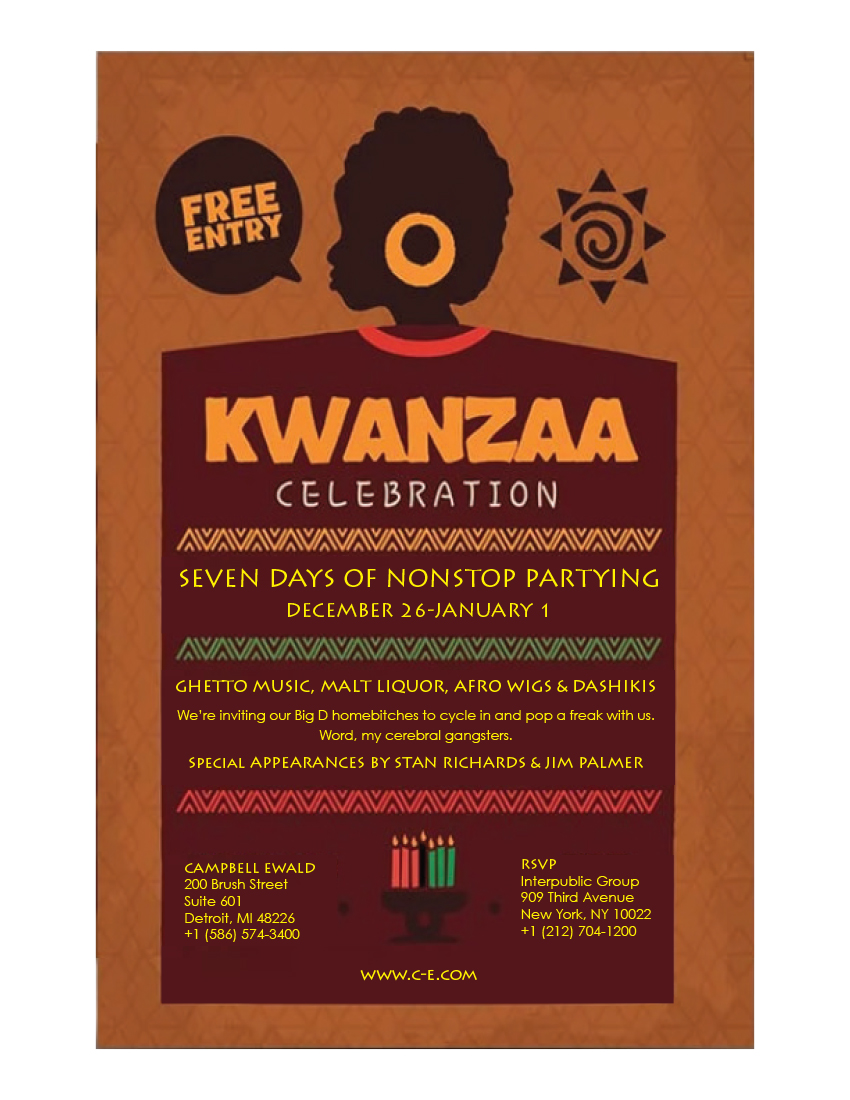
16080: Krazy Kwanzaa Koncepts.


To celebrate Kwanzaa, advertisers and advertising agencies considered a variety of concepts—which were ultimately scrapped for lack of interest and lackluster investment. MultiCultClassics gained access to a handful of the ideas presented here.


Friday, November 11, 2022

16026: Sniffing The Annual ANA Divershitty Report.


Advertising Age spotlighted the annual ANA divershitty report—also available for download at the trade organization’s website—which presents the obvious: In Adland, the White women’s bandwagon zooms ahead, leaving racial and ethnic minorities behind.


Of course, the facts did not dissuade ANA CEO Bob Liodice from gushing, “Here’s our headline: Representation of women in the industry overall and in leadership positions continues to be strong, and I am happy to tell you that we are finally making strides to improve ethnic diversity.”


The “headline” proves that Liodice would never survive as a copywriter, at least not if prerequisites for the position included honesty, accuracy and integrity.


Additionally, the “strides” are really strikes—i.e., strikeouts—given that the data clearly shows Blacks, Latinx, Indigenous Peoples and Asian Americans remain woefully underrepresented.


The highest numbers for Blacks constitute entry-level, administrative, clerical and support roles. And it’s a safe bet that the Black senior-level figures reflect a spike in hiring human heat shields and first-ever Chief Diversity Officers.


Indigenous Peoples maintain their spots at the bottom of the proverbial totem pole, failing to even achieve single-digit numbers.


Here’s MultiCultClassics’ headline: In Adland, you can’t beat the systemic racism.


Diversity In U.S. Marketing Industry Increases But Black And Latinx Representation Still Lag


The ANA's annual diversity report shows that 29.1% of marketing employees are diverse


By Jade Yan


U.S. companies have made gains in increasing diversity inside their marketing departments but change is still slow to come, especially when it comes to Black, Hispanic and non-binary representation.


The progress—and shortfalls—are documented in the Association of National Advertisers’ fifth annual diversity report, which is produced with its Alliance for Inclusive and Multicultural Marketing (AIMM). This edition comes about two years after brands began making pledges towards racial justice, including announcing that they would diversify their supply chain to include small BIPOC-owned businesses and new hires, during and after the uprisings that followed the murder of George Floyd.


The report, which surveys marketers that are ANA members, such as Delta Airlines and Walgreens, shows that 29.1% of marketing employees are diverse, up from 26% when the report was first published in 2018. Also, chief marketing officers are overwhelmingly white, the report showed. Diversity in the position is measured at 14.6%, up slightly from 13.7% in 2021.


The survey of overall members includes responses from 32,623 people regarding gender identity and 29,194 people on ethnicity.


Despite increasing since 2021, Latinx and Black individuals continue to be underrepresented in relation to their group proportions in the overall U.S. population, the ANA reports.


Black employees make up 7.2% of the industry's workforce, an increase from 6.6% last year. However, that percentage is still below the 12.1% of the U.S. population that is Black. And while Latinx individuals now make up 10.9% of the workforce, a jump from last year’s 8.9%, Latinx people represent 18.7% of the total U.S. population.


Native American, Alaskan Native, Native Hawaiian, Pacific Islander and multiracial employees make up 3.2% of marketer employees.


Non-Hispanic white employees are decreasing but still comprise the majority, at 67.7% of the marketing workforce. Asian marketer employees—at 10.2% this year, down from 11.7% in 2021—over-index when compared to 5.9% Asian representation across the overall U.S. population.


When it comes to gender, female employees now make up 68.3% of marketing employees compared to men, who make up 31.6%. Non-binary employees make up just 0.1% of the ANA member workforce, according to the report.


The report includes a section summarizing what respondents say are the “challenges or unique pain points” in boosting diversity. Companies gave reasons such as location and an inability to meet financial compensation expectations as hindering their ability to hire diverse talent.

Thursday, October 07, 2021

15566: ANA Clannish Rally For Masters…?


Advertising Age reported on the annual ANA Masters of Marketing soiree, where COVID-19 likely inspired a drop in attendance from 3,000 in 2019 to 500 this year.


Most amusing—in an outrageously hypocritical way—is an image from the event (depicted above) showing ANA CEO Bob Liodice presenting the trade organization’s ethnicity figures. The numbers have not changed in the last three years. Hell, it’s a safe bet the numbers have not progressed much in the last three decades.


The “Masters” are still predominately White.

Monday, October 07, 2019

14779: ANA Members Are Masters Of Hypocritical Bullshit And Blatant Lies.

Advertising Age reported the ANA kicked off its latest soiree with a “major focus on multicultural marketing”—including hyping its “#SeeALL” propaganda, a colored version of its “#SeeHerdivertisement diversion. Um, the ANA has been gnashing its dentures over diversity for more than a decade, with no progress worth reporting. Although maybe it can be argued that ANA CEO Bob Liodice opting against producing another self-promotional video on the topic is progress. Sorry, but repeatedly advocating for equality without actually doing anything is patronizing and passive bias.

ANA’s annual meeting begins with major focus on multicultural marketing

ANA CEO Bob Liodice hones in on diversity in opening speech, ignores hot-button issues like media transparency

By E.J. Schultz

For the past several years, Association of National Advertisers CEO Bob Liodice has kicked off the group’s largest conference of the year by ticking off a laundry list of issues plaguing the industry, including the opaque digital media supply chain, ad fraud and the ANA’s long-running fight with media agencies over transparency in contracts.

But on Thursday, as he opened this year’s “Masters of Marketing” at the Rosen Shingle Creek resort in Orlando, Liodice abandoned the typically combative tone in favor of focusing on a single issue: diversity.

He urged the trade group’s members to make multicultural marketing a priority by plugging several ANA initiatives, such as “#SeeALL,” a new program aimed at getting marketers to better target multicultural communities. It is an offshoot to the long-running #SeeHer” initiative that seeks to boost by 20% the accurate portrayals of women and girls in U.S. advertising and media by 2020.

“SeeALL” is led by the ANA’s Multicultural Marketing and Diversity Committee, which has also launched a new “cultural insights impact measure.” The metric, known as CIIM, “identifies the impact and effectiveness of cultural insights in ads and programming and how these have the potential to affect sales lift,” according to a September blog post by the ANA’s multicultural marketing chairperson Gilbert Dávila.

“When you infuse cultural insights into your advertising … you can actually generate a lift in sales … and that is what this is all about—to be able to dive growth while we are being purposeful marketers,” Liodice said in his speech.

On the growth front, Liodice delivered positive news, saying that eight in 10 Fortune 500 companies grew revenue last year, while six in 10 grew after-tax profits. That is an improvement over recent years, during which roughly half of the companies on the list have experienced declining after-tax profits. “Our job now is to institutionalize that growth and ensure it’s not just a one time event,” Liodice said.

But when it comes to multicultural marketing as a growth lever, the industry has a long way to go. Multicultural consumers comprise nearly 40 percent of the total U.S. population, but multicultural media investments make up only about 5 percent of total advertising and marketing spending, according to a study published in August by the ANA’s Alliance for Inclusive and Multicultural Marketing.

Also, more than 60 percent of Fortune 500 companies are spending less than 1 percent of their of their advertising budget on segment-specific targeted media, according to the ANA. The trade group is “prioritizing inclusion and equality as a call to action for corporations looking to drive incremental growth,” Dávila said in the September blog post.

Liodice in his speech played a video featuring several chief marketers touting multicultural marketing, including Target marketing chief Rick Gomez, who remarked that “prioritizing the multicultural consumer: it’s no longer a nice to do, it’s a must-do.”

Left unsaid in Liodice’s speech is the failure by companies to promote people of color to top marketing jobs. Only nine of the chief marketing officers at the nation’s largest 100 brands and companies were minorities, down from 11 CMOs in 2017, according to a recent study from executive recruitment firm Spencer Stuart. Also, none of the 18 CMOs hired last year were minorities.

The lack of diversity in senior positions is apparent at this year’s conference: an overwhelming majority of the 3,000 people attending the event are white.

Friday, June 22, 2018

14194: Cannes Cons V.

Adweek reported on another divertsity display presented at the Cannes Lions Festival of Creativity: #WriteHerRight sponsored by the Association of National Advertisers. The new initiative is designed to erase gender stereotypes and ensure authentic depictions of women in advertising. The stunt has the support of major advertisers including AT&T, Coca-Cola, Ford, General Motors, Johnson & Johnson, Kellogg, L’Oréal, PepsiCo, P&G, Verizon and Walmart. In short, #WriteHerRight is another example of lazy and biased prioritizing. That is, racial and ethnic inequality in adland is a much bigger problem than gender inequality. Yet patronizing organizations like the ANA opt to promote White women with quotas, deadlines, omnichannel programs and hearty backing from top clients. For minorities, the ANA uploads homemade videos and assembles an “army” that ultimately showed all the aggressiveness and might of The Salvation Army. The latest effort is reportedly finalizing the development of “a dedicated metric focused on the portrayal of multicultural women in storytelling”—demonstrating again how people of color take a back seat on the White women’s bandwagon. Plus, how will the “dedicated metric” record stereotypical portrayals such as Annie the Chicken Queen, the Pine-Sol Lady, the Honey Bunches of Oats Lady, Aunt Jemima, etc.?

ANA Takes Vow at Cannes to Erase Gender Stereotypes From Ads

#WriteHerRight pledge has support from major brands including P&G, PepsiCo and Walmart

By Lindsay Rittenhouse

CANNES, France—The Association of National Advertisers’ SeeHer movement, which formed in 2016 as an advocate for gender equality in ads, unveiled a new program to ensure storytellers have the means and knowledge to depict women in authentic ways, and major brands including Walmart, Microsoft and Procter & Gamble have pledged their support.

With #WriteHerRight, the ANA’s SeeHer created a platform to fuel discourse on gender inequality in storytelling with showrunners, actors and network executives—putting the issue in front of those who can facilitate change, Stephen Quinn, ANA’s SeeHer chair and former CMO of Walmart and PepsiCo, announced during a Cannes Lions presentation.

The ANA noted in a statement this initiative highlights an expanded partnership between SeeHer, content creators and media partners to drive more accurate portrayals of women in ads across all platforms. The #WriteHerRight platform will also partner with 2018 Adweek Disruptor Alma Har’el’s Free the Bid to help it place more female directors behind the camera and therefore reduce unconscious bias in storytelling, according to Quinn.

“The average age, race and body type of the women depicted in content today represent just a small fraction of the female population,” Dr. Knatokie Ford, SeeHer advisor on STEM & Entertainment Engagement, said in a statement, “That means most women and girls have likely never seen themselves reflected in the media.”

SeeHer’s research shows that unbiased ads increase return on investment by 30 percent, and 90 percent of parents have reported their number one concern with TV shows is the lack of authentic role models they see for their daughters.

As part of the #WriteHerRight outreach, SeeHer produced a “tip sheet” for storytellers featuring statistics on media representation and a list of 10 questions designed to raise awareness and diminish unconscious bias. SeeHer said the sheet was derived from a recent event the group hosted with television writers. It will be distributed to showrunners and SeeHer’s network partners.

SeeHer added that #WriteHerRight will specifically showcase TV writers who have developed strong female characters, void of stereotypes. An interactive #WriteHerRight blog will also be deployed on SeeHer’s website in the coming months to serve as a forum for writers to share their advice on how exactly to write women accurately into stories.

After the unveiling of #WriteHerRight, Quinn told Adweek during a phone conversation from Cannes that he is “excited and surprised” by the support he’s received so far today from producers, writers, showrunners and others in the media industry.

“I didn’t know what kind of reaction we would get,” Quinn said. “We thought some [critics] might be like ‘we don’t need you to tell us how to produce our content’ … which we’re not.”

In an additional statement, Quinn explained, “We are not looking to control creativity or solicit story ideas. We believe that by inviting storytellers to join our movement, we are that much closer to the day when all the images that women and girls see in the media not only mirror the real world but reflect a society they want to live in—and that is good business.”

Quinn said SeeHer measures gendered stereotypes in storytelling by rating content, including ads and TV shows, against its “Gen score” metric. He added that broadcasters, publishers, media agencies and other member organizations have “adjusted their content” based off SeeHer’s findings.

The organization is in the final stages of developing a dedicated metric focused on the portrayal of multicultural women in storytelling, as well, Quinn added.

SeeHer has the support of more than 70 sizable brands including AT&T, P&G, CVS, Coca-Cola, Kellogg, Georgia-Pacific, Ford, General Motors, Verizon, PepsiCo, L’Oréal, Johnson & Johnson, Microsoft, Walmart and Weight Watchers. According to the ANA, this is the first time in which U.S. advertisers have united to address the issue of gender-biased storytelling.

“At Weight Watchers, we aim to inspire healthy habits for real life, which means representing people and life authentically, reflecting diversity of the community we serve,” Gail Tifford, SeeHer co-founder and chief brand officer for Weight Watchers, said in a statement. “We believe content creators and brands are all storytellers and that the tools provided by SeeHer can move us from being aware of biases to actively making changes to be more inclusive.”

In an Adweek contributor piece, P&G chief brand officer Marc Pritchard explains his rationale for supporting SeeHer and #WriteHerRight in depth. P&G has come out with some of the best examples in recent years of ads that authentically showcase female characters including the “#LoveOverBias” iteration of “Thank You, Mom” from Wieden + Kennedy and “The Talk” from BBDO New York.

SeeHer launched in 2016 in partnership with the Female Quotient with the goal to see a 20-plus percent increase in the accurate portrayal of women and girls in ads by 2020, the 100th anniversary of women gaining the right to vote in the U.S.

Monday, October 17, 2016

13394: AIMM Sounds LAME.

Advertising Age reported the ANA launched the Alliance for Inclusive and Multicultural Marketing—aka AIMM—a new partnership that ANA President and CEO Bob Liodice proclaimed will create a “united blueprint for the evolution of multicultural and diverse-segment marketing in America.” Too bad the ANA has plenty of damning data to show multicultural marketing has actually experienced a devolution over the years—it’s in a death spiral. Liodice also stated, “Our strategic intent is to reach out to all constituencies in order to collectively make a difference in realizing the potential of multicultural marketing.” Um, the ANA should be realize by now that the potential of multicultural marketing amounts to diminishing crumbs. Additionally, AIMM will be charged with “finding new ways to discuss and tackle diversity within the advertising and marketing communities.” Okay, so the goals are to resuscitate flat-lining multicultural marketing and address the global dearth-of-diversity dilemma that has gone unsolved for over 60 years. But wait, it gets better. The invitation-only participants of the bold alliance are the very multicultural marketers and advertising industry minorities who have historically been unable to increase the crumbs and commitment required to make progress possible. It’s like asking the Harlem Globetrotters to compete in the NBA Finals—no offense to the Harlem Globetrotters. The ANA is the Association of National Advertisers. As recent events have shown, clients possess the power to demand diversity from White advertising agencies. To ignite change, they don’t need an alliance. They just need to ask.

The ANA’s New Alliance Wants to Provide the Blueprint for Multicultural Marketing

Leaders from various communities will head the group

By Katie Richards

As the advertising industry continues to find ways to improve upon its diversity problem and clients continue to demand more diverse agencies and work, the Association of National Advertisers announced today the launch of a new group that will target multicultural marketing, named the Alliance for Inclusive and Multicultural Marketing, or AIMM.

According to ANA president and CEO Bob Liodice, the goal of AIMM will be to bring together leaders from African American, Hispanic, Asian and LGBT marketing communities to help establish a “united blueprint for the evolution of multicultural and diverse-segment marketing in America.” For the first year, the group will be open by invitation only.

Some of the key goals for AIMM, laid out by the ANA, include finding new ways to discuss and tackle diversity within the advertising and marketing communities, creating and distributing “best practices of multicultural and diverse demographic segments,” invest in research and create a multicultural marketing knowledge center.

“Our strategic intent is to reach out to all constituencies in order to collectively make a difference in realizing the potential of multicultural marketing” Liodice said in a statement.

Liodice will co-chair AIMM alongside Michael Lacorazza, EVP, brand and advertising integrated marketing at Wells Fargo. Other members of AIMM as of its launch today include the AHA: The Voice of Hispanic marketing, Anheuser-Busch, Burrell Communications, Coca-Cola, Dunkin Donuts, IW Group, Kaiser Permanente, Kellogg, López Negrete Communications, NBC Universal, OMD, Procter & Gamble, Target 10, Univision, Video Advertising Bureau and Wells Fargo.

The formation of the new alliance follows the ANA’s 2016 Multicultural Excellence Awards, created to recognize outstanding creative work featuring African Americans, Asians, Hispanics, LGBTs and people with disabilities. Anomaly took home this year’s best in show award for its “Stay Connected” work for Duracell, which tells the story of a grandfather learning to live with a hearing disability.

Saturday, June 18, 2016

13226: #SeeHer Looks Like Bullshit.

Adweek reported on the latest diverted diversity dung heap from the ANA, whereby the trade group is launching an initiative designed to create more accurate depictions of women in the media. According to Adweek, the effort will include providing advertisers and advertising agencies with “tool kits to score their creative to make sure it accurately portrays women and girls, and encourage brands to review their ads for unconscious bias.” Okey-doke. First of all, what makes the ANA an authority on portraying women—or anything else, for that matter? Hell, ANA President and Chief Executive Officer Bob Liodice can’t even portray himself without producing an embarrassing mess. Will agencies that effectively utilize the tool kits also win free certification from The 3% Conference, as well as gain eligibility for a Glass Lion at Cannes? Wonder if this latest faux philanthropic endeavor will be more successful than the Army for diversity.

How the ANA Will Push for More Accurate Portrayals of Women in Ads

AFE and Girls’ Lounge partnering in #SeeHer initiative

By Christine Birkner

The clichéd, sexist portrayals of women and girls in advertising just took another blow from the ANA’s Alliance for Family Entertainment (ANA AFE). On Thursday, the organization announced the launch of #SeeHer, an initiative that aims to create a more accurate portrayal of women in the media. The goal is to see a 20-plus percent increase in the accurate portrayal of women and girls in ads by 2020, the 100th anniversary of women gaining the right to vote in the U.S.

More than 50 marketers met at the White House to announce the initiative at the United State of Women Summit in Washington, D.C.

Through #SeeHer, the ANA AFE will provide marketers, ad agencies and media agencies with tool kits to score their creative to make sure it accurately portrays women and girls, and encourage brands to review their ads for unconscious bias. #SeeHer also includes a data-tracking Gender Equality Measure to identify advertising that supports girls and women, and a website where consumers can see ads that reflect the initiative’s message.

“The right advertising environment for women can improve ad effectiveness by as much as 30 percent, so there is a business imperative to truthfully and accurately portraying women and girls. More importantly, it’s the right thing to do,” said Bob Liodice, CEO of the ANA, in a statement. “We’ll know that our job is done when every CMO and agency CEO associated with the ANA never produces an ad that diminishes the role of girls or women in our society.”

Industry leaders including Gail Tifford, vice president of media and digital engagement at Unilever North America, and Shelley Zalis, CEO and founder of The Girls’ Lounge, are partnering with ANA AFE on the effort. “We need to be conscious of our unconscious biases and ensure the visibility of women and girls in media and advertising is authentic and inspiring, because we believe if you can see her, you can be her,” Zalis said in a statement.

In January, the agency Badger & Winters introduced a similar initiative, #WomenNotObjects, which aims to combat ads that objectify women and fight sexism in advertising.

Thursday, June 11, 2015

12705: ANA Seeking Kickbacks.

Adweek reported the ANA will conduct a “fact-finding probe” into the allegations involving media-buying kickbacks. Let’s hope the investigation gets more results than the ANA’s half-assed exposés on the inequities of multicultural marketing and the industry’s dearth of diversity.

ANA to Launch Fact-Finding Probe Into Media-Buying Kickback Claims

Group’s goal is to ‘clean this mess up’

By Andrew McMains

Are media agencies pooling media purchases to get rebates on the time and space they’re buying and not passing those savings on to their clients? With another investigation set to start, that question won’t go away anytime soon.

The Association of National Advertisers is about to launch a search for a consultant to examine claims that media agencies are getting “kickbacks” from media sellers in the United States by buying media for multiple clients at the same time.

The practice is not unusual in overseas markets but not the norm in the U.S. and now marketers—egged on by former media agency leaders like Jon Mandel—want to get to the bottom of it.

The new investigation comes in the wake of the ANA and 4A’s starting a joint task force to study how agency-marketer contracts are set and develop a code of conduct.

“The issue that we have is we don’t know where truth lies,” Bob Liodice, president and CEO of the ANA, told Adweek.

The goal is to get an objective look at the situation, Liodice explained. “Let’s hire a third party to take an unbiased look at the way the industry is operating,” he said, “to be able to synthesize all the various perspectives that are in the marketplace and to do whatever research” is necessary “to provide a clean understanding of what is taking place, so that we can effectuate the right discipline and the right behaviors that will start to clean this mess up.”

The ANA’s board of directors initiated the search after hearing from Mandel and others that media agencies are benefiting from volume discounts in the U.S. and may be hiding that benefit through overseas units. Mandel raised this issue at an ANA conference in March, and it has simmered in the minds of marketers ever since.

“There’s a level of disbelief,” Liodice said. “We had several knowing people present to the board” who “validated what Jon Mandel has been talking about.”

Liodice declined to further describe the “knowing people,” who he said insisted on confidentiality before addressing the board.

When asked about the reactions of board members, Liodice said that some are “bewildered, some are confused, some are angry, some are disbelieving.”

Broadly, marketers sense that there’s a problem here, but its extent is unknown. Figuring that out is the core assignment the ANA will distribute among consultants.

The association is still drafting a request for proposals, but it could be ready as soon as next week. Based on submissions and possibly a round of presentations, the ANA will hire a consultant, but that’s at least a month away. For now, however, board members are satisfied that the process is underway.

“Recognizing that there is a substantial amount of information that is in the marketplace, you have to come to the realization that you can’t bury your head in the sand and hope that it goes away,” Liodice said.

“We are not out to throw anybody under the bus,” he said. “That is not the intent. But it is to get a clear articulation of facts, to say, ‘C’mon, how can anybody dispute these facts?’”

Thursday, October 23, 2014

12154: ANA Grabs More Ass(ociations).

The New York Times reported the Association of National Advertisers is on a merger tear, planning to acquire the Business Marketing Association. In May, the ANA picked up the Brand Activation Association. Wow, it’s just one blockbuster deal after another. Publicis Groupe Chairman-CEO Maurice Levy must be green with envy—but he vehemently refuses to comment on it or any other merger-related incident. Plus, it’s yet another opportunity for ANA President and CEO Bob Liodice to build troops for the Army to Advance Industry Diversity.

Association of National Advertisers to Acquire the Business Marketing Association

By Stuart Elliott

For the second time in five months, a venerable marketing trade association is acquiring another.

The Association of National Advertisers in New York, founded in 1910, has agreed to acquire the Business Marketing Association in Naperville, Ill., which was founded in 1922. The two associations are announcing the agreement on Friday morning.

It was the Association of National Advertisers that also made the acquisition in May, taking over an organization known as the Brand Activation Association, which had dated to 1911 and was long known as the Promotion Marketing Association. The Brand Activation Association became a division of the Association of National Advertisers, and that is what will become of the Business Marketing Association, effective on Nov. 30, pending approval of its members in a vote that is to begin on Friday.

The Business Marketing Association and the Association of National Advertisers are in many ways two sides of a similar coin. The Business Marketing Association has 2,500 members in what is called business-to-business marketing or b.-to-b. marketing — say, a maker of jet engines selling its engines to an airline or a maker of X-ray machines selling them to hospitals.

And the Association of National Advertisers, which has more than 630 member companies, represents business-to-consumer marketers, the firms that sell goods and services to the public.

The deal, for undisclosed financial terms, is being announced during the annual conference of the advertisers association, which began on Wednesday in Orlando, Fla., and is to continue through Saturday. The conference, called the Masters of Marketing, has set an attendance record, with more than 2,800 registered attendees.

Although “giving up your independence is emotional,” Steve Liguori, chairman of the Business Marketing Association, said in a phone interview from the conference on Thursday, “the A.N.A. can help us because of its scale and breadth.”

“The A.N.A. reached out to us several months ago and said, ‘We want to be all things marketing,'” Mr. Liguori said. “We’ve got the passion and expertise in b.-to-b., but we lack the scale.”

In becoming a division of the Association of National Advertisers, he added, the Business Marketing Association will move to New York from Naperville and its board of directors – which has approved the acquisition — will become a board of advisers. Al Maag, executive director of the association, will remain in his job, Mr. Liguori said.

Robert D. Liodice, president and chief executive of the advertisers association, said the agreement “enriches and complements the A.N.A.'s offerings,” adding, “Through the B.M.A. integration, the A.N.A. will be able to enhance its programs and the insights we deliver to our members.”

In announcing the acquisition in May of the Brand Activation Association, Mr. Liodice described his organization as “always looking to see how we can add to our portfolio” as it seeks to be “a full-service association for our members.”

The pair of acquisitions suggests that additional consolidation in the crowded field of marketing industry organizations may be forthcoming if executives start believing that fewer, larger associations may be more effective than many, smaller ones.

Saturday, May 24, 2014

11877: 2 Associations = 1 Ass.

The New York Times reported the Association of National Advertisers is acquiring the Brand Activation Association. Hopefully, there will less initial hoopla than the failed Publicis-Omnicom merger. Perhaps ANA President and CEO Bob Liodice will post another compelling video explaining the new partnership. Looking forward to learning how the Brand Activation Association will bring more firepower to the Army to Advance Industry Diversity.

One Venerable Ad Trade Association Is Acquiring Another

By Stuart Elliott

Two marketing trade associations, each of them more than a century old, are joining forces.

The Association of National Advertisers in New York, founded in 1910, has agreed to acquire the Brand Activation Association, also based in New York and founded in 1911. The agreement is being announced on Thursday morning by both associations.

The advertisers association represents, by its own count, more than 600 companies that sell 10,000 brands and spend an estimated $250 billion each year on marketing. The Brand Activation Association — known until last year as the Promotion Marketing Association — represents firms involved in areas like promotional marketing, shopper marketing, relationship marketing and old-school “reminder” marketing in the form of giveaway items: pens, calendars, coffee mugs, baseball caps and the like.

The boards of both associations have unanimously approved the acquisition plan, which would take effect July 1. Members of both organizations are expected to formally ratify the acquisition at their meetings next month.

The Brand Activation Association is to become an operating division of the advertisers association and retain its name. Bonnie Carlson, its president and chief executive, will be president of the division.

“I think we’re breaking some new ground,” Ms. Carlson said in a phone interview on Wednesday, referring to the idea of one trade association absorbing another.

“It’s about clout,” she said of the combination, because her organization will be “sharing more resources” by joining with the advertisers association.

And “it’s about content,” Ms. Carlson said, in that the advertisers association will gain additional conferences and events to add to its offerings to members. For example, the B.A.A.'s annual law conference will continue, she added, as will the annual presentation of honors called the Reggie Awards.

Robert D. Liodice, president and chief executive of the advertisers association, said: “In trying to be a full-service association for our members, we’re always looking to see how we can add to our portfolio, especially in the content area. Like any company, there are two ways: Build your own, or acquire.”

Because two associations are involved rather than, say, two agencies, two cable companies or two soup makers, no money is changing hands, Mr. Liodice said. “It’s a merging of operations,” he added, “and we end up being the parent company.”

This may be the first time the advertisers association has made an acquisition, Mr. Liodice said, noting that in the past the organization has done the opposite, as when it spun off a committee in 1936 that became the independent Advertising Research Foundation.

There is overlap between members of both associations, Mr. Liodice and Ms. Carlson said. She listed marketers that belong to both, like Coca-Cola, Kraft Foods, McDonald’s, Microsoft and Procter & Gamble.

(Mr. Liodice said that other members of the B.A.A. like agencies and service providers would receive some kind of associate membership in his organization rather than full membership because his organization limits membership to advertisers.)

Mr. Liodice and Ms. Carlson said they first began discussing joining forces at a lunch in September.

Might the coming together of two industry associations augur more mash-ups? There are a number of organizations that the denizens of Madison Avenue can join.

“A lot of our members feel there’s such a proliferation,” Ms. Carlson said, and say it could “help them if there were fewer, bigger ones.”

The coming-together of the two associations is, coincidentally, being announced after the recent unraveling of a merger between two giant agency holding groups.

Tuesday, January 14, 2014

11695: Even More Ad Tax Crap.

Advertising Age reported on the latest hand-wringing over the proposed Ad Tax that will allegedly put 1.7 million jobs at risk. Can’t help but wonder about the diversity of the threatened jobholders. When White executives face risky scenarios, lobbyists are hired, studies are conducted and bullshit PR runs at an all-time high.

Study: Tax-Reform Proposals Would Put 1.7 Million Jobs at Risk

Proposals Unlikely to Pass, but Groups Still On Guard

By Ana Radelat

Facing a threat from Capitol Hill that would hurt the ability of businesses to deduct advertising expenses, the Association of National Advertisers released a study that says the move would badly hurt the U.S. economy.

The study, conducted by IHS Global Insight, said that by 2017 advertising will directly and indirectly foster $6.5 trillion in U.S. economic activity and help support 22.1 million U.S. jobs. It also found that each dollar spent on advertising expenses generates nearly $22 of economic output.

The study is a response to two proposals aimed at cutting the overall corporate tax rate. Senate Finance Committee Chairman Max Baucus, D-Mont., and House Ways and Means Committee Chairman David Camp, R-Mich., have each proposed allowing businesses to deduct only 50 percent of their advertising expenses in a tax year and require the balance to be amortized over five years (Senate plan) or 10 years (House plan.)

Advertising is now treated as an ordinary business expense, fully deductible in the year incurred.

The ANA said the Senate plan would put 1.7 million jobs and $456 billion in sales at risk.

“This would undermine sales and innovation across each business sector,” said ANA President Bob Liodice. “This is the most wide-ranging and destructive threat the advertising industry has ever seen.”

The ANA, which was joined by The Advertising Coalition in releasing the study, has for months argued that proposals to alter the deductibility of advertising expenses would harm the U.S. economy. But, in a new effort to pressure lawmakers, the IHS Global Insight study breaks down the tax proposals’ impact on every state and each of the nation’s 435 congressional districts. For instance, the study said advertising is responsible for 673,062 or 16.6%, of all jobs in Michigan and 1.4 million or 16.4% of all Jobs in New York.

But whether Congress will act on a tax bill this year is in doubt.

Mr. Baucus had planned on leaving office at the end of this year. But now that he is President Obama’s choice to become the ambassador to China, he will likely leave before then.

This is also an election year, which makes it less likely lawmakers will want to tackle a controversial issue like taxes. And next year, Mr. Camp will have to relinquish his role as chairman of the House Ways and Means Committee due to House GOP rules that place term limits on such positions.

ANA lobbyist Dan Jaffe said there may be time for Mr. Baucus to push forward his tax proposal before he leaves for China. Mr. Jaffe also said Mr. Camp’s impending term-limiting “may create an incentive for him to push harder” this year.

“I think it’s very shortsighted to believe nothing will happen,” Mr. Jaffe said.

Jim Davidson, executive director of The Advertising Coalition, said that even if the 113th Congress fails to address tax reform, the threat to the advertising industry will remain in future Congresses.

“It will just keep coming and coming and coming,” he said.

Saturday, November 23, 2013

11591: Support The Ad Tax.

Advertising Age published an editorial by 4As President-CEO Nancy Hill regarding Congress potentially passing a tax provision or bill that would alter the long-held deduction of advertising costs. The trade publication also ran a story featuring other industry wonks bemoaning the possible “ad tax” creation.

Hill wrote, “We must bring the full power of our collective voices to the opposition. If you haven’t already, contact your members of Congress and let them know that what we do is essential to the businesses in their districts and in the nation as a whole. General tax reform may a worthy goal, but changing the advertising deduction is not the path to take.”

“It is essential that everybody in the advertising community speak up loudly and quickly that this proposal is misguided and highly damaging,” implored ANA Group Exec VP-Government Relations Dan Jaffe. ANA CEO Bob Liodice chipped in that “a major new tax liability which would increase the cost of advertising and cause a substantial disincentive for companies to spend additional advertising dollars.”

Whatever.

Let’s hope the battle cry is more effective this time versus the 2009 bullshit attempt at building an army to advance industry diversity.

Then again, let’s not.

Hill added, “Changing or removing the advertising deduction is also contrary to more than 100 years of business history.” Hey, that’s roughly the same amount of time that our industry has dragged its feet on reforming discriminatory hiring practices. Liodice would have to grudgingly admit to it as well. Additionally, Publicis Groupe Overlord Maurice Lévy gushed over the election of Barack Obama in 2009; hence, you’d think he would support the president’s tax reform proposals.

But seriously, why should a field that thrives on exclusivity also enjoy special monetary benefits? Hell, Congress shouldn’t just stop at instituting the “ad tax” on Madison Avenue. Legislators should launch a “diversity tax” too, fining advertising agencies for failing to integrate their ranks.

Now that’s an idea worth rallying around.