Thursday, March 09, 2023

10671: Explaining White Chief Diversity Officers.

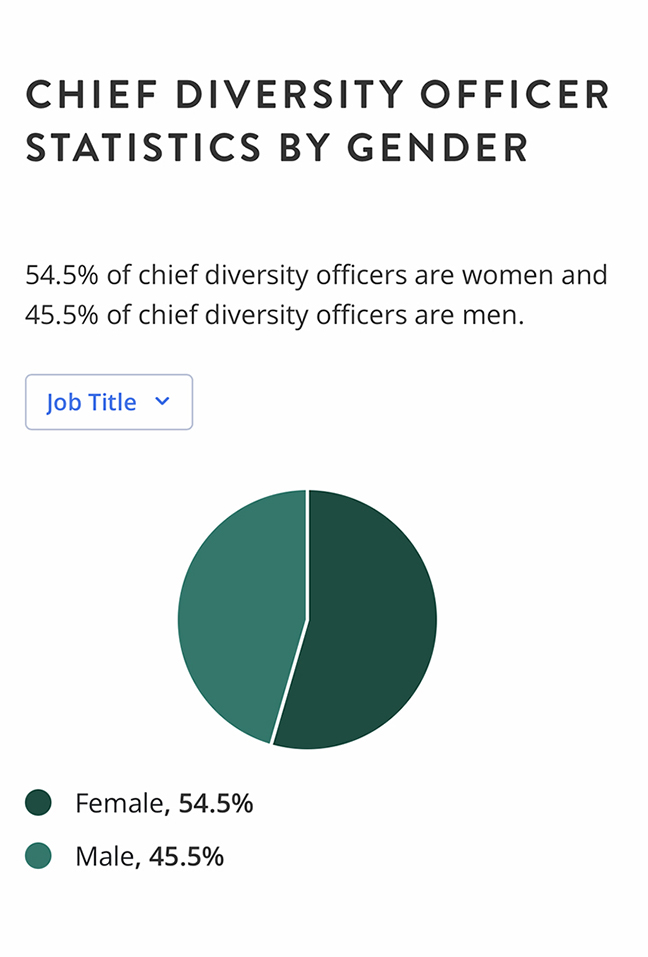
Job search platform Zippia published the charts depicted above and below, indicating that the majority of Chief Diversity Officers are female (54.5% female vs. 45.5% male) and White (with the race and ethnicity percentages closely reflecting the exclusivity in Adland).


The figures are not specifically for Adland—but for the sake of this post, pretend that the charts provide an accurate portrayal of the CDO makeup in the advertising industry.


While the industry has presented PR-friendly optics—i.e., delegating the role to people of color—there are plenty of considerations that might explain the dominance of White women and White men serving as CDOs, including also being:


• Members of the LGBTQI community


• People with disabilities


• Neurodiverse individuals


• Military veterans


• Senior citizens


From there, other probable explanations include:


• Appointing via favoritism, nepotism, or cronyism


• Attaching the title and duties to a resident HR employee


• Holding a firm belief in “diversity of thought”


• Awarding the position to very progressive White man (extraordinarily rare)


• Allocating diversity budget for scholarship and mentorship programs—whereby the CDO title is handed to the White person who hatched the educational scheme


• White women satisfy diversity requirements


• White advertising agencies love systemic racism

Wednesday, March 08, 2023

10670: Why Adland Is So Hard For Blacks.


Campaign published a perspective from Graham Stanley Advertising President and CEO Larry Woodard, who sought to explain why DE&I in Adland is so hard. What makes Woodard’s words so pathetic? He’s been parroting the POV for decades. What makes it all even more pathetic? While Woodard’s editorial resided near the bottom of Campaign’s homepage, the lead story at the top of the page advocated for gender diversity—i.e., White women—in White advertising agencies.


Why is DE&I in Adland so hard? Because for the White men and White women running the show, systemic racism is so easy.


Why diversity and inclusion is so hard


By Larry Woodard


The answer is simple — but it is also so difficult that it might very well be impossible.


This piece is for everyone, but especially those who run ad agencies. I’m not blaming or shaming, just taking on a difficult topic with some good, old-fashioned truth-telling. I’m now at the age where just seeing the truth in print represents progress.


I remember proudly attending my first 4A’s convention more than 30 years ago. Agency leaders from across the country convened to discuss the most important issues facing our industry. I was young and full of excitement and optimism about my profession. 


Imagine my delight as then President O. Birtch Drake addressed the attendees by calling out lack of diversity as one of the most critical issues facing our industry. I was excited that our industry was tackling important issues head on. Of the hundreds in attendance, I had seen only three or so other people of color. But Birtch was on the job. 


More than 35 years and three presidents later, it feels like the movie Groundhog Day. I’m stuck in an unending cycle where one of “those” guys stands behind a podium and addresses the leaders of the largest and most influential agencies in the country with solemn sincerity to sound the clarion call that agencies must become more diverse. Then we eat food, go to breakout sessions, play golf or tennis, go home and come back to another locale to do it again a year later. And in the interim, nothing changes.


Why is diversity and inclusion so hard? Why have changes been so slow in coming? The answer is simple. In fact, the solution is simple. But it is also so difficult that it might very well be impossible.


The group with the power to make change is disincentivized to do so.


Despite the Black population making up just under 14% of the U.S. population, we make up about 5% of ad agencies. Whites account for nearly 90% of the advertising workforce. If agencies truly reflected the makeup of the country, many of the people working there now would not be. Those who would still be there would have to learn about things that they currently have no interest in — like how other people think and what they care about.


Here is where it gets hard. Black influence is pervasive in culture, music, sports and entertainment. Almost all Black people can code shift — change language, dress and even behavior to fit into the dominant white culture. But very few white people can code shift into ethnic cultures.


To put it simply, most black creatives work with cultural handcuffs. Their bosses generally don’t know how to evaluate or rate their ideas — so, consequently, they don’t get presented to clients. They can’t be their authentic selves at agencies. Most importantly, they almost never become the boss. There have been a handful of Black CCOs at big agencies, but even in their departments, Blacks are still underrepresented. 


How does this change? White people have to believe that the creative becomes better when those producing it are diverse. They have to promote more Black people into positions where they can approve the work being presented to clients.


Current best practices include hiring a director of diversity and inclusion. This is like hiring a hall monitor when you need a principal. D&I positions often have no teeth and lack resources. True diversity and inclusion must be driven by the people (usually white and male) who run agencies. But their representation has to decrease, by percentage, in order for minority representation to increase. What incentive do they have to relinquish or share power?


At some point, to really represent diverse points of view, people of color must be among the shot callers at agencies. I’ve seen agency leaders try to dictate diversity strategies by tying bonuses to meeting certain criteria. But these never hold — because the true measure of success in the ad business will always be profit and client satisfaction. 


People of color have made progress in society by fighting, demonstrating, suing and pretending like we’re white — but we’ve not succeeded in getting into positions that allow us to make lasting changes.


Can you imagine a world where even 20% of major agencies have people of color running their creative departments? Can you imagine a world where even 30% of the workforce at major agencies are people of color? Can you imagine a world where the entire point of view of the agency is truly diverse?


I can’t…and you can’t either. That puts a bow on why diversity and inclusion is so hard.

Tuesday, March 07, 2023

10669: Exclusivity Beats Eloquence, Racism Defeats Reason.

Adweek published a provocative perspective from M&C Saatchi Sport & Entertainment Brand Strategy SVP Sabrina Lynch that will probably go way over the heads of the average White adperson and/or Caucasian client. Seems like Lynch used roughly 1,250 big words to say that Blacks are not a monolithic audience.


There is undoubtedly a companion PowerPoint deck ready to clobber clients, confusing them to the point of coughing up crumbs for a multicultural marketing tactic.


It’s challenging to convince clients to create more nuanced and mindful multicultural marketing when there is clear and consistent data that shows Blacks are not just underrepresented in advertising—they are underserved as an audience too. Plus, Black advertising agencies are underutilized and underpaid.


The issues listed directly above can be summarized in four words: Adland loves systemic racism.


The Duality of Black Life Matters


Marketers need to move beyond trauma bonding and contend with how Blackness is portrayed and defined


By Sabrina Lynch


Black History Month is rife with triggers for a Black person.


This may not be a surprising revelation. Every activity or message that recognizes the history of the African diaspora that built America is meticulously workshopped to maintain a balance that celebrates Black achievements—including historical contributions—alongside allyship over the atrocities still impacting Black communities. However, the mark frequently missed by the industry is an accurate depiction of the intersectionality of Black identity.


The default approach to marketing Blackness is seemingly reliant on symbolic and material representation, where a Black person’s body becomes a vessel for another person’s interpretation of Black folklore, language and movement. The portrayal of Blackness at a skin-deep level dismisses the cultural identities audiences hold dear, and Black representation becomes far more one-dimensional. It starts to mean something more when multiple layers of identity are applied.


Spotlighting the sense of connectedness that local, global and national communities feel due to what they experience because of their skin color is sound but does not tell the story of the diversity of these experiences from people with an array of backgrounds. More often than not, creative campaigns designed for mass American audiences—with Black people at the core—are built on trauma bonding, depicting the distress that comes with one’s ethnicity.


Since 2020, most U.S. advertisers have made an effort to be more precise in using Black representation to promote a product’s or business’ relevance in their lives. Whether it is being a resource or an ally, these strategies have primarily been pointed commentary on the daily challenges of being Black, such as racial injustice tackled by Nike in “Dream Crazy,” disparities in maternal and paternal parenting stress poignantly addressed in P&G’s “The Talk” or reluctant capital investment in female entrepreneurism highlighted by Mastercard’s “Shop, Share and Support Black Women-Owned Businesses” campaign. But there is existence outside of the trauma endured. They are fragments in an immense tapestry of life. For Black Americans, who have inherited and endured centuries of systemic racism, driving attachment through empathy will only carry a brand so far. It should go without saying that showing wokeness has a shelf life.


Intersectional storytelling


There are layers to the Black experience that are rarely portrayed, all of which are missed opportunities to recognize a larger community at hand. Notably absent are the nuanced and personal differences in cultural identity. Case in point: There are Americans who identify as African American, and there are first-generation Americans who refer to themselves as Black to recognize their lineage, whether Ghanaian, Guyanese or Grenadian. You also have those who sit at the intersection of country, race and nationality—born of the African diaspora, raised in a predominantly white country, now living in America.


Instead, tropes are created and perpetuated in advertising campaigns. All to answer one question asked with naive candor: “What kind of Black do we want to portray?” Maybe it’s the Metropolis Maven—a witty city dweller unmatched in ambition—or the Protective Parent, seething over the ban of AP African American Studies. Let’s not forget the Style Setter, who lives to bust jokes with friends on the block, or the Activist still reeling from the death of Tyre Nichols. Of course, there’s the Musichead, fluent in hip-hop slang.


While there’s nothing wrong with these particular personalities, they’re still a microscopic interpretation of the polylithic experience of being Black in America. It would be irresponsible to continue depicting the Black experience in such a narrow-minded way: There’s no exploration of duality, of embracing the joy and the pain of just being Black. A person of color can be the epitome of style, laugh with friends, have a visceral reaction to another racial atrocity and nod their head to the lyrics of “Mother I Sober” by Kendrick Lamar during a moment of quiet reflection. All on the same day. Sometimes the same hour. We must acknowledge the hybridity of lives led across the country far more than we currently do.


Advertising has a responsibility of care in Black storytelling, not only in positive representation but in building esteem, tempering social isolation and breaking the cycle of destructive patterns that portray Black as always synonymous with trauma and Afro-Americentrism—an approach that has historically hurt Black families and communities. Even when the flip side of trauma is given space to be conveyed in a campaign, it’s usually a lighthearted nod to cultural colloquialism, movement, music or fashion to provide an “insider” point-of-view of Black joy.


Now, arguably both approaches have the best intentions, but they are in danger of permitting the creation of outsider perspectives of very real human experiences. This also applies to Black creatives who may well be behind the design of an advertising campaign. Perspective can make or break resonance, drawing a gray line between cultural observation and preserving a stereotype of Black experience through expected social conventions. Just look to TikTok creator DameDamian, who has faced backlash over this approach.


That said, none of this critique means that the industry should hold back on how they evolve the way they represent people of color. The point is to do it better by understanding the different values and customs held by this audience. In a survey by the Alliance for Inclusive and Multicultural Marketing, 60% of consumers from diverse communities shared they felt “invisible or underrepresented” in ads, increasing from 58% in 2021. And with 46.8 million people in the U.S. identifying as Black, keeping up with how they self-identify is crucial—for example, while Black and African American may be used interchangeably, they are inherently different.


It begins with understanding how your advertising strategies have defined Blackness over the past three years. Merriam-Webster offers two interpretations:


a: the fact or state of belonging to a population group that has dark pigmentation of the skin : the fact or state of being Black


b: the social and cultural identity and experience of Black people : representations or expressions of this (as in art or literature)


So far, the go-to approach has been the former over the latter. Campaigns need to be more demonstrative of the microcosms of Black lives instead of being a singular, generic viewpoint based on age or U.S. geography. This is where thorough audience mapping will be your best friend, pinpointing the behavioral nuances that will inform scripts, casting and messaging. Going more in-depth with this exercise will give your creative the best possible chance to hit home for the intended target. When have we seen an acute observation of the differences between Caribbean American and American Caribbean households in the U.S., or the different bonds Afro-Latinos and Black Hispanics may have with their biracial families in navigating the duality of their cultural makeup? Touching upon the interrelation of ethnicity is not seen as a strategic imperative, unless the advertising is aimed directly at diasporic countries. But the diaspora is already here and well-established.


Let’s not forget the deal-breaker: defining the quality of Blackness’ role in storytelling. There runs the high risk that the narrative comes across as a representation exercise, where non-Black audiences walk away with a simplistic idea about the constitution of Black life. This is what leads to skepticism, an intuitive reflex in Black communities who could misinterpret your creative as an appropriation of struggle or joy for voyeurism. Nuanced identity is the future, and the future is now.

Monday, March 06, 2023

10668: Broken Promises, Fortified Prejudice.


Digiday Podcast spoke with Revolt CEO Detavio Samuels, who said advertisers have failed to deliver on promises to support Black-owned media. This is not news for anyone, especially vocal and litigious critics like Byron Allen. When it comes to all things related to equality and fairness in Adland, promises, pledges, and commitments translate to performative lies—which perpetuates systemic racism, the only thing that the ruling majority is truly dedicated to delivering. Besides crumbs.


Revolt’s Detavio Samuels says advertisers have fallen short on commitments to Black-owned media companies


By Tim Peterson


Nearly three years after advertisers and agencies pledged to diversify their spending to support Black-owned media companies, there remains a shortfall in the amount of money actually making it to Black-owned media businesses.


“We’ve definitely seen movement and momentum. But without question, I think that they have fallen very short from the promises that they’ve made. And even this year, with all the talk about the recession and with all of the cuts, I think even their desire to deliver on those commitments are even smaller,” said Detavio Samuels, CEO of Revolt on the latest episode of the Digiday Podcast.


As a Black-owned media company that was founded by Sean Combs and operates a TV network as well as streaming and digital properties, Revolt has worked to address one of advertisers’ top complaints: “That there was not enough inventory in Black-owned media in order to deliver against the commitments,” Samuels said. Among those efforts have been Revolt’s launches of free, ad-supported streaming TV channels across services including most recently Vizio’s WatchFree+.


“There are thousands of FAST channels that exist today. But when you look at those FAST channels, most of the platforms that have FAST channels have somewhere between zero to maybe two Black content-focused channels. And so we see that as a massive opportunity,” Samuels said.


Despite advertisers’ DE&I shortcomings and the overall shrinking of the traditional TV business, Revolt’s revenues have continued to grow, and its digital revenue has surpassed its linear TV revenue despite the latter revenue stream continuing to grow.


“Now our digital revenue is much larger than our linear revenue. Over the last few years, we’ve seen our digital revenue growth about 9x to 10x, whereas our linear revenue has probably grown closer to 4x to 5x. And so streaming and digital is without question the biggest portion of our business right now,” Samuels said.


Here are a few highlights from the conversation, which have been edited for length and clarity.


Digital revenue dominance


Streaming and digital is without question the biggest portion of our business right now. When you look at [Revolt’s overall revenue] last year, let’s call it five-eighths digital and three-eighths linear.


Streaming subscription saturation


We see subscription as an opportunity. But as you know, the subscription market is just highly saturated. And for those people who know the difference between a red ocean and a blue ocean, I very much see the subscription business as a red ocean where you have several massive players competing. It’s no longer about growing the market; it’s about stealing share.


Keeping score of advertisers’ commitments


What most advertisers haven’t done is come up with a scorecard. There’s no transparency. And so we are working with third parties to come up with some sort of scorecard that can showcase whether brands have been increasing their spend with Black-owned media over the last few years or not.


DE&I dollars in an economic downturn


My business training always taught me that, when you need to make cuts, you go for the biggest piece of the pie. And so I don’t understand how advertisers and brands — even if they are having to do cuts — still can’t get to 2-3-4-5-6-7-8% [of their budgets being spent] on Black-owned media. And so that is absolutely a concern. And so we’re going to keep the pressure on advertisers and brands to make sure they deliver against the commitments that they made.

Sunday, March 05, 2023

10667: Fast Times For Forty Days…?

Are these fasting advertisements for Lent?

Saturday, March 04, 2023

10666: Lunch Meat & Baloney.


Oh, HILL Yeah…? Aw hell no.

Friday, March 03, 2023

10665: TGIFried Chicken From Popeyes.

Advertising Age reported Popeyes put its US creative account in review, effectively delivering a kick in the gut to Gut, its AOR for the last three years. The shop executed work deemed praiseworthy as well as gut-wrenching garbage. Popeyes even awarded White advertising agency McKinney with a six-month project to handle during the pitch process. Will the next AOR bring back Megan Thee Stallion or Annie the Chicken Queen?


Thursday, March 02, 2023

10664: CDO = Chatbot Diversity Officer…?


Adweek published a provocative perspective from X_Stereotype CEO and Founder Larry Adams, who presented clichéd and original ideas about Black History Month and inclusive marketing.


The clichés involved suggesting a BHM shift from commemorating the past to embracing the future—a viewpoint executed regularly and extensively in the previous month.


The original ideas—original not necessarily translating to good—included suggestions for igniting DEI with AI. Perfect—apply artificial intelligence to artificial interest.


The possibilities are intriguing for sure, as AI is currently being utilized for various advertising functions. Imagine replacing Chief Diversity Officers with chatbots. Hell, many CDOs are essentially chatbots already, spewing canned responses for diversity, equity, and inclusion.


Black History Month Ads Need a Makeover


The next wave of inclusive marketing will see the intersection of AI and DEI


By Larry Adams


As we celebrate Black History Month in the United States, it’s important to remember our purpose and goal to continue striving for racial equality and justice. We also need to recognize that for too long, the history and experiences of Black people have been marginalized and misunderstood. How can we tell a story we don’t understand? How can we connect authentically if we’re meeting a quota? If we are to truly honor Black history and culture, we must find ways to ensure that Black stories and perspectives are included in the narrative. In short: Black History Month needs a makeover. Rather than simply commemorating the past, we should be looking ahead to how we can drive inclusion in the future, and how data and AI can aid the cause.


It’s been a little over two years since brands and businesses en masse pledged their commitment to diversity and inclusion—ample time for these proud corporate promises to turn into an empty checkbox on a very long to-do list. Don’t think we haven’t noticed. This first wave of DEI is over.


The second wave of DEI will have brands asking themselves: Is it even worth doing? Of course it is, and the smart brands will start to look at the ROI and see the payoff, literally, in the pockets of shareholders of companies that have made DEI a true priority. In DEI 2.0, we’ll see a new wave of inclusion that goes far beyond ticking a box—because when diversity and inclusion are taken into account with a business-minded focus, it rewards both shareholders and our society.


It sounds like an oxymoron that benefiting shareholders also serves the greater good—but this is the benefit of being inclusive. 39% of your purchasing audience is multicultural, and mostly Black, which means inclusive communication can unlock this market. When you reach a wider audience, your ad dollars go farther, new customers are acquired and shareholders are happy.


It’s easy to understand the importance of diversity and inclusion across the board, but these efforts are often misunderstood when it comes to marketing. In the olden days (and things are very much still being done this way), a brand might target women aged 18 to 34 who live in a certain city or make a certain amount of money. Our research has shown that these traditional demographic markers hold less and less power over purchasing behavior. Socioeconomic status, region and education don’t impact intent to purchase—but our experiences do. Studies have shown that a person’s lived experiences, diversity and gender are more significant signals as to whether or not they’ll make a purchase. It makes sense; the lives we lead, the things we do, the experiences that shape us far better explain who we are than statistics on a spreadsheet.


So where does AI factor in? AI is already being used to find hidden patterns and correlations in large data sets, which can be used to create predictive models and inform decision-making. We can use this technology to identify areas where disparities exist and ultimately create more equitable access and outcomes for marketers. By training AI to analyze content through a lens of diversity and inclusion, we can identify purchasing propensity, racial bias and risk factors in content.


Human behavior, including consumer choice, is highly influenced by emotional state, diversity of experience and one’s internalized view of self-identity. These states are reliably expressed in our language and can therefore be detected in both written and spoken speech, with the latter providing multimodal cues (textual and audio) from which to detect emotion, and the latter processed along the unimodal text domain using natural language processing (NLP) techniques. This means that when provided with the right models, AI can be used to detect any bias or racism in content—from the concept to the script to the full-blown campaign level—as well as to identify any topics that may be associated with exclusion or discrimination. The patterns of emotions clearly differ across commercials in a highly interpretable manner. You feel this when you watch ads—now it’s calculable.


By analyzing content through the lens of diversity and inclusion, AI can help organizations better understand how their content reflects their commitments. Our data reveals a strong correlation between positive emotional responses and positive interpretations of diversity in content. Technology has advanced too far for us to still be operating by guesswork, especially when it comes to inclusion.


Communicating with an audience as diverse as the U.S. population is much more nuanced than previously perceived by marketers. Businesses must focus on the most effective triggers of persuasion. Emotion and inclusion are major driving forces in consumers’ decisions to make a purchase and spread the word about their purchase. In order to make this process as frictionless as possible, and to open the aperture wider, requires a deeper understanding of emotions, sentiment and diversity experience, which were proven to predict purchasing propensity across our studies. Purchasing intent has a high and positive correlation with content that is perceived as inclusive and evokes positive emotions.


As we enter DEI 2.0, we’ll also see the importance of updating our marketing strategies from “targeting” to “including.” The biggest difference between the two? No one wants to feel targeted, and everyone wants to feel included. We already see it in the media we’re served today, when we’re inundated by ads that make us feel like a walking statistic as opposed to consuming content that resonates with us and makes us feel heard.


Many companies believe the goal is to tighten the range and zero in on a singular, specific audience, when it’s really time to expand our reach. We’re long overdue to ditch the stereotypical tropes about gender and race and start to relate on an emotional, sentimental and experiential level with our audiences. Meeting consumers where they are, from an identity perspective, is key to moving from targeting to inclusion. For far too long we, people of color, have been portrayed in ways that do not reflect our identities and are removed from our experiences. Include our stories, appeal to our emotions and sentiments, connect with us authentically—we will invest in your brands and advocate loudly. We will create deep connections and become loyal to your products and brands. 


Just as American politics have diverged, brands will soon sit on either end of a similar spectrum. Brands that are waiting for this wave of diversity and inclusion to pass will realize it’s not going anywhere; brands that wholeheartedly bring scaled solutions to their businesses—solutions that put the power of inclusion in every content creator’s hands by leveraging multicultural models, AI and NLP—will be rewarded. Using the cloud of infinitesimal data computation empowers brands to get the scaled solutions we need to start to address the lack of representation in the marketing ecosystem.


In order to elevate Black History Month to keep up with the modern era, we need to not just take the stereotypes out of storytelling and marketing—there must also be a data-driven, insights-driven approach to DEI that ultimately benefits business growth. We’ve proven how multicultural understanding will only make your ads better; the brands that are really leaning into this approach are showing now, more than ever, that they truly have their finger on the pulse of this country.

Wednesday, March 01, 2023

10663: Confronting Bullshit With Wit.

Sir John Hegarty suggests confronting prejudice with wit.


Okay, that’s an irresistible comedic setup.


The DEI efforts at BBH are a joke.


Hegarty is a culturally clueless clown.