Thursday, November 30, 2006

Essay 1385


Bring out her inner diva. And all the standard copywriting clichés.

Essay 1384


From The New York Daily News…

---------------------------------------

The hate factory — N-word outburst adds to the denigration that passes as entertainment


By Stanley Crouch

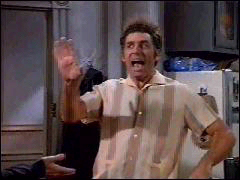
When “Seinfeld” comedian Michael Richards lost his cool and began a racist rant at some noisy customers in a Hollywood comedy club, it seemed to surprise a number of people. It shouldn’t. What is actually surprising is that it has taken this long for some airhead made famous by a very popular but insipid television series to flip out within the context of today’s minstrel entertainments.

Naturally, a lawyer representing the affronted audience members did not feel that it was enough for Richards to apologize on television; he still needs to pay them some money for what they had to suffer at his hands.

The question, however, is what exactly did the patrons suffer?

What they actually suffered, if anything, was an unintended caricature of a redneck in heated rage, expressing conventional disdain for black people. Richards said that 50 years ago, the black members of the noisy group of comedy club customers would have been hanged, and stabbed in the backside with a pitchfork. Before leaving the stage, Richards reminded the assembled that when it was all over, he would still be wealthy and the black people would still be, well, N-words.

The painfully unfunny comedian Paul Rodriguez performed on the same stage that evening and told the press that if one uses the N-word and is not African-American, a lot of explaining will have to be made.

In the interest of equality, no black comedian should get a pass when using insulting and denigrating words in the middle of an act. It all seems very simple to me. We do not need to accept the conventions of insult and denigration that have been established by black comedians and rappers.

And I do not feel that there should be a freedom of speech issue raised either. Nor do I feel that any laws need to be passed.

This was another moment to question what the ongoing vulgarization of our popular culture has actually come to mean. Two groups — women and black people — are disdainfully addressed and demeaned constantly. Only one has made any protest against being the constant butt of overstated vulgarity. White women have stood up against the misogyny in popular entertainment, but black people have not had much to say about the denigration.

Rap producers and others in the business of selling anything that gives a little spice to the minstrel content of our popular culture have been known to claim that the N-word has become a common means of expression and has taken on a universal understanding through rap. We can now be treated to young people of all ethnic groups referring to each other when using the word.

Does that prove anything? I think not. When Richard Pryor first made liberal use of the N-word, he could not have imagined what emerged in the wake of his performances. But when Pryor himself took a position against minstrel updates, no one listened to him. He had passed out the right of irresponsibility and could not take it back.

So what remains before us is the issue of coming to terms with a popular culture in which the N-word, bitches and hos have become no more than condiments in a particularly unappetizing meal. We need not ban their use, but we do need to face the fact that we have been hustled far more often than not.

Essay 1383


…Not by the color of our skin but by the content of our cartoon character.

Essay 1382


Political News in a MultiCultClassics Monologue…

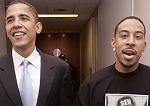
• U.S. Sen. Barack Obama teamed with rapper Ludacris to hype AIDS awareness. “I talk a lot about sex in my music, but you don’t ever hear me talk about condoms,” said Ludacris. “I can’t speak for other rappers, but I think it’s important that I let you know to be safe when you’re having sex. Young people need to know about HIV/AIDS before it is too late, so it’s extremely important that we talk about it.” Wow, a rapper promoting safe sex. What’s next, a Black man becoming president?

• The Los Angeles City Council decided to back the mayor’s veto of a proposed settlement in the case involving a Black firefighter who was served dog food by coworkers (see Essay 1379). “All I have to say is that I look forward to trying the case,” said the firefighter’s lawyer. “I think it will come back to haunt the mayor and the city,” said a City Councilman who opposed the mayor’s veto. “The greater message is you can be dehumanized, and nobody cares. I think it was a very poor [decision] that will send shock waves through a community … that will sit back and say, ‘The same old thing.’”

Wednesday, November 29, 2006

Essay 1381


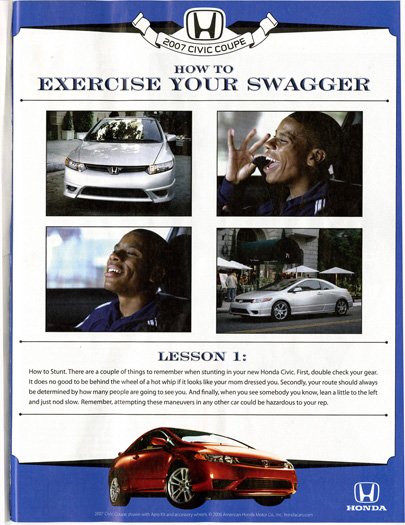
This ad will not help its creators regain their swagger.

Essay 1380


The New York Times published a story on the issues surrounding law firms hiring and retaining Black lawyers. While recruiting efforts and pressure from clients has boosted the number of Black associates, they’re less likely to remain or make partner versus White peers. A controversial new study found law firms have hired Blacks with much lower grades than Whites, potentially setting them up to fail. “If everyone in the law firms knows you’re hiring according to a double standard, you actually may end up compromising the confidence that partners and others have in the ability of people hired on the basis of preference,” said the president of the Center for Equal Opportunity. “It actually reinforces stereotypes.”

Click on the essay title above to read the full story.

Essay 1379


Kibbles N’ News Bits in a MultiCultClassics Monologue…

• The case involving the Los Angeles Black firefighter who was served dog food by his coworkers continues to boil (see Essay 1303). The firefighter originally received a $2.7 million settlement offer from the city. However, the mayor vetoed the action after public complaints. Now the City Council is divided over the incident. “Whatever anyone says about me, I’ve always tried to do what’s right,” said the firefighter. “This is wrong. If four Black firemen did it to a White fireman, I would stand up [with] the White fireman and say it was wrong.” The City Council is scheduled to make a decision today. Then everyone’s getting together at the firehouse for a spaghetti dinner.

• Snoop Dogg is in the doghouse, getting arrested for felony drug- and weapons-related charges. The arrest was connected to an investigation after Mr. Dogg was apprehended last month at a Burbank airport for allegedly packing a handgun and marijuana. This time, the cops searched the rapper, his ride and his home, ultimately charging him with packing a firearm, cocaine and marijuana. Plus, the man had a false compartment in his vehicle. Not sure why Snoop bothers — he ought to simply install a gun rack and greenhouse in his ride.

• Michael Richards continues to cause cultural controversy. When it was revealed Richards incorporated anti-Semitic rants in a recent comedy routine, publicist Howard Rubenstein said Richards “is Jewish. He’s not anti-Semitic at all. He was role-playing.” However, Jewish organizations said Richards has not converted to Judaism; plus, his parents are not Jewish. “Technically, not having been born by blood as Jewish and not formally going into a conversion, it was purely his interpretation of having adopted Judaism as his religion,” explained Rubenstein. “He told me, ‘I’m Jewish,’ when I asked him. … He said there were two mentors who raised him and who had a big influence on his life, and they were Jewish. He said, ‘I agree with the concepts and the religious beliefs of Judaism and I’ve adopted Judaism as my religion.’ … He really thinks of himself as Jewish.” Hey, he also thinks he’s not a racist.

Essay 1378


Beyond Sound. Beyond Machine. Beyond Contrived.

Tuesday, November 28, 2006

Essay 1377


In 2004, Advertising Age published the following news item (the story actually ran with the prophetic typo in its headline).

---------------------------------------------

Fudge attacks death of diversity.

Young & Rubicam Brands management will review a “very comprehensive diversity plan” in coming weeks, said Ann Fudge, chairman-CEO of the WPP Group network. In a speech about her career before members of the Advertising Club of New York City, she mentioned her surprise, upon taking her current job, at the advertising industry’s “dearth of diversity.” She emphasized that the challenge is not unique to the advertising industry, but it “has a way to go.” Since joining in May 2003, Ms. Fudge has undertaken a thorough evaluation of the agency’s workforce, including minorities. She didn’t divulge details on the plan, but said that “it is not just about getting the numbers.”

---------------------------------------------

Today, Advertising Age reported that Fudge is retiring from Young & Rubicam (see Essay 1375).

Quick — somebody ask her about the success of the “very comprehensive diversity plan” before she jets.

Chances are, Fudge’s departure will cut the agency’s Black executive total by roughly, um, 100 percent.

According to AdAge, Fudge hopes to focus on nonprofit work. Although one could argue that’s essentially what she did while trying to right the unprofitable Y&R.

However, there is another volunteer effort Fudge ought to consider: Dealing with the advertising industry’s diversity dilemma.

Imagine the clout and credibility she’d bring to the party. Fudge would make a formidable partner with Patricia Gatling, Commissioner and Chair of the New York City Commission on Human Rights. Add Jesse Jackson, Al Sharpton, New York City Councilman Larry Seabrook and Sanford Moore, and it’s the most amazing Black-dominated Dream Team since the 1992 USA Olympic Basketball squad.

So what do you say, Ms. Fudge? Here’s your opportunity to accomplish something truly groundbreaking on Madison Avenue.

Essay 1376


From The Associated Press…

---------------------------------------

Entertainers urged to end use of race slur

By Greg Risling

LOS ANGELES -- Black leaders on Monday challenged the entertainment industry, including rap artists, actors and major studios, to stop using the racial slur that triggered the Michael Richards furor.

Jesse Jackson and others said they will meet with TV networks, film companies and musicians to discuss the “n-word.” They also sought an effort by the public to stop using the term.

“We want to give our ancestors a Christmas present,” Jackson said at a news conference. “Dignity over degradation.”

Jackson also urged consumers to not buy a DVD box set of the seventh season of the TV show “Seinfeld” that was released last week.

Richards, who played the wacky neighbor Kramer on “Seinfeld,” triggered outrage with a Nov. 17 racial tirade against two black men when he was heckled during a comedy routine at the Laugh Factory nightclub in West Hollywood. A patron recorded the outburst with a video camera phone.

Richards has made several apologies, including one Sunday on Jackson’s syndicated radio program, in which he has said he is not a racist and was motivated by anger.

At the news conference, comedian Paul Mooney said he has used the “n-word” numerous times during performances but will no longer do so after watching Richards’ rant.

“He’s my Dr. Phil,” the black comedian said. “He’s cured me.”

Asked about free-speech issues, Jackson said the word is “unprotected.”

Rep. Maxine Waters (D-Calif.) charged that only situations such as the Richards incident turn mainstream media attention to issues involving the black community.

“This is not simply about whether or not the black community forgives or forgets; this is about understanding that this is pervasive, that this happens in all of our institutions, one way or the other,” Waters said.

Laugh Factory owner Jamie Masada extended an invitation to Richards to perform on Dec. 4 at the club to apologize to the guests who attended the Nov. 17 performance.

“He has no intention of going back there and performing right now,” Richards’ publicist Howard Rubenstein said.

Essay 1375


From AdAge.com…

----------------------------------------------

Ann Fudge Retires From Young & Rubicam Brands

Groundbreaking Chairman-CEO Leaves After Three Years

By Lisa Sanders

NEW YORK (AdAge.com) -- Ann Fudge, the embattled former Kraft Foods executive who took the helm of Young & Rubicam Brands in May 2003, is retiring at year’s end, the company announced today.

While her appointment was groundbreaking, Ann Fudge’s performance at the company’s helm was largely regarded as underwhelming.

No immediate successor is planned.

Client-side experience
When she was named to succeed Michael Dolan three years ago as chairman-CEO, Ms. Fudge immediately made headlines for becoming the top-ranking African-American female in the advertising industry. A graduate of Harvard Business School who built a career in marketing at General Foods and then Kraft, Ms. Fudge brought a history of client-side experience to her job heading one of the world’s largest global marketing communications companies.

While her appointment was groundbreaking, her performance at the company’s helm was largely regarded as underwhelming. She was widely criticized for focusing initially on the internal operations of Y&R, the advertising agency and most well-known unit of Young & Rubicam Brands, rather than diving into client relationships and luring new business.

By late 2005, the agency’s North American offices lost major accounts -- Ford Motor Cos.’ Jaguar, Computer Associates and Sony Consumer Electronics, most significantly -- and Ms. Fudge announced the launch of a search to for an executive to lead the Y&R network. Earlier this year, Hamish McLennan took over that role.

McLennan’s focus
Mr. McLennan, a 40-year-old Australian, was appointed CEO of Y&R in June. He earned a reputation as an energetic and no-nonsense leader running the Australian and New Zealand operations of Young & Rubicam Brands, which he helped to revive after joining in 2002 by focusing on winning new business; he has brought the same goal to the Y&R network.

Ms. Fudge intends to devote more time to nonprofit activities. She currently sits on the boards of the Rockefeller Foundation and the Council on Foreign Relations, as well as General Electric Co.

Essay 1374


From The Chicago Sun-Times…

-------------------------------------------------

Unfunny tirade opens old wounds

BY JESSE JACKSON

“Kramer” is sorry -- in both senses of that word. After unleashing a hateful racial assault on two customers whom he thought were disrupting his act, Michael Richards apologizes. “I’m not a racist,” he says. He seeks counseling for his rage. He asks forgiveness -- or at least hopes that we’ll forget.

But Richards is not alone. His rage reopened an old wound, but there is much glass -- much of it cutting and fresh -- in that wound. He acts in a context -- and the context is a coarsening of racial division.

Consider: Faced with a close Senate race in Tennessee, the Republican National Committee abandoned its self-professed desire to “reach out” and ponied up for an ugly ad designed to appeal to the ugliest of racial fears: that African Americans will take white women. Referring to Harold Ford’s making a serious run for the Senate, the ad features a young, white model, nude from the shoulder up, who closes saying, “Harold, call me.” Clever, effective and one of the ugliest appeals to racial fears since Willy Horton in the 1988 presidential campaign.

Republican conservatives also launched vitriolic campaigns against immigrants -- read Latinos. “They” would take your jobs, would bankrupt Medicaid, and were overcrowding our schools. Latino immigrants became the equivalent of Ronald Reagan’s fictional “welfare queen” living high off of welfare.

Republicans in the Senate then returned Mississippi Sen. Trent Lott to a leadership post. Lott lost the post when he suggested that the nation would be far better off if the apartheid candidate Strom Thurmond had won the presidency in 1948. Nina Simone used to sing a refrain that “Everybody knows about Mississippi.” Mississippi has grown a lot since then. But Republicans in search of election clearly have not.

Consider the media. There were no African-American regulars on “Seinfeld,” even though it was set in New York City. TV is no longer a completely white ghetto. Oprah Winfrey remains a remarkable phenomenon. But look at the talk show hosts from the news hour to midnight: There is not an African American or Latino among them. Tavis Smiley is the sole notable exception -- and he’s on the educational channel, PBS.

This has an impact. Lott’s ascension to leadership is treated with kid gloves. The survivors of Hurricane Katrina in New Orleans are described as refugees, not citizens. And too little attention is paid to the “urban removal” program that has been the centerpiece of the administration’s response to the crisis in New Orleans.

The use of the hate word -- n----- -- has become too culturally acceptable. Some of this comes from black culture and the informal use of the word in teasing mode. In fact, this is hate language. It’s a punch in the groin disguised as a word.

Our forefathers created the First Amendment to ensure a robust public debate and to prohibit the government from making laws to squelch political speech, even speech critical of our leaders. But obscenity has never enjoyed that protection, nor should it. Yelling “fire” in a crowded theater does not have protection. Similarly, hate speech -- like that wielded by Richards -- has and should be illegal.

All this makes people testy. Most Americans want to put segregation and racism behind us. In California, minorities are moving into the majority. Affirmative action and civil rights have opened doors and smashed through glass ceilings. Yet at the same time, Americans pump billions into a prison industrial complex that is built on a racially discriminatory justice system, where African Americans are more likely to be stopped by police, more likely to be arrested, more likely to be charged with a serious crime, more likely to do time. The administration has essentially gutted enforcement of the civil rights laws. The assault on affirmative action continues.

Richards opened an old wound, but one that is inflamed with new glass and new cuts. We can’t pretend the wound is healed when the bleeding is getting worse.

Essay 1373


Take it from a “friend” — this concept sucks.

Monday, November 27, 2006

Essay 1372


More comments from Michael Richards’ radio interview with the Rev. Jesse Jackson…

“That’s why I’m shattered by it. The way this came through me was like a freight train.”

“After it was over, when I went to look for them, they had gone. … And I’ve tried to meet them, to talk to them, to get to some healing … because, um, of the hate. The hate that came … on all sides.”

“I was brought up in a Black neighborhood till I was 11 years old. My best friends were African Americans.”

“This rage has no color. I know that what I said hurt an African American. … I will take full responsibility for this and promote apology and go for healing.”

“I was in a place of humiliation, and I came out with uh, a tirade to humiliate. … There’s no justification for the things that I said.”

Essay 1371


Um, lifting these burgers won’t build bulging biceps — but rather, bulging, bloated bellies.

Sunday, November 26, 2006

Essay 1370


Last September, MultiCultClassics published a column by Stanley Crouch that spotlighted Callie Herd, a woman dedicated to providing college scholarship information for Black and Latino students.

Herd said, “What I’m doing is trying to educate them. It’s not that Blacks and Latinos don’t want to go to college or need scholarship money; they just don’t know what is going on. At the advice of my son, I started a blog to get past writing individual letters. That just about wore me out. But the blog reaches so many.”

“It is located at www.ctherd.blogspot.com. There are millions of dollars available, just waiting for those who know how to ask for them. … It’s all about knowing, and that’s all I’m trying to provide. Well-used knowledge is part of the solution.”

Herd has updated her blog with new internships, summer programs, scholarships, etc. Some of the deadlines are approaching.

Spread the word. Click on the essay title above to visit Herd’s blog.

Essay 1369


Pimp up your cell. Chat Honeys. Phat Girls. Mobile Booty. This probably qualifies as a crunk call.

Essay 1368


Raining on Parades with a MultiCultClassics Monologue…

• The New York Times reported on controversy surrounding traditional Sunday parading in New Orleans. While parade organizers insist the events help heal the community from the aftermath of Hurricane Katrina, police argue the crowds can spark violence. As a result, law officials have beefed up security, ultimately charging hefty fees to parade organizers. Talk about raining on someone’s parade. Click on the essay title above to read the full story.

• Michael Richards appeared with the Rev. Jesse Jackson on a Sunday radio program. Richards claimed he had never used such racist language before. “That’s why I’m shattered by it. The way this came through me was like a freight train. After it was over, when I went to look for [the alleged hecklers], they had gone. And I’ve tried to meet them, to talk to them, to get some healing,” said Richards, insisting his words were fueled by anger versus racism. Regarding the incident, Jackson remarked, “We must not return hate with hate. We want to assess the impact of what he said, and what Mel Gibson said. … The Richards incident is like the Katrina crisis that lifted the face off of poverty in America and opened up old wounds for new examination and debate. His meltdown is historically rooted in a disturbing trend.” Additionally, Richards’ new publicist Howard Rubenstein reported his client is seeking professional help. Which also continues the disturbing trend of Hollywood bigots needing to have their heads examined (see Mel Gibson).

• Despite national Black Friday sales reports indicating a 6 percent rise over last year’s figures across the board, Wal-Mart showed disappointing results for the early holiday shopping season. In fact, the mega-retailer expects to record a 0.1 percent decline in sales versus last year’s figures. It should be interesting to see if new advertising agency Draft FCB can restore the smiley faces to Wal-Mart officials.

Essay 1367


Slurs merit ire, not laws

By Clarence Page

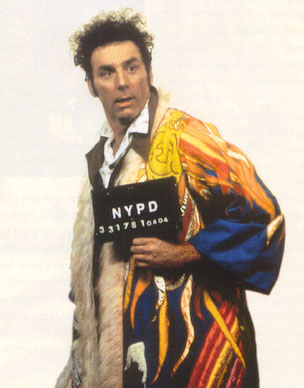
Until his racist rant at a Los Angeles comedy club threw his faltering stand-up comedy career onto a bonfire of insanity, Michael Richards was best known to millions as The Guy Who Used to Play Cosmo Kramer on “Seinfeld,” one of the most popular shows in TV history. Now he’s known as the mixed-up weirdo who gave us something besides sports and the midterm elections to talk about over Thanksgiving dinners.

By now you know the story: A raging Richards was caught on video camera spewing the N-word and making obscene lynching references at some black hecklers in the audience.

When the remorseful Richards later apologized (“I’m very, very sorry”) on CBS’ “The Late Show With David Letterman,” even he seemed to disbelieve his own denials of racism. “I’m not a racist, that’s what [is] so insane about this,” he said in a rambling satellite interview. “And yet it is said. It comes through, it fires out of me and even now in the passion that’s here as I confront myself.” His passive voice (“… It is said …”) sounded as unconvincing as President Ronald Reagan’s saying “mistakes were made” to disassociate himself from the Iran-contra fiasco. Richards sounded like a man trying desperately to disconnect himself from something that he, and only he, stands accountable for.

His apology to “Afro-Americans,” a term I have not heard much since the 1960s, revealed a man oddly out of touch with cultural currents, especially for an aspiring stand-up comedian. Yet, if being out of touch on race were a crime, the world would not have enough jails to hold all of the offenders.

With that in mind, one hopes that Richards will not be alone in using this incident as a learning experience, although I am not expecting miracles. The progress we have made from the era of lynchings to the era of racial bridge-builders, like Bill Cosby, Sen. Barack Obama (D-Ill.) and Oprah Winfrey, fools too many people into thinking our racial divide has been closed--until an ugly surprise like Richards’ toxic tirade erupts.

Instead of helping us to learn, celebrities caught in such eruptions tend to do what Richards has done: They hire a spin doctor.

Richards hired Howard Rubinstein, a big-time crisis manager aptly described by The Washington Post’s Lisa de Moraes as “The go-to guy for celebrities who have really stepped in it.” Rubinstein, in turn, helped arrange apologetic phone calls by Richards to the go-to guys for big-time black rage, the Revs. Jesse Jackson and Al Sharpton.

Jackson has been talking to members of Congress about prohibiting the use of hate language in mass media, according to a WBBM-Ch. 2 news report. If so, let us hope those talks don’t get far. It is easy to agree with Jackson that hate speech divides society and can lead to violence, but if we let Congress decide which speech is and isn’t hateful, a lot of comedy clubs would be out of business.

And that’s not all. Everything offends somebody. Imagine the repercussions for TV shows like BET’s “Comic View” or HBO’s “Def Comedy Jam” that feature black stand-up comedians. I’ve heard from readers, for example, who are offended when black comics on TV poke fun at whites, Hispanics or Asians in their audiences. From the black cultural point of view, such a good-natured call-out can defuse racial tensions. But, to some white folks and others viewing at home, it’s hate speech.

The same caution should greet the looming legal actions that the two black male targets of Richards’ wrath might take. They’ve hired celebrity attorney Gloria Allred, the go-to woman for newsmakers with an actionable gripe. In a CNN appearance with her clients, Allred said they deserve compensation for the emotional pain they suffered. If so, I shudder to think where that could end. Current hate-crime laws add penalties to assault and other serious crimes if the offender’s speech indicates it was motivated by hate. But, if abusive speech without physical damage is grounds for a lawsuit, the biggest laughs will be coming from lawyers.

Richards is living with his own punishment, properly condemned by the court of public opinion. Even his hip and edgy comrades in comedy are acknowledging that there still are lines of decency that none of us should cross.

Among the offended is the real Kenny Kramer, on whom Richard’s character was based. “Use some of that ‘Seinfeld’ money to buy yourself an act!” he advised.

Right. Try some anger-management therapy too.

Essay 1366


The mid-September search at Borders for The Houdini Solution by Ernie Schenck initially failed to secure a copy.

But only because we presumed it would be in the Sales and Marketing section. And why not? Ernie Schenck is a career adman: winner of a gazillion advertising awards, leader of top-flight advertising agencies, writer/editor of the advertising column for Communication Arts magazine and overlord of a blog titled, “Ernie Schenck Calls This Advertising?” Yep, it made all the sense in the world to believe the guy’s first book would be shelved alongside the advertising-related selections.

As it turns out, Borders stocks The Houdini Solution in the Management area. Additionally, the back cover labels the work as “Business/Self-Help.”

Like the magician who inspired the book, The Houdini Solution categorically refuses to remain shackled in any single box.

That’s also the key premise Schenck presents through roughly 220 pages. The author basically proposes that people reject the typical creative goal of thinking outside the box, opting instead to embrace the constraints inside the box.

While advertising enthusiasts will discover much to love about The Houdini Solution, the book ventures beyond the general vicinity of Madison Avenue, ultimately appealing to anyone who exercises their grey matter for a living.

In many respects, Schenck celebrates the creative process in a 21st century style. The Houdini Solution is a contemporary companion to classics like Conceptual Blockbusting by James Adams, Lateral Thinking by Edward de Bono and A Whack On The Side Of The Head by Roger von Oech.

To be clear, Schenck’s “thinking inside the box” theory is not a cop-out, offering excuses for substandard responses to challenges. Rather, readers are coached to maximize their problem-solving skills and generate extraordinary results — within the box.

In other words, brainstorm like the NASA staffers who triumphed against life-threatening, overwhelming odds during the Apollo 13 flight. Or foil the opposition by emulating the tactics of MacGyver. Rejigger the tools at your disposal and re-envision the perceived restrictions to concoct a wow-factor invention — that’s what The Houdini Solution is preaching.

The author proves his points with cool case studies and anecdotes. He counters the clichéd obstacles with razor-sharp strategies. And Professor Schenck wraps everything up with a series of 50 instructional devices introduced as homework.

The “glass-is-half-full” spirit — and Schenck would contend there’s no reason you can’t use the limited liquid and container to build the next big thing — puts The Houdini Solution in the Self-Help arena with The Power of Positive Thinking by Norman Vincent Peale and Unlimited Power by Tony Robbins. Hey, some might argue the book could comfortably stand in the Philosophy aisle.

Readers familiar with Ernie Schenck’s writing have come to expect passionate, provocative and compelling perspectives, served with entertaining flair. Rest assured, The Houdini Solution performs amazing feats for fans and newbies alike.

Those who wish to avoid scouring the local bookstores’ Sales and Marketing, Management, Self-Help, Philosophy and Creative Cookbooks sections can make The Houdini Solution magically appear inside the mailbox via online sellers BarnesAndNoble.com and Amazon.com.

Saturday, November 25, 2006

Essay 1365


Kramer vs. Kramer in a MultiCultClassics Monologue…

• The real Kramer is speaking out. Kenny Kramer, the man who inspired the Kramer character from the Seinfeld show, has been doing interviews ever since the infamous tirade. “I did at least 15 to 20 interviews,” said the true Kramer. “All hell broke loose. There were lots of e-mails. They were about 9-1 positive. … I know the guy. … He’s not this outgoing ball of fun that people would expect Kramer to be. They think [he’d] be exciting, lovable, laughable. But he’s quiet, introspective, even paranoid. He’s a very wound-up guy. But I don’t think he’s a racist.” Based on the depictions of the character in Seinfeld episodes, it’s probably a good idea to question the credibility and intelligence of the real Kramer.

• No surprise, the audience members on the receiving end of Michael Richards’ racist rant want an apology and cash. “To have him do what he did to me … I can’t even explain it,” said one of the two men. “I was humiliated, even scared at one point.” The dissed duo hired a lawyer, who hopes to bring the matter before a judge. Howard Rubenstein, representing Richards, insists his client wants to express remorse but has been unable to find the club goers. Right, Richards tracked down Jesse Jackson and Al Sharpton, but he can’t locate two dudes who have already appeared on national entertainment programs to tell their side of the story.

• Comedian Tom Green has come to Richards’ defense. “Anybody in that room … would have had just cause to have gotten up onstage that night and punched Michael Richards right in the [bleep]ing face … [Bleep], dude. Kramer [bleep]ing lost it. But at the end of the day, I don’t think Michael Richards is a racist,” wrote Green in his blog. “Unlike Mel Gibson, who probably does hold racist attitudes, I don’t think Michael Richards doesn’t like black people. I think he was just trying to say the craziest and most vile thing in that room he could possibly muster. And I think he dug deep, into the darkest corners of his mind, to say those evil things to those men. But he did it in a small room, in an exchange, during a performance, and it wasn’t meant for us. It was just meant for that room. So why don’t we just let them settle it? … Let’s leave Michael Richards alone.” Note to Howard Rubenstein: You do not want Tom Green as a character witness.

• A town manager from Golden Beach, Florida, sparked controversy when she referred to her Black assistant as a “mammy.” The White town manager then tried to apologize by saying she “loved Aunt Jemima.” No word yet if Howard Rubenstein has been contacted.

Essay 1364


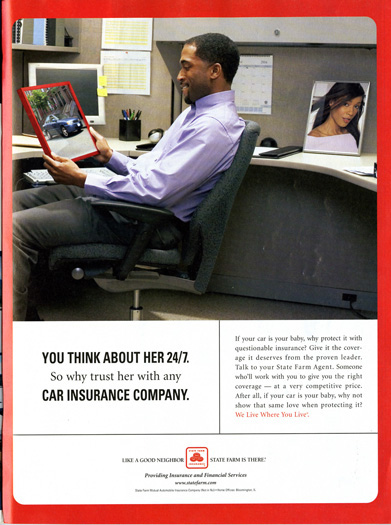
Like a good neighbor, State Farm is there. Unfortunately, there’s not a good idea here.

Friday, November 24, 2006

Essay 1363


Celebrating Anti-Black Friday in a MultiCultClassics Monologue…

• The Rev. Jesse Jackson had more to say regarding his conversation with Michael Richards. “Clearly, he needs some race-sensibility training and some psychiatric help. His anger is volatile and dangerous to himself and others,” said Jackson. “I hope he gets the help he needs. But the culture that’s producing this kind of animosity toward Blacks must be addressed. We’re increasingly facing cultural isolation in Hollywood, in the movies and in TV. … We have to evaluate the use of the n-word and categorize it as hate speech, no matter who uses it.” Wonder if Richards might ultimately be charged with a hate crime.

• A Mexican drug gang known for violence ran a half-page newspaper ad, declaring itself as being anti-crime. The gang had claimed responsibility for a September attack where gunmen left five human heads in a local bar. The ad read, “Our only reason for being is that we love our state, and we are not willing to allow the dignity of our people to be trampled on.” And if you don’t believe them, they’ll chop off your head.

Essay 1362


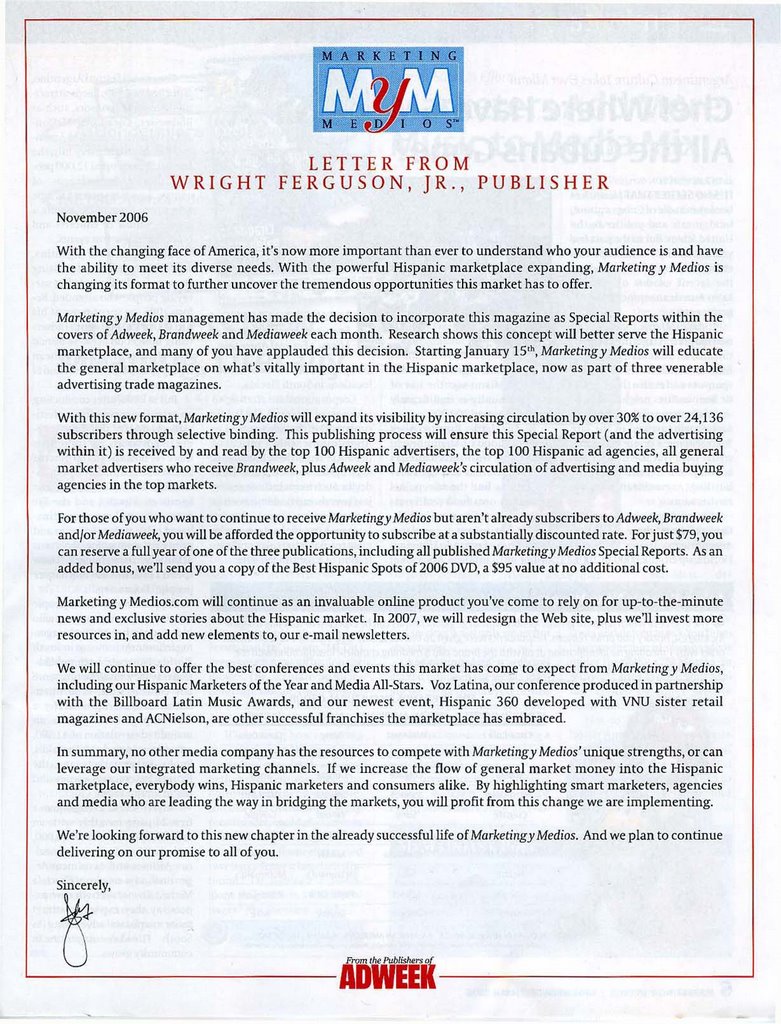
The final issue of Marketing y Medios greets readers with a letter (depicted above) from publisher Wright Ferguson, Jr. The message speaks with all the warmth and sincerity of an eviction notice — and for subscribers and fans, that’s essentially what it is.

Ferguson unveils the plot to fold Marketing y Medios, while literally trying to sell subscriptions to VNU trade magazines (Exclusively available for a limited time at special discounted rates of just $79! Plus, act now and VNU will toss in a Best Hispanic Spots 2006 DVD — a $95 value — absolutely FREE! Hurry, operators are standing by!).

The letter opens by proclaiming, “With the changing face of America, it’s now more important than ever to understand who your audience is and have the ability to meet its diverse needs.” It’s always peculiar to hear such revelations from key figures of an industry constantly demonstrating cultural cluelessness on nearly every level imaginable.

Ferguson then announces the strategy to seed Marketing y Medios content as Special Reports within sister titles Adweek, Brandweek and Mediaweek. According to Ferguson, “Research shows this concept will better serve the Hispanic marketplace, and many of you have applauded this decision.”

Yes, the spirited and rowdy ovations have been deafening.

And, gee whiz, we all know how research ultimately inspires the wisest course of action — although it would be nice to peruse the PowerPoint summary report supporting Ferguson’s case. Additionally, it’s semi-ironic that multicultural advertising agencies are often handcuffed with insufficient resources for research, yet VNU uncovered insights to validate eliminating one of the few multicultural marketing publications in existence.

Ferguson’s ramblings about expanded visibility and increased circulation are undoubtedly rooted in bottom-line thinking. The motivations appear to be focused on offering extra ad space and consolidating subscription dollars. While reaching a broader audience aids VNU’s multicultural efforts, Ferguson fails to exhibit a tangible benefit for current readers. Now we have the convenience of purchasing up to three magazines at higher prices to enjoy condensed versions of Marketing y Medios. Gracias, Señor Ferguson!

To confirm the questionable nature of this entire fiasco, Marketing y Medios.com will keep running, with schemes to enhance the overall design and e-mail newsletters. If blending the magazine content is such a breakthrough idea, why not employ a similar tactic with the online components?

Ferguson argues, “If we increase the flow of general market money into the Hispanic marketplace, everybody wins, Hispanic marketers and consumers alike. By highlighting smart marketers, agencies and media who are leading the way in bridging the markets, you will profit from this change we are implementing.”

Who is Ferguson really addressing here? Can we expect VNU profit checks in our mailboxes soon?

The attempt to season VNU’s corporate-based maneuver with a “do the right thing” flavor is downright distasteful.

Stating that the allegedly improved format means “Marketing y Medios will educate the general marketplace on what’s vitally important in the Hispanic marketplace” is bizarre too.

No one would deny exposing the general market audience to the wonders of the Hispanic marketplace is cool. Especially since the general market audience generally remains narrow-minded and ignorant on “the changing face of America.” Besides, Hispanic marketing deserves a bigger spotlight. But there’s so much about this VNU affair that simply stinks.

The ballyhooed mutual rewards of the grand rearrangement seem imbalanced. The Hispanic marketing community loses a premier publication. The general marketing community gains a complimentary monthly insert.

Pardon the overreaction, but it feels like — as opposed to more strongly inviting the general market audience to join the Marketing y Medios fiesta — the Hispanics are being forced to assimilate into the outdated majority arena.

The Hispanic marketplace is growing at an incredible rate. The attention it warrants should be proportionately amplified. Slipping Marketing y Medios excerpts into general market publications did not necessitate erasing the magazine. Hell, providing samples to a larger audience might have fueled greater interest in experiencing the whole enchilada.

Ferguson and his cronies aren’t doing anyone a favor with this direction. Technically, Hispanic editorial coverage should have been inflated to establish VNU’s journalistic credibility and responsibilities.

There are minimal indications that the industry is moving towards legitimate integration. There are less signs of general market money flowing into the Hispanic marketplace. Advertising agencies remain separate and unequal. These are critical issues demanding thoughtful, proactive deliberation and measurable executions.

Launching Marketing y Medios in 2004 looked like a thoughtful, proactive venture. Killing it in 2006 is a miserable execution.

Ferguson closes the letter by writing, “And we plan to continue delivering on our promise to all of you.” All of you can reread the letter forever — you’ll find zero references to any promise.

Unfortunately, empty promises are status quo in the wonderful world of advertising and marketing.

-------------------------------------------

Visitors are invited to review the eulogy for Marketing y Medios by clicking on the essay title above.

Thursday, November 23, 2006

Essay 1361


Explanations, apologies and assorted mea culpas in a MultiCultClassics Monologue…

• Michael Richards hired New York publicist Howard Rubenstein, who arranged conferences with Black leaders. Jesse Jackson received a phone call and reported that Richards expressed “his remorse and his confusion. … He’s embarrassed. He got caught on tape. That’s a big part of his anxiety now.” Rubenstein proclaimed, “Michael apologized profusely. … He wants to heal the tremendous wound that he’s inflicted on the American public and on the African-American community. … I think it was a positive discussion.” Yes, Richards undoubtedly communicated his sincere remorse to all Afro-Americans.

• O.J. Simpson admitted, “I did it” — for the money. “It’s all blood money and unfortunately I had to join the jackals,” said Simpson, referring to authors of books about him. “[Payments from the cancelled book and TV program] helped me get out of debt and secure my homestead.” Simpson showed little remorse and insisted, “I’ve been pimped for 12 years. Everyone’s made money on me.” Not sure Fred Goldman would agree with that, although Simpson had words for him too. “[The Goldmans] have become professional victims. America, you’re being duped by these people.” Well, there’s no argument that Simpson is an expert on duplicity.

• The Los Angeles City Council voted to settle another discrimination lawsuit involving the Fire Department. This time, a former firefighter accused the organization of age discrimination. Charges included being subjected to derogatory remarks; plus, a superior once instructed other station members to “make sure that you vacuum up all that dead skin around the [plaintiff’s and other older firefighters’] beds.” Los Angeles will pay the former firefighter $350,000. Maybe Michael Richards should consider a career switch to firefighting.

Essay 1360


From the final issue of Marketing y Medios…

-----------------------------------------------

Diversity Advertising Fades Giving New Face to Print

By Jaime Mejía-Mazuera

In their quest for engaging consumers in more aggressive ways, corporations have steadily abandoned diversity ads — those ads that deliver a message about their commitment to the community, highlighting efforts to recruit a diverse workforce or hire minority suppliers — in favor of more direct-to-consumer messages. But the shift of those corporate dollars has hit some Hispanic magazines in the process.

“Corporations are pulling back budgets in what we call diversity advertising and putting more in hardcore advertising,” says David Taggart, general manager and group publisher of leading Hispanic publishing company Editorial Televisa, based in Miami. Instead, promoting products and services to Hispanics is becoming a preferred way to reach out. Editorial Televisa has been particularly hit by the trend, as close to 20 percent of the advertising budget of English-language magazines Hispanic and Hispanic Trends depends on so-called diversity dollars.

According to Media Economics Group, the Ft. Lauderdale, Fla.-based agency that monitors multicultural ad spending, Hispanic magazine reported ad revenue of $7.5 million in 2005, about 14 percent less than the previous year. Those figures are shy of the $31 million the magazine reaped in 2001.

The decline in diversity ads is not good news for some Hispanic business titles that also have suffered from an overall decline in spend by automakers, the consolidation in the telecom industry and the entry of new magazine players, along with several new media options available to advertisers. Taggart, however, is optimistic because as magazines break into new ad categories, consumer advertising overall is growing.

In fact, print advertising in Hispanic-targeted magazines is growing overall. Ad spend actually grew 27.4 percent from August 2005 to August 2006 for an estimated total of $22.7 million, per Media Economics Group.

And while the decline in diversity ads might be sore for some, Hispanic advertising agencies and media buyers say this is actually a good sign of evolution in the market.

“In the past it was all [advertisers] did,” says Alex López Negrete, president and CEO of Houston-based Lopez Negrete Communications. “Now corporations are becoming more sophisticated about what they are doing to reach the Hispanic community. So the budgets are being used in new and more diverse ways. Corporations also have a lot of new media options.”

López Negrete notes that diversity advertising belongs to a previous era, in which “the ads were in English and were mostly developed by general-market agencies.”

One Lopez Negrete client, Wal-Mart, is among those that still conduct diversity advertising in some magazines, but the retailer also has stepped up efforts to reach out with a more direct pitch.

“The message has to change at the consumer level. It is nice to know what you are doing with the community, but corporations have to invest in educating Hispanics on their products and services,” says Ricardo López Valencia, senior vice president for diversity markets at ING, one of the top 25 financial services advertisers in Hispanic magazines.

Not everyone is cutting back. Aetna, the health services company based in Hartford, Conn., says its budget is growing close to 10 percent to reach Hispanics through a message of supporting diversity.

“The big difference now is we are exploring many different avenues to reach the Hispanic community,” says Raymond Arroyo, Aetna’s head of diversity.

He says diversity ads are only one option for Aetna, which also, for example, has formed an alliance with the Hispanic Association of Colleges and Universities to support education among Hispanics.

Essay 1359


The Washington Post continues its series titled, “Being a Black Man,” with an installment detailing a young man’s job hunt. On November 20, Post Staff Writer David Finkel was online answering questions about the story. The questions and comments cover a host of viewpoints — it’s all definitely worth reading. Click on the essay title above to check it out.

Wednesday, November 22, 2006

Essay 1358


Here’s the final Editor’s Note from Marketing y Medios…

------------------------------------------

La Última y Nos Vamos

Popular wisdom tells us you should never trust a Mexican when he or she tells you “La última y nos vamos” (the last one and we’re outta here). But as I write this note and prepare to send this issue to the printer, I can assure you this is indeed my última, the last I write … at least here at Marketing y Medios.

Trust me. These past 29 months have been some of the most intense and interesting of my career. Not only because I was given the opportunity to craft a totally new magazine from scratch, but because I always enjoyed the editorial freedom and resources that very few publishing companies allow these days. And as if all that were not enough, I was able to meet and work with some of the smartest and fun people I have ever met.

Twenty-three issues later, and as Marketing y Medios enters a new era, I have decided it was time for me to do the same. Leaving, though, will not be easy. Giving birth to these pages reminded me that business journalism can be a lot of fun, but most importantly, that it can make a difference in the way corporations and executives go about their work. Call me a romantic, but if at least one of you thought differently about Hispanic marketing after reading an article in these pages, I could say my stint here was not in vain.

So here’s to an amazing journey covering — and uncovering — the myths and wonders of the business.

Laura Martínez Ruiz-Velasco

Essay 1357


Take No Offense — It’s Just A MultiCultClassics Monologue…

• The New York Post published a story featuring friends and foes trying to explain Michael Richards’ racist rant (see Essay 1354). Folks paint a portrait of a demanding and abusive individual. One person said Richards is a punctuality freak who “gets very upset if he doesn’t go up [on stage] when he’s scheduled to go up. He’s very tightly wound.” Another former associate claims the comic gets pissed off “when someone disagrees with his point of view.” A comedienne related a run-in with Richards after she accidentally knocked over his tape recorder while on set at a comedy club. “You will never work in this town again. I’ll make sure of that, you little cunt,” quoted the comedienne. “You’re a cunt, cunt, cunt, dirty little cunt, on and on, and I starting thinking to myself, you know, I only accept those kinds of terms of endearment from my dad or grandma, not from some prick who is using his fame to be a dick!” Even the Rev. Al Sharpton weighed in, calling Richards’ apology on David Letterman’s show “unacceptable.” Sharpton said, “[He] should apologize to the people to whom his remarks were directed and most offended. … In all due respect to David Letterman, it seems strange that one would insult African-Americans in a long tirade and then go on a white television show with a mostly white studio and viewing audience to make a statement of apology.” Note to Sharpton: When confronting Richards, make sure not to interrupt him or knock over any tape recorders.

• Six Muslims were removed from a Minneapolis flight when fellow passengers expressed concern after the group prayed in the terminal. Additionally, a passenger claimed hearing the group criticizing the U.S. and speaking angrily. Security asked the men to leave the airplane. “The police came and take us off the plane in front of all the passengers in a very humiliating way,” said a group member. “I never felt bad in my life like yesterday. It was the worst moment in my life when I see six imams, six leaders in this community, humiliated.” Let’s hope these guys don’t wind up at a Michael Richards comedy club appearance.

Essay 1356


From The Washington Post…

-----------------------------------------------

In a Land Bleak in Opportunity, ‘Redskins’ Is One More Barb

By Courtland Milloy

MACY, Neb.

This is the capital of the Omaha Nation, homeland to Jillian Pappan, 19, one of six young Native Americans who have taken legal action to change the name of the Washington Redskins. I recently visited the reservation during a road trip west to learn more about the culture and convictions of a tribe that had produced such a firebrand.

Pappan, as it turned out, was away attending college in South Dakota. And many of her peers were more impressed with her efforts to get a higher education than those to cancel the Redskins trademark. True, the legal action showed that Pappan had not forgotten where she came from or who she was. But going to college had been her ticket off the 14,000-acre reservation, where 80 percent of the tribe is unemployed.

And there were others who wanted nothing more than to punch that ticket as well.

At the public school, I asked two seniors about their plans after graduation. “I want to go to college,” said Sissy Spears, 17, sounding as if she were wishing upon a star. “I want to study business administration and Native American culture.”

Ricky Saunsoci, also 17, nodded. “Me, too,” he said.

Scattered around the school were a few modest, well-kept homes. But other dwellings were run-down and appeared almost uninhabitable. For a tribe that settled along the Missouri River in the 1500s, long before even Lewis and Clark showed up, progress has been slow, the setbacks, many.

“Native Americans are the only people in this country who have treaties with the U.S. government, and there are many instances in which these contracts have been broken,” said Loretta Webster, chief of tribal operations. “If we had received what we had been promised, I’m sure many of our people would be much better off.”

Outside of Webster’s office, residents had gathered to apply for jobs and fill out applications for social services. You could see in many of their faces just how much substance abuse and violence, born of poverty and frustration, had taken their toll. Changing the name of a professional football team could not have been further from their minds. Yet, even the use of a name such as “Redskins” -- being debated in the U.S. Patent and Trademark Office after the six filed a petition saying it breaks a law prohibiting trademarks that disparage any race -- was part of an ongoing struggle for dignity and self-respect.

“’Redskins’ is offensive; there are no two ways about it,” Webster said, noting that the use of Native Americans as mascots was just one form of the disrespect many experience. “Going into town in search of work or just to shop can result in prejudice and humiliation. Not long ago, I was standing at the front of a line in a store and the cashier waited on everyone behind me. I said, ‘Am I invisible or something?’”

The petition was filed in August, but no date has been set for the hearing. The six who initiated the action are: Pappan; Shquanebin Lone-Bentley, 19, from the Seneca Nation; Phillip Gover, 23, from the Paiute Tribe; Amanda Black Horse, 24, from the Navajo Nation; Courtney Tsotigh, 18, from the Kiowa Tribe; and Marcus Briggs, 22, from the Muskogee Tribe.

Another group of older Native Americans had filed a similar petition in 1992 but lost on appeal. Now a new generation has taken up the fight. And even more are lining up to join them.

“I find the word ‘redskins’ offensive,” Spears told me. “When people say they are honoring us by using ‘redskin’ as a mascot, I say they don’t have a clue about what honor and respect means to us.”

It struck me as ironic, however, that the Omaha Tribe school was called “home of the Chiefs” and featured the image of a tribal leader as its logo. Explained Saunsoci: “I believe the use of natives to represent the spirit of a school or team can be good or bad, depending on how it’s used. When native people use them, we do not disparage ourselves and subject our people to ridicule.”

There was hope on the reservation, not just despair. Indeed, everyone I met was looking forward to Thanksgiving Day. Families would gather at the home of an elder for good food and conversation.

“We gather to give thanks for family and friends,” Spears said, adding, “and for our culture, which has survived in spite of it all.”

Tuesday, November 21, 2006

Essay 1355


Real Cosmo Kramer Quotes, Slightly Rejiggered…

Kramer (breaking up with his girlfriend): “I must’ve been out of my mind! Look at you. Why don’t you do something with your life? You sit around here all day. You contribute nothing to society. You’re just taking up space. How could I be with someone like you? I wouldn’t respect myself. A n-----! Look, there’s a n-----!”

Kramer: “Because I’m like ice, buddy. When I don’t like you, you’ve got problems. Throw his ass out! He’s a n-----!”

Kramer: “They’re gonna cut him open, his guts’ll be all over the place! Shut up! Fifty years ago, we’d have you upside down with a fucking fork up your ass!”

Kramer: “Who’s gonna turn down a Junior Mint? It’s chocolate, it’s peppermint — He’s a n-----! — it’s delicious!”

Kramer (after learning how much money Jerry makes): “I don’t think I can talk to you any more. I feel inferior. You calling me cracker-ass, n-----?”

Kramer: “Hey, you know what would make a great coffee table book? A coffee table book about coffee tables! It’s uncalled for you to interrupt my ass, you cheap motherfucker!”

Kramer: “I’m Cosmo Kramer, the Assman! That’s what happens when you interrupt the White [Ass]man, don’t you know?”

Kramer: He’s not a Nazi, Elaine. He just happens to be a little eccentric. Most geniuses are. He’s a n-----!”

Kramer: If you’re not gonna be a part of a civil society, then just get in your car and drive on over to the East Side. They’re going to arrest me for calling a Black man a n-----!”

Essay 1354


Killing onstage with a MultiCultClassics Monologue…

• O.J. Simpson’s book and TV program were killed. Regarding the decision to end the projects, News Corp. Chairman and CEO Rupert Murdoch essentially said, “I did it.” Murdoch’s official statement read, “I and senior management agree with the American public that this was an ill-considered project. … We are sorry for any pain this has caused the families of Ron Goldman and Nicole Brown Simpson.” Maybe they can rework the video into a “When Animals Attack” spin-off.

• Michael Richards apologized for his racist rant delivered during a performance at a Los Angeles comedy club. Richards repeatedly directed the N-word at a heckler. “I was at a comedy club trying to do my act, and I got heckled and I took it badly and went into a rage,” said the former Kramer of Seinfeld fame. “For me to be in a comedy club and flip out and say this crap, I’m deeply, deeply sorry. I’m not a racist. That’s what’s so insane about this.” Wonder if Richards will now plan a comedy tour with Sacha Baron Cohen and Mel Gibson.

Essay 1353


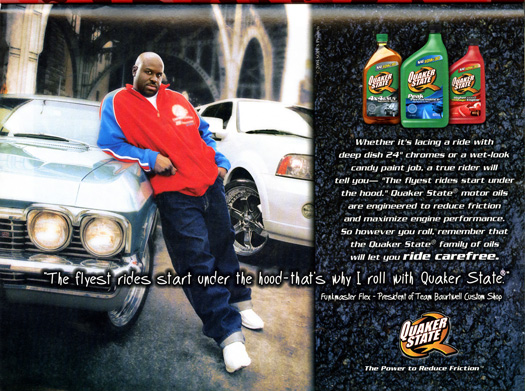
Quaker State proclaims a true rider will tell you — “The flyest rides start under the hood.” Right, that’s exactly what we’d expect to hear from other Quaker State spokesmen like Steve Kinser, Jeff Gordon and Jimmie Johnson.

Monday, November 20, 2006

Essay 1352


One more comment added to the responses (see Essays 1345, 1341, 1337 and 1332) to the AdAge story presented in Essay 1326…

César Chavéz consultant. We begin with the basics, which are responsibility for yourself, family and education. You strive for excellence. I am sure you are familiar with the saying “freedom comes with discipline.” Fairness does not always exist, and discrimination based on color, gender and religion unfortunately does exist. But I also know that many live with chips on their shoulder and I have a hard time going anywhere with those who do. They always feel that people are out to get them. Poor service in the restaurant, asked for I.D. in the airport, Disney Land was filled to capacity and they could not get in. Whatever it is they always have a gripe. Look at the school records, look at the prison numbers, look at real problems. You want to be Chavéz, then get campaigns together that communicate responsibility, job competitiveness, etc. It’s amazing how many times I try to hire graphic artists, Website developers and other creative talent in L.A. Unfortunately, no matter what color or gender they are, many are real flakes. There are good jobs and good pay for those who prepare and have sound work ethics, and that should be encouraged. I disagree strongly that Latinos will benefit from a Jesse Jackson. — VALENCIA, CA

Essay 1351


Questionable taste in a MultiCultClassics Monologue…

• The King may be exiled from Spain. Health Ministry officials charge a Burger King ad campaign violates Spanish efforts to fight obesity. The humongous XXL burger flies in the face of an agreement to refrain from hyping huge portions of food. “In this campaign, we are simply promoting a line of burgers that has formed part of our menu in recent years,” responded Burger King. “Our philosophy can be summed up with the motto ‘As you like it,’ in which our customers’ taste trumps all.” Gee, who died of a massive heart attack and made these guys king?

• A bunch of FOX affiliates have opted against airing the upcoming O.J. Simpson program. “After careful consideration regarding the nature of the show, as well as the feedback we received from the viewers of northeast Wisconsin, we determined that this programming was not serving the local public interest,” said the general manager of a Wisconsin station. Not sure which FOX programs serve the public interest.

Essay 1350


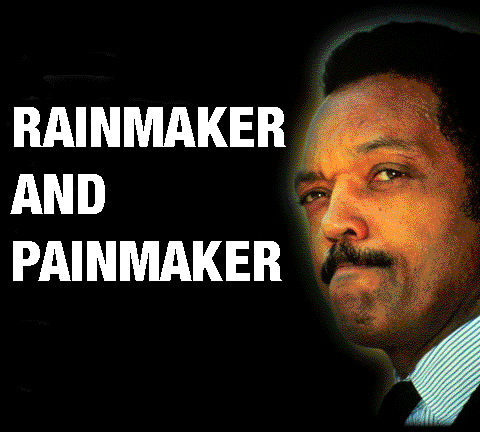
One of the many phrases made popular by the Rev. Jesse Jackson is, “I am somebody!” For Madison Avenue honchos, it may ultimately be revised to read, “I am somebody who will make your lives a living hell!”

Advertising Age headlined, “Jesse Jackson Enters Ad Industry Diversity Fray” (see Essay 1326). At the 2006 ANA Multicultural Marketing Conference in Los Angeles, Jackson announced plans for nationwide public hearings and a “major workshop on advertising.”

Jackson declared, “There is no shortage of talent. … Don’t put the [Latino] and the Black agency under your roof. Empower them to grow. McCann Erickson is not Burrell. Foote — whatever it is you call that company — is not Uniworld. Empower them to be a force at the table, don’t co-opt them by saying here’s a buyout.”

The original goal of pro-diversity activists entailed simply getting agencies to employ more minorities. But Jackson took things further by recommending the industry abolish the ghetto status of multicultural shops too. Now there’s progressive thinking that’s downright radical.

Not sure why Jackson finally decided to officially speak out. Insiders claim the man has repeatedly offered his influence, but multicultural advertising figures asked him to back off to avoid upsetting client-agency relationships.

Online responses included the typical outrage that Jackson usually sparks (see Essays 1345, 1341, 1337 and 1332). One person typed, “Isn’t Jesse supposed to be a minister? What gives him the right to butt in on every industry’s existence (Coca-Cola, for example)? … He drives me crazy.”

Another complainer sniffed, “Well, Jackson’s involvement confirms that this entire issue is just a circus for the politicos and the press. Jackson is nothing if not a divider of the races (it is how he makes his living!). He has no industry qualifications or expertise that would qualify him to be involved in this imaginary ‘problem.’”

It’s safe to guess Jackson doesn’t fret over such attacks. Hell, he’s probably more worried about finding words that rhyme with advertising.

Besides, the short-fused critics are short on the facts.

The Rev. Jesse Jackson just celebrated his 65th birthday and 40 years of Civil Rights-related service.

A recent Jackson interview revealed, “I was born during the Second World War under legal apartheid, in racially segregated Greenville, South Carolina. … It was illegal for Black people to make the same amount of money as White people. A second-class education for Blacks was the law. You couldn’t apply to the state universities.

“My father was a veteran of World War II, came back home, and couldn’t vote. I was born under conditions where we were not second-class people, but had second-class positions as a matter of law, a kind of state terrorism.”

In 1960, college freshman Jesse Jackson was arrested with seven other students for attempting to access the White-dominated public library in Greenville. “They called us ignorant, but arrested us for trying to use the library,” said Jackson. “That was my most daring act to that point.”

Jackson has always worked for voting rights, participating in the Selma to Montgomery marches in 1965. He later joined the historic movement led by Dr. Martin Luther King Jr.

As national director of Operation Breadbasket, Jackson created business breakthroughs. “Breadbasket was a great highlight because we opened all kinds of closed doors to businesses,” said Jackson. “Putting Black products on shelves: Joe Louis Milk, Johnson Publishing Company magazines, Parker House Sausage. The barriers started collapsing. Ads in Black newspapers — we got [Illinois] state treasurer Adlai Stevenson to make an adjustment in the law to put money in Black banks. What we did at Breadbasket became a method and model for all of urban America.” Hey, Jackson deserves the label of marketing and promotional guru.

Jackson was present at Dr. King’s assassination. “A traumatic moment — it was a world-changing moment for the entire Civil Rights struggle at that stage,” remembered Jackson. “But we were determined not to let one bullet kill the whole movement, so we didn’t stop.”

Jackson ran for President of the United States in 1984 and 1988. His 1988 Democratic National Convention Address introduced the proclamation, “Keep hope alive!” Have any advertising copywriters ever produced a better tagline?

Through the years, Jackson has masterminded numerous protests and boycotts seeking fairness, equality and justice. In 1984, he negotiated the release of a Navy flier being held prisoner in Syria. From Wall Street to Sesame Street, Jackson’s consistently made positive impacts. Plus, the man leads an organization where “we have met every Saturday since 1966 — for 40 years — educating, inspiring, directing, and becoming a frame of reference for our struggle, and there’s a whole generation of people who have benefited.”

Like it or not, Jesse Jackson brings a high-level, powerful presence to the advertising industry’s diversity dilemma. Don’t be surprised if Jackson rouses public and client support as well. His personal background shows he’s uniquely skilled at battling all forms of discrimination. Given this icon’s credentials and résumé, you’d be hard-pressed to find anyone in the business more qualified to play in the continuing proceedings.

Yes, it’s unfortunate that the industry has failed to police itself. Additionally, it’s too bad insiders can’t affect change without risking career suicide. But the haters can quit ranting, raving and whining. Jesse Jackson is on the scene, and he’s not going away anytime soon.

In closing, let’s recognize that Jackson’s most famous targets in the advertising industry — Coca-Cola and Toyota — appear to be prospering quite nicely since his interventions. There’s no reason to believe the ad biz won’t flourish likewise.

Keep hope alive!

[MultiCultClassics note: Much of the biographical information in this essay was acquired from a story by David Smallwood, whose work was published by “N’Digo: A Magapaper For The Urbane.” Click on the essay title above to read the full story.]

Essay 1349


Addiction is an equal opportunity disease? Maybe it requires affirmative intervention.

Sunday, November 19, 2006

Essay 1348


Sunday Brunch served with O.J. in a MultiCultClassics Monologue…

• Judith Regan, publisher of the upcoming O.J. Simpson book, released an 8-page statement insisting she’s not in it for the loot. “I didn’t know what to expect when I got the call that the killer wanted to confess,” wrote Regan. “But I knew one thing. I wanted the confession for my own selfish reasons and for the symbolism of that act. For me, it was personal.” Regan said she believed Simpson’s proceeds would go to his children; plus, she said, “What I wanted was closure, not money.” Funny how she got little closure, but will probably receive tons of money.

• O.J. proclaimed during a 2004 videotaped discussion that he’d go to great lengths to make loot. “If it’s something for me to promote, I’d go on Geraldo’s show. I don’t give a fuck,” said O.J. on a video that never aired. “Just as long as you’re talkin’ about me and helping me make some money — ha ha ha!” As a comedian, O.J. could really kill.

• Some California booksellers are refusing to promote the O.J. book, insisting they’ll donate any profits to charity. Certain dealers feel they were hoodwinked, as the publisher promised a potential blockbuster, but refused to reveal the subject and author. Meanwhile, Wal-Mart intends to sell the book with no regrets and said, “The ultimate factor in the decision to carry this title is that we think our customers will want it.” Can’t wait to see the retailer’s holiday promos for this item.

• Rapper The Game was arrested in Manhattan for impersonating a cop. The artist allegedly hopped into a livery cab after an appearance on the “Late Show with David Letterman,” flashed a badge and told the driver to run through red lights because he was in a hurry to get somewhere. The rapper’s lawyer disputed the story and said, “This whole case is so ludicrous.” Hey, don’t blame it on another rapper.

Essay 1347


What’s working here? Nothing. Not the copy. Not the layout. Absolutely nothing.

Essay 1346


MultiCultClassics recently presented an article spotlighting Lowell Thompson, an original crusader in the fight against racism in the advertising industry (see Essay 1317). Thompson wound up writing a rebuttal to the newspaper that published the story. Here it is…

-------------------------------------------

Paint It Unwhite

I guess I should be happy the Reader decided to finally cover (at least tangentially) my art career, even if it took four years to do it [The Business, November 10]. Better late than never, they say. At least Ms. Isaacs got my name and most of the facts right.

She also got a remarkable amount of my bio in very little space. Too bad her editor hid her good work behind a facile headline, “Paint It Black.”

I admit I didn’t get the reference to an old Rolling Stones tune until somebody mentioned it. I’m more of a Bob Dylan, Chi-Lites, Bill Withers fan.

But though I now understand the lure of the obvious play on words, I must still register my frustration. Maybe it’s the adman and writer in me, but I think the headline, though catchy, is the exact opposite of what the article and my efforts are about. If it had been submitted to me by a writer in my group in an ad agency, I would have said, “It’s clever but it’s off-strategy.”

I don’t want to paint the Chicago downtown art world black. I want to finally paint it in full color.

I believe one of the reasons the contemporary fine art world in general and American art in particular is so ignored by most Americans is because much of it is so incestuously, monolithically white, male, Eurocentric, and bland. Kinda like baseball and basketball before Robinson and Russell.

African-American artists are largely still confined to the Negro Leagues of Art.

And this is not only in major museums and galleries. Although I recently sold two small paintings to Deloitte & Touche, the giant accounting/consulting firm, most corporate art collections have only token representation of “un-white” artists. I recently visited one of Chicago’s biggest law firms, whose offices are filled with art. I looked in vain for work by Black or Hispanic artists. This “artpartheid” artificially lowers the future value of the collections of collectors, black, white, and other, who support artists of color. While paintings by Picasso and Pollock are breaking auction records of $140 million plus, few works by African-American artists have ever even cracked the $100,000 mark.

Remember, when Pollock, de Kooning, et al moved the center of the art world from Europe to New York in the late 40s and 50s it was still 1950s America. My goal is to open American art to the Black, Brown, Yellow, Red, Gay, disabled, etc, country we live in today.

But besides the headline, I write here not so much as a complaint but as an addendum. There are also a few more things that didn't make the editor’s cut that Reader readers might want to know:

1. I’ve got over 30 of my “Chicago fer Real” paintings on display in the Chicago Artists’ Open Studio at State and Lake until the end of November.

2. There are two other artists in the Open Studio with me. I invited Dale Washington and Alicia Lee to exhibit their paintings.

3. One out of every three collectors who’ve bought my work aren’t “Black.” There are more and more “white” Americans who can see beyond their skin.

Lowell Thompson

BTW: The address is 179, not 177 N. State.

[To learn more about the art of Lowell Thompson, click on the essay title above.]

Saturday, November 18, 2006

Essay 1345


A philosophical comment added to the responses (see Essays 1341, 1337 and 1332) to the AdAge story presented in Essay 1326…

i understand what people are speaking about. yes, if you have your cake why not eat it, because i thought that’s what it was for. watch the clichés because that is the way people think, but it doesn't make it so. i am a minority in the construction business. it is so sad that people are still greedy, but remember the wealth of the wicked is laid up for the righteous; whites are and have been on top for a long time not because their families are rich. are they so deserving? but greed comes in many ways. oh, but woe to them, they do wicked things. what is a man who gains riches but loses his soul? it is so sad that minorities are smarter and intelligent and have the skills of any other race, but still are not treated fairly. 10% of contracts out here are supposed to go to minorities. you [whites] are not doing us a favor. every time i go to the store, i pay my taxes. those are my tax dollars — and the tax dollars of my children, mother, father and ancestors too. but they have done it for so long, taking, taking and taking. it’s been 400 years too long. — st. louis, MO

Essay 1344


The Washington Post continues its series titled, “Being a Black Man,” with installments focused on the challenges of balancing Blackness with business. The stories include discussions with Antwanye Ford and Andre Rogers, founders of technology consulting firm Enlightened Inc., who grapple with whether or not to promote their company as being owned and operated by two Black men. Additionally, on November 20 at 11am ET Post staffer David Finkel will be online presenting the experience of one Black man’s job hunt and the obstacles he faced in the search. Click on the essay title above for the full details.

Essay 1343


Don’t mean to overreact, but why call it the Affluent Hispanic Marketplace versus just identifying folks as business professionals? Is this an attempt to counter the belief that Affluent Hispanic is an oxymoron?

Essay 1342


How a poor boy built a rich legacy

By Stanley Crouch

Ed Bradley died last week at 65 and his passing drew a great deal of attention because he had been in the eye of the American public for a quarter of a century. His work on “60 Minutes” made him one the most highly regarded professionals in television. Both Bradley and the Sunday evening show managed to maintain viewers while remaining separate from the medium’s inclination to the superficial, the stupid and the overstated.

It was because of that separation that Bradley was so important in our time, which has come to distinguish itself by the descent into a vulgar combination of crude materialism supported by narcissistic self-obsession that would not have been imaginable when this black guy first kept turning up week after week. His extraordinary range of reporting was so rich in quality — and the human depth that makes all quality possible — that Bradley could not be dismissed as just another example of special favors because of his skin tone.

Clearly, he was one of those superb individuals who had gotten where he was because of his talent and his belief in the possibility of upward mobility.

Bradley grew up impoverished in West Philadelphia and was told by one his teachers at a Catholic school for the underprivileged that any one of the students in class could become whatever he wanted. Bradley loved to point out that there he was, sitting and listening, having neither a pot to fill nor a window to throw it out of, but he believed what his teacher said and lived accordingly.

In our time, celebrity bypasses accomplishment and is almost always connected to wealth and popularity. Ed Bradley was fortunate to have grown up in an era when, despite being overtly racist, people of his caliber were not oppressed by the kind of mediocre dreams that come from the world of hip hop and a mass culture in which one can be paid inordinate amounts of money for candid photographs taken of unknowing movie or pop music stars.

Ed Bradley benefitted from the tough and unsentimental background that taught him there was a compensation for the fact that the world might not be fair and one might be cheated out of something he should either win or something he should own. If one learned something, that information was his or hers for life. That could be why Bradley believed his teacher.

That belief led him to become a disk jockey, to report on the war in Vietnam from the ground, three years among the bullets, the grenades, the killed, the wounded, the maimed and the devastated countryside. Bradley understood the universals of courage, cowardice, competence and ineptitude. He learned that bullets and bad luck play no favorites in terms of color, religion, class or nationality.

His reporting raised many important questions, challenged some decisions made in the courts, and revealed the extraordinary and the slimy with equal insight.

The result is that he was as respected by a murderer like Timothy McVeigh as he was by Michael Jordan.

That was made possible by Ed Bradley’s upbringing, which supplied him with more than the paralytic cynicism of those who supposedly know all too well or all too much. He was also protected from the spiritual squalor, the ignorance and the putrid dreams of our debased popular culture.

Ed Bradley was a great individual, and whatever our culture does, it needs to nurture the cultural elements that fuel the drive of those who wish for more than a high position in the gutter.

Friday, November 17, 2006

Essay 1341


Another comment added to the responses (see Essays 1337 and 1332) to the AdAge story presented in Essay 1326…

> To the Beaverton, OR writer — RIGHT ON! Isn’t Jesse supposed to be a minister? What gives him the right to butt in on every industry’s existence (Coca-Cola, for example)? By the way, shouldn’t people/firms be hired simply for their merits? I don’t care if you are purple or blue, if your qualifications and talents are better than a white person’s, you’re hired. Why does he think minority firms need to be “empowered”? How about just saying, “Do a good job and you’ll succeed.” The fact that your skin color is not in the majority, does not give you the right to receive preferential treatment (or better test scores when trying to get into college over in the state of Michigan). He drives me crazy. It’s amazing he makes so much money doing crap like this. Why does he even have any credibility? He counseled Bill Clinton, for crying out loud. A lying, cheating, President of the United States. That anyone ever listens to Jesse Jackson is completely beyond me. — Schaumburg, IL

Essay 1340


Check these Crest and abreva ads appearing in the same issue of Essence. Better check that you don’t mix up the two products during use.

Essay 1339


Thank Jesus It’s Friday with a MultiCultClassics Monologue…

• Jesus has returned. The Marine Reserves’ Toys for Tots program reversed its decision, and will now accept the donated talking Jesus dolls (see Essay 1329). According to an announcement on the organization’s Web site, “The talking Jesus doll issue has been resolved. … Toys for Tots has found appropriate places for these items. We have notified the donor of our willingness to handle this transaction.” Next up: Dealing with a donation of talking Borat dolls.

• The Homeland Security Department’s inspector general announced electronic enhancements to the proposed border fence could wind up costing 15 times the original $2 billion estimate. “Early forecasts and estimates of the program’s value range from $8 billion to $30 billion,” said the official. Which means offsetting costs will require employing a ton of undocumented workers.

Essay 1338


Not sure if the old man is supposed to be Moses, Father Time or God. Definitely not sure why He’s guaranteeing results for Web and mobile marketing.

Thursday, November 16, 2006

Essay 1337


Sanford Moore and Mr. HustleKnocker comment on the responses (see Essay 1332) to the AdAge story presented in Essay 1326…

> I’m the individual that Ad Age credited with “triggering the agency investigation.” The facts as documented by repeated NYC Human Rights Commission investigations [are] that a condition of “de facto segregation” exists for Blacks on Madison Avenue. So stop your whining about Blacks seeking their rightful opportunities. To the Mexican-American respondent, what have Mexican-Americans or Latinos done to fight for justice on Madison Avenue? Cesar Chavez for whom I was a consultant has been dead for over a decade, who has replaced him in the Latino community as a champion for minority rights not just Latino rights? So don’t be so quick to down Jesse Jackson… we’re fighting a fight that your people have and will benefit from. — NYC, NY

> I don’t know J.J. but I do know one of his more popular contemporaries along with a few others in the Civil Rights arena. I can tell you this much about most Civil Rights leaders: When they get on board an issue, it’s only because the issue’s gotten out of hand all on its own; and, guys like him have been chomping at the bit to get at the ad industry for years, not because they can get paid, but because they’ve seen the employment data and have had to listen to several decades of war stories from educated, talented and deserving black and Hispanic professionals who’ve dealt with this industry. And, truth be told, most of us have discouraged these guys from getting involved only out of the basic belief that the industry would be smart enough to actually evolve on its own. (Who knew that hiring talented people, agencies and vendors from diverse ethnicities and respecting ethnic consumers would be this damn hard?) But what you’re seeing now is what happens when people say stuff like, “Well, how come the ethnic agencies don’t hire more whites” and they (minorities) need to stop whining. Our industry is upwards of 95% white, many of whom have proven themselves to be less than deserving of jobs. Ethnic shops are banned from AOR status -- not even allowed in those pitches. The crap ethnic professionals have to put up with at the shops of major marketers, from clients and colleagues, related to race and ability, etc, is only outweighed by the 50 years of excuses about the reasons for it. So yup, it’s now a circus. And you guys made it one by ignoring the big elephant in the middle of the room -- the one you brought in. Either help fix the problem or pass me a bag of peanuts and some cotton candy and shut up. Fools. — Chicago, IL

Essay 1336


(Article from the latest issue of AdAge.)

Essay 1335


Sifting through celebrity garbage in a MultiCultClassics Monologue…

• O.J. Simpson wept during his TV interview, where he presents the “hypothetical” details of the infamous slayings. “I don’t think two people could be murdered without everyone being covered in blood,” opined Simpson. CBS ought to consider launching CSI: OJ.

• The New York Post reported Naomi Campbell faces a potential community service sentence including collecting trash. But Campbell’s lawyer questioned the move. “I think it’s dangerous, in all candor, to put a female of her celebrity in a public place, surrounded by hundreds of photographers. I have to assume that there are going to be people who say, ‘Let’s shoot her; let’s stab her; let’s mug her,” said the lawyer. Given the supermodel’s reputation, it’s safe to assume most people would be afraid to attack her.

• Sacha Baron Cohen expressed surprise that his movie has stirred outrage with certain groups. “The joke is not on Kazakhstan,” said the Borat creator. “I think the joke is on people who can believe that the Kazakhstan that I describe can exist — who believe that there’s a country where homosexuals wear blue hats and the women live in cages. … Part of the movie shows the absurdity of holding any form of racial prejudice, whether it’s hatred of African-Americans or of Jews.” Have you heard the one about the Jew comedian who thought he was making insightful social commentary with a film whose most memorable moment involves an obscene fight between two naked men?

Essay 1334


KnowledgeBase Marketing could use some knowledge based on writing headlines.

Essay 1333


The following appeared in The Chicago Tribune…

----------------------------------------------

Racism by another name is ‘diversity’

By Jonah Goldberg, Tribune Media Services

It’s time to admit that “diversity” is code for racism. If it makes you feel better, we can call it “nice” racism or “well-intentioned” racism or “racism that’s good for you.” Except that’s the rub: It’s racism that may be good for you if “you” are a diversity guru, a rich white liberal, a college administrator or one of sundry other types. But the question of whether diversity is good for “them” is a different question altogether, and much more difficult to answer.


If by “them” you mean minorities such as Jews, Chinese-Americans, Indian-Americans and other people of Asian descent, then the ongoing national obsession with diversity probably isn’t good. Indeed, that’s why Jian Li, a freshman at Yale, filed a civil rights complaint against Princeton University for rejecting him. Li had nigh-upon perfect test scores and grades, yet Princeton turned him down. He’ll probably get nowhere with his complaint--he did get into Yale after all--but it shines a light on an uncomfortable reality.

“Theoretically, affirmative action is supposed to take spots away from white applicants and redistribute them to underrepresented minorities,” Li told the Daily Princetonian. “What’s happening is one segment of the minority population is losing places to another segment of minorities, namely Asians to underrepresented minorities.”

Li points to a study conducted by two Princeton academics last year that concluded if you got rid of racial preferences in higher education, the number of whites admitted to schools would remain fairly constant. However, without racial preferences, Asians would take roughly 80 percent of the positions now allotted to Hispanic and black students. In other words, there is a quota--though none dare call it that--keeping Asians out of elite schools in numbers disproportionate to their merit. This is the same sort of quota once used to keep Jews out of the Ivy League--not because of their lack of qualifications, but because having too many Jews would change the “feel” of, say, Harvard or Yale. Today, it’s the same thing, only we’ve given that feeling a name: diversity.

The greater irony is that it is far from clear that diversity is good for black students either. Peter Kirsanow, a member of the U.S. Commission on Civil Rights, notes that there is now ample empirical data showing that the supposed benefits of diversity in education are fleeting when real and often are simply nonexistent. Black students admitted to universities above their skill level often do poorly and fail to graduate in high numbers. UCLA law professor Richard Sander found that nearly half of black law students reside in the bottom 10 percent of their law-school classes. If they went to schools one notch down, they might do far better.

Kirsanow asks: “Would college administrators continue to mouth platitudes about affirmative action if their students knew that preferential admissions cause black law students to flunk out at 2 1/2 times the rate of whites? Or that black law students are six times less likely to pass the bar? Or that half of black law students never become lawyers?”

But all this misses the point. Today’s diversity doctrine was contrived as a means of making racial preferences permanent. After all, affirmative action was intended as a temporary remedy for the tragic mistreatment of African-Americans. But as affirmative action drifted into racial preferences, it became constitutionally suspect because racial preferences are by definition discriminatory. If I give extra credit to Joe because he’s black, I’m making things just that much harder for Tom because he’s white. The brilliance of the diversity doctrine is that it does an end-run around all of this by saying that diversity isn’t so much about helping the underprivileged, it’s about providing a rich educational experience for everyone. When the University of Michigan’s admissions policies were being reviewed by the Supreme Court, former school president Lee Bollinger explained that diversity was as “as essential as the study of the Middle Ages, of international politics and of Shakespeare” because exposure to people of different hues lies at the core of the educational experience. That’s another way of saying that racial preferences are forever, just like the timeless works of the immortal bard. That business about redressing past discrimination against blacks is no longer the name of the game. It’s difficult to put into words how condescending this is in that it renders black students into props, show-and-tell objects for the other kids’ educational benefit. There was a time when condescension, discrimination, arrogant social engineering along racial lines and the like were dubbed racism. And, to paraphrase Shakespeare, racism by any other name still stinks.

Jonah Goldberg is an editor at National Review Online.

Wednesday, November 15, 2006

Essay 1332


Damn, nobody sparks controversy like Jesse Jackson. Below are initial responses to the AdAge story presented in Essay 1326…

-------------------------------------------------

> Well, Jackson’s involvement confirms that this entire issue is just a circus for the politicos and the press. Jackson is nothing if not a divider of the races (it is how he makes his living!). He has no industry qualifications or expertise that would qualify him to be involved in this imaginary “problem.” Show me the proof that ad agencies specifically bar non-whites from employment or agency ownership. Produce the facts showing that agencies secretly plot to ensure that the ad industry repels non-whites. Neither can be done. It’s a free country, and anyone who wants to can gain the skills and education to work in the industry. What a waste of time, money, and media attention is this entire issue. Shame on the ad industry for letting itself be bullied into creating this circus! — Beaverton, OR

> DG’s question resounds with misplaced cynicism. He (and many others) would be surprised to learn the truth. Just as there are some who challenge the legitimacy of multicultural ad agencies, there are voices that cry foul that these agencies are practicing reverse discrimination. The argument is, “If mainstream agencies have to integrate, shouldn’t multicultural agencies be compelled to integrate as well?” This argument is both typical and profoundly ignorant. Anyone who actually takes a serious look at multicultural ad agencies will see that they are in fact genuine examples of the very best workforce diversity practices. At any multicultural agency that has more than 10 or 20 employees, there is a robust variety of every ethnic background including Caucasian. And these diverse employees are represented at every level of the organization and in every department. I can think of no better example of this than UniWorld. — RIDGEFIELD, CT

> If you believe Jackson’s quote — “It’s not in my interests to choose diversity over equality,” he said. “I’m not saying don’t have diversity in your company. [But] employees is one thing, co-partners is another.” You have to be a fool. As a Mexican American, I always feel infuriated we he tries to speak for me. Look, Jesse Jackson wants his cake and consume it all. His interests are self-serving and the man will never change. He wants himself and his organization to be in everyone’s business. Minority owned or not, he wants credit. You have to read between the lines when he speaks. Yes, he has done things for equality, but don’t allow him to deceive us with the same speech for everything. — VALENCIA, CA

> I’d be most curious to better understand the hiring practices and demographic composition of Uniworld, Burrell and other minority agencies. DG NYC — New York, NY

Essay 1331


From AdAge.com…

--------------------------------------

Advertising Schools Increase Diversity Recruiting Efforts
Scholarships and Other Programs Seek to Boost Minority Enrollment

By Andrew Hampp

NEW YORK (AdAge.com) -- If it seems like common sense that the ad industry can only be as diverse as its pipeline, it’s only sensible to ask how that pipeline -- namely the portfolio schools -- is doing with its own diversity struggles. The answer: better.

Miami Ad School
The Miami Ad School, for example, has a student body comprised of 23% minority and 28% international students. Since the hiring of former Ogilvy creative officer Rick Boyko as managing director, the Adcenter at Virginia Commonwealth University has seen its minority numbers nearly double in the past two years to 38% for the class of 2007.

But everyone involved concedes there’s still plenty of room for improvement.

And top administrators are grappling with their own theories -- what detractors would call excuses -- regarding recruiting difficulties.

Other disciplines?
“I’ve talked to agencies, and the things I hear back from them is that parents often encourage their kids to go into other disciplines where they think they can succeed with more opportunities,” said Pippa Seichrist, president of the Miami Ad School.

“For many people, advertising is a very different kind of decision,” said Deanne McLean, senior VP-director of creative recruitment at DDB. “It’s almost like going into the entertainment world, and I’m sure those parents had a difficult time seeing it as something lucrative.”

Financial setbacks are another reason some minority students have trouble sticking with advertising. However, more scholarship programs are being implemented by top schools to retain and attract those students.

DDB scholarship
Most notably, the Bill Bernbach Scholarship from DDB, Chicago, every year gives five minority students $5,000 for each year of their studies. When it started in 1998, the program drew more interest and financial support from participating agencies than from student applicants.

“The first year we offered the scholarship, we had less than 10 contenders,” Ms. McLean said. The program has made it a point to stress quality over quantity: At a recent job fair with VCU, for example, 75 recruiters came out to meet with 45 students.

Beyond family and financial pressures, schools and agencies alike are discovering that many students don't even consider advertising as a career when conducting their college searches.

According to Tony Pearman, third-district diversity chair of the American Advertising Federation, a big problem is that “students of ethnic backgrounds are not looking at advertising from an early age. The challenge is they’re coming into it late.”

New AAF programs
Mr. Pearman and the AAF started an internship and scholarship program this year targeting minority high-school and even junior-high students in an effort to introduce them to a career they might not have considered otherwise.

Making the portfolio schools more open and welcoming has also been key in the growth of minority enrollment at schools such as VCU. Mr. Boyko increased his school’s numbers by revamping the application process for the two-year graduate program.

“We wanted to get a little more insight into who this person was so we weren’t just looking at their book but at the person behind the book,” Mr. Boyko said. “The problem I saw when I came here was students who had better degrees from better undergraduate programs like Texas or Colorado had a better shot at getting in.” He added it was a matter of searching outside the traditional ad-school applicant pool. But while ad schools are making incremental improvements in diversity, the industry itself has plenty of catching up to do.

‘Racism of inertia’
“I would attribute the lack of minorities to racism of inertia,” said Mark Robinson, managing partner for multicultural-consulting firm S/R Communications. “It’s no conspiracy, no overt act, no malice toward minorities. It’s simply, ‘I’m going to do what I did yesterday again and again and again.’” Mr. Robinson, who believes networking is the best way for anyone to get into the industry, never attended a traditional ad school. Instead, he earned a bachelor’s degree in fiction writing from Amherst College. “Fiction writing and working in advertising are pretty much the same,” he joked.

“The industry does need to step up and do a better job of recruiting,” Mr. Boyko said. “There could be more of a long-term plan to build programs. We have limited funds. All schools are underfunded, and the opportunity to grow the leaders of tomorrow that are diverse both in gender and color is something that could still use investment from the industry.”

Essay 1330


AdAge.com presents video clips from key speakers at the recent ANA Multicultural Conference. The client representatives offer some sobering commentary. Click on the essay title above to check it out.

Essay 1329


By the book with a MultiCultClassics Monologue…

• O.J. Simpson is releasing a book that details “how he would have committed the murders if he were the one responsible,” according to his publisher. The acquitted lady-killer will also appear on television to discuss the book’s topic. Um, didn’t CourtTV already present all of this — during the actual trials?

• A lawsuit filed by a former housekeeper for Naomi Campbell says, “Rather than a ‘supermodel,’ [Campbell is] nothing more than a ‘violent super-bigot,’ [with] discriminatory tendencies against working people for which she must be held responsible.” The infamous diva has responded by recently donning a t-shirt that read, “Naomi Hit Me” on the front and “And I Loved It” on the other side. She has also appeared in commercials joking about her nasty streak. Campbell must be receiving tips from O.J.

• The Marine Reserves’ Toys for Tots program rejected a donation of talking Jesus dolls, balking over the item’s religious nature. A spokesman for the organization explained, “We can’t take a chance on sending a talking Jesus doll to a Jewish family or a Muslim family.” What would Jesus doll do?

Essay 1328


From national news sources…

-------------------------------

‘Borat’ villagers: Movie makes fun of our poverty

BY WILLIAM J. KOLE

GLOD, Romania -- The name of this remote Romanian village means “mud,” and that’s exactly what angry locals are throwing back at comedian Sacha Baron Cohen.

Cohen used Glod’s Gypsies as stand-ins for Kazakhs in his hit movie, “Borat: Cultural Learnings of America for Make Benefit Glorious Nation of Kazakhstan.” Now villagers are threatening to sue the film’s producers for paying them a pittance to put farm animals in their homes and perform other crude antics.

Residents and local officials in the scruffy hamlet said Tuesday they were horrified and humiliated to learn their abject poverty and simple ways are ridiculed in a movie.

“We thought they came here to help us -- not mock us,” said Dana Luca, 40, sweeping a manure-stained street lined with shabby homes of crumbling brick and corrugated iron sheeting. “We are poor people, but we are still people.”

Not everyone in Glod is upset. Sorina Luca, 25, excitedly described how she was given $3.30 for, among other things, bringing a pig into her home.

“I really liked it,” she said. “We are poor and miserable. Nothing ever happens here.”

Essay 1327


Euro RSCG 4D can deliver nearly three million ethnic teens. But if you want an advertising agency qualified to deliver relevant messages to reach them, you’re on your own.

Essay 1326


From AdAge.com…

---------------------------------------

Jesse Jackson Enters Ad Industry Diversity Fray
Tells ANA Conference More Public Hearings Planned

By Laurel Wentz

LOS ANGELES (AdAge.com) -- Civil rights activist Rev. Jesse Jackson at a Tuesday session of the Association of National Advertisers’ Multicultural Marketing Conference said more public hearings on the diversity practices of the advertising industry were being planned in Los Angeles, Chicago and Atlanta.

New York agreements
Subpoenas issued in connections with the threat of similar hearings earlier this year in New York forced 11 of Manhattan’s largest agencies to sign historic diversity hiring agreements with the New York Commission on Human Rights.

Rev. Jackson mentioned the new hearings during a Q&A session following his keynote address at the ANA event in Fairmont Miramar Hotel here and said they would be focused on “advertising industry exclusion policies.”

Wall Street Project
He also said there will be a “major workshop on advertising” at the Wall Street Project conference the Rainbow Push Coalition is holding in early January 2007 in New York. Rev. Jackson founded the Coalition in 1986 as a political activist group that has been heavily involved in issues related to minority rights ever since.

Although full details of the new multi-city hearings were not available, Butch Wing, the national political coordinator of the Rainbow Push Coalition, said the hearings Rev. Jackson mentioned for Los Angeles, Chicago and Atlanta were likely intended to happen in conjunction with the Coalition’s annual conferences in those cities next year. He also said the advertising workshop at the New York conference is still being organized.

Black agencies
Rev. Jackson also said during the Q&A that African-American agencies should be encouraged to grow independently under minority ownership rather than be acquired by advertising holding companies.

“There is no shortage of talent,” he said. “Don’t put the Latin and the black agency under your roof. Empower them to grow. McCann Erickson is not Burrell. Foote -- whatever it is you call that company -- is not Uniworld. Empower them to be a force at the table, don’t co-opt them by saying here’s a buyout.”

New York-based Uniworld is 100% owned by WPP Group, and Chicago-based Burrell is 49% owned by Publicis Groupe, but Mr. Jackson’s point apparently was that both are venerable African-American agencies.

Minority-held equity
He also said that diversity does not necessarily lead to equality, but that where there is minority-held equity there will be diversity.

“It’s not in my interests to choose diversity over equality,” he said. “I’m not saying don’t have diversity in your company. [But] employees is one thing, co-partners is another.”

CORRECTION: (1.) As a result of an editing error, the early morning e-mail newsletter blast that originally announced this story contained text that said this conference was an American Association of Advertising Agencies (AAAA) event when, in fact, it was an Association of National Advertisers’ (ANA) event. (2.) An earlier version of this story incorrectly reported that Uniworld is 100% owned by WPP Group. The agency is majority owned by Byron Lewis; WPP has a minority stake.

Essay 1325


From nationwide news sources…

------------------------------------

Tuskegee Airmen to Be Honored at Last

Lt. Col. Herbert Carter has a lot of memories about two of this country’s hardest-fought battles -- one against Adolf Hitler, the other against Jim Crow.

Carter made history in World War II as one of the first African-American fighter pilots, CBS News correspondent Richard Schlesinger reports. At age 22 he was an original member of the all-black Tuskegee Airmen, who had to fight for the right to fight for their country.

“We were told that we were lackadaisical. That was an insult, to say that you were too stupid to serve your country,” Carter says.

At the time, black servicemen were seen more often in the kitchen than the cockpit.

“Our philosophy was that the antidote to racism and separatism was excellence in performance,” Carter says.

They trained hard at the base in Tuskegee Ala., which has been made a national historic site and will soon be restored.

Today, no one doubts the skill or the patriotism or the heroism of those pilots. But back when Tuskegee was their training base, during the war, the only people who expected the Tuskegee Airmen to succeed were the airmen themselves.

“We were damn good!” Carter says.

He’s not just bragging. There were about 1,000 black fighter pilots in the group. They flew more than 16,000 times during the war, won more than 900 medals -- and the Germans never shot down a bomber they were protecting.

New York Rep. Charles Rangel led the fight to award the Tuskegee Airmen the highest honor Congress can bestow, the Congressional Gold Medal, as a tribute to their victories over there and their suffering over here.

“The sad part of the story is when they came home, they were just black men who served their country and were subjected to the same discrimination that existed before their heroic acts,” says Rangel.

The Airmen have won a slew of other honors, but this medal can't come too soon for Carter.

“It simply says that the United States of America is saying, finally, a job well done,” he says.

Carter is one of only about 130 known surviving Tuskegee pilots -- old men now whose skills were recognized years ago, but who are only now getting the recognition they deserve.

Tuesday, November 14, 2006

Essay 1324


Extreme makeovers in a MultiCultClassics Monologue…

• KFC’s Colonel Sanders got a makeover (see above). He’s now wearing a red apron, and there appear to be slight facial modifications. “This change gives us a chance not only to make sure we stay relevant but also communicates to customers the realness of Colonel Sanders and the fact that he was a chef,” said the president of KFC’s U.S. division. The president of Yum’s international restaurant division added, “The thing that’s distinct about the Colonel is that he was a real person, he did spend time in the kitchen, he did develop the original recipe himself, and I think what this logo does is reinforce that in a very simple but dramatic way.” Wow, these guys are really full of chickenshit.

• The Census Bureau reported racial gaps persist — and even increased — in the areas of income, education and home ownership. White incomes were two-thirds higher than Black incomes, and 40 percent higher than Latino incomes. “Race is so associated with class in the United States that it may not be direct discrimination, but it still matters indirectly,” said a sociology professor at New York University. “It doesn’t mean it’s any less powerful just because it’s indirect.”

• Turns out Borat may not be banned in Russia after all (see Essay 1305). The Federal Agency for Culture and Cinematography decided to halt Borat’s release, charging the film “might seem disparaging in relation to certain ethnic groups and religions.” But the theatrical sales director at Twentieth Century Fox C.I.S. hopes the organization will change its mind and insists the decision is not final. “This story is not over,” said the theatrical sales director. This can only mean one thing: Borat’s bribing the theatrical sales director.

Essay 1323


This is clearly the work of a creative wannabe.

Essay 1322


From The Washington Post…

------------------------------------------------

In King’s Honor, A Dream Achieved

By Petula Dvorak and Robert E. Pierre
Washington Post Staff Writers

Two presidents, a renowned poet and lions of the civil rights movement joined thousands gathered on the Mall yesterday to mark the spot where a memorial will be built to honor Martin Luther King Jr., the visionary pastor who beseeched the nation to live up to its principles and earned a place in the pantheon of American history.

Ground was broken for a memorial to the slain civil rights leader to be built along the edge of the Tidal Basin, midway between monuments to Thomas Jefferson and Abraham Lincoln. It will be the first on the Mall honoring an African American and the first that does not memorialize a president or a war hero.

Ignoring the gloomy weather, people wearing dapper hats and winter coats came by Metro, by bus, by limousine. Fathers brought sons to impart a history lesson. Celebrities waved and smiled. And dignitaries spoke of a movement sparked by a man trying to be a good minister.

President Bush said the memorial will give King his “rightful place among the great Americans honored on our Mall.” He said King’s message of justice and liberty “continues to inspire millions across the world” and was not silenced even when he was felled by an assassin’s bullet.

“Dr. King was on this earth just 39 years,” the president said, but his ideas are “eternal.”

The crowd of several thousand attending the ceremonial groundbreaking gave a standing ovation to former president Bill Clinton, who signed the bill authorizing the monument on the prestigious piece of land tucked in the Tidal Basin’s famous ring of cherry trees.

“It belongs here,” said Clinton, basking in the crowd’s enthusiasm. Jefferson “told us we were all created equal,” and Lincoln abolished slavery; but both “left much undone,” Clinton said.

He added that contemporary lessons could be learned from King’s legacy of nonviolence. “Civil disobedience works better than suicide bombing,” he said. And the memorial to King reminds people that “the time is always ripe to do right.”

Clinton and Bush were joined by talk show host Oprah Winfrey, Sen. Barack Obama (D-Ill.), poet Maya Angelou, three of King’s children and designer Tommy Hilfiger, among others.

On her way to the stage, gingerly stepping around the edges of mud puddles, Winfrey said she came to the event because “I’ve lived the dream.”

On stage, she elaborated: “It is because of Dr. King that I stand, that I have a voice to be heard,” Winfrey said. “I do not take that for granted. Not for one breath. … Because he was the seed of the free, I get to be the blossom.”

King’s children said they hoped the memorial would be a place where millions of children would come to learn about their father’s work and the beginnings of the civil rights movement.

“Our father just wanted to be a great pastor,” said Bernice King, his youngest child. “Little did he know, he became a great pastor to a nation.”

The memorial is scheduled to open in 2008, though fundraising is still underway and the day’s ceremonies did not mark an official beginning of construction. Organizers have raised about two-thirds of the $100 million needed to develop the four-acre site, which will include a sculpted likeness of King and references to many of his most memorable speeches, including the famous “I Have a Dream” oratory on the steps of the Lincoln Memorial.

Some in the audience remembered the sweltering August day in 1963 when King made that speech a half-mile away. The young men who marched with King are now well into their 60s and 70s. Organizers have been pushing for a monument for more than 20 years and want participants in the movement to witness its completion, said Harry E. Johnson Sr., president of the Washington, D.C. Martin Luther King Jr. National Memorial Project Foundation.

That opportunity slipped away for King’s widow, Coretta Scott King, who died in January.

Lawrence Guyot is a 67-year-old District resident who worked with King in Mississippi. He said that anyone who lived through the mayhem and strife of the 1960s and said that they had envisioned such a memorial back then was “telling a lie.”

Perhaps little Dontae Ryan II, 3, will tell others someday that he, too, witnessed history. Dontae watched cartoons on a portable DVD player as his father, Dontae Ryan I, listened to three of King’s children speak yesterday. Ryan attended along with hundreds of other members of Alpha Phi Alpha, the fraternity that King belonged to and that has shepherded the effort for a memorial for two decades.

“He might not remember that he was here,” Ryan said of his son. “But I can show him the pictures. I think it was necessary to be here, as an Alpha and as a black man.”

Beritu Haile-Selassie, 54, came to the Mall and stood outside the security gates holding a handmade poster to King that read “You dared to dream! Thank you!”

And that message -- to dream -- endures. Civil rights stalwarts Andrew Young and Jesse L. Jackson teared up recalling the man they had walked alongside to help tear down the walls of segregation. As the shovels dug into the ground, Young turned to audience members and urged them: “Keep turning the dirt. Keep turning the dirt.”

Essay 1321


Why do publications dedicated to advertising produce really shitty ads for themselves? (Plus, why does Advertising Age promise to “Reach Your Core Audience” by presenting a photograph featuring a Black man? Given the industry’s dearth of diversity, Black adfolks must account for a teeny tiny core audience.)

Monday, November 13, 2006

Essay 1320


From the latest issue of Adweek. Now Italian Americans are taking offense to the stereotypes generated by Madison Avenue. Imagine that.

Essay 1319


The Apocalypto is upon us with a MultiCultClassics Monologue…

• The Los Angeles Times reported Mel Gibson is reaching out to Latinos and Native Americans to hype his upcoming movie. Gibson apparently hopes to also offset any potential negative reactions associated with his recent anti-Semitic rant. Note to Mel: You’ve got nothing to worry about, considering the box-office success of the anti-Semitic Borat. (Click on the essay title above to catch the full story.)

• Elton John went on a rant against organized religion. “I think religion has always tried to turn hatred toward gay people,” said John. “Religion promotes the hatred and spite against gays. … But there are so many people I know who are gay and love their religion. … From my point of view, I would ban religion completely. Organized religion doesn’t seem to work. It turns people into really hateful lemmings and it’s not really compassionate.” Sacha Baron Cohen will probably tap John to handle the soundtrack for the next Borat flick.

Essay 1318


This ad is the Master of Ultimate Irrelevance.

Sunday, November 12, 2006

Essay 1317


The following story appeared in the latest issue of The Chicago Reader. Lowell Thompson is an original crusader in the fight against racism in the advertising industry.

----------------------------------------------

Paint It Black

Lowell Thompson fought racism in the ad industry. Now he’s targeting the wine-and-cheese scene.

By Deanna Isaacs

Lowell Thompson Lectures
When: Fridays through 11/24, 3 PM
Where: Open Studio, 177 N. State
Info: 312-744-6630, cityofchicago.org/culturalaffairs

THE LAST TIME the Reader heard from adman turned artist Lowell Thompson, he was getting ready to take on segregation in the city’s museums and galleries. He planned to stand in front of the Art Institute in a sandwich board and offer to unveil his own work to passersby. At 8 AM on a bitterly cold February day he gave it a try, donning his signature black eye patch and a sign that read TO SEE SOME ART, JUST ASK. The response was icy: tourists, willing to pay $12 to cruise the Art Institute’s collection, gave him the cold shoulder, and locals bent on getting to work were unstoppable. It was a learning experience, he says.

This week Thompson was prepping to show his paintings of life on the streets of Chicago in a more conducive setting—the city’s Open Studio space in the Page Brothers Building at the corner of State and Lake.

This new gig also required some hustle. Thompson had noticed city art honcho Nathan Mason frequenting a Starbucks in Uptown and began speaking to him there. “I told him, ‘I’m an artist: I’d like a crack at that Loop studio,’” Thompson says. “I didn’t think he took it seriously.” But when Thompson scored an exhibit at the Bezazian Library in September, Mason showed up to hear him talk about it, and soon after that offered him one of the Loop space’s monthly residencies. Mason says he’s been filling the slots on an ad hoc basis because the city’s selling the 1872 landmark building. (A planning department spokesperson says final negotiations are under way with Marc Realty; the city will soon offer less-visible artist residencies in the pedway beneath the Chicago Cultural Center.) He remembered Thompson speaking up at a meeting about the city-run Chicago Artists Resource Web site and says he thought he would do a good job of engaging the public in the Open Studio.

Mason got that right: speaking out is a Thompson specialty, a habit he says cost him a very nice career in advertising. After growing up in the Robert Taylor Homes, scraping by in high school, and throwing away an SAIC scholarship after a few months, he landed a starter job at advertising giant Foote, Cone & Belding. Thompson says he owes that break to the civil rights movement: Martin Luther King Jr. had been killed three months earlier and corporate America was scrambling for some diversity in its ranks. Between 1968 and 1980 Thompson moved rapidly up the ladder, with jobs at six major white-run firms before he wound up as a vice president at Burrell, then the country’s largest black-owned communications company. He left that position a year later, chafing at assignments exclusively aimed at black audiences and tired of working for others, and became a freelance art director. During the 80s he says he averaged $75,000 a year working half-time and shared a Clio (the industry’s highest honor) for a Bulls television ad campaign.

But by the 90s it seemed to Thompson that the ad industry was regressing. Even as a freelancer he was pigeonholed, and the mainstream work went to agencies that looked whiter than ever. He researched the creative departments of the 25 largest ad agencies and determined that out of a workforce of more than 6,500, less than 1 percent—about 60 people—were black. He says he shared this information with an editor at Advertising Age, which published a cover story based on it, scooping Thompson himself, whose 12-page story, “The Invisible Man in the Gray Flannel Suit,” was published in the graphics-industry journal Print in ’93. According to Thompson, those two pieces, along with the flurry of coverage that followed, finished off most of what was left of his advertising career.

Thompson then turned his energies to Partnership Against Racism, a nonprofit he founded in ’93 and ran with Derek Simons, a white Catholic priest who also joined Thompson as cohost of the award-winning Sunday morning radio program The Race Question on WLIT FM. The organization, which aimed to conquer racism (through advertising and other media) by the year 2000, lasted about five years; Thompson, who admits paperwork is not his strength, says it got to the point where “to blow it out and make it much bigger, I would have to become more of a bureaucrat.” He chose to let it fold.

Around this time Thompson became active in the white studies movement. In ’95 he self-published Whitefolks: Seeing America Through Black Eyes, which included a study of the racist writings of Thomas Jefferson and pronounced hypocrisy the central American trait. He sold hardcover copies at $50 each to finance a paperback run of several thousand, and says he plans to reissue but needs a bunch of money up front to make it happen. (He also published a cartoon follow-up, The Whitefolks Funny? Book.)

The quest for cash inspired Thompson’s rebirth as a fine artist six years ago. He attended a show of “not bad” work by another artist and watched it get snapped up; when the artist confided, “I gotta go back to the hotel tonight and do some more pictures,” Thompson says he told himself, “I gotta look into this.” He hit on capturing Chicago (“the way Hopper captured urban America”) using photographs or video to preserve a moment, then painting the image freehand in acrylic on sand resin. (The work he’s showing at the Open Studio is priced at $75 to $5,000.) Thompson says there’s a developing black middle-class market that didn’t exist when he was a youngster, with new galleries and a social life built around private home shows and collecting. But he claims the Chicago art scene is as segregated as the ad industry and wants to do something about it. “Compared to what other people have gone through, I’ve led a charmed life,” he says, “but deep down inside I feel like I haven’t done anything important. I know I can’t change the world, but I can help make stuff happen. I plan to integrate the fine-art world the way Dr. King and his people did the society at large in the 1950s and ’60s.

“The fine-art world is like Selma in a snowstorm right now: it’s that white, and it’s oblivious,” he says. “If I did a survey of downtown and north-side galleries and museums, I bet I would find a lower percentage of African-Americans—in terms of numbers, money, influence—than what I found in the ad agencies. And the fact that nobody’s saying anything is embarrassing. Kerry James Marshall? It’s like in the 50s saying, ‘Hey, there’s Nat King Cole.’ It would be a great thing for Chicago to be the leader in this, to be the most all-American art city, but nobody’s interested. Every time I talk about it people start looking the other way. The black people are scared to talk about it; the whites don’t want to hear it. I may be wrong, but at least there should be a discussion.”

Essay 1316


Reports and retorts in a MultiCultClassics Monologue…

• The Chicago Tribune reported on the 100-year anniversary of the American Jewish Committee, the country’s first civil-rights organization. The AJC launched to fight anti-Semitism, and ultimately served as a model for other U.S. civil rights groups. Click on the essay title above to read the full story.

• The New York Post reported hate crimes are up in the city, with Jews and gays receiving the biggest spikes. Incidents against Jews jumped 28 percent, while anti-gay crimes increased 20 percent. Surges occurred in every category except Whites and “others” — the latter group covering crimes targeting more than one ethnic group at once. Sort of like the Borat movie.

• Oprah attended the Mary J. Blige concert at the House of Blues in Chicago, with security allegedly prepping the joint for her arrival and departure. Winfrey walked in and out through the front door, although she was allowed to cut past the crowd to get to her private area. These accommodations would not have been necessary if Oprah had decided to catch K-Fed’s show a few nights earlier (see Essay 1300).

Essay 1315


For your multicultural needs, try Ethnic Technologies’ state-of-the-art crystal ball.

Essay 1314


From The Chicago Sun-Times…

-----------------------------------

New Urban League chief reels in political stars
Obama, Durbin join in at annual fund-raiser

BY MONIFA THOMAS Staff Reporter

It pays to be on a first-name basis with the state’s top political figures.

Always one of the big social events of the year, the Chicago Urban League’s annual fund-raising dinner had an extra touch of star power Saturday, thanks in part to the connections of its new president.

Mayor Daley, Illinois Attorney General Lisa Madigan and Senators Dick Durbin and Barack Obama were among the featured speakers at the league’s 45th annual Golden Fellowship Dinner, the first since Gov. Blagojevich’s former press secretary Cheryle Jackson became the first black woman to lead the 90-year-old organization.

Blagojevich was listed as a speaker but did not attend.

Jackson takes the reins at a time when the nation’s oldest civil rights groups are struggling to remain relevant.

Founded in 1916 to help African Americans who migrated to Chicago from the rural South, the Chicago Urban League currently has about 1,200 members. Jackson stressed the need for new membership in her remarks Saturday night.

‘Excited and thrilled’
Jackson, 41, appealed to members of her generation, who may have benefitted from the civil rights movement but did not participate in it, to commit their time and resources in reaching the organization’s goals, namely economic, educational and political advancement for African Americans.

“I am so excited and thrilled about the potential [of the Chicago Urban League] because it is huge,” Jackson told approximately 1,700 confirmed guests at the event, held this year at the Chicago Hilton on South Michigan.

Tickets sold for $600 each.

Durbin, in his remarks, gave Obama much of the credit for the Democrats’ success in last week’s midterm elections.

“There’s only one person in America that had more impact on that election, and he lives in the White House,” Durbin said, noting Obama’s cross-country campaigning for Democratic candidates.

[Click on the essay title above to learn more about the Chicago Urban League.]

Essay 1313


From CNN.com…

----------------------------

Issues trump skin color, black voters tell Republicans

WASHINGTON (AP) -- Republicans had hoped the midterm election would brand 2006 as the year of the black Republican.

That did not happen.

With high-profile losses in Maryland’s Senate race and in contests for governor in Ohio and Pennsylvania, prospects for Republican gains among black voters turned up short this year and gave scant hope for 2008.

Republican Michael Steele, Maryland’s lieutenant governor, lost to Democrat Rep. Ben Cardin by almost 10 percent.

Ken Blackwell, a conservative darling who would have been Ohio’s first black governor, lost by nearly 24 percent.

And Lynn Swann failed by 21 percent to secure the Pennsylvania governor’s office.

The three black Republicans were touted as a new face for the party, which has been perceived as predominantly white for years. But Republicans have vowed -- and continue to vow -- to change that.

“History will show, these candidates represent a new breed of Republican leaders,” said Tara Wall of the Republican National Committee. “This is just the beginning.”

[Click on the essay title above to read the full story.]

Saturday, November 11, 2006

Essay 1312


Borat’s Cyrbonics — that is, his butchering of the Cyrillic alphabet — is another example of the racial insults behind the character and movie. It’s no wonder that folks from Russia and Kazakhstan have taken offense. Imagine the reactions if Sacha Baron Cohen tried the same comedic angles in Brownface, Yellowface or Blackface.


Essay 1311


Food for thought with a side of MultiCultClassics Monlogue…

• A burrito is not a sandwich, according to a judge in Massachusetts. A Panera Bread restaurant sought to prevent a Mexican restaurant from opening in the same mall, citing a clause in its lease that prohibits another sandwich joint from renting space in the shopping center. But the judge declared that a single tortilla does not equal two slices of bread. Somebody call the ACLU pronto.

• Madonna’s father is launching limited-edition wine under the Material Girl’s name. The label will feature images from Madonna’s recent tour and CD, and Madonna and daddy will sign and number the bottles. The wine will retail for $39.99. Wonder if Catholic churches will consider using it for communion services.

• Rapper Juvenile beat the rap in a lawsuit filed against him by a cop who charged she was injured while scuffling with the artist and his crew in a Florida shopping mall in 1999. “We got them, we got them, we got them,” said Juvenile. “Just the fact that it’s a rap artist against the police, that never happens. Rappers never win. We never win against the police or the government.” Talk about a juvenile response.

Essay 1310


Bet there’s a series of Black-targeted ads for Pepsi: Pepsi N BBQ, Pepsi N Gospel Choir, Pepsi N Graduation, Pepsi N Family Reunion, Pepsi N Jazz Musicians, Pepsi N Hoops, etc.

Essay 1309


Insiders bemoan state of the black sitcom

By Mekeisha Madden Toby
New York Times news service

There is no better way to address the current state of African-American sitcoms than with the comments comedians have made about them.

Funnyman Steve Harvey, who once had a series on The WB, says all fledgling broadcast networks get their bearings with African-American sitcoms, only to cut them once they get established.

Comedian Cedric the Entertainer, formerly of Fox and The WB, has joked that white viewers get “Desperate Housewives,” African-Americans get fictional equivalents such as “Desperate Sistahs” or a “‘CSI’ spinoff set in Detroit.”

Such cracks might be funnier if it weren’t the case that the only four remaining African-American comedies on TV have been lumped together by the one network showcasing this programming, fledgling hybrid The CW.

For comparison, prime time and cable combined had less than a dozen such shows a year ago, with six on UPN. Of course, this was before the advent of The CW, a marriage between former The WB and UPN and their programming.

“When I first heard that The WB and UPN were becoming one, I worried that the black shows would be the casualty,” says Marlita Blackman, president of Direct Media Connection Advertising, a Southfield, Mich., firm that buys minority ad spots for corporations.

“I guess my fears have pretty much been realized.”

As for African-American-centric dramas, they are non-existent on the small screen, and there is little indication that will change any time soon. Although Spike Lee has signed a deal to develop a drama series for NBC, it may be a long shot -- historically, black sitcoms have lived longer on prime time.

Even the African-American shows that are on prime-time TV are all being lumped together on one night (currently Mondays, which they were unceremoniously shifted to two weeks after dismal ratings haunted a Sunday night debut).

This makes for what Tukufu Zuberi, the director of the Africana Studies Center at the University of Pennsylvania in Philadelphia, calls the “ghetto-ization of television.”

“Is it worse to have these shows, or these shows on that night?” Zuberi asks.

“Part of the problem is the lack of balance,” Zuberi says. “There has never really been an accurate depiction.

“Most African-Americans are not as poor as the Evanses (‘Good Times’) and not as rich as the Huxtables (‘The Cosby Show’).”

Zuberi’s concern with The CW’s 7-9 p.m. Monday lineup -- Chris Rock’s “Everybody Hates Chris,” “All of Us,” “Girlfriends” and its spinoff “The Game” – isn’t that it’s offensive but that it wastes an opportunity to incite social change.

“Chris Rock is a comic genius, and his ability to put ideas together makes me laugh,” says Zuberi, who is also a sociology professor at the University of Pennsylvania. “But in what way is his show changing our distorted image in our cultural canon? It’s not.”

The CW’s programming decision, coupled with the dearth of other African-American shows to choose from, also troubles some in the industry.

“It’s unfortunate in the landscape of television,” said Mara Brock Akil, executive producer and creator of “Girlfriends” and “The Game.”

“Let’s not forget, it wasn’t that long ago, Cosby rebuilt the half-hour, and Fox built its whole network on niche programming.” (Fox’s early flagship hits included “In Living Color” and “Martin.”)

As for Rock, he has addressed the whole controversy with one joke about his show’s main character, a younger version of himself: “The role of Chris will be played by a white girl.”

Essay 1308


From The New York Post…

------------------------------------------

NO LAUGHING MATTER
GAL-BASHING COMICS AT WOMEN’S BENEFIT

By Andrea Peyser

The comedy show was supposed to raise money for homeless women.

This is not funny.

But one comedian starring in the event Wednesday night thought it would be a riot to joke about maiming, killing and urinating on his “bitch.”

Another thought it was a blast to kid about smashing the skull of his toddler daughter.

The raunchfest - called Comedy Cares for the Homeless - took off at Town Hall in Midtown, headlined by funnywomen Paula Poundstone and Caroline Rhea.

But after suffering through the show, one major donor immediately yanked her support from Care for the Homeless, which is now building a Bronx shelter for women - many of them victims of domestic violence.

“It’s open season on women,” said an angry Merle Hoffman, president of Choices women’s clinic, who removed her support. “That’s what really infuriates me - misogyny is the last permissible thing.”

Also in the audience were an unamused Sonia Ossorio, president of the city’s National Organization for Women, and Liz Abzug.

Now, I like to think I have a seriously twisted sense of humor. But I was among those who felt ill when I heard comic Patrice O’Neal (he’s a guy) instruct men on how to turn a lover into a pirate - ejaculating into a woman’s eye, then kicking a leg until she says “arrrghhhh.”

He also drew laughs - and gasps - by teaching men to improve orgasm by paralyzing partners during the act.

Then Louis C.K., whose HBO series, “Lucky Louie,” was mercifully canceled, one-upped his twisted colleague - joking about “decimating” his “stupid” 4-year-old daughter by bashing her in the head.

Bobby Watts, executive director of Care for the Homeless, told me he’d had “some complaints” about the show. Though in a frantic e-mail to Hoffman, Watts insisted that one of the show’s producers, Caroline Thompson, was “outraged” by the material and “let [the comics] have it” backstage. Thompson did not return a call.

“I want to state that I do not condone the offensive, woman-hating nature of the routines,” Watts wrote to Hoffman.

But another producer, Mark Krantz, disputed that anyone was upset - and he said organizers knew very well what the comics might say.

“We’re sorry if it offended, but the performers knew why they were there, and they were there for free,” said Krantz. He said the event’s organizers “walked into this with their eyes open.”

I’m sure on some planet these comics are funny.

But for a women’s homeless shelter? That’s a bad joke.

Friday, November 10, 2006

Essay 1307

Taking a ride through the typical car magazine…


Wheel Discount appropriately uses cheap tactics. And cheap chicks.


Perfect for road rage enthusiasts — rims and revolvers!


Pinnacle’s proofreader was too distracted to catch the misspelling of irresistible.


It’s hard out here for a john when you’ve blown your loot on seats.

Essay 1306


You can translate this ad’s copy and probably still not understand it.

Essay 1305


Ban, booze and boo-yah in a MultiCultClassics Monologue…

• Borat’s banned in Russia. The Federal Culture and Cinematography Agency effectively nixed the film, citing concerns that Borat would fuel already negative, violent feelings surrounding religion and ethnicity in the country. Borat becomes the first movie to be restricted in this way — besides pornography. Wonder if Russians would be more offended by Borat or Ron Jeremy.

• Back in the U.S.A., Borat is being sued by the frat boys who appeared in the movie, drinking and spewing racist remarks with the star. The guys charge that film producers got them drunk and tricked them into signing waivers. Now the young men are suffering from humiliation, emotional distress and loss of reputation. Is it possible to lose reputation if you don’t have any to begin with?

• Muslims across the nation — and across the world — are celebrating the victory of Minnesota’s Keith Ellison, the first Muslim in Congress. “It’s a step forward; it gives the Muslims a little bit of a sense of belonging,” said Osama A. Siblani, the publisher of The Arab American News, a weekly in Dearborn, Michigan. “It is also a signal to the rest of the world that America has nothing against Muslims. If we did, he wouldn’t have been elected.” A former senior Senate staff member added, “Congress needs to reflect the diversity of America, and that means its vibrant religious diversity as well. … It’s good to have diverse voices on the House floor, in committees and caucus meetings. It is good for the country to have different views aired, especially when the primary national issues relate to Islam and affect Muslims in this country and Muslims overseas.” No comment yet from Borat.

Thursday, November 09, 2006

Essay 1304


Whose idea was it to decorate diapers with Winnie the Pooh?

Essay 1303


Special Victims Edition of a MultiCultClassics Monologue…

• The G-Unit G-Un charges were dropped, along with other charges against rappers Lloyd Banks, Young Buck, Spider Loc and their entourage. The ten folks faced possible jail time for getting nabbed with firearms by cops near Madison Square Garden last August. Their lawyer remarked, “This is another example of NYPD’s ‘Hip Hop Police’ arresting people who never should have been arrested.” Dick Wolf ought to create a new series titled, “Law & Order: Hip Hop Unit.”

• USA Today reported that historically Black colleges and universities have been recruiting Hispanics to boost enrollment and add diversity. “…These institutions have realized that students are not going to migrate to them simply because they have to. They have other choices,” said Charles Greene of the White House Initiative on Historically Black Colleges and Universities. Black colleges and universities “have to look at some non-traditional students as potential candidates.” Are Kadeem Hardison and Jasmine Guy available for recruiting efforts?

• A Black firefighter from Los Angeles received a $2.7 million settlement for a racial-harassment lawsuit. Fellow firefighters had served the co-worker spaghetti laced with dog food. The defendants’ lawyer insisted it was “a good-natured prank … [not] in any way motivated by race.” Critics disagree. “The association of a black man and dog food resonates with the deep historical roots of slavery and the corresponding dehumanization,” said a sociologist. “It’s not just silly stuff. It’s racially motivated. … The organization labels it as macho, ‘boys will be boys’ behavior. I think it’s more about keeping Blacks out by making their lives so miserable that they don’t want to stay.” Fire Chief William Bamattre called the incident “intolerable” and a violation of department “guidelines on what’s professional performance. … That type of harassment or prank or whatever you call it is not consistent with what the public expects from the Fire Department, the confidence the public has in us.” In the meantime, folks are cautioned to avoid the firehouse chili.

Essay 1302


The kids are sporting cool necklaces, bracelets, barrettes and a bejeweled scepter — yet they’re settling for a dog-bowl crown…?

Essay 1301


From the latest issue of Newsweek…

-------------------------------------------------------

Rappers & Rebuttals

Forty Seattle teenagers gathered at the University of Washington this summer to practice for their high-school debate teams. Seminars included break-dancing and deejaying. Some counselors were local hip-hop artists. As camp wound down, the students showed off their progress, rhyming arguments and mixing in R&B tracks.

Hip-hop has come to high-school debate. Les Lynn, director of the National Association of Urban Debate Leagues, says a stylistic fusion came naturally as more inner-city schools got involved. Ten years ago, only three urban public high schools had competitive debate teams; now there are more than 300. Jen Johnson, who organized the Seattle camp, says hip-hop is definitely a draw.

She needed to double capacity this summer to accommodate increased demand. Precious Reese, 16, was one of the newcomers. “I had seen debate, but it didn’t seem like something I would want to do,” says Reese. “But hip-hop debate, it informs you in a way you can understand.” Critics question, is this really debate? “In established debate circles, their main concern is to ensure that the rigor, the critical thinking, the analytical reasoning—that these are still there,” says Lynn. Often they are, he adds. “This isn’t an excuse simply to listen to music.”

—Lee Hudson Teslik

[Click on the essay title above to learn more about the National Association of Urban Debate Leagues.]

Wednesday, November 08, 2006

Essay 1300


A quick follow-up to the story in Essay 1297…

---------------------------------------------------------

Cheap tix for tonight’s Kevin Federline show

By Terry Armour, The Chicago Tribune

Apparently, Britney Spears isn’t the only one fed up with K-Fed.

Ticket sales for Kevin Federline’s show tonight at the House of Blues are so slow, the venue is now giving them away—with a $2.25 convenience charge.

On Tuesday, Spears announced she had filed for divorce from the wannabe rapper in Los Angeles County Superior Court.

Federline is scheduled to take the stage barely 24 hours after the Spears filing became public. Spears cited the familiar “irreconcilable differences,” according to court spokeswoman Kathy Roberts.

The Tribune has learned that various tabloid magazines and TV crews, including Access Hollywood and Entertainment Tonight, already have contacted the concert venue to secure media credentials for the show.

Federline was scheduled to arrive in Chicago this morning.

According to the divorce papers, Spears, who previously had a 55-hour Las Vegas marriage to childhood friend Jason Alexander, is requesting custody of the couple’s children—Sean Preston, 1, and Jayden James Federline, born Sept. 12—with visitation rights for Federline.

And as if it couldn’t get any stranger, one tabloid is reporting that Spears, 24, and Federline, 28, weren’t even married on Sept. 18, 2004, but on Oct. 6.

The filing came just a day after Spears made a surprise appearance on David Letterman’s “Late Show,” showing that she was back in shape after giving birth to her second child.

Essay 1299


Hip news with a MultiCultClassics Monologue…

• Shaking it like Shakira shook up a Shakira wannabe, who’s now shaking a lawsuit. A New Jersey woman entered a “Shake it like Shakira” dance contest and injured her knee while performing on the Manhattan establishment’s bar. “Between people and bartenders spilling drinks on the bar, it’s just not a safe surface,” said the woman’s lawyer. “The event itself was inherently unsafe.” That’s probably true, as the regularly-held contests feature thong-wearing patrons grinding for the boys.

• Britney dumps K-Fed. Bush dumps R-Feld. Borat dumps on American public.

• Bill Cosby quietly dumped a sexual-assault case by settling out of court. Cosby was accused of drugging and sexually assaulting a woman in 2004. The case inspired a dozen more women to step forward, insisting Cosby had assaulted them too. The terms of the settlement remain confidential. Meanwhile, Cosby continues his nationwide tour, dumping on folks for their lack of morals and responsibility.

Essay 1298


Respect The Name. Respect The Game. Respect The Drink.

OK, but it’s tough to respect the art direction and copywriting.

Essay 1297


From The Associated Press…

--------------------------------------------

K-Fed says he paid his dues as a rapper

BY SANDY COHEN

LOS ANGELES -- Kevin Federline is pretty much a walking punch line. But when you meet him in person, surprise: He's soft-spoken, he looks you in the eye and he seems grounded, if a little out of touch.

Federline – aka K-Fed and Mr. Britney Spears -- wants to be taken seriously as a rapper. The 28-year-old, who’s scheduled to perform Wednesday at the House of Blues [in Chicago], says he’s more than just a tabloid target: He’s a working father of four dedicated to developing himself as an artist.

“That’s like the big transition, how I can get people to relate to that,” Federline says thoughtfully while dragging on a Marlboro Light. “They’re thinking about the family life and K-Fed and all this stuff, he’s living off her and blah, blah, blah. They don’t know that I paid for my own album and I paid my way. I paid my dues to be able to do this.”

Federline took a dance-strewn route to his rap dreams, working as a backup dancer for artists including Pink, Destiny’s Child, ‘N Sync and Michael Jackson.

But the Fresno, Calif., native says music “was always in the back of my mind since I was young.” It’s just that break-dancing was big when he was a boy, he explains, so he learned the moves. Then he heard he could make money doing it. The middle child in a family of six, Federline moved to Los Angeles nine years ago to work as a dancer and found success almost immediately.

He was still dancing -- and dating former girlfriend Shar Jackson -- when he and Spears fell in love in 2004.

The two first met when Federline was 20 and Spears was 16, he says. When they reconnected a few years later, “it was one of those love-at-first-sight type deals,” he says. Jackson gave birth to Federline’s son Kaleb in July 2004. Spears and Federline wed two months later. (He and Jackson also have a daughter, Kori, 4.)

Their romance seemed to both horrify and amuse the nation. The idea that America’s favorite pop princess would take up with a chain-smoking background dancer who was already in a relationship was grist for plenty of gossip columns; the couple’s wild exploits just made their relationship more of a target.

When his wife got pregnant, Federline began building a recording studio in their Malibu mansion. He started working on his album after their son Sean Preston was born.

He brought in writer-producers such as Kanye West collaborator Bosko and Jonathan “J.R.” Rotem. The result? “Playing With Fire,” 13 thumping tracks of K-Fed on K-Fed. He brags about his wealth (“One earring costs more than your budget”), postures about his rhyming skills (“When this emcee cocks the hammer you can’t touch me”) and takes swipes at the media. Spears joins in for one track.

Federline insists that the tabloids’ take on him as a party-loving bad boy is all wrong. He sees himself as a family man. And when it comes to his two sons with Spears, he changes diapers and doles out the discipline.

Promoting the album means spending a lot of time away from home, away from his wife and children. But Federline says it’s worth it.

“It’s a sacrifice that you have to make. I want my children to look up to me. I don’t want them to be like, ‘Oh, Daddy’s around all the time, you know, he’s not doing nothing ever.’ I want them to know what it’s like to have to work hard and get the big payoff at the end.”

Tuesday, November 07, 2006

Essay 1296


Your daily horoscope: Prepare to say adios to mucho dineros.

Essay 1295


It’s about a week old, but the following appeared in Screen Magazine. Somebody tell Hadji Williams folks are ripping off his themes from Knock The Hustle…

---------------------------------------------------

Revolving Door 10.30.06

By Dan Patton

AMERICA LOVES ITS PIMPS. “Pimp My Ride” rolls coast to coast, “Pimp Juice” flows down throats and during Halloween, pimp wannabes step out with phony hoes. Even those who don’t dress like hoes still slut up their clothes. Who knows, maybe someday we’ll see hooker hobos. Yep, there’s no time like Halloween for celebrating the brutal exploitation of women unless, of course, you’re a brutally exploited woman. Then it probably sucks. Protests against this trend appear in the media, but often lack the power to reverse it. Advertising’s finesse, on the other hand, might have more success.

Advertising agencies understand the pimp lifestyle better than any other type of company because they, like pimps, thrive on the art of profitable exploitation. The difference is, they do it without breaking the law and without hurting anyone. For the most part.

I mean, sure, you can argue that the woman who spilled McDonald’s coffee on her lap may have craved the piping hot beverage as a result of some ad campaign. And you can argue that kids are fat because cartoon characters in commercials tell them sugar is an essential food group. And you can argue that people smoke because the Marlboro man looks so cool with a square dangling from his mouth. Well, okay. You can say a lot of things to suggest that advertising does not do the work of a benevolent charity.

But at the same time, agencies frequently do work for free on behalf of charities. So enough already. We’re talking about Halloween, and the one thing that can steer Halloween back to the innocent garden where Charlie Brown waited for the Great Pumpkin is advertising. In other words, we need more mascots. Yes, mascots: fun, goofy, harmless spokespeople and spokesthings. We had it made back in the days before it was okay for trick-or-treaters to play adult fantasy on a night supposedly devoted to ghosts.

What happened to the Orville Redenbacher’s and the old ladies who shouted, “Where’s the beef?” Yeah, Crispin Porter + Bogusky gave us the Burger King guy, but he’s the creepiest weirdo to appear in a television commercial since Bob Dole leered at 19-year-old Britney Spears after he lost the 1996 election and pimped himself out to Pepsico. I’d rather watch an hour of tampon commercials with my mom than see that again.

Wait a minute. Did I say, “pimped”?

Essay 1294


Have it your way with a MultiCultClassics Monologue…

• Two New Mexico cops are suing Burger King after being served Whoppers laced with marijuana. The officers were halfway finished eating the burgers before realizing the patties had pot. “God forbid these officers didn’t realize their burgers were laced with pot and then were called to a violent situation where they’d have to draw their firearms,” said their lawyer. “Their lives were placed in danger because of these [restaurant crew] idiots and Burger King.” Maybe being fried is better than flame-broiled.

• The moronic student who sparked controversy by dressing up as Hitler for Halloween is in the news again (see Essay 1273). But this time, he actually joined marchers at his school who were protesting his costume. The idiot declared, “They called it a walk of tolerance and respect, so I figured I would go and show my tolerance and respect for other people’s views of my costume.” This kid probably regularly eats at Burger King in New Mexico.

Essay 1293


Not sure how Steven Spielberg and Harrison Ford would feel about this. Pretty sure the rapper doesn’t care.

Essay 1292


Anyone familiar with the Russian (a.k.a. Cyrillic) alphabet will immediately spot the typo in posters for “Borat: Cultural Learnings of America for Make Benefit Glorious Nation of Kazakhstan.” The letter serving as an “A” in the title figure’s name (see image above) is actually the phonetic equivalent of a “D” in the English alphabet.

The movie ultimately takes advantage of viewers’ unfamiliarity with the Russian alphabet — as well as our collective ignorance on a host of other cultural tips.

Borat’s skyrocketing popularity cannot be denied. But that doesn’t mean we shouldn’t be disturbed by the rave reviews.

Critics have drawn similarities between Borat and MTV’s Jackass. The comparisons are an insult to Jackass. Yes, both entertainment vehicles share a level of crudeness and obscenity. But Borat is rooted in racism. Only a jackass would fail to recognize it.

Forget the proclamations that Borat is an equal opportunity offender targeting everyone and everything with biased barbs. It just ain’t true. There are no gags involving Latinos, Asians, Indians, Muslims, Native Americans and the usual suspects. Borat preys on specific segments in styles ranging from subliminal to slick to sick.

Aside from a cameo appearance by Republican activist Alan Keyes, the Black folks in Borat’s world are prostitutes and dice-rolling punks. It’s interesting that Sacha Baron Cohen forwards this negative vision, given that he’s made a fortune biting hip-hop via his Ali G persona. It’s also interesting that Borat is much more comfortable hanging with homeboys in the hood (and homosexuals!) than with a sweet Jewish couple in a suburban bed & breakfast.

Borat appears to be patently anti-Semitic. But is he really? In a weird way, the movie is almost pro-Semitic. Jewish folks are depicted as powerful and frightening. There are no stereotypical Jews displaying ugly qualities. Borat simply hates and fears them. We’ll let blog-visiting shrinks probe whatever is behind the man’s peculiar attitudes in this area.

On the other hand, Christians get skewered in the film. They are presented as dumb, narrow-minded crackers speaking in tongues. Hell, the movie even shows imagery that’s nothing short of blasphemous. While Borat would never stage nasty acts in a synagogue, he’s eager to disrupt Christian services with his sophomoric sinning.

Kazakhstan receives the worst smearing in this movie. The country is a rung below Third-World status. Its citizens are stupid, thieving, lying, repugnant perverts and whores. Incest is the norm. Misogyny and masturbation flourish. Bashing Jews is cool. And defecation is a public affair.

Hey, why not? Who would possibly complain about the defamation of a foreign nation? It’s just a joke, right?

You’d think Americans wouldn’t need a countering documentary from The Discovery Channel or National Geographic to confirm the mean-spirited caricatures Borat brings to the screen.

Heaven forbid Mr. Cohen would have played the same game by leading with Blacks, Latinos, Asians or Native Americans. The protests would be swift and deadly, at least in terms of killing profits. And focus groups wouldn’t accept Indian or Muslim characters — they’d be too unattractive.

No, Cohen opted to mess with a relatively unknown and obscure community not yet protected by political correctness. The decision feels calculated — and cowardly. Yet sold-out audiences are rolling in the aisles, while Sacha Baron Cohen is laughing all the way to the bank.

Hollywood long ago abandoned icons of insensitivity like Charlie Chan, The Cisco Kid and Amos ‘n’ Andy. Sports teams have reconsidered their Native American mascots. Advertisers like Anheuser-Busch have experienced public backlash when inventing critters like “Steve and Zagar” for Bud Light. Borat far exceeds any of the aforementioned in the despicable department. He’s not very niiiiice.

People insist that you shouldn’t judge this movie unless you’ve seen it. It’s tough to support such an argument. Are we required to attend KKK or Nazi rallies to verify prejudice takes place?

In short, Borat means Bigot. That may not be a literal translation, but it’s definitely a figurative one.

Monday, November 06, 2006

Essay 1291


How come this Latino-focused ad for Iman Cosmetics only depicts the Latina topless? Not that anyone’s complaining, but for the sake of equality, all the women should have gone naked.

Essay 1290


America Runs From MultiCultClassics Monologues…

• New York Mayor Michael Bloomberg’s efforts to ban restaurants using trans fats will affect donut shops too. Krispy Kreme and Dunkin’ Donuts deep-fry their products with trans-fat-filled oils. Time to make (a change to) the donuts.

• Nielsen Media Research is delaying the launch of its new advertising rating system, due to cable companies pointing out screw-ups in the design. “We have $50 billion in advertising revenue riding on this,” said NBC Universal’s president of research. “There’s no value in rushing to do something before it’s ready. We are trying to develop a ratings system that we are going to be dealing with for years to come.” Gee, Nielsen’s alleged botching of recording results for minority markets never stopped them from rolling out something before it’s ready.

• Looks like Everybody Hates Chris — including his wife. Comedian Chris Rock has hired a lawyer initiate proceedings to divorce his wife of ten years. Believe it or not, Rock just finished filming a movie titled, “I Think I Love My Wife.”

• Madonna accused the media of being racist in its commentary and criticism surrounding her adoption of an African boy. “There’s a lot of Brits — reporters on the street — who’ve said ‘Why don’t you adopt a kid from Britain?’ Or ‘Why did you adopt a Black child?’” said Madonna. Imagine if she had adopted a Black kid from Britain.

Sunday, November 05, 2006

Essay 1289


This Nordstrom diversity ad seems to be screaming, “Look! We hired a Black guy!”

Essay 1288


“Minority Rules: Turn Your Ethnicity Into A Competitive Edge” by Kenneth Arroyo Roldan with Gary M. Stern offers smart advice to survive and thrive in the corporate world.

Roldan brings fresh perspectives to the issues. At the Northern Manhattan Coalition for Immigrant Rights, he provided the Latino community with educational opportunities. As an Assistant Attorney General at the Office of the New York State Attorney General, Roldan gained expertise in employment discrimination cases. And he’s currently the CEO of Wesley, Brown & Bartle, a top minority recruiting firm. The man has played the game from a variety of positions, making him uniquely qualified to dictate new rules.

Roldan believes most minorities aren’t psychologically or culturally prepared for business careers. The book presents a six-step plan that shows folks how to recognize, respond to and overcome the professional hurdles. There’s a conservative slant to Roldan’s strategies, but it’s hard to deny the insights and instructions can lead to success.

“Minority Rules” includes case studies and interviews to add real-life texture — although the interviewees seem a tad polite and tame. Then again, it’s pretty rare for minorities to openly air the dirty laundry hanging around in America’s Ivory Towers. Adpeople can catch stories from executives at the UniWorld Group and Kang & Lee Advertising.

Roldan is straightforward and honest about the role of ethnicity in the workplace. He encourages folks to use culture to professional advantages, but warns readers to avoid relying on it. In fact, Roldan repeatedly cautions against completely specializing in ethnic marketing, as such a course creates pigeonholes that are difficult to escape.

“Minority Rules” ultimately teaches minorities to excel by executing within competitive environments without abandoning their true identities. It’s sort of a KICK-ASSimilation viewpoint.

Click on the essay title above to learn more about the book.

Essay 1287


A Stereotypical Sunday MultiCultClassics Monologue…

• Borat rules at the box office. This shows the entertainment value of bigotry and stereotypes. The film is rated R — probably for racism.

• Two children of Martin Luther King Jr. are questioning the location of a proposed civil-rights museum. The Coca-Cola Company donated land for the museum near Atlanta’s tourist area. Martin Luther King III and Bernice King think the museum should be built closer to the King Center and Ebenezer Baptist Church. Bernice King remarked, “It just seems appropriate to place something of this magnitude, a civil- and human-rights museum, in a place where it has more of a historical context.” Hey, Coke executives probably preferred the product placement potential of the donated land, which will be near the future World of Coca-Cola Museum.

• “The public eye has always been kind to me, and until recently I have been able to live a pretty normal life. … Now it seems there is speculation and interest in my private life and relationships. So, rather than ignore those who choose to publish their opinions without actually talking to me, I am happy to dispel any rumors or misconceptions and am quite proud to say that I am a very content gay man living my life to the fullest and feel most fortunate to be working with wonderful people in the business I love,” proclaimed actor Neil Patrick Harris of “Doogie Howser, M.D.” fame. Didn’t realize anyone really cared.

Essay 1286


If GE really has the world from which to choose, why does the ad only depict three American-looking Blacks?

Essay 1285


From worldwide news sources…

---------------------------------------

Nazi’s chosen children reunite
Secret program gave Aryan kids to SS families

BY MELISSA EDDY

BERLIN -- For decades they suffered in silence, aging Germans who as children were selected by the Nazis for their Aryan qualities and handed over to SS families. Collectively known as “Lebensborn children,” some will gather publicly today for the first time.

Many are trying to make peace with the past. They are asking questions, tracing their roots and demanding that the truth be told about SS chief Heinrich Himmler’s Lebensborn, or “Source of Life,” program.

“It is an important issue, and it is time that it finally comes to light,” said 64-year-old Dagmar Jung, whose adoptive parents refused for years to answer her questions about her past as a Lebensborn child.

This weekend, Jung will be in the eastern town of Wernigerode, where the Nazis ran the “Harz” Lebensborn home, for a meeting of Lebensspuren -- Traces of Life -- a group formed last year. For the first time, part of the session will be open to the public.

Of the group’s 60 members, about two-thirds are Lebensborn children who, now in their 60s, feel a need to break one of the last taboos about the Adolf Hitler era.

Lebensborn was a lesser-known side of Nazi racial experiments. While millions of Jews and others deemed “undesirable” were being slaughtered, thousands of children were selected for Aryan physical qualities and given to families of SS members.

The Nazis kept the program, created in 1935, so secret that many of those selected do not know who they are.

“I want to give others courage,” said Jung, who for 30 years has tried to piece together her true identity “To send the message, no matter how old you are, it is worth it to find out where you came from.”

Saturday, November 04, 2006

Essay 1284


News from the Western World in a MultiCultClassics Monologue…

• Kanye West stormed the stage at the MTV Europe Music Awards to complain about losing in the best video award category to Justice and Simian for “We Are Your Friends.” During West’s curse-filled rant for his video “Touch The Sky,” the artist proclaimed the work “cost a million dollars, Pamela Anderson was in it. I was jumping across canyons. … If I don’t win, the awards show loses credibility.” Seems like West is the only one in danger of losing credibility. Justice and Simian probably thought of West, “We Are NOT Your Friends.”

• ABC News revealed Army recruiters lying to students. The false statements included telling the recruits that the war in Iraq was over. When asked about the probability of being shipped to Iraq, a student was told, “No, we’re bringing people back.” Another recruiter declared, “We’re not at war. War ended a long time ago.” Maybe John Kerry was right after all with his botched joke.

Essay 1283


This Nexus Radio ad appearing in Asian-focused magazines seems to prove that regardless of the culture, sex sells.

Essay 1282


What Obama isn’t: black like me

By Stanley Crouch

If Barack Obama makes it all the way to becoming the Democratic nominee for President in 2008, a feat he says he may attempt, a much more complex understanding of the difference between color and ethnic identity will be upon us for the very first time.

Back in 2004, Alan Keyes made this point quite often. Keyes was the black Republican carpetbagger chosen by the elephants to run against Obama for the U.S. Senate seat from Illinois. The choice of Keyes was either a Republican version of affirmative action or an example of just how dumb the party believes black voters to be, since it was obvious that Keyes came from the Southeast, not the Midwest.

That race was never much of a contest, but one fascinating subplot was how Keyes was unable to draw a meaningful distinction between himself as a black American and Obama as an African-American. After all, Obama’s mother is of white U.S. stock. His father is a black Kenyan. Other than color, Obama did not — does not — share a heritage with the majority of black Americans, who are descendants of plantation slaves.

Of course, the idea that one would be a better or a worse representative of black Americans depending upon his or her culture or ethnic group is clearly absurd. Even slavery itself initially came under fire from white Christians — the first of whom to separate themselves from the institution were Quakers. The majority of the Union troops were white, and so were those who have brought about the most important civil rights legislation.

Why then do we still have such a simple-minded conception of black and white — and how does it color the way we see Obama? The naive ideas coming out of Pan-Africanism are at the root of the confusion. When Pan-African ideas began to take shape in the 19th century, all black people, regardless of where in the world they lived, suffered and shared a common body of injustices. Europe, after all, had colonized much of the black world, and the United States had enslaved people of African descent for nearly 250 years.

Suffice it to say: This is no longer the case.

So when black Americans refer to Obama as “one of us,” I do not know what they are talking about. In his new book, “The Audacity of Hope,” Obama makes it clear that, while he has experienced some light versions of typical racial stereotypes, he cannot claim those problems as his own — nor has he lived the life of a black American.

Will this matter in the end? Probably not. Obama is being greeted with the same kind of public affection that Colin Powell had when he seemed ready to knock Bill Clinton out of the Oval Office. For many reasons, most of them personal, Powell did not become the first black American to be a serious presidential contender.

I doubt Obama will share Powell’s fate, but if he throws his hat in the ring, he will have to run as the son of a white woman and an African immigrant. If we then end up with him as our first black President, he will have come into the White House through a side door — which might, at this point, be the only one that’s open.

Friday, November 03, 2006

Essay 1281


Ever notice how companies boasting to boost your brand presence do such lousy jobs of promoting themselves?

Essay 1280


Busting Rhymes and More in a MultiCultClassics Monologue…

• Busta Rhymes continues to run into trouble with the law. Now the rapper received a summons for yapping on his cell phone while driving — right past a New York police station. Rhymes allegedly cursed the cops, mashed the ticket and tossed it before driving off. Guess he’s taking the Mel Gibson approach to dealing with law enforcement.

• The FDNY’s recruitment campaign appears to be working, as officials reported receiving over 22,000 applications, with 7,850 being minorities. FDNY Commissioner Nicholas Scoppetta said, “Never, ever have we had 35.5 percent plus minorities applying for the Fire Department and that was the focus of this campaign.” Wonder if the applicants include Busta Rhymes.

• Ford Motor Company announced plans to reduce raises and health benefits for salaried employees. “Ford has declared the next two years off-limits for profits,” said an economist with the Center for Automotive Research in Ann Arbor, Michigan. “Companies that aren’t going to make money for years can’t pay benefits.” In other words, seeking a position with Ford at this point would definitely be considered a bold move.

Essay 1279


Mexican pop band RBD inspired a fragrance and an energy drink. Which probably means they have absolutely no singing talent.

Essay 1278


Seems rappers all want to be ‘Young’ or ‘Lil’

By Brett Johnson
For The Associated Press

NEW YORK -- Hip-hop has always been about youth. Yet these days, perhaps more than ever, rap has become a young man’s game -- literally.

With a generation of rappers sharing the prefix “Young” -- Young Jeezy, Young Dro, Young Buck, Yung Joc, among others -- it’s clear that today’s hip-hop places a premium on not only what’s new, but who’s young.

Young Jeezy (born Jay Jenkins) claims his alias dates to his days hustling in Atlanta, long before he even started rhyming professionally.

“I was always the young dude in the clique so the OG homies used to call me ‘Young,’” he says.

But at age 29, Jeezy -- who is preparing to release his sophomore disc, “The Inspiration: Thug Motivation 102,” in December -- knows he may not be able to call himself Young too much longer.

“I feel young though. I feel I represent for the young; this is my way of kind of touching base with them,” he explains, before adding, “Yeah, ain’t nobody want to [deal] with you if they think you old.”

Tamara Palmer, author of “Country Fried Soul: Adventures of Dirty South Hip-Hop,” recalls an earlier time when rap names such as Grandmaster Flash or Grand Wizard Theodore often denoted age and wisdom. (The most notable exception being late '80s one hit wonder, Young MC.)

“Now people are caught up in projecting themselves as being youthful,” Palmer says. “It makes you wonder -- when Jeezy’s 50, is he still Young Jeezy?”

Palmer acknowledges that historically rap artists have used similar pseudonyms. One could compile a long list of variations: Lil (Lil Kim, Lil Cease, Lil Jon, Lil Scrappy, Lil Wayne) or Mac (Mac Dre, Mac Mall) or Big (Big Daddy Kane, Big Pun, Notorious B.I.G.). She says the name “borrowing” has more to do with market considerations than a lack of creativity.

“People are afraid to be too esoteric or ‘out there’ with their aliases, because they want to have a name that doesn’t scare away the masses,” Palmer adds. “Lil Wayne is not the most innovative moniker out there, for example, but he’s undoubtedly creative when it comes to his wordplay.”

Rodney Toole, 21, had to play around with his name before sticking with Young Hot Rod.

“Coming into the rap industry, I was actually Young Rod, a name I had since junior high,” says the Sacramento native who signed to 50 Cent’s G-Unit label in February. “We changed it to Hot Rod because there were too many Youngs in the industry, and with Young Buck being down in the crew.”

But to avoid copyright issues with another rock act called Hot Rod, he agreed to tack on Young.

“You’ll see Young Hot Rod in print and on the album cover,” he says, referring to his forthcoming debut, “Fastlane.”

“But I tell everyone to call me Hot Rod.”

His label mate Young Buck (born David Brown), 25, remains diplomatic about the whole trend. Like Jeezy, the Nashville MC earned his title from the older hustlers he ran with before his rap career took off.

“Rappers see us winning, and they grab hold of the Young cause they want to win,” says Buck, whose second solo disc, “Buck the World,” drops in November. “At the end of the day, it don’t get me upset. I’d almost sound wrong for checking a [fellow rapper] about his name. It ain’t that serious.”

Thursday, November 02, 2006

Essay 1277


Late-breaking nonsense in a MultiCultClassics Monologue…

• In 2004 Barack Obama’s political campaign included lurid sex charges involving a Hollywood hottie. Fortunately for Obama, the scandalous affairs belonged to opponent Jack Ryan and ex-wife Jeri (pictured above). Republican Ryan dropped out of the Senate race when details of his nasty divorce surfaced — including accusations that he tried to persuade his wife to get busy with strangers in European sex clubs. Ms. Ryan is currently appearing in the latest issue of FHM, which inspired this news item.

• Chicago alderwoman Dorothy Tillman wants to put the brakes on plans to privatize certain city parking facilities because it would involve doing business with Morgan Stanley Investment Management — a corporation with ties to slavery. Tillman has fiercely opposed associating with any company with slave trade episodes in its history. In Morgan Stanley’s case, Tillman insists the corporation lied when originally asked about its past. “J.P. Morgan would be nothing if it was not for Black folks. And they’re going to come here and pee in our face and tell us it’s raining? … Now, they got on suits and they think they can still step on Black folks 400 years later — and I say no,” declared Tillman. Maybe we should refer to the company as J. Pee Morgan.

• Tyra Banks’ latest stunt involved masquerading as a male rapper named Uncle Don. “I actually had a suit thing that went over me that made me have pecs and, like, a six-pack,” said Banks. Given the drama that often accompanies rappers, the suit hopefully included a bulletproof vest.

Essay 1276


Back again by unpopular demand — a MultiCultClassics Monologue…

• Hitler returned to Brooklyn, fighting for his right to freedom of expression. The student who dressed as Adolf Hitler for Halloween (see Essay 1273) held a press conference to whine about the disciplinary action taken against him — with his mommy at his side. He was taunted by hecklers shouting, “You’re pathetic!” “I’m not a Nazi. It’s a Halloween costume," cried the idiot. “People have taken it too seriously … I’m not going to go around and kill Jews or anything.” Yo, kid, folks know you’re not a Nazi. Time to realize you’re a moron.

• Big Tobacco won a ruling that will allow for the continued promotion of “light” and “low tar” cigarettes while appeals for an earlier judgment are reviewed. Guess the cigarette makers temporarily won their right to freedom of misleading expression.

Essay 1275


Visionaries would see no differences between this ad and the majority of minority diversity messages, and they would see it lacks greatness. Simply put, the ad sucks.

Wednesday, November 01, 2006

Essay 1274


The viewpoint above appeared in the latest issue of Advertising Age.

Essay 1273


Post-Halloween Hijinks in a MultiCultClassics Monologue…

• A student attending Brooklyn’s Leon M. Goldstein High School (named after a prominent Jewish educator) sparked controversy by celebrating Halloween with an Adolf Hitler costume (pictured above). The school’s dean allegedly pulled the moron from class by saying, “Excuse me, fuhrer, can I talk to you for a minute?” The student was then taken to the administrator’s office and told, “Are you out of your mind, you idiot? … Consider yourself my prisoner of war.” It’s apparent that stupidity runs in the family, as the kid’s mother declared, “This is a matter of artistic free expression and a school not being stupid. … [The dean is] offended by a parody of Hitler — and he’s acting like Hitler.”

• A fraternity at John Hopkins University was suspended for staging a “Halloween in the Hood” party that drew protests from Black students. The online party invite instructed guests to don “regional clothing from our locale” including “bling bling ice ice, grills” and “hoochie hoops.” Maybe next year they can stage a “Duke Lacrosse Team” party instead.

Essay 1272


Folks from over 50 countries attended MegaFest in Atlanta, where they encountered a goodwill ambassador of international renown — the Pine-Sol Lady.