Showing posts with label misogyny. Show all posts

Wednesday, September 16, 2026

17602: More Amateurish Clubbing Of Callaway And Good Good Golf.


MediaPost published yet another perspective swinging at Callaway and Good Good Golf for their misogynistic marketing.

The author insisted the campaign “needs to be studied by anyone in the ad industry.”

Um, not really. There’s nothing new about the cultural cluelessness, circumstances, or root causes displayed by Callaway and Good Good Golf. Unfortunately, the concept and execution fortify a major stereotype about golf; ie, the game is dominated by White men.

The author’s recommendation involves four questions that should have been asked before greenlighting the concept.

Um, not really. Questions should have been asked and answered when writing the brief. And the concept should have been screened against the brief.

Contrary to the author’s contention that the scenario says something about creator campaigns, the issue is more basic.

First, experience, discipline, and mastery of craft are critical for success—it has nothing to do with the titles of anyone behind the production. In today’s arena, creator does not translate to creative director.

Second, insular and exclusive minds generate ignorant ideas. Full stop.

What The Good Good-Callaway Fallout Should Teach Brands About Creator Campaigns

By Kari O’Neill, Op-Ed Contributor

Good Good’s Callaway campaign, which features Good Good co-founder Garrett Clark running down and aggressively tackling female professional golfer Alexis Miestowski to stop her from grabbing his new Good Good-Callaway driver, needs to be studied by anyone in the ad industry.  

This is a profound example of a mistake in creative strategy. The allure of content creators is huge, but brands need to remain hyper-aware of what concepts are strategically sound for their brand. 

What Good Good said inspired the campaign. Good Good may defend the ad by saying it was a parody of the movie Obsession, where the main character buys a supernatural toy that grants him his wish to make his crush fall in love with him — to the point of unsettling horror. Good Good probably stood up in front of executives and claimed that’s how good the driver is — that the audience would be obsessed with it.   

Unfortunately, the response has been the exact opposite, with many calling out its use of domestic violence against women for entertainment. Amidst the backlash, even Clark admitted, it was “a super dumb ad concept, terrible ad in general. Not the greatest idea.”  

Here’s what Callaway needed to ask Good Good before green-lighting the concept.   

Is this pop culture reference relevant for the brand?  

One clear blindspot for Good Good was likely assuming what is popular in its own social circles may not be relevant to Callaway’s audience. Asking if Obsession was in the movie zeitgeist or something the masses would relate to should have been the primary question posed of the concept. Would the ad still resonate if the audience didn’t know about Obsession? Given that Obsession was released in May 2026 nationally and in the summer, a key risk is easily seen that the ad’s reference back to the movie likely would not be top of mind. 
 
Does this reinforce or add to a brand’s story?  

Additionally, a parody can be extremely effective, but only if translated conceptually well from the original creative into an exciting, authentic brand story. In Good Good’s concept, would the target audience see themselves in the story of the parody? Do most people see themselves in a horror film? Probably not. That, in and of itself, should have killed the concept. 
 
Is this the right feeling for the brand?  

Is this ominous feeling the right one Callaway wants people to walk away with after being introduced to this new driver? While the sound design itself clearly is inspired by horror films, it’s clear that the music alludes to harm while being played over an image of a woman being tackled to the ground. Don’t let an internally-focused haze mask the inappropriateness of the concept.  

Who has the power in the story?  

Even if this driver is targeted only to a male audience (which it probably isn’t, but let’s pretend), why did the person tackled have to be a woman? Strategically, what’s the advantage in that versus a man? The answer: absolutely nothing and worse. The hovering over her body while threatening her takes it even further from the corner of potentially funny to utterly unacceptable. 

Because cancel culture is always a risk in the world of creators and brands, brands need to be aware of power dynamics, whether its gender, race, or sexual orientation, among many others.   

The fallout certainly is not what anyone intended or wanted. According to Front Office Sports, three people, including Good Good’s vice president of brand marketing, Jeffrey Lefkovits have been fired. Good Good has lost its sponsorships from Callaway, its PGA Tour event title sponsorship, and its Golf Channel show, Big Break x Good Good.   

Dick’s Sporting Goods and Golf Galaxy also pulled Good Good merch off shelves. This is a critical lesson for all brands to take a step back and ensure the right questions are being asked of a creator’s concept. Not enough questioning strategically could be the difference between an exciting launch and a brand nightmare.

Tuesday, September 08, 2026

17593: On Zapping Callaway And Good Good Golf.

Adweek published more seemingly self-promotional schadenfreude from the Chief Marketing Officer of Zappi, who threw her sanctimonious soapbox at Callaway and Good Good Golf for their misogynistic marketing.

The author made one semi-insightful point: “The problem is that the infrastructure hasn’t kept up. Brands are producing more content, across more platforms, with more partners, for more audiences. The old model of heavily researching a few major campaigns wasn’t built for hundreds of smaller decisions.”

This is followed by shameless self-promotion, as the CMO presents Zappi AI services as capable of screening content quickly and efficiently.

There are key flaws in the proposal.

First, the old model never heavily researched a few major campaigns—at least not through a culturally competent lens. Indeed, work was evaluated with an exclusive, predominately White perspective.

Second, AI has already been called out for its cultural cluelessness. The real problem in this area involves technology and algorithms created with an exclusive, predominately White perspective.

Third, the root problem—which Adland has absolutely failed to address for at least 75 years—is the global DEIBA+ issue. That is, White advertising agencies—and companies like Zappi—perpetuate an exclusive, predominately White perspective.

The problem is that the infrastructure is built on systemic racism.

Callaway and Good Good’s Ad Was So Bad, Even AI Audiences Sounded the Alarm

Callaway and Good Good are arguing about approval, but should be arguing about why no process existed to flag the video before it aired

By Nataly Kelly

You know the clip by now. Good Good co-founder Garrett Clark shoves fellow creator Alexis Miestowski to the ground as she reaches for his new Callaway driver. He stands over her and tells her not to touch it.

The ad is gone. So is the partnership. 

Retailers pulled Good Good merchandise, the company withdrew as title sponsor of a PGA Tour event, while Callaway pledged $1 million to organizations working to prevent violence against women in an effort to wash away the controversy. 

And the entire public argument is about approval. Callaway CEO Chip Brewer says the video was produced by Good Good but signed off by Callaway, and that “that approval should have never happened.” 

On Friday morning, Good Good CEO Matt Kendrick broke an 11-year Twitter silence at 3:38 a.m. to accuse Callaway of asking for the ad, approving it, then dropping his company in a “coordinated media blitz.” Asked whether he’d sue, he replied: “Not opposed.”

Both men are addressing the wrong questions. It’s not about who approved the ad; it’s how nobody and no process stopped it before it went live, when the tools to catch the warning signs cost less than the driver they’re selling. 

The story is much bigger than just one terrible ad

We’ve entered a dynamic where brands and creators need each other. Brands need creators to reach communities they can’t, while creators need to monetize their audiences.

That relationship comes with risk, as brands put decades or centuries of hard-earned equity into the hands of culturally nimble third parties, and ask them to translate it for new audiences. That’s inherently risky. It’s also increasingly necessary.

Creators aren’t the problem. The problem is that the infrastructure hasn’t kept up. Brands are producing more content, across more platforms, with more partners, for more audiences. The old model of heavily researching a few major campaigns wasn’t built for hundreds of smaller decisions.

An ad so bad even AI frowned upon it

The frustrating thing about the Good Good ad is that the warning signs weren’t particularly difficult to find. We tested the ad after it was pulled, first with U.S. consumers. It performed significantly below advertising norms on appeal, likelihood to drive behavior, brand fit, relevance, believability, and attention.

More telling was the reaction underneath those scores. Nearly one-third said there was something offensive, unpleasant, or disturbing about the ad. Shock was eight times higher than our norm. 

But let’s assume the Good Good and Callaway teams involved didn’t have the time, resources, or know-how to commission a traditional market research study for one piece of creator content. Fair enough. They at least could have tested the ad with AI.

So that’s what we did at Zappi. We ran the creative past 150 AI synthetic respondents trained on real consumer response data. We had answers back in just minutes. The ad received the lowest possible score (1/5) and even synthetic respondents could spot the warning signs about the content of the ad. Its recommendation, in hindsight, is almost unbearable to read: “Soften or clarify the physical moment so it reads as playful rather than awkward.”

Testing with humans allows you to feel the fire and know exactly how hot it was. But AI was a smoke detector that, if it had only been in place, would have told people to look more closely before the brand equity went down in flames.

Now, to be very clear, AI should never be the cultural arbiter deciding what’s acceptable, but when content moves faster than the infrastructure legacy brands have at their disposal, it can be an incredibly helpful early warning system that tells a human when something deserves a second look. 

What brand leaders should take from this

Who’s at fault here? Everybody involved. Who can learn from it? Marketers. Agencies. All of us.

Creator partnerships and the creator economy aren’t going away. Neither is the pressure to produce more content, faster, for increasingly fragmented audiences.

Brands need creators, and creators need brands. Both need better guardrails, frankly, to cover their own (brand) asse(t)s. 

For brands, those guardrails protect hard-earned equity. For creators, they protect the livelihood and audience they’ve spent years building. The lesson isn’t to slow creator marketing down until it resembles traditional advertising. It’s to build processes capable of moving just as fast as the media they’re meant to govern. And in this not-so-new reality, what the Callaway scandal makes clear is that AI already has an important role to play, but that many brands remain behind the curve.

Sunday, January 13, 2019

14470: Divertsity And Dildos At The Consumer Electronics Show.

Advertising Age reported on a sex scandal at CES, where a company was disqualified after winning an innovation award, and even prevented from attending as a show exhibitor. The problems stemmed from the company’s innovative entry: a robotic dildo. Of course, the company’s female founder is turning the scenario into an example of gender bias in the tech industry, insisting that CES has allowed men with sex devices to exhibit in the past. “CES and the [Consumer Technology Association] have a long, documented history of gender bias, sexism, misogyny, and double standards—much like the tech industry as a whole,” the company founder complained. “From the exclusion of female founders and executives to the lack of female-focused products allowed to exhibit on the floor—there are demonstrable issues with diversity.” Sounds like somebody desperately needs her own invention.

Sex toy maker blasts CES over award flip-flop

Company says it was stripped of innovation honor and not even allowed to exhibit at the tech show

By Garett Sloane

The Consumer Electronics Show stripped a sex toy of its innovation award, and the maker of the robotic stimulator is not taking the snub lying down.

The hardware firm behind the sex toy is called Lora Dicarlo, and its founder Lora Haddock issued a strong rebuke of CES and its leadership on Tuesday regarding their decision to take back the awarding of the honor, pointing to it as evidence of the ongoing issue of gender-bias in tech. The firm had submitted its Osé personal massager into the robotics and drone product category.

“Our almost entirely female team of engineers is developing new micro-robotic technology that mimics all of the sensations of a human mouth, tongue, and fingers, for an experience that feels just like a real partner,” Haddock wrote in a blog post. “We’re talking about truly innovative robotics.”

Not only had CES reneged on the accolade, Haddock said, but they then blocked Lora DiCarlo from attending as an exhibitor at the annual event.

“The product does not fit into any of our existing product categories and should not have been accepted for the Innovation Awards Program,” a CES spokeswoman said in an e-mail statement on Tuesday. “[The Consumer Technology Association] has communicated this position to Lora DiCarlo. We have apologized to the company for our mistake.”

However, Haddock pointed to other sex-related tech that appeared at CES in the past. For example, Abyss Creations has showed off sex robots at the Las Vegas tradeshow.

CES organizers were not immediately available for further comment.

At last year’s CES, organizers were criticized when no women were included in its lineup of keynote speakers. Haddock said there is a bias against women at the event and in the tech industry, in general.

“CES and the CTA have a long, documented history of gender bias, sexism, misogyny, and double standards—much like the tech industry as a whole,” Haddock wrote. “From the exclusion of female founders and executives to the lack of female-focused products allowed to exhibit on the floor—there are demonstrable issues with diversity.”

Tuesday, August 21, 2018

14268: Females Fundamentally Flawed…?

Advertising Age published a perspective from Zambezi CEO Jean Freeman, who opined that women can better advance professionally by learning business fundamentals. Um, if a man had made such a statement, he’d likely be branded as a mansplaining misogynist. Why haven’t Kat Gordon and Cindy Gallop complained that women are being held back in adland because no one will teach them the basics? Maybe the 4As should build an all-girls high school to educate female students about P&L, balance sheets and legal documents. But seriously, is there really a problem with women in advertising displaying corporate cluelessness? Cultural cluelessness is forever in abundance. Women, however, appear to be doing fine managing clients, adhering to budgets and handling all the responsibilities of running advertising agencies. Hey, only racial and ethnic minorities require remedial training to qualify for positions in the advertising industry.

Beyond empowerment: The case for teaching business fundamentals to women

By Jean Freeman

There’s no shortage of women’s events these days. I’ve attended them all — 3% Conference, Makers, Girlboss Rally, Fortune’s Most Powerful Women Next Gen, She Runs It. These platforms have had a meaningful impact on the ascension of the next generation of women leaders. They inspire creativity, confidence, community, and also encourage mentoring. More women (and men) are stepping up to mentor the next generation of women.

But in addition to mentoring, I’m seeing an even more pressing need for teaching. Specifically, teaching business fundamentals. Much of the discussion at women’s conferences focuses on personal actions, emotional intelligence, building self-confidence and creating a personal brand. This is all valid, but gender equity platforms need more rigor around the mechanics of business. Fundamental business smarts are what will truly move women forward, and women are recognizing this.

Frustrated with the slow progress in corporate environments, more women are going into business for themselves, founding companies at a historic rate. According to a recent study, women-owned businesses account for 30 percent of all businesses worldwide.

One of my favorite Ted talks is “The Career Advice You Probably Didn’t Get,” by Susan Colantuono, CEO of Leading Women. She pointed out that the most important skill set that determines whether women in business move up the ladder and out of the bog of middle management, where 50 percent of the workforce historically is women, “has to do with understanding where the organization is going, what its strategy is, what financial targets it has in place, and understanding your role in moving the organization forward. This is that missing 33 percent of the career success equation for women, not because it’s missing in our capabilities or abilities, but because it’s missing in the advice that we’re given.”

Teaching women how a company runs is key. We need to develop learning around business and financial skills—the kind of expertise that contributes directly to a company’s success and profitability. We need to expand the offerings at conferences to also include business overview and training. Understanding the mechanics of P&L, why the balance sheet is probably the most important financial document, and how to interpret legal documents are examples of the fundamentals to which women at the mid level should be exposed.

Of course, not all staffers are interested in such details (regardless of gender). In our industry, we have creatives, brand planners and designers who laser-focus on the content we produce. Nevertheless, as agency leaders it’s incumbent upon us to identify and nurture the businessperson within our employees, especially women. At our agency, we’ve started a program to teach our creatives how to understand and consider business objectives when creating campaigns. We not only teach our agency’s business model, we teach our client’s business model. The same program can be applied to teaching women as well.

As Susan points out in her Ted talk, companies achieve their financial goals when “everyone is pulling in the same direction.” It’s in our own self-interest as business leaders to teach women more than just self-esteem and assertiveness in business. We want people who will help companies move our business. We need to lean into the hard skills, not the soft skills. Understanding business fundamentals will propel women into the higher ranks. Once they have the tools, they really will become empowered.

Jean Freeman

Named one of the 4As’ 100 People Who Make Advertising Great in 2017 and to Working Mothers of the Year by She Runs It, Zambezi CEO Jean Freeman works closely with organizations that advance women in advertising, including SheSays, The 3% Conference, Pledge Parental Leave and Free the Bid.

Tuesday, May 16, 2017

13681: Garden-Variety Lunacy.

Campaign reported on the latest installment of the Erin Johnson-Gustavo Martinez soap opera, with lawyers exchanging pre-trial jabs. Here’s one point worth noting:

Also under contention is the subpoena of Johnson’s medical records. Lawyers for the defense have requested authorization to subpoena her mental health records, which Johnson lawyers have declined to provide.

Earlier this week, Martinez’s lawyer Ricki Roer filed a letter to the court requesting to address “a defendant’s entitlement to discovery of plaintiff’s psychological/mental health records, even when only ‘garden variety’ emotional distress damages are claimed.”

Wow, Martinez and his lawyers are lowdown assholes. Has anyone inquired about Martinez’s mental state? Based on everything recorded to date, the man is a garden-variety bigot, misogynist and moron.

Johnson, WPP battle over access to sensitive documents as TBWA is pulled into drama

By Eleftheria Parpis

The holding company’s lawyers seek to keep its internal investigation private while asking to see Johnson’s emails about an alleged job offer.

As the Erin Johnson lawsuit against J. Walter Thompson, WPP and former CEO Gustavo Martinez inches its way to trial, the legal teams are butting heads over the admissibility of sensitive documents.

In documents filed with the US Southern District Court on Wednesday, lawyers for WPP and JWT requested a protective order to stop Johnson, JWT’s Chief Communications Officer, from subpoenaing documents pertaining to the internal investigation conducted by Bettina Plevan, a partner at law firm Proskauer Rose, in the weeks after Johnson filed her sexual harassment lawsuit. Howard J. Rubin, partner at WPP legal firm Davis & Gilbert, claims that the report, which details the substance of Plevan’s interviews with 32 current and former agency employees, is protected by attorney-client privilege.

The defense is also seeking a protective order to block access to documents related to a report prepared by Merrick Rossein, an employment law professor and human resources consultant who provided equal-employment training to Martinez and counsel to the agency’s legal team after the suit was filed, including advice about the retention of Martinez in an executive position elsewhere at the holding company.

Reports summarizing the findings were shared with Johnson and the legal team from Vladeck, Raskin & Clark “subject to an agreement that Plaintiff would treat the reports as confidential,” writes Rubin.

The defense is also arguing that Johnson should be compelled to turn over documents “relating to her efforts to seek alternative employment, including at another advertising agency, TBWA Worldwide.”

It was earlier revealed that Johnson had been offered a job at Omnicom’s TBWA\Chiat\Day before filing her suit, but turned it down, telling Martinez in a text that she was “loyal” to him and “felt like we had a good year together.” The defense lawyers argue that any documents related to that job offer are relevant “to whether she believed she was experiencing harassment and/or retaliatory treatment,” and whether her working environment at JWT was “as hostile or retaliatory as she claims.”

Asked whether the agency had been contacted by attorneys regarding the case, a TBWA spokeswoman said, “We haven’t received the subpoena yet and can’t comment.”

The flurry of memos filed Wednesday also included a request from the defense lawyers for a 60-day extention of the discovery deadline, citing Johnson’s “voluminous and burdensome discovery requests.” Johnson’s legal team has subpoenaed Plevan and Rossein for all documents related to the case, including communications that concern Martinez’s “ability to use the English language,” a defense lawyers for Martinez and WPP have used to explain Johnson’s claims that Martinez regularly made comments about rape and sex, using terms like “talk about the sex” and “sex of angels.”

The plaintiffs are also attempting to subpoena all documents about behavior and statements Martinez made “with respect to women or their appearance,” “Jews or Westchester County,” “people of color,” the Miami corporate meeting where Martinez was recorded making a rape joke, and female employees like global president Claire Capeci, who Martinez, claim Johnson’s lawyers, said was “bossy” and should be “hogtied” or “raped.”

The legal teams met last month with Magistrate Judge James C. Francis to discuss discovery but were unsuccessful in attempts to reach an agreement.

Also under contention is the subpoena of Johnson’s medical records. Lawyers for the defense have requested authorization to subpoena her mental health records, which Johnson lawyers have declined to provide.

Earlier this week, Martinez’s lawyer Ricki Roer filed a letter to the court requesting to address “a defendant’s entitlement to discovery of plaintiff’s psychological/mental health records, even when only ‘garden variety’ emotional distress damages are claimed.”

At the conference on April 26, states Roer in the letter, Johnson “for the first time stipulated” that she would be “claiming ‘only garden variety’ emotional damages.” The judge approved the team’s request to file a motion.

Calls to representatives for WPP and Johnson for comment were not immediately returned.

The current deadline for discovery is May 26.

Tuesday, December 09, 2014

12295: Kidding With Condoms.

This Durex campaign was allegedly created by a student in India. Here’s some advice for the wannabe adman:

Tip 1: Don’t produce spec ads for condoms, as it’s a clichéd and contrived tactic to gain attention.

Tip 2: Definitely follow Tip 1 if you’re living in a country where misogyny and rape are big problems.

From Ads of the World.

Friday, July 11, 2014

11952: Cumia Commentary.

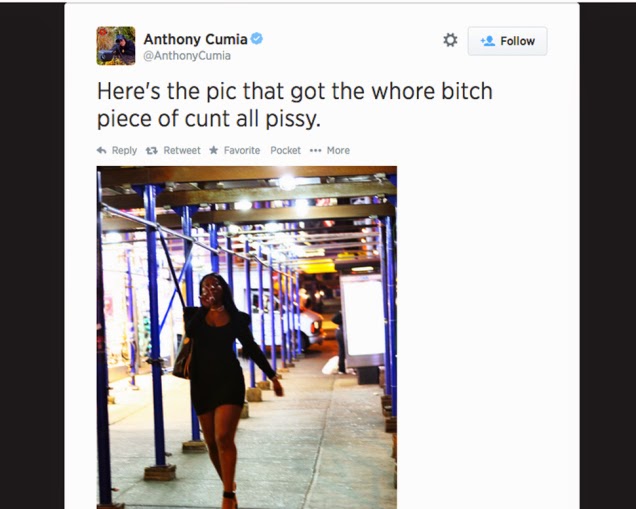
Wonder if Anthony Cumia—formerly of The Opie & Anthony Show on SiriusXM—will be asked to serve as a character witness for Donald Sterling. Gawker posted samples of Cumia’s Twitter rant, and it’s not pretty. Gotta believe even Don Imus would shun the shock jock. The culturally clueless, misogynistic moron deserved to get bitch slapped—and pink-slipped.

Sunday, June 08, 2014

11896: Head-Scratching Over Scratchgard.

This ad from India is disturbing on a couple of levels. Is the kid using a “Privacy Scratchgard” in order to conceal his phone porn usage? Isn’t there enough controversy surrounding the objectification of and violence against women in India?

From Ads of the World.

Sunday, March 23, 2014

Tuesday, January 21, 2014

11709: Global Ignorance.

Not sure what this campaign from Turkey is trying to communicate. Pretty sure it’s insulting, misogynistic and racist.

From Ads of the World.

Thursday, November 21, 2013

11587: Army Looks Pretty Dumb.

The New York Post reported the Army thinks “ugly” women make for more competent soldiers. Look for Dove to exploit this notion in a self-absorbed, hypocritical and promotional style.

Army: ‘Ugly’ women seem more competent

By Joe Tacopino

Attention, pretty girls — Uncle Sam does not want you!

An Army colonel has called for pictures of only “ugly” women to be used in promotional material, because they are perceived as more competent than sexy female soldiers, according to Politico.

In leaked e-mails, Col. Lynette Arnhart says pretty girls should not be used to promote the Army because they look like they wouldn’t want to “break a nail.”

“In general, ugly women are perceived as competent while pretty women are perceived as having used their looks to get ahead,” the colonel wrote.

Arnhart is on a panel trying to entice more woman into combat roles.

“There is a general tendency to select nice-looking women when we select a photo,” Arnhart said. “Such photos undermine the rest of the message, and may even make people ask if breaking a nail is considered hazardous duty.”

Tuesday, October 08, 2013

11497: Dearth Of Digital Dames.

Adweek interviewed entrepreneur Rachel Sklar, discussing the dearth of digital dames—which was packaged under the overall heading of diversity. Looks like Karen Mallia’s perspective does not hold true. Sure, women face discrimination in the interactive space too; however, they’re still waaaaay better off than minorities.

Rachel Sklar Emphasizes That Diversity, Inclusiveness Are Good for Business

Entrepreneur speaks out about women in tech

By David Taintor

In the past month alone, the tech industry has seen a string of headlines that talk of men pushing misogynistic apps or taking a crude tack when discussing women on Twitter. Rachel Sklar, an entrepreneur who has co-founded two organizations—Change the Ratio and TheLi.st—that seek to shine a light on women in tech and media, said stories like these validate the work she does. She recently spoke to Adweek about how inclusiveness and diversity are business assets.

You’ve spoken out a lot about the lack of recognition that women in tech receive. Are things getting better at all on that front?


Things are definitely getting better. There are women everywhere doing amazing, innovative, critical things. By and large, this is still an issue. But I do think it is definitely changing. Change the Ratio, I think, has actually changed the ratio. And that’s not to take credit for amazing stuff done by amazing women who don’t know me and have nothing to do with me. It has to do with a greater awareness on the part of investors, and influencers, and decision makers and gatekeepers that it is actually important to diversify. And that entrepreneurs are not just packaged looking like Mark Zuckerberg and The Social Network. And that where you don’t have diversity, you’re leaving an incredible number of market opportunities on the table.

There have been a number of headlines recently about insensitive men in the tech world, with Pax Dickinson at Business Insider and a couple of sexist panels at TechCrunch Disrupt. What’s your reaction when you see those stories?


These are things that are very validating. That is the irony of the business that I am in: validation that comes from realizing that things need to change and things need to get better. So when you've got these two bros on stage making an app about staring at women’s bodies and objectifying them, nothing makes it more clear that there needs to be more women—and treated with more respect—in the industry than that.

And that’s something that affects bottom line. Amazing, qualified people with a spine and a brain and a heart won’t gravitate toward that kind of behavior. I just always try to hammer home: it is a business asset to be a mensch. It’s a business asset to be forward-looking, forward-thinking, inclusive, someone who sets a good example and leads in a progressive way.

You helped launch Sheryl Sandberg’s Lean In organization. Are you still involved?


I was on the launch committee for Lean In, and I did a few events with Sheryl in New York with women in this space. And I don’t have a formal, ongoing role, but I am sort of an ongoing friend of the organization. Jessica Bennett, who is the editorial director at Lean In, she’s on TheLi.st. She and I are good friends and have lots of things we want to do together. It’s very symbiotic. Lean In has been a very useful thing for me. There was a sea change that came with it. It made my life so much easier, in addition to being an amazing handbook with all the data I needed.

What’s an average day like for you?

I think, particularly for most entrepreneurs who are in the early stages, there’s no such thing as an average day. I’m in the reaction business in many respects. I’ve become sort of a go-to to send up the bat signal for sexism happening somewhere.

I’ve gotten better over the years, in terms of what things demand me to drop everything and respond. It’s like the outrage-o-meter—I’ve trained myself to wait until it reaches a certain point. Because TheLi.st is a mission-driven organization, it’s in many ways determined by responsiveness.

When was the last time your outrage-o-meter was set off?


It’s been generally set off over the shutdown, the Republican shutdown. Because, with every wave of new stories of who is affected, and what kind of loss is experienced as a result of it, a flash wave of realization that the people who are going to be feeling the brunt of this are the people who are least protected and cared for in society. And the people making these decisions are people who have money and resources and have privilege. I spend a lot of my time engaged with the concept of privilege, who has it and who doesn't have it and of the people who do have it, how they are deploying it. Often the people who have it are not deploying it in an enlightened way. And I try to enlighten them.

Wednesday, September 25, 2013

11469: Gorillas In Our Midst.

The New York Daily News reported on Patrick, a 430-pound male gorilla being evicted from Dallas Zoo after displaying aggressive, sexist behavior towards female apes. Too bad Patrick doesn’t work in the advertising industry, where sexual harassment, gender discrimination and misogyny are totally acceptable. In fact, the monkeys on Madison Avenue are rarely bounced for such behavior; rather, the victimized females are typically shuttled off with hush money. And if rude simians are expelled, it’s usually with financial backing from cronies for a startup agency.

‘Sexist’ gorilla being kicked out of Dallas Zoo

Patrick, a 23-year-old Western lowland gorilla who was born in the Bronx Zoo in 1990, has nipped at female apes he was to mate with and even bit one, and has belittled others. Patrick will be transferred to the Riverbanks Zoo and Gardens in Columbia, S.C.

By Lee Moran / NEW YORK DAILY NEWS

A “sexist” male gorilla at Dallas Zoo is being evicted and sent for therapy after he bit one female companion and belittled others.

Patrick — a 430-pound Western lowland born at New York’s Bronx Zoo in 1990 — will be moved to Riverbanks Zoo and Gardens in Columbia, S.C., according to ABC 27.

It’s hoped that his new bachelor pad at the resort known for helping primates with behavior problems will bring out his softer side.

Bosses in Dallas said the cranky 23-year-old ape gets along fine with humans, but not with other gorillas.

When he was paired up with females to breed, he instead bit one and nipped at others.

He only had one male pal — Jabari — but he was shot dead in 2004 after escaping and injuring three people, according to the Dallas News.

So Patrick was forced to spend his time alone in his own enclosure.

With Dallas Zoo acquiring two new male gorillas, officials say the time has come to move him on.

“It’s not like we haven’t tried, he’s been here for 18 years,” Dallas Zoo spokeswoman Laurie Holloway told Reuters.

“He’s beautiful and smart and everyone loves him. We’re really sad to see him go, but it’s for the best for the zoo and for Patrick,” she added.

The grumpy beast will at first be separated from Riverbanks’ three other gorillas. Eventually, it’s hoped, he will move in with them to a spacious living area.

Thursday, September 05, 2013

11418: Malaysian Marriage Mess.

Borders in Malaysia thinks that in order for a woman to keep a man, she must learn to cook. Perhaps this sort of cluelessness led to the bookseller’s demise in the U.S.

Wednesday, November 21, 2012

Thursday, May 26, 2011

8818: News & Nonsense.


Entertaining stupidity in a MultiCultClassics Monologue…

• Disney opted to drop its SEAL TEAM 6 trademark application after the U.S. Navy filed an application as well. News sources indicated Disney withdrew its application “out of deference to the Navy.” Plus, Disney probably realized it was not smart to mess with the guys who put a bullet in Osama Bin Laden’s head.

• Former NFL player Tiki Barber compared himself to Holocaust victim Anne Frank in a Sports Illustrated article. Barber was discussing moving with his girlfriend into the attic of his agent’s home. “[My agent is] Jewish,” said Barber, “and it was like a reverse Anne Frank thing.” The major difference being Frank’s diary has been read worldwide, while Barber’s literary efforts usually head straight to the bookstore remainder bin.

• MSNBC personality Ed Schultz was suspended for one week without pay for calling conservative radio host Laura Ingraham a slut. “I used vile and inappropriate language,” said Schultz. “I am deeply sorry, and I apologize. It was wrong, uncalled for, and I recognize the severity of what I said. … I have embarrassed my family, I have embarrassed this company… I have been in this business since 1978 and I’ve made a lot of mistakes. This is the lowest of low for me.” The man is such a media and attention whore.

Friday, July 09, 2010

7771: Mel Gibson Cultural Clueless Scorecard.


The actor has managed to display ugly bias towards:
• Gays
• Jews
• Blacks
• Latinos
• Women/Russians
• Asians (Based on dialogue directed at Jet Li in Lethal Weapon 4)

Tuesday, March 03, 2009

6504: Trust Me, This Show Still Sucks.


Only 11 minutes into the latest episode of TNT series Trust Me, and the show already continued to display the White male cluelessness so prevalent in our industry. Sarah Krajicek-Hunter announced her new partner had been hired, and all the Young Turks wanted to know was, “Is she hot?” Conner enjoyed a full-body massage from a female masseuse in Mason McGuire’s office. And later, he presented a radio script for Bertolli® pasta, complete with a stereotypical Italian accent.

Within the next 10 minutes, viewers discovered that Krajicek-Hunter’s new partner had left the business to “have a few kids,” and the woman appeared dismayed to learn she’d have to work during the weekend. By golly, isn’t this exactly what Neil French complained about?

The third quarter saw Mason and Conner staging a high-pitched screech fest, once again affirming the two are whiny bitches.

The last 15 minutes flipped the script momentarily, with Krajicek-Hunter griping over her partner’s professional priorities. Hey, it would have been politically incorrect for one of the men to express such a position. In a final exhibition of White male dominance, Tony the boss dismissed everyone’s comped ideas for his own scribbled notion.

Friday, February 08, 2008

5099: It’s Hardball Out Here For A Pimp.


What is it with White men in the media making references about prostitutes? MSNBC’s David Shuster has been suspended for his on-air comments directed at Chelsea Clinton. Wonder if he’ll blame rappers for inspiring the remark.