Sunday, March 06, 2016

13114: Nepotism Trumps Diverted Diversity.

Campaign spotlighted an ad campaign jointly created by Sir John Hegarty and his son. The diversity advocate is essentially a nepotistic asshole. Oh, and their commercial sucks too. It’s patronizing pap probably produced to pander to PrideAM Award jury participants. The entire scenario is a bizarro blend of nepotism trumps diversity and diverted diversity. Give the Hegarty clan credit for originality in perpetuating exclusivity.

Watch: John Hegarty and son’s first joint ad campaign for men’s fashion service

By Omar Oakes

John Hegarty and his son are today unveiling their first joint ad campaign after writing an inaugural spot for a men’s fashion service.

The ad, by Hegarty’s incubator business, The Garage Soho, has been written for The Chapar, which aims to provide an alternative to the “torture” of shopping on the high street with the help of a personal stylist.

After curating a selection of premium items to suit the shopper’s own personal taste and body shape, The Chapar then delivers a bespoke ‘trunk’ direct to the customer’s home or office.

The 60-second spot was written by John Hegarty and directed by Elliot Hegarty through Royle Productions. It was art directed by Rosy Thomas.

The ad is being launched on cinema and will be unveiled by Picturehouse Central in London this afternoon during an exclusive movie screening of Hail, Caesar!, the new movie by the Coen Brothers.

Saturday, March 05, 2016

13113: Typecasting Calls.

Adfreak spotlighted a video featuring actresses reading real casting call specs with sexist requirements. Hey, someone should do a similar video for minority actors, where the routine casting call specs include racist stereotypes that are discriminatory and arguably illegal.

Actresses Read the Real (and Really Sexist) Casting Calls They’re Subjected to Each Day Project encourages women to create their own content

By David Griner

If you needed evidence women are still stymied by stereotypes in ads and shows, look no further than this eye-opening and eye-rolling video.

“Casting Call, The Project” features 18 women reading real casting notices into the camera, with their reactions ranging from raised eyebrows and exasperated sighs to obscenities and abject disgust.

“In our quest to find and create work, we became all too familiar with reading character breakdowns posted on casting call notices via the numerous casting websites (some legitimate and reputable, others, not so much),” wrote the three artists who created the project. “Throughout this journey, we would often share with each other particularly ridiculous, hysterical and appalling casting call notices.”

The three friends—Julie Asriyan, Laura Bray and Jenna Ciralli—decided to compile some of these many infuriating notices into a video that could be passed along by those who share their frustrations. The plan seems to be working, with the video having received more than 320,000 views in its first 24 hours on Facebook.

Each casting call included in the video is riddled with undertones (or blatant overtones) of stereotypes about gender, race, age and body type.

Most convey the usual ad/film stereotypes: “Loves being a woman, so she probably wears a push-up bra.” “She’s actually pretty, even with no makeup.” “Nerdy type of girl, nevertheless she has a boyfriend who loves her.” “Her cleavage is her best feature.”

Several highlight the casting industry’s laughable view of feminism, with lines like: “Lead actress needed for film about feminism. She is moderately attractive.” Another: “Prefer an actor who is not thin. This is a great role for a feminist.”

The goal of the project, created by three friends in New York, isn’t just to point out the industry’s sexism and ridiculous tropes. It’s also about showing creative women why they should also be focused on producing their own content. By taking ownership of the creative process, women can “bring about the roles we all want to see for female actors,” the project’s creators said.

If you’re interested in learning more about the women included in the video, you can read their acting bios on the project’s website, CastingCallTheProject.com.

Friday, March 04, 2016

13112: The Jury Is Out.

Adweek published the latest attempt at diverted diversity from Kat Gordon, who targeted AAF President James Edmund Datri and the Chicago American Advertising Awards for assembling an all-White-male jury. Of course, Gordon is only upset because the group doesn’t include White women. Even Adweek identified Gordon as “the founder of The 3 Percent Conference, an event that strives to elevate and expand female representation in media and advertising”—despite Gordon once insisting, “I am not advocating on behalf of my gender. I’m advocating on behalf of our industry. We all will prosper—every gender, ethnicity and culture—when we stop perpetuating this maxim [‘It doesn’t matter who does the creative, as long as they’re good.’] and embrace a more complex and prosperous truth.” Right.

An Open Letter to the AAF President on the Ridiculousness of All-Male, All-White Juries

Chicago ad awards panel includes no women or minorities

By Kat Gordon

Dear Mr. James Edmund Datri,

The year is 2016. Or it was, last I checked. Yet seeing the lineup that the Chicago Advertising Federation put together for this year’s American Advertising Awards judging, I wondered if it might be 1955:

Eleven judges. All men. All white.

As Cindy Gallop so powerfully stated at the most recent 3 Percent Conference, we must “change the optics” in our industry. Every time an image of all white dudes or a list of all white dudes like yours appears, here’s what it says: “I want a homogenous creative department. I want my creative department/leadership team to be all white men.”

Or, in your case, “I want a homogenous creative jury. I want my jury to be all white men.”

In a year when many major creative awards have embraced the Art Directors Club’s 50/50 Initiative, pledging for a gender-balanced jury, the Chicago AdFed’s lineup shows a staggering lack of relevance. Ironically, two of the Chicago jurors, Todd Ziaja and Kevin Lynch, work for agencies—Razorfish and BBDO respectively—that are sponsors of the 50/50 Initiative.

You may wonder why I am directing this letter to you, the president and CEO of the American Advertising Federation, rather than to Patrick Farrey, the executive director of the Chicago AdFed. Farrey demonstrated his lack of sensitivity to this issue last year when the invitation to the American Advertising Awards gala, formerly known as the Addys, showed creatives gathered at a urinal, beneath the headline: “Who Measured Up?” (You can see the invite below.)

The Twittersphere erupted with criticism for this campaign, calling the work lazy and insensitive. Farrey did not apologize but issued this response to the brouhaha that ensued:

“Great advertising is almost always risk-taking, if not occasionally irreverent. There is no doubt that the promotional campaign for the 2015 CAF American Advertising Awards competition pushed the envelope. Our intent was not to offend anyone, but rather to inspire the Chicago ad community to submit their best work into our long-standing, highly respected competition.”

This level of response isn’t satisfying to key talent in the Chicago market. Jean Batthany, ecd at DDB Chicago, responded to this week’s jury announcement by showcasing how embarrassing Chicago’s lineup was compared with the Andy Awards: “While judging the 2016 International Andy Awards, Susan Fowler Credle, global CCO at FCB, shared a photo of Xanthe Wells, former CCO at The Pitch, in the jury room with her baby in her arms along with Mark Tutssel, global CCO of Leo Burnett. Led by Chairman Colleen DeCourcy, co-ecd at Wieden + Kennedy, six of this year’s 26 incredibly talented judges were women, including Chicago’s own Liz Taylor, ecd at Ogilvy. A stark contrast to the all-male jury of 11 selected to judge Chicago’s 2016 Addys.

“Why? Why is it so goddamn hard? Why is it six steps forward toward gender balance in creative leadership and six steps right back. Come on, Chicago Ad Federation. You’re embarrassing us.”

I agree with Batthany. I myself just flew home Saturday night from Orange County, where I judged the local Addys. Last year, I judged the Seattle Addys. There is no shortage of creative women ready and willing to serve as judges. In fact, the ADC’s 50/50 Directory lists 373 women to invite.

There is no excuse or defense for this level of homogeneity. Homogeneity is the enemy of creativity. The more diverse people you have creating or evaluating work, the better the output. Ask Harvard. Or McKinsey. Or Catalyst.

Mr. Datri, you have a problem in Chicago. And Patrick Farrey should answer for it.

Kat Gordon is the founder of The 3 Percent Conference, an event that strives to elevate and expand female representation in media and advertising.

Thursday, March 03, 2016

13111: Dumping Campbell Ewald.

Adweek reported two more clients have dumped Campbell Ewald, and one of the abandoning clients confirmed the decision was tied to the Ghetto Day email. The trade publication even named the creative director who authored the offending email. Are the defections—in regards to firing an agency for displaying racism and cultural cluelessness—unprecedented in the history of advertising? And will it lead to actual change in the industry? It’s hard to predict. But it sure is entertaining to witness. Don’t expect IPG to add the terminations to the list of firsts in the areas of diversity and inclusion. Meanwhile, the folks at Campbell Ewald must be seriously chugging Malt 45s at this point.

2 More Clients Leave Campbell Ewald, With One Citing Agency’s Racist Email Controversy

Edward Jones, Henry Ford Health Centers won’t renew contracts

By Patrick Coffee

Campbell Ewald made headlines both in and out of the advertising world in January for firing CEO Jim Palmer over a staffer’s racist email, and the incident still seems to be casting a shadow over the agency.

Today Adweek learned that two key clients have chosen to follow the lead of USAA, which terminated its contract with the IPG shop days after the story came to light. Financial services company Edward Jones and Detroit-based healthcare organization Henry Ford Health System will not renew their current Campbell Ewald contracts, which expire on April 17 and May 31, respectively.

Although Edward Jones would not comment on why it was ending its relationship with Campbell Ewald, a Henry Ford Health System spokesperson confirmed that its decision was linked to the agency’s high-profile incident of racial insensitivity by a creative director.

“The decision was the result of serious consideration by our leadership team,” the brand representative said. “We assessed our partnership based on our values and commitment to supporting a diverse culture.”

At issue is an email sent by Jim Houck, an executive creative director in the agency’s San Antonio office. The email invited staffers to a “Ghetto Days” event at the Texas office, promising “ghetto music, Malt 45s at lunch, and of course, drugs and prostitution are legal all day.”

The email was sent in October 2015, but Houck wasn’t fired until the message was published by Adweek’s AgencySpy blog in January.

When it became clear that CEO Jim Palmer had known about the email for months, the agency chief was swiftly terminated by parent company IPG and replaced by Campbell Ewald president Kevin Wertz. The same day, Adweek learned that major San Antonio client USAA planned to end its relationship with Campbell Ewald and seek an agency that shared the brand’s “culture and core values.”

Now it appears the client losses didn’t end with USAA, though it’s hard to tell how much of the recent decisions were based on the email controversy and subsequent leadership shift.

Edward Jones has elected to transfer the entirety of its marketing business to Chicago-based independent agency Cramer-Krasselt, which had already been handled much of its advertising work since 2009.

Henry Ford Health System, meanwhile, says it will launch a creative review to pick its newest agency partner at an undisclosed date.

Campbell Ewald won the talent acquisition portion of the Edward Jones business in a 2013 review after the client launched a new recruiting initiative with the goal of employing 20,000 financial advisers by the year 2020. It then added Henry Ford Health System to its roster last summer amidst a streak of wins that followed the loss of the U.S. Navy recruiting account to Y&R after 15 years. (In addition to Henry Ford, that group of wins also included Travelocity and the New York State Tourism account, colloquially known as “I Heart New York.”)

An Edward Jones spokesperson declined to comment on whether its decision was in any way tied to the “Ghetto Day” controversy, telling Adweek, “Edward Jones has decided to end its relationship with Campbell Ewald and move marketing support for our financial adviser recruiting efforts to Cramer-Krasselt. We believe this move will ensure consistency in our message and result in gains in efficiency.”

A Campbell Ewald spokesperson declined to comment on the client losses.

In a February interview following Palmer’s ouster, IPG CEO Michael Roth told Adweek that he had confidence in the agency’s new leadership and reiterated IPG’s commitment to diversity and inclusion across all its agency networks.

According to Kantar Media, Edward Jones spent approximately $16.7 million on paid media from January to September of 2015, the most recent period on record. Henry Ford Health System spent just over $1 million during the same period. For all of 2014, the respective numbers were approximately $30 million and $3.1 million.

Wednesday, March 02, 2016

13110: Promises, Promises.

Campaign reported 14 agencies and companies in the advertising and marketing industry committed to IPA’s Web stunt, pledging to meet diversity goals by 2020. Conspicuously absent from the list of revolutionaries are any prominent White advertising agencies. They were probably too busy diverting diversity and/or planning trips to Cannes in pursuit of a Glass Lion.

Agencies sign up to IPA diversity goals

By Gurjit Degun

Fourteen agencies and companies in the industry have signed up to the IPA’s diversity goals.

Adam & Eve/DDB launched a campaign around the IPA’s objectives last week urging agencies to make the most of the extra day this leap year.

The move was backed by Twitter, Campaign and the IPA, which have joined Adam & Eve in making the pledges.

The IPA is asking companies to pledge that: 40 per cent female representation in senior positions by 2020; 15 per cent black, Asian and minority-ethnic representation in senior positions by 2020; to eliminate unconscious bias through training; to raise awareness of flexible or agile working policies.

The agencies that have signed up to wewillmaketheleap.com include the7stars, MediaCom, Creston Unlimited, Mr President, DCM, The Gild, Twitter, Thinkbox, Nabs, Bernstein-Rein, Havas Media Group, White October, Maxus and Mindshare.

13109: Diversity Deficit Is 100% Bullshit.

A comment left for the previous post on Campbell Ewald Detroit pointed out a factoid that MultiCultClassics failed to address. That is, the photo featuring the agency’s predominately White female staff is even more outrageous when considering that Detroit has the largest Black population of all U.S. cities at 84.3%. How would the 3% Conference spin that figure? MultiCultClassics had a similar reaction many years ago when visiting Richmond, Virginia, where Blacks comprise over 50% of the population. There were restaurants and clubs filled with Blacks literally within blocks of The Martin Agency. Yet the late Mike Hughes once confessed, “We’ve done a pretty poor job on diversity as an industry and we’ve got to do better.” Hughes could’ve started doing better by simply strolling down the street.

Tuesday, March 01, 2016

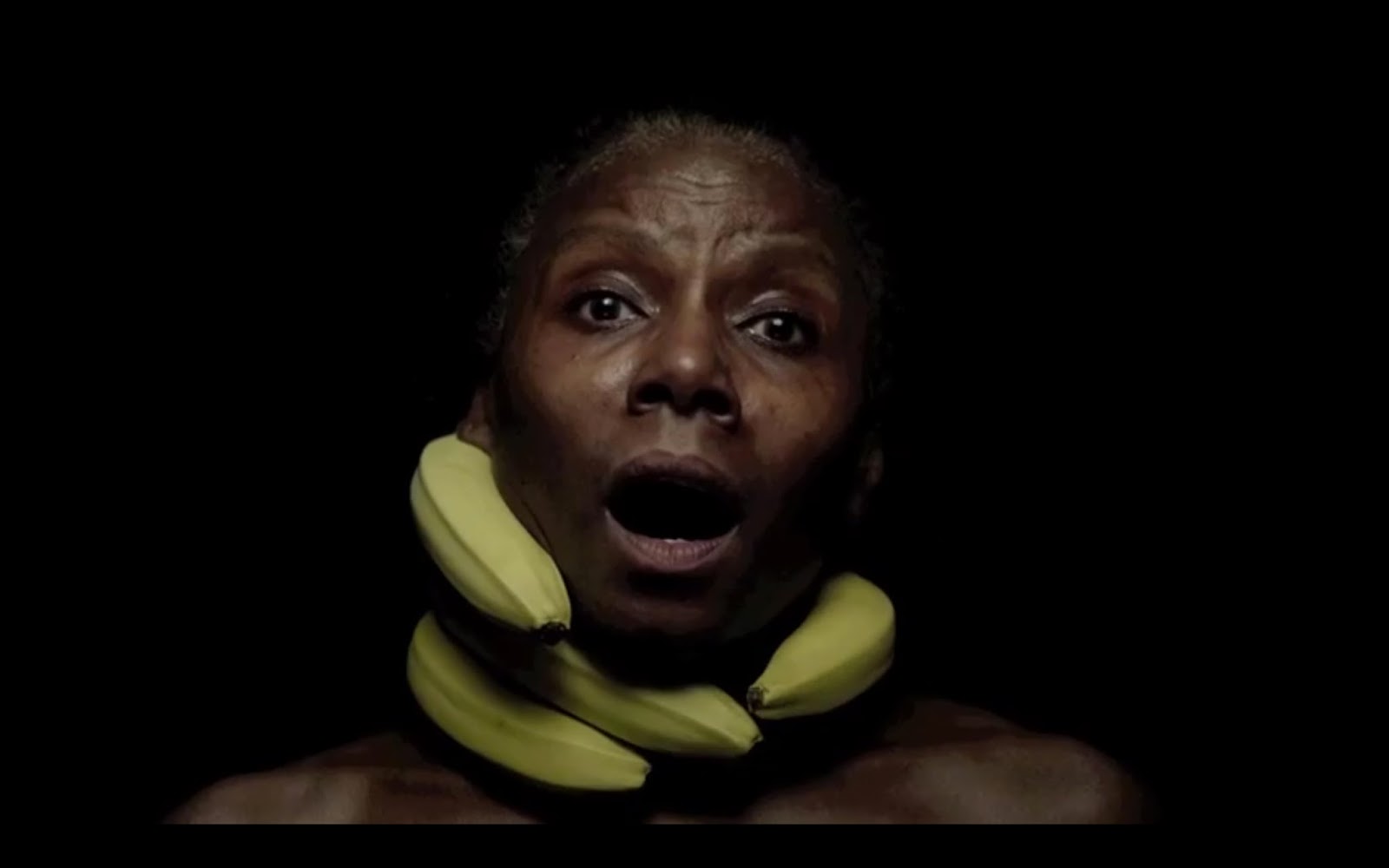
13108: Day-Oh No!

M&C Saatchi Berlin created this Oxfam commercial showing Black people being strangled by bananas. Is there a companion spot with Blacks being beaten with fried chicken drumsticks?

13107: Campbell’s Soup Kitchen.

A MultiCultClassics visitor pointed to a Twitter tweet showing Campbell Ewald Detroit spent the last day of Black History Month “helping to feed 15,000 families in Southeast Detroit…” The message included, “This is how we #DayItForward…”—as opposed to Campbell Ewald San Antonio’s #GhettoDayItForward. Based on the Twitter images, Campbell Ewald Detroit is predominately White and female, which makes the office extremely diverse by today’s advertising industry standards. Mission accomplished, 3% Conference! Missing from the photos is former Campbell Ewald CEO Jim Palmer, who will likely not need a free meal anytime soon, despite being fired for his inaction in the face of Blackface. Hell, Palmer will land a new job in the field before a minority gets hired.

Monday, February 29, 2016

13106: Best BHM Bullshit Ever.

CNN asked, “Was February 2016 the best Black History Month ever?” From #OscarsSoWhite to Beyoncé’s So Black, CNN declared a plethora of progress took place in a 29-day span. Okay, except it sure didn’t happen in the advertising industry. For starters, there appeared to be a dramatic decline in BHM advertisements. White advertising agencies allegedly held meetings to discuss avoiding another Campbell Ewald debacle. USA TODAY claimed Super Bowl 50 ads put diversity on display—ignoring that the “diversity” was created via exclusivity. Benetton blew diversity big time. Bartle Bogle Hegarty celebrated Black sheep with White shit. The AAF mimicked the Academy Awards with its 2016 Advertising Hall of Fame inductees. There was IPG, IPA and IPO bullshit—as well as bullshit from another White man who diverted diversity in defense of dames. Ogilvy helped NASCAR and IBM reach diverse audiences with Caucasian campaigns. Sure, Michael Houston and Vann Graves presented positive moments, but their achievements did not offset the diversity business as usual on Madison Avenue.

Sunday, February 28, 2016

13105: Kohl’s Is Mixed Up.

Did Kohl’s try to bring diversity to the Academy Awards with its interracial family? The retailer deserves a nomination for Best Patronizing Pap.

13104: #WatsonSoWhite.

Advertising Age spotlighted the Ogilvy-created IBM Watson commercials slated to run during the Academy Awards. IBM VP-Content and Global Creative Ann Rubin gushed, “With the diversity of the audience watching, we wanted to reach out in a way that is very consumable through humor and ignite the conversation about cognitive computing.” Huh? Once again, an advertiser allegedly sought to reach a diverse audience, yet hired a painfully White advertising agency. And Ogilvy once again shat out an exclusively White campaign starring Ridley Scott and Carrie Fisher. Hell, even the robots in Fisher’s spot appear to be White.

13103: BHM 2016—Mickey D’s.

12 Months. 365 Days. 8760 Hours. 525,600 Minutes. 1 Tired Concept.

13102: Droga5’s Post-Racial Pap.

For the Y, Droga5 has gone from unflattering depictions of underserved communities to cutesie kiddies. The latest commercial presents Zoe, a racially ambiguous child who will potentially run for president in 2064. Hey, that’s well before the Leo Burnett prediction of a culturally diverse advertising industry by 2079. In fact, little Zoe has a better chance of serving as POTUS than landing a job at Droga5.

Saturday, February 27, 2016

13101: BHM 2016—CURLS.

CURLS celebrates Black History Month with #CurlsGirlsRule—not to be confused with Black Girls Rule.

13100: Why Cannes Is Crumby.

Campaign reported on how Cannes Lions produces profit and perpetuates the racism discriminatory exclusivity in the advertising world.

According to the report, the awards machine runs on a “self-reinforcing business model” that reflects the self-reinforcing segregation in the field—along with the industry’s problems of self-centeredness, self-absorption and self-regulation that are leading to self-destruction.

An IPO filing showed Cannes Lions generates $59 million in annual revenue. How many multicultural advertising agencies make that much money per year? BTW, does the enterprise employ minority vendors—besides the celebrity entertainers?

Cannes Lions, appropriately enough, is the Academy Awards of adland. Except the advertising industry is much more whitewashed than Hollywood. No, really. The premier awards festival exposes the exclusivity and the exclusion. The ruling majority decides which work is best and who is most talented. Hell, the Caucasian committees even introduce categories and trophies to extend income, expand country-club cliques and establish faux philanthropy. Recent years have seen new awards for holding companies, clients, pharma and White women.

Imagine if Cannes Lions honored multicultural advertising. Unfortunately, there’s simply no money to be made with such an effort. Plus, it would require crafting Lions from crumbs.

IPO filing reveals how Cannes Lions makes $59M in annual revenue

By Douglas Quenqua

Constant expansion and a “self-reinforcing business model” fuel growth of adland’s most prestigious (and expensive) awards show

The Cannes Lions International Festival of Creativity earned $59 million (£41m) in 2014, up from $43 million (£30m) — or 37% — in 2012, according to a prospectus released by parent company Ascential in preparation for its IPO on the London Stock Exchange.

Though full-year revenues were not available for 2015, the festival’s revenues in the first three quarters of the year increased $9.2 million (£6.4m) over the same period in 2014. Revenues for 2013 were not disclosed.

The disclosure form released on Tuesday provides a first-time glimpse into the financial performance and growth strategy of the ad industry’s most prestigious — and expensive — awards show.

The festival shows healthy year-over-year revenue growth, due in part to a “self-reinforcing business model” in which agencies must compete to win Lions because they have convinced clients of their value, the document says.

“Agencies themselves have promoted the awards such that their clients now recognise a Lion as the barometer of an agency’s creative talent, and agencies consequently compete to win Lions and market their Lions wins to their clients, reinforcing the circle,” the prospectus says.

Though longtime Lions participants may find little in the 240-page document they didn’t already suspect, it nonetheless provides confirmation of the festival’s financial dependence on agencies and their clients — which goes far beyond mere entry and delegate fees. For example, the prospectus boasts of business advantages such as “creative firms who promote the festival for their own marketing purposes at no cost to Cannes Lions,” industry players who “suggest speaking slots and pay all speaker fees” and “eminent creatives who donate their time free of cost” to act as judges.

As evidence of the strategy’s effectiveness, Ascential cites its Customer Value Retention rate — the amount of money repeat customers spend at consecutive festivals — as an impressive 94% for 2015. From 2012 to 2014, the festival’s yield per delegate increased by a compound annual growth rate of 8%, and award entries per yield increased by 10%.

Though the prospectus doesn’t include a breakdown of revenue streams for the Cannes Lions Festival itself, an itemization of Ascential’s entire Exhibitions & Festivals division — of which the Cannes Lions is the largest event (30% of revenue) — does provide clues. In 2014, the division generated 47% of its revenue from selling exhibition space, 19% from delegate fees, 14% from award entries, 7% from sponsorship fees and 12% from other services.

Laying out plans for future growth, the prospectus details a strategy that will be familiar to agency creatives: new categories, more VIP delegate options and expanded late fees.

“The Group intends to increase Customer numbers by developing new products to attract new Customers and leverage existing products to enter adjacent end-markets,” the prospectus states. “For example, the Group intends to continue to utilise Cannes Lions’ brand prominence and customer relationships to develop new propositions like Lions Innovation and thereby attract new Customers in adjacent end-markets.”

Launched in 2015, Lions Innovation attracted 845 award entries and 485 paying delegates, 63% of which were new to the festival. Lions Health, launched in 2014, generated $1.9 million in revenue last year.

Entry fees for the 2016 Lions range from about $600 to $1,400, placing them in the top tier of ad industry award shows. Entry fees for the 2016 Clios range from $500 to $1,000, and Effies fees run from about $500 to $1300. All such shows offer the option to file past deadline for those willing to pay an expanded fee.

Cannes Lions is seen as one of the most prized assets in the Ascential empire, which also owns trade shows Money20/20 and Bett, titles such as Drapers, Nursing Times and Retail Week, and the retail data company WGSN. According to the prospectus, it accounted for 13% of total group revenue in 2014.

Thursday, February 25, 2016

13098: Scratching The Indie Itch.

From Campaign…

Why I’m starting my own agency

By Vann Graves

And why I’m asking you to help name it

More than two decades ago, at a time when our industry was just a little simpler, I joined BBDO New York as a completely green, yet unwaveringly optimistic, creative intern. I was lucky enough to be ushered into this crazy business by the late Phil Dusenberry — the legendary man behind campaigns like GE’s “We Bring Good Things to Life” and Pepsi’s “The Choice of a New Generation,” and certainly one of the industry’s greatest creative leaders.

Phil must have instantly picked up on my determined enthusiasm, as he didn’t waste a minute instilling in me the importance of independence when it comes to fostering great creativity. A certain amount of independence is absolutely critical to it. This is still true today, even as the advertising industry has evolved and gotten more complex. Undeniably, every creative still has an innate desire to craft things without others telling them what to do. This eventually turns into a desire to strike out on one’s own. Even Phil tried his hand at this in 1969. After his initial seven-year stint as a copywriter at BBDO, he left the agency to start Dusenberry Ruriani & Kornhauser, returning to BBDO in 1977. He came back, because, despite its “bigness,” BBDO ultimately offered him the perfect balance of creative freedom and opportunity. It was home, and Phil was fulfilled.

For a very long time, I was creatively fulfilled there too. I spent 15 years at BBDO, and I got to work alongside some of the best in the business. The mentorship of these brilliant creative minds is precisely what got me to VP, Creative Director by the time I left. Later, I spent six years at McCann New York, where I got to work on massive clients like Coke, MasterCard and American Airlines. Many of these accounts were equally as inspiring to me on a personal level as they were impressive. There aren’t many other places where you can work on a piece of business like the U.S. Army after you’ve already dreamed up loads of creative ideas from actually being on active duty. I was on a high, and I wasn’t coming down anytime soon.

Fast forward to 2015, when life and love kicked in. My best friend and devoted wife landed her dream job in Chattanooga, Tenn. It was my turn to be her biggest cheerleader. Fortuitously, Chattanooga was an emerging hub for startups, bubbling with the same spirit of possibility that I displayed on my first day at BBDO. Phil’s simple lesson came flooding back: “It’s all about the work, the work, the work,” and soon, the indie itch started to emerge. However, I wasn’t ready to go all in yet — that was a big step.

Leaving McCann was terrifying, and I wanted to create a situation that gave me the best of two worlds — a welcoming, established home and a place where I could produce and practice my craft on my own. I was thrilled when an opportunity arose for a job as President and CCO at Fancy Rhino, a young production company that had gotten a successful start a few years before in the documentary space. I was at a place where I saw the potential to creatively shape a company — not just its clients — and suddenly, the pull to do my own thing started to grow.

I stayed at Fancy Rhino for about a year. During that time, my indie itch only got stronger. I began to realize that while my opportunity there was great, it was not a perfect fit. With a final push from Shelley Prevost, the CEO of our first client, Torch, it felt like it was now or never. So, I reached out to a few friends (now my founding team), and they agreed that it was time to create something that we believed in. A year away from big agency life had opened my eyes. I was ready to take the plunge.

By that time, I knew that a different kind of agency model was essential to making creativity work in a rapidly shifting marketplace, and I knew that this model would not come to full fruition until I built it from scratch. Marketers today are demanding high quality, shareable content, in every form. And they are demanding it faster than ever before. However, it takes a certain type of creative agency to understand that content is not just content for its own sake — when executed properly, it is a highly effective creative solution to a business problem. It also takes a certain type of creative agency to bring quality content to market quickly and efficiently enough to meet these demands.

My founding team, formed with former colleagues of similar mindset, will be armed with a skillset rooted in both production and creative. Using our agility and technical capabilities to encourage experimentation with content, our goal is to integrate production seamlessly into the brand building process. We will have the freedom to deliver beyond a client’s brief and to demonstrate that we can steer our creative in many different directions.

My hope in starting my own agency is that other entrepreneurially-minded creatives might also be inspired by the prospect that, amidst the noise of technology and new media, creativity does still matter; that an efficient structure enables it; and that this noise is actually an opportunity, not a hindrance. Every day, threats to the agency model are bemoaned and dissected; so-called “in-house agencies” are becoming the norm to solving the problem of efficiency, and the agency world is pointing its fingers at Silicon Valley, Hollywood, and publishers for encroaching on a space that we used to own. But we need to stop pointing fingers and realize that agencies can have a model that’s special and capable of bringing big ideas to life — as long as we’re willing to rethink how we operate those agencies.

In the spirit of honoring the bold creative ideas I’ll be asking my clients to trust me with, I’m putting my money where my mouth is and asking the industry to help me name my new agency. And in a nod to the entrepreneurial drive that I credit to my creative friends and mentors, I’ve asked a few of them to throw their suggestions in the hat. The name will be decided through a poll that will be featured here tomorrow. I couldn’t be more thrilled and excited to be able to strike out on my own in an industry that truly never shies away from possibility.

13097: IPAsinine Gesture.

Campaign reported IPA issued a fresh call-to-action for diversity in adland, staging a promotion that coincidentally coincides with the end of Black History Month in the United States of America. Specifically, IPA is joining Twitter, Campaign and Adam & Eve/DDB to request that White media and advertising agencies make a pledge on February 29 to reach four diversity goals in four years. Um, Twitter, Campaign, Adam & Eve/DDB and IPA are the Four Horsemen of the Apocalypse in regards to diversity. Plus, the top goal—promoting more White women to senior roles—isn’t even a legitimate diversity achievement. IPA urged White shops to show their commitment at wewillmaketheleap.com. However, the site is a non-functioning, static page as of this writing, symbolizing the false promises that have stymied progress for decades. And ironically, it resembles the branding of Jesse Jackson’s Rainbow PUSH Coalition. IPA, please take a leap—off the nearest cliff.

IPA renews push for diversity goals

By Gurjit Degun

The IPA, Twitter and Campaign are backing Adam & Eve/DDB in urging agencies to use the extra day in February to “make the leap” towards achieving their diversity goals by 2020.

Agencies and media owners are being called on to make a pledge on 29 February to achieve four targets over the next four years.

They have been asked to visit wewillmaketheleap.com to submit their pledge and Tweet that they have signed up to the campaign.

The four IPA targets are: 40 per cent female representation in senior positions by 2020; 15 per cent black, Asian and minority-ethnic representation in senior positions by 2020; to eliminate unconscious bias through training; to raise awareness of flexible or agile working policies.

Tammy Einav, a managing director at Adam & Eve/DDB, said: “This is an important moment for us to truly embrace the diversity of talent and ensure equal and fair employment.”

In January, Campaign published figures on gender and ethnicity balances among IPA member agencies.

Tom Knox, the president of the IPA, said: “By asking agencies to make a pledge and take a step, it should move the issue far higher up their agenda.”

13096: BHM 2016—RNC.

The Republican National Committee celebrates Black History Month—no, really, they are celebrating the month—with a video saluting Black Republican Trailblazers. Not in the tribute: Ben Carson. Plus, no comments on “The Blacks” from Donald Trump.

13095: Dusting Off Ashes And Embers.

From The Los Angeles Times…

Ava DuVernay’s Oscar-week gift: a rare screening with the Broad of Haile Gerima’s ‘Ashes and Embers’

By Carolina A. Miranda

In 1982, the Ethiopian American director Haile Gerima released a feature-length film on the struggles of a black veteran in the wake of the Vietnam War. “Ashes and Embers” told the story of Ned Charles, a man contending with the psychological scars of conflict, both in the U.S. and abroad.

But the film was never widely seen in its day; it never received full theatrical distribution. Since then, it has been practically impossible to catch on the big screen, only rarely materializing at festivals.

“Mr. Gerima is a master of cinema who has been overlooked,” Ava DuVernay says via telephone from New Orleans, where she is directing the television series “Queen Sugar.” “This film is a singular part of the black cinematic canon.”

Well, now “Ashes and Embers” is set to get some valuable screen time. And the timing couldn’t be better as #OscarsSoWhite reaches its climax with Sunday’s Academy Awards.

Thanks to DuVernay’s efforts, as well as the Broad museum, Gerima’s drama shows at REDCAT on Thursday as part of the series called Array. Curated by DuVernay, Array is presenting half a dozen films over the course of several months — principally those directed by women and underrepresented minorities.

“There is nothing we would rather be doing the week of the Oscars,” Ed Patuto, director of audience engagement at the Broad, says of the screening. “The Oscars will come and go. The controversy — we will see how that plays out. But we will keep doing what we are doing, observing the creativity of filmmaking.”

The series is part of a long-running project undertaken by DuVernay to promote and distribute work by artists who are frequently overlooked by the Hollywood distribution machine. Gerima’s film will not only screen in Los Angeles, it will also land on Netflix at the end of February — and Array will host other public screenings at the National Museum of African American History and Culture in Washington and the Schomberg Center in New York.

“That’s been a major objective of Array,” Patuto says. “It’s to take these gems which have been important to filmmakers of color, and to make them accessible to a broader audience.”

The series is an extension of a distribution collective that DuVernay launched in 2010 called the African American Film Festival Releasing Movement (Affirm). Its goal: to distribute work by black filmmakers, including DuVernay’s own early movies — “The Middle of Nowhere” and “I Will Follow” — made before DuVernay achieved renown as director of the Martin Luther King Jr. biopic “Selma.”

“That’s how I got ‘Middle of Nowhere’ into the world,” she says. “And that’s what led to me directing ‘Selma.’ There is a connection.”

Last summer, the collective changed its name from Affirm to Array, adding films by women and other underrepresented directors to its roster. (The Times Glenn Whipp wrote about it.)

And late last year, DuVernay teamed up with the Broad to present these and other works to the public as a series.

For the screening of “Ashes and Embers,” Gerima will be in attendance — interviewed by cinematographer Bradford Young, of “Selma” and “A Most Violent Year.” Viewers will also be invited to go to the Broad’s galleries to learn about works inspired by social justice issues.

The intent is to put work such as Gerima’s top-of-mind — especially at a time when Hollywood is grappling with issues of diversity.

The director was part of the L.A. Rebellion, an important group of black Los Angeles filmmakers that emerged out of UCLA in the 1970s that included figures such as Charles Burnett (“Killer of Sheep”) and Julie Dash (“Daughters of the Dust”).

Like many of his fellow filmmakers, his work shows a view of Southern California that isn’t always depicted in the movies.

“You’re not seeing much of black Los Angeles on film,” says DuVernay. “You’re not seeing Watts. You’re not seeing Compton. You’re not seeing South L.A. This is the Los Angeles we should see in movies — with all of its texture and its nuances. It has not been seen or explored enough.”