Showing posts with label lowell thompson. Show all posts

Friday, April 25, 2025

17044: Racing With RaceMan.


Via Bronzecomm, Lowell Thompson—aka RaceMan—announces his latest venture…


An Ad Agency for the Human Race


After a career of creating ads and commercials that sell products and services, I want to sell something much more important. I call it “humaneness”. 


I’ve been talking about my idea for years, but the recent turn of political events force me to put up or shut up. I think the pure, unadulterated embrace of hate, cruelty, bullying and greed is the culmination of the gradual, almost imperceptible dehumanization of humans in America. And I think my lifelong profession — advertising — has had a huge hand in this. So I want to use my hand, mind and heart to undo some of the damage. I’m inviting other advets to join me. 


My answer is to create communications in all media that promote human kindness, decency and respect for all living things, especially our fellow humans. My first product will be my “The Humane Race” T-shirt. By buying and wearing it, you say to the world that you are humane. You prove it by your actions. 


Right now, my Humane Initiative is still in its embryonic stage. I’m still working out the details. I’m asking others to join me. I’m looking for partners who can help me plan its structure, build a website and other marketing materials, contact potential private and public members and basically build a brand-new type of communications company that’s “like an ad agency…for the human race”. 


Interested? Contact Lowell Thompson at lowelltho@gmail.com. If you’re on Facebook, search for my HUMANE group and join it.

Wednesday, February 26, 2025

16979: BHM 2025—Channels Changers.


Channels Changers—the breakthrough documentary by Lowell Thompson—is hyped as follows:


This powerful film shines a light on the trailblazing African American admen and women of the 1960s, 70s, and 80s. It showcases their groundbreaking contributions to the advertising industry and the lasting legacy they’ve left behind.


Watch it via PBS now.

Tuesday, July 09, 2024

16700: Replaying Lowell Thompson On His Channels Changers Documentary.


In January 2023, Print Magazine interviewed Lowell Thompson, spotlighting his Channels Changers documentary on Chicago’s Black advertising executives.


The Daily Heller: Lowell Thompson’s Documentary on Chicago’s Black Ad Men and Women


By Steven Heller


Channels Changers is a documentary that chronicles African Americans who made a significant impact on Chicago’s advertising industry, as the film’s co-creator, Lowell Thompson, says. Advertising was, as he points out in this interview and the film clip below, an entry point for creative practitioners, many of whom learned “on the street” and produced iconic commercials and campaigns for national and local brands. This is an important missing link in the history of American advertising (and myth-making).


Thompson started his creative career at Foote, Cone & Belding, Chicago, in 1968, as an art director trainee, a few months after Martin Luther King, Jr. was murdered in Memphis. He spent the next 50+ years creating advertising, art, books and more.


Channels Changers is almost finished, but needs GoFundMe support to complete post-production. Here, Thompson tells us more about the project.


Is Channels Changers the first film to cover this subject matter?


I think so. I actually planned it as a book, but then I met Cotton Stevenson on Facebook. He’s a “white” retired adman who worked in some of the same agencies I did in Chicago about 10 years after I’d been there, so we’d never met. He retired, moved to San Jose, went back to school and earned a master’s degree in documentary filmmaking. He’d been watching my … er … exploits on Facebook, and when I put up some things about my memoirs, Mad Invisible Man, he called and suggested we make it a film.


Why has this been such a well-kept secret?


Vance Packard called ad folks “the hidden persuaders.” AfAm ad folks are the most hidden hidden persuaders. We’re even hidden from other hidden persuaders … unless they happened to bump into us in one of the few agencies that hired us. But to actually answer your question, I think although ads and commercials are rampant, the ad industry as a subject is inherently secret. It’s kinda like what they say about making sausage. People just want to eat the sausage, not watch it being made. Ads are even worse. People don’t go out of their way to “eat” ads. They only like some of them, at best. They don’t want to think about them, period!


About 10 years ago, Art & Copy, a documentary about some of the top ad creative people, came out. I think it was very good, but I don’t think many people saw it. The only movie I know of that was ever made about this subject was Putney Swope. It was a feature film satire directed by Robert Downey Sr. [about a white-run ad agency that by mistake elects a Black president]. I suspect part of the reasons no one has done what we’re doing is that in New York, African Americans in advertising were even more invisible than Ellison’s Invisible Man. Although AfAm Chicagoans have historically been lesser in numbers than in New York, we have almost always been a bigger portion of the whole population. That fact gave us more political, economic and cultural clout in our city.


I want to make sure we make this point in Channels Changers. The Harlem Renaissance in the 1920s was made famous because it happened in the city where American media was based. But the real renaissance had already been happening in music since Jelly Roll Morton, King Oliver and then Louis Armstrong came up from New Orleans and made the roaring ’20s roar in Al Capone’s Jazz joints on the South Side of Chicago.


The world-famous Harlem Globetrotters? Born on Chicago’s South Side in the mid-’20s. Abe Saperstein dubbed what was then the Savoy Big Five (Wendell Phillips High School students who played out of the Savoy Ballroom), “The Harlem Globetrotters.” Why? Because New York white elites and media people were going up to Harlem to slum and had made Harlem synonymous with “Black America.”


What is it about Chicago that provided opportunities that did not seem available on Madison Avenue?


Even though the Black population has dropped precipitously in Chicago (it was about 40% when Harold Washington was elected mayor in 1983) in the last decade, we still make up a little under 30%. New York’s Black population gradually moved up to 25%. I think Black Chicago also had a more cohesive culture because they came overwhelmingly from Mississippi, Georgia and Alabama. Many more in New York weren’t even born in the USA, being from the Caribbean, Haiti, Cuba, South America and many countries in Africa. That’s why the most powerful Black media names came out of Chicago: Ida B. Wells, The Chicago Defender, Johnson Publishing (which published Ebony and Jet). We’ll show how that media savvy and success led to the first successful Black-owned ad agencies.


Was there a ghettoization of Black creative directors in the industry? Did your colleagues mostly work on products aimed at Black people?


Oh, that’s an easy one. No. I didn’t work at a Black-owned agency or on a “Blacks-only” account until my last days working full time. I ended my full-time career at Burrell, as VP, associate creative director. Tom Burrell was the only person in the creative department above me. Before that I’d worked at Foote, Cone & Belding, McCann-Erickson, Young & Rubicam, Needham, Harper & Steers, J. Walter Thompson and Leo Burnett, never on Black accounts.


Your film also brings to light talented Black women.


Yes. I started in the business about the same time as Carol Williams, who now owns what she says is the largest independent-owned Black ad agency in the world. But there was also Barbara Proctor, who started her own agency in the early ’70s. And there were a good number of AfAm writers and some art directors like Alma Hopkins, Emma Young and others I worked with. But in New York there was Caroline Jones, who started as a secretary at a big white agency and went on to found more than one agency. The reason is the same as AfAm men.


Where did the creative workforce come from? Did it have anything to do with Chicago’s music heritage?


In my case it just came in off the street. The music heritage had more influence as suppliers, not workers in the agencies, although Barbara Proctor did work in the music business as a promoter and PR person before she got into advertising. She is said to have helped bring the Beatles to the U.S. when she worked at an AfAm-owned record company, VeeJay.


Did you learn to be an ad man in school or by working?


I tell folks I went to kindergarten at FCB and got my Ph.D. from JWT. I didn’t have a clue about advertising until I was smack-dab in the middle of it. That’s why I attribute my career to Dr. M.L. King and the Civil Rights Movement. But I would guess that most creative people of any color in the business in my day never planned to create ads and commercials for a living. They seemed to be would-be journalists, novelists, artists, actors, etc.


There are some iconic ads that sprang from Chicago. Was there much cross-pollination between there and New York?


Man, am I glad you asked that question. One of the people I’ve been trying to catch up with to interview for Channels Changers is Joey Randall. He’s a native New Yorker who came to Chi-Town in the mid ’70s, I think. He told me he actually came to Chicago because he had an idea for a Coke commercial that featured a bunch of guys doo-wopping. It became the iconic “StreetSong” spot for Coke the put Burrell on the TV advertising map. James Glover had worked at Y&R New York before he came to Needham, Harper & Steers and did the “Morning Glory” spot for McDonald’s breakfast. Harry “the legend” Webber came to Chicago for a few minutes. I ended up taking his office at Leo Burnett. Shirley Riley, who did a series of Clio award-winning spots for AT&T, came to Chicago but did not have a good time.


How far along are you with the film? Are they other “heroes” of the industry yet to be documented?


We actually have almost all of the interviews done. Cotton is about to get on a plane to Florida this weekend to go to interview Tom Burrell and Ray Lyle (who was an art director/producer on the Uncola campaign). We’re planning to start editing next month. There are plenty of heroes and sheroes, and not just in Chicago. Byron Lewis, who started UniWorld, is still kickin’. There are some folks on the West Coast who have done some great stuff.


Graphic design was long a second cousin to advertising. Was it that way in Chicago?


Yes, as far as I know, graphic designers lived on a whole other planet. It takes a strange mentality to be an ad person, and graphic designers generally don’t make great ad folks. Neither do novelists or journalists.


What do you want the audience to take away from this film that has been lost and now found?


Ha! That the whole multicolored mix of media, advertising and entertainment we live with today started—more than any other place on the planet—in Chicago.

Monday, July 08, 2024

16699: The Latest On Lowell Thompson.


Reel Chicago spotlighted a screening of Channels Changers, a documentary on Chicago’s Black advertising executives created by Lowell Thompson, Alaric Martin, and others. Thompson is an original crusader in the battle for diversity in Adland, steadfastly fighting to change the channels of systemic racism in the industry and beyond.


Check out the Reel Chicago content, which includes lots of photos of VIP attendees.


The Black ad community celebrates the premiere of Channels Changers


By Barbara Roche


Members of the advertising community gathered at the Gene Siskel Center on Monday evening to honor the veterans and icons of Chicago’s Black ad agencies, whose legacies are now documented in the heartfelt film Channels Changers.


Produced by Gypsy Chicago Productions, Channels Changers introduces viewers to the largely unseen world of African American ad professionals of the 60s, 70s, and 80s.


The film highlights the pioneering Black advertising executives in Chicago’s top agencies, who significantly transformed the landscape of advertising and media during that era and beyond.


Lowell Thompson, an expert on the subject who introduces the film, collaborated with fellow veteran adman, Cotton Stevenson, to create a documentary about this remarkable period and the Black ad trailblazers. Producer, Laurel Dobose brought in Editor, Alaric C. Martin, who throughout the evening was referred to as the Mastermind behind the film. Alaric had the enormous task of sifting through hours of footage to painstakingly create the template in which the story unfolds. Truly a labor of love by all involved.


Channels Changers illustrates how the Civil Rights movement and the riots following Martin Luther King Jr.’s assassination prompted corporate America to finally open its doors to Black people.


Gypsy Chicago Productions interviewed over 20 Black ad professionals from that period, including industry giants Tom Burrell and Carol H. Williams, who went on to establish nationally renowned agencies. The stories of these trailblazers reveal the significant challenges they faced as they entered the predominantly white advertising world. The film also features a number of ads, commercials, and campaigns that many may not have realized were created by African Americans.


Stevenson assembled a team of top-level filmmakers, many of whom were old friends from his days as a Chicago creative executive. The film’s initial funding came from the Field Foundation of Chicago and Chicago ad agencies FCB, Ogilvy, Leo Burnett, and DDB, with additional financial support from a GoFundMe campaign.


A reception followed the screening, where old friends exchanged hugs, laughs, and memories… lots of memories. It was much like a family reunion. There were no strangers in the room. Everyone’s paths had crossed at some time during their career.


The documentary was created as an educational film. At this time it is not likely that it will be seen on the streaming services. For further information about Channels Changers, please contact Terry Peigh, Executive Producer (tpeigh@me.com).


Film Credits:


• Executive Producers: Cotton Stevenson, Lowell Thompson, Terry Peigh


• Producer: Laurel Dobose


• Writers: Lowell Thompson, Alaric C. Martin


• Consulting Producer: Alaric C. Martin


• Director/ Director of Photography: Bill Youmans


• Editor/Motion Graphics: Alaric C. Martin


• Sound Design & Mix: Sidney Jones, Jr. BAM Studios Chicago


• Colorist: Pete Jannotta, Color By Pete


• Trailer Colorist: Bob Sliga


• Title Design Animation/ Webmaster: Dani Dudovick, Double Dog Productions


• Videographers: Dennis Thompson Joe Brooks Cal Evans


• Location Sound: Dustin Berta, Case Chamberlain, Daniel Hernandez


• Main Title Music: Darryl Duncan, GameBeat Studios


• Hair and Makeup: Marcus Geeter


• Wheel Man: Michael J. Manhoff


• Legal: Ellen Duff Ratcliffe, Duff & Peel


• Transportation Coordinator: Maura Donahue


• Special Project Consultant: Bill Izzo

Sunday, January 16, 2022

15681: Lowell Thompson Goes Full Circle.


The December 2021 issue of Chicago magazine spotlighted Colored Circle, a sculpture by Artist/Writer/Recovering Adman Lowell Thompson. The guy continues to turn political commentary into an artform.


Tuesday, January 19, 2021

15280: MLK Day After.


Here’s a belated MLK Day perspective:


In the advertising industry, awards, applause, and accolades are bestowed upon “leaders” in White advertising agencies and holding companies for their faux commitment to diversity. The faux adjective, incidentally, is used to note that—despite persistent public pontificating—the Caucasian corporations have little or no authentic progress to exhibit. That is, EEO-1 data shows non-Whites remain woefully underrepresented. The diversity trophy winners are not living up to their revolutionary reputations.


Meanwhile, non-Whites actively advocating for change are covertly or blatantly criticized, condemned, cursed at, cold-shouldered, crapped on and cut from the industry. To make an ironic—and perhaps inappropriate—observation, the true leaders for equality get shot down.


What would Dr. Martin Luther King Jr. have to say about that?

Saturday, June 11, 2016

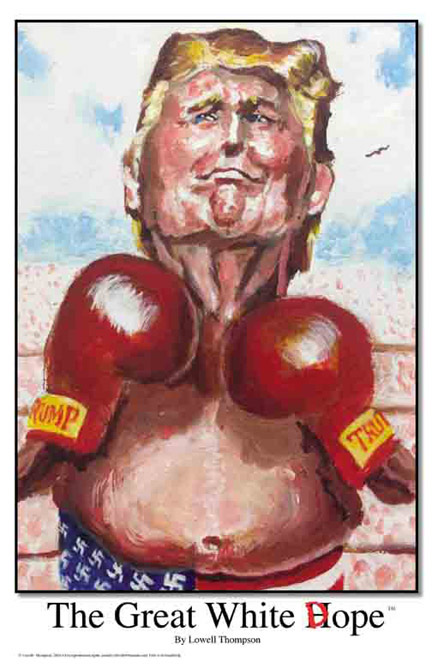
13219: Thompson On Trump.

Artist/Writer/Recovering Adman Lowell Thompson painted the image depicted above. To learn more and purchase prints, click here.

Friday, October 16, 2015

12891: Raise Your Voice Repercussions.

The theme for Blog Action Day 2015 is Raise Your Voice.

If you raise your voice for the alleged plight of White women in the advertising industry, expect to receive respect, reverence, rewards, kisses, kudos, compliments, applause, accolades, acclaim, praise, prestige and payouts—even if you’re a pathetic and patronizing douchebag.

If you raise your voice for the acknowledged plight of Black people in the advertising industry, expect to be blacklisted, blackballed, black eyed and blacked out—unless you’re a White, wonderful, wise, witty, worldly douchebag. Or a Chief Diversity Officer.

It’s time to raise your voice over such disparities in raising one’s voice on Madison Avenue.

Monday, September 07, 2015

12841: What Labor Day Means.

According to Wikipedia, Labor Day “honors the American labor movement and the contributions that workers have made to the strength, prosperity, and well-being of their country.” It also leads campaigning politicians to write stuff like the following:

Labor Day is a time for honoring the working people of this country. It is also a time to celebrate the accomplishments of the activists and organizers who fought for the 40-hour work week, occupational safety, minimum wage law, Social Security, Medicare, Medicaid and affordable housing. These working people, and their unions, resisted the oligarchs of their day, fought for a more responsive democracy, and built the middle class.

Yet what does Labor Day mean to the advertising industry? It might underscore the field’s hypocrisy similar to the way MLK Day does; that is, White advertising agencies are awarded time off despite operating in violation of Dr. King’s dream. With Labor Day, we enjoy a holiday thanks to the accomplishments of people who fought for fairness in the workplace—despite our dismal failures in the area of diversity. Then again, it’s a wonder no one has taken the opportunity to cheer the amazing progress experienced by White women in our ranks.

On Labor Day, advertising industry laborers should salute the people who have legitimately strived to bring change to the field. For the overwhelming majority who can’t even begin to identify the activists, here are a few names for starters:

Roy Eaton

Sanford Moore

Bill Sharp

Lincoln Stephens

Lowell Thompson

Harry Webber

Hadji Williams

Feel free to add more names via comments.

Saturday, July 18, 2015

12769: Good White Folks.

Recovering Artist/Writer/Adman Lowell Thompson is working on a sequel to his 1996 book, White Folks: Seeing America Through Black Eyes. The next book is titled Good White Folks—and its work-in-progress content may be previewed at Thompson’s associated blog now.

Tuesday, July 07, 2015

12751: Lowell Thompson’s Down In Uptown.

Recovering Artist/Writer/Adman Lowell Thompson has finally decided on the opening reception date for his exhibition at the Uptown Arts Center. Get the details here.

Wednesday, June 17, 2015

12716: Presidential Debate.

Artist/Writer/Recovering Adman Lowell Thompson—aka RaceMan—will discuss President Barack Obama on June 27, 2015.

Tuesday, June 16, 2015

12713: Booking Lowell Thompson.

Artist/Writer/Recovering Adman Lowell Thompson is out on the street. 57th Street Books, that is. The original shirt-pocket edition of “RaceMan Answers” is back on the shelves of the iconic bookstore at 57th and Kimbark in Chicago. Pick up an autographed copy today.

Thursday, June 11, 2015

Thursday, May 14, 2015

12662: Black & White Cartoon.

Artist/Writer/Recovering Adman Lowell Thompson created the cartoon depicted above and is open to receiving comments from the culturally competent and critics alike.

Thursday, April 30, 2015

Monday, March 23, 2015