Friday, June 30, 2006

Essay 759


New York Public Radio conducted a discussion on our segregated industry. Below is a brief overview. Click on the essay title above to hear it all. (Thanks to Hadji Williams for bringing this stuff to our attention.)

------------------------------------

Segregated Ad Industry

Joining us are

Richard Wayner: President/CEO of the True Agency and Chairman and CEO of Alliance TRACE Media.
Lisa Sanders: Reporter at Advertising Age.
Don Richards: Senior Vice President of Agency Diversity Programs at the 4As.

The Issue:

The Human Rights Commission is investigating why the number of African Americans working in mid- and upper-level jobs in general market agencies is so low. They’re comparing numbers of African Americans currently employed to those taken from the last time the Commission undertook a broad look at the industry, which was from 1968 to 1978. The Commission began this probe in Nov. 2004. The Commission’s chief, Pat Gatling, earlier this month announced that her agency will hold hearings on this topic Sept. 24-29, and has sent subpoenas to 16 chiefs of New York City agencies, requesting that they testify.

In response to the Commission’s efforts since the probe began, back in Nov. 2004, the industry has hired several lobbyists (as well as lawyers). Most recently, the industry trade group, the Four As has hired a firm, Bolton St. John’s, to lobby members of the New York City City Council, and specifically members of the Committee on Civil Rights, and its chairman, city councilman Larry Seabrook. That’s because several months ago, Councilman Seabrook said his committee is going to hold public hearings of its own on this issue. These hearings would be separate from the Commission’s.

Richard Wayner, CEO of The True Agency, did make allegations that there tend to be “silos” in the industry of agencies that handle multi-cultural and ethnic accounts versus agencies that handle general market business. Some in the industry believe that the doling out of accounts along target-market agency lines leads to minorities being segregated, largely working in ethnic agencies.

Essay 758


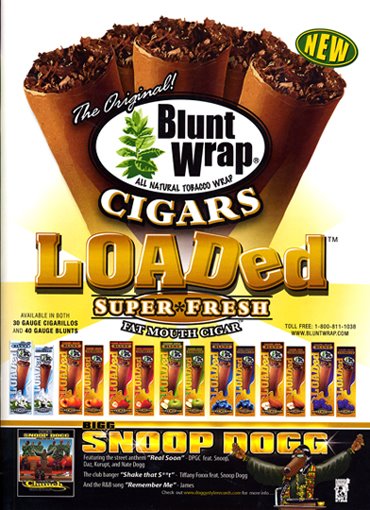
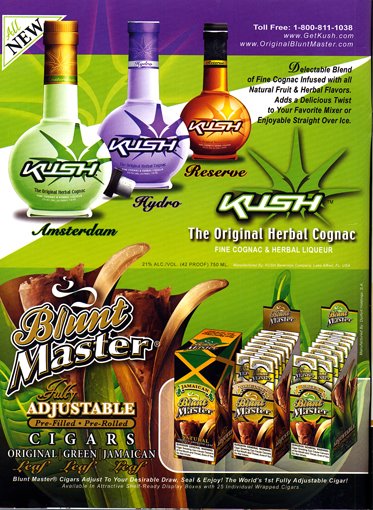
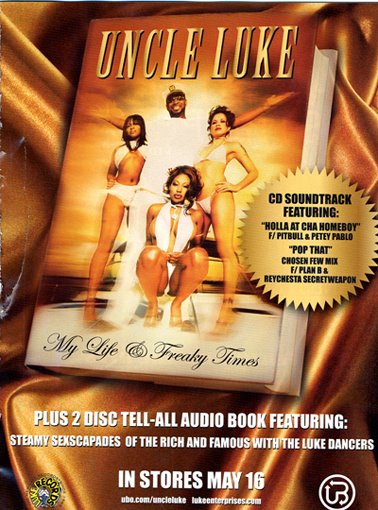
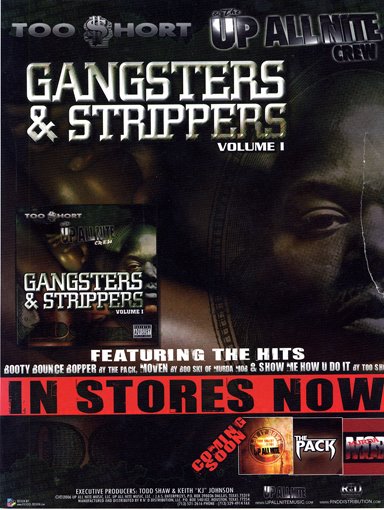
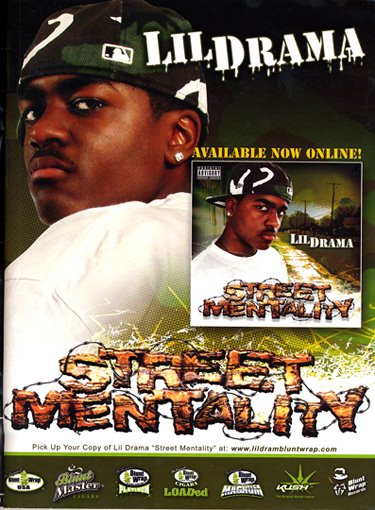
MultiCultClassics presents hard-core Hip Hop hype…

No hard-core Hip Hop hype collection would be complete without ads for rappers’ favorite sustenance: blunts and cognac. Yet these messages are surprisingly straightforward and attitude-free, almost out of place in the typical urban ‘zine.

Essay 757


No money and no-shows in a MultiCultClassics Monologue…

• The New York Post reported that Michael Jackson was broke just before his latest sex scandal, owing hundreds of millions of dollars. Jacko’s lawyer said the superstar was just forgetful and explained, “Genius comes with eccentricity and quirkiness in other areas.” You think?

• Rapper-actor DMX failed to show up for his court date, prompting the judge to issue a warrant for his arrest. You would think a guy routinely caught exceeding speed limits would be able to drive to court on time.

• Currently incarcerated Lil’ Kim will be celebrating Independence Day one day early, as she’s scheduled to be released on July 3. Let’s hope she doesn’t ask DMX for a ride home from prison.

• Chicago White Sox manager Ozzie Guillen — who recently was slapped with a fine and ordered to attend sensitivity training after referring to a sports columnist as a fag (see Essay 723) — now plans to attend the Gay Games in Chicago. Friends and organizers invited Guillen to the event to be held next month. “Yeah, I’m going. … But I had plans to go even before I was asked,” Guillen said. “I’ve had plans to go there for a long time.” He probably intends to heckle the participants from the stands.

• Less than half of the National Guard troops slated to patrol the Mexican border have actually shown up. Many Guardsmen have been busy dealing with natural disasters like floods in the East, wildfires out West and potential storms in the South. The rest have probably been joyriding with DMX.

Thursday, June 29, 2006

Essay 756


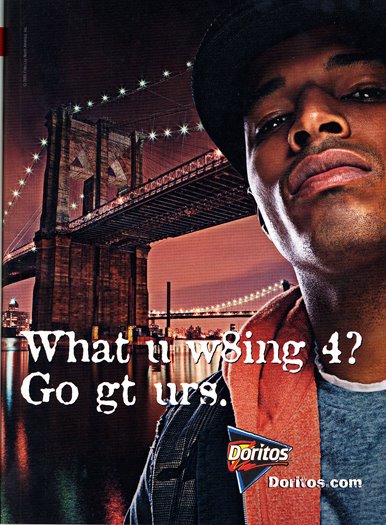
MultiCultClassics presents hard-core Hip Hop hype…

This ad’s kinda old, but still worth a look.

What u w8ing 4?

W8ing 4 D xplanation 4 ur idea.

Essay 755


From The New York Post…

------------------------------------------

NEW ‘JUAN’ AIMS TO PERK UP COFFEE EXPORTS

By PAUL THARP

Meet the new, improved “Juan Valdez.”

Colombia’s new coffee ambassador to the world — an icon of advertising for nearly a half-century — in no longer just an actor for hire but a real coffee grower working the lush slopes of Colombia's coffee country.

Carlos Castañeda, 39, a father of three, was picked after a two-year search by the industry’s trade group to tour the globe from Tokyo to Amsterdam promoting Colombian coffee. At stake is $1.4 billion in exports.

Sales slumped last year by $100 million from a glut of coffee beans but it wasn’t the fault of the previous Juan Valdez — professional actor Carlos Sanchez, 71, who hung up his poncho a month ago after 37 years on the job.

The new pitchman inherits the trademark white straw hat and faithful mule Conchita, who’ll remain in the same role.

“Half of his time will be spent working on his own coffee farm and for the rest he’ll be traveling the world for the other growers,” Juan Esteban Orduz, president of the Colombia Coffee Federation, told The Post.

The new Juan Valdez is a third-generation coffee grower from a rural village fittingly named Andes.

He became an overnight celebrity in South America in recent days after his identity was disclosed.

The federation had sent teams across the countryside for two years to interview hundreds of young men with bushy mustaches from among the country’s nearly 400,000 coffee growers.

A reality TV show was created about the hunt.

The Juan Valdez trademark — one of the most recognizable in the world — is to be inducted into the Advertising Hall of Fame in the fall.

The fictional figure even made it to Hollywood, sharing a scene with comic Jim Carrey in the film “Bruce Almighty.”

The first Juan Valdez was created by Madison Avenue in 1959, and was played for a decade by actor José Duval, a Cuban.

------------------------------------------

Click on the essay title above to visit The National Federation Of Coffee Growers Of Colombia website and meet the new Juan Valdez.

Essay 754


MultiCultClassics presents hard-core Hip Hop hype…

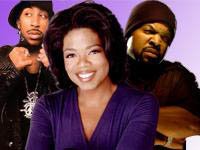
Oprah declared, “I’m not opposed to rap. I’m opposed to being marginalized as a woman.” Think of these ads as a few more reasons why folks like Ludacris, Ice Cube and Fiddy won’t receive invitations to Winfrey’s gab fest anytime soon.


Wednesday, June 28, 2006

Essay 753


From AdAge.com…

------------------------------------------

U.S. Hispanic Agencies Win Two Cannes Lions
Grupo Gallegos Scores in Film, La Comunidad in Cyber
By Laurel Wentz

CANNES, France (AdAge.com) -- Grupo Gallegos, an independent U.S. Hispanic ad agency based in Los Angeles, won a Bronze Lion for an Energizer spot called “Beard” at the Cannes Lions International Advertising Festival, one of two prizes the U.S. Hispanic market won at this year’s festival.

Grupo Gallegos won a Bronze Lion for its Energizer TV spot.

Shortlisted
Hopes had been raised because two other Hispanic agencies, Omnicom Group’s Dieste Harmel & Partners and independent La Comunidad, Miami, had spots on the film shortlist. Dieste Harmel had two Anheuser-Busch commercials for Budweiser, “Mini Mouth” and “Pinky,” on the shortlist, and La Comunidad had two shortlisted Virgin Mobile ads, “Convertible Car” and “Office.” A third La Comunidad spot, an international ad for MTV Worldwide called “Give Me an M,” was also on the list.

A Puerto Rican ad agency, Badillo Nazca Saatchi & Saatchi, San Juan, had a shortlisted spot called “Journey” for the Toyota 4Runner.

The winning Grupo Gallegos ad is about a man whose beard grows so ridiculously fast that his razor, using Energizer batteries, is constantly on. The “Beard” ad has won gold awards at three ad shows: FIAP, a leading Latin American ad festival based in Buenos Aires; El Sol, an ad festival in Spain that Latin American agencies also compete in; and the Addy awards in the U.S.

Cyber Lion winner
Although there was only one U.S. Hispanic film winner this year, the U.S. Hispanic market got its first cyber winner. The internet portion of La Comunidad’s Virgin Mobile campaign “I’m Not Normal” won a Cyber Lion.

Last year the U.S. Hispanic market had its best-ever performance at Cannes, winning three Silver Lions, including one to Grupo Gallegos for an earlier Energizer spot called “Japanese Hand.” The other two winners were Lapiz, Chicago, for a Kellogg's Special K spot called “Fiber Cycle” and La Comunidad for a spot for VH1 called “Parents’ Day.”

At Cannes, Hispanic creatives gathered at La Chunga restaurant for the second annual dinner for creatives from U.S. Hispanic agencies June 20. Earlier that day, Team USA played in the festival’s Beach Soccer Tournament.

Essay 752


MultiCultClassics presents hard-core Hip Hop hype…

Wonder how many of the sexy honeys at Phat Girls are phat — and how many are just plain fat? Smooth operators are standing by.

Essay 751


Pimp your MultiCultClassics Monologue…

• Senator Charles Grassley wants the IRS to go after pimps, slamming them with fines and prison time for not filing employment forms and withholding taxes for their employees. “The thugs who run these trafficking rings are exploiting society’s poorest girls and women for personal gain,” Grassley said. “The IRS goes after drug traffickers. It can go after sex traffickers.” It’s hard out in the Senate for a pimp.

• Michael Jackson fired his business managers, hired new financial advisors and plans to move to Europe. A spokeswoman for Jacko called the changes “the first of a sweeping restructuring of his personal and business affairs.” Sounds like the same approach he’s taken with his face.

• Oglala Sioux tribal leaders in South Dakota plan to create roadblocks to prohibit members from bringing beer into their community. While booze has already been banned on their reservation, four nearby stores still sell beer to folks. The leaders intend to confiscate any beer bought in the area. One storeowner said, “I just don’t know how it’s going to work or how they have any legal grounds to confiscate any beer. I just don’t think they’ll get anyone to stop for them.” Sounds like a job for The Lone Ranger and Tonto.

Essay 750


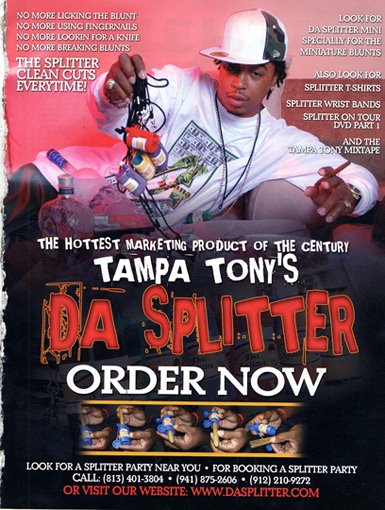
MultiCultClassics presents hard-core Hip Hop hype…

Tampa Tony makes like a street-savvy Ron Popeil with the hottest marketing product of the century: Da Splitter. Think of it as a Ginsu knife for gangstas.

Tuesday, June 27, 2006

Essay 749


The following letter appeared in the July 2006 issue of Communication Arts…

-------------------------------------------------------

Lack of Diversity

The reason I am sending this letter is to voice my displeasure with the design industry. Employers are dishonest. They say they want highly creative professionals, all the while producing substandard products with very little creative value. The terminology of so-called creative firms (as stated on many Web sites) has started to sound more like investment banking or corporate rhetoric than a creative mission. If this is the true climate of the industry, schools should stop teaching design theory and start teaching business theory instead. We’ve become what other industries have become, dull, boring and stagnant.

Part of what is making the industry stale is lack of diversity. I’m always hard pressed to find other minorities at design events. In fact, finding a minority in design magazines or books is also rare. In this day and age everyone wants to tap into the urban demographic. Yet this demographic is rarely employed in most forms; interesting. How can you design for an urban market with no urban creatives? I know how, you make assumptions.

Now I know you have published issues in the past highlighting the history of minority creatives, but I guess the industry doesn’t get it. I hope in the future the design community can come to grips with these issues and move forward. Maybe someday we’ll grow to be as creative, diverse and interesting as we should be.

Kenneth Thomas
Graphic Designer
Philadelphia, Pennsylvania

Essay 748


MultiCultClassics presents hard-core Hip Hop hype…

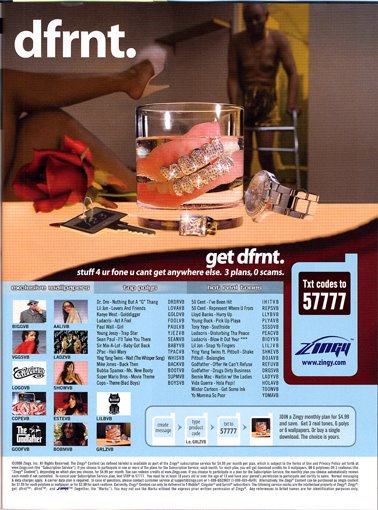
Pimp your phone with the hottest ringtones and fly wallpapers. Yo, somebody call an art director already!


Essay 747


The following appeared on AdAge.com…

--------------------------------------

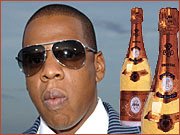
Rap Mogul’s Boycott of Cristal Champagne Unlikely to Hurt Brand

Def Jam President Jay-Z Angered by Liquor Marketer’s Comments

By Jeremy Mullman

CHICAGO (AdAge.com) -- Rapper and Def Jam Records President Jay-Z’s much-hyped boycott of Cristal isn’t likely to cost the vintage champagne brand any dead presidents, according to beverage industry experts. But it could give Cristal’s competitors a reason to pop a few corks of their own.

‘Economist’ comments
The tempest in a champagne flute kicked off when Frederic Rouzaud, managing director of Cristal parent Louis Roederer, told The Economist that he viewed his brand’s ubiquity in hip-hop lyrics and videos -- such as Jay-Z’s own line “let’s sip the Cris and get pissy-pissy” -- with a combination of “curiosity and serenity.”

“[Whether it hurts the brand] is a good question, but what can we do?” Mr. Rouzard told the magazine. “I’m sure Dom Perignon or Krug would be delighted to have their business.”

But the rapper, who once popped bottles of Cristal onstage, took that as a dis, saying, “I view his comments as racist and will no longer support any of his products.”

High-profile hip-hop association
The split raises the question of whether losing its high-profile hip-hop association will hurt Cristal.

Alcohol-industry experts say the spat is unlikely to affect Cristal sales.

“You’re talking about a small-production brand with a luxury audience that was selling everything it produced long before [rappers began embracing it],” said beverage-marketing consultant Arthur Shapiro.

But it may cost the brand its already-threatened standing as the hip-hop world’s champagne of choice. According to San Francisco-based Agenda, which tracks brand mentions on the pop charts, Cristal slipped to eighth place from seventh in its 2005 “American Brandstand” survey, while rival vintage bubbly Dom Perignon rose to 12 from 17.

Dom’s parent, Louis Vuitton Moet Hennessy, also owns the No. 6 brand, Hennessy cognac.

“Hip-hop is very important to us,” said Noel Hankin, Moet Hennessy’s senior VP-multicultural initiatives.

Hip-hop cognac
Cognac producers, in particular, have found hip-hop to be fertile ground. Hennessy rival Courvoisier saw sales rise 30% in 2002 -- reportedly the brand’s biggest sales boost since Napoleon named it the official supplier to the Imperial Court of France -- after Busta Rhymes released the single “Pass the Courvoisier.”

Courvoisier has embraced its hip-hop following with a series of targeted sponsorships. A spokeswoman said the brand is “is very pleased that consumers of different cultural heritages ... select Courvoisier as their spirit of choice.”

But the sales of distilled spirits such as Hennessy and Courvoisier -- which total about 5 million cases a year -- are far more volatile than those of a brand such as Cristal, which typically only produces a caseload in the mid- to upper-five figures and none at all during poor vintages.

‘Not have an impact’
“[The Jay-Z flap] will not have any impact on our global sales because Cristal is largely sold out anyway,” said Xavier Barlier, VP-marketing for Roederer's U.S. distributor, Maisons Marques & Domaines.

Still, Mr. Rouzard did release a statement clarifying Cristal’s position on its place within the universe of bling: “The House of Louis Roederer could not have been in existence since 1776 without having the utmost regard for, and interest in, all forms of art and culture.”

But of course.

Essay 746


MultiCultClassics presents hard-core Hip Hop hype…

The Original King of Bling displays the latest watches. Don’t let the ad’s tacky design fool you. The retailer’s website features timepieces going for up to $26,000. So why can’t the King afford an art director?

Essay 745


Hollywood trash in a MultiCultClassics Monologue…

• Boy George arrived in New York to begin the five-day community service sentence for his October cocaine-related conviction. George will act as a garbage man. Who decided that being a garbage man should be considered punishment?


• Rush Limbaugh was questioned at Palm Beach International Airport for carrying drugs without a prescription. This time, it wasn’t painkillers, but Viagra. Guess Limbaugh’s personality isn’t the only thing that’s dysfunctional.

• Michael Jackson is facing his latest court battle, this time with a pornographer and business associate charging the King of Pop owes him $3.8 million. The former associate said he loaned Jacko money for stuff including the production of two TV specials intended to improve the artist’s reputation. Um, Jackson ought to demand a refund for those efforts.

• Naomi Campbell is being sued by another maid who claims the supermodel beat her. Campbell’s current legal problems could land her in jail for seven years, along with deportation. Or it will probably lead to a new and highly profitable reality TV series.

• A new study now says teens are having fewer babies and dropping out of school less. However, there’s an increase in the number of kids living in poverty. Maybe they should try to land jobs as Naomi Campbell’s housekeepers.

Essay 744


MultiCultClassics presents hard-core Hip Hop hype…

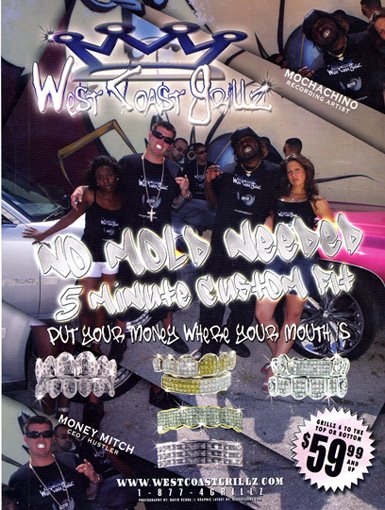
Lenscrafters guarantees glasses in about an hour. Domino’s delivers pizza in 30 minutes or less. But they’re amateurs compared to West Coast Grillz, where you’ll get a 5-minute custom fit. Boo-yaa!

Essay 743


From The New York Times…

--------------------------------------------------------

The Deal That Let Atlanta Retain Dr. King’s Papers
By SHAILA DEWAN

ATLANTA— It was in a short conversation over dinner, devoid of bargaining, that Mayor Shirley Franklin took the first step toward ensuring that a significant chunk of this city’s patrimony would be returned here for good.

“She said, ‘How much?’ I told her the price, and she said, ‘O.K.,’” recalled Phillip Jones, a King family representative who met with the mayor that day, June 18, to discuss the impending auction of the bulk of the papers belonging to the Rev. Dr. Martin Luther King Jr.

Late last Friday, a week before the auction was to be held at Sotheby’s in New York, where the papers are on exhibit, officials announced a deal. With no collateral, Ms. Franklin had secured a privately financed loan of $32 million allowing a nonprofit organization created by the city to stop the auction and buy the collection from the King family. The papers are to go to Morehouse College here, Dr. King’s alma mater.

Dexter King, the younger of Dr. King’s two sons, said he thought his father and mother, Coretta Scott King, who died this year, would have been happy with the arrangement.

“I actually felt that if Atlanta really could step up and do this, it would be so wonderful, and I’m personally grateful to the mayor as well as to Ambassador Young,” Mr. King said of Andrew Young, who had been encouraging Ms. Franklin’s efforts. “It really was a community effort, and that’s what I appreciated most about it.”

As with many of the King family’s decisions, the prospect of the auction had brought grumbling among Dr. King’s former associates, persistent critics of the family and city boosters who said Atlanta, his hometown, was the collection’s rightful home.

Some had said the millions that the collection would fetch at auction was nothing but ransom that would go to the four King children, who have frequently provoked scorn for their handling of their father’s legacy and the nonprofit center here that bears his name. Others had fretted that the collection — 10,000 items, most of which bear Dr. King’s handwriting — would be sold to a private owner and lost to scholars, or to Atlanta, forever.

But none of Atlanta’s institutions was prepared to muster the asking price for the papers, and it was rumored that New York City, among other parties, was prepared to compete for them. It was left to Ms. Franklin to take action. To ensure an advantage, she agreed to pay $2 million more than the $30 million for which the papers were appraised in the late 1990’s.

“I didn’t want to risk losing the papers over a million dollars,” the mayor said in a telephone interview Monday. “To Atlanta they are priceless.”

Mr. Jones, the King family representative, defended the price, saying, “Those in the know said to us over and over again: this auction, these papers are going to go way above the appraised value.”

Still, some people whom Ms. Franklin approached for help thought the family should simply donate the papers. Dr. King’s two sons had already been criticized for taking six-figure salaries from the King Center while it fell into disrepair and for aggressively defending their right to control their father’s intellectual property. And in insisting on retaining the copyright, some scholars had complained, the family had made it hard for the papers to find an institutional home.

But archivists say such an arrangement is not unusual.

“It’s a double standard,” Dexter King said from his home in Malibu, Calif. If the family makes a point of retaining copyright, he said, “then all of a sudden we see in the media, ‘The King family is greedy’; no, we’re just following the historical standard.”

Ms. Franklin said she had three points in response to people who thought the family should have given the papers away. “Dr. King copyrighted his own work,” she said, “so he expected that it would have value and expected it would be part of the legacy. Mrs. King very much supported the sale of the papers to the appropriate institution. And the third thing that I say is that Dr. King left the rest of us a tremendous legacy, but he was not a wealthy man,” and the bulk of his family’s inheritance lies in his intellectual property.

In coming up with the necessary money, Ms. Franklin began to call in favors from a long list of Atlanta’s major corporations and prominent citizens, including Delta Air Lines, Coca-Cola and Tyler Perry, author and star of “Diary of a Mad Black Woman.” Ultimately, Wal-Mart, Home Depot, the developer Herman Russell, Turner Broadcasting and Cox Enterprises, the owner of The Atlanta Journal-Constitution, also agreed to help.

Meanwhile, Mr. Jones told Sotheby’s that he thought the family had a buyer.

The deal still requires some work, though: Ms. Franklin has secured only $8.8 million in pledges; the rest of the money is in loan guarantees. Last Wednesday, David Redden, a vice president of Sotheby’s, spoke to the mayor for the first time and asked whether, before the auction was canceled, she would be able to come up with the money. In reply, she cited one of her major accomplishments: raising $3 billion to bail out the city’s water system, which had been ailing for years.

During a week of intense negotiations, Ms. Franklin decided that the papers would go to historically black Morehouse College, which was attended not only by Dr. King but also by his father, grandfather and two sons. Morehouse, where Dr. King’s funeral was held after his assassination in 1968, does not have its own archives, however, and so the collection will initially be housed at a library serving that college and several others.

The deal was hailed as a victory for Ms. Franklin. It was, The Journal-Constitution reported, a “classic Atlanta story — like winning the 1996 Olympics — of taking a near impossible challenge and galvanizing city support to make it happen.”

Monday, June 26, 2006

Essay 742


The following appeared in The Chicago Tribune…

------------------------------------------------

R. Kelly judge should rethink sex tape ruling

By Dawn Turner Trice

Earlier this month Vincent Gaughan, the Cook County Criminal Court judge presiding over R&B superstar R. Kelly’s child pornography trial, ruled that a videotape that appears to show Kelly engaging in sex acts with a 14-year-old girl could be shown in open court during the trial.

Does this ruling bother you?

I think it should because showing the tape would mean everybody in the courtroom would see a child in her most embarrassing, degrading and humiliating moment. For justice to be served, only the judge and jury needs to see this tape.

While I find the ruling enraging, what ticks me off more is that I haven’t heard much of a stir about this from victims rights advocates or others who profess to believe that it’s important to protect the identity and the rights of victims of child pornography and rape.

I haven’t seen the video. Don’t want to see it. But, like many of you, I’m well aware that it depicts a child engaging in sex acts so explicit and lewd that apparently it's difficult to think of her as a victim or a sympathetic figure.

Without a doubt she’s both. By law, no matter how minors behave, they cannot legally consent to sex. (It’s still mind-boggling to me that Kelly has not been charged with rape. He says he’s not guilty of the child porn charges.)

Perhaps I’ve missed the furor over Gaughan’s ruling.

I certainly didn’t miss the one that erupted earlier this year after Cook County Circuit Judge Kerry Kennedy threatened to jail a young Naperville woman during a rape trial. She had refused to watch herself in a 2002 video that showed the then-16-year-old semiconscious and having sex with the defendant and another young man in a Burr Ridge home.

Before Kennedy figured out that jailing this young woman was a nutty move, victims rights groups and the media pounced. And rightfully so.

Victims rights advocates said it wasn’t fair to jail her for not wanting to relive one of the most traumatic moments of her life.

They said it could have a chilling effect on rape victims contemplating whether to bring their abusers to justice. The defendant in this case eventually was found not guilty of sexual assault and child pornography charges.

Although no two cases are exactly alike, what links these cases is the casual, if not reckless, disregard on the parts of the judges.

Legal experts say Gaughan’s ruling was highly unusual because he ruled over the objections of both the prosecution and the defense.

“The reason to file the motion to allow only the judge, jury and the press to view the tape was to protect [the victim],” Assistant Cook County State’s Atty. Shauna Boliker told me.

Gaughan apparently doesn't believe the victim--now 21--deserves such protection. He said that he understands that allowing the video to be viewed in open court might mean people would be watching child pornography. But, he said, the tape is the cornerstone of the prosecution’s case against Kelly and making it secret might undermine the public’s confidence in the jury’s verdict.

Nevermind what the prosecution itself wants. Nevermind that we’ve seen countless rape cases in which only the jury and judge have been allowed to view evidence and these cases weren’t compromised.

I asked Sean Black, spokesman for the Illinois Coalition Against Sexual Assault, why his organization hasn’t been rallying against this ruling as it did in the Burr Ridge case. He said the coalition simply didn’t know about it.

He called the ruling disappointing and disturbing and said the group now plans to keep an eye on the case and do more research. I sincerely hope so. I also hope the prosecution fights harder to get this ruling reversed.

You may believe that because the video has been floating around the Internet, Gaughan’s ruling isn’t such a big deal. I wholeheartedly disagree. It’s one thing to view child porn on some trashy Internet site (and in doing so, subject yourself to possible prosecution). It’s quite another to have it sanctioned in a court of law.

The postponed R. Kelly trial is going to be a circus when it gets under way. This ruling will make it even more so.

I find no legitimate reason for allowing everyone in the courtroom to view this video. It sets a bad precedent. It re-victimizes the victim in a way that may not be illegal but feels just as criminal.

Essay 741


Getting testy in a MultiCultClassics Monologue…

• A new study shows young males in school are doing better with tests and academic success than earlier reported, arguing against the notion that there is a “Boy Crisis.” The report stated, “The real story is not bad news about boys doing worse… it’s good news about girls doing better.” Education Sector senior policy analyst Sara Mead said, “There’s no doubt that some groups of boys — particularly Hispanic and black boys and boys from low-income homes — are in real trouble… But the predominant issues for them are race and class, not gender.” Hey, now that’s great news. Let’s celebrate!

• Busta Rhymes has been dealing with ugly custody battles with his former girlfriend/mother of his children. The ugliness also involves the fact that the woman ultimately dumped Rhymes for another woman. “His ego is definitely hurt,” said Rhymes’ ex. “If he’s being emotional, then let him just be emotional — that’s like the bitch in him. If you want to be emotional, I don’t have a problem with that,” but “he’s wearing his emotions on his sleeve.” Plus, he’s probably struggling to find words that rhyme with lesbian.

Essay 740


MultiCultClassics presents hard-core Hip Hop hype…

Based on the typical Hip Hop ads featured here, it seems like an enterprising art director could make some serious bling by hooking up with these rappers and introducing them to 21st century design.


Essay 739


From The New York Times…

-----------------------------------------

Hey, Gay Spender, Marketers Spending Time With You
By STUART ELLIOTT

FOR years, advertisers seeking to reach gay and lesbian consumers concentrated their spending in the print media. There were few effective or efficient alternatives among the media that offered the appealing attributes of sight, sound and motion.

To be sure, those advertisers could have bought commercial time on television. But spots during TV series that would seem appropriate — “Will & Grace,” for example — cost too much; the shows ran on mainstream networks and the audiences included so many heterosexuals.

That limited media menu is starting to be broadened. TV, the Internet, radio and even movies are joining magazines and newspapers as places to pitch products to gay men and lesbians.

For instance, the proliferation of film festivals intended for gay and lesbian moviegoers has helped turn such events into marketing venues. The Stolichnaya brand of vodka sold by Pernod Ricard USA is underwriting a documentary, “Be Real,” and a complementary Web site (stoli.com/bereal), presenting what are called “stories from queer America” in the form of profiles of six lesbians and gay men.

“The film festivals have become an increasingly important gathering place, offering a way for the community to see itself,” said Stephanie Blackwood, partner and account director at Double Platinum in New York, which conceived the project as part of its duties as the Stolichnaya agency for the gay and lesbian market.

• ”Be Real,” which runs 53 minutes, was produced by two documentary filmmakers, Beverly Kopf and Bobbie Birleffi, and directed by Ms. Birleffi. The film has been screened in cities that frequently play host to gay and lesbian movie festivals, like Miami, New York and San Francisco, along with some that do not, like Birmingham, Ala.

“We didn’t just want to sponsor film festivals. We wanted to be way involved on a grass-roots level,” said Adam Rosen, senior brand manager for Stolichnaya at the Pernod Ricard USA division in New York, part of Pernod Ricard.

Although the title “Be Real” refers to a theme of Stolichnaya ads that it is “genuine Russian vodka,” the project is “about more than the brand,” said Mr. Rosen, who is an executive producer of the documentary. "We want to showcase our commitment to the community in a culturally relevant way.

“This film will be the springboard for all our advertising and marketing in the year to come,” Mr. Rosen said, adding that the budget for the “Be Real” project, including production and promotion, is more than $3 million.

A year ago this week, the media giant Viacom introduced Logo, a cable television network and a Web site (logoonline.com) aimed at gay men and lesbians, as well as their friends and families. The Logo cable channel is available in 23 million households, compared with 13 million last June.

To date, more than 60 mainstream marketers have advertised on Logo, including Ameriprise Financial, Anheuser-Busch, Bacardi, Continental Airlines, Dell, Eastman Kodak, eBay, General Motors, Johnson & Johnson, the Orbitz unit of Cendant, Sears Holdings, Sony and Subaru. ”There was pent-up demand for a channel to cater to this consumer,” said John Nash, president at Moon City Productions in New York, the agency that creates campaigns aimed at gays for Subaru, part of Fuji Heavy Industries.

Because “Subaru is a mature brand in this space, in its 11th year of doing gay and lesbian outreach,” Mr. Nash said, he was eager to add television to a media plan that has long been dominated by print outlets.

Subaru was one of three charter advertisers on Logo, along with Orbitz, owned by the Cendant Corporation, and the Paramount Pictures division of Viacom. Initially, Subaru ran ads on Logo that were produced for mainstream consumers and created by the brand's general-market agency, DDB Worldwide in New York, part of the Omnicom Group.

Since October, Subaru has been running three customized commercials on Logo, created by Moon City for the network. “They have exceeded our expectations,” Mr. Nash said. Two more will be introduced next month.

The customized Subaru spots offer subtle cues meant to signal the intended audience. When two people are shown together, for instance, they are both men or both women.

“TV, of course, is one of the most powerful media,” Mr. Nash said. “And you can get people to pay attention by running commercials in a contextual environment like a Logo. But if you goose it that extra amount with custom creative, awareness goes up 15 or 20 percent.”

Along those same lines, Logo is offering advertisers the chance to run nontraditional commercials that avoid overt product peddling.

The commercials, which Logo executives call interstitials because they run between shows, are being sponsored by three marketers: the Sears, Roebuck unit of Sears Holdings; Subaru; and the TomTom brand of global positioning systems sold by TomTom International.

“In the early research we did, testing what our audience was looking for, they said they wanted to see ads on the channel to see who would be reaching out to them,” said Lisa Sherman, senior vice president and general manager at Logo in New York, part of the MTV Networks division of Viacom.

At the same time, “we have to be careful not to overreach,” Ms. Sherman said, “and stay within the boundaries” that separate advertising from programming.

The TomTom interstitials, each lasting 20 seconds, offer travel tips.

The Sears-sponsored segments, each two minutes long, feature Dave Alhadeff, the owner of a design store, offering home décor ideas.

In one, as he discusses energy-efficient appliances, he mentions by name the Kenmore Elite line sold by Sears.

For Subaru, the two-minute interstitials play like condensed versions of “Get Real,” offering glimpses of Subaru owners like Mary Seton Corboy, a pioneer in urban agriculture who runs Greensgrow Farm in Philadelphia, and a couple, Pamela Fletcher and Susan Murphy, who are triathletes and expedition racers.

“In this fragmented media age, everybody’s demanding hypercustomized creative to talk to specialized audiences,” said Brian Graden, president at Logo and at MTV Networks Music Group Entertainment.

“We’re all coming up to speed together on the best way to reach this audience,” he added.

• As marketers show interest in Logo, Mr. Graden’s “we” is expanding to include other media companies.

For example, the Bravo cable network owned by NBC Universal, part of General Electric, teamed up with Planet Out to introduce on June 1 a Web site (outzonetv.com) aimed at lesbians and gay men.

The features on the Web site include television shows, blogs, video clips and social networking.

Among the sponsors are gay.com, operated by Planet Out, and the IFC cable network, part of the Rainbow Media Holdings unit of the Cablevision Systems Corporation.

Rainbow Media? Now there is an example of how to talk to a specialized audience.

Sunday, June 25, 2006

Essay 738


More late news: Here are comments responding to the story regarding New York ad agency chiefs receiving subpoenas for the upcoming diversity hearings (the AdAge.com story appeared in Essay 684 — click on the essay title above to review)…

>As someone who has worked on the agency side as well as in city and state government, I’d suggest the Human Rights Commission carefully consider the following prior to the scheduled hearings; Review hiring practices among all relevant companies involved in advertising services not just the top 16 ad agencies. HRC should be concerned with all related companies not just the "”low hanging” fruit. The contention that blacks comprised only 9% of all ad employees compared to the 25% of NYC's population may be true. But if I remember correctly, approximately 10% of the US population is black. As advertising is a national business, if not global, the current composition is in line with the US population. Moreover, when all advertising related companies are included the proportion of blacks would exceed their incidence in the US population. The HRC is a Mayoral agency. I’d encourage them to carefully review the demographic composition of their own advertising/marketing personnel and roster of advertising service suppliers. They may find issues of their own. Finally, most government accounts, such as the Army and the New York State lottery, require their agencies provide detailed information on their practices and proactive steps to encourage minority employment. I’m sure the ad chiefs have the same hiring motives as the vast majority of business executives...evaluating individuals on their merits. David Ganz New York, NY — New York, NY

>Throw another crutch out there for no-talent people who want to be hired on the basis of skin color. Diversity is a code word, folks. It’s just more high toned sounding. Let’s diversify the NBA. — Raleigh, NC

>This is political flim-flamming. Just like when they investigated minority representation in the entertainment biz. When you send in your portfolio, nobody knows what color you are. — Beverly Hills, CA

>I’m glad the city is finally doing something about diversity in the ad agency business. There is a conspicuous lack of black and Hispanic faces in the business. In addition, there is a lack of hiring women-owned and certified businesses for subcontracting. I’m tired of sitting through “diversity” meetings with large gov’t contractors who say they hire advertising and marketing subcontractors only to be faced with a big Mad Ave firm at the actual meeting who does not, in fact, do that. — NY, NY

Essay 737


This is a little late, but below are comments responding to Earl Graves Jr.’s recent rant on our racist industry (article appeared on AdAge.com and Essay 687 — click on the essay title above to review)…

----------------------------------------------------------

>Bias Agencies Put Auto Companies At Risk. The Automotive Industry is dying because it has saturated two-thirds of the country and its revival and survival is dependent upon reaching ethnic minority car buyers. The industry is miss-targeting a third of its customers, and cannot reach this important market with White agencies. The auto industry should require companies it does business with to be as diverse as the customers they need to reach, similar to how they require auto suppliers to do business with minority suppliers. General market agencies have refused to provide the necessary research to track African American car buyers, and have virtually ignored them along with Second and Third generation Latinos and Asians. Ford and General Motors are particularly at risk, because they have no way of effectively reaching ethnic minority car buyers. Perhaps if they had the right research, they would market all their models to African Americans, who by the way, already buy all model lines. More “Madison Avenue” campaigns and bright ideas simply cannot revive these companies, because there are over 600 models competing for only 17 million vehicles annually. If these agencies supported media which struggles to serve the growing multicultural market, perhaps there would be more educated car buyers and the annual new vehicle sales volume would be 20 million. Then maybe auto companies would not be laying off employees, shutting down plants and putting suppliers out of business. The auto industry has no one to blame but itself for allowing these agencies to get away with their bigoted practices for so long. Randi Payton, CEO & President of On Wheels, Inc., which publishes African Americans On Wheels, Latinos On Wheels and Asians On Wheels magazines. — UPPER MARLBORO, MD

>Yes the ad industry is racist. We’ve known that for the last 7 decades. Now what are we in the African-American community going to do about it? (Yes, I’m Black.) The real problems is the fact the African-American consumers won’t stop buying product from brands that don’t advertise to them in their own media vehicles. Until that social issue is solved, outside of the ad community, we marketers to the African-American target won’t see any movement in the dollars being spent. It is almost as simple as that. In addition, African-American media outlets must invest in measurement tools. So that marketers will have no reason to deny the impact of the African-American audience. In the last ten years there simply has not been enough growth in the area of African-American marketing measurement and tracking versus the rest of the audiences being targeted. Period. How is it that African-Americans are the longest standing minority yet there is no record of our behavior patterns, purchase traits, etc.? I’m not buying that this can’t be done. No one has invested in it yet; and that is what is sad. I can find out the purchase habits, product ownership, viewing patterns and lifestyle of a pig farmer in rural Iowa (no offense to my Midwestern brethren) and put it in a database so that I know how many other pig farmers share his traits. I can also see this same segment in syndicated research and in white papers. Where are these same sources for African Americans? I challenge my counterparts in the African-American marketing arena to create these sources where they don’t currently exist. How is it that the entire industry has moved toward data driven segmentation, ROI, CRM, and database marketing, except for African-American media and agencies? Why aren’t the agencies that target and the media that serve the one of the most valuable segment in the U.S., if not globally, for trendsetters, tastemakers, and influencers actually investing in building out these services within their companies? Until African-American media and agencies actually take on this effort to build out the more data-driven marketing services and research that quantify the effect of the African-American audience — with projectable numbers and predictive analytics, client side marketers won’t embrace greater investment in targeting the audience. And we all know once client side marketers spend more money against the African-American market the hiring practices changing to add more people of color will change on the client side; which will result in the needed change within agencies for more people of color. Agencies reflect the culture of their clients first and foremost, so the change must start with the client-marketers' cultures, marketing and hiring practices and agencies will follow in lockstep. — New York, NY

>You see, it’s the Round Rock, TX comment on this comment page that is exactly the problem. He/she states that the CEO of B.E. runs a “racist organization.” So, because a magazine, TV/cable network, radio network or otherwise that targets and caters to the AA target, speaks their language has an emotional attachment to their community and their audience, THAT MAKES THEM A RACIST??? You know, Round Rock happens to be where Dell Computers resides. I’m hoping this comment is not from one of their employees with media placement responsibilities. A subpoena in Round Rock might be in order... — New York, NY

>Talk about playing the race card. It’s essentially saying, ‘We’re a black magazine and we want your money. If you don’t spend it here, then you're a racist.’ What? That type of attitude is inclined to have me tell my media buyers to buy from anyone but him just for kicking such a bad attitude about it. What a punk. — Suwanee, GA

>If, as Mr. Graves has said, they’ve “proven the net worth of [the black] segment” and clients still don’t want to pay for it, the sales message has been lost. If the black community only spends dollars with advertisers who support diversity the advertisers will listen. It’s all about business and doesn’t have to be regulated by the government. The black community has the power to effect change. Let’s get organized and see it happen. — Anchorage, AK

>Having been on both sides of the fence, in general market and ethnic agencies (as a “white” guy) i think that gm agencies on average are too lily white in their thinking and they do make the mistake that everybody’s white just with darker skin. This makes sense when you consider the privileged background that most ad people come from. Also there is a perception that ethnic agencies aren’t as strong as general market agencies. part of that is true, part of that is living up to diminished expectations. Of course you’re not going to attract as talented people when a large part of the work is adapting general market strategies. Oh put some spanish in it, put a black person in—they’ll love it. Funny thing is that african-american agencies are probably much larger racists than what you encounter in a general market agency. I’m not putting a value statement, it makes sense—why wouldn’t blacks in power feel a little hostile towards the white guy. Payback man. i love it when the numbers are bandied about and no digging behind them takes place. there are 9% AA’s in ad agencies—fewer in upper management, compared to 25% AA’s in New York. This makes sense. Why because if you look at where most of the ad industry gets their people—second tier kids of affluence (bain, goldman was just out of reach)—you would expect that blacks on average have less of an affluent class, and more kids who are trying to become wealthy. if you’re really hungry for success you don’t go into advertising. plus it’s hard to get in if you don’t have money because the internships don’t pay—how do expect to get a more representative slice of the population if you don’t pay your interns. i grew up lower middle-class, i never had an internship—i stumbled in because i knew someone who knew someone because i was at a top-notch school where people tend to be of a higher social class. i know that i’m different than most who grow up in my environment, but we can attract people from different social classes if the industry chose to change it’s pay structure. if it doesn’t—we’ll just continue to get second tier rich kids, and we will mover further and further away from the c-level suite planner — Chicago, IL

>I have been in this industry since 1974. There are still no African Americans hired in any creative, or management positions at any agency within the entire Knoxville and East Tennessee region. That is exactly why I had to start my own firm in 1979. It is criminal how these agencies across the country get away with this blatant discrimination and it is just now being called into check. Now they are running to the Hispanic market for cover! What really needs to be investigated is the amount of discrimination occurring now that young people especially are being required to apply for jobs only online! How smart! Now we don’t even get the opportunity to address racism face to face. — KNOXVILLE, TN

>Amen to Earl, Jr. who is echoing the sentiments of his dad and a host of black publishers going back to John Russworm and Samuel Cornish, publishers of America’s first black-owned newspaper, Freedom’s Journal, in 1827. Black Enterprise, Ebony, Jet and the more than 200 black-owned newspapers have survived, for the most part, in spite of this insidious institutional racism that repeats itself with each generation. I wonder if it begins in the university classroom where so many of the young hires are trained. Even among the African American execs, unless they are mentored by someone who knows the history, role and purpose of black-owned media, the mind-set remains the same. Just yesterday, our ad manager was told by a BET exec that black newspapers cannot fulfill there advertising needs. Yet, we are flooded with press releases and phone inquiries to cover and report on their events for our collective circulation of over 1 million readers. Our community reads Black Enterprise. We understand the importance of its continued existence and appreciate all of the news and information it continues to provide. It is not only an asset to its targeted market, but to every corporation that is truly committed to serving a diverse marketplace. Thanks to folks like Rev. Jesse Jackson and Al Sharpton, members of the NAACP and a few informed local and national politicians, ad agencies have begun to examine themselves and are taking note of their discriminatory practices. The American Advertising Federation established the Mosaic Principles and Practices for Effective Advertising in the American Multicultural Marketplace (www.aaf.org/multi/principles.html, of which only a small number of corporations and advertising agencies have signed on as supporters). This entire effort was the result of Tom Joyner’s use of the airwaves to “call out” a New York ad agency following the release of a memo that contained a racist statement. In closing, I sent a letter to Earl Graves, Sr. congratulating him for naming his son his successor. In it I said, “I have two sons, ages 18 and 20, who represent the next generation of Black Enterprise readers. Black Enterprise lives on through them.” Earl, Jr. represents the next generation. As a representative of the generation that preceded him, I too am angry but have found a way to succeed in spite of the racism. My dad did it, Earl’s dad did it and he will, too. Denise Rolark Barnes, Publisher The Washington Informer www.washingtoninformer.com — Washington, DC

>This seems less like a cry for equality than a ploy to spend money advertising in his magazine. As a white kid growing up, it was drilled into my head that skin color doesn’t matter. Now he says that “they believe African-Americans and Latinos are white people in black skin,” Ummmm, okay, so I guess he’s telling me there’s deeper difference that a dumb-ass white boy will never understand. That’s lame. But that’s besides the point. I agree that the lack of diversity in ad agencies is an abomination. Especially on the creative side. I don’t get it. Blacks and latinos are more than represented in every other creative field. Why not advertising? — San Diego, CA

>Hmmm, the president-CEO of a racist organization states that the ad industry is racist. Go figure. — Round Rock, TX

>I think we really have to identify the African-American culture better. African-Americans in the U.S. are segmented similar to the Hispanic culture. Some are assimilated into the general market and some are acculturated. The only difference is that there isn’t a language to clearly define the segments. African-Americans recognize this, but because of our history have not really embraced it fully. Is racism still alive, of course, but I think there is more to this issue. If African-Americans clearly own and identify the distinction of assimilated vs. acculturated we can then communicate this to the advertising world. Capturing these segments could begin to bring better understanding on how media dollars should be spent to target African-Americans. We all know African-American spending is prevalent, but a deeper study on “who” is spending what among African-Americans is where it should start. For the future I hope we can begin to dissect the problems and educate one another. And for the record, I love Seinfeld one of the best shows ever! The Cosby Show has them beat though. Davaughnu Banks —Detroit, MI

>I have to say that this article definitely is the hard truth that I have come to know since I have been in the media field. I have worked at media agencies and am now at the only LA interconnect and I have to say if the problem isn’t racism then what is it? At present there is only one black woman in sales at my job now and that’s me. At present the powers that be have no intention of making me part of the actual sales team so I am left only one option. — Los Angeles, CA

>I’m a little “fuzzy” on Mr. Graves’ issue. Is it that media dollars are not targeted to blacks or is it that media dollars are not targeted to “black” owned media outlets? — New York, NY

>This is the problem. We worry how much money we spend on each market. If we keep thinking like this agencies are going to remain segregated. Hispanic, black, general market... That’s ridiculous! Tell the military, baseball and southern schools if they’re not better off with diversity. — Chicago, IL

Essay 736


OK, it’s highly likely that the morons behind this ad will insist focus group research showed the spouses of snorers would go to extreme measures to solve the problem. But this image is truly disturbing, insensitive and irresponsible. Or are we overreacting?

Essay 735


Mistaken identity and more miscues in a MultiCultClassics Monologue…

• The Washington Post continues its series titled, “Being a Black Man.” The latest installment relates the tale of Elias Fishburne, a hairdresser who landed in jail after being mistaken for a fugitive. Click on the essay title above to view the story.

• California Governor Arnold Schwarzenegger denied the Bush administration’s request to send an additional 1,500 National Guard troops to the Mexican border. Schwarzenegger believes the action would have depleted the California Guard too drastically. He’s probably investigating sending Terminator units instead.

• Hate-crime convict Nicholas Minucci wants to say he’s sorry to his victim’s mother and even hang out with the victim. “Maybe we can meet one day, maybe one day we’ll play ball or go to a club together,” said Minucci during a recent interview. Minucci also is open to receiving jail visits from his victim. “I’d take him as a visitor. I’d definitely talk to him.” Um, don’t hold your breath.

• Black historian John Hope Franklin went on a rant over the alleged growing acceptance of the N-word. Franklin said, “When the N-word is used, it’s not a sign of sophistication or advancement. It’s a sign from my point of view of degradation. It’s a sign that you don’t have any respect for yourself and don’t have any respect for anybody else. … Treating me right involves respect, and respect involves proper courtesy and proper tribute to me and my ancestors.” Hey, maybe Franklin should visit Nick Minucci.

Essay 734


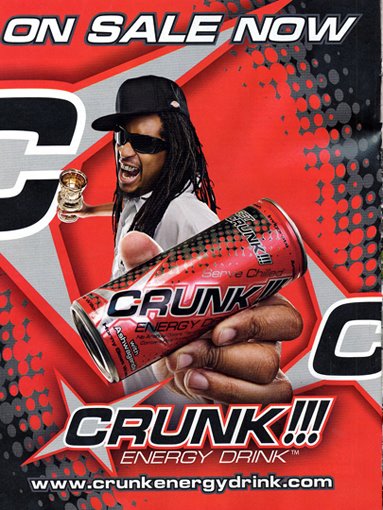
MultiCultClassics presents hard-core Hip Hop hype…

No, it’s not a parody ad. Crunk!!! Energy Drink is the real deal. Probably soon to be available in 40-ounce servings. It’s all the creation of Hip Hop artist Lil’ Jon, and the website leads to a variety of cool — or crunk — details. Click on the essay title above to check it out.

Essay 733


The following appeared in nationwide news sources…

--------------------------------------

Tinkering with voting rights

By Clarence Page

WASHINGTON -- A not-too-funny thing happened to the 1965 Voting Rights Act on its way to renewal in the House of Representatives: A real debate broke out.

The act has been protecting the voting rights of minorities for 41 years. Contrary to widespread and Internet-fed rumors, the fundamental right of minorities to vote is not in danger.

Some of the act’s more controversial enforcement provisions, however, must be reviewed and renewed by next year. Advocates are hoping for a 25-year extension.

No problem, thought leaders of the elephant party. After a stunning 33-1 landslide endorsement from the House Judiciary Committee, House Republican leaders expected easy passage for the measure.

House GOP leaders hoped to use the bill’s passage as a big election-year outreach to minority voters. This would have followed the noble tradition of the late Senate Republican Leader Everett M. Dirksen of Illinois, who helped push President Lyndon B. Johnson’s civil rights legislation to passage in the 1960s, despite opposition from Southern segregationist Democrats and Dixiecrats.

But House GOP leaders canceled their scheduled debate and vote Wednesday. A rebellion broke out, mainly over two issues: the law’s special requirements for the states of the old segregated South, and the law's requirements that foreign-language ballots and interpreters be provided in precincts where substantial numbers of voters are struggling with English.

That language issue is an odd spillover from the ongoing debate over illegal immigration and has no rational place in a debate about voting rights. After all, voters are citizens, regardless of their origins. Any assistance, linguistic or otherwise, that helps citizens exercise their right to vote should be applauded, not exploited by demagogues.

Even so, the English-only lawmakers provided new and unexpected allies for the defenders of states’ rights, bringing the House process to a screeching halt and complicating matters in the Senate, where Judiciary Committee Chairman Arlen Specter (R-Pa.) had planned to bring up an identical bill this coming week.

That’s OK. This country needs to have debates such as this every so often, so we can measure how much racial progress we have made as Americans and how we can best make more.

The 1965 Voting Rights Act’s most controversial provision requires nine states that have a documented history of poll taxes, literacy tests, voter intimidation and other discriminatory voting measures against minority voters to receive “pre-clearance” from the Department of Justice before they can make any changes in their election laws or procedures.

U.S. Rep. Lynn Westmoreland (R-Ga.) became the point man in that argument, saying it was unfair to single out Alabama, Alaska, Arizona, Georgia, Louisiana, Mississippi, South Carolina, Texas and Virginia in this day and age.

Yet, one need only peruse some of the approximately 1,000 cases upon which the Justice Department has acted since the Voting Rights Act was last renewed in 1982 to find plenty that has kept the department busy.

In 2001, for example, the all-white board of aldermen in Kilmichael, Miss., just happened to cancel the town’s local elections only three weeks before Election Day, just as it was becoming apparent that the town's first black mayor and council members might be elected. The aldermen, elected at large, wanted the delay so they could remap the town into districts, which would have protected some board seats held by whites. That wasn’t a good enough reason for the Justice Department, which rejected the change.

In 2003, election officials in suburban Harris County, outside Houston, failed to provide bilingual assistance to Vietnamese voters, who had grown to almost 2 percent of the county population. The Justice Department and Asian-American legal-aid organizations worked out an agreement that resulted in bilingual assistance and other reforms. In the wake of those changes, Harris County elected its first Vietnamese candidate, Democratic businessman Hubert Vo, to the Texas state legislature in November 2004.

Outside the South, you have cases such as the South Dakota gerrymander that packed Native Americans into one state legislative district to limit their political influence. Although the state ignored its obligation to submit voting changes for pre-clearance, the Voting Rights Act gave Indian residents the power they needed to sue the state in federal court, and in 2004, they won.

“The right to vote,” Thomas Paine once said, “is the primary right by which other rights are protected.” Indeed, democracy cannot survive if that right is not protected fully for every qualified voter.

The nine states designated by the act certainly are not the only sections of the country with a history for electoral shenanigans. But neither have the states been inconvenienced terribly, especially in comparison with the inconveniences minority voters suffered before the Voting Rights Act became law.

Saturday, June 24, 2006

Essay 732


AOL posted the photo above and declared, “Jessica Alba’s ‘Ethnic Look’ Redefines Beauty.”

Hey, guess the Dove girls didn’t manage to change our minds after all. Imagine that.

Essay 731


The following appeared on AlterNet.com…

---------------------------------------------------

Rappers Aren’t Feeling Oprah’s Love

By Yvonne Bynoe

Ludacris was the first rapper to complain about Oprah. In the May 2006 issue of GQ, he said that Oprah only grudgingly invited him to her show because of his role in the Oscar-winning film “Crash.” Ludacris called Oprah “unfair” and said that she edited his comments and lectured him about his music.

Then 50 Cent -- the infamous crack dealer turned rap artist -- joined the fray, telling the Associated Press that Oprah rarely invites rap artists on her show. Revealing his disdain for what he characterized as Oprah’s older, female, and primarily white audience, he said, “[I] couldn’t care less about Oprah or her show.”

And now Ice Cube, the former frontman for controversial rap group N.W.A, has expressed his displeasure with Oprah. He told FHM magazine that he’s been involved with three projects that were pitched to Oprah but has yet to receive an invite. “Maybe Oprah’s got a problem with hip hop,” Ice Cube said.

But contrary to what Ludacris, 50 Cent and Ice Cube have implied, Oprah has had rap artists on her show, but her tastes lean more toward John Legend and Alicia Keys than to Lil Wayne and Trina. To promote the film “Barbershop,” Oprah invited rapper-actress Eve and comedian Cederic the Entertainer. Sean “P-Diddy” Combs was on before he ran the New York City marathon to raise money for local public schools. Incendiary rap artist-producer Kanye West, whose religious anthem “Jesus Walks” stirred up controversy among church folks, has also appeared on her show. Queen Latifah and LL Cool J have sat on Oprah’s stage. More importantly, rap artist-producer Missy Elliott and “queen of hip hop” Mary J. Blige were both part of Oprah’s Legends Weekend celebrating accomplished black women.

Earlier this month Oprah responded to her critics, explaining to MTV: “I respect other people’s rights to do whatever they want to do in music and art. ... I don’t want to be marginalized by music or any form of art. ... I feel rap is a form of expression, as is jazz. I’m not opposed to rap. I’m opposed to being marginalized as a woman.”

In case Oprah’s comments need some decoding, what she’s saying is she believes rap artists should be free to record songs that call women “bitches” and “hos,” and she should be equally free not to invite them on her show. Oprah does not have a problem with rap music -- she has a problem with rap that degrades women.

There’s a particular arrogance that permeates Ludacris, 50 Cent and Ice Cube’s statements, as if Oprah owes them a spot on her show. It’s Oprah who has issues by refusing to celebrate black men who’ve made millions by demeaning black women?

If songs such as Ludacris’ “Move Bitch” or NWA’s “A Bitch Iz A Bitch” are not Oprah’s cup of tea, then why should she be obligated to give them a platform? It doesn’t seem to occur to these black men (or their supporters) that Oprah has the right not to use her show -- which is seen by 21 million viewers a week in 105 countries -- to promote performers whose work she feels is misogynistic or offensive. Oprah may not be kicking any black feminist credentials, but rather than blindly using her influence to “help the brothers,” she is choosing not to support black entertainers whose work denies the humanity of black women.

The main focus of this brouhaha is not hip hop or rap, but the commercially successful subset of these genres that has transformed the public image of black women from flygirls to bitches, tricks, ‘hos and chickenheads. This is the same sector of hip hop that has mainstreamed stripper culture, reduced the value of women to their body parts (remember Nelly’s music video “Tip Drill?”) and mocked the importance of love.

Rap shouldn’t be banned or censored, but if living in an open society means that performers are free to express themselves, then that same freedom of expression must be extended to folks who aren’t feeling it. Unfortunately, among black Americans there is little substantive debate about how popular culture affects our communities; any criticism of rap music, however slight or legitimate, is routinely dismissed as “hating.”

In early 2004, Motivational Education Entertainment (MEE), a Philadelphia communications firm, released a nationwide study of 2,000 “urban” teens. The authors of the study concluded that, overall, the teens in their survey believed “black females are valued by no one.”

The vast majority of the teens received their perceptions about life from the rap they regularly consumed. The study states that one of the most relevant changes in the hip hop generation (from their civil rights and black power movement predecessors) is an open disdain for black women. It makes perfect sense, then, that Oprah would not want to even indirectly advance messages that negatively impact young black women.

In his FHM interview, Ice Cube claims he deserves an invite to Oprah’s show because of his “rags-to-riches story.” Sure, Ice Cube has made millions -- but his success was founded on songs like NWA’s “One Less Bitch,” and the extremely raunchy “Giving Up the Nappy Dugout” (a solo release).

What Ice Cube fails to understand is that Oprah herself is the prototype for the “rags to riches” stories she highlights on her show; her life has been much more dramatic than those of many rap artists. She grew up dirt-poor in rural Mississippi to unwed parents. At age 9 -- and repeatedly thereafter -- she was sexually abused by a relative. She endured years of bad relationships, drug addictions, weight problems, and a career-changing demotion that moved her from her news anchor seat to co-hosting a morning talk show.

Oprah credits her fortune to education and faith; her shows reflect her strong belief in self-transformation. For over 20 years, Oprah has featured “success” stories on her show. Most of these have been women who became influential through perseverance and creativity, as well as people who have overcome adversity, tragedy or abuse to create richer lives for themselves, their families or communities. For Oprah, success is not predicated on amassing large sums of money; it is based on the contribution a person makes to improving his or her world.

Oprah has her detractors, mainly because she uses her show to promote the subjects she cares about. Implicit in all of the criticism from rap artists is the idea that because Oprah is black, she is expected to push every black entertainer’s latest film or album, regardless of her opinion. The underlying sentiment is that if she is unwilling to set aside her values, then she can’t be down for black people.

This position assumes that what is good for black entertainers is good for all black folks -- a highly arguable notion. There are many media outlets that expose U.S. rap artists to the global marketplace. But Oprah is virtually alone in her ability, through her selection of guests, to provide the world with a broader view of black Americans and their achievements. For black women, who are so commonly equated with the stereotypes of half-naked, gyrating women found in rap music videos, an opposing portrayal is welcome.

If the brothers feel they need more media visibility, they should use their millions to finance their own talk shows, instead of jocking Oprah Winfrey.

---------------------------------------------------

Yvonne Bynoe is the author of two books: “Stand & Deliver: Political Activism, Leadership and Hip Hop Culture” and the “Encyclopedia of Rap and Hip Hop Culture.” She is also a regular panelist on the National Public Radio program News & Notes with Ed Gordon.

Essay 730


Back to school with a MultiCultClassics Monologue…

• The Sotheby’s auction is off. The Martin Luther King Jr. collection of papers and books (pictured above) will go to Morehouse College, thanks to the efforts of a group led by Atlanta mayor Shirley Franklin. The group reportedly bought it all for over $30 million. “I can’t imagine a better home than the home of Dr. King for this collection,” said a Sotheby’s official. “It was there for years, it’s going to be there forever. I think that’s a marvelous conclusion to this extraordinary process. It guarantees that it will be looked after properly and made available to the public.” It might have been interesting to watch the auction proceed. Wonder if Oprah or Diddy would have stepped forward to nab a few pieces.

• PETA is petitioning Webster’s Dictionary to revise the word “circus” to “animal cruelty.” A PETA member explained, “As more people become aware of the cruelty and violence that goes on behind the scenes [at circuses], the definition needs to be updated.” Not sure how kids will respond to Disney’s JoJo’s Animal Cruelty. Or how about Animal Cruelty du Soleil?

• The Border Patrol Academy in New Mexico is the place to be for wannabe agents, where cadets learn to shoot weapons, make vehicle stops and speak Spanish (pictured below). The training is not easy, as only 1 in 30 applicants successfully completes the program. There’s definitely material for a reality TV show or sitcom here.

Essay 729


MultiCultClassics rolls with Cars & Colored Folks…

This looks like an example of what happens when the Black agency must take the general-market ad and create a targeted message. The end result isn’t old school — it’s just old. At least the art director didn’t go with a graffiti-style font.

Friday, June 23, 2006

Essay 728


The following appeared on Datelinehollywood.com…

-----------------------------------------------

POLICE FEAR OPRAH-RAPPERS FEUD COULD SPIRAL OUT OF CONTROL

Hollywood — The bad blood between Oprah Winfrey and rappers Ice Cube, Ludacris and 50 Cent has led police to call for a peace summit in a desperate effort to stop the violence.

In the latest incident, Ice Cube was fired on at a house party in South Beach, Florida over the weekend. The rapper was not seriously hurt, but a bullet did graze his right shoulder. Ice Cube told police that he spotted a fat, bald man with a mustache, holding a gun, and running out of the house right after the shooting.

“I didn’t get a long look, but it was enough to convince me that it was Dr. Phil,” said Ice Cube. “Everyone knows Dr. Phil is super tight with Oprah. She wants a war. She’s going to get a war!”

Ice Cube and fellow rappers Ludacris and 50 Cent have recently attacked Oprah for refusing to book hip-hop acts on her influential talkshow. After the public criticism, the violence suddenly erupted.

50 Cent, who prides himself on having been shot nine times and surviving the ordeal, was shot another seven times last month while coming out of a hip-hop radio station in New York City. After the shooting, 50 Cent went to a record-signing party, a late dinner with a few close friends, a nightcap at a local strip club before his bodyguards drove him to a hospital to be treated for the gunshot wounds. Ice Cube is said to be in great condition.

“In that case, witnesses say the shooter was a woman,” said Det. William Markey of the NYPD. “Some say she shouted, ‘How do you like us now, bitch?!’ We have one witness who says she looked like Gayle King, who is Oprah’s closest friend. We’re still looking into that, but we haven’t been able to confirm that.”

Oprah’s longtime boyfriend, Steadman Graham, became a victim of an apparent retaliation two weeks ago when he was attacked outside Lantana, a restaurant on Lake Michigan Drive in Chicago.

“He was on the sidewalk, waiting for the valet guy to bring him his car when the incident happened,” said Courtney Giffin, a spokesperson for Graham. “He was suddenly hit three times by three different cars that drove up onto the sidewalk. We don’t think it’s a coincidence that all three cars were Pontiac G6s , the same cars Oprah gave to her audience a couple of years ago.”

Steadman is still at Chicago Memorial Hospital recovering from serious injuries.

Police agencies in several cities have called on Oprah and the rappers to attend a peace summit next month.

“We’re not going to attend this peace summit,” said Ice Cube and 50 Cent in a written statement. “This isn’t over.”

Oprah has made no comment about the incidents, but Ludacris has backed off his threats and says he plans on attending the peace summit.

“I’ve dealt with a lot of crazy, violent people in my time,” said Ludacris. “These shootings have been happening, but Oprah hasn’t said a word about it yet. Can you imagine what would happen to me if Oprah told her audience to go after me. I’d have 50 million crazy bitches hunting me down. No way!”

According to an insider, Ludacris decided to back off after watching a recent episode of Oprah where she gave away free items to her audience.
“It was one of those special episodes, Oprah’s Favorite Things,” said the insider. “Although she made no reference to her feud, most of the favorite things she gave away were semi-automatic guns, grenades and rifles.”

Essay 727


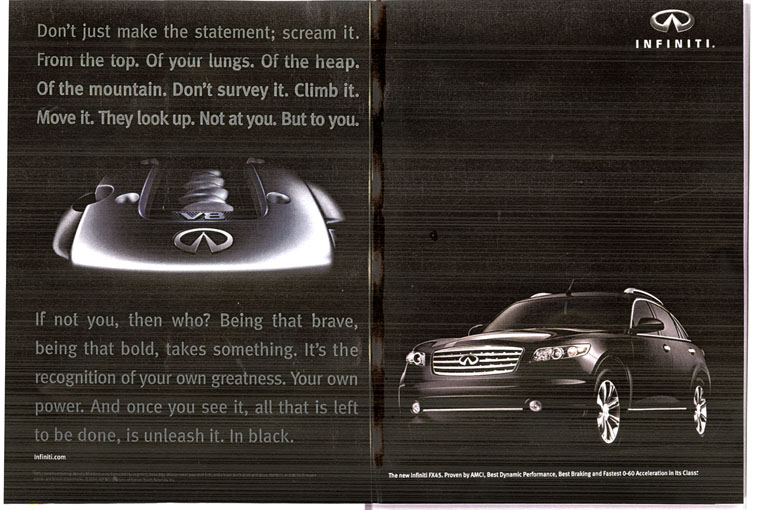
MultiCultClassics rolls with Cars & Colored Folks…

This Infiniti ad makes a statement: The copywriter. Is taking himself. Way. Too. Seriously.

Essay 726


School daze in a MultiCultClassics Monologue…

• The Washington Post continues its series titled, “Being a Black Man.” The latest installment highlights two star athletes and their lives in Washington’s Ballou Senior High School (pictured above). “My whole thing is to change the stereotype of people in Southeast,” said one of the featured students. “We wanted people to say that good, intelligent, athletic students come out of Ballou.” Click on the essay title above to check it out.

• Congratulations to Shaelon Wright of Queens, New York, who was selected to receive a free college education and eight years of mentoring courtesy of “The Boule” — a low-profile fraternity comprised of some of the biggest Black professional men in the country. “I don’t know why I was chosen,” Wright said. “I think it was because I am hard-working and do a lot of extracurricular activities. And I’m lucky, too.” Past members of “The Boule” include Martin Luther King Jr., Arthur Ashe and W.E.B. DuBois. So Wright’s probably being a tad humble in saying he’s lucky.

• USA Today reported a new study reveals dropout rates are up in big-city schools nationwide. The story stated, “Students in a handful of big-city school districts have a less than 50-50 chance of graduating from high school with their peers, and a few cities graduate far fewer than half each spring… Among the nation’s 50 largest districts, the study finds, three graduate fewer than 40%: Detroit (21.7%), Baltimore (38.5%) and New York City (38.9%).” Somebody needs to spend more time promoting the kids at Ballou and Shaelon Wright.

• A new report showed teens are dropping soft drinks in favor of coffee-laced refreshment, sports drinks and water. In fact, about 25 percent of teens are apparently too through with sugary soft drinks, seeking to maintain healthier, buff physiques. The other 75 percent are probably part of the alleged obesity epidemic.

• Western Union has taken heat over the years for charging so much to Mexicans making money transfers. But according to a news report, “Western Union executives will sign a contract with immigrant leaders and the governor of Michoacan in Chicago on Saturday to help bankroll enterprises in that Mexican state organized by immigrant clubs in the U.S.” It’s all part of the company’s goal to give back to its highly profitable customers, who sent about $20 billion to Mexico in 2005. But not everyone is buying it. “It’s a sellout,” said the president of the Hispanic Council in Bensenville, Illinois. “This company is trying to buy us off, but they need to make amends first by changing their fundamental business practices. That’s the only way we are going to be friends again.” Don’t hold your breath waiting for Western Union to wire a reply to that statement.

• Canada is poised to apologize to its Chinese citizens for charging a “head tax” over a century ago. Tens of thousands of Chinese were taxed to stay in the country and bring their kin — even though the people were helping to build Canada’s railroad system. The Chinese community has long sought a formal apology and compensation for survivors and their families. Just don’t ask the Canadian government to wire the cash via Western Union.

Essay 725


The following appeared in The Chicago Tribune…

----------------------------------------------

Singleton: Greenlight people of color

By Patrick Goldstein
Tribune Newspapers: Los Angeles Times

In Hollywood, to paraphrase the old James Brown song, it’s a white, white, very white world. Sometimes, when I sit in on a production meeting or visit a movie set or have lunch at the Grill, I’m struck by the fact that in an industry with an ever-growing roster of African-American and Latino actors and filmmakers, the odds of my seeing a black or Latino executive are about as good as seeing a studio chief pumping gas at a truck stop in Wyoming.

Having made movies about multiethnic subjects his entire career, both as a hit director (“Boyz N the Hood,” “Four Brothers” and “2 Fast 2 Furious”) as well as a producer (“Hustle & Flow”), John Singleton knows exactly what it’s like to pitch an idea that revolves around people of color to a roomful of white executives. “Basically, the American studio structure is the same as it’s been since Louis B. Mayer and Jack Warner ran the business,” he says. “This is not one of these businesses run by affirmative action. In Hollywood, affirmative action is all about -- how much money can you make?”

After his success bankrolling “Hustle & Flow” with his own money, Singleton is rolling the dice again, having earned a rare opportunity to bypass the stodgy studio greenlighting process and make the kind of movies that reflect an increasingly diverse country. Singleton and Universal Pictures are announcing this week that Universal will market and distribute five films financed and produced by Singleton. Each made for less than $15 million, the films will be distributed either by Universal or its Focus and Rogue divisions. The importance of the deal is that the studio has agreed to release the finished pictures; all the creative decisions are made by Singleton.

1st project now filming

The first film in Universal’s agreement with Singleton’s New Deal Productions is “Illegal Tender,” a family drama about a young man and his mother who try to escape the drug-fueled violence of their old neighborhood in the Bronx. Directed by Franc Reyes, it is now filming in New York and Puerto Rico. Singleton is providing the funding for the $8 million picture, while lining up money for future projects.

It’s clear that the new slate of films will reflect Singleton’s interests as a filmmaker, which have evolved from such personal projects as “Rosewood” to more genre-oriented films such as “Four Brothers” and “Shaft.” “If you make a movie for less than $15 million with the right genre elements and a young, multiethnic cast, you can make a nice profit,” he says. “These aren’t movies where people are sitting around talking all the time. Franc’s film is a lot like ‘Scarface,’ but with a Latino mother and son. It’s got a lot of heart, but Franc jokes that whenever he sees me, I’m going, ‘Can’t we have more guns in this shot?’”

Singleton says he approached Paramount Pictures, which released “Hustle & Flow,” but the studio wasn’t interested in a deal. Universal was a perfect fit, not only because the studio has already made a number of multiethnic pictures, but also because Singleton has a close relationship with new Universal Chairman Marc Shmuger.

“I’ve known Marc for 16 years, and I consider him a friend,” Singleton says. In fact, “Boyz N the Hood” was the first picture Shmuger worked on when he came to Sony in 1991 as an advertising executive. When Shmuger later moved to Universal, he worked with Singleton on “2 Fast 2 Furious.”

“From the very beginning of his career, John has crossed over to all kinds of audiences,” Shmuger says. “He’s always stood out as someone who’s not only in touch with the youth culture, but who has a great eye for casting and finding new talent. It’s no secret that our industry is badly in need of discovering fresh actors and filmmakers, and we expect that John will be a bridge to help us connect with them.”

Shmuger is especially excited about reaching the Latino audience, which he says is the fastest-growing demographic in the country. (Latinos were a big force behind “Nacho Libre's” $27.5 million opening this past weekend.) “They way over-index for moviegoing, so they’re going to be an increasingly big force in pop culture. They come to the broad-based movies we make, but we haven’t been successfully focused on creating the movies that speak to them, which is what John’s trying to do.”

The problem, as Singleton sees it, is that Hollywood isn’t always comfortable with new faces from unfamiliar cultures. Reyes’ last film, “Empire,” was a low-budget hit in 2002. But he hasn’t directed a film since. When I asked Singleton why, he answered: “He’s almost 6 feet tall, he’s Puerto Rican and he’s opinionated. Being Puerto Rican has made it tougher for him, no doubt.”

Embarrassing question

Wouldn’t Hollywood do a better job of creating movies that speak to this multiethnic audience if the studio executive suites weren’t so lily white? It’s an especially embarrassing question for the film industry, which is full of supporters of all sorts of progressive causes, but when it comes to hiring people of color, betrays a huge gap between its ideals and its actions.

“Forget about what’s right, if you’re dealing with a pop culture that’s so driven by Latinos and African-Americans, you’d think it would just be good practice to have people of color in those jobs,” says Spike Lee, who’s been a longtime advocate of improved Hollywood minority hiring practices. “But when they are making the big decisions, about greenlighting movies and TV shows, we’re not participating.

“I’ve been meeting with executives who can make movies for 20 years, and I’ve never sat across the table from someone who looked like me. When I do see a young black face, I think -- did they pull ‘em in from the mailroom? It’s like they have someone in a glass case on the shelf that says, ‘Break the glass in case Spike Lee comes into the room!’”

A survey of African-American or Latino production executives at a vice president level or higher found one executive each at 20th Century Fox, New Line and Paramount, none at Universal, Warner Bros. and Sony Pictures. After three days of trying, I couldn’t get an answer out of Disney’s corporate publicity staff, so I’m guessing they’re at zero, too. Whenever I would ask studio chiefs for an explanation, there was usually a long, awkward silence.

Some executives believe progress is being made, even if it is painfully slow. “I think if you look at our company or at the talent agencies, you’re starting to see more faces of color,” says New Line production chief Toby Emmerich. “This certainly isn’t something that's under the radar with our human resources department.”

In the music business, black artists and producers have successfully made the leap to running record labels, including Diddy, Dr. Dre, L.A. Reid, Jermaine Dupri and Jay-Z. Singleton sees Jay-Z as an intriguing role model.

“I want to do for the movie business what Jay-Z did in the music business,” he says. “He’s the guy everyone goes to for guidance, which is a role I want to embrace, being a godfather to a new generation of filmmakers.”

Essay 724


MultiCultClassics rolls with Cars & Colored Folks…

Mr. Goodwrench can now help with your family reunion? Maybe the campaign will extend with Mr. Goodwrench lending a hand at graduations, barbecues and double-dutching — plus, he can DJ to appeal to the youth market.

Thursday, June 22, 2006

Essay 723


Bad Boys in a MultiCultClassics Monologue…

• Chicago White Sox manager Ozzie Guillen was fined and ordered to attend sensitivity training after referring to a sports columnist as a [bleeping] fag (see Essay 720). “Ozzie Guillen used language that is offensive and completely unacceptable,” said MLB Commissioner Bud Selig. “Baseball is a social institution with responsibility to set appropriate tone and example. Conduct or language that reflects otherwise will not be tolerated. The use of slurs embarrasses the individual, the club and the game.” Um, does Selig realize he’s running one of the most racist professional sports leagues — and it’s also mired in never-ending steroids scandals?

• Rapper-actor DMX ran into trouble with the law again. He was cited for packing a concealed weapon after cops spied him removing a pistol from its holster outside an Arizona nightclub. Hey, maybe DMX was planning to help the National Guard secure the border against illegal immigrants.

• House Republicans nixed voting to renew the Voting Rights Act, deciding to postpone things while they review complaints from colleagues. Party members argue the law unfairly targets Southern states with additional oversight, and Georgia’s Republican congressman is pushing an amendment designed to give his state greater authority to revise their voting rules. But opponents insist the Southern states have earned the added scrutiny through their historically racist behavior. Somebody send Ozzie Guillen and DMX to address the conservative lawmakers.

Essay 722


More comments in response to the AdAge.com article appearing in Essay 708…

-----------------------------------------------------------

>Shame on Don Richards of the Four A’s for saying, “There are more pressing issues (than diversity at agencies): profit margins, compensation, and an overall talent drain from the industry. I don’t believe that agencies shy away from trying to get minority employees. But it is more in the middle of things that keep agencies awake at night than a top priority.” (Ad Age, June 19, 2006) It is just that type of backwards logic that has resulted in the current state of affairs in the industry. If agencies do not seriously embrace diversity there will be no replacements for those exiting the industry, therefore resulting in decreased profits and ultimately lower compensation for those remaining. Wake up! Within the next 10 to 20 years nearly half of the population will be black and brown. How can you purport to create messages that speak to diverse populations if management and the majority of your employees come from a homogenous pool? If the agencies and media properties that they advertise in do not quickly begin to reflect the population outside of their offices these organizations will have more to worry about more than profit margins and compensation. The issue will then be their ultimate survival. Mariama Todd Meredith Corporation — NY, NY

>Well, hope this trend changes in the future. This is quite disheartening for students in MBA programs who do not care about the pay package, but who enter advertising for the love of the profession. I’ve worked as a Senior Account Manager in advertising firms in India for 3 years, working for the likes of Mediaedge and Universal McCann and have just moved into the Temple MBA Program last year, and my hope was to get into the advertising industry as soon as I graduated. I hope this trend changes a bit. This is the 1st article I’ve read today morning and I feel really down:( — Philadelphia, PA

>I’m a 55-year-old Latino marketing executive with 30 years of in house positions under my belt. The few times during my career when I did interview with agencies (admittedly I stopped interviewing with agencies in the mid-80’s) the response I got was perfunctory and dismissive. There were never any other minorities in the agencies ostensibly interviewing me, and I wondered why they had bothered to talk to me at all — then I remembered I probably helped their EEO/AA reporting. Sounds like the industry has not changed much. kenpodo@aol.com — GARDEN CITY, NY

>Great article and something that I have been complaining about to my peers for quite some time. It’s not like multicultural employees cannot contribute to a general market audience. I actually wrote a short rant about this very topic on my blog a while back and got engaged in some intense discussion with a handful of creative folk on Adrants. The following is a copy of the article: So ... here I am going through my daily Adrants email when I came upon the headline: “White” agencies are biased, greedy, stupid. Of course in order for this to be the first non-agency post on my site it must have been something that really burns my ass. Firstly, why are there multicultural agencies in the first place? If there is ever going to be racial equality or one America, shouldn’t we first be able to hire multicultural people to do general market advertising? Let’s think about this for a minute, would agency A (white agency) have to hire agency B (multicultural agency) to do a promotion for a hispanic market product if we had the same multicultural people in creative and planning positions in agency A? Which at that point would just be called an “ad agency” — go figure. Does this continued polarization of the American public have to be aided by the so called ad agencies and media of the country? Although done innocently. And it’s not only the “white” agencies’ fault, I know I couldn’t get a job at one of the multinational agencies in Miami if I didn’t speak spanish, now what am I to do if I wanted the multinational agency experience, and the multicultural agencies don’t want to hire me because I don’t fit into that exact multicultural target. And multinationals just don’t hire the multicultural staff (some less than others). Be it because of available talent or necessity. I love when people rant on about all the issues but continue to proliferate the issues, by further segmenting the problem, why can’t we just come up with a possible and optimistic solution. Its like religion (I know I shouldn’t go there, but I am), how many new churches open up every day by someone who says I know a better way, my translation of the word of God in whatever denomination is right and a bunch of people go off and follow. Is that really spreading the good news or further segmenting that particular religion? Can’t we just try to fix the problem inside whatever place of worship or agency we are involved in, instead of forcing people to go off and create their “own” thing to target their “own” people. Isn’t “own” a pretty selfish word? (own — adj. Of or belonging to oneself or itself). Let’s take for instance Trinidad, the country is made pretty much up of 39.6% African and 40.3% East Indian. But yet there is not a separate advertisement for East Indians and Africans. Hmmmm, why is that? Should they now have an East Indian Ad agency and an African agency as well? When can we as a people learn that people are people, we have different backgrounds and cultures but we all exist on the same planet and have to interact with each other daily, we all eat very similar foods (although we try to say we don’t), and listen to very similar music (although we try to say we don’t). I heard a “white” guy blaring “Laffy Taffy” in his chrome rimmed car. And I love Gretchen Wilson’s “All jacked up” and I am black. Can we all just get along? Can there be an agency that does just as targeted work for the hispanic as they do for the caucasian? Can an agency have a multicultural ECD and a caucasian CD? Can a multicultural agency wrap itself into an already established multinational (which should equal to multicultural)? Don’t we all have the same cable companies that offer pretty much the same shows — so the hispanic and the african american is watching the same Desperate Housewives episode (I know I tune in for Eva, and Nicollette) Does an african american show always have to be a comedy? Don’t get me wrong the shows are good, but come on ... every show! Does COPS always have to show “poor” black, white and hispanic people? Common denominator here “poor.” At least here it’s not a race thing! o.k. I’m done for now. Got that off my chest ... thanks, Hadji. So here is my solution, as I believe firmly in the saying if you are not part of the solution you are part of the problem. Can we get one multinational agency to hire multicultural staff and offer the client (remember the people you are trying to do the best work for) a multicultural creative offering that appeals to everyone all in house? Sorry, had to look up multicultural because I forgot what it really meant: mul·ti·cul·tur·al Pronunciation Key (mlt-klchr-l, -t-) adj. — Of, relating to, or including several cultures. Since when did culture mean only hispanic/african american and asian? Regards, chief creative altruist — Fort Lauderdale, FL
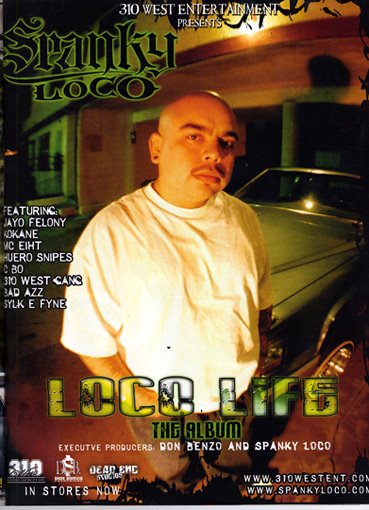
>There may be some continuing truth to Harold Levine’s experience in the ‘60s -- shops further afield from the historical center of the industry, either psychologically or geographically, seem to be more open environments. Our agency of 30-some people in Cleveland, Ohio has hired African Americans, Indians and Pakistanis in recent years, simply because they were talented people who we believed could help us do better work. And that, after all, is the real issue every agency should be concerned with. By the way, I also agree with Jack Lindgren -- of more than 100 advertising students I have taught at a large public university in the last three years, only three have been minority students. Incidentally, two of those three were among the most talented students I’ve had the pleasure to know. — Cleveland, OH

>This is a sad, but sobering article. My personal experience as a minority seeking employment in the advertising industry has been full of challenges and some questionable situations. Unfortunately, this is the state we are in and I feel many talented persons have been lost to other industries because of racism. Another great source on this topic is a discussion on NPR.org. Ed Gordon’s News and Notes June 13th show “Black Voices missing on Madison Avenue” examines the issue deeply and references Allen Pugh, Vice President of GlobalHue. Continue to encourage open dialogue and God Bless. — Cincinnati, OH

Essay 721


MultiCultClassics rolls with Cars & Colored Folks…

Earlier this year, Sony was dissed for its graffiti-style PlayStation Portable campaign. Community and political leaders were offended by the tagger imagery. Taggers thought Sony was trying too hard. This Xplod Audio ad may inspire similar eye-rolling reactions from its intended target, especially with the copy: “It’s how you roll. … PS Turbo Cones keep every beat bumpin.’ And Sony’s new amps power up the sickest rhymes. It’s a total system for the tightest sound.” Word.

Meanwhile, the Cooper Zeon XST has been named “The Official Tire Of The Streets.” According to the copy, “Zeons handle. Zeons Grip. And they look tight doing it.” Yo, they’re the perfect complement to Sony Xplod Audio.

Essay 720


Daily dissing in a MultiCultClassics Monologue…

• Chicago White Sox manager Ozzie Guillen (pictured above) is taking heat for calling sports columnist Jay Mariotti a [bleeping] fag. Guillen has been known to launch profanity-filled tirades. Delivering an apology, the fiery skipper said, “The word I used, I should have used something different. A lot of people’s feelings were hurt and I didn’t mean it that way.” Given the animosity that Guillen and most Chicago sports fans have for Mariotti, the manager probably should have opted for the more appropriate “fucking jerk-off.”

• Now AT&T is changing its privacy policy, telling customers that it may disclose Internet and television records to government and law enforcement agencies. The company’s tagline — “Your world. Delivered.” — gets new meaning every day.

• Coretta King’s elder son now says it was a “big mistake” to stop Harry Belafonte from speaking at his mother’s funeral. While Belafonte charged the Bush administration with influencing the decision to rescind his invitation to the ceremony, King’s son denied it. “There was a big mix-up,” King said. “It certainly didn’t have anything to do with President Bush being there.” Guess Bush didn’t sing, “Daylight come and me wan’ Harry go home.”

• A New York City Council member proposed limiting the number of fast food joints in areas where there are youth obesity problems. The council member declared, “We have to be as strong with obesity as with the cigarette campaign. More people die from obesity-related issues than smoking cigarettes.” Yeah, but kids will die of embarrassment after being identified as living in fatso neighborhoods.

Essay 719


MultiCultClassics rolls with Cars & Colored Folks…

S.U.V.I.P. seems to clash with “THE BIGGEST, BADDEST BENZ EVER.” But the creative team probably needed something to give the ad Black appeal.

Wednesday, June 21, 2006

Essay 718


Conquests and casinos in a MultiCultClassics Monologue…

• Mickey D’s is trying to take over the planet. Already the fast food leader in most civilized countries, the burger behemoth is aiming to conquer China. One key tactic involves a partnership with China’s largest gasoline retailer to capitalize on drive-through service. Their tagline could be, “Get more gas.” In China, Mickey D’s is currently a distant second to Kentucky Fried Chicken. Guess “Chicken Capital U.S.A.” extends far beyond the U.S.A.

• Last year, American Indian casinos revenue grew to about $23 billion — expanding over three times quicker than traditional gambling operations. The surge is linked to greater offerings at existing casinos and increased marketing efforts that include Las Vegas-inspired attractions. This is the 10th consecutive year where revenue jumped about 15 percent. Mickey D’s ought to hire some American Indians to oversee operations in China.

Essay 717


MultiCultClassics rolls with Cars & Colored Folks…

DaimlerChrysler autoworkers show off their pride, although the awkward posing fails to show off the car.

Tuesday, June 20, 2006

Essay 716


After two days, a measly two comments were posted in response to the AdAge.com report presented in Essay 708…

------------------------------------------

> It's extremely disheartening that this article and some quoted in it make it seem like the advertising industry can choose to simply use minority-staffed contractors instead of hiring minorities onto their staff. That mentality is indeed racist because it assumes that minorities can only contribute when doing multicultural advertising or marketing. In reality, minorities, like anyone else, can provide great insight and ideas to any client — not just ones looking to target minorities. Ad agencies should evaluate minorities the same way they evaluate anyone else applying for the same job and hire them based on their intelligence, experience and qualifications to add to their pool of talent — not just because they may be able to advertise or relate to other people of the same skin color. ~ Chavon Mitchell, Northlich, Inc. Cincinnati –Cincinnati, OH

> Great article on a topic that so many skirt around because it takes them out of their comfort zone. As a minority manager in advertising (the only in my division of 300 employees), I have to say that this article rings true and that as far as we’ve come, we’ve still got a way to go. — Deerfield Beach, FL

Essay 715


MultiCultClassics rolls with Cars & Colored Folks…

No collection of Black ads for rides would be complete without an ad for rims. Davin keeps it simple with limited edition rims and a standard edition hottie.

Essay 714


Quick hits and minor assaults in a MultiCultClassics Monologue…

• Forget climbing fences and ladders. The latest trend for illegal immigrants involves sneaking into the U.S. inside cars and trucks. According to a story in The Washington Post, “[Illegal immigrants] cram themselves into empty gas tanks, hollowed-out dashboards and even engines. Others hide inside cargo, from piñatas to washing machines.” Let’s hope they’re using American-made vehicles.

• It’s not over yet for Rep. Cynthia McKinney (see Essay 699). Capitol police union officials are pissed off that a grand jury decided against indicting McKinney for assaulting an officer. So they’re asking the House ethics committee to review the incident. McKinney did not return calls for a statement. She was probably using her cell phone to beat someone.

Essay 713


MultiCultClassics rolls with Cars & Colored Folks…

Nissan temporarily abandons the Black ad clichés for general-market ad clichés with this “identical twins” concept. Is it progress or pathetic? And should somebody hook up these brothas with the Doublemint twins?

Monday, June 19, 2006

Essay 712


From the latest issue of Newsweek…

------------------------------------------

Chappelle: A Dozen Skits, a Million Questions

On July 9, Comedy Central will air what it’s calling “Chappelle’s Show: The Lost Episodes,” but that must be a typo. These are really the last episodes, as in the dozen skits Dave Chappelle had filmed before he went crazy or to Africa or wherever he went after he walked away from his $55 million (or so) contract. Chappelle himself had nothing to do with this salvage job; in fact, the two blues guys who croon the “Chappelle’s Show” theme stop, hilariously, and say: “I don’t think he’s comin’.” “When each sketch is over, I still expect to see Dave come running out,” says “Chappelle’s Show” co-creator Neal Brennan, who packaged these three shows. “You still kind of hope it’s a joke and he’s not really gone.”

The sketches themselves are just as topical and subversive as ever. There’s one where Dave is at a party dancing to posthumous Tupac music that’s suspiciously prescient. Another features Chappelle as the host of “Hip Hop Newsbreak” in the kind of extreme whiteface no one else would dare. But the most interesting pieces feature Chappelle as himself, including one where various people grossly overcharge him now that he’s a millionaire and another where he exacts revenge on people who didn’t take him seriously before he hit it big. Only Chappelle knows exactly why he left the show, but his own fame was clearly heavy on his mind.

—Marc Peyser

Essay 711


MultiCultClassics rolls with Cars & Colored Folks…

Here’s another Dodge ad proclaiming, “Respect the unexpected.”

OK, but it’s hard to respect the art direction and copywriting.

Essay 710


Delayed reactions to the AdAge.com story posted in Essay 708…

>>The New York City Commission on Human Rights investigation into Madison Avenue’s hiring practices has stirred a maelstrom of emotional discussion around that one big question -- and this time around, industry leaders hope that the discussion might just last long enough to yield some solutions.

[Delayed reaction: Um, it looks like only minority industry leaders hope the discussion will last long and lead to progress.]

>>Renetta McCann said, “In my 28 years, I’ve had about five substantial conversations on the issue of racial diversity in advertising. That’s about one every five years.”

[Delayed reaction: Yo, that’s still five more than the 4As and AAF have had — combined.]

>>Others cite a rule intended to fuel diversity -- government mandates that minority contracts be afforded only to minority-owned agencies -- as hampering it, leaving general-market agencies to decide if it’s in their best interests to work with minority-staffed agencies rather staff up with nonwhites themselves.

[Delayed reaction: That’s possibly the lamest excuse offered to date.]

>>“There’s not a lot of desire by [general-market] agencies to become more integrated,” admitted Don Richards, senior VP-agency diversity at the American Association of Advertising Agencies.

[Delayed reaction: Nice to hear this coming from a man whose primary goal is to ignite change. Then again, Richards spent many years at Leo Burnett failing to inspire diversity. Wonder why anyone thought he’d be more successful on a global scale.]

>>Sheldon Fischer, CEO of consulting firm GoldenKnock/Pipeline International, chairman of the Four A’s diversity advisory board recruitment subcommittee, and an adviser to Operation Success, called it “a Crackerjack box that turned out to be empty. No prize, nothing to eat.”

[Delayed reaction: Actually, it’s more appropriate to call it a Cracker box.]

>>Others maintain that the number of African-Americans interested in the business is small. Several respondents to a March AdAge.com poll reported that in their college classes, few African-Americans enrolled in advertising courses.

[Delayed reaction: Let’s not confuse end results with root causes. Low interest is fueled by high exclusivity/racism.]

>>Some observers point out that to win large government contracts, general-market agencies must work with minority-owned vendors, so it is in general market agencies’ interests to work with the best minority-staffed agencies rather than staff up with minorities themselves.

[Delayed reaction: That rivals the lamest excuse offered to date. Plus, the majority of minority-staffed agencies rarely feel like they’re working with general-market agencies in these scenarios — rather, they’re literally and figuratively relegated to being the minority partner.]

Essay 709


A full-time mess in a MultiCultClassics Monologue…

• The New York Times reported on the growing complexities of illegal immigrants working in the U.S. The story stated, “In contrast to the typical image of an illegal immigrant — paid in cash, working under the table for small-scale labor contractors on a California farm or a suburban construction site — a majority now work for mainstream companies, not fly-by-night operators, and are hired and paid like any other American worker.” Additionally, “More than half of the estimated seven million immigrants toiling illegally in the United States get a regular paycheck every week or two, experts say. At the end of the year they receive a W-2 form. Come April 15, many file income tax returns using special ID numbers issued by the Internal Revenue Service so foreigners can pay taxes. Some even get a refund check in the mail.” Click on the essay title above for all the details.

• The Washington Post reported that employers are rarely penalized for hiring illegal workers. According to the story, “In 1999, the United States initiated fines against 417 companies. In 2004, it issued fine notices to three.” A spokesperson for an advocacy group backing stricter workplace enforcement said, “The claims of [the Bush administration] and its commitment to interior enforcement of immigration laws are laughable. … The administration only discovered immigration enforcement over the past few months, five years into its existence, and only then because they realized that a pro-enforcement pose was necessary to get their amnesty plan approved.” Plus, they didn’t want to lose their landscapers.

Essay 708


From AdAge.com…

-----------------------------------------------------

Advertising: An Industry Still So White, but Few Will Discuss It

Ad-World Culture and Pay Scale Hurt Minority Recruitment

By Lisa Sanders

NEW YORK (AdAge.com) -- Want to know why there are so few black employees in the ad business? Look to its roots, culture and compensation practices.

The New York City Commission on Human Rights investigation into Madison Avenue’s hiring practices has stirred a maelstrom of emotional discussion around that one big question -- and this time around, industry leaders hope that the discussion might just last long enough to yield some solutions.

Comfort levels
“Curiously, while we operate in an industry that prides itself on participating in the cultural zeitgeist, if you will, we are not an industry that is tremendously comfortable with differences,” said Renetta McCann, CEO, Starcom MediaVest Group. Ms. McCann, one of the top-ranked black women in the business, notes that historically, the industry has not had a huge appetite for this issue. “In my 28 years, I’ve had about five substantial conversations on the issue of racial diversity in advertising. That’s about one every five years.”

Indeed, few executives in the business are willing to go near the subject and several of those who commented for this story chose to do so anonymously. But the wide spectrum of reasons they cite range from nepotism -- or what might even be called institutional racism, (a business that started as a white business that’s continued to hire its own) -- to inertia and clients’ indifference to the issue. Some also believe the problem has to do with advertising’s inability to compete with better-paying industries for the most qualified candidates.

Minority-owned agencies
Others cite a rule intended to fuel diversity -- government mandates that minority contracts be afforded only to minority-owned agencies -- as hampering it, leaving general-market agencies to decide if it’s in their best interests to work with minority-staffed agencies rather staff up with nonwhites themselves.

But while opinions vary, one thing seems clear: Were there no pressure on agencies by a government authority, agencies would be unlikely to take action. “There’s not a lot of desire by [general-market] agencies to become more integrated,” admitted Don Richards, senior VP-agency diversity at the American Association of Advertising Agencies. “There are more pressing issues: profit margins, compensation, and an overall talent drain from the industry. I don’t believe that agencies shy away from trying to get minority employees. But it is more in the middle of things that keep agencies awake at night than a top priority.”

Under threat of government investigation into their hiring practices, the Four A’s in September 2004 launched Operation Success, dubbed “the advertising diversity initiative program,” which intended to help agency members improve their minority-hiring efforts. Sheldon Fischer, CEO of consulting firm GoldenKnock/Pipeline International, chairman of the Four A’s diversity advisory board recruitment subcommittee, and an adviser to Operation Success, called it “a Crackerjack box that turned out to be empty. No prize, nothing to eat.”

‘They aren’t wanted’
His take on the reason that there aren’t more blacks in the ad industry: “They aren’t wanted. Though these agencies are enormous in terms of their global impact, they are small shops politically. They appear to be close-knit families. They hire from among their own: there is nepotism and politics.” What’s more, clients aren’t pushing for change. “Absolutely, if a client asked for more African-Americans on their accounts, agencies would respond,” said Mr. Richards of the Four A’s. “They’d devote resources to it and make an effort.”

The industry has a history of segregation by race and gender. Harold Levine, founder of now-defunct Levine, Huntley, Schmidt & Beaver, recalls that when he interviewed at agencies after World War II, he was told to limit his job search to those agencies known as Jewish only. “It was only in the late ‘60s, in the midst of the creative revolution, and small agencies were hiring Jews and women. It was only then that the giant agencies started to talk about diversity. The history of the agency business is one of white male Christians. The culture is very white and masculine.”

A push during the 1960s and 1970s to bring more African-Americans into the business led to some progress. Gil Griffin, an African-American lawyer in the early 1970s, joined now-defunct Kenyon & Eckhardt as senior VP-administration. “It was not a figurehead role,” said Mr. Griffin, who credits one man, Leo Kelmanson, for having the courage to appoint him. “At the time, other firms were debating whether to hire a black copywriter. He had bravery, will and sense of fairness to be way ahead of his contemporaries.” Other agencies hired African-Americans then, but, recalled Gene Morris, chairman-CEO of E. Morris Communications, Chicago, “most of those people didn’t stick around.”

No people ‘like them’ at the top
That lack of top-level senior talent continues to exist today, and makes for difficulty in recruiting and retention at all levels. Mr. Griffin, who now heads recruitment firm Korn/Ferry International’s diversity practice, asked why young people would want to go to an agency if they don’t see people like them at the top.

Others maintain that the number of African-Americans interested in the business is small. Several respondents to a March AdAge.com poll reported that in their college classes, few African-Americans enrolled in advertising courses. Jack Lindgren, who teaches advertising at University of Virginia, says of the 40 kids in his classes per year, “only a few” are African-American: “If I have one or two, I’m very lucky.”

Another reason cited for the low numbers is high demand for a small pool of qualified candidates. “There’s a certain percentage of African-Americans in the general population, and those that have graduated from college are a small part of that. Competition for them is strong,” said Mr. Richards. “They’ve got options.”

Entry pay levels
Pay in advertising pales in comparison with other white-collar industries, particularly for MBA’s. Notes executive recruiter Paul Gumbinner: “The best and the brightest MBA’s are being paid $35,000 to $40,000 to start. Why should they go into advertising when they can go almost anywhere else for twice that?”

Still, Carol Dudley, coordinator, the office of career development at Howard University’s John H. Johnson School of Communications, said that while some shops -- including TM, Saatchi & Saatchi and Ogilvy -- attend the school’s annual career fair, overall agency attendance is low. Of the school’s 287 graduates in 2006, 29 graduated with ad degrees, and three took jobs in agencies.

Some observers point out that to win large government contracts, general-market agencies must work with minority-owned vendors, so it is in general market agencies’ interests to work with the best minority-staffed agencies rather than staff up with minorities themselves.


“We are not an industry that is tremendously comfortable with differences,” said Renetta McCann, CEO of Starcom MediaVest Group (pictured above).

Essay 707


MultiCultClassics rolls with Cars & Colored Folks…

I see dead people. Chevy presents a curious tribute to deceased recording artists for Black Music Month.


Sunday, June 18, 2006

Essay 706


Late-breaking entertainment news in a MultiCultClassics Monologue…

• Beyoncé was tricked into a face-off with PETA representatives who questioned the superstar’s penchant for fur. An eBay auction for a dinner date with Beyoncé was secretly won by PETA, who used the opportunity to confront the singer and videotape the encounter. Beyoncé should have stood her ground and ordered steak and lobsters for everyone.

• American Idol champion Ruben Studdard won $2 million in a lawsuit against his former manager, who mismanaged the crooner’s loot and credit cards. Studdard probably should have also sued the dude for mismanaging his career.

• AOL displayed some tacky insensitivity by showing the picture below of Bobby Brown and Whitney Houston with the headline: “We Admit It, We’re Addicts. Even Terrible Reality TV Like ‘Bobby’ Hooked Us…”

Essay 705


More borderline insanity in a MultiCultClassics Monologue…

• The southern border is still a major problem, with folks legally and illegally crossing over for the jobs regular citizens no longer want (pictured above). Governmental and law enforcement officials debate controversial tactics to deal with the flow of immigrants. The continuing saga in the U.S.? Nope, it’s Mexico’s own immigration dilemma, as people from nearly two dozen other countries flow into the country. The New York Times published a story titled, “Mexico Worries About Its Own Southern Border.” Click on the essay title above to check it out.

• Texas ranchers, tired of illegal immigrants damaging cattle fences while crossing the border, have set up ladders to solve the problem. But most potential border jumpers ignore the assistance, fearing the ladders are traps monitored by the Border Patrol. The ranchers would probably be more effective posing as smugglers with beat-up vans.

• The National Guard is poised to officially begin working along the border today. “The Jump Start operation has begun,” said a Border Patrol spokesman. “They are being issued orders and are being processed and trained. … The National Guard is not going to be involved in any law enforcement mission. … Actual arrests, seizures, custodial — none of that stuff. The Border Patrol agents are the ones trained to determine probable cause, effect arrests, and it is impossible to bring the National Guard up to speed on that.” Additionally, most of the troops will be unarmed. So exactly what will the National Guard be doing? Setting up ladders for cattle ranchers?

Essay 704


MultiCultClassics rolls with Cars & Colored Folks…

Honda continues its “Civic Nation” campaign by proclaiming, “Once again, it’s on.”

Once again, it’s forced.

Essay 703


From The Miami Herald…

-------------------------------------------------------------------

Bush declares June Caribbean heritage month

After President Bush announced June as Caribbean-American Heritage Month, South Florida's Caribbean communities said they hoped the act will be more than symbolic.

BY JACQUELINE CHARLES

Ask the Rev. Ouida McDonald why there needs to be a Caribbean-American Heritage Month, and the Lauderhill resident looks no further than the person who has consumed much of her ministry these past few years: Marcus Mosiah Garvey.

Born in 1887 in St. Ann’s Bay, Jamaica, Garvey became the leader of one of the largest black movements in the United States, black nationalism. It promoted self-sufficiency among blacks.

“He impacted so much in American history,” McDonald said.

Still, the contributions of Garvey, Jamaica's first national hero, and other Caribbean nationals are often discounted or overlooked in U.S. history textbooks.

“When people talk about the immigrant experience in the United States, they often talk about the Polish, the Italians and the Irish,” said Clarie Nelson, president and founder of the Washington, D.C.-based Institute of Caribbean Studies. “Caribbean people have long been coming here.”

President Bush on June 5 signed a proclamation declaring June Caribbean-American Heritage Month. U.S. lawmakers earlier this year agreed to create the month following years of lobbying by the Caribbean community. On Monday, the White House will further acknowledge the month with an invitation-only reception in the Indian Treaty Room.

“For centuries, Caribbean Americans have enriched our society and added to the strength of America,” the president wrote. “They have been leaders in government, sports, entertainment, the arts, and many other fields.”

In South Florida, where Caribbean nationals -- estimated at nearly 400,000 -- make up one of the fastest growing segments in the community, McDonald and others hope not only to highlight those contributions but to keep the spotlight on the ongoing struggles. One example: the decades-old fight to exonerate Garvey, who was sentenced on charges of mail fraud in New York in June 1923. Paroled four years later, the discredited leader was deported to Jamaica. He died in London in 1940. But June isn’t only about paying homage to Caribbean heroes.

“The month is about bringing visibility to our presence, and contributions of our presence so we can begin to articulate our own vision of America,” said Nelson, whose group led the Capitol Hill lobbying. “It’s about giving us a voice.”

Caribbean magazine publisher and journalist I. Jabulani Tafari and others hope fellow Caribbean nationals use that voice to bridge differences among themselves and their African-American counterparts. He hopes the month doesn’t become one more tool that divides an already divided community.

“If Caribbean history month can make the Caribbean island people love each other better and realize the similarities to propel them to greater Caribbean unity, then that would be great,” said Tafari, who also advocates Garvey’s exoneration.

“Garvey was about the same mission on behalf of all of us, black people,” Tafari said. “Whatever you conceive yourself to be, a Barbadian, Jamaican or American, we still all face the same challenges, discrimination. We face the same oppression and our solutions had to be the same.”

Essay 702


From The Chicago Sun-Times…

-------------------------------------------------------------------

Mexican envoy: Immigration a ‘shared responsibility’

BY LYNN SWEET, SUN-TIMES COLUMNIST

For months now, I’ve been writing about the divisive immigration debate before Congress from the U.S. perspective.

I sat down with the Mexican ambassador to the United States, Carlos de Icaza, at the Mexican Embassy in Washington, and realized how different the story is from the other side.

To the United States, the issue is called immigration; the diplomat speaks of “migration.”

“We recognize that we haven’t created all of the economic and social opportunities for our people to stay in Mexico,” Icaza told me.

The career diplomat, posted to the embassy since March 2004, visits Chicago on Monday to speak to the Chicago Council on Foreign Relations.

The House passed a bill to make illegal immigrants felons. The Senate approved a measure with a guest worker program and a path to citizenship for illegal immigrants. Both bills provide for a fence along parts of the southern border. It’s not clear the House and Senate will reconcile their differences and send President Bush the “comprehensive” legislation he wants to sign.

“Mexico is willing to do its part,” Icaza said. He said the official position of his government is this: If the United States created a temporary worker program with plenty of visas, Mexico would agree to be responsible for guaranteeing its own citizens depart Mexico legally.

If Mexicans knew they could come and go legally as guest workers -- a concept Icaza calls “circularity” -- the incentive for border jumping and smuggling would diminish.

Last month, Bush sent National Guard troops to help seal the southern border. That prompted Mexican President Vicente Fox to raise concerns of militarization on the border.

I asked Icaza if a fence was seen as an insult.

“We need between the United States and Mexico to build more bridges,” he said.

The following is an edited conversation with Icaza:

Q. You have written Mexico “has proposed to work with the United States under the principle of shared responsibility” for legal “migration.” Does your country believe the United States shares this principle?

A. “I hope it does. … What we have between the United States and Mexico is a migration driven by wages. There is a gap in wages between our countries. The American economy is 15 times the size of the Mexican economy.

“When I speak of shared responsibility, this means … that both countries are responsible for the migration flow … as an economic, social, human and political issue. Shared responsibility means that each country has to do its part. We recognize that we haven’t created all of the economic and social opportunities for our people to stay in Mexico. … We need our people to stay. The future of our country is at stake.”

Q. The House and Senate legislation?

A. “We hope the American Congress will acknowledge that Mexico is a friendly country … that instead of blaming each other, or finger pointing at each other, we can work together. This is the only sensible thing to do.”

Q. So the message is the Mexican government wants people to come home? Do you think that has gotten out to the United States?

A. “Let’s not put this out of context. … What we want here is comprehensive immigration reform, which means several things. From our point of view, first and foremost, a solution for the people who are living here because you have millions of people who live in a state of fear; they have uncertainty of collecting their wages. They are very hardworking people. So we would hope there will be a path to legalize their situation.”

Q. Does it matter to your country that the proposals are to build fences along the southern border with Mexico and not along the northern border with Canada?

A. “We would expect the same treatment as the Canadians. That’s the least we would expect.”

Q. From your country’s perspective, is Congress agreeing on no bill better than the House bill?

A. “I don’t think the status quo is good for anyone involved.”

Saturday, June 17, 2006

Essay 701


The following appeared in The New York Times…

-------------------------------------------------------------------

A Hard Core, Hip-Hop Spiritual Journey

By BRENDA GOODMAN

ATLANTA, June 16 — Just as the sun started to burn through the smog on a recent Monday morning, the Rev. Ricardo Xavier-Zatwon Bailey, 32, a priest at Holy Spirit Roman Catholic Church here, loosened his collar, slipped on his headphones and rolled up to a radio-studio microphone.

“Yes, party people, it’s Father Ricardo Bailey coming at you live and hard core from the basilica at Q-100."

Sandwiched between songs by the likes of Trick Daddy and the Pussycat Dolls, Father Bailey has a weekly gig on one of the most popular morning shows in Atlanta, “The Bert Show,” where he has been introduced to listeners as “Father Crunk.”

That an ordained Catholic priest might call himself “Crunk,” a hip-hop fusion of the words “crazy” and “drunk,” might seem outrageous enough, but what is really making Atlantans choke on their morning coffee are his radio riffs, which take their cues as much from the pages of People magazine as the Book of Proverbs.

[Click on the essay title above to read the full story.]

Essay 700


Greyhound continues to roll with urban appeal (see Essay 591). But the hip imagery — Yo, let’s show dudes playing hoops! — is pretty stereotypical.

Essay 699


Justice is bland in a MultiCultClassics Monologue…

• A grand jury decided not to indict Rep. Cynthia McKinney for her March 29 scuffle with a Capitol Police officer (see Essay 516). Last April McKinney said, “I am sorry that this misunderstanding happened at all, and I regret its escalation, and I apologize. There should not have been any physical contact in this incident.” She then broke into song (see photo above).

• The consumer group that filed a lawsuit against KFC for its unhealthy food items (see Essay 690) is now aiming at Starbucks. “People expect foods from Dunkin’ Donuts to be unhealthy, but Starbucks has more of an upper middle class, healthy, hip, politically correct facade,” said a spokesman for the consumer group. “But the food is just as harmful to your arteries.” Hey, could somebody please remove the fat from Starbucks’ prices?

• Black workers at Six Flags America griped to the ACLU, charging the theme parks violate their civil rights by restricting ethnic hairstyles (two workers pictured below). An employee handbook includes mandates stating braids “must be in neat, even rows and without beads or other ornaments.” An ACLU official said, “This is culturally very, very insensitive and possibly discrimination. … The question is, how long do we have to keep going around and around with this when it comes to people of African descent and the natural style of the hair that they wear?” Well, probably at least as long as the wait in line for The Avalanche ride.

Friday, June 16, 2006

Essay 698


Whoever thought it would be cool to pimp my community health mobile ought to have their creative license revoked.

Essay 697


Bling, bribes and bullshit in a MultiCultClassics Monologue…

• Jacob the Jeweler, bling supplier to stars like Madonna, Diddy and Allen Iverson, was arrested for allegedly laundering money with big-time drug dealers (Manhattan shop pictured above). “We are confident that once the government is advised of all the facts surrounding these issues that all of the charges against [Jacob the Jeweler] will be completely dismissed,” said the jeweler’s lawyer. In other words, the bling bribes are in the mail.

• Democrats voted to oust Rep. William Jefferson from the Ways and Means Committee while he’s dealing with the federal bribery investigation. After the vote, Jefferson said he’d spend the night deliberating on his next move. “I’m just going to go to my office,” Jefferson said. “I’m just going to wait and see.” And probably check out the contents of his office refrigerator.

• Two weeks ago, it was revealed that Blacks account for only 2 percent of UCLA’s incoming freshmen (see Essay 659). Now Black leaders are charging the school unfairly rejects minority applicants. The Alliance for Equal Opportunity in Education, a newly created group comprised of community leaders, alumni and student leaders, held a press conference to broadcast their grievances. One group member said, “[Black applicants] have been accepted at UC Berkeley, they have been accepted at USC, they have been accepted to top campuses across this country and yet we find some of those same students have been denied at UCLA.” At this point, the 96 Black incoming freshmen must feel like Ruby Bridges.

Essay 696


With this Mickey D’s ad for Asian salads, it appears that design and art direction were completely foreign to the creative team. Even the fake “Exploring Asia” book is poorly executed.

Thursday, June 15, 2006

Essay 695


Apologies and other sorry items in a MultiCultClassics Monologue…

• President Bush apologized to a reporter after joking about his sunglasses. It turns out the reporter wears shades because of a vision disorder. Bush and his staff should start sporting Ray-Bans too, as they completely lack vision.

• A Marine apologized for an Internet video where he sang about killing an Iraqi family. “It’s a song that I made up and it was nothing more than something supposed to be funny,” said the Marine. Military people have a strange sense of humor.

• A new poll shows support for President Bush has risen after the death of terrorist Abu Musab al-Zarqawi. No word yet if Bush will produce a music video celebrating the killing.

Essay 694


Not sure what United Healthcare is really saying here. The chalkboard seems to imply that High Cost and Low Quality are connected. Wouldn’t most people believe High Cost relates to High Quality, and Low Cost relates to Low Quality? And why wait until the very last words in the body copy to identify the target as African Americans?

Somebody needs to erase this ad and start over.

Essay 693


The Chicago Sun-Times published responses to the column posted in Essay 675…

--------------------------------------------------

A column by Mary Mitchell last Sunday sparked passionate e-mails about black fatherhood:

***

In the first place, there are too many children growing up in society in ALL races without fathers. However, the problem is an epidemic in the black community. Stepping up to the plate now, after the horse is out of the barn, won’t work. Black men and women need to learn how not to be in this situation in the first place.

Alan

***

[N]ot all absentee fathers are neglecting their children because of their lack of love or responsibility. It is so much more than that. I am engaged to a wonderful black man who has tried since his separation and divorce from his ex-wife to see his children. This ordeal has been going on for approximately six years now. Regardless of why their relationship failed, this woman (mother) has continuously made it very difficult for him to see his two wonderful kids.

Charlene

***

While I applaud the thousands of single black mothers who are raising children alone, they should not ever be confused with taking the place of a father. The last time I checked, a father is a man, just as a mother is a woman. I recognize the rising divorce rate within the African-American community, but that’s no reason to denigrate fathers, many of whom are also raising their children alone. It’s likely you’d never hear something as degrading as this within any other ethnic group. Yet, the Number One radio station in the third largest city in America, whose audience is predominately black, holds this event as a badge of honor.

Joe

***

Although there is no denying that there are African-American mothers who have to take on the role as both mother and father, I feel that acknowledging this fact on Father’s Day is a proverbial slap in the face! Yes, the issue needs to be addressed, but not on a day that is supposed to honor those fathers who are more than, in the words of Les Brown, “Sperm Donors.” Yes, there needs to be dialogue and change but not on the day set aside for responsible fathers.

Edwin

***

Why in the HELL are black men always criticized and critiqued on Father’s Day? NO OTHER RACE OF MEN IN THIS COUNTRY ARE SO SCRUTINIZED THE WAY WE ARE. I did not grow up with a father, but that doesn’t MEAN I go broadcasting that to America. I just did what I have to do and learned lessons from responsible people.

Mark

***

I have spent a large part of my 66 years on this Earth vvvvvvvvvvery close to black families. The problems are so enormous until many of our black men are just plain overwhelmed. First of all they do not have the opportunity to be trained to compete in this modern day society. The jobs that afford one to raise a family, buy a house and purchase an automobile and then take proper care of their family is virtually an American dream.

Redell

Wednesday, June 14, 2006

Essay 692


This old ad for Palmolive Oxy Plus uses B. Smith with the headline, “B.Powerful.”

Wonder if the general-market agency did a version with Bea Arthur.

Essay 691


The following appeared in The Chicago Sun-Times…

----------------------------------------------------------------------

Marketers pursue kids ad nauseam

BY CINDY RICHARDS

Watching a movie with my husband can be a mildly frustrating experience.

First, it’s tough to find a movie on which we can agree. He’s a science fiction fan (the older and campier, the better) while the kids and I are fans of just about anything else.

Then, there’s the fact that he would nearly always prefer to read. So there are times when we’ll be watching a movie while he tries to read. The kids complain about the bright lights that allow him to see; he complains about the loud dialogue that allows us to hear.

Sooner or later, he’ll give up on the book and tune into the flick. The next thing we know, he is belting out “product placement” every time an actor raises a can of Coke, boards a United Airlines plane or climbs into a Ford vehicle.

Irritating? Yes, but only because it means we miss some bit of dialogue and have to stop, rewind and replay the movie to hear the critical conversation.

I wouldn’t dream of asking him to stop. I like that our kids get regular reminders that the fantasy world we are watching has a cynical, commercial side to it that is delivered in increasingly subtle ways that seep into every corner of our lives.

The kids are 10 and 12 now, the age when peer pressure begins to take a heavy toll. Wearing the right clothes, saying the right things, having the right ring tones can be the keys to whether it’s a good day or a bad one.

The marketing geniuses know that. It’s why they pay to have actors drink their colas or drive their cars. And, yes, I know the marketing companies (and many of you) believe it is our job and our problem as parents to shield my kids from the insidious influence of America’s marketing machinery. We try. It’s why we mostly watch movies rather than television and why any TV we watch is recorded on our TiVo so we can zip through the commercials when we watch it later.

Even so, it’s tough to avoid the marketing influence that comes at our children from every direction.

I used to think that at least books were safe. No longer.

The New York Times reported Monday that books are the new frontier for product placement marketing to our kids.

“We ought to be outraged by this,” said Susan Linn, author of Consuming Kids: The Hostile Takeover of Childhood, a book that looks at the myriad ways companies market to our children and how we as parents might stem the tide. She also is a psychologist, member of a coalition called The Campaign for a Commercial-Free Childhood and a parent who, like my husband, yells “product placement” when her family is watching a movie.

When a kid is reading and stumbles across a clever product placement “nobody’s going to be yelling it out. Parents are not going to know,” Linn said. “The whole notion that parents can be gatekeepers, it’s not possible.”

And the number of places in which our kids are assaulted with advertising continues to grow. We’ve already given over our classrooms to Channel One and a new company, BusRadio, is asking school systems across the country to turn over their bus-riding students for yet another onslaught of captive advertising.

Soon, they won’t be able to read a book safely either.

Linn said we as parents ought to be railing against this, to think of the commercial corruption of our children on par with the efforts to win the vote for women or civil rights for African Americans.

Is it really that important?

Yes, because marketing and media is insidious and fills every crevice of our children’s lives. The result: impulse buying, blind brand loyalty and demands for instant gratification as well as childhood obesity, growing violence, sexual promiscuity, underage drinking and drug abuse.

Are they all a direct result of marketing messages? Not solely. But marketers certainly must share in the blame. And if we are to save our kids, “it’s not enough to yell product placement,” Linn said.

Visit the campaign’s Web site, www.commercialfreechildhood.org, for more information and suggestions on ways to make your voice heard.

Essay 690


Unhealthy thoughts in a MultiCultClassics Monologue…

• A consumer group is suing Colonel Sanders to stop frying stuff in unhealthy fat. “Trans fat is almost everywhere on [the KFC] menu. By frying in such a dangerous oil, KFC is making its unsuspecting consumers’ arteries Extra Crispy,” said a consumer group spokesperson. Maybe the fast feeder’s tagline should be revised to “Chicken Capital Offense USA.”

• A retired Wisconsin farmer wants to create a memorial to Adolf Hitler. The farmer had served in the German army during World War II. “I like the U.S.,” he said. “I can’t understand why people don’t know the truth. This is for understanding, not hate.” Hope the man will understand when people hate him.

• An investigation has found FEMA handed out over $1.4 billion in fake assistance to Hurricane Katrina victims. Shysters used the money for everything from porn videos to vacations to season tickets to New Orleans Saints football games. Although one could argue the Saints presented greater disasters than the hurricane.

• Physicist Stephen Hawking proclaimed that mankind must ultimately leave Earth to inhabit other places in the universe, as there are increasing indications that our planet will be destroyed. “It is important for the human race to spread out into space for the survival of the species,” said Hawking. “Life on Earth is at the ever-increasing risk of being wiped out by a disaster, such as sudden global warming, nuclear war, a genetically engineered virus or other dangers we have not yet thought of.” Hawking’s “work has been highly theoretical physics, not in astrophysics or global politics or anything like that,” said an astrophysicist from MIT. “He is certainly stepping outside his research domain.” Actually, Hawking can’t step at all.

Essay 689


File this under unintentionally bizarre media placement.

In the latest issue of Ebony, a Merck psa-style insert discusses cervical cancer with images of women’s lips — opposite an ad for Fashion Fair lipsticks and lip liner pencils.

Tuesday, June 13, 2006

Essay 688


From BlackEnterprise.com…

---------------------------------------------------------------

Black Enterprise symposium looks at discrimination by advertising agencies

By Mashaun Simon

Increasing diversity in the advertising industry hinges on holding agencies and their clients accountable, consumers getting more involved, and changing hiring policies, panelists said during a Black Enterprise symposium Monday.

The panel discussion: “Diversity on Madison Avenue: Myth, Reality, or Illusion?” was held in conjunction with the announcement of Black Enterprise magazine’s second annual list of the best companies for diversity, featured in the July issue. BE evaluated diversity programs, consulted with diversity experts and corporate diversity officers, and conducted an extensive survey of more than 1,000 of the country’s largest publicly traded companies as well as more than 50 leading global companies with significant U.S. operations.

After last year’s list was published, more companies made an effort to be included this year with an increase in response of nearly 42%. Interest in the list, and efforts made by companies to demonstrate significant representation of African Americans and other minorities, encouraged BE editors to boost the number of companies on the list from 30 in 2005 to 40 in 2006.

Moderated by National Public Radio host Ed Gordon, the symposium served as a forum to highlight the challenges African Americans have working in the advertising industry and the small amount of advertising dollars allocated to minority-owned media.

Even as Black Enterprise celebrates the positive strides that companies are making in diversity, it shouldn’t be forgotten that the companies are being recognized for improving practices that were once non-existent, said panelist, Rev. Al Sharpton, president of National Action Network.

“It is like when my mother would pat me on the head for doing something good after being spanked,” he said.

African Americans must continue to hold the companies accountable to ensure they are doing better and make noise when they are not, Sharpton said.

Sharpton, along with Ken Smikle, founder and president of Target Market News; New York City Councilman, Larry Seabrook; Monica Emerson, executive director of DaimlerChrysler’s corporate diversity office; and Allen Pugh of advertising agency GlobalHue, all shared their opinions of the current climate and what improvements need to be made.

“Corporate America has taken too much for granted,” Smikle said. “The consumer relationship is buffered by what the ad agencies are doing with their clients.”

Consumers are largely oblivious to what is going on in the advertising industry, continued Smikle.

“Until the information is put out through the black media as to what is happening with ad agencies and their lack of investing in the black community, the consumer will not know how to make noise.”

Seabrooks agreed, adding that there needs to be a connection between the community and the advertising industry.

“We then must call out the corporations that are not responding. We have been too nice to those that have been too nasty,” Seabrooks said.

Last week, the New York City Commission on Human Rights issued subpoenas to CEOs of 16 New York advertising agencies as well as people familiar with diversity and hiring in advertising to appear at a hearing on the issue, current scheduled for Sept. 25, said New York City Human Rights Deputy Commissioner Avery Mehlman.

Just as companies that don’t hire and promote African Americans or advertise in black media must be taken to task, blacks should patronize companies that have a positive relationship with the community, Emerson said.

“We must [find out] what companies are working on our behalf and support those companies,” she said.

Near the end of the symposium, Smikle charged everyone in the room to make their voices heard by going home, pulling their favorite product off the shelf and calling the 800-number on the package.

“I want you to ask them when was the last time they spent money on an African American not-for-profit or given in advertising to the African American media and when can I get a response?”

Emerson added, “And if you do not get the response you are looking for make it known in your spending with that company.”

--Additional reporting by Philana Patterson

Essay 687


The latest from AdAge.com…

-------------------------------------------

‘Black Enterprise’ Magazine Chief Calls Ad Industry ‘Racist’

African-American Execs Want Increased Spending in Minority Media

By Lisa Sanders

NEW YORK (AdAge.com) -- Saying the advertising industry is “licensed to practice racism,” the president-CEO of Black Enterprise magazine yesterday called for consumer and political activism aimed at increasing the number of marketing dollars spent with black-owned media on products popular with black consumers.

Earl “Butch” Graves Jr., President-CEO of ‘Black Enterprise’ magazine charged that black media are not getting a fair share of media spending aimed at black consumers

Earl “Butch” Graves Jr. said agencies that specialize in targeting blacks often are not responsible for media buying and planning for products bought by blacks. One source, he said, is “basic racism. This is one of the most racist industries in this country. Period. I’m angry about it. Agencies are licensed to practice racism, not just in hiring but also in investing in these media.”

Rising debate over hiring
Mr. Graves made the comments at an event sponsored by the magazine to promote its annual “40 Best Companies for Diversity” special report. The magazine’s forum comes a time of rising debate about the role of blacks and other minorities in advertising and why they are not represented in large numbers in senior roles in the industry.

“We’ve got to get to these stakeholders," said Allen Pugh, exec VP-director of client services at GlobalHue, a multicultural agency headquartered in Detroit. “They’ve gotten a free lunch. They’re not spending [with us] when we over-index in their media.”

Added panelist Ken Smikle, founder and president, Target Market News: “I charge everyone: Pull your favorite product off the shelf. Call the 800 number. Ask them, ‘When was the last time you donated to a black philanthropic group? When was the last time you spent on black-owned media?’ Make one phone call. That would change everything.”

And Monica Emerson, executive director, corporate diversity office, DaimlerChrysler, said: “If you don’t get the response you want, change how you spend.”

Ad execs subpoenaed
New York's Commission on Human Rights last week subpoenaed 16 top executives from the city’s advertising firms to testify in September in public hearings on agency hiring practices, with specific emphasis on the absence of blacks in senior positions. The City Council’s Committee on Civil Rights, led by Councilman Larry Seabrook, has said it also intends to hold hearings on the issue in the coming months. In May, Sen. John Kerry, D-Mass., requested the Government Accountability Office investigate the federal government’s compliance with a 2000 law that seeks to increase minority advertising-contracting opportunities.

More than 100 corporate human-resources and diversity executives at major U.S. corporations attended yesterday’s event, as well as advertising executives from Black Enterprise and other marketing organizations.

Mr. Graves cited figures from advertising agency Global Hue as an example of the disparity in marketing budgets and media buys: More than 20% of consumers who have bought a Chrysler 300C are black, yet far less than 20% of the vehicle’s ad budget is being spent to target blacks directly.

Marketers believe ads placed in and on general-market media reach blacks, but Mr. Graves and others contend that’s not the case. Said GlobalHue’s Mr. Pugh: “We’ve proven the net worth of [the black] segment. They know our buying power. Clients don’t want to pay for it.”

Fundamental difference
A veteran of both general-market and multicultural agencies, Mr. Pugh argues there's a fundamental difference in the way general-market agencies view blacks and other ethnic markets and the way multicultural agencies view them. "A general-market agency will have one or two African-Americans or Latinos on staff to represent that point of view, but essentially they believe African-Americans and Latinos are white people in black skin. They put black and Latino faces in an ad and say, 'Hey, we advertise to them.' At an ethnic agency, we live in the communities; we know the populations."

Eugene Morris, head of E. Morris Communications, a Chicago agency that specializes in targeting blacks, said: “Marketers assume that their [general-market] message reaches African-Americans. But reaching them is not selling them. African-American agencies develop culturally relevant messages. We’re also in the community, so can offer a total marketing solution, including promotions, for instance. African-Americans’ media-consumption habits are different from that of the general market. I can tell you that, for years, ‘Seinfeld’ was the No. 1 TV show. I’ve never seen it.”

Tyson Foods VP-Diversity Shown Coker said the panel today “moved me to action. We have an active executive-diversity council, and this has made me want to bring the issue to the attention of its members. I plan to bring this to the forefront.” Tyson’s agencies include Havas' Arnold Worldwide, Boston; MGP; E. Morris Communications; and Lopez Negrete.

Essay 686


A Moronic MultiCultClassics Monologue…

• A Sacramento atheist lost his legal bid to have “In God We Trust” removed from all currency (see Essay 239). “There is no proper allegation that the government compelled plaintiff to affirm a repugnant belief in monotheism,” the judge declared. At which point the moron plaintiff probably muttered, “Goddamn!”

• A Long Island high school sparked controversy when two students placed Adolf Hitler quotes under their yearbook photos. Outraged parents prompted the school to offer revised copies of the annual. “There are no swastikas in his room,” said the parent of one of the boys. “He’s just a kid and he didn’t think about the source of the quote.” It’s always great when your Dad has to explain to the world that you’re a moron.

• Violent crime is up across the country, recording the largest surge since 1991. Officials claim the numbers reflect a resurgence of gang activity. Spanky and his crew deny any wrongdoing.

Essay 685


Here’s a headline that deserves to land in the Copywriters Hall of Shame: On A Sunny Tuesday Afternoon Aunt Jenny Didn’t Have A Heart Attack.

It’s a stroke of genius.

Monday, June 12, 2006

Essay 684


The following appeared on AdAge.com…

---------------------------------------------------

Ad Agency Chiefs Subpoenaed for NYC Diversity Hearings

Testimony Scheduled to Coincide with Advertising Week

By Lisa Sanders

NEW YORK (AdAge.com) -- There will be two parades taking place during September’s Advertising Week: a march of ad icons and a procession of Madison Avenue’s leading executives to testify at hearings on the issue of their agencies' poor records in hiring black employees.

16 executives
The Human Rights Commission last week sent subpoenas to 16 chief executives of large New York City-based agencies, including such adland luminaries as DDB’s recently-appointed CEO Chuck Brymer and Ogilvy’s Co-CEO North America Bill Gray. Those subpoenas, according to an executive familiar with the situation, request the ad chiefs to appear at the public hearings, which will be held in New York City from Sept. 25 through 29.

That means their testimonies will coincide with the annual celebration of advertising that is Advertising Week-although maybe “coincide” is the wrong word, given that shaming the industry into improving its minority recruitment efforts clearly seems to be part of the HRC’s strategy. A commission spokeswoman declined to comment on anything relating to the matter.

In addition to Messrs. Brymer and Grey, other executives who have been subpoenaed include Gerry Frascione, CEO, BBDO North America; Lawrence Kimmel, CEO, Grey Direct; Mary Baglivo, CEO, Saatchi & Saatchi, New York; and Christoph Becker, chairman-chief creative officer, FCB, New York.

Two-year investigation
The hearings are the next step in a nearly two-year-long investigation by the commission into Madison Avenue’s hiring practices of minorities, with a specific focus on the number of black people employed by the shops. After the hearings, a report will be written, based on the findings, and the commission will “take appropriate action,” depending on what is uncovered, according to an executive close to the matter.

Scrutiny of the industry began in November 2004, when the commission queried nearly 20 agencies regarding their employment of minorities, asking for such details as the number of agency employees; a breakdown of those employees by job categories; and an analysis of employee race and ethnicity within each job category.

The commission took action after receiving allegations that the industry could be in violation of New York City’s Human Rights Law, said an HRC spokeswoman at the time. Several months later, the commission upgraded its probe to a formal investigation.

Legal powers
Its jurisdiction includes the ability to prosecute discrimination based on race, creed, color, and national origin in employment, public accommodations and housing as well as commercial space. Those found to have violated the law may be fined up to $100,000. To date, no ad agency has been sued for discrimination. The hearings look to bring clarity to the investigation and reach a resolution, said another executive familiar with the matter.

Lawyers for the agencies and the HRC over the past year have had on-and-off discussions on the issue. The HRC has not publicly disclosed data garnered from the agencies. One executive familiar with talks said that in 1968, the last time the commission investigated the issue, of 40 agencies, black employees represented 3.53% of total employment. Today, of the 16 agencies being spotlighted, 9% of all employees are black. Critics charge that blacks, which represent 25% of New York City’s population (whites comprise 35%), are underrepresented in the ranks of agency employees, particularly within senior management.

The HRC’s September hearings are separate from plans underway by the Civil Rights Committee of New York’s City Council to hold hearings on similar issues. Councilman Larry Seabrook, head of the Civil Rights Committee, has pledged to hold hearings (AA, March 6) but a date has not yet been set.

Attorneys representing the agencies didn’t return calls for comment.

Essay 683


Here’s a follow-up to the column presented in Essay 654…

-----------------------------------------------------

Readers express kudos, concern for black men

By Dawn Turner Trice

Recently I wrote about entertainer Bill Cosby’s comments during a commencement address to the 2006 graduates of Spelman College in Atlanta. Cosby told the graduates of the historically African-American women's college that they would have to step up and lead because too many black men were falling by the wayside.

A few hours before Cosby’s address, I was across the street attending a graduation ceremony at the historically black Morehouse College. Morehouse is an all-male liberal arts college, and the ceremony was breathtaking because the men were so impressive.

The point of the column was that it’s time for Cosby's message to include more balance. I agree with much of what Cosby says. I interviewed him around this time two years ago for a two-part Father’s Day column. We had a lengthy and candid conversation, after which I believed his message on parenting to be a bitter but absolutely necessary pill, even though it was too all-encompassing. It’s also one meant to inspire debate and solutions.

Still, no nation of people, no race of people, no community of people has ever benefited from only hearing the negative side of who they are. While it’s necessary to tell the truth about the problems, it’s also necessary to highlight the positives. In too many communities, it’s easy to find role models such as thugs; the opportunities to see examples of young black men striving to be the best are far scarcer.

Well, that’s what I have to say. Here’s what some of you wrote to me:

I tend to agree with Cosby on many of the things he is trying to say but I do wish he could balance his talk a little more. It’s like the bad ones get all the attention and the good ones get ignored. Seems to me it would be better to place much attention on the good ones and not give the bad ones the air time (except in the case where they are turning toward the good).

P. M.

As a black woman raising a beautiful black male child, we crave to hear newsworthy stories depicting the pinnacle of academic achievement seized by our young black male children. Just maybe, the next time you’ll share with your audience the other positive role models who exist in our everyday life mentoring youths at church, in park districts, schools and prisons. Equally important are the young men who give back to their communities while climbing academic, corporate and social ladders.

M.H.

I graduated from Howard University, a historically black university, in 2004. I’m currently a third-year medical student at Wake Forest University School of Medicine. The black male to female ratio is depressing! If you look at colleges and graduate school enrollment, the numbers don’t lie. There are far more black women than men. My older sister just graduated from law school and she cites the same problem.

N.F.

Mr. Cosby’s remarks are unfortunately needed. To say he knows about the other guys is an understatement. He and his wife’s donations to black colleges are legendary. Cosby is a realist. He is talking about the millions of bad guys who are more influential than the comparative handful of high achieving, positive black graduates. These young women need to hear this for their own survival.

M.M.

Cosby is speaking to those whose parents didn’t finish high school and who don’t tell their children that the only way out is through education. They are the ones who feel like there's no hope, so why bother trying. We all, in the black community, know a problem exists. We need to find a way to remedy this situation within the black community by any means necessary. And if Bill Cosby gets us talking about this topic and working on solutions, then I’m glad about it.

K.S.

I’m in school, studying to become a high school English teacher. After class the other day, I rushed home and dropped to my knees to express this thought to God: “I just finished my fifth semester and have only seen two other African-American males in my smaller classes and two in my lecture class. Why? Where are my brothers? Please help me see more of people like me doing what needs to be done. Please!” But reading about the Morehouse men lets me know that we’re still learning, sharing, empowering, mentoring, producing and also cultivating each other (and the world). We’re alive!

G.C.

As always, thanks for reading.

Essay 682


Keeping abreast with a MultiCultClassics Monologue…

• A group of moms in South Beach, Florida, held a “nurse-in” to protest a Starbucks that had allegedly kicked out a mother for nursing her infant. Starbucks had a different take on things, insisting the mother was expelled for changing diapers on a table inside the coffeehouse. If the mother’s side of the story is true, it would be a violation of a Florida law that supports a mother’s right to breast-feed her infant anywhere she’s legally allowed to do so. By the way, didn’t the original Starbucks logo feature a bare-breasted mermaid? Regardless, it’s highly likely that men witnessing the “nurse-in” made plenty of comments incorporating the word “grande.”


• A Broadway dancer (pictured above) charges she was sexually harassed, verbally abused and wrongfully fired because her breasts are too large. The woman was a performer in the Billy Joel musical “Movin’ Out” — plus, she was a C-cup when originally hired. She claims her breasts naturally grew to a D-cup after she gained weight, requiring refitting her costumes. This led to the problems detailed in her lawsuit. The woman is demanding $100 million. Billy Joel ultimately commented, “Under no circumstances would I ever have anyone fired for having breasts that were too large.” He then probably started singing “Just the way you are.”

• A New York singer is recovering from an attack that was probably a hate crime. Kevin Aviance, whose work has appeared on Billboard’s dance chart, was beaten by a group of men allegedly screaming anti-gay slurs. Aviance usually performs in drag, but was “dressed like a boy” when jumped. Guess a performer’s bra size really can lead to trouble in New York.

• There’s a new name for road rage: intermittent explosive disorder. Research shows 7.3 percent of the public may be affected by the disorder. The figure is significantly higher among advertising agency employees.

• A prominent Black activist from Los Angeles has joined The Minuteman Project, becoming one of the few Black participants. Ted Hayes is denouncing illegal immigration and proclaiming, “There was a time when Black folks did a lot of the work that illegal immigrants are taking. They came in here and undercut our salaries in their desperation for survival. … They say to an employer, ‘I can do that for half,’ and the ‘emplo[yer]-slavists’ says, ‘You’re on.’ Goodbye, Black man. … The only way we can get those jobs is to undercut their pay, and if we undercut their pay, my God … we’re in the White man’s slavery again.” Sounds like somebody’s suffering from intermittent explosive disorder.

Essay 681


P&G literally stitched together images from past Black print ads to produce this quilt of mediocrity. The copy is forced, clumsily tying all the cleaning products to Black home life. It’s a wonder the headline doesn’t read, “P&G in da house.”

Sunday, June 11, 2006

Essay 680


From The Chicago Tribune…

---------------------------------------------------

THE N-WORD
Does anyone have the right to say it?

By Kayce T. Ataiyero, a Tribune staff reporter

FOR GENERATIONS, THE N-WORD has possessed a terrible power to divide, deride and dehumanize. As steeped as it is in this country’s ugly history of slavery and racial oppression, this slur also is a remarkably malleable contemporary concept.

It can stretch from being a symbol of white bigotry to a tool of black empowerment to a latter-day non sequitur used by young whites looking for a cachet of cool.

Though the n-word has been controversial for some time, its most recent metamorphosis is particularly troubling. It has become such a popularly traded form of cultural currency in mainstream America that a black comedian, Damon Wayans, wants to trademark the word for a clothing line.

And as more black entertainers use the word to bolster their street cred, its attractiveness to outsiders grows, as does the confusion over its use.

This quandary was at the heart of a hate-crime case in which a white man was on trial in New York on charges of beating a black man with a baseball bat. His defense: His use of the word did not necessarily indicate racism, since black people sometimes use it as a term of endearment. He was convicted of a hate crime Friday.

If the word, then, has come full circle, what hasn’t evolved is the visceral disgust many black people feel at hearing others use it. Some of them are looking to break the cycle.

This spring, Brooklyn friends Jill Merritt and Kovan Flowers were listening to a radio discussion in which young people from all races were saying it’s OK to use the n-word, arguing that rappers use it all the time and it doesn’t mean anything.

In response, Merritt and Flowers launched the Web site www.abolishthenword.com to spread information about the word’s hateful history and to encourage blacks to stop using it. Through word of mouth and e-mail chains, news of the site has circled the globe and revived a centuries-old debate.

The founders have appeared on news programs on CNN and elsewhere, and black message boards and blogs have been abuzz with debate about the site.

Merritt, 38, a costumer, and Flowers, 36, a stage manager, are targeting young people, hoping to educate them about the word and offer them other vocabulary options. They believe the first step in deleting the word from pop culture is to remove it from the lips of blacks.

“I feel like there is a lack of self-respect when someone uses any word that is derogatory when referring to themselves,” Merritt said. “It is such a crazy word that causes so much pain and controversy. It should just be abolished for that.”

The n-word may be crazy, but it also is resilient, having survived numerous attempts by civil rights groups to eradicate it in the three decades since black entertainers such as Richard Pryor ushered it into the mainstream.

Pryor offered America a new n-word punch line, one in which white people often were the butt of the joke. He was brilliant, and he tackled racism head-on and with a piercing humor that disarmed blacks and whites.

But now, as black entertainers try to cash in on the word, selling appropriation rights to the mainstream, everyday black people are growing more conflicted about the word’s use.

Some black people are deeply disturbed by the use of the n-word and by its growing popularity in mainstream culture. Others think the word no longer carries as much historical weight and therefore is acceptable to use in certain situations. Few blacks, however, think it is ever acceptable for white people to use.

The divide is largely generational, with older blacks typically being most opposed to popular use of the n-word. Many carry with them vivid, ugly memories of when the word was used against them and fail to see anything positive in it.

As an English teacher at Sojourner Truth Continuation High School in Los Angeles, Olivia Hilburn hears students using the word often and is working to get them to make different word choices, she said. The school held “Abolish the N-word” day on Friday.

“It disturbs me that we are using that word as a term of endearment. There is nothing endearing about it,” she said. “Sista and brotha, those are terms of endearment.”

Later in his career, after a life-changing trip to Africa, Pryor denounced use of the word, but it was too late. Once you let the n-word out, it can’t be controlled. It can grow into an unwieldy, destructive force that becomes larger than the person who utters it. That’s why I have deliberately avoided using the word in this article. I didn’t want the distraction.

Many scholars trace the etymology of the n-word to the Latin word niger, meaning black. The Latin niger morphed into Negro in English, and the n-word likely sprang from the mispronunciation of Negro by white Southerners. Later, the “n-word” euphemism was popularized by the media during coverage of the racially charged O.J. Simpson murder trial.

The n-word’s place in American discourse was sealed by the early 1800s.

John Rickford, a linguistics professor at Stanford University, said the more recent trend of black people’s using the word is the result of what is called semantic inversion, the positive twisting of negative words by their victims as a form of empowerment. It’s what gays did with queer and what women have done with the b-word.

The subversion of the n-word was followed by semantic bleaching, the process in which non-blacks adopted the positive characteristics of the word while discarding the racial meaning, rendering it generic.

But, Rickford said, many blacks think they alone have proprietary license over the n-word.

Rickford said blacks have been complaining about white use of black language since Claude Brown, author of “Manchild in the Promised Land,” wrote about the topic in “The Language of Soul,” an Esquire article published in 1968. But blacks have been historically powerless to fight it, he said.

“A lot of language is natural and subconscious, and it doesn’t respond well to dictates from above,” he said. “You can try to teach and preach and shape, but ultimately, you can’t stop it from going where it will.”

David Pilgrim, curator of the Jim Crow Museum of Racist Memorabilia in Big Rapids, Mich., agrees that you can’t stop the n-word. He doesn’t buy into the notion of blacks’ reclaiming the word as a method of empowerment.

“Black people did not create the word and the venom behind it. I think [the n-word] is [white people’s] word,” Pilgrim said.

But Todd Boyd, a professor of critical studies at the University of Southern California, said that black people are taking the n-word too seriously and giving the debate too much fuel.

For him, Boyd said, the n-word is just a word, and he has never been offended by it. He said he frequently uses it in conversation and writing because it distills the reality of the black urban experience.

“I love the word myself,” he said. “It is a commentary on what black people have endured … a history this country has not fully addressed. It reflects that when it is not cleaned up by the PC police. More often than not, I consider myself [an n-word]. I’m [an n-word] with a PhD, but I am [an n-word] nonetheless.”

Essay 679


All over the map with a MultiCultClassics Monologue…

• The Census Bureau reports that New Orleans has become Whiter, wealthier and older (see charts above). “This confirms what some people thought: There was a selective out-migration of poorer minorities,” said a demographer with the Brookings Institution. In other words, Hurricane Katrina did more damage to lower-income Blacks, making it tough for them to return. The Chocolate City continues to evolve.


• Kimberly-Clark terminated 105 workers from its Wisconsin diaper plant, and plans to cut 10 percent of its 62,000-person workforce worldwide. That’s a shitload of layoffs.

• An ex-Ford Motor Company worker fired just nine months before becoming eligible for full pension recently received a package saluting his 30 years of service. The package included a certificate, letter from company honcho Bill Ford and a gift catalog. The former employee called it “a slap in the face.” Ford officials probably called it a bold move.

• The KKK and other White supremacist groups gathered at the Antietam National Battlefield, site of the U.S. Civil War’s bloodiest battle. There were about 30 Klan members and friends, matched by about 30 counter-demonstrators — plus, nearly 200 federal, state and local law enforcement officials. It may have been the bloodiest waste of manpower in history.

• Lil’ Eazy-E, son of late rapper Eazy-E, was arrested for a traffic violation and possession of a firearm; plus, two accompanying pals were hit with a firearm violation and probation violation. Guess he’s carrying on the family tradition.

• Denny’s is facing new racial discrimination charges, this time from minority restaurant owners. A Michigan-based restaurant-management company filed a complaint alleging Denny’s routinely placed minority franchisees in underperforming locations, while handing the better locations to White franchisees. Denny’s officials called the claim “false and without merit.” Given the restaurant chain’s history of bias, can any charge truly be considered without merit?

• The Washington Post continues its series titled, “Being a Black Man.” The latest installment spotlights Eric L. Motley, a Republican on the move (pictured below). Click on the essay title above to check it out.

Essay 678


Pepsi continues its asinine tabloid parody advertising (see Essay 579). In recent years, celebrities have successfully sued various scandal publications. Will somebody please initiate legal action to stop this campaign?

Essay 677


In Chinese restaurants, he was the kid who was always given the fork. In his largely white Covina public schools, he was the one beaten up and taunted as a “Chinaman” and “burnt potato chip.”

Kip Fulbeck, a Santa Barbara artist, filmmaker, athlete and art professor who is of Chinese, Irish, Welsh and English descent, was born at a time when several states still banned mixed-race marriages and the children of such unions were routinely stigmatized.

But 41 years later, as interracial marriages have exponentially increased, Fulbeck is now celebrated as one of the nation’s leading artists focused on work about mixed-race Asians, known as “hapas.” He recently published a book on hapa identity, “Part Asian 100% Hapa,” and this weekend opened a related photographic exhibit at the Japanese American National Museum in Little Tokyo.

The exhibit reflects an evolution in the perception of multiracial people from the bizarre freaks and "tortured mulattoes" popularized in film and literature a century ago to simply normal. Hapa — originally a derogatory Hawaiian word for half-breed — has been embraced as a term of pride.

“Before, people would look at you like you were a science experiment,” said Fulbeck, a lanky Fontana native who sports a surfer’s tan and a waist-up Japanese tattoo.

“Now, we’re everywhere.”

------------------------------------------------

This excerpt opens an article on mixed-race Asians published by The Los Angeles Times. Click on the essay title above to view the full story.

Essay 676


From The New York Times…

----------------------------------------------------

Hawaiians Weigh Options as Native-Status Bill Stalls

By JANIS L. MAGIN

HONOLULU, June 10 — This weekend Hawaii celebrates the birthday of the king who united the islands nearly 200 years ago. But as the colorful flower leis were draped over a towering golden statue of the warrior king on Friday, the people of the state remained divided over whether the federal government should grant recognition to Hawaii’s native people.

The issue was dealt what may turn out to be a fatal blow by the Senate on Thursday, when a bill giving Native Hawaiians the same legal standing as American Indians and Native Alaskans failed to get the 60 votes required to bring it to the floor for debate. The tally was 56 to 41, with Republicans casting all 41 no votes.

It has been nearly six years since Senator Daniel K. Akaka, Democrat of Hawaii, first introduced the measure popularly known in the islands as the Akaka bill. Although modified since its first introduction in July 2000, the bill, titled the Native Hawaiian Government Reorganization Act, proposes to create a governing body for the estimated 400,000 Native Hawaiians in the United States.

The new governing body would have the power to negotiate with the federal and state authorities over the disposition of thousands of acres of land and other resources taken by the United States when the federal government annexed the islands in 1898.

Supporters in Hawaii say the legislation is necessary to protect the native culture and to shield programs benefiting Native Hawaiians from legal challenges, but critics counter that it is race-based legislation that could lead to secession.

Robin Puanani Danner, chief executive and president of the Council for Native Hawaiian Advancement, said passage of the bill would be a continuation of the same recognition to Native Hawaiians that Congress has already extended to American Indians and Native Alaskans.

“It’s the right thing to do for the people of Hawaii, native and nonnative,” said Ms. Danner, who watched the Senate vote from the gallery. “In short, this bill puts everybody in our state at the table.

“We’re all after the same thing: the health, well-being and perpetuation of the Native Hawaiian community and culture,” she said in a telephone interview from Washington. “It’s the source from where our state draws its identity.”

Kamehameha Schools, the private institution endowed by a Hawaiian princess’s multibillion-dollar trust whose Hawaiians-only admissions policy has been challenged in federal court, issued a statement saying school officials were disappointed by the Senate vote.

“We will continue to collaborate with the educators and organizations who are committed to improving the well-being of the Hawaiian people at the perpetuation of our culture,” the school’s trustees said in the statement.

H. William Burgess, a lawyer in Honolulu and the leader of a group called Aloha for All, which opposes the Akaka bill, said millions of dollars had been spent by the state and other organizations promoting what he said was a bad idea.

“As people learn more and more about it, they realize how dumb it is, creating a race-based government,” said Mr. Burgess, who also represents a group of plaintiffs suing two state agencies, the Office of Hawaiian Affairs and the Department of Hawaiian Home Lands, whose programs benefit Native Hawaiians.

Richard Rowland of the Grassroot Institute of Hawaii said a poll conducted by his organization last month found that nearly 70 percent of more than 21,000 Hawaii residents contacted by telephone said they would support allowing people in the state to vote on the federal recognition bill before Congress considered it.

Mr. Rowland said the poll “told us that our elected officials are completely out of touch with their constituencies.”

“It just affirmed the fact that the people want to vote on it,” he said. “We found that two out of three residents of Hawaii are opposed to the Akaka bill, period. And last year we got almost the same thing.”

Mr. Rowland said he had not spoken to Mr. Akaka about putting the measure before the people.

“It never crossed my mind,” he said. “I think he’s frozen in concrete in his approach. I think that no matter what happens, he’s wedded to this idea, the Akaka bill idea.”

Mr. Akaka is meeting with his supporters to determine what to do next, said his spokeswoman, Donna Dela Cruz.

“Senator Akaka was more energized this week after the vote, which caught a lot of people by surprise,” she said, adding that Mr. Akaka was thrilled to have a chance to explain the bill to his Senate colleagues. “It was a victory for him just to talk about this issue on the floor.”

Mr. Akaka had prepared to do that last fall, after lawmakers returned to Washington from their August break, but legislation providing aid to victims of Hurricane Katrina pushed discussion of the Hawaiian recognition bill to the side. Concerns were raised by the Bush administration at the time over the need to include language protecting military installations in Hawaii and prohibiting casino gambling. The bill was amended so that the Pentagon would not face negotiations over its land and to prohibit gambling in the islands.

The sides also disagree about whether the bill is likely to be revived, either this session or next, when the new Congress convenes in January.

Meanwhile, on Friday, the golden statue of King Kamehameha I across the street from Iolani Palace, the nation's only royal residence, was draped with dozens of giant leis to mark the birthday of the king, the legendary monarch who united the Hawaiian Islands in the early 1800’s.

Kamehameha Day each year is observed on June 11, although since that falls on a Sunday this year, the official state holiday is Monday.

Essay 675


From The Chicago Sun-Times…

------------------------------------------------

Absence of black fathers deserves real conversation

BY MARY MITCHELL, SUN-TIMES COLUMNIST

About two weeks before my father died, a paperback edition of Becoming Dad, written by Pulitzer Prize-winning journalist Leonard Pitts Jr., landed on my desk. When I finished reading it, I gave it to my eldest son. Although I was blessed to have a loving father, so much so that I’ve often described myself as “a daddy’s girl,” my son never developed a relationship with his biological father.

My son is good at hiding the scars his father’s absence caused, but every now and then they erupt like a painful boil. I passed along Pitts’ book, which reveals his own troubled relationship with his father, as a way of giving my son hope that one day his wounds will heal.

While the subject of fatherless homes has been discussed constantly in the media, those conversations were driven by alarming statistics about drugs, black incarceration and illiteracy. Pitts’ book puts those statistics into context by showing the real-life consequences of a black male growing up without a father.

“We can talk about race and crime and the cheap, addictive drug that hit African-American neighborhoods like a bomb in the 1980s. We can talk about education and unemployment and the selective persecution of the justice system …” Pitts wrote.

“Yet even granting each of these concerns its individual space, who can deny that the most immediate threat facing black children is the simple fact that black fathers are not at home?”

An angry buzz

The simple truth is that while there are many black fathers doing the right thing, there are still far too many who are not. But unraveling the reasons why this condition is so pronounced among black families is difficult. Obviously, the first step on this long journey has to be a conversation among black men and women.

But that is also proving to be difficult.

Recently Les Brown, a well-known motivational speaker who hosts a radio show on Clear Channel’s V-103 on Sunday mornings, delivered a scathing commentary about “sperm donors” -- men who father children and do absolutely nothing to provide for or nurture them.

“Sperm donors allow their children to run around hungry and tattered,” Brown said. “Don’t be fooled, there are some sperm donors that are dressed up and carry briefcases.”

Instead of hearing “right on,” Brown was swamped with criticism.

Also, an angry buzz over a paid event -- promoted as a celebration honoring “real fathers and mothers who serve as fathers” -- is being sponsored by V-103 on Father’s Day, the same date and at the same time as Black Chicago’s annual “Real Men Cook.”

The controversy threatens to drown out meaningful dialogue on this topic.

“What I am offended by most is that they would use Father’s Day to really talk about mothers,” said Yvette Moyo, co-founder of “Real Men Cook.”

“We have been working -- me personally for 18 years -- to have Father’s Day be the one day that we try to tell the truth in our community. All black men don’t fit the stereotype. This day is about real men, not about men who are falling short of their obligations. What I really resent is that Clear Channel has intruded into the space that we consider sacred and used it for something else.”

‘Fathers are becoming obsolete’

While there may be a legitimate reason to resent Clear Channel’s audacity, black men who have been scarred by so-called “sperm donors,” are desperate for healing. Brown warns that this crisis is too important for black people to get distracted by the small stuff.

“The issue isn’t whether mothers can be fathers. The issue is how -- as black men -- we are not doing our part to raise our children. There are a lot of brothers stepping up to the plate, but that’s not happening in a majority of black families. That is what we should be focusing on,” he said.

Like it or not, when the census reports nearly half of all black families are headed by a single mother, we must acknowledge that “fathers are becoming obsolete. A luxury appointment,” as Pitts puts it.

In interviews, Pitts discovered black men who were eager to discuss fears about becoming fathers. After all, how does a man become a daddy when he has no positive examples? And how does he bury the ghost of a bad father and pick up the mantle of a good one?

Father’s Day is a week away, so there’s still time to make a plan.

“Real Men Cook” will be held at the South Shore Cultural Center, 7059 South Shore Drive. Call (773) 947-0700 for ticket information. Or contact Ticketmaster about V-103’s Father’s Day event.

Also, at only $16 in paperback, Becoming Dad: Black Men and the Journey to Fatherhood would make a great Father’s Day gift.

Saturday, June 10, 2006

Essay 674


Biggie news in a Super-Sized MultiCultClassics Monologue…

• Wendy’s has decided to remove Biggie portions from its menu. However, it has nothing to do with being healthier, like the fast feeder’s recent decision to switch to better cooking oil (see Essay 667). This latest maneuver is simply a name change motivated by customers’ confusion between Biggie and Great Biggie options. Wendy’s will now go with standard small, medium and large designations. So customers can continue to drag their Biggie and Great Biggie asses to the burger joint without worry.

• A high school graduation in Levittown, Pennsylvania, beefed up security because a street gang had threatened to murder the class president. Attendees passed through metal detectors, and undercover cops roamed through the crowds. The class president wound up delivering his address via satellite video from a remote location. Look for some entrepreneur to soon invent bullet-proof caps and gowns.

• A new survey shows teen smoking is no longer on the decline. Wonder if it’s connected with the increase of folks depicted smoking in television shows and movies. Then again, based on the Levittown graduation ceremony, teens are probably at greater risk of getting smoked.

• Another aspiring rapper was smoked at a Harlem bar. Julio Montez had recently penned lyrics predicting his own death. Then again, a rapper predicting death is like Wayne Newton guessing he’ll get hit by women’s underwear.


• WPP leader Martin Sorrell (pictured above) pissed off the leader of an ad agency in China. During a press conference to announce the end of a 14-year-old partnership with WPP’s Grey agency, Yan Gang of Beijing Guoan Advertising Corp. said Sorrell “had absolutely no manners, no upbringing and no culture.” Sorrell allegedly failed to meet with Yan Gang to discuss issues surrounding their joint venture. Sounds like a case of Crouching Tiger, Hidden Agenda.

• Fendi is suing Wal-Mart for selling counterfeit handbags at Sam’s Club stores. Can’t think of anything sadder than Wal-Mart shoppers sporting Fendi handbags.

• Nick Minucci (pictured below) was found guilty of second-degree assault as a hate crime, despite a defense that argued using the N-Word is not an act of racism (see Essay 667). “The jury has sent out a message that crimes predicated on hate cannot be tolerated,” said Queens District Attorney Richard Brown. Minucci now faces up to 25 years in prison, where he can continue his N-Word defense with the brothas behind bars.

Essay 673


MultiCultClassics presents Diversity and Adversity…

Wendy’s calls supplier diversity a main ingredient. But is it on the menu of Wendy’s advertising agencies? The true facts would probably make you nauseous.

Friday, June 09, 2006

Essay 672


Another Friday Morning MultiCultClassics Monologue…

• The Washington Post continues its series titled, “Being a Black Man.” The latest piece celebrates the unique challenges of raising Black boys. Click on the essay title above to check it out.

• A Cook County judge ruled that the press and public may view the infamous R. Kelly videotape during the upcoming trial (see Essay 655). This is good news for the three people in America who have not already seen it.

• The Governor of Texas announced plans to install night-vision cameras along the Mexican border and let the public report incoming illegal immigrants via a toll-free hotline. The governor said, “I look at this as not different from the neighborhood watches we have had in our communities for years and years.” Or potential material for a spin-off to “America’s Funniest Home Videos.”

• A Philly cheesesteak joint has mandated that customers speak English when ordering. “They don’t know how lucky they are. All we’re asking them to do is learn the English language,” the restaurant owner said. “We’re out to help these people, but they’ve got to help themselves, too.” You know the apocalypse is upon us when folks from Philly are trying to enforce English as the primary language.

• The archives of Martin Luther King Jr. are being put up for auction. The King family sought to sell the collection to an institution or library, but they were unable to find interested buyers. Now the items will be sold via Sotheby’s. And if that doesn’t work, look for everything to appear on eBay.

Essay 671


MultiCultClassics presents Diversity and Adversity…

New York Life boasts about integrity with its supplier diversity ad. Wonder if integrity can be used to describe the diversity commitments of the financial leader’s advertising agencies. Hey, New York Life, it’s time to check out the company you keep.

Essay 670


Here’s another piece from the latest issue of Marketing y Medios. MultiCultClassics offers random thoughts directly following the viewpoint.

------------------------------------------------------------------------

Hispanic Ad Shops: Survival of the Fittest

[Tony Stanol (pictured above) has run global accounts at FCB, BBDO and JWT in New York and, more recently, headed up all client services departments at La Agencia de Orcí in Los Angeles.]

SPANISH-LANGUAGE media in this country dates back centuries, with periodicals and signage catering to an audience that has come to be called U.S. Hispanics. Paradoxically, the Hispanic advertising industry itself is in its infancy. While the first professional U.S. advertising agency, NW Ayer, opened its doors in 1869, the Hispanic advertising industry is only approximately 20 years old.

So how are Hispanic shops evolving? What challenges do they face? Are there any lessons to be learned from the older Anglo industry? Having worked in general-market agencies and Hispanic, here is an insider’s perspective.

The U.S. advertising industry has experienced unprecedented expansion during the past 20 years. It is an era marked by a series of earthshaking events, such as voracious holding companies gobbling up the strongest agencies, account planning coming ashore and new media vehicles suddenly populating the world.

But what about Hispanic agencies during this era? Here’s a snapshot:

Total Hispanic agency revenue amounted to nearly a half-billion dollars last year, compared to approximately $20 billion for all agencies. Some Hispanic shops are old-timers still around from the 1980s. They include Siboney and Orcí as offspring from agency networks FCB and McCann, respectively. More recently, we have seen a number of self-starters, including Grupo Gallegos and Vidal, who broke off from their previous partners.

For the most part, Hispanic shops tend to be full service. Primarily, they address the language need since general-market shops no longer even pretend to do Spanish well. They also provide an important cultural counterbalance: self-advocating the importance of the Latino consumer. If they don’t do this, no one will.

The fact is, Hispanic shops have not evolved much during the past 20 years! In some respects, they are less sophisticated than many of the leading general-market agencies. This may be because of their short histories, their miniscule budgets and resources they have to work with, and the depth of experience among many of their people.

Hispanic agencies are at an evolutionary crossroads: More advertisers need to be convinced about the market potential. Latinos represent 14 percent of the U.S. population but receive only 3 percent of total advertising spending. Even Web-based ad spending is now higher than Hispanic. This sector of the ad industry must either evolve or die.

In my opinion, there are five evolutionary challenges facing Hispanic agencies. Not surprisingly, they come right out of the trends that are shaping the general market:

>Wrestling with agency independence

>Media unbundling

>Who owns the consumer?

>The language debate

>Upping creative quality

And of these, the most divisive challenge is media unbundling.

One recent headline captured the tension of this issue perfectly: “Media Chiefs to Ad Folks: We’ve Split, Get Over It.”

There’s a lot of hand-wringing about general-market media departments leaving the building — and for good reason. These departures were not necessarily engineered at the altar of what’s good for the client. Creative and media do not get to play together. Integration denied.

Will this happen to Hispanic agencies? Some contend that it’s already happening. Tapestry, part of Starcom Mediavest (Publicis), controls approximately $300 million in U.S. multicultural media. And Carat has recently swept away Hyundai, Kia, Radio Shack and Rent-A-Center from their full-service Hispanic agencies.

Hispanic agencies should beware of losing this huge competitive advantage. In contrast to my general-market experience, I found it invaluable to have a media department nestled in Hispanic agency Orcí when I worked there. It helps integrate creative ideas with media if both parties are brought to the table together early and often. You have an edge in knowing the market better than the other guy.

Yes, the strong will survive. But this is a perfect time in history for Hispanic agencies to learn from their Anglo brethren and smartly deliver integration.

------------------------------------------------------------------------

Tony Stanol is a unique adman, given that he spent the overwhelming majority of his career with general-market shops before working roughly one year at La Agencia de Orcí. Does this really make him an insider — or an outsider who took an extended field trip at a minority firm?

Stanol’s perspectives are not exactly insightful or breakthrough.

Hispanic agency revenue is significantly less than the dollars awarded to other agencies. No kidding.

Stanol proclaims, “The truth is, Hispanic shops have not evolved much during the past 20 years! In some respects, they are less sophisticated than many of the leading general-market agencies.” One could argue that general-market shops have not made much progress either. In fact, two of Stanol’s past employers, FCB and JWT, have arguably devolved during the past 20 years! Plus, most general-market agencies are less sophisticated than many of the leading general-market agencies.

And let’s not forget the efforts of general-market agencies and clients that have hindered Hispanic agencies from moving forward. As Stanol admits, “general-market agencies no longer even pretend to do Spanish well.” But they sure did try to maintain the façade for quite a while. The clients’ contributions include the continued lack of financial contributions to Hispanic marketing — a paltry 3 percent of total advertising spending, according to Stanol.

Stanol insists, “This [Hispanic] sector of the ad industry must either evolve or die.” Well, what about the rest of the players? The truth is, the industry and clients must evolve their biased thinking and behavior or they’ll kill the sector.

The author concludes by stating, “…This is a perfect time for Hispanic agencies to learn from their Anglo brethren and smartly deliver integration.” Not an easy task in an industry fueled by segregation. Lead the way, StAnglo… er, Stanol.

------------------------------------------------------------------------

[Thanks to Marketing y Medios for continuing to present fresh perspectives. And apologies to editor Laura Martínez Ruiz-Velasco, who wishes bloggers wouldn’t copy her publication’s contents like this — although readers are strongly encouraged to click on the essay title above to check out MyM’s website.]

Thursday, June 08, 2006

Essay 669


From the latest issue of Marketing y Medios…

----------------------------------------------------------------------

Painting the Face of Hispanic Market
Black Latinos in media are a rarity, as clients and agencies opt for generic ‘Latino look’

By Derek Reveron

THE MAY issue of Latina magazine features something that one does not often see in Hispanic media: a black Latina on the cover. In this case, it’s up-and-coming Dominican actress Zoë Saldana.

Latina makes it a point to seek out black Latinas as part of its editorial philosophy of representing all Latino colors in photos and advertisements. “We want black and white models, the Aztec-looking and indigenous, different skin tones and hair textures to represent all of our readers,” says Victoria Sánchez-Lincoln, Latina’s fashion director.

The strategy is a rarity in Hispanic-targeted marketing and media, where black Latinos are all but invisible. Among the reasons? The lingering effects of centuries of racism in Latin America still subtly influence skin-color preferences among Hispanics.

Marketers often prefer olive-skinned or light brown Latinos with black straight hair and Caucasian-like features because they are perceived to have the broadest appeal among Hispanics of all colors. In addition, Latinos arrive in the United States from countries where white models and actors dominate marketing and media images, and blacks traditionally have appeared as stereotyped characters.

The Center for Hispanic Marketing Communications at Florida State University in Tallahassee recently completed a study titled “Skin Color in Television Commercials Directed to Hispanics,” which examined 367 television spots that AHAA member agencies posted on their Web sites. The study concluded: “Individuals of black and Asian complexion are notably absent.”

However, the study reported, the number of whites and Latino “browns” were about evenly represented. The study provided celebrity examples of its definitions of skin color. Whites were Caucasians, such as talk-show host Cristina Saralegui. Blacks were Latinos about the same color as baseball player Sammy Sosa. Browns resembled boxer Oscar de la Hoya. Professor Felipe Korzenny, founding director of the center, says that Eva Longoria, the Latina star of ABC’s hit Desperate Housewives, also falls under the study’s definition of brown.

Overall, 49 percent of ads in the study featured white males, 5 percent had black males, and 52 percent had brown males. Thirty-four percent had white females, 5 percent had black females, and 45 percent had brown females. Korzenny knows of no similar study for Hispanic magazines, but the percentages would likely be roughly similar, he says.

Advertising and marketing executives cite several reasons for such results.

Some marketers don’t associate black skin with being Latino. “Clients think of what I call Afro-Caribbean Latinos as more African American than Latino,” says Joe Zubizarreta, COO of Coral Gables, Fla.-based Zubi Advertising. He has heard stories about U.S. Latino ad shops that pitched dark-skinned Latinos for ads, with confused clients responding, “Wait a minute, that’s an African American-looking person. Why would you put them in a commercial for Hispanics?”

The color caste system that the Spanish conquerors developed in Latin America centuries ago included several skin-tone categories, with black at the bottom. The informal classifications still influence Latinos worldwide today. “I know many Latinos who don’t want their kids to marry black Latinos because they will have dark-skinned children who will lack economic opportunities in the future,” says Suzanne Irizarry de Lopez, director of business development for Eastern Research Services in Dallas. Adds Korzenny, “It is the Latino tradition of believing that light skin and being blonde are the standards of beauty and sophistication.” Latinos, including some in advertising and marketing, also may unconsciously associate white skin with higher credibility and status, he says.

But advertising executives say they choose the best talent for the job, and that entails selecting the Latino “look” that best represents the targeted market. Jaime Gonzalez Mir, general manger of Dieste Harmel & Partners’ New York office, says the brown look, which he calls “Mediterranean,” works best with the overall U.S. Hispanic market. “When you talk about a mass appeal brand on national television, you need to pick the most multicultural look, especially for Spanish-language television, because you don’t want to alienate one Latino nationality and speak to as many as possible,” says Gonzalez Mir.

Zubizarreta agrees. “A Mexican mestizo look might not work in Miami, and a dark-skinned Dominican might look out of place in a Los Angeles spot,” he says. “It’s a matter of staying as generic as possible so that skin color does not become the focal point of the message you’re trying to give.”

Latinos who come to the U.S. are accustomed to seeing whites dominate advertisements in their home countries. “Latin American cultures are racist cultures where European types are seen as superior. Those images are perpetrated in the Spanish media by those who come to this country,” says Hombre magazine publisher Francisco Romeo. Korzenny cites Mexico as an example. “Ads look practically like those in Scandinavia. It’s common to have European-looking models that don’t represent the predominately mestizo population.”

Edward Rincón, president of Dallas research firm Rincón & Associates, once asked a creative executive for an agency in Mexico why ads in the country feature so many blonde actors. The executive explained that the ads appeal to many Mexicans who aspire to live a middle-class lifestyle that they associate with being white, Rincón says.

Latin Americans in the U.S. come from cultures that have a tradition of portraying blacks as stereotyped caricatures. Exaggerated portrayals of blacks have appeared on Latin American product labels for decades. For example, the Negrita brand of purple corn pudding, known in Peru as mazamorra, features a rendering of a black woman with big red lips and a red rag tied on her head. The Copacabana brand of instant chocolate sold in Santiago, Chile, also depicts a black woman with huge red lips and bulging eyes carrying a basket of cocoa leaves on her head.

So how should U.S. marketers handle the color issue? “Realize that the color bias is still with us, and as marketers recognize it in our decision making,” Korzenny says. “We need for the people we serve to feel good about themselves by representing them.”

Essay 668


MultiCultClassics presents Diversity and Adversity…

Kodak shows off its commitment to supplier diversity. But it’s probably a whole different picture with the film manufacturer’s advertising agencies. Kodak’s tagline is, “Share Moments. Share Life.” Will they share how diverse their advertising partners really are?

Essay 667


Word up with a MultiCultClassics Monologue…

• The Nick Minucci hate-crime trial in New York continues to seek validation for using the N-Word (see Essay 663). The latest expert to testify on the topic was none other than Harvard professor Randall Kennedy, author of “Nigger: The Strange Career of a Troublesome Word.” Randall testified, “The word is used in a lot of different ways. … Sometimes it’s a racial slur. Sometimes it’s used as a term of endearment.” Let’s hope closing arguments don’t start with addressing the jury as, “My niggaz…”

• A new study by Tulane University and the University of California, Berkeley, shows about 25 percent of the construction workers rebuilding New Orleans are illegal immigrants. The study also revealed that about 45 percent of the overall workers are Hispanic. These folks are also receiving lower wages and fewer benefits. “It’s inconsistent with American values, to say, ‘You’re here working six days a week, nine and a half hours a day, and you don’t have any rights,’” said one study professor. The Minuteman Project would probably have a different perspective on things.

• Wendy’s is switching to healthier cooking oil for its products. “The trend is for a bit healthier,” said Wendy’s senior vice president for research and development. “We wanted to look at our products and improve our nutritional profile.” Right, that would account for the current corny spots touting the fast feeder’s Frosty dessert.

Wednesday, June 07, 2006

Essay 666


MultiCultClassics presents Diversity and Adversity…

The Home Depot salutes the diversity of its suppliers. Any minorities in the house at The Home Depot’s advertising agencies?

Essay 665


A Midweek Mini MultiCultClassics Monologue…

• City of Los Angeles lawyers are griping that lawyers for the family of slain rapper Notorious B.I.G. are going all out — and even lying — to “satisfy their ambition to extract hundreds of millions of dollars” from the city. The family had filed a wrongful-death suit against the city, which led to a mistrial when it was discovered that liars in the LAPD deliberately withheld evidence. At this point, it’s unclear if the city lawyers are actually upset or simply lying.

• President Bush continues to push his melting pot views. “One aspect of making sure we have an immigration system that works, that’s orderly and fair, is to actively reach out and help people assimilate into our country,” said Bush. “That means to learn the values and history and language of America.” Wonder when Bush plans to learn the language himself.

Tuesday, June 06, 2006

Essay 664


MultiCultClassics presents Diversity and Adversity…

GlaxoSmithKline seems to view supplier diversity as a science. But is diversity a key element with GSK’s advertising agencies? The truth could lead to negative side effects.
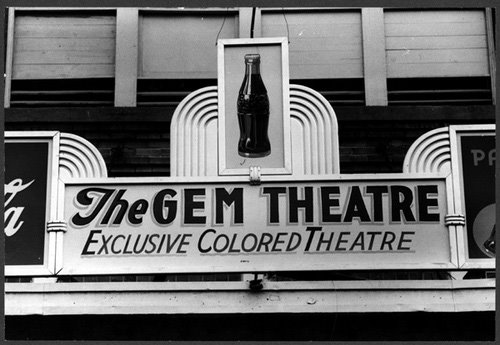
Essay 663


The apocalypse is definitely upon us with a MultiCultClassics Monologue…

• New Draft FCB Group CEO Howard Draft (pictured above) said, “A client told me that now, when I launch a product, I don’t have to call an army of agencies. … I can have one company that is great in all areas and drive my business from an ROI standpoint with highly creative solutions.” Um, there are just a few problems with this notion. FCB was never great in any area. Plus, Draft and FCB were never considered capable of delivering highly creative solutions. In fact, the press releases and interview quotes coming from this merger may be the most breakthrough hype either shop has produced in decades.

• Golf wunderkind Michelle Wie failed in her attempt to qualify for the Men’s U.S. Open. If Wie is permitted to try out for the men’s tournaments, what’s to stop someone like John Daly from joining the women’s competition just to pick up some easy beer money?

• The National Guard officially started working along the Mexican border on Monday, supporting the Border Patrol in stopping the flow of illegal immigrants. “It’s exciting to do something that’s relevant to the safety of the United States,” said one unit commander. “There is a sense of excitement when you are doing something real-world.” Actually, the real-world test happens once they set up a detention camp.

• Verizon will pay about $49 million to over 12,000 former and current employees, settling a lawsuit charging pregnancy discrimination. The legal action was originally initiated against Nynex and Bell Atlantic, Verizon’s predecessors. “This comes out of a different era,” said a Verizon spokesman. “The people who were here then by and large don’t work for the company anymore. We think our record today is exemplary, and this was not an admission of having done anything wrong. It is simply a matter of trying to get this behind us to move on.” Can you pay me now? Good.

• DMX should change his name DMV. The rapper-actor was pulled over in New York for driving at “unreasonable speeds.” Given his past violations, including crashing into an airport security gate and driving at over 100 mph, it’s pretty clear he has his own definition for “unreasonable.”

• On Monday, the Nicholas Minucci hate-crime trial featured a hip-hop guru who proclaimed that using the N-Word doesn’t mean you’re racist. “A white kid with gold fronts, sagging britches — he gets a pass,” said the self-proclaimed expert. “In this day and age, the sting has been taken away from [the N-Word].” Guess the defense will also try to argue that beating someone’s skull with a baseball bat is a common display of endearment among homies.

Monday, June 05, 2006

Essay 662


MultiCultClassics presents Diversity and Adversity…

This FedEx supplier diversity ad touts the headline, “Reliability Doesn’t Have A Color.” Chances are, the shipping company’s advertising agencies absolutely, positively do have a color: White.

Essay 661


Monday morning’s MultiCultClassics Monologue…

• Lark Voorhies (pictured above), former star of “Saved By The Bell,” filed a lawsuit against The National Enquirer. Voorhies says the publication of a 2005 story claiming the actress was being treated for a coke problem resulted in the loss of “potential acting and hosting jobs.” As if Voorhies didn’t lose the alleged opportunities based on, say, her “Saved By The Bell” performances.

• The nonpartisan Urban Institute conducted a study of taxes and immigrants in Washington. The results showed the area’s immigrant households match native-born Americans when it comes to paying taxes, but illegal immigrants contribute significantly less — paying less than $1 of every $5 they earn in taxes. But when you consider that many illegal immigrants are being paid “under the table” and many others are flat out lying about their employment status, one can only hope the study was not funded by taxpayers’ dollars.

• Bishop Tod. D. Brown, the most senior Roman Catholic leader in Orange County, caused controversy with a recent sermon calling for charitable immigration policies. “As Christians, Catholic Christians, we cannot let fear rule us,” Brown said. “Christ commands us to love one another — even our enemies. We cannot let the fear of losing jobs, of educating illegal immigrants, and healthcare costs be major reasons for promulgating laws that violate our Christian heritage.” Parishioners were divided by the comments. “My own personal opinion is the church should stick to spiritual matters,” one churchgoer said. “I just don’t think they need to be telling people how to think or vote. They sure shouldn’t be involved in politics.” Um, it’s a little too late to hope for that.

Sunday, June 04, 2006

Essay 660


MultiCultClassics presents Diversity and Adversity…

Despite Denny’s history of discriminating against minority diners, the restaurant chain celebrates differences in its supplier diversity ad. But let’s discuss the diversity commitments of Denny’s advertising agencies over a cup of coffee. To borrow the final line of this ad, the results could be stimulating.

Essay 659


Putting On The Sunday Best For A MultiCultClassics Monologue…

• “Black men in America today are deeply divided over the way they see themselves and their country.

Black men report the same ambitions as most Americans -- for career success, a loving marriage, children, respect. And yet most are harshly critical of other black men, associating the group with irresponsibility and crime.

Black men describe a society rife with opportunities for advancement and models for success. But they also express a deep fear that their hold on the good life is fragile, in part because of discrimination they continue to experience in their daily lives.”

That’s the start of the latest installment of “Being a Black Man” — a new series from The Washington Post. Click on the essay title above to check it out.

• If the proposed expansions go through, the Border Patrol may surpass the F.B.I. as the biggest federal law enforcement agency. But recruiting and training remains a difficult chore, especially with lots of officers being accused of misconduct. “This is not something where you can snap your fingers and have thousands go on the job,” said an analyst at the nonpartisan Migration Policy Institute. “It is a demanding job, and training is important and intense.” Which makes The Minuteman Project volunteers all the more pathetic.

• UCLA expects 4,852 freshmen this fall. But only 96 will be Black, which translates to about 2 percent — and for those wondering, 20 are recruited athletes. School officials are calling the situation a crisis. Maybe UCLA just needs to create a cooler drumline.

• A California jury awarded $61 million to a couple of FedEx drivers of Lebanese descent who accused a manager of harassing them with racial slurs. The abuse included being called “terrorists” and other epithets. The lawsuit charged FedEx with failing to enforce its anti-discrimination policies. FedEx officials called the award excessive, and the company plans to appeal. In other words, the drivers shouldn’t expect to have the money delivered overnight.

Essay 658


MultiCultClassics presents Diversity and Adversity…

[Advertisers love to hype their own diversity initiatives (see Essay 617). They also love bragging about their supplier diversity programs. Conversely, the advertisers’ advertising agencies — which technically could be considered suppliers — continue to demonstrate minimal interest in diversity. This week, MultiCultClassics spotlights a collection of supplier diversity messages from major advertisers.]

The Coca-Cola Company makes a promise “to benefit and refresh everyone who is touched by our business” in the supplier diversity ad above. Unfortunately, Coke can’t promise its advertising agencies will make similar commitments to supplier diversity. Although the soft drink giant probably tapped a minority shop to produce this lame concept.

Saturday, June 03, 2006

Essay 657


Around the world with a MultiCultClassics Monologue…

• “What does it mean to be a black man? Imagine three African American boys, kindergartners who are largely alike in intelligence, talent and character, whose potential seems limitless. According to a wealth of statistics and academic studies, in just over a decade one of the boys is likely to be locked up or headed to prison. The second boy -- if he hasn't already dropped out -- will seriously weigh leaving high school and be pointed toward an uncertain future. The third boy will be speeding toward success by most measures.”

That’s the start of a series from The Washington Post titled “Being a Black Man.” Click on the essay title above to check it all out.

• Folks in Germany are concerned about the blatant racism expected to erupt during the World Cup soccer finals. Minority players are routinely harassed by fanatical fans, facing verbal and physical threats on and off the field. Non-White World Cup visitors are even being warned to steer clear of certain areas in the country, as they may also become victims of discrimination and potential hate crimes. “It used to be violence, and violence is still a part of the picture at least in parts of Eastern Europe. But it’s now about race," said the director of Kick It Out, a London-based group focused on fighting racism in soccer. You know it’s bad when there’s a group solely dedicated to the issue. Somebody get Jesse Jackson and Al Sharpton a few soccer balls already.

• “We are racists, certainly,” said Isaac Humala, leader of the Peruvian Nationalist Movement. “We advocate saving the copper race (the Incan descendants in Peru) from extinction, disintegration and degeneration. Everyone is a racist, because nationalism is something that is in the blood, just like it is with the Japanese in Japan and the Germans in Germany.” Somebody get this guy to the World Cup soccer finals.

Essay 656


The following appeared in news sources nationwide…

---------------------------------------------------

‘CSI: NY’ star offers lessons for black youths

BY ERIN TEXEIRA

NEW YORK -- In Hollywood, even bad publicity is good publicity. But in the real world, the bad news about black men is overwhelming.

Actor Hill Harper of “CSI: NY” wants to help.

His first book, Letters to a Young Brother: MANifest Your Destiny, offers life guidance to black youngsters. It was written as e-mails sent between Harper and a young fan, and includes advice from the spiritual to the practical.

Harper’s advice starts with how to choose good friends and make school less tedious, even fun. One chapter helps readers make sense of being reared by a single parent, true for two-thirds of black children. There’s advice on how to impress girls, recover from mistakes and not get caught up in today’s bling-bling culture.

Not typical topics of conversation for a young actor looking to elbow his way into leading man roles. But Harper, 39, isn’t typical. He was studying economics and sociology at Brown University when he stumbled upon an acting class. He got a law degree and a master’s in public administration at Harvard, graduating cum laude, while going on auditions.

He recently talked about life and the new book.

Q. You’ve mentored black boys for years, and you often visit schools. Is that where the book idea came from?

A. Yes. About 18 months ago, two young men at a middle school in New York pulled me aside after I gave a talk. They said they wanted to go to college, but no one in their family had done that and they didn't have any money and they weren’t good at taking tests. “What can we do?” These were answerable questions, but I realized I can’t talk to every kid. I went home and started writing the book.

Q. The questions from your “young brother” are specific: “Hill, what if school is not for me?”

A. Those are all questions and issues that real young men have asked me personally. I write about my life lessons, but I bring other voices in, too. There are quotes from people like James Baldwin and Will Smith. I have an e-mail from the rapper Nas about being a man. I also have my professor from Harvard Law School, Charles J. Ogletree Jr., write about how he succeeded even though his parents didn’t finish high school. I want to show that these people can exist in the same place. They’re not mutually exclusive.

Q. That’s tough for a lot of kids to accept, isn’t it? Many black kids feel like being good in school is not cool. So much of “cool” today starts and ends with hip-hop.

A. My biggest problem with hip-hop: It doesn’t explain the journey. Rappers say, “I went from standing on the corner to riding in a limo.” But they don’t talk about the work they did to get there. I mentor a little boy, and a few years ago he said, “Hill, I cannot be happy unless I have a platinum Rolex and a Bentley with 20-inch rims.” He was dead serious. Where does a 9-year-old get that? It’s from TV and music videos.

Friday, June 02, 2006

Essay 655


Ludacris and assorted nutcases in a MultiCultClassics Monologue…

• Ludacris and Kanye West did not rip off other rappers’ rhymes, according to a jury ruling in the artists’ favor. The two stars faced a lawsuit by the rap group IOF, who insisted the hit “Stand Up” stole sections from IOF’s “Straight Like That” (see Essay 623). But the jury did not buy it, leaving IOF SOL.

• Lawyers on both sides of the R. Kelly trial requested that the public be barred from viewing the infamous video of the singer having sex with the allegedly underage female. They all argued that only the judge, jurors and lawyers should be permitted to watch, as the graphic material would ultimately embarrass the girl. Um, think we’re all beyond it at this point.

• Now that Draft and FCB are merging to form Draft FCB Group, it should be interesting to watch the inevitable culture clash. Most adfolks view the event as another sign that the apocalypse is upon us, while direct enthusiasts are cheering it as a monumental victory. From a creative perspective, it appears to be the marriage of a very ugly couple. “I don’t think the 30-second commercial will ever go away, but its value in the marketing mix has been diminishing,” Howard Draft proclaimed. “The consumer controls the experience now.” That’s right, Mr. Draft. And let’s remember that the consumer is currently tossing over 98 percent of your work directly into the trash.

Essay 654


Cosby needn’t look far to find fine black men

By Dawn Turner Trice

A few hours before entertainer Bill Cosby gave his recent commencement address at Spelman College, Atlanta’s historically black women’s college, I was sitting in the audience at a graduation ceremony across the street at the historically black men’s college, Morehouse.

I was there for Harold Lee Whack Jr., a young man I’ve watched grow up. Four years ago, he graduated from Homewood-Flossmoor High School and began his post-secondary education at Morehouse, majoring in international studies.

Around the world, Morehouse is perhaps best known as the alma mater of Martin Luther King Jr. It’s also known as the private liberal arts college that often graduates more black men at one time than any other college in the U.S.

What I didn’t know and wasn’t quite prepared for was just how moving the school’s 122nd commencement ceremony would be. (And not solely because I have a crush on actor Denzel Washington, who was in the audience on behalf of his graduating son.)

As is tradition, the ceremony began with the young men--decked out in their robes and Sunday best, and led by drummers--marching from the Martin Luther King Jr. International Chapel across campus to the quadrangle, where the ceremony is held.

We audience members viewed the pageantry of the march on two video screens over the stage.

We watched more than 500 graduates pass through the campus gate, which was closed behind them, symbolizing the end of an era. They were joined by alumni who held signs indicating the decade in which they graduated. Some went as far back as the 1930s.

It rained on and off that Sunday morning, but little could detract from the moment or these impressive men.

Perhaps this is why I was troubled when I later heard about Cosby’s comments to more than 500 Spelman graduates across the street.

According to a transcript, Cosby told the women that it was time for them to lead because too many black men were incapable of doing so.

He said, “The men as young boys are dropping out of high school, but they have memorized the lyrics of very difficult rap songs and they know how to braid each other’s hair.”

He said the black race depends on the young sisters graduating all across this United States.

It’s true that you don’t have to look far to find any number of grim studies or statistics regarding young black men. Here’s one: For every white male in prison who is college age, there are 28 in college; for black men, that ratio drops to less than 1 in 3.

Though statistics like these can no longer be ignored, they tend to overshadow the achievements of young black men who are marching forward.

During the Morehouse ceremony, we learned about a young man whose father died in the Sept. 11 terror attacks and another who spent part of his teen years in homeless shelters. Both still found a way to graduate Phi Beta Kappa and magna cum laude.

The class valedictorian, an English major who had a perfect 4.0 grade-point average, was a star athlete in high school but wanted to prove himself as a scholar. He graduated Phi Beta Kappa and summa cum laude. Although he has been accepted into Harvard Law School, he’s deferring his entrance a year so he can study and work in Asia.

Whack, my young friend, graduated Phi Beta Kappa and magna cum laude, and is heading to Northwestern University for a graduate degree in journalism.

This year, nearly half of Morehouse’s seniors graduated with honors. The students excelled in activities from mentoring to athletics. Many already have traveled the world.

What’s ailing black males is such a complex stew that some folks have reached the point of utter frustration. I understand this.

And I don’t deny that Cosby offered up some truths as he called on Spelman’s graduation class to step up. They should, but not because there are no brothers willing or able to do so.

Cosby knows better. He’s on Morehouse's board of trustees.

I agree that we can’t ignore the young black men who are falling behind. But neither should we disregard the ones who, in the face of all these negatives, are standing tall.

Thursday, June 01, 2006

Essay 653


Cool beans! It’s another MultiCultClassics Monologue…

• Carlos Sanchez, the actor who portrayed ‘Juan Valdez’ for four decades, is saying adios. He was probably tired of spending so much time playing second fiddle to a jackass. Now the national federation of Columbian coffee producers is seeking a replacement actor for the iconic character. We formally nominate Carlos Mencia.

• It really is hard out here for a pimp. Dave “Super Dave” Phillips hoped to launch a cable TV program showcasing his adventures in pimpdom. Instead, he was sentenced to 17 years in federal prison. Now he’ll be someone else’s bitch.

• New York City Councilman Peter Vallone Jr. has become famous for his war on graffiti. But now taggers are fighting back by spraying the man’s name all over the city, Internet message boards and more. Look for Sony to produce new graffiti-style ads for its PlayStation Portable product featuring Vallone-inspired characters.

• The American Association of Advertising Agencies hired a lobbyist to handle the diversity hearings proposed by the New York City Human Rights Commission. Members of the New York group planned to publicly probe adfolks and clients about the lack of diversity in the industry. Wonder if Carlos Sanchez will be asked to testify.

Essay 652


Toyota says: Rub your eyes if you want to, it’s a Camry.

Scratch your head if you want to, it’s a shitty ad.