Showing posts with label new york. Show all posts

Tuesday, April 08, 2025

17027: McCann New York, New Yank, New Yuck.


Adweek reported McCann NY nixed the Chief Creative Officer and Head of Growth roles, positioning the moves as restructuring designed to enhance nimbleness and better serve clients.


Is the reengineering an admission that White advertising agencies have too many levels of political power? Or is McCann simply preparing for the inevitable redundancy RIF—i.e., executing preemptive pruning before becoming collateral damage in the impending Omnicom acquisition of IPG?


EXCLUSIVE: McCann NY Eliminates CCO and Head of Growth Roles


Shayne Millington and Suresh Raj will exit the agency as McCann streamlines oversight under North America leadership


By Audrey Kemp & Brittaney Kiefer


McCann New York is eliminating its top creative and growth roles as part of a restructure that will place oversight under regional North America leadership, according to an internal memo sent to staff Monday and obtained by ADWEEK.


As a result, chief creative officer Shayne Millington and head of growth Suresh Raj will depart the agency at the end of the month.


The memo frames the changes as part of an effort to consolidate leadership under regional executives and prioritize roles directly responsible for delivering creative and strategic work.


“Our goal of partnering with our clients to help them find their truth and tell it well means our leaders and teams need to be closer to the work,” the memo reads. “To achieve this, we need to simplify our structure to reduce layers of leadership so that we can put more emphasis on roles that create the work.”


Millington, who has led McCann NY’s creative department for more than nine years, will not be replaced. During her tenure, she led work that made McCann New York the most awarded agency in the city at Cannes in 2023 and was named ADWEEK’s Agency All-Star Creative of the Year in 2024.


Britt Nolan, who joined McCann in January from Leo Burnett, will now oversee creative operations for North America, including the New York and Detroit offices. He will also join the agency’s executive leadership team and work alongside executive creative directors Leo Barbosa, Cuanan Cronwright, and Lance Parrish.


A spokesperson confirmed the changes to ADWEEK: “We are grateful for Shayne’s leadership over the years and for all that she’s done to help make McCann what it is today. We’re excited for what’s ahead with Britt at the creative helm, leading us into our next chapter.”


Meanwhile, Raj’s responsibilities will be absorbed by Michelle Tang, McCann Worldgroup’s North America chief growth officer, who is returning to lead the New York growth team in addition her regional oversight. Tang, who rejoins the executive leadership team, has played a key role in securing key accounts including TJ Maxx and Prudential, according to the memo.


The spokesperson also added that Raj chose to depart on his own terms to pursue a new opportunity.


“During his time with us, Suresh redefined how we approach new business, bringing in new brands for the network—and has been a champion for inclusivity and collaboration and pushed us to think bigger and bolder about how we grow,” the memo states.


The leadership shakeup comes amid ongoing business challenges for McCann, as the agency continues to cycle through high-profile client losses including Verizon and MGM Resorts.


The changes also come as IPG prepares for its proposed merger with Omnicom, announced in December 2024. The deal, which would create the world’s largest advertising holding company, is projected to generate $750 million in annual cost savings—likely through operational consolidations and reductions in overlapping positions.


“Please join me in welcoming Britt and welcoming back Michelle, and in wishing Shayne and Suresh all the very best in their new chapters,” the memo concludes.

Saturday, November 09, 2024

16834: Not Kidding With Kidneys.


Get answers to the headline from LiveOnNY.

Wednesday, June 26, 2024

16686: Adland’s Systemic Racism Repeats In New York, New York.

Mediapsssst at MediaPost spotlighted a report from the Center for an Urban Future (CUF) in New York City, presenting proposals to expand access to careers in Adland for New Yorkers of color.


Has this organization contacted the New York City Commission on Human Rights for a few pointers?


With all due respect, the CUF report reads like a student essay compared to the work done by the New York City Commission on Human Rights, along with Cyrus Mehri and the Madison Avenue Project.


Hard to imagine CUF will fare better than the aforementioned entities—who only achieved temporary success at best—as systemic racism has proven to be a powerful force in Adland. Plus, CUF is not being nearly as assertive in its ambitions. Time will tell.


Report: How To Fix Madison Avenue’s Diversity Problem


By Richard Whitman, Columnist


A new report from a New York City thinktank indicates that the advertising industry remains one of the least diverse sectors in the city.


That’s not new. The city has been complaining about poor Adland diversity numbers for decades.


What’s interesting about the report is some of the ideas it offers to improve the situation.


The report, from the Center For An Urban Future, recommends that city and state leaders expand access to advertising careers in New York City through a series of investments, including an “Advertising Talent Pipeline,” modeled on the successful Tech Talent Pipeline.


And the report also gives a shoutout to some programs that appear to be working like the 4A’s Foundation’s Multicultural Advertising Internship Program and “promising steps” taken by Horizon Media to combine career exploration in high schools with paid internships that lead to jobs.


The city and the industry should redouble efforts to “promote, replicate, and scale up industry efforts that are already working,” like the above-referenced efforts, per the report.

Sunday, October 15, 2023

16413: Do The Museum Thing With Spike Lee.


Muse by Clio spotlighted the “Spike Lee: Creative Sources” exhibit at the Brooklyn Museum, featuring over 450 items from the iconic director’s personal collection. The exhibit was curated by Kimberli Gant, whose father is Phil Gant—an adman with a resume that includes serving as Chief Creative Officer at BBDO Chicago for many years. Of course, the art show offers Lee an opportunity to hype his promotional products alongside museum stuff too.


Brooklyn Museum Explores Spike Lee's Creative Inspirations


Show features Knicks jerseys, Prince’s guitar and Gordon Parks’ photographs


By Christine Champagne


Thankfully for the Brooklyn Museum—as well as all of us who are interested in what makes one of the world’s foremost filmmakers tick—Spike Lee is an avid collector. “People know him as a filmmaker, and that is an aspect of who he is. But he is also a preserver of history and culture,” says Kimberli Gant, curator of the new exhibit “Spike Lee: Creative Sources.”


Which means that Gant had a treasure trove of artifacts relating to Black history, Lee’s family story, Brooklyn, sports, music, film and photography to draw from as she crafted the comprehensive and thought-provoking show. It displays more than 450 items exploring the people, places and ideas that have driven and inspired the director throughout his nearly 40-year career.


Among the wide variety of notable objects featured are a cast-iron bank from the late 1800s depicting three caricatured Black baseball players; Toni Morrison first editions; a portrait of Aaron Copland, one of Lee’s favorite composers, taken by legendary photographer Gordon Parks; a football jersey signed by Colin Kaepernick; Prince’s “love symbol” guitar; and the hot pink, double-breasted suit Louis Vuitton artistic director Virgil Abloh designed for Lee to rock at the 2021 Cannes Film Festival, where he served as the event’s first Black jury president.


An entire room of the exhibit is devoted to Lee’s New York Knicks memorabilia.


Also on display: the Oscar Lee won in 2019 for Best Adapted Screenplay for BlacKkKlansman, some of the director’s hand-written notes, as well as posters for his films Do the Right Thing, Jungle Fever, Bamboozled, Malcolm X and 25th Hour.


Michael Jordan played a big role in Lee’s entrée into the ad world, and No.23 is duly represented by autographed photos. The exhibit also incorporates kicks Jordan gifted to Lee, who famously directed and appeared with the basketball legend in iconic Nike ads from the 1990s. Lee played Mars Blackmon, his character from the breakthrough 1986 film She’s Gotta Have It.


Reflecting on the significance of Lee forming Spike DDB and bringing his cinematic world into to the ad space, Gant, who reveals that her dad was “an ad guy,” muses, “I think it reminds us that creators have always had what we would call the commercial side of themselves and the more avant-garde side.”


In addition to learning about the prolific director's many influences, Gant hopes visitors will take a moment to reflect on the people, places, events and media that inspire their own creativity.


“When people come to a show like this, I want them to be inquisitive. I want them to be curious about their own inspirations,” Gant says. “You are a complex human with a lot that fuels you, and sometimes you need to just take a moment to remember that.”


“Spike Lee: Creative Sources” is scheduled to run through February 4, 2024.

Sunday, May 28, 2023

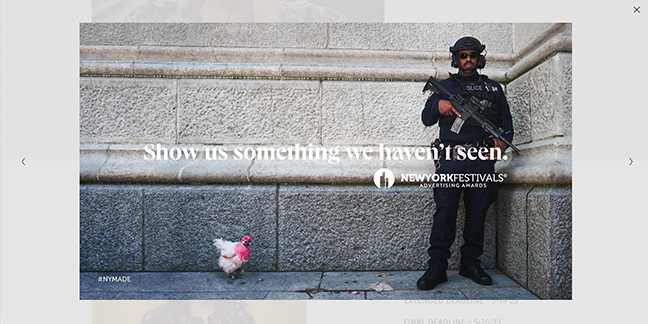
16267: New York Festivals Continue To Lower The Bar.


New York Festivals Advertising Awards perpetuates the peculiar paradox of advertising award shows being promoted with campaigns that are anything but award-winning ideas.


These ads perfectly combine mediocre copywriting with hackneyed art direction.


Bad Concept + Terrible Execution is the equation to avoid, no?


Friday, April 28, 2023

16232: Award-Worthy Cultural Cluelessness From Adland.

Here are more New York Festivals promotions with questionable content.


Does Adland really need more evidence of sexism and #MeToo issues—as well as insensitivity for social justice and activism? (Or could the lower image also be displaying insensitivity for gun violence?)


Wednesday, April 26, 2023

16229: Been There. Seen That. SMH.


This New York Festivals promotion underscores what Bill Bernbach said:


“Be provocative. But be sure your provocativeness stems from your product. You are not right if in your ad you stand a man on his head just to get attention. You are right if you have him on his head to show how your product keeps things from falling out of his pockets.”


The posting also underscores the peculiar paradox of advertising award shows being promoted with campaigns that are anything but award-winning ideas.

Thursday, November 24, 2022

16040: Happy Anti-Racist Thanksgiving.

The New York State Coalition Against Domestic Violence presents Decolonizing Thanksgiving: A Toolkit for Combatting Racism in Schools—a bountiful harvest of anti-racist resources.

Tuesday, March 24, 2020

14961: Pride Train On Track To Derail Anti-Asian Hate.

Adweek reported on the Pride Train campaign designed to combat anti-Asian hate and racism, which has spiked during the COVID-19 crisis. Gee, guess the Ad Council’s #AloneTogether propaganda isn’t working…

Faux Subway Posters Urge NYC Commuters to Curb Anti-Asian Hate

Campaign launched at the height of coronavirus-fueled xenophobia

By Mary Emily O’Hara

Two weeks ago, when people still left their homes and New Yorkers took the subway to work, Thomas Shim and Evan Choi snuck from station to station pasting up posters. With the Metropolitan Transit Authority (MTA) logo stamped in the upper right corner and the familiar phrase “Service Information” emblazoned across the top, the posters looked like official public notices from the city agency that operates one of the world’s most busiest commuter systems.

Featuring colors from the Chinese, Korean and Japanese flags, the official-looking announcements tell riders: “No ignorance, racism, or xenophobia allowed at this station at any time.”

But the posters weren’t officially sanctioned by the MTA. Instead, they are the latest guerrilla campaign by Pride Train, the same group that brought attention to LGBTQ Pride Month and racist attacks at subway stations is now tackling xenophobia related to the coronavirus.

Shim, one of the founders of Pride Train and a creative strategist at Instagram, told Adweek the inspiration for the latest posters came from the rise in anti-Asian attacks since the coronavirus pandemicstarted.

“As an Asian American, I’m hyper-aware of my surroundings, and I’ve felt watched,” said Shim, who has Korean and Japanese ancestry. “And it doesn’t help that some of my friends and neighbors have been yelled and spat at.”

Public attacks on Asian Americans and Asian immigrants began to ramp up in February, with reports of violence around the U.S. as well as internationally. One viral video showed a Chinese woman wearing a paper medical mask being chased, holding her arms up to block her face as a man threw things at her, and finally being violently grabbed and hit.

Less violent—but still impactful—forms of discrimination took hold quickly as the virus spread, with Asian American restaurants becoming deserted to the point where food bloggers started a #SupportChinatown campaign in an attempt to keep businesses open.

Choi, who is Korean and works as a freelance art director, said he’s experienced harassment mostly at later hours when subways and public areas are more deserted. “When I go outside around 9 or 10 [at night] when there are fewer people around, people have said things to me like, ‘Get out of the country,’” he said.

“Since Thomas and I started this project, I hear a lot from my Korean friends who say, ‘Thank you for doing this; I’m really afraid to go out and get harassed,’” Choi said. “Right now is the highest point of it. There’s a lot of misconceptions like, ‘Asians are the virus.’”

On Pride Train’s Twitter account, a photo of the recent posters was met with harsh responses that served as examples of why the campaign is needed. “The left are so ignorant they believe a virus is a race,” said one reply, seemingly clueless about the spate of violent attacks the campaign is trying to halt.

The majority of responses to the campaign have been positive, but Shim said he was surprised that some of the strongest negative feedback came from Asian and Asian American people on social media.

“The Chinese flag has a very heavy stigma attached to it,” said Shim. “A lot of our Vietnamese and Hong Kong followers found it to have [negative] connotations. We tried to see it as a national flag rather than a party flag, but obviously, people are reading into it.” Shim said that Pride Train understands why the Chinese flag—which is also the flag of the country’s communist party—is upsetting for many people.

The response has been a learning curve for the small group of creatives that are already accustomed to a certain amount of bigoted feedback.

“Just like I can’t fully understand what a trans person goes through day-to-day, I can’t understand what a Vietnamese person sees,” Shim said. “As we’re aiming for radical inclusivity, we are asking how to do it better.”

Sunday, November 11, 2018

14374: 12 Pillars For Black Soldiers.

From WKBW Buffalo…

Breaking ground on a new African American Veterans Monument

By Rebecca Thornburg

BUFFALO, N.Y. (WKBW) - The Buffalo and Erie County Naval Park is expanding. Twelve pillars representing the 12 American military conflicts will rise to recognize the African American soldiers that have fought for this country.

“We as African Americans have been shedding our blood for this country since its very inception,” Walter Cole, a Vietnam Veteran and Buffalo native said. He is proud that their will be a memorial that celebrates African American soldiers in Western New York.

The monument will have a brick foundation with names of fallen African American soldiers from Western New York with the 12 ten- foot pillars scattered around.

“May these hallow grounds be a place where all people may gather to remember that it was not just one gender, one race, not just one heritage, that served our country with bravery and loyalty,” Darius Pridgen, Buffalo Common Council President and U.S. Air Force Veteran said.

Vietnam Veteran Ken Stevens hopes the memorial will educate students on the African American soldiers that were once forgotten.

The construction on the monument will begin next spring and the African American Veterans Monument Committees plans to have the piece completed by Veterans day of next year.

Saturday, July 07, 2018

14220: Bad Times, Bad Idea.

TBWA\Chiat\Day in New York is responsible for this Brooklyn Film Festival campaign—with arguably culturally clueless credit being given for the creation of the Blues and Swing Dancing. The campaign also features a video with swing dancers during the Great Depression, and the cast doesn’t include a single Black person, but there is an Asian-American couple…?! Another video celebrates how urban decay led to graffiti. And both videos take an awkward swipe at President Donald Trump. The tagline reads, “Bad times make great art.” Um, not in the case of this campaign.

Tuesday, April 10, 2018

14102: Chinatown Colonization…?

Advertising Age spotlighted a startup agency—Chinatown Bureau—headquartered in New York’s Chinatown. Chief Strategy Officer Marie Berry said, “In New York’s Chinatown, there is this common belief that tomorrow is better than today. ... It’s more so a mindset than a location. We believe it’s really the combination of heritage and [a] forward-looking spirit.” Okay, but what’s with the agency founders’ portrait featuring an oh-so-urban background? It doesn’t seem to appropriately represent Chinatown or an agency offering forward-thinking digital products and consulting. Rather, it looks like another example of appropriating Black culture—as if the founders want to holler, “Hey, look! We’re cool!” Better hope the graffiti isn’t communicating something nasty or inappropriate too.

Chinatown Bureau offers new ‘operating system’ for agencies

By Megan Graham

A pair of WPP expats have their way, agencies and marketers of the future will use an “operating system” that’s as integral to the creative process as Snow Leopard is to a MacBook Pro.

Paul Miser and Marie Berry, who worked together at WPP’s Hudson Rouge on Lincoln Motor Co.’s connected consumer relationships business, are opening Chinatown Bureau, a combination digital product studio and consultancy based—you guessed it—in New York’s Chinatown.

Chief Strategy Officer Berry says Chinatown Bureau is eyeing a five-year timeline to build products that tackle inefficiencies she and CEO Miser struggled with while working in the ad business. “We have a ton of problems that we’ve experienced,” Berry says, in areas including resourcing and talent management, “uninspired” briefings and overall workflow management.

The first tool they’re building is a martech product they say will help companies ensure consistent branding. Companies would be able to run assets through the automated system to ensure that brand imagery follows guidelines for logo, font, colors and style of photograph. Chinatown Bureau says it’s working with audio brand Beats by Dr. Dre on the product and plans a pilot with the marketer in the fourth quarter. The marketer wouldn’t comment on the relationship.

Miser says he expects to have enterprise-type solutions for larger clients, as well as a way to open up application programming interfaces so other agencies or other developers can build on top of the products. The company also wants to have a self-service model for companies that need a more affordable option.

“Having worked in the largest networks of communication agencies, we see the barriers for small and midsized companies,” Berry says.

In the meantime, Miser is leading the consultancy side of the business, which offers everything from user experience and design to revenue modeling. Clients on that side include OpenFin, a fintech startup.

“In New York’s Chinatown,” says Berry, “there is this common belief that tomorrow is better than today. ... It’s more so a mindset than a location. We believe it’s really the combination of heritage and [a] forward-looking spirit.”

Sunday, March 04, 2018

14052: Job Insecurity In Adland.

The recent AgencySpy postings depicted above show the state of job security in adland. At 3:31 pm, the blog noted TBWA\Chiat\Day New York welcomed a new Head of Integrated Production. About two hours later, it was announced that the White advertising agency cut staffers. These days, updating agency org charts and employee directories warrants a full-time employee.

Thursday, March 01, 2018

14047: Droga5% Reduction.

Advertising Age reported Droga5 dumped 5% of its New York workforce, including several HR staffers. Wonder if the HR wonks were quietly released as a result of the internal investigation by an outside firm versus reductions in billings. The scenario also shows why the advertising industry struggles to recruit and retain talent. After all, even at the allegedly successful White advertising agencies, you can witness someone get fired after an internal investigation or when a mattress company cuts its marketing budget—and the innocent usually lose their jobs quicker than the sexual predators.

Droga5 Lays Off 5 Percent of New York Staff

By Lindsay Stein

Droga5 has laid off about 5 percent, which is approximately 40 people, in its New York office.

The layoffs were across all major departments at the agency, including several people in HR. Droga5 declined to comment on specifics around the job cuts.

“Droga5 has made the difficult decision to reduce its workforce in New York by approximately 5 percent in order to reshape the business in line with current business demands,” an agency spokeswoman said in a statement. “We express our gratitude to the affected employees for their many contributions to Droga5.”

According to people with knowledge of the matter, two Droga5 clients — Tencent and Mattress Firm — have significantly reduced their scope of work with the agency recently. Droga began working with both companies in the middle of last year.

Mattress Firm did not respond to calls for comment. Tencent was not immediately available for comment.

The staff reduction also follows Droga5 parting ways with Chief Creative Officer Ted Royer after putting him on leave and hiring an outside firm to handle an internal investigation in the shop’s HR processes earlier this month. In late January, Droga held meetings throughout the agency to discuss HR matters.

Monday, February 26, 2018

14036: BHM 2018—NYU.

The school dining hall served BBQ Ribs, Mac & Cheese, Mashed Sweet Potatoes, Collard Greens, White Rice, Lima Beans and Corn Bread—along with red Kool-Aid and watermelon-flavored water—for BHM at NYU. WTF. Get the FYI at CNN.

Friday, July 28, 2017

13767: Google, Silence Yourself.

The Google Doodle for July 28 salutes the 100th anniversary of the Silent Parade in New York that covered Fifth Avenue to—appropriately enough—Madison Avenue. “Today’s Doodle commemorates the 100th anniversary of the Silent Parade,” explained Google, “and honors those whose silence resonates a century later.” Not sure what that last line means. Modern-day Madison Avenue doesn’t have enough Blacks to execute a line dance, let alone a parade. And when asked about its Black representation, Google resorts to being silent.

Friday, April 14, 2017

13640: Fearless Girl Follies.

The artist behind the “Charging Bull” sculpture on Wall Street is demanding that “Fearless Girl” be removed, as the new sculpture is messing with the original meaning of his work—which was intended to symbolize freedom, peace, strength, power and love. Of course, all the diverted diversity defenders are lashing back at the artist. But the truth is, the bull creator is right. Like it or not, “Fearless Girl” is a sponsored advertising stunt. Besides, there are other NYC locations where she could be positioned to make an even bolder declaration of fearlessness.

Stand before Fox News headquarters to protest Bill O’Reilly’s sexual harassment.

Face off with Trump Tower to generate a huge political statement.

Hey, why not bring attention to the discriminatory dearth of diversity in the advertising industry by returning to her birthplace at McCann New York?

Wednesday, March 29, 2017

13613: V&F Is B&S.

Adweek published a lengthy piece on a Grey London stunt intended to spark industry-wide diversity. What’s the breakthrough concept? Rename the agency after its founders—two White men of Jewish descent—who opened the flagship New York shop in 1917 when anti-Semitism was prevalent. Okay, but in that very same year, Blacks held a silent march in Harlem to protest getting lynched, beaten and burned. Lawrence Valenstein and Arthur Fatt feared their names could cost them business. Blacks feared their skin color could cost them their lives—and it would take 30-40 years before Blacks would actually be hired at New York advertising agencies. Oddly enough, the Grey London scheme is intended to woo racial and ethnic minorities. So to perhaps offset all the Old White Guys imagery, the bold initiative includes minority scholarships and high school outreach efforts. Gee, how original. Sorry, but even in 2017, White men of Jewish descent have a much better and easier chance of landing jobs at Grey London than racial and ethnic minorities—and this would still be the case if the shop suddenly hired Gustavo Martinez as its CEO.

Grey London Renames Itself Valenstein & Fatt, After Grey’s Jewish Founders, in Call for Diversity

Office will take the name for 100 days, urges industry to change too

By Tim Nudd

Grey London is using the agency’s own 100-year-old origin story as a springboard for an industry-wide call to embrace diversity and acceptance via a self-branding campaign, launching today, in which it will rename itself, for more than three months, as Valenstein & Fatt, after its Jewish founders.

It’s 1917. New York is booming. Two young Jewish entrepreneurs, Lawrence Valenstein and Arthur Fatt, set up a company. But anti-Semitism is rife. Their names could cost them business. So they call it Grey, after the color of the wallpaper.

The London office will fully operate as Valenstein & Fatt—changing its office signage, stationery and business cards, answering its phones that way, even operating under that name in pitches—for the next 100 days.

The initiative is happening just as the British government is triggering Article 50 and begins the process of disconnecting the U.K. from the European Union. It is also launching as “xenophobia is raising its ugly head once more, along with political isolationism,” the agency adds.

Also, the symbolic gesture of the name change is being backed up by more concrete plans, including the following steps, in the agency’s own words:

1) We are publishing our diversity data. Progress cannot be made without clear measures and transparency about who we are today. Our new study is independent and in-depth and is based on the voluntary responses of 305 individuals, which represents over 60 percent of the agency and reported according to standards set by the British Office of National Statistics (ONS). Research developed in partnership with PSB examines roots, identity, education and lifestyle. It will be measured and shared annually and we are encouraging other agencies to take it up as their methodology.

2) We are launching a cross-industry taskforce to identify the barriers to recruitment and retention of talent among ethnic minorities. The first gathering will be co-chaired by Trevor Philips OBE and CEO Leo Rayman, and we are inviting leading organizations in this space and the most progressive agencies, including chairwoman of Mediacom, Karen Blackett, to join us in agreeing industry-wide initiatives and targets. We will also commit to targets for our advertising output, to ensure that it is nationally representative.

3) We are launching the Valenstein & Fatt Bursary to pay a year’s rent for up to two young people from ethnic minority and disadvantaged backgrounds. To qualify, candidates must have been offered a job at Grey, be state educated and live outside of greater London. Applications are open from this summer.

4) We will inspire the next generation, by working with 100 primary and secondary schools to introduce students to a career in the creative industries. Working with exec head Michelle Williams and education therapist Jodie Cariss and starting with the New Wave Federation primary schools in London’s Hackney, we will offer a tailor-made program for the schools involved, from assemblies to full-day workshops, coaching and agency open days.

5) We will develop our diverse talent. Recognizing that recruiting people with different start points isn’t enough, 50 individuals identified as ones to watch will be matched and formally mentored by our executive and senior leadership. In parallel we will run community mentoring workshops open to any member of the agency who wants to participate.

[This video explains more about the project.]

Adweek spoke to Sarah Jenkins, chief marketing officer at Valenstein & Fatt, about the initiative.

Where did this idea come from?

We’re an agency that is feeling the craziness of the last 12-18 months. The world feels a little bit uglier. A little bit less welcoming. So we wanted to make sure we were celebrating difference. And getting diversity right into the heart of our organization. Coincidentally it’s a big year for Grey this year—100 years old. So the Valenstein and Fatt story feels relevant and meaningful in the context of business and society today. Subsequently celebrating them, and telling their story, was the right way for us to make a definitive statement about our diversity commitment moving forward.

While a great gesture, this idea will also clearly cause confusion here and there. Is dealing with that confusion an embodiment of the kind of hard work needed to commit to diversity?

It’s definitely got some risk, but good ideas are hard work and generally require a healthy kick of bravery. Which is a lovely parallel with the spirit of our founders. It definitely helps that we are in the communication business, so hopefully, for the vast, vast majority of the time, we can avoid confusing people.

Tell us why the concrete steps you are also taking will make a difference.

We should first talk about what we are going to get wrong. Diversity is complex, nuanced and gnarly. So they might not all make the difference we are wanting. We’ll fail fast and go again and tell everyone what’s gone wrong, so they don’t make the same mistake.

That said, we have worked hard to get our first initiatives right. We have talked to some brilliant and smart organizations like Channel 4 and the Social Mobility Foundation. Progressive agencies like Mediacom. People who have spent years thinking about the problem and the solutions, like Trevor Phillips. And we’ve backed our own instincts.

When you break down the initiatives, it’s hard not to see them working in some form. One-hundred schools. That’s at least 1,000 kids we are going to hang out with, possibly closer to 5,000 or even 10,000—how can they not help inspire kids to stay curious and think about a career in our industry?

A bursary to help kickstart your first 12 months in—how can they not help us attract some of the best state-educated kids in the country?

Dedicated time and investment to ensure all our diverse talent are able to develop and a clear leadership program to ensure all the glass ceilings are smashing and stay smashed—how can that not inspire the next generation of young leaders, no matter what their background and who they are?

Working with the best agencies and businesses in our industry to push the diversity agenda, so that the smartest, most creative minds are applying themselves to a big gnarly comms and behavioral challenges—how can that not shift the diversity dial in ad land?

What metrics will you look at to gauge the improvement in diversity, both at Grey and across the industry?

As an agency, we will gauge success by seeing more diverse talent coming into the building. And that is any diverse talent. We would love to encourage more people from BAME backgrounds. And more people who are state-school educated. To have more diverse talent identified as future leaders. Future leaders we then keep in our agency, or at the very least we keep in the industry.

As an industry… for agencies to stop fudging their diversity numbers and realize that diversity is a genuine commercial win, not a marketing headline or some weird, point scoring exercise. For advertising to be seen at the forefront of diversity in business, particularly in attracting the best young talent. I mean, fair play to the accountancy firms for leading from the front, but surely, with our insane communication and creative skills, we should be helping them set the bar, not be running behind them.

Wednesday, February 22, 2017

13563: Tinny Titanium.

Campaign reported Titanium Worldwide (a minority-owned collective headquartered in New York City) tapped member Ten35 (a shop with offices in Chicago and Houston that focuses on multicultural and generational audiences) to help Mercedes-Benz woo Blacks in Atlanta. The scenario underscores the advertising industry’s diversity zaniness on multiple levels. That is, a minority-owned collective headquartered in New York City—which has a Black population of about 25%—must recruit a shop with offices in Chicago and Houston—which have respective Black populations of about 36% and 25%—to service a client in Atlanta—which has a Black population of about 54%. Mercedes-Benz couldn’t find a qualified agency in Atlanta, where Blacks essentially dominate? To top it all off, the photo illustrating this news story featured a White woman. Perfect.

Meet the minority-owned collective fueling Mercedes-Benz’s African-American outreach

By Kathryn Luttner

Titanium Worldwide catered to the LGBT community first; now, it’s after Atlanta residents for the automaker.

It’s not often that a football team gets to play their first game in a new stadium as reigning world champions. But with their appearance in the Super Bowl this Sunday, the Atlanta Falcons could be exactly that when they christen Mercedes-Benz Stadium next season. This stroke of luck wasn’t part of Mercedes-Benz USA’s original plan to win over Atlanta residents, but for VP of Marketing Drew Slaven, it doesn’t hurt the brand’s chances in a town where the automaker is planting some serious roots.

The initiative, titled “Take Back Atlanta,” began two years ago when Mercedes-Benz moved its American headquarters from Montvale, N.J., to an Atlanta suburb. That same year, the brand bought the naming rights to the Falcons’ new stadium, making it the second to bear the Mercedes-Benz name (the other is the Mercedes-Benz Superdome in New Orleans). Now, the automaker has tapped Chicago and Houston-based marketing agency Ten35 (part of minority-owned collective Titanium Worldwide) to connect with African Americans in its new hometown.

To be clear, Slaven doesn’t like the term “Take Back Atlanta”—even though the phrase originated from the automaker—because he said, Mercedes-Benz is the best-selling luxury automotive brand in town, so “there’s nothing to take back.” Although it isn’t entirely focused on the African American community, that is a big factor. “In our new home, we want to not simply be No. 1, we really want Atlanta and Mercedes-Benz to go hand-in-hand,” Slaven said.

If you haven’t heard of Titanium Worldwide or read about Mercedes-Benz’s big push into the African American community, it’s all part of Titanium CEO Robyn Streisand’s plan. She takes a “walk, crawl, run” strategy to business—and her own collective of minority-owned agencies is a testament. Titanium Worldwide soft launched in 2013, but Streisand, an LGBT entrepreneur (and Barbara’s second cousin), didn’t announce it until last year, because she wanted to “prove the model. Holding companies are watching us.”

That model, she said, bloomed from a frustration she encountered after 20 years at her own marketing agency The Mixx. Fortune 500 companies regularly approached for small jobs, she said, but when it came to the big campaigns, the argument was always the same: minority-owned businesses simply didn’t have the depth—in talent, money and resources—to do the job. So Streisand interviewed more than 150 agencies across the United States and landed on 17 to form Titanium. “There’s no overlap in skill sets,” Streisand said proudly. “Everyone has their own lane.”

And yet, there’s one point of contact and one P&L (while maintaining 17 individual agencies), which was one of the attractions for Mercedes-Benz who had been a client of The Mixx for 10 years. (The other, Slaven said, was authenticity. “When you want to talk to a community, to work with a provider that understands that [community]—that lives that [community]—is really important,” he said.) That single point of contact is something agencies are increasingly looking to provide, as witnessed by recent client-centric restructurings from Publicis and Ogilvy.

In 2015, the community that Mercedes-Benz zeroed in on was LGBT. That same year, the U.S. Supreme Court ruled to legalize same-sex marriages, so the timing was no coincidence. Titanium developed a year-long strategy of print and digital advertising, in addition to paid social media and an event at the New York International Auto Show, to deliver 2.2 million digital impressions and 135 percent increase in brand mentions on gay news websites.

Plus, the National Gay Media Association awarded Mercedes-Benz the top honor in its automotive category at its first Ad POP Awards (POP stands for Pride in Online and Print). In the end, Streisand said marketers have thanked her for “getting corporate to wake up and smell the coffee.”

“It can’t be that you’re just advertising at Gay Pride,” she said. “You want 100 percent on the HRC Equality Index. One and done at Pride is not enough anymore.”

Fast forward to 2017, and Ten35 is implementing Streisand’s “walk, crawl, run” strategy to its Take Atlanta Back initiative. Sherman Wright, managing partner and COO of the agency, said the campaign won’t be a one-off effort. While it’s still in development, Wright said to expect “heavy digital components and an experiential element” that connects personally with the communities of Atlanta.

“What’s important to understand is the African American community is not this monolithic community,” Wright said, adding that it’s important for marketers to understand the nuances. “You look at things such as accomplishments and that values are placed in achievement. Making sure the idea of luxury comes through this idea of achievement” is extremely important to African Americans, so look for Mercedes-Benz and Ten35’s work to pay “homage to that journey and the hard work and commitment that goes into it.”

If successful, Wright said the carmaker will expand this African American initiative nationwide, taking the minority-owned collective along with them—proving that together, minority-owned agencies can tackle the big jobs.