Friday, June 24, 2016

13233: Smoking Weed.

Campaign reported Unilever Chief Marketing Officer Keith Weed declared during a Cannes speech that his company would cease portraying “vacuous” women in advertising, citing research showing women preferred progressive depictions in campaigns. Can’t wait to see how Axe will evolve. After making his bold statements, Weed probably rushed off to the VaynerMedia party.

No more ‘vacuous’ women in ads, says Unilever’s Keith Weed

Unilever has pledged to stamp out female stereotypes in its ads, after finding more progressive campaigns play better with their target audience.

Speaking at Cannes Lions 2016, chief marketing officer Keith Weed unveiled internal Unilever research analysing 1,000 ads from different countries and found 50% contained stereotypical portrayals of women.

This is not a moral issue, it’s an economic issue. We will create better advertising if we create advertising that is more progressive and start challenging those stereotypes

Just 1% conveyed women as funny, 2% showed them as intelligent, and 3% showed them as leaders.

The research examined Unilever’s own advertising output, split into “progressive” and “normative”, and found that the more progressive ads resonated better with audiences. According to Weed, the ads had 12% greater impact, in terms of consumers actively enjoying and feeling involved with the ads.

“These are all big swings,” he said. “This is not a moral issue, it’s an economic issue. We will create better advertising if we create advertising that is more progressive and start challenging those stereotypes.”

Weed described Unilever’s move towards “unstereotyping” after coralling the views of its internal marketers and agencies.

“We are going to start moving in this direction,” he said. “First of all, we’ll look at the role of women in our advertising, and we don’t want women to have a secondary ‘at service’ [role] to product news.

“We want to move to women who are full, authentic and have an aspirational achieving focus.”

Unilever will also challenge “vacuous, blank, agreeable and thin” personality stereotypes, instead moving to three-dimensional portrayals of women.

And finally, it will move away from one advertising view of women, moving to a more “enjoyable”, non-critical reflection of women.

Weed shared images of Sunsilk shampoo, popular in Asia, which featured images of a woman wearing a headscarf.

Weed acknowledged the gender stereotyping of men in advertising, but said Unilever would focus on women as its target audience is predominantly female.

His comments come a year after the launch of the Glass Lion at Cannes, which is awarded to campaigns that fight gender stereotypes.

Unilever has yet to be nominated for a campaign, with rival P&G this year picking up a nomination for its Persil India ‘Share the load’ campaign, and last year winning a gong for the Always ‘Like a Girl’ spot.

There was only one nomination from the UK for this year’s Glass Lion category, for AMV BBDO’s Guinness spot, featuring gay rugby player Gareth Thomas.

Thursday, June 23, 2016

13232: Gallop’s Goofy Gripe.

Adweek reported Cindy Gallop complained about the Bayer advertisement depicted above, calling it a nasty example of the work created by our “male-dominated ad industry” and awarded by “male-dominated juries.” Okay, but earlier in the week when Gallop was hyping her Make Love Not Porn bullshit, she declared, “So, please film the sex you’re having at Cannes, and it will transform you and your sex lives!” Plus, how does Gallop know the headline isn’t quoting a female?

Cindy Gallop Calls Out ‘Male-Dominated Ad Industry’ for Giving This Ad a Bronze Lion at Cannes

Work from Bayer, AlmapBBDO

By Kristina Monllos

Cannes Lions has its second cringeworthy moment, this time from a Bronze Lion winner.

The outdoor ad, for Bayer from AlmapBBDO in Sao Paulo, reads “Don’t worry babe, I’m not filming this.mov” and features aspirin boxes.

Cindy Gallop, the former agency exec and vocal women’s advocate, has again brought attention to Cannes Lions ceremony tweeting a photo of the ad and commenting, “Don’t use this to sell aspirin, male-dominated ad industry [and] don’t award it, male dominated juries.”

“We have asked that BBDO discontinue any further use, dissemination or promotion of this campaign,” said a spokesman for Bayer.

He added, “The concept was presented to our local marketing team in Brazil by BBDO as one of several campaigns that the agency intended to submit for this year’s Cannes Lions festival. In order to meet the requirements for submission to Cannes, BBDO paid for limited placement in Brazil. Bayer has not advertised Aspirin through any channel in Brazil for several years.”

A group of female Brazilian creatives brought the ad to Gallop’s attention, who according to Gallop, were “very unhappy about it, particularly given this very recent, high-profile and utterly appalling case in Brazil.” The Brazilian case referenced deals with a 16-year-old girl who was allegedly gang raped by 30 men who also took pictures of her and posted them on social media without her consent.

“Work like this is still being approved and awarded because our industry and especially creative leadership, creative departments and creative awards juries are dominated by men,” said Gallop.

Gallop added: “I am regularly contacted by both women and right-thinking men in our industry, who share with me things that need calling out but which they are too afraid to call out themselves for fear of retaliation (rightly so—I also regularly get stories of such retaliation).”

The Bronze Lion was awarded to AlmapBBDO for three outdoor ads, including the one reference in the tweet as well as two other iterations; “It’s ok, I’m not taking any notes.doc” and “Relax, it’s not like this is being recorded.mp3.”

A spokesman for BBDO referred Adweek to Bayer for comment.

13231: Off The Wall With 180LA.

AgencySpy spotlighted a spot for 360FLY by 180LA that is 110% culturally clueless. If anyone is wondering how such a mess could ever get out of an agency without being questioned, well, just view the 180LA leadership exclusivity.

Wednesday, June 22, 2016

13230: Self-Seeking & Selfishness.

Adweek reported the Cannes Lionesses are seeking the “original Peggy Olsons” at Cannes. “We’re trying to find the first Lionesses, the original Peggy Olsons,” purred a Cannes Lioness. “Cannes has an amazing archive, but the data on female creatives doesn’t go that far back. They started in 1954, but [information about female creatives] from that date isn’t available. So we’re going to have to do a proper bit of detective work to find out who the original Lioness was.” Yes, let’s salute all the noble White women who blazed trails and—like their White male perpetrators/counterparts—completely ignored the people of color facing far more discrimination. Maybe the next sleuthing will uncover the original Dawn Chambers and Hollis.

2 Female Agency Creatives Are Trying to Track Down the ‘Original Peggy Olsons’ at Cannes

Finding the first Lionesses

By Kristina Monllos

Last year, after winning their first Cannes Lion, a pair of creatives from Mcgarrybowen in London, Holly Fallows and Charlotte Watmough, started a movement called Cannes Lionesses to champion female creatives at Cannes. This year, the women are back, and they’re on a mission to find the first female creative winner of the Cannes Gold Lion.

“We’re trying to find the first Lionesses, the original Peggy Olsons,” Fallows told Adweek. “Cannes has an amazing archive, but the data on female creatives doesn’t go that far back. They started in 1954, but [information about female creatives] from that date isn’t available. So we’re going to have to do a proper bit of detective work to find out who the original Lioness was.”

Fallows added, “We want to create this definitive list [of female creative Cannes Lions winners] from 1954 to 2016 so that we get this archive of amazing female creative talent that are winning awards. It’s to inspire people, really.”

During their time at Cannes this year, the duo is conducting interviews with past Cannes Lionesses including Grey’s Vicki Maguire, and Saatchi & Saatchi’s Kate Stanners and Rosie Arnold.

“We’ve set up loads of interviews with past winners, and we’re going to track down the winners from this year and interview them so the website can be more of a source of inspiration and motivation,” said Fallows.

Fallows and Watmough are also hoping anyone who knows of or has information about the first Cannes Lioness will reach out to them. They’re using the hashtag #canneslionesses on social media to spread their message.

“We were obviously aware that there’s a gender imbalance in the industry, but within our agency, it’s never been an issue,” said Fallows. “Winning the award made us realize, when we saw everyone walk up on stage and there weren’t any females, that’s when the penny dropped.”

Tuesday, June 21, 2016

13229: Cannes Lionesses And Liars.

Campaign published a call-to-arms from Cannes Lionesses—an example of diverted diversity worthy of a Glass Lion. Or an ADCOLOR® Award, at least. “The lack of senior female creative blights the industry and affects the work,” declared the Cannes Lionesses. “Without them the work simply does not represent the diversity demanded by today’s society. And that’s not what our clients want or what our consumers need.” Of course, the womanifesto does not extend its convictions to racial and ethnic diversity. Given that the predominately White women comprising the organization have likely done little to nothing to promote real diversity throughout their careers, this grand endeavor seems a tad narcissistic and hypocritical. The Lions and Lionesses could benefit from inviting a few Black Panthers too.

Cannes Lionesses hunt first females to take on the Lions

A lot of heat — but not a lot of light — has been generated by the gender diversity debate in advertising.

It is right for us as an industry to bemoan the lack of agency female representation, particularly in creative departments.

But we must do more

The lack of senior female creative blights the industry and affects the work. Without them the work simply does not represent the diversity demanded by today’s society. And that’s not what our clients want or what our consumers need.

The time has come to point out the obvious and truly celebrate female creativity; to ram home the reasons as to just why it is vital that the industry is more gender representative; to inspire the women who we hope will follow in our footsteps in ever increasing numbers.

On the prowl

Too few of us consider a career in creative, put off, perhaps, by its reputation as a “Mad Men” all boys club instead of championing our inner Peggy Olsons. Too many find it a struggle too far to clamber up the industry’s greasy pole and land those coveted senior creative roles. It’s not about tokenism; about employing or promoting women for women’s sake. It is more, much more, than that — about realising that an industry with too few senior females on board is missing out on so much. With more women that matter involved in creating advertising, the creative bar is set higher for everyone, men, women, clients, agencies and — ultimately — the consumer.

So where better to lead the charge than at the Cannes Lions International Festival of Creativity, the world’s most prestigious and publicised celebration of advertising (and more)?

For the second year running, two creatives at Mcgarrybowen London are proud to host the Cannes Lionesses — a website that celebrates and champions female creativity.

This year we’re going large — broadening and expanding the site to get even more women involved in the conversation.

Striking gold

By shining a light on brilliant and award-wining creativity we hope to shift the dial from the 267 female Cannes Lions winners last year (from a pool of thousands) to something rather more representative.

Our mission, in fact, is to seek out those first ever female creatives to strike Cannes gold.

The ambition of the website www.canneslionesses.com is to document all of the Cannes Lionnesses to have picked up metal from the festival’s launch in 1954 to the present day.

We will film this year’s crop of female Cannes winners and are sharing interviews with high profile winners from previous years and from across the globe.

Grey’s Vicki Maguire, Kate Stanners of Saatchi & Saatchi and Rosie Arnold, soon to join AMV BBDO from BBH, are among the (too few) female luminaries to be involved from the UK.

By offering advice and career tips to today and tomorrow’s crop of female creatives we hope to inspire women to push for their rightful places at Adland’s top tables.

But we can’t do it alone. We want — need — the advertising and wider marketing industries (including, yes, men) to join the conversation by using the hashtag #canneslionesses on social channels. We need them to get their rolodex out, ask their old boss to search out the first female Lions winners from back in the day and help us make the list complete.

You can also find Cannes Lionesses on Instagram and Twitter. Come on Cannes, help us roar!

Monday, June 20, 2016

13228: Johnson Publishing Quits Publishing.

From The Chicago Tribune…

Johnson Publishing sells Ebony, Jet magazines to Texas firm

Johnson Publishing sells magazines that have chronicled African-American life since 1945

By Robert Channick • Contact Reporter

After a 71-year run in Chicago, Johnson Publishing is getting out of publishing.

The company said Tuesday it has sold Ebony, its iconic African-American lifestyle magazine, and the now digital-only Jet magazine to Clear View Group, an Austin, Texas-based private equity firm, for an undisclosed amount.

Johnson Publishing will retain its Fashion Fair Cosmetics business and its historic Ebony photo archives, which remains up for sale. The deal, which closed in May, also included the assumption of debt.

A family-owned business throughout its history, Ebony has documented the African-American experience since it first hit newsstands in 1945. It has shaped culture ever since, coming into its own as it reported from the front lines of the civil rights movement during the 1960s in powerful photos and prose.

In recent years, though, Johnson Publishing has seen declining media revenues as it struggled to evolve from print to digital platforms.

Linda Johnson Rice, chairman of Johnson Publishing and daughter of founder John Johnson, will serve as chairman emeritus on the board of the new company.

“This is the next chapter in retaining the legacy that my father, John H. Johnson, built to ensure the celebration of African-Americans,” she said in a statement Tuesday.

The new publishing entity, Ebony Media Operations, will maintain the magazine’s Chicago headquarters and its New York editorial office, as well as much of the current staff, according to Michael Gibson, co-founder and chairman of African-American-owned Clear View Group.

It is the first investment in the publishing business for Clear View.

“We made this purchase because this is an iconic brand — it’s the most-recognized brand in the African-American community,” said Gibson, 59. “We just think this is a great opportunity for us.”

Cheryl McKissack, who has served as chief operating officer since 2013, will assume the role of CEO of the new publishing entity under Clear View, operating out of the magazine’s Chicago office. Kierna Mayo is stepping down as editor-in-chief of Ebony to pursue other opportunities, Gibson said.

Chicago-based Kyra Kyles, who has headed up digital content for Ebony and Jet since last June, will add the role of editor-in-chief of Ebony, Gibson said.

“When we make an investment, that’s what we look for — a strong team that can actually run the company,” Gibson said. “We’re not managers or experts by any stretch of imagination in the media business. What we bring to the table is very strong networking and the ability to raise financing and the ability to establish a vision for the company.”

Desiree Rogers, the former social secretary for President Barack Obama who has been steering Johnson Publishing since 2010, will remain CEO, focusing on the cosmetics business, which represents about half of the company’s total revenue.

“The overall strategy of separating these two distinct businesses — media and cosmetics — will ensure that both iconic brands are positioned for future investment and growth,” Rogers said in a statement.

Under Rogers, Johnson Publishing made a number of moves in an effort to shore up finances. Those included taking on a minority partner in 2011, and taking the money-losing weekly digest Jet out of print circulation in 2014.

In January 2015, Johnson Publishing put its entire photo archive up for sale, hoping to raise $40 million. The historic collection spans seven decades of African-American history, chronicling everyone from Martin Luther King Jr. to Sammy Davis Jr.

The collection is still for sale, Rogers said Tuesday.

While the publishing industry continues to face headwinds — year-over-year magazine revenue is down 9 percent through April, according to Standard Media Index — Gibson said Ebony will remain in print for the foreseeable future. At the same time, he recognizes the need to ramp up digital growth.

“There’s a lot of good reasons to keep the print,” Gibson said. “That will always be our anchor. We want to grow the digital platform more consistently with both Ebony and Jet.”

Gibson also sees opportunity in leveraging and expanding Ebony’s events business. But in the end, the greatest asset he acquired was the legacy of a brand, one which he hopes will be influential for years to come.

“It’s a dream come true,” Gibson said. “Growing up, we had Ebony and Jet in our household all along. You knew you made it when you made it to the cover of Ebony or Jet. It is just exciting — I pinch myself every morning.”

Sunday, June 19, 2016

13227: Cluelessness From Cannes.

Campaign asked a bunch of predominately White Cannes attendees, “What will dominate the conversation at Cannes?” and “What should dominate the conversation at Cannes?” Funny how the trade publication recognized a distinction between the discussions that “will” and “should” happen. Whatever. The responses covered a diversity of diversity-related opinions. Here are excerpts from the “will” and “should” categories, along with MultiCultClassics comments for each:

Will

Advertising glitterati cooing about rubbing shoulders with the non-advertising glitterati. A middle-aged Chief Creative Officer, unable to handle his liquor. The spillage of said middle-aged dude’s booze on someone’s Givenchy shoes.

Okay, this quote technically isn’t about diversity, but its ageist and sexist tone is pretty amusing.

Diversity. Yes, I know, we talk about it every year. The fact we’re still talking about it says there’s still a problem. Sure, small steps can be made to resolve the matter in the short term, but long-term change means investing time in our industry’s future. It starts with supporting women-in-advertising groups like AWNY and getting actively involved in their conferences or making our industry more visible to the wealth of talent at historically black colleges.

Yes, let’s talk about it every year—then address it with the same tired solutions that have proven ineffective. Start by promoting White women, followed by scheduling visits to HBCUs and inner-city communities to identify—but not actually hire—non-White candidates.

After an intense few months of well-publicized industry messes when it comes to our overwhelming sameness, workplace diversity will dominate the conversation—and the optics—at Cannes this year. Less “too many guys, one girl,” more attention called to who’s really creating the kind of change we need.

This person seems to be pushing a diverted diversity platform, given the gender equality undertones in the statement. But who is “really creating the kind of change we need”—and what have they really accomplished to warrant receiving attention? Gee, isn’t winning a Glass Lion recognition enough?

Should

Ways JWT fu*cked up while handling the Gustavo Martinez case and how our industry can be better about owning up to our mistakes. How all the folks that go up on stage to receive awards, all look the same in spite of this being the “INTERNATIONAL festival of creativity.” Cindy Gallop’s chat on being pro-sex and pro-porn and knowing the difference to humanize the advertising message.

Hey, you almost sounded enlightened and culturally competent until mentioning Cindy Gallop.

I hope to hear a lot more conversations that address the talent and industry’s gender equality issue—I’ve been fortunate enough to be in an agency where culture and talent development are a priority, but I also know that being a women in data is still considered an exception rather than the norm, so I would love to hear more about the industry’s collective stance on changing that.

For gender equality—at least in reference to White women—the industry’s collective stance is to show full support. For all other equality, the industry’s collective stance is to show full indifference and disinterest.

Diversity. But not in the workforce—in how we think about whom we’re talking to as brands, and importantly, from whom we take inspiration. American marketers have an unhealthy coastal/urban/upper-middle-class bias that’s increasingly distressing. When we talk about “millennials,” for instance, we’re talking largely about relatively wealthy, white, highly educated city dwellers. Prince showed us that amazing culture and creativity could come from anywhere and stay there successfully. Life is full of interesting aspirations that don’t always stem from who we’ve deemed “trendsetters”—to discount them is a mistake that deserves more attention. At the end of the day, both topics are tied deeply together. Too often, we talk to and about ourselves. Maybe by solving the “will be talked about” problem, we can solve the “should be talked about” problem too.

This meandering mush came from a strategist. ‘Nuff said.

I think the advertising industry often reflects culture, and at our best, we lead culture. Conversation in culture currently is rife with equality and diversity issues. The conversation for our industry, and at Cannes, should be around how we can lead our culture away from division and disadvantage and toward opportunity, creativity and a full life for all of us. The conversation around women’s rights, gay rights, religious rights, all of our rights, is a conversation about equality. For our industry, we have a real cultural opening to show how equality belongs to every one, every single one of us; that equality is not about taking anything away from anyone, but about giving to everyone. Equality, we have all agreed, is a right, but until it shows up that way, this industry has the talent, power and exposure, right now, to make equality something we can create, together.

“The conversation around women’s rights, gay rights, religious rights, all of our rights, is a conversation about equality.” Only in the advertising industry could a conversation about equality not include mentioning racial and ethnic groups.

Saturday, June 18, 2016

13226: #SeeHer Looks Like Bullshit.

Adweek reported on the latest diverted diversity dung heap from the ANA, whereby the trade group is launching an initiative designed to create more accurate depictions of women in the media. According to Adweek, the effort will include providing advertisers and advertising agencies with “tool kits to score their creative to make sure it accurately portrays women and girls, and encourage brands to review their ads for unconscious bias.” Okey-doke. First of all, what makes the ANA an authority on portraying women—or anything else, for that matter? Hell, ANA President and Chief Executive Officer Bob Liodice can’t even portray himself without producing an embarrassing mess. Will agencies that effectively utilize the tool kits also win free certification from The 3% Conference, as well as gain eligibility for a Glass Lion at Cannes? Wonder if this latest faux philanthropic endeavor will be more successful than the Army for diversity.

How the ANA Will Push for More Accurate Portrayals of Women in Ads

AFE and Girls’ Lounge partnering in #SeeHer initiative

By Christine Birkner

The clichéd, sexist portrayals of women and girls in advertising just took another blow from the ANA’s Alliance for Family Entertainment (ANA AFE). On Thursday, the organization announced the launch of #SeeHer, an initiative that aims to create a more accurate portrayal of women in the media. The goal is to see a 20-plus percent increase in the accurate portrayal of women and girls in ads by 2020, the 100th anniversary of women gaining the right to vote in the U.S.

More than 50 marketers met at the White House to announce the initiative at the United State of Women Summit in Washington, D.C.

Through #SeeHer, the ANA AFE will provide marketers, ad agencies and media agencies with tool kits to score their creative to make sure it accurately portrays women and girls, and encourage brands to review their ads for unconscious bias. #SeeHer also includes a data-tracking Gender Equality Measure to identify advertising that supports girls and women, and a website where consumers can see ads that reflect the initiative’s message.

“The right advertising environment for women can improve ad effectiveness by as much as 30 percent, so there is a business imperative to truthfully and accurately portraying women and girls. More importantly, it’s the right thing to do,” said Bob Liodice, CEO of the ANA, in a statement. “We’ll know that our job is done when every CMO and agency CEO associated with the ANA never produces an ad that diminishes the role of girls or women in our society.”

Industry leaders including Gail Tifford, vice president of media and digital engagement at Unilever North America, and Shelley Zalis, CEO and founder of The Girls’ Lounge, are partnering with ANA AFE on the effort. “We need to be conscious of our unconscious biases and ensure the visibility of women and girls in media and advertising is authentic and inspiring, because we believe if you can see her, you can be her,” Zalis said in a statement.

In January, the agency Badger & Winters introduced a similar initiative, #WomenNotObjects, which aims to combat ads that objectify women and fight sexism in advertising.

Thursday, June 16, 2016

13224: White-Collar Crime.

Adweek reported on Bill Grizack, an ad strategist who conned multiple White advertising agencies by falsifying $269 million in client contracts, ultimately earning a 5-7 year prison sentence. Grizack’s former employers include McKinney, The Variable, Egg Strategy, Goodby Silverstein & Partners, Venables Bell & Partners and Interbrand. Which just goes to show that even a totally corrupt White man has a better shot of landing a job in advertising versus a minority.

Ad Strategist Sentenced to 5-7 Years in Prison for Faking $269 Million in Client Contracts

Bill Grizack deceived multiple agencies, costing dozens of jobs

By Patrick Coffee

WINSTON-SALEM, N.C.—“There are certain politicians in this country who could probably take notes from this man. … I’ve never seen anything quite like this.”

With those words, North Carolina Superior Court Judge John O. Craig sentenced former senior strategist and agency partner William John “Bill” Grizack to serve 57 to 81 months in state prison for defrauding ad agencies McKinney and The Variable (formerly known as Pave Advertising) with fake contracts from Coca-Cola and Brown-Forman. According to an earlier report in The Winston-Salem Journal, state prosecutor W. Scott Harkey stated that these fictional accounts would have been worth an estimated $269 million.

“This is a case about lies and deception that fueled an upper-class lifestyle,” said Harkey today in arguing for a harsh sentence, stating that Grizack “perpetuated his scheme for eight months,” and that the fraud persisted long after Pave partnered with Cheil Worldwide’s McKinney. The agencies hired 40 advertising professionals from around the country to work on the fake business. All of these employees lost their jobs when executives discovered the deceptions pulled off by Grizack, who was employed by both agencies at the time.

The case, which has been covered extensively by Adweek’s AgencySpy blog, officially began in November 2015 when the state of North Carolina charged Grizack with three felonies related to obtaining or attempting to obtain money or property via false pretenses.

But the story of Grizack’s deception is more than five years in the making, and it involves at least six different agencies that employed Grizack before his crimes caught up with him.

“Right after his scheme was discovered by executives at Pave and McKinney,” Harkey said, “he went to [Colorado’s Egg Strategy] and did the exact same thing” by falsifying a $14 million contract with McDonald’s.

Timeline of Deceit

Pave Advertising of Winston-Salem hired Grizack in the summer of 2010, and he moved up within the organization largely on the strength of a proprietary data-based software program that he called Brand Forensics. The agency later renamed itself The Variable and promoted this product as a key differentiator, describing it in a 2011 press release as “a derivative of the search engine results page algorithm that allows The Variable to determine with statistical significance where a query starts, where it ends, and where it stops along the way.”

Grizack and his fellow executives used the software to pitch new business and sought other agencies to form a partnership based on the advantages that it could supposedly grant to clients.

His attorney says the software was real and effective, but Grizack began to falsify contracts when he couldn’t land the clients he wanted.

“[Grizack] created a software program that, from the victim’s own mouth, was ‘revolutionary,’” said defense attorney Bernard Desrosiers, adding, “He started getting legitimate contracts from clients, but the two he wanted most he couldn’t get.”

Grizack then developed a plan to fake the wins using what The Variable president and partner Keith Vest described as “fake contracts, fake email addresses, fake phone numbers and fake documents” that allowed him to “[impersonate] officers at these companies.”

The False Promise of New Business

Grizack badly wanted to become a partner at Pave. In order to do so without paying a $150,000 partnership fee, he was required to bring in at least $500,000 in new business revenue—a requirement he satisfied via what Judge Craig called “a very ingenious scheme.”

Desrosiers conceded that Grizack was motivated by greed and pride, stating: “He thought he could get away with it. He didn’t.”

Multiple current and former employees of The Variable attended the court hearing, and as Desrosiers described Grizack’s “crime-free life,” a female attendee began shaking her head emphatically, earning a rebuke from the judge who threatened to remove her from the courtroom.

“Grizack was not out to please anyone. He is a con man who is addicted to lying,” said Vest in his subsequent statement to the court.

“We don’t want to see Grizack do this to other companies,” Vest said. “He conned the company he worked for before us. He conned us and McKinney. The company he moved to after ours was able to uncover his deceit before it went too far.”

His newer deception was only revealed, Vest said, because an unidentified person contacted Egg Strategy to alert the agency that the McDonald’s account was fake.

$4 Million Lost, Along With Jobs

Harkey claimed that Grizack’s deceptions led to $4 million in combined losses for The Variable and McKinney. These losses also took a human toll, as Harkey illustrated by reading from emails written by former employees at the two agencies, one of whom had worked at Pave/The Variable for more than a decade before losing the job.

In the years after Grizack was fired, the two agencies worked with the North Carolina State Bureau of Investigation to build a case against him. Those efforts were led by special agent Kevin Snead, who received thanks from both Harkey and Vest in the courtroom.

Grizack pleaded guilty to all charges on March 3 of this year, but he continued to gain employment as a highly paid senior strategist for nearly five months after the charges were first filed. After leaving Egg Strategy in late 2014, he moved to California and worked at Los Angeles’ Dailey Advertising as chief strategy officer for nearly a year. He listed his address as West Hollywood when entering his plea, but up to that very day, he was simultaneously employed or contracted by three agencies in the San Francisco area: Goodby Silverstein & Partners, Venables Bell & Partners and Omnicom consultancy Interbrand.

In a statement, Grizack apologized to his former employers while shaking his head profusely, thanking the court, his wife and his two daughters. “From my heart, I am truly, truly sorry,” he said.

The judge said that the most important factor in his sentencing decision was the fact that dozens of people lost their jobs because of Grizack’s actions. He then cited an unnamed “rare genetic disorder that could be fatal and most likely will greatly shorten his lifespan” in explaining why he did not choose a longer sentence.

But the judge also pointed out that the agencies deserve some blame for letting their judgment be clouded by wishful thinking and the potential for financial gain.

“There is just a small amount of gullibility and greed on the part of the victims,” he said, comparing the case to the tale of the goose that laid the golden eggs. “I hope you will take this as a hard-earned lesson.”

Spokespeople for McKinney and Egg Strategy declined to comment on the case.

Wednesday, June 15, 2016

13223: McHypocrisy.

The hype for these advertisements reads, “With the campaign, McDonald's wants to continue celebrating tolerance, diversity and generosity.” Okay, but Mickey D’s continues to conspire with White advertising agencies where there is no tolerance and diversity; plus, the fast feeder hardly shows generosity to its minority shops, paying them McCrumbs.

Tuesday, June 14, 2016

Monday, June 13, 2016

13221: JWTurd.

Campaign published the latest diverted diversity drivel from JWT Worldwide Chairwoman and CEO Tamara Ingram, who shared her insipid insights on promoting White women in the creative department. Most outrageous is Ingram’s declaration, “Insist on a diverse candidate roster for every opening.” Diverse, however, only applies to gender—and does not even include racial and ethnic qualifiers. “If you tell recruiters, hiring managers and key decision makers that there must be a female candidate for every opportunity, believe me, it will happen,” proclaimed Ingram. If you tell recruiters, hiring managers and key decision makers that there must be a non-White candidate for every opportunity, believe me, it will never happen. At the end of the day, is Ingram any more evolved than her predecessor, Gustavo Martinez? If JWT really wants to attract women, perhaps they should stop treating Erin Johnson like shit. Just a thought.

Tamara Ingram: How to get more women in creative departments

Tamara Ingram, JWT’s chief executive, will debate how we can recruit, retain and develop female talent with a panel of creative women at the IPA and 4A’s ‘World Wise Women’ session in Cannes. To set the scene, she shares her top tips on how to get more women in creative departments.

1. Executive commitment, planned actions and measurement are more important than good intentions

Change doesn’t happen without these three things. Real change requires determination, consistency over time… and a lot of leadership impatience with the status quo. That’s true inside our individual agencies and across our industry. We need to work together to push this agenda.

Talking about it and showing intent generates momentum, creates conversation, and continually forces this topic to the top of the agenda.

2. Insist on a diverse candidate roster for every opening

That’s for external hires, internal promotions and even internships. If you tell recruiters, hiring managers and key decision makers that there must be a female candidate for every opportunity, believe me, it will happen.

Then make sure a woman is part of the interview panel. And finally, hire on potential, not credentials. The latter can be used to screen someone out. The former is inclusive and can energise your entire team.

3. Create true flexibility in the ways someone can do their job

Of course that’s not just for women, but they often have greater constraints on their time. And personal stress rarely breeds great ideas. We need to offer a range of programmes that accommodate different demands at different stages of our lives.

4. Provide mentors, sponsors and female role models

They are going to know where the unconscious bias lurks in your culture. They ‘get it’ and can advocate for the women they are supporting. And we need to raise the visibility of female leaders in the industry (not just the creative department). Show it can be achieved. Make sure female creative leaders are seen on jury panels and in the trade press.

5. Visibly change the conversation

We’ve released groundbreaking work on ‘Female Tribes’. It’s estimated that women control up to two-thirds of the $18tn (£12.69tn) global consumer spend. If we want to truly engage this audience, we need to understand women’s value as consumers and wealth creators, leaders and influencers: the idea of Female Capital.

How can we develop the brand ideas that come out of these insights without creative talent that represents the communities we live in? And by the way, this is not a tip only to be wheeled out for “special” briefs/special occasions.

We all need to challenge creative briefs where we see “housewife with kids” on the audience section. Because if over 70% of mothers work in the UK and the US, the “housewife” doesn’t exist, and we’re creating work for a mythical audience. Creative departments — male and female — need to be alive to this idea.

Additional speakers at the ‘World Wise Women’ lunchtime Cannes event will include: Kate Stanners, global chief creative officer at Saatchi & Saatchi; Lauren Connolly, executive vice-president and executive creative director, BBDO New York; Nancy Hill, president and chief executive at the 4As; and Becky McOwen-Banks, creative director at FCB Inferno and co-founder of Creative Equals.

The event will be chaired by IPA’s president, Tom Knox.

Sunday, June 12, 2016

13220: Accidental Racist, Accidental Truth…?

If you buy into the thinking behind this Twitter scam ad from Creative Circus, you could also argue that unconscious bias is still bias—and the advertising agencies and companies using unconscious bias to excuse discriminatory practices are simply full of shit.

Saturday, June 11, 2016

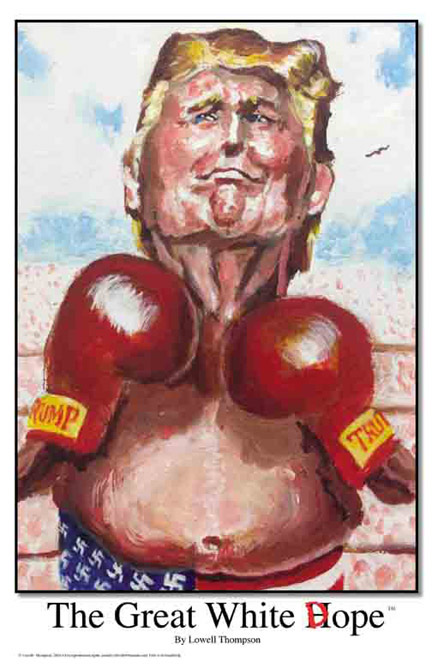
13219: Thompson On Trump.

Artist/Writer/Recovering Adman Lowell Thompson painted the image depicted above. To learn more and purchase prints, click here.

Friday, June 10, 2016

13218: Making Pirates Look Good.

Adweek reported IPG and Omnicom signed a pledge to fight digital piracy, joining Publicis Groupe and WPP, who signed the pledge last year. To put the noble act into perspective, the four holding companies also pledged to embrace diversity over a decade ago, and minority representation in the advertising industry has not measurably increased at all. The Four Stooges make pirates look like model citizens.

Interpublic and Omnicom Have Signed Pledge to Combat Ad-Supported Digital Piracy

They join WPP and Publicis in fighting copyright infringement

By Marty Swant

Two more major agency holding companies have pledged to take greater action to combat digital piracy that costs the advertising industry billions of dollars every year.

According to the Trustworthy Accountability Group (TAG)—an industry group founded to combat ad fraud—Interpublic and Omnicom have signed TAG’s anti-piracy pledge to prevent ads from showing up on pirated or copyright-infringing websites. The pledge, signed last year by Publicis and WPP, commits the companies to using services that meet TAG’s requirements for preventing ads on pirated content. Also among the newest companies to sign the pledge are Google and GoDaddy.

An IAB study released in November found that advertising and pay-for-content revenue loss as a result of digital piracy can add up to around $2.4 billion a year. Content on pirated sites varies from videos, live events, music, video games and text.

According to TAG CEO Mike Zaneis, the additions mark a “really major step forward” for the anti-piracy program. He said the dozens of companies that have signed the pledge provide scale with the billions of advertising dollars going through TAG’s approved anti-piracy software.

“They know that their ads aren’t going to show up in these pirate sites,” he said in an interview. “They’re not going to have these types of adjacencies to criminal activity and their ad dollars are not going into the pockets of criminals. So it’s immeasurable increase in trust.”

Omnicom was one of the founding partners of TAG, helping to fund the organization when it was getting started in 2015. In an interview on Thursday morning, Omnicom Digital CEO Jonathan Nelson said piracy and fraud are “huge issues.”

“Piracy is a problem in the industry and we are looking to create value for clients and one of the ways we create value for clients is by fighting piracy,” Nelson said. “(TAG’s anti-piracy pledge) is one of the tools to do it…It’s a no-brainer.”

Thursday, June 09, 2016

13217: Vayntrub To The Victor.

Advertising Age reported AT&T is launching a humungous review to consolidate its creative and media with one holding company. According to Ad Age, “Not affected by the search will be its multicultural advertising, which is handled by multiple agencies…” Of course not. Redistributing crumbs isn’t worth the time and money—and the victorious White holding company will probably ultimately steal the crumbs via the total market smokescreen. Also, don’t expect the new Hispanic holding company to be considered. But count on Milana Vayntrub to make the final decision in the shootout.

AT&T Holds Massive Review for U.S. Creative and Media

Incumbents WPP, Omnicom Invited to Participate

By Maureen Morrison

AT&T, the nation’s second largest advertiser, is holding a massive review for its U.S. creative and media accounts.

The company is seeking one holding company solution for the vast majority of its advertising. Omnicom and WPP are the only holding companies invited to the review, which is being overseen by MediaLink. Omnicom’s BBDO handles creative for the AT&T brand, while WPP’s MEC fields media and Grey handles creative for DirecTV.

A spokesman said the review encompasses the vast majority of creative, digital and media for AT&T and DirecTV in the U.S. and will include corporate brand work, as well as its business solutions and entertainment business. He added that the review is expected to finish at the end of the summer.

Not affected by the search will be its multicultural advertising, which is handled by multiple agencies, and Cricket, its smaller wireless brand, which is handled by Argonaut. The spokesman said that MEC does Cricket’s media buying, and that while Cricket creative for now won’t change, media buying still could.

BBDO and MEC have has been working with AT&T since 2007. Grey has been handling DirecTV since 2010. MEC’s mobile carrier experience extends overseas, where it won the international Vodafone account in 2014. At the time, AT&T was rumored to be eyeing a Vodafone acquisition.

BBDO and MEC declined to comment. WPP and Omnicom didn’t immediately respond to a request for comment. Grey executives couldn’t immediately be reached.

“We’re looking to improve efficiencies, quality and consistency across the portfolio,” said the AT&T spokesman. “We will examine the costs in the past to determine fair and reasonable pricing for creative and media buying.” He added that the company may decide to bring some ad services in-house in the future, but said that what that could mean is still up in the air.

The fate of some other agencies, such as independent shops, was unclear, as the company has a lengthy roster. A couple Publicis agencies, such as Razorfish and Sapient are also on the roster and their fate is similarly unknown.

After AT&T acquired DirecTV in July 2015, the company had been holding a series of jump balls for project work, which often resulted in BBDO and Grey pitching against one another to create campaigns for projects that included both the AT&T and DirecTV brands.

AT&T is second only to Procter & Gamble in terms of ad spending in the U.S., according to Ad Age’s DataCenter. In 2014, it spent a total of $3.27 billion on both measured and unmeasured media, according to data analyzed by Ad Age’s DataCenter.

Contributing: Alexandra Bruell

Wednesday, June 08, 2016

13216: JWT & WPP BS.

Adweek reported on the latest legal volleys in the JWT Gustavo Martinez debacle, with Erin Johnson’s legal team arguing that WPP is pooh-poohing Martinez’s alleged bad behavior. A fresh filing also included, “if you complain of discrimination [at JWT], you will be attacked publicly, be branded as a liar and ostracized.” Actually, this contention applies to the entire advertising industry, as evidenced by any minority who has publicly pointed out the racist exclusivity, only to be ultimately blacklisted and banished from the field. Thank goodness new JWT Worldwide Chairwoman and CEO Tamara Ingram has established a hotline for employees to air their grievances. Act now—operators are standing by!

Legal Filing Claims WPP Is Downplaying ‘Sexist, Humiliating’ Behavior by Former JWT CEO

Erin Johnson’s lawyers say lawsuit should continue

By David Griner

The legal team for Erin Johnson says her agency’s parent company, WPP, is trying to downplay offensive behavior by ousted JWT CEO Gustavo Martinez while also tacitly discouraging other potential whistleblowers from stepping forward.

The agency holding company’s response to Johnson’s claims of discrimination by Martinez, her lawyers say, sends the message that “if you complain of discrimination, you will be attacked publicly, be branded as a liar and ostracized.”

The strong words continue an ongoing battle in the legal system and the court of public opinion dating back to March, when Johnson, JWT’s global communications director, filed a lawsuit alleging discrimination, harassment and a hostile work environment stemming from Martinez’s allegedly frequent and negative comments about women, minorities and Jews.

After initially standing behind Martinez, WPP hired an independent investigative agency soon after the allegations came to light. Soon after that, Martinez abruptly resigned. However, his exit has not stalled Johnson’s case against her employer.

In May, all three defendants in the case—Martinez, JWT and WPP—filed motions to have Johnson’s lawsuit dismissed. They claimed that Johnson had failed to prove that Martinez’s controversial comments, including a recorded staff meeting where he made light of rape, amounted to discrimination against Johnson.

This week, Johnson’s attorneys filed their response to the motion, calling Martinez’s rebuttal to her lawsuit “wrong both factually and legally.”

Her filing also takes issue with WPP’s claim that there are not enough proven instances of bad behavior by Martinez to show Johnson faced a hostile work environment at JWT.

“Corporate defendants list six such incidents [of offensive comments by Martinez],” Johnson’s new filing states. “That behavior, without more, could state a claim for a hostile environment. In addition, however, defendants ignore that those allegations are far from describing isolated incidents, but instead are examples of sexist, humiliating and threatening behavior that was typical of Martinez.”

In their motion for dismissal, WPP’s lawyers stated that Johnson’s claims didn’t illustrate a hostile work environment based on sexual harassment because she made “no allegation that he actually talked about ‘the sex.’”

Johnson’s lawyers fired back in their countermotion, saying Martinez’s comments were often overtly sexual in nature.

“The sex-based nature of Martinez’s offensive comments and conduct frequently was explicit,” her legal team’s new filing states. “For example, when Johnson told Martinez that his comments about rape were not acceptable in the workplace, he responded by telling her that ‘American women are too sensitive.’ Shortly thereafter, he grabbed Johnson around the neck with his arm, telling her to come to him so that he could rape her in the bathroom.”

WPP declined to comment on Johnson’s newest filing.

(Adweek included a copy of the latest filing from Johnson’s legal team.)

Tuesday, June 07, 2016

13215: Annie The Chicken Florist.

Annie the Chicken Queen is running out of cooking concepts, introducing Magnolia Blossom Chicken, which is essentially the same old shitty chicken shaped like flowers. Pick up your battered bouquet today!

Monday, June 06, 2016

13214: Displaying Hypocrisy.

This American Apparel window display announces, “Women represent only 12 percent of engineers in all major tech companies.” Um, American Apparel advocating for women’s equality is like the advertising industry advocating for diversity.

Sunday, June 05, 2016

13213: Criminal Complacency.

Campaign published quotes from a discussion on diversity in the advertising and media industries featuring MediaCom Chairwoman Karen Blackett and Stonewall CEO Ruth Hunt. “What’s really struck me about the media industry is a significant complacency,” declared Hunt. “There is assumption of meritocracy, an assumption that creative is meritocratic and an absolute instinct to only work with your friends and people you trust and worked with before.”

Okay, the official definition of complacency includes:

1. a feeling of quiet pleasure or security, often while unaware of some potential danger, defect, or the like; self-satisfaction or smug satisfaction with an existing situation, condition, etc.

Hunt hit the proverbial nail on the head. However, she failed to effectively qualify the complacency—“significant” is too polite. Better qualifiers include:

Culturally clueless complacency

Racist complacency

Criminal complacency

The quiet pleasure and smug satisfaction of exclusivity is an ethical, moral and legal violation that cannot be tolerated with complacency.

Stonewall CEO: media industry ‘complacent’ about diversity

The advertising and media industry risks alienating clients and audiences because of its “complacent” attitude towards diversity, the chief executive of Stonewall has claimed.

By Omar Oakes

Ruth Hunt, the chief executive of the LBGT equality rights charity, told Friday’s Media360 conference in Brighton that a “lack of imagination” was responsible to diversity not being taken seriously by agencies and media owners.

She said: “What’s really struck me about the media industry is a significant complacency. There is assumption of meritocracy, an assumption that creative is meritocratic and an absolute instinct to only work with your friends and people you trust and worked with before.

“There is a very insider and outsider culture in media. If you are in any way other from the main group of people, who like working with people like them who get what they’re thinking in two-and-a-half sentences.

“The limitation that has creates means you are missing a significant amount of different views within that group. You’re missing audiences and clients. Organisations we’re working with like the big banks won’t want to work with you because you’ll feel anachronistic.”

However, Hunt did single out Channel 4 for praise as the “crème de la crème” when it comes to diversity. Her fellow panelist Paul Sapsford, the broadcaster’s group continuity manager, talked about Channel 4’s Year of Disability 2016, which aims to increase on and off-screen representation of disabled people.

Separately, Channel 4 launched a competition at Advertising Week Europe last month, which will see £1m in airtime gifted to a brand that comes up with the best creative idea featuring people with disabilities.

Karen Blackett, the chairwoman of MediaCom, pointed to a vicious circle in which the media industry fails to attract ethnically diverse candidates because they do not see enough ethnic people in advertising, while a lack of diversity within agencies meant creative ideas lacked ethnic representation.

She said: “What we do is set cultural norms. If you don’t see yourself on screen, whether that’s in a programme on an ad that’s a clear issue, not just for altruistic reasons but for business reasons.

“If you’ve got purchasing power of BAME increasing in the UK by 10-fold, ad they’re not seeing themselves in an ad or programme, there’s no relevancy.”

Saturday, June 04, 2016

13212: Muhammad Ali (1942-2016).

From The New York Times…

Muhammad Ali, Titan of Boxing and the 20th Century, Dies at 74

By Robert Lipsyte

Muhammad Ali, the three-time world heavyweight boxing champion who helped define his turbulent times as the most charismatic and controversial sports figure of the 20th century, died on Friday. He was 74.

His death was confirmed by Bob Gunnell, a family spokesman.

Ali was the most thrilling if not the best heavyweight ever, carrying into the ring a physically lyrical, unorthodox boxing style that fused speed, agility and power more seamlessly than that of any fighter before him.

But he was more than the sum of his athletic gifts. An agile mind, a buoyant personality, a brash self-confidence and an evolving set of personal convictions fostered a magnetism that the ring alone could not contain. He entertained as much with his mouth as with his fists, narrating his life with a patter of inventive doggerel. (“Me! Wheeeeee!”)

Ali was as polarizing a superstar as the sports world has ever produced — both admired and vilified in the 1960s and ’70s for his religious, political and social stances. His refusal to be drafted during the Vietnam War, his rejection of racial integration at the height of the civil rights movement, his conversion from Christianity to Islam and the changing of his “slave” name, Cassius Clay, to one bestowed by the separatist black sect he joined, the Lost-Found Nation of Islam, were perceived as serious threats by the conservative establishment and noble acts of defiance by the liberal opposition.

Loved or hated, he remained for 50 years one of the most recognizable people on the planet.

In later life Ali became something of a secular saint, a legend in soft focus. He was respected for having sacrificed more than three years of his boxing prime and untold millions of dollars for his antiwar principles after being banished from the ring; he was extolled for his un-self-conscious gallantry in the face of incurable illness, and he was beloved for his accommodating sweetness in public.

In 1996, he was trembling and nearly mute as he lit the Olympic caldron in Atlanta.

That passive image was far removed from the exuberant, talkative, vainglorious 22-year-old who bounded out of Louisville, Ky., and onto the world stage in 1964 with an upset victory over Sonny Liston to become the world champion. The press called him the Louisville Lip. He called himself the Greatest.

Ali also proved to be a shape-shifter — a public figure who kept reinventing his persona.

As a bubbly teenage gold medalist at the 1960 Olympics in Rome, he parroted America’s Cold War line, lecturing a Soviet reporter about the superiority of the United States. But he became a critic of his country and a government target in 1966 with his declaration “I ain’t got nothing against them Vietcong.”

“He lived a lot of lives for a lot of people,” said the comedian and civil rights activist Dick Gregory. “He was able to tell white folks for us to go to hell.”

But Ali had his hypocrisies, or at least inconsistencies. How could he consider himself a “race man” yet mock the skin color, hair and features of other African-Americans, most notably Joe Frazier, his rival and opponent in three classic matches? Ali called him “the gorilla,” and long afterward Frazier continued to express hurt and bitterness.

If there was a supertitle to Ali’s operatic life, it was this: “I don’t have to be who you want me to be; I’m free to be who I want.” He made that statement the morning after he won his first heavyweight title. It informed every aspect of his life, including the way he boxed.

The traditionalist fight crowd was appalled by his style; he kept his hands too low, the critics said, and instead of allowing punches to “slip” past his head by bobbing and weaving, he leaned back from them.

Eventually his approach prevailed. Over 21 years, he won 56 fights and lost five. His Ali Shuffle may have been pure showboating, but the “rope-a-dope” — in which he rested on the ring’s ropes and let an opponent punch himself out — was the stratagem that won the Rumble in the Jungle against George Foreman in 1974, the fight in Zaire (now the Democratic Republic of Congo) in which he regained his title.

His personal life was paradoxical. Ali belonged to a sect that emphasized strong families, a subject on which he lectured, yet he had dalliances as casual as autograph sessions. A brief first marriage to Sonji Roi ended in divorce after she refused to dress and behave as a proper Nation wife. (She died in 2005.) While married to Belinda Boyd, his second wife, Ali traveled openly with Veronica Porche, whom he later married. That marriage, too, ended in divorce.

Ali was politically and socially idiosyncratic as well. After the attacks of Sept. 11, 2001, the television interviewer David Frost asked him if he considered Al Qaeda and the Taliban evil. He replied that terrorism was wrong but that he had to “dodge questions like that” because “I have people who love me.” He said he had “businesses around the country” and an image to consider.

As a spokesman for the Muhammad Ali Center, a museum dedicated to “respect, hope and understanding,” which opened in his hometown, Louisville, in 2005, he was known to interrupt a fund-raising meeting with an ethnic joke. In one he said: “If a black man, a Mexican and a Puerto Rican are sitting in the back of a car, who’s driving? Give up? The po-lice.”

But Ali had generated so much good will by then that there was little he could say or do that would change the public’s perception of him.

“We forgive Muhammad Ali his excesses,” an Ali biographer, Dave Kindred, wrote, “because we see in him the child in us, and if he is foolish or cruel, if he is arrogant, if he is outrageously in love with his reflection, we forgive him because we no more can condemn him than condemn a rainbow for dissolving into the dark. Rainbows are born of thunderstorms, and Muhammad Ali is both.”

Read the full story here.

Friday, June 03, 2016

13211: ¡Ay, Crumba!

Adweek reported former Facebook Vice President Alexandre Hohagen is starting the world’s first Hispanic holding company. Hope it fares better than the last minority-owned holding company. The enterprise intends to specialize in young Spanish speakers. What’s the Spanish word for crumbs?

Former Facebook Exec Is Launching the World’s First Hispanic Holding Company

Alexandre Hohagen will help brands cater to young Spanish speakers

By Patrick Coffee

Alexandre Hohagen’s career to date has focused on two crucial elements of the marketing equation: digital media and young Hispanic consumers.

Over the last decade, he served as managing director of Google’s operations in Brazil and vp of Latin America and U.S. Hispanics for Facebook before stepping down in 2015. Now he and his business partner, former Isobar global chairman Pedro Cabral, want to help plot the future of the market they know best by creating the ad industry’s first Hispanic digital holding company.

In March, the partners acquired Miami-based agency Nobox. The 15-year-old shop currently works with clients including Netflix, PlayStation, Marriott, Royal Caribbean and Volkswagen, but Hohagen told Adweek that his long-term plans have only begun to take shape.

“I love to build things,” he said, “And I really see this as a much bigger than Nobox. We want to build a holding company made of independent agencies focused on creative, technology and performance for the Latin American and U.S. Hispanic audiences.”

Hohagen aims to address a very real problem for brands: a growing group of Hispanic consumers who aren’t properly served by the industry’s biggest agencies. “What I see is that [these consumers] are so relevant to the general market,” he said, “But very few local agencies understand U.S. Hispanics. When we consider the online world, it’s even worse.”

The newly appointed Nobox CEO plans to use the insights he gathered working for two of the world’s most powerful tech companies to better manage brands’ relationships with widely varied groups of young Hispanics. He noted, for example, that a given brand’s approach when trying to reach consumers of Mexican descent should differ from campaigns targeted to Puerto Ricans.

“Many clients who understand the importance of having a different set of communications to target Hispanics are working with specialist agencies,” he said. “What we want to offer, for a Ford or an American Airlines, is the opportunity to speak with Hispanics in both Latin America and the U.S.”

In shaping his company, Hohagen plans to use his experience at Google and Facebook to better navigate the agency world. “We know how many times [Sir Martin] Sorrell has referred to Facebook and Google as ‘frenemies,’” he said, “But on the other hand, they created a lot of opportunities for agencies, which gives me an interesting perspective on how to work with those clients. Look how many people left agencies to work at Facebook. I’m just doing the reverse.”

Regarding his approach to better utilizing those agencies’ existing resources, he said, “They’ve been talking with clients about creative. Now we are trying to talk about business objectives before creative. When I think about acquiring more companies, it’s to help them in the execution of ideas, strategy and the consultancy part [of the equation], which is in my mind the model we want to pursue.”

Hohagen and Cabral are already working on the next round of their long-term strategy; they have identified one agency based in Brazil and one based in Mexico as the second and third potential partners in their planned holding company.

“We are an alternative to the big groups who are trying to acquire agencies,” he said. “But small, promising agencies want to work with someone like us, grow their businesses and then think about being acquired by the big groups.”

Thursday, June 02, 2016

13210: Covering Diverted Diversity.

This week’s cover of Advertising Age features past “Women to Watch” honorees—a group of predominately White women who are now staunch advocates for promoting more White women. Has anyone watched these women to examine their records on promoting actual diversity?

Wednesday, June 01, 2016

13209: Disputing Diverted Diversity.

From Advertising Age…

Black (Ad) Lives Matter: The Industry’s Biggest Diversity Problem

It’s Made Great Strides on Gender, but Not When It Comes to Race

By Ken Wheaton

It was a pretty impressive thing to watch. As the Erin Johnson-Gustavo Martinez case exploded over adland, an industry that often seems long on talk and short on action rushed to mobilize. At the annual 4A’s confab, rather than hide from this potential PR nightmare, those gathered rallied and planted a flag in the ground declaring that this sort of sexist, chauvinistic behavior will not stand.

Women must be respected, listened to and, yes, promoted.

But lost in all this were a couple of salient points.

While there was suddenly a lot of frank discussion about gender—indeed, the 4A’s added a panel to the conference at the last minute—and much of it was couched in terms of “diversity,” you probably could have counted the number of African-Americans in attendance on two hands.

And some of the most heinous remarks allegedly made by Martinez had nothing to do with sexism and everything to do with race. Indeed, the closest thing to a smoking gun in the case so far is a video of Martinez at another confab in Miami addressing a team of J. Walter Thompson employees. Much has been made of the fact that he made a joke about rape. It’s a loaded word and one that automatically brings to mind gender. But the joke, such as it was, was actually made at the expense of African-Americans. And he followed up a comment portraying them as sexual aggressors with comments depicting them as thieves.

Yet the overwhelming majority of talk about diversity over the last few months has been about gender rather than race. Perhaps it’s easier to talk about because we can see some light at the end of the tunnel when it comes to gender issues—and because there are more women in the industry.

This isn’t to say there aren’t gender problems that need to be addressed. Women are still underrepresented in the C-suites and in the creative departments of ad agencies. They’re not paid as much as men. And something has to be done about family leave. Those are major faults that need fixing—and they’re among the harder ones to remedy. But as in much of the rest of the business world, the trends are fairly clear. Women have been and are on the rise.

What’s not happening is any appreciable climb in the number of African-Americans in the ranks of advertising agencies.

Consider this assessment of the ad business:

“Despite expressed intentions to reform, the industry’s past record cast doubt upon its willingness and ability to police itself. Spokesmen testified that … the industry and individual companies might be trusted to make the necessary changes without governmental intervention. But critics contended that the industry has forfeited the confidence of the minority communities, and that government agencies must step in.”

So wrote the New York City Commission on Human Rights in 1978 after finding that only 5% of the industry’s workforce in 1967 comprised black and Hispanic workers.

Fast-forward to 2004 and the Commission on Human Rights had to go after ad agencies again because little to no progress had been made. It took a two-year investigation and the threat of subpoenas and public hearings to get major New York agencies to agree to modest minority hiring goals. A little improvement ensued. On average, the 15 agencies involved set a goal of hiring 18% minorities and ended up hiring 25%. “But,” we wrote at the time, “it’s no secret that it was a specific lack of African-Americans in the agency world that drove the investigation. And a closer look at the numbers shows that of the total new minority hires, only about 30% were African-American.”

In fact, according to a 2008 study conducted by economist Marc Bendick Jr., while African-Americans would be expected to make up 9.5% of the professionals in advertising (a number even lower than the 13% in the general population), it turns out they made up only—wait for it -- 5.8%. On the executive and managerial side, African-Americans made up only 3.2% compared with an expected 7.2%.

That study was conducted on behalf of the law firm Mehri & Skalet, which had started to investigate the possibility of a class-action lawsuit. Discussing the industry’s attempts to remedy the problem with internship programs, in-house minority councils and job fairs, attorney Cyrus Mehri said at the time, “What needs fixing isn’t the African-Americans; it’s the white guy running the agency. We want to relentlessly focus on not the excluded groups but the excluding groups, the people who control the power and make the decisions. That’s where people are running into barriers. The leadership has to come from the top.”

I’ve been told plenty of times that it’s Ad Age’s responsibility to do something about the diversity problem. Over the years, we’ve covered it from a journalistic perspective, but after a while, we’re just writing the same story over and over again, complete with the platitudes and excuses.

We now include questions about diversity in our Agency A-List entries. But those numbers are hard to check, when they’re even given. A number of agencies hide behind holding company policies about disclosure of such things. Others like to talk about all the South Americans and Europeans they’re hiring.

And while we’ve made a concerted effort to include more nonwhite faces in our lists of honorifics and on stage at our conferences—and I think we are getting better at it—we’re still going to sometimes find ourselves with a group photo on the cover that doesn’t have a black face in it.

What’s to be done? I’m not quite sure. This is a case in which we don’t really need more data or frank discussion. We need action. Cyrus Mehri wasn’t the only person who’s said the solution has to come from the very top. 4A’s President-CEO Nancy Hill said the exact same thing at the conference this year. And leading female execs including JWT’s Tamara Ingram, Facebook’s Carolyn Everson and AMV BBDO’s Cilla Snowball are pushing forward on this front. There are a number of efforts underway to right this wrong, but this is the sort of problem that can only be fixed by those with the hiring power—and the budgets to do so.

And because they’ve been mobilized and because they’re changing the dynamics of companies and boardrooms, perhaps this new group of leading women—of any race—are the ones to succeed where so many men before them have failed.